United Kingdom Vol. VI, Issue 2, February 2018
Licensed under Creative Common Page 31
http://ijecm.co.uk/
ISSN 2348 0386
THE EFFECT OF WORK AUTONOMY, SELF-EFFICACY AND WORK
ENGAGEMENT TOWARDS ORGANIZATIONAL COMMITMENT
Sarinah
Lecturer, Sekolah Tinggi Manajemen Transportasi Trisakti, Indonesia Student, Doctoral Programme at Universitas Negeri Jakarta, Indonesia
Maruf Akbar
Lecturer, Universitas Negeri Jakarta, Indonesia [email protected]
Ricardianto Prasadja
Lecturer, Sekolah Tinggi Manajemen Transportasi Trisakti, Indonesia Student, Doctoral Programme at Universitas Negeri Jakarta, Indonesia
Abstract
This paper aims to find out the effects Work autonomy, self-efficacy, and work engagement on
organizational commitment, and the effects job autonomy and self-efficacy on work engagement
also the effects job autonomy on self-efficacy. Path analysis method with field survey was used
in this research. Population consisted of 109 employees of PT. Transportation Jakarta and
simple random sampling technique with Cochran formula resulting 85 sample size. Instrument
development was through framing indicators of variable, testing instruments, and testing
reliability and validity. Results confirmed that: (1) Job autonomy has positive direct effect on
organizational commitment, (2) Self-efficacy has positive direct effect on organizational
commitment, (3) work engagement has positive direct effect on organizational commitment, (4)
job autonomy has positive direct effect on work engagement, (5) self- efficacy has positive direct
effect on work engagement and (6) job autonomy has positive direct effect on self-efficacy.
Keywords: Organizational commitment, Job autonomy, self-efficacy, work engagement and
Licensed under Creative Common Page 32 INTRODUCTION
Organizational commitment reflects employees’ attitude to the organization. The attitude is the
result of a psychological bound between the organization and the employees which affect how far an individual can identify the organizational goal and value, perform the best performance, and reach the organizational objectives and is willing to be involved in the organization.
According to Klein et al. in Wright and Kehoe (2008), there are three commitment elements that should be distinguished, namely: target, strength, and rational or the underlying principle of commitment. Commitment target declines other than focus to the commitment, commitment strength replicate the intensity towards the target, and rational or the underlying principle of commitment is the rationalization of individual commitment.
Dhar (2015) states that organizational commitment is the strength and individual’s
involvement to a certain organization. Becker et al. (2015) refers it as an individual recognizes and realizes an environment with all its variants gives a proper and sufficient understanding towards a commitment in an organization, individuals, and groups, goals and attitudes. Askew
et al. (2013) emphasizes more on the connection of the organizational commitment to attitude of the member of a certain organization, psychological bound of employee and his organization.
Meyer and Allen in Dhar (2015) divides commitment into three different aspects, those are: affective commitment, continuous, and normative. Therefore, it defines that the different work target is not the aspect or dimension which underlies the willing to build a global commitment in a structural hierarchy. The employees are strongly committed to several work targets, not other things, based on their willingness to accept the organizational values, strategies and their strong will to work for the organization’s success and to stay within the
organization (Morin et al., 2015),
Morin et al.(2015) contributes commitment theory in two ways. First, expanding the application of person-centered approach (centering on an individual) to work commitment. Second, testing the profiles that involve all three commitment thinking pattern simultaneously since it is related to the two different target; organization and work.
DKI Jakarta as the capital city of Indonesia has become the first city in South East and South Asia in the implementation of BRT, whose track lane is 208km, to have the longest track lane in the world (Transjakarta, 2017). In 2014, DKI Jakarta province has roads that consist of toll roads, primary artery roads, secondary artery roads, and administrative roads with approximate length of 6.955.842.26 km.
Licensed under Creative Common Page 33 Pricing (ERP) has given a effect to the community to use public transportation as TransJakarta Busway (Rotaris and Danielis, 2014). Based on transportation Statistics of DKI Jakarta (2015), in 2014, the percentage of vehicle DKI Jakarta is as follow: Motorcycle 74.67%, passenger cars 18.64%, load car 3.48%, bus 2.07% and special vehicles 0.79%.
When TransJakarta was established for the first time, it created some disputes coming from the stakeholders, especially from the citizens of Jakarta. The disputes were based on the past experience of public transportation use which was notorious of not having a comfortable and efficient fleet. Previously, transportation business was not based on the road, and it did not follow the latest public transportation trend. Consequently, people were anxious about whether or not the operator of TransJakarta transportation system would be able to provide and maintain the high-quality standard services as expected by the public of Jakarta.
The image above describes that PT. Transjakarta has served 123,73 million passengers in 2016, it rose up significantly compared to the previous year which was only 102,95 million. It shows a increase in the number of people who use TransJakarta as transportation mode to take them to their destination (Transjakarta, 2017).
One of the most important aspects to measure the quality of service is the level of employee’s performance. Gallie (2003) suggests that work autonomy is a work quality dimension. Hackman and Oldham (1975, p. 162) defines work autonomy as “how far the work
has given substantial freedom, independence, and wisdom in work schedule and decide the procedure used in the practice”. Freedom, based on Cohen-Meitar et al. (2009) refers to a
chance for individuals to make judgments in the work place and to choose the kind of jobs and to stimulate responsibility from employees’ experience from the result of their work (Eboch,
2015) and intrinsic motivation contribution (George and Jones, 2012), as well to have positive connection between the employees’ attitude and organizational performance.
As Volmer et al. (2012) adds that work autonomy refers to how far an individual can decide the speed, the sequence, and the method on how to finish his job and also how work exception should be handled.
Self-efficacy is the self aspect that is generally related to the endurance (Salanova et al.,
Licensed under Creative Common Page 34 states that even tough individual perception environmental adaptation are variables, depends on self-efficacy level, since they are nurtured by environmental factors so that an individual tends to be engaged in his job and performs it well.
Work engagement is “a positive thing, comply with the circumstances which is
connected to work of mind marked with optimism, dedication, and absorption” (Schaufeli et al.,
2006, p. 702). Optimism “refers to high level of energy and mental endurance during working, willingness to invest an effort in one’s job, and perseverance in overcoming the obstacles”; dedication “refers to the feeling of significance/importance, enthusiasm, inspiration, pride and challenge”; absorption “marked by full concentration and drown happily in one’s job, time flies and difficult to be separated from one’s job”.
Bakker and Demerouti (2008) prove that a bound worker is better than unbound worker and transfer to someone else. Work engagement is a positive psychological response to empower working condition to get the feeling of bigger working effectiveness (Laschinger et al., 2009), contribute to good mental and physical health (Caesens andStinglhamber, 2014), positive condition which is connected to proactive attitude (Petrou et al., 2012), cognitive awareness and emotional connection (Harter et al., 2002), contrary to burn-out dimension (Maslach andLeiter, 1997), and counterpart positive boredom and affective-cognitive positive welfare (Maslach et al., 2001) and also an active agent who have initiative in the work place, and resulted in a cycle of positive feedback for themselves (Schaufeli and Salanova, 2008)
May et al. (2004) introduces three dimensional concept of woking bound which emphasizes on three components i.e. physical, emotional and cognitive. Shirom (2003) introduces three dimensions Shirom-Malemed Vigor Measure (SMVM) which is a spirit concept with physical, emotional and employees’ cognitive liveliness. Whilst Peterson et al. (2005)
introduce three absorption conceptualizations those are; time flies, fully concentrate on an activity, losing self-sense. Employees are extremely happy and contented with their lives with work engagement as the most powerful predictors from each three orientations.
The objective of the research is to find out empirically; (1) the effect of work autonomy to the organizational commitment, (2) the effect of self-efficacy towards the organizational commitment, (3) the effect of work engagement to organizational commitment, (4) the effect of work autonomy towards work engagement, (6) the effect of work autonomy to self-efficacy.
METHOD
Licensed under Creative Common Page 35 working experience or above. The total population studied was 109 employees, and by using Cochran formulae of categorical data resulting in 85 respondents. Data collection technique used in this research for field study data was by using questionnaires sent to the respondents. Data analysis technique used was descriptive statistics and inferential.
The test result would analyze the items with the validity test using Pearson correlation (Creswell, 2009) and the reliability would be calculated by using Conbach Alpha (Creswell, 2009). The valid and reliable queries were arranged into a prepared questionnaire, and then were distributed to the actual research that was PT. Transportasi Jakarta.
Test of estimated error normality was used to examine analysis requirement. Variants linearity was tested by regression. After all analysis requirements were completed, analysis was then continued with model testing and hypotheses testing. Data gathered were analyzed by regression and correlation as the base of doing path analysis. The next analysis was by doing simple regression and correlation by using Pearson Product Moment and carried on by calculating path coefficients for each constructed path (Lomax and Hahs-Vaughn, 2012).
ANALYSIS AND RESULTS
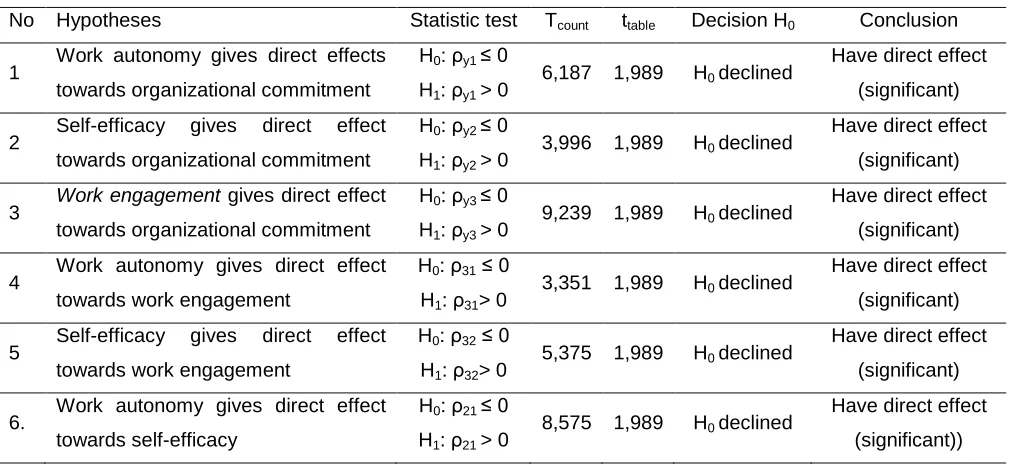
The result of this research shows that work autonomy directly gives positive effect towards organizational commitment. It means that there will be an increase in organizational commitment if work autonomy was given to the employees.
Table 1. Hypothesis Test Results
No Hypotheses Statistic test Tcount ttable Decision H0 Conclusion
1 Work autonomy gives direct effects towards organizational commitment
H0: ρy1 ≤ 0
H1: ρy1 > 0
6,187 1,989 H0 declined
Have direct effect (significant)
2 Self-efficacy gives direct effect towards organizational commitment
H0: ρy2 ≤ 0
H1: ρy2 > 0
3,996 1,989 H0 declined
Have direct effect (significant)
3 Work engagement gives direct effect towards organizational commitment
H0: ρy3 ≤ 0
H1: ρy3 > 0
9,239 1,989 H0 declined
Have direct effect (significant)
4 Work autonomy gives direct effect towards work engagement
H0: ρ31 ≤ 0
H1: ρ31> 0
3,351 1,989 H0 declined
Have direct effect (significant)
5 Self-efficacy gives direct effect towards work engagement
H0: ρ32 ≤ 0
H1: ρ32> 0
5,375 1,989 H0 declined
Have direct effect (significant)
6. Work autonomy gives direct effect towards self-efficacy
H0: ρ21 ≤ 0
H1: ρ21 > 0
8,575 1,989 H0 declined
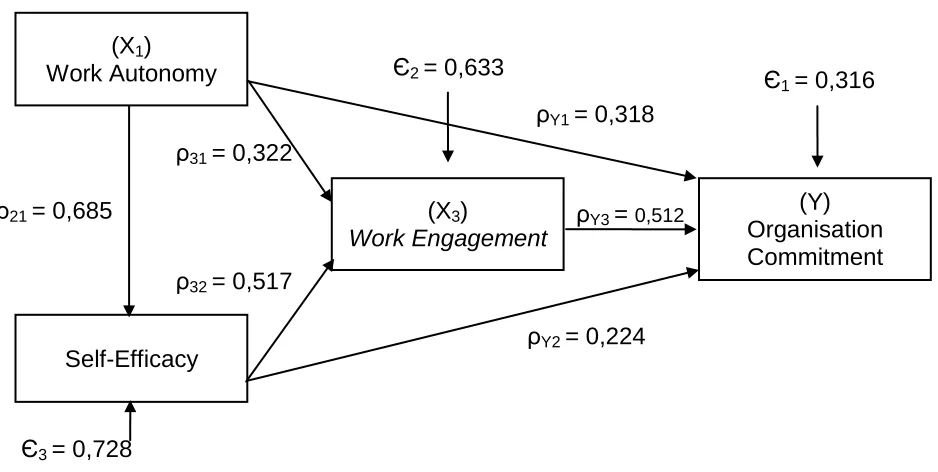
Licensed under Creative Common Page 36 Figure 1. Empiric Causal Model 2
Direct Effect of work autonomy towards organizational commitment
Result of this research shows that there is a positive effect of work autonomy towards organizational commitment, this result supports the previous research done by Park and Searcy (2012) finds out that stronger work autonomy is connected organizational commitment in an organization which is more competitive, qualified, and organizational commitment. This research mediates the connection between work autonomy and employees’ mental welfares. PT.
Transportasi Jakarta is an organization that has competitive qualities and this is because of the support from the regional government, therefore, PT TransJakarta has to provide more work autonomy to its employees. When PT. TransJakarta gives more work autonomy, the employees can consider their freedom and judgment as indications that PT. Transportasi Jakarta respect and appreciate their opinions.
It can be seen here that discretion as giving work autonomy can be interpreted as a support from PT. Transportasi Jakarta to its employees. The employees who are given more work autonomy, generally, have more commitment and are better mentally. Based on the discussion above, it can be concluded that, individually, work autonomy have an effect towards organizational commitment. Work autonomy correlates with employees attitude resulted in the increase of employees’ commitment to the organization. For that reason, it is clearly seen that
work autonomy has a direct positive effect t organizational commitment.
(X
1)
Work Autonomy
Self-Efficacy
(Y)
Organisation
Commitment
(X
3)
Work Engagement
ρ
Y1= 0,318
ρ
Y2= 0,224
ρ
31= 0,322
ρ
32= 0,517
ρ
21= 0,685
Є
2= 0,633
Є
1
= 0,316
Є
3= 0,728
Licensed under Creative Common Page 37 Direct Effect of self-efficacy towards organizational commitment
A previous research done Canrinus et al. (2012) found out that to build organizational commitment there is a psychological connection between a person and his work based on an affective reaction to his position. With this background it can be assumed that employees’
self-efficacy contributes to organizational commitment. To test this statement, Canrinus et al. (2012) simulate in a conceptual model of self-efficacy effect towards organizational commitment which partly mediated by the change of employees’ motivation level. Responsibility is merely a factor
for the employees to work optimally and it is connected to organizational commitment factors. Self-efficacy and the change of motivation level are often described in employees’ focal
attitude. Self-efficacy and motivation level changes represent personal perspectives in employees on how they see themselves as professionals in their work. Employees regards that there is a possibility of reaching a valuable result will lead them to certain attitude. If an employee believes that he can get a positive result, consequently, he will possibly repeat the same attitude.
Commitment to each employee can be influenced by the organization’s characteristics; employees with high performance will develop in an environment that has commitment to the organization’s high performance. Therefore, it is apparent that self-efficacy has positive direct
effect towards organizational commitment.
Direct effect of work engagement towards organizational commitment
According to the study conducted by Hakanen et al. (2006), it is explained that work engagement mediates the effect of work resources to organizational commitment. In other words, motivation process with resources as simultaneous support of work engagement and organizational commitment, so that work engagement has predicative values towards employees’ organizational commitment. Besides, Hakanen et al. (2006) state, assuming that employees’ work engagement influence employees’ commitment to organization because
organization provides employees with resources that are not only possible in reaching their work goals but also giving opportunities for them to learn, grow and develop
Licensed under Creative Common Page 38 aspects. It is obvious that work engagement has direct positive effect towards organizational commitment.
Positive Direct effect of work autonomy towards work engagement
A study done by Zhang et al. (2016) reveal that work autonomy makes employee feel free to decide an free from control or external hurdles. Consequently, work autonomy can be taken as an important work resource which promotes work engagement. Seen from Job Demands-Resources Model it can be assumed that motivation process with work resource as work autonomy, influences work engagement. Furthermore, Zhang et al. (2016) state in their study that member of the team with high work autonomy would involve further in risk-taking, alternative thinking, and hopefully promote creativity.
Work autonomy generally is a part of work features needed in organization and closely related to work motivation. Employees with high work autonomy can decide how and when to do the job assigned, have chances to use personal judgments in doing the job so that they will have more responsibility on the result of their work. Work autonomy is also taken as an important work resource which promotes three dimension of work engagement which is passion, dedication and absorption.
Positive Direct Effect of Self-Efficacy on Work Engagement
Referring to a study conducted by Caesens and Stinglhamber (2014), it is shown that the more people have high level of self-efficacy, the more absorptive they are to the job and they will put every efforts and energy to do an optimal work. Self-efficacy also increases intrinsic interest to failed activities in the past. In the same perspectives, self-efficacy can be an important determinant of work engagement.
By judging employee’s contribution through positive evaluative feedback on employees
performance will encourage employees to be more engaged to the mastery of work experience. The higher self-efficacy employees have the more absorptive employees to their job. Employees who are engaged to have energetic connection and are effective in doing their work activities and have high level of mental resistant. So that they can logically think that work engagement can contribute to employees’ upright physical and mental health. Accordingly, work engagement has beneficial consequences to employees’ welfares.
Positive Direct Effect of work autonomy towards self-efficacy
Licensed under Creative Common Page 39 encouraging positive result as motivation and self-efficacy. Individual who thinks that his job is particularly autonomous will feel that they can do their job by himself without having to get too much guidance so that it will create a connection between autonomy and efficacy.
Work autonomy in the work place related to individual result and also organizational. Employees with work autonomy show bigger work satisfaction; become more creative and has lower turnover will emotional exhaustion. Work autonomy also related to bigger persistent in handling difficulties, learning better, performing better, and handling problems more effectively. Hence, having motivated work autonomy is a significant advantage for organization or team work as well as to facilitate motivation and self-efficacy is some consequences that have to be acquired by the organization.
CONCLUSION
The result of this research can be concluded that there is a positive direct effect towards organizational commitment of PT. Transportasi Jakarta. Work autonomy is given by considering freedom and discretion as indication that company respects and appreciates employees’
opinion and the employees have obligation to reply to the support they received from the company and do their best effort to the course of organizational goals. This thing will contribute to the employees’ understanding improvement and end up in employees’ organizational
commitment.
There is a positive direct effect of self-efficacy to organizational commitment. Self-efficacy of PT. Transportasi Jakarta is related psychologically between the employees and the work. Self-efficacy is mediated by the change of employees’ motivational level and able to strengthen employees’ responsibility of their work. In their personal perspectives, employees
see themselves as professionals in their work.
There is a positive direct effect on work engagement towards organizational commitment. The leaders of PT. Transportasi Jakarta should intensify their employees’ work
engagement to give inspiration by motivation process/self-efficacy and work resources and also fulfilling employees basic needs or achieving work goals so that the employees will not only reach their work goals but also to give chances to learn, grow and develop and have positive thought to their work.
There is a positive direct effect of work autonomy to work engagement. The increase of employees’ work autonomy at PT. Transportasi Jakarta enables employees to feel free to
Licensed under Creative Common Page 40 alternative thinking and problem solving, and all expected to increase creativity, and to increase employees’ work engagement.
There is a positive direct effect of self-efficacy towards work engagement. Leaders of PT. Transportasi Jakarta should broaden jobs’ assimilation, improve intrinsic interest through failed activities from the past, assess employees’ contribution by evaluative feedback on employees’ performance, and also induce energetic and affective connection towards employees’ working activities, and also have high level of mental resistant. By having bigger
number of employees with high self-efficacy employees will enter in every efforts and energy to reach optimal work, have similar perspectives, become important determinants of work engagement, and will promote employees to be more engaged in the mastery of work experience. In other words, employees think that work engagement contributes towards employees’ excellent physical and mental health. Moreover, work engagement has beneficial consequences to employees’ welfare.
There is a direct positive effect of work autonomy to self-efficacy. PT. Transportasi Jakarta’s employees work autonomy should be sustained since it plays an important role in
enhancing positive result such as motivation and self-efficacy that creates connection between work autonomy and self-efficacy. In addition, it is also increase greater work satisfaction, become more creative, have low turnover will and emotional exhaustion, and have bigger persistence in facing problems, learn better, work better, and handle problems more effectively.
This research could be developed wider by conducting studies on variables such as Job Involvement, Job Attitude, Job Embeddedness, Leadership Style, and Work Environment that will increase employees’ organizational commitment which has not been examined because of
the limitation of time and fund.
REFERENCES
Ahuja, M.K., Chudoba, K.M., Kacmar, C.J., McKnight, D.H., George, J.F. (2007). IT Road Warriors: Balancing Work–Family Conflict, Job Autonomy, and Work Overload to Mitigate Turnover Intentions. MIS Quarterly, 31(1): 1–17.
Askew, K., Taing, M.U., Johnson, R.E. (2013). The Effects of Commitment to Multiple Foci: An Analysis of Relative Influence and Interactions. Human Performance, 26(3): 171–190.
Bakker, A.B., Demerouti, E., Hakanen, J.J., Xanthopoulou, D. (2007). Job Resources Boost Work Engagement, Particularly when Job Demands are High. Journal of Educational Psychology, 99(2): 274– 284.
Bakker, A.B., Demerouti, E. (2008). Towards a Model of Work Engagement. Career Development International, 13(3): 209–223.
Licensed under Creative Common Page 41 Battistelli, A., Montani, F., Odoardi, C. (2015). The Impact of Feedback from Job and Task Autonomy in the Relationship between Dispositional Resistance to Change and Innovative Work Behaviour. European Journal of Work and Organizational Psychology, 22(1): 26–41.
Becker, T.E., Kernan, M.C., Clark, K.D., and Klein, H.J. (2015). Dual Commitments to Organizations and Professions: Different Motivational Pathways to Productivity. Journal of Management, 3: 1–24.
Becker, T.E., Kernan, M.C., Clark, K.D., and Klein, H.J. (2015). Dual Commitments to Organizations and Professions: Different Motivational Pathways to Productivity. Journal of Management, 3: 1–24.
Caesens, G., Stinglhamber, F. (2014). The Relationship between Perceived Organizational Support and Work Engagement: The Role of Self-Efficacy and Its Outcomes. Revue Européenne de Psychologie Appliquée, 64(5): 259–267.
Canrinus, E.T., Helms-Lorenz, M., Beijaard, D., Buitink, J., Hofman, A. (2012). Self-Efficacy, Job Satisfaction, Motivation and Commitment: Exploring the Relationships between Indicators of Teachers’ Professional Identity. European Journal of Psychology of Education, 27(1): 115–132.
Chen, G., Gully, S.M., Eden, D. (2001). Validation of a New General Self-Efficacy Scale. Organizational Research Methods, 4(1): 62–83.
Christian, M.S., Garza, A.S., Slaughter, J.E. (2011). Work Engagement: A Quantitative Review and Test of its relations with Task and Contextual Performance. Personnel Psychology, 64(1): 89–136.
Cohen-Meitar, R., Carmeli, A., Waldman, D.A. (2009). Linking Meaningfulness in the Workplace to Employee Creativity: The Intervening Role of Organizational Identification and Positive Psychological Experiences. Creativity Research Journal, 21(4): 361–375.
Creswell, J.W. (2009). Research Design: Qualitative, Quantitative, and Mixed Methods Approaches. California: SAGE Publications. Inc.
De Neve, D., Devos, G., Tuytens, M. (2015). The Importance of Job Resources and Self-Efficacy for Beginning Teachers’ Professional Learning in Differentiated Instruction. Teaching and Teacher Education, 47: 30–41.
Dhar, R.L. (2015). Service Quality and the Training of Employees: The Mediating Role of Organizational Commitment. Tourism Management, 46: 419–430.
Dierdorff, E.C., Morgeson, F. (2013). Getting What the Occupation Gives: Exploring Multilevel Links between Work Design and Occupational Values. Personnel Psychology, 66(3): 687–721.
Dysvik, A., Kuvaas, B. (2011). Intrinsic Motivation as a Moderator on the Relationship between Perceived Job Autonomy and Work Performance. European Journal of Work and Organizational Psychology. 20(3): 367–387.
Eboch, K. (2015). Seeing the Forest (and Your Tree) Envisioning Motivation and Performance in Work Design. Dalam E.Bendoly, W.V. Wezel, D.G. Bachrach (Eds.), The Handbook of Behavioral Operations Management: Social and Psychological Dynamics in Production and Service Settings. New York: Oxford University Press.
Farr-Wharton, R., Brunetto, Y., Shacklock, K. (2011). Professionals' Supervisor–Subordinat Relationships, Autonomy and Commitment in Australia: A Leader–Member Exchange Theory Perspective. The International Journal of Human Resource Management, 22(17): 3496–3512.
Gagne, M., Bhave, D. (2011). Autonomy in the Workplace: An Essential Ingredient to Employee Engagement and Well-Being in Every Culture. Dalam V.I. Chirkov, R.M. Ryan, K.M. Sheldon (Eds.), Human Autonomy in Cross-Cultural Context: Perspectives on the Psychology of Agency, Freedom, and Well-Being, Netherlands: Springer Netherlands.
Gallie, D. (2003). The Quality of Working Life: Is Scandinavia Different? European Sociological Review, 19(1): 61–79.
Licensed under Creative Common Page 42 Hackman, J., and Oldham, G. (1975). Development of the Job Diagnostic Survey. Journal of Applied Psychology, 60(2): 159–170.
Hackman, J. R., and Oldham, G. R. (1976). Motivation through the Design of Work: Test of a Theory. Organizational Behavior and Human Performance, 16(2): 250–279.
Hakanen, J.J., Bakker, A.B., Schaufeli, W.B. (2006). Burnout and Work Engagement among Teachers. Journal of School Psychology, 43(6): 495–513.
Harter, J.K., Schmidt, F.L. (2002). Business-Unit-Level Relationship between Employee Satisfaction, Employee Engagement, and Business Outcomes: A Meta-Analysis. Journal of Applied Psychology, 87(2): 268–279.
Jungert, T., Koestner, R.F. Houlfort, N., Schattke, K. (2013). Distinguishing Source of Autonomy Support in Relation to Workers’ Motivation and Self-Efficacy. The Journal of Social Psychology, 153(6): 651–666.
Klein, J. A. (1991). A Reexamination of Autonomy in Light of New Manufacturing Practices. Human Relations, 44(1): 21–38.
Klein, H.J., Molloy, J.C., Brinsfield, C.T. (2012). Reconceptualizing Workplace Commitment to Redress a Stretched Construct: Revisiting Assumptions and Removing Confounds. Academy of Management Review, 37(1): 130–151.
Laschinger, H.K.S., Wilk, P., Cho, J., Greco, P. (2009). Empowerment, Engagement and Perceived Effectiveness in Nursing Work Environments: Does Experience Matter?. Journal of Nursing Management, 17(5): 636–646.
Leow, K.L., Khong, K.W. Organizational Commitment: The Study of Organizational Justice and Leader Member Exchange (LMX) Among Auditors in Malaysia. International Journal of Business and Information, 4(2): 161–198.
Lomax, R.G., Hahs-Vaughn, D.L. (2012). An Introduction to Statistical Concepts. New York: Routledge. Lorente, L., Salanova, M., Martinez, I.M., Maria Vera, M. (2014). How Personal Resources Predict Work Engagement and Self-Rated Performance among Construction Workers: A Social Cognitive Perspective. International Journal of Psychology, 49(3): 200–207.
Luthans, F., Youssef, C.M. (2007). Emerging Positive Organizational Behavior. Journal of Management, 33(3): 321–349.
Maslach, C., Leiter. M.P. (1997). The Truth about Burnout: How Organizations cause Personal Stress and What to do About It. San Francisco: John Wiley.
Maslach, C., Schaufeli, W.B., Leiter, M.P. Job Burnout. The Annual Review of Psychology, 52(1): 397– 422.
Mastenbroek, N.J.J.M., Jaarsma, A.D.C., Scherpbier, A.J.J.A., Van Beukelen, P., Demerouti, E. (2014). The Role of Personal Resources in Explaining Well-Being and Performance: A Study among Young Veterinary Professionals. European Journal of Work and Organizational Psychology, 23(2): 190–202.
May, D.R., Gilson, R.L., Harter, L.M. (2004). The Psychological Conditions of Meaningfulness, Safety and Availability and the Engagement of the Human Spirit at Work. Journal of Occupational and Organizational Psychology, 77(1): 11–37.
Meyer, J.P., Stanley, L.J., Vandenberg, R.J. (2013). A Person-Centered Approach to the Study of Commitment. Human Resource Management Review, 23(2): 190–202.
Morin, A.J. S., Meyer, J.P., McInerney, D.M., Marsh, H.W. (2015). Profiles of Dual Commitment to the Occupation and Organization: Relations to Well-Being and Turnover Intentions. Asia Pacific Journal of Management, 32(3): 717–744.
Licensed under Creative Common Page 43 Ng, K., Ang, S., Chan, K. (2008). Personality and Leader Effectiveness: A Moderated Mediation Model of Leadership Self-Efficacy, Job Demands, and Job Autonomy. Journal of Applied Psychology, 93(4): 733– 743.
Pallant, J. (2011). SPSS Survival Manual: A Step by Step Guide to Data Analysis using SPSS. Australia: Allen & Unwin.
Park, R., Searcy, D. (2012). Job Autonomy as a Predictor of Mental Well-Being: The Moderating Role of Quality-Competitive Environment. Journal of Business and Psychology, 27(3): 305–316.
Peccei, R., Giangreco, A., Sebastiano, A. (2011). The Role of Organisational Commitment in the Analysis of Resistance to Change: Co-Predictor and Moderator Effects. Personnel Review, 40(2): 185–204.
Peng, J., Li, D., Zhang, Z., Tian, Y., Miao, D., Xiao, W., Zhang, J. (2014). How can Core Self-Evaluations influence Job Burnout? The Key Roles of Organizational Commitment and Job Satisfaction. Journal of Health Psychology, 1–10.
Peterson, C., Park, N., Seligman, M.E.P. (2005). Orientations to Happiness and Life Satisfaction: The Full Life versus the Empty Life. Journal of Happiness Studies, 6 (1): 25–41.
Petrou, P., Demerouti, E., Peeters, M.C.W., Schaufeli, W.B., Hetland, J. (2012). Crafting a Job on a Daily Basis: Contextual Correlates and the Link to Work Engagement. Journal of Organizational Behavior, 33(8): 1120–1141.
Piccolo, R.F., Greenbaum, R., Den Hartog, D.N., Folger, R. (2010). The Relationship between Ethical Leadership and Core Job Characteristics. Journal of Organizational Behavior, 31(2-3): 259–278.
Rapp, A., Agnihotri, R., Baker, T.L., Andzulis, J.M. (2015). Competitive Intelligence Collection and Use by Sales and Service Representatives: How Managers’ Recognition and Autonomy Moderate Individual Performance. Journal of the Academy of Marketing Science, 43(3): 357–374.
Rotaris, L., Danielis, R. (2014). The Impact of Transportation Demand Management Policies on Commuting to College Facilities: A Case Study at the University of Trieste, Italy. Transportation Research Part A, 67: 127–140.
Runco, M.A. (2014). Creativity: Theories and Themes: Research, Development, and Practice. San Diego: Elsevier.
Salanova, M., Bakker, A.B., Llorens, S. (2006). Flow at Work: Evidence for an Upward Spiral of Personal and Organizational Resources. Journal of Happiness Studies, 7(1): 1–22.
Salanova, M., Schaufeli, W.B., Xanthopoulou, D., Bakker, A.B. (2010). The Gain Spiral of Resources and Work Engagement. Dalam A.B. Bakker and M.P. Leiter (Eds.), Work Engagement: A Handbook of Essential Theory and Research (pp. 118-132). New York, NY: Psychology Press.
Schaufeli, W.B., Bakker, A.B., Salanova, M. (2006). The Measurement of Work Engagement with a Short Questionnaire: A Cross-National Study. Educational and Psychological Measurement, 66(4): 701–716.
Schaufeli, W.B., Salanova, M. (2008). Enhancing Work Engagement through the Management of Human Resources. Dalam K. Naswall, J. Hellgren, M. Sverke, The Individual in the Changing Working Life. New York: Cambridge University Press.
Shirom, A. (2003). Feeling Vigorous at Work? The Construct of Vigor and the Study of Positive Affect in Organizations. Dalam D. Ganster, P.L. Perrewe (eds.), Research in Organizational Stress and Well-Being Volume III. Greenwich, CT: JAI Press.
Simbula, S., Guglielmi, D., Schaufeli, W.B. (2011). A Three-Wave Study of Job Resources, Self-Efficacy, and Work Engagement among Italian Schoolteachers. European Journal of Work and Organizational Psychology, 20(3): 285–304.
Statistik Transportasi DKI Jakarta (2015). Transportasi Darat. Jakarta.
Licensed under Creative Common Page 44 Wang, A., Cheng, B. (2010). When does Benevolent Leadership Lead To Creativity? The Moderating Role of Creative Role Identity and Job Autonomy. Journal of Organizational Behavior, 31(1): 106–121.
Wright, P.M., Kehoe, R.R. (2008). Human Resource Practices and Organizational Commitment: A Deeper Examination. Asia Pacific Journal of Human Resources, 46(1): 6–20.