Open Access Journal of Sports Medicine
Heart rate response during a simulated Olympic
boxing match is predominantly above ventilatory
threshold 2: a cross sectional study
Claudio Andre Barbosa de Lira1
Luiz Fernando Peixinho-Pena2
Rodrigo Luiz Vancini1,2
Rafael Júlio de Freitas Guina Fachina3,4
Alexandre Aparecido de
Almeida2
Marília dos Santos Andrade2
Antonio Carlos da Silva2
1Setor de Fisiologia Humana e do
Exercício, Universidade Federal de Goiás (UFG), Câmpus Jataí, Jataí, GO, Brazil; 2Departamento de
Fisiologia, Universidade Federal de São Paulo (UNIFESP), São Paulo, SP, Brazil; 3Departamento de Ciência
do Esporte, Faculdade de Educação Física (FEF), Universidade Estadual de Campinas (UNICAMP), Campinas, Brazil; 4Confederação Brasileira de
Basketball (CBB), Rio de Janeiro, Brazil
Correspondence: Claudio Andre Barbosa de Lira
Setor de Fisiologia Humana e do Exercício, Universidade Federal de Goiás (UFG), Câmpus Jataí; Rod BR 364, km 192, Parque Industrial, 3800, CP 03, 75801-615, Jataí, GO, Brazil
Tel +55 64 3606 8301 Email [email protected]
Abstract: The present study aimed to describe heart rate (HR) responses during a simulated Olympic boxing match and examine physiological parameters of boxing athletes. Ten highly trained Olympic boxing athletes (six men and four women) performed a maximal graded exercise test on a motorized treadmill to determine maximal oxygen uptake (52.2 mL ⋅ kg-1 ⋅ min-1± 7.2 mL ⋅ kg-1 ⋅ min-1) and ventilatory thresholds 1 and 2. Ventilatory
thresholds 1 and 2 were used to classify the intensity of exercise based on respective HR during a boxing match. In addition, oxygen uptake (V.O2) was estimated during the match based on the HR response and the HR-V.O2 relationship obtained from a maximal graded exercise test for each participant. On a separate day, participants performed a boxing match lasting three rounds, 2 minutes each, with a 1-minute recovery period between each round, during which HR was measured. In this context, HR and V.O2 were above ventilatory threshold 2 during 219.8 seconds ± 67.4 seconds. There was an increase in HR and V.O2 as a function of round (round 3 round 2 round 1, P 0.0001).These findings may direct individual training programs for boxing practitioners and other athletes.
Keywords: heart rate, physiological profile, intermittent exercise, combat sports, boxing
Introduction
Boxing is a combat sport in which athletes try to strike and/or defend themselves from the attacks of their opponents. Matches are characterized by dynamic phases of short duration, which involve almost all muscle groups in complex movements characterized by short phases of maximal and/or supramaximal effort intensity, which lead to rapid
accelerations and decelerations of body segments.1
To obtain an understanding of the physiological capacities underlying boxing performance, it would be useful to know the cardiovascular demand and the degree of recruitment of anaerobic metabolism during a match. These physiological variables
would provide benchmarks for improving and monitoring athlete training regimens.2,3 In
addition, it could provide a basis for athletic performance strategies, as it would enable one to identify an athlete’s potentials and limitations.4 Heart rate (HR) monitoring offers
the opportunity to directly and easily evaluate the physiological profile of
discipline-specific performance and inexpensively evaluate the physiological demands.5 However,
few studies in the literature have reported on the physiological demands of combat
sports.1,6–9 In this context, maximal graded exercise testing is commonly employed to
determine physiological response to exercise. Maximum oxygen uptake (V.O2 max) of
an individual, which serves as a good marker for aerobic fitness, can be achieved during an exhaustive exercise test. Furthermore, graded maximal exercise testing allows for
Dove
press
O R I G I N A L R E S E A R C H
open access to scientific and medical research
Open Access Full Text Article
Open Access Journal of Sports Medicine downloaded from https://www.dovepress.com/ by 118.70.13.36 on 26-Aug-2020
For personal use only.
Number of times this article has been viewed
This article was published in the following Dove Press journal: Open Access Journal of Sports Medicine
the determination of ventilatory thresholds (first ventilatory threshold [VT1] and second ventilatory threshold [VT2]). VT1 corresponds to the break point in the plot of carbon dioxide production (V.CO2) as a function of oxygen uptake (V.O2). At that point, the ventilatory equivalent for O2 (V.E/V.O2) increases without an increase in the ventilatory equivalent for CO2 (V.E/V.CO2). VT2 is located between VT1 and V.O2
max, when V.E/V.CO2 starts to increase as V.E/V.O2 continues
to increase. In practical terms, VT1 and VT2 can be used to
prescribe exercise and to classify exercise intensity.
Because the popularity of combat sports practice is increasing,6,10,11 research into the physiological profile of these
sports is necessary. Therefore, the aims of this study were to investigate physiological parameters of amateur boxers and to describe HR responses during a simulated boxing match. Also, the study compared HR responses during a simulated
boxing match with those of HR associated with VT1 and VT2
attained during a maximal graded exercise test.
Methods
Participants
Ten highly trained boxing athletes (six men [two junior and four senior] and four women [two junior and two senior]) were recruited from local boxing teams located in São Paulo, Brazil. The age and anthropometrical characteristics of the participants are presented in Table 1. Each participant’s height and weight were measured to the nearest 0.1 cm and 0.1 kg, respectively. Skinfold thicknesses were obtained to estimate body fat percentage. Skinfold measurements were taken from seven sites on the right side of the body: triceps, subscapular, suprailiac, chest, abdomen, thigh, and midaxillary using a Lange skinfold caliper (Cambridge Scientif ic Industries, Inc, MD, USA). All skinfold measurements were carried out by the same examiner (to avoid inter examiner variability), who was previously trained and experienced in the use of skinfold calipers. Duplicate measurements were obtained, and the mean recorded value
was used to determine body density.12 The Jackson and
Pollock equation13 was used for male athletes, and the
equation formulated by Jackson et al14 was used for the
female athletes. Body density values were then converted
to body fat percentage using the Siri equations.15
All athletes trained five times a week in 2.5 hour sessions and had accumulated more than 2 years of training and competition. Their training focused on the development of technical and tactical skills that were specific to the sport of boxing and on the improvement of match-related fitness. All experimental procedures were approved by the University Human Research Ethics Committee and conformed to the principles outlined in the Declaration of Helsinki. All participants signed informed consent forms prior to participating in the study. For those participants under 18 years of age, written informed consent was signed by parents or guardians. All athletes were highly motivated to participate in the study and familiar with all testing methods. Participants continued their regular training programs and were requested, with their coaches consent, to refrain from strenuous workouts on the day before the test.
Baseline medical examinations
Before the beginning of the experimental procedures, each participant came to the laboratory for anamnesis and a physical examination to assess their health. These tests did not reveal any abnormalities that could contraindicate the participants’ inclusion in the study.
Experimental procedures
Each participant reported to the laboratory on two separate occasions. During the first session, a maximal graded exercise test was administrated to determine VT1, VT2, and V.O2 max, as well as their associated running velocities and HR. In the second visit to the laboratory, the participants performed a simulated boxing match. A period of at least 48 hours separated the two laboratory visits, and all experimental procedures were completed within a 2-week period. All participants were instructed to refrain from eating 2 hours before laboratory visits and to abstain from caffeine, alcohol, and strenuous physical activity on each test day. Water intake was allowed ad libitum. The temperature and relative
humidity in the testing laboratory ranged from 21°C–23°C
and 55%–65%, respectively, for all trials. We carried out our experiments in both the morning and afternoon. However, for each participant, the maximal graded exercise test and simulated boxing match were conducted at the same time of day.
Prior to performing the maximal graded exercise test, participants were given a standardized set of instructions
Table 1 Characteristics of the boxing athletes Female athletes
(n = 4) Male athletes (n = 6) Total (n = 10)
Age (years) 17.7 ± 1.7 18.0 ± 2.0 17. 9 ± 1.8 Height (cm) 164.3 ± 7.7 173.4 ± 7.5 169.7 ± 8.5 Body mass (kg) 61.2 ± 6.6 65.9 ± 12.2 64.0 ± 10.1 Body fat (%) 22.0 ± 3.5 12.7 ± 5.3 16.4 ± 6.5
Note: Data are presented as the means ± standard deviation.
Dovepress de Lira et al
Open Access Journal of Sports Medicine downloaded from https://www.dovepress.com/ by 118.70.13.36 on 26-Aug-2020
explaining the test. On completion of these preliminary procedures, each participant underwent an incremental maximal exercise test on a motorized treadmill (Super ATL, Inbrasport Ltd, São Geraldo, MG, Brazil) with 0% slope. The schedule of this test consisted of a 5-minute warm-up period at 6 km ⋅ h-1, and then the initial speed was adjusted to
7 km ⋅ h-1, followed by progressive increases of the treadmill
speed at a rate of 1 km ⋅ h-1 every minute until participant
exhaustion. During the exercise testing, participants were verbally encouraged to exercise for as long as possible. Respiratory gas samples of each breath were analyzed using a gas analyzer (K4b2, COSMED, Rome, Italy). Before each test, the gas analyzer was calibrated using gas of a known
concentration (16% of O2 and 4% of CO2; White Martins,
Rio de Janeiro, Brazil), and the flow meter was calibrated using a 3 L syringe (Hans Rudolph, Inc, Shawnee, KS, USA). A Polar Electronics HR monitor (Polar Electronics, FS1, Kempele, Oulu, Finland) was used to record in real-time, as the metabolic system utilized in this study was equipped with a receiver unit, able to capture the signal.
The following data (averaged over 20 seconds) were obtained: V.O2 (mL ⋅ min-1) at standard temperature (0°C)
and barometric pressure at sea level, V.CO2 (mL ⋅ min-1)
at standard temperature (0°C) and barometric pressure
at sea level, respiratory exchange ratio (RER), minute ventilation V.E (L ⋅ min-1) at body temperature and pressure
saturated, respiratory rate (breaths per minute [bpm]), ventilatory equivalents for O2 and CO2 (V.E/V.O2 and V.E/
V.CO2, respectively), expired fractions of O2 and CO2 (%) and HR (beats per minute [bpm]). Peak treadmill velocity was defined as the last achieved running speed sustained
for at least 30 seconds. V.O2 max was always defined as the
highest 20-second averaged V.O2 value with inclusion criteria consistent with conventional guidelines for V.O2 max (eg,
an inability to sustain the workload, relative HR .95%
predicted for their age, RER at maximal exercise .1.1,
and V.O2 plateau [the point at which V.O2 increases less than 150 mL ⋅ min-1 for a given increase in workload]). Ventilatory
thresholds were assessed using established criteria.16 Briefly,
VT1 corresponds to the break point in the plot of V.CO2 as a function of V.O2. At that point, V.E/V.O2 increases without an increase in V.E/V.CO2. VT2 was located between VT1 and V.O2
max, when V.E/V.CO2 starts to increase and V.E/V.O2 continues
to increase. VT1 and VT2 were determined independently
by three experienced investigators. If agreement between two out of three investigators was not achieved, VT was determined by consensus. To determine the V.O2 and V.E at VT1 and VT2, the average of the last 20 seconds of each
corresponding level was used. In practical terms, ventilatory thresholds represent points that can be used to classify the intensity of aerobic exercise.
Finally, the second visit to the laboratory was used to apply a simulation of a boxing match. This simulation was
conducted in a boxing ring (6 m × 6 m) and was
accompa-nied by a referee with extensive experience in boxing. The participants were instructed to prepare themselves as they usually would for an official match. Participants performed a 10 minute warm up, which consisted of standard boxing movements, and then rested on a bench until HR returned to the pre-exercise level. The match consisted of three rounds, each 2 minutes long, with 1 minute of recovery between them. During each recovery period, the participant sat on a bench and was allowed to drink water. To simulate a match as realistically as possible, a sparring partner with a skilled trainer was enlisted. This partner had the same body mass, height, sex, ability, and boxing experience as the evaluated athlete and was aware of his or her participation in a scientific study. Additionally, the athletes were verbally encouraged by their coaches throughout the match to perform as well as possible. After the 1 minute recovery period following the last round, an additional 10 minute period of further recovery was allowed (final recovery). HR was recorded before, dur-ing (includdur-ing rest periods between rounds), and after the simulated boxing match. HR registers (5-s average HR value) were monitored by a commercially available telemetric system (Suunto Team Pod, Suunto, Vantaa, Finland), which allowed us to monitor heart rate in real time. HR recorded during a simulated boxing match was compared with HRs corresponding to VT1 and VT2. In addition, V.O2 was esti-mated during the match for each participant based on the HR
response and the HR-V.O2 relationship for each participant
as determined from maximal graded exercise test results. Despite the indirect V.O2 estimation by HR-V.O2 relationship obtained from maximal graded exercise test, this strategy is
considered valid for intermittent activities.17–19
Statistical analysis
All variables presented normal distributions (P . 0.05)
according to Kolmogorov–Smirnov tests. Therefore, the differences between rounds were analyzed by one-way ANOVA (analysis of variance) for repeated measures. When significant modifications were found, the Tukey post hoc procedure was performed to localize the difference. Pearson linear regression analysis was used to determine any potential linear relationships between variables. All statistical analyses were performed with GraphPad Prism 5.0 (San Diego, CA,
Dovepress Heart rate response and simulated boxing sparing
Open Access Journal of Sports Medicine downloaded from https://www.dovepress.com/ by 118.70.13.36 on 26-Aug-2020
USA). The level of significance was P 0.05. Data are shown
as the means ± standard deviations.
Results
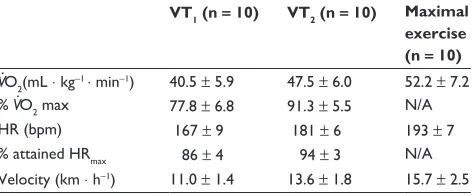
Data for the maximal graded exercise test are shown in Table 2. All participants (n = 10) attained age-predicted
maximum HR, RER . 1.1, fatigue and V.O2 plateau
(when V.O2 increased less than 150 mL ⋅ min-1 for a
given increase in workload). The V.O2 max of the athletes was 52.2 mL ⋅ kg-1 ⋅ min-1± 7.2 mL ⋅ kg-1 ⋅ min-1 and was
reached at a treadmill speed of 15.7 km ⋅ h-1± 2.5 km ⋅ h-1,
with a maximum heart rate (HRmax) of 193 bpm ± 7 bpm. VT1
and VT2 were detected in all cases. The V.O2 levels at VT1 and VT2 were 40.5 mL ⋅ kg-1 ⋅ min-1± 5.9 mL ⋅ kg-1 ⋅ min-1 and
47.5 mL ⋅ kg-1 ⋅ min-1 ± 6.0 mL ⋅ kg-1 ⋅ min-1, respectively, and were
reached at treadmill speeds of 11.0 km ⋅ h-1± 1.4 km ⋅ h-1 and
13.6 km ⋅ h-1± 1.8 km ⋅ h–1, with HRs of 167 bpm ± 9 bpm and
181 bpm ± 6 bpm, respectively.
The HR behavior during the simulated boxing match is
shown in Table 3. There was a round effect (P 0.0001):
the highest HR and percent of HRmax were attained in round
three and were 4.7% (P = 0.0008) and 5.5% (P= 0.0009)
higher than those attained in round one, respectively. The
average HR in round two and percent of HRmax attained
were both 4.5% (P 0.0001 for both) higher than those attained in round one. The average HR in round three and
the respective percent of HRmax attained were 6.3% and 5.5%
(P 0.0001 for both) higher than those obtained in round
one, respectively. In round one, the average time spent at a
HR below the VT1 level was 22.5 seconds ± 23.9 seconds,
time spent at a HR between the VT1 and VT2 levels was
47.9 seconds ± 35.5 seconds, and time spent at a HR
above the VT2 level was 49.6 seconds ± 42.7 seconds. In
round two, the average time spent below the VT1 HR was
9.0 seconds ± 7.5 seconds, between the VT1 and VT2 HRs
was 21.0 seconds ± 7.8 seconds and above the VT2 HR was
90.0 seconds ± 12.9 seconds. In round three, the mean time
spent below the VT1 HR was 7.0 seconds ± 16.0 seconds and
5.6 seconds ± 13.0 seconds, between the VT1 and VT2 was
14.0 ± 6.0 and above the VT2 was 99.0 seconds ± 14.0 seconds. It is noteworthy that there was a progressive decrease in
the amount of time below the VT1 HR and, consequently,
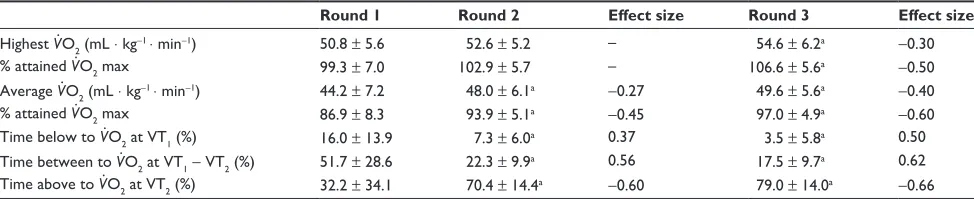
a gradual increase of the time spent above the VT2 HR. Similar behavior was found in estimated V.O2 during the simulated boxing match (Table 4).
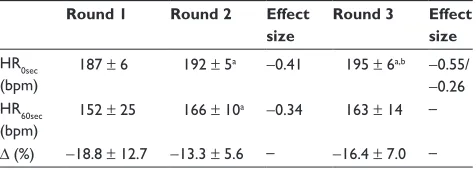
There was a round effect for HR recovery (P 0.0001):
HR measured immediately at the end of the round was significantly different between rounds (Table 5) (round
three . round two . round one). Regarding HR after
60 seconds of recovery, there was a significant difference
only between round one and round two (P = 0.0235). HR
recovery [∆ (%)] was 13%–19% for all rounds, without
differences between them (P= 0.1034). In absolute values,
the decrease in HR was 35 bpm ± 23 bpm, 26 bpm ± 11 bpm,
and 32 bpm ± 13 bpm, respectively, for round one, round
two, and round three, without differences between them (P= 0.1229).
There were no significant correlations between aerobic variables and ∆ (%). V.O2 max and its ∆ (%) (r= 0.5432 and P= 0.1047), V.O2 at VT1 and its ∆ (%) (r= 0.5336 and P= 0.1122),
V.O2 at VT2 and its ∆ (%) (r= 0.6307 and P= 0.0506), V.O2
max and its ∆ (%) (r= 0.5227 and P= 0.1211), VT1 and its
∆ (%) (r= 0.5157 and P= 0.1271) and VT2 and its ∆ (%)
(r= 0.5026 and P= 0.1387) were all not correlated with HR
recovery.
Discussion
The primary aims of the present study were to describe the behavior of HR during a simulated Olympic boxing match and characterize the intensity of the modality and physiological profile of these athletes. The main finding of this descriptive study was that the average intensity of a simulated boxing match was very severe, as an appreciable
percentage (∼60%) of the exercise bout occurred at an
intensity greater than VT2, based on maximal HR (above
85% of the age-predicted maximal HR).
The findings of this study show that the percentage of the simulated boxing match at exercise intensities greater than VT1 was much higher than routinely observed in athletes
during spontaneous training,20 although it is within the range
of individual high-intensity training bouts in athletes.21
Wushu, Chito Ryu Seisan Kata, taekwondo, and Muay Thai are also combat sports that present elevated
Table 2 Physiological parameter characterization obtained by graded exercise maximal test
VT1 (n = 10) VT2 (n = 10) Maximal exercise (n = 10)
V˙O2(mL ⋅ kg-1 ⋅ min-1) 40.5 ± 5.9 47.5 ± 6.0 52.2 ± 7.2
% V˙O2 max 77.8 ± 6.8 91.3 ± 5.5 N/A HR (bpm) 167 ± 9 181 ± 6 193 ± 7 % attained HRmax 86 ± 4 94 ± 3 N/A Velocity (km ⋅ h-1) 11.0 ± 1.4 13.6 ± 1.8 15.7 ± 2.5 Note: Data are presented as the means ± standard deviation.
Abbreviations: bpm, beats per minute; HR, heart rate; HRmax, maximum heart rate; N/A, not applicable; V˙O2, oxygen uptake; VT, ventilator threshold.
Dovepress de Lira et al
Open Access Journal of Sports Medicine downloaded from https://www.dovepress.com/ by 118.70.13.36 on 26-Aug-2020
intensities during matches.4,22–25 Bridge et al25 evaluated
the HR responses of specific Taekwondo training activities practiced by experienced practitioners in a natural training environment and found that this sport stimulated the HR to
reach 64.7%–81.4% of HRmax. Therefore, boxing, as with
other combat sports, has a strong impact on cardiovascular and respiratory functions.
However, as an episodic training activity, the comparatively high intensity may be associated with an effective training
response. In particular, results presented by Helgerud et al26
and Laursen et al27 have suggested that improving V.O
2 max
in already trained athletes, required training intensities
which approached the intensity of V.O2 max. This could be a
plausible explanation for the high V.O2 max observed in our
athletes. Other studies of boxing and various combat sports have found similar values of V.O2 max.7,11,22
Another objective of the present study was to determine the aerobic physiological parameters of boxers. This is an important objective because the physiological profile is used to modify training programs and assist with individual competition strategies. For example, an athlete with a substantial maximal aerobic power (ie, high V.O2
max) would be encouraged to maintain a high intensity
of action during a match. On the other hand, an athlete with superior strength and anaerobic capacity might be more selective in the initiation of attacks28 and be more
explosive in the implementation of boxing actions. In this study, we found that athletes presented high V.O2 max. In addition, the elevated% HRmax and%V.O2 max attained during simulated boxing matches indicates that anaerobic complementation is important to this sport. Similar findings have been demonstrated previously for karate and taekwondo athletes.7,24,29
Reinforcing the importance of aerobic metabolism
for performance in boxing, Guidetti et al7 examined
the relationship between ranking in boxing competition p e r f o r m a n c e a n d s o m e a e r o b i c p hy s i o l og i c a l parameters in eight middleweight-class elite Italian boxing athletes. A Spearman rho correlation analysis revealed that the V.O2 at the individual anaerobic threshold (46.0 mL ⋅ kg-1 ⋅ min-1± 4.2 mL ⋅ kg-1 ⋅ min-1, r= 0.91) and
the hand-grip strength (58.2 kg ± 6.9 kg, r= 0.87) were
highly correlated (P 0.01) with boxing competition
ranking. V.O2 max (57.5 mL ⋅ kg-1 ⋅ min-1± 4.7 mL ⋅ kg-1 ⋅ min-1,
r= 0.81) and wrist girth (17.6 cm ± 0.6 cm, r= 0.78) were
moderately (P 0.05) correlated. These data suggest
Table 3 Heart rate and time (expressed as relative percentage) in each metabolic zone, defined as below VT1, between the VT1 and
VT2, and above the VT2 during a simulated boxing match (n = 10)
Round 1 Round 2 Effect size Round 3 Effect size
Highest HR (bpm) 190 ± 8 194 ± 6 – 199 ± 5a -0.56
% predicted HRmax 98 ± 4 101 ± 3 – 103 ± 2a -0.62
Average HR (bpm) 175 ± 11 183 ± 6a -0.41 186 ± 7a -0.51
% attained HRmax 91 ± 5 95 ± 3a -0.43 96 ± 2a -0.55
Time below to HR at VT1 (%) 19.0 ± 20.0 7.0 ± 6.0a 0.37 5.6 ± 13.0a 0.37
Time between to HR at VT1- VT2 (%)
40.0 ± 30.0 18.0 ± 6.0a 0.45 11.6 ± 5.1a 0.55
Time above to HR at VT2 (%) 41.0 ± 36.0 75.0 ± 11.0a -0.54 82.8 ± 11.5a -0.61 Notes: Data are presented as the means ± standard deviation. aDifferent from round 1 (P 0.05). Effect size is a measure that describes the magnitude of the difference between two groups.
Abbreviations: bpm, beats per minute; HR, heart rate; HRmax, maximum heart rate; VT, ventilatory threshold.
Table 4 Estimated oxygen uptake and time (expressed as relative percentage) in each metabolic zone, defined as below VT1, between the VT1 and VT2, and above the VT2 during a simulated boxing match (n = 10)
Round 1 Round 2 Effect size Round 3 Effect size
Highest V˙ O2 (mL ⋅ kg-1 ⋅ min-1) 50.8 ± 5.6 52.6 ± 5.2 – 54.6 ± 6.2a -0.30
% attained V˙ O2 max 99.3 ± 7.0 102.9 ± 5.7 – 106.6 ± 5.6a -0.50
Average V˙ O2 (mL ⋅ kg-1 ⋅ min-1) 44.2 ± 7.2 48.0 ± 6.1a -0.27 49.6 ± 5.6a -0.40
% attained V˙ O2 max 86.9 ± 8.3 93.9 ± 5.1a -0.45 97.0 ± 4.9a -0.60
Time below to V˙ O2 at VT1 (%) 16.0 ± 13.9 7.3 ± 6.0a 0.37 3.5 ± 5.8a 0.50
Time between to V˙ O2 at VT1- VT2 (%) 51.7 ± 28.6 22.3 ± 9.9a 0.56 17.5 ± 9.7a 0.62
Time above to V˙ O2 at VT2 (%) 32.2 ± 34.1 70.4 ± 14.4a -0.60 79.0 ± 14.0a -0.66 Notes: Data are presented as the means ± standard deviation. aDifferent from Round 1 (P 0.05). Effect size is a measure that describes the magnitude of the difference between two groups.
Abbreviations:V˙O2, oxygen uptake; VT, ventilatory threshold.
Dovepress Heart rate response and simulated boxing sparing
Open Access Journal of Sports Medicine downloaded from https://www.dovepress.com/ by 118.70.13.36 on 26-Aug-2020
that two basic factors are related to boxing performance: physical fitness, as indicated by individual anaerobic threshold and maximal oxygen uptake, and upper body muscular strength, as indicated by hand-grip strength (related to anaerobic metabolism).
Despite the development of lightweight, portable metabolic devices to measure physiological responses during an activity, one of the difficulties of working with boxing (and
other combat sports) is measuring the V.O2 during a match.
Another reason V.O2 was not measured in the current study was our intent to maintain the “ecological validity” of simulated matches. The term “ecological validity” in this setting refers specifically to the interaction of boxing athletes with their
natural environment and practices.25 Therefore, we estimated
the V.O2 during the simulated boxing match. We verified that
V.O2 attained during the matches reflected the high intensity of boxing, as mentioned above. Again, these results underscore the importance of a minimum of aerobic fitness for boxing athletes and suggest some guidelines for the intensity of
training, in accordance with the literature.8
Increases in physiological variables (V.O2 and HR) were
observed over the course of the simulated boxing match and similarly in other intermittent sport activities. In addition, indirect V.O2 estimation by HR-V.O2 relationship is commonly considered acceptable for intermittent activities.17–19 This
indicates that there was a greater energy demand for the completion of high-intensity actions as sparing progressed. We suggest three factors that could be related to the increase in physiological demand during the match. First, athletes may have been under thermal stress due to protective garments. Second, the short rest periods between rounds (1 minute) did not allow sufficient time for physiological variables to decline. A third possibility is that each participant’s
competition strategy led to increased demand in each round. It is common for combat-sport athletes to save energy for the last period of the combat, when the most decisive attacks normally occur, resulting in an increase in the metabolic
response during the last round.24,30
Finally, of particular interest in this study, was the ability of the athletes to recover their HR between rounds as analyzed through the relationships between aerobic variables (V.O2 max, VT1, and VT2) and the decrease in HR. We found no correlations between these variables. There are two explanations for this: First, in martial arts environments, HR overestimations have been attributed to the static nature of upper and lower limb movements or only to upper limb
movements (small muscle mass),31,32 which seems plausible.33
However, HR overestimations may also be attributed to emotional factors or thermal stress (as mentioned above). Together, these factors can contribute to a failure of HR
to show appreciable recovery between work intervals.34
Second, HR recovery following exercise is controlled by
complex interactions between neural and humoral factors.35
In this context, systemic stress metabolite accumulation during postexercise recovery (eg, plasma epinephrine,
lactate, H+, and inorganic phosphate)36 might promote
sympathetic activity via chemoreflex control of HR37 and,
consequently, delay HR recovery. Buchheit et al38 compared
the HR recovery response among children, adolescents, and adults, while also taking into account power output and the postexercise blood lactate concentration and acidosis. These authors showed that children experienced significantly faster HR recovery compared with their adolescent and adult counterparts. This apparent difference in HR recovery
was associated with lower blood lactate and H+ in children
compared with adolescents and adults because children have
an immature capacity for anaerobic metabolism.38 Although
the concentration of lactate was not measured in this study, it is likely that our volunteers presented a high concentration of this blood metabolite because, as mentioned earlier, this activity is of high intensity and therefore requires a significant anaerobic contribution.
Strengths and limitations
of this study
First, our sample contained female and male participants. There are obvious differences in physiological and morphological characteristics between sexes (Table 1 and 2). For instance, women have a lower lung volume, cardiac
output, V.O2 max, and hemoglobin concentration as well as a
greater body fat content compared to men.39,40 However, there
Table 5 Decrease in HR from 0–60 seconds after round as a percentage of HR measured immediately at the end of the round (n = 10)
Round 1 Round 2 Effect size
Round 3 Effect size
HR0sec (bpm)
187 ± 6 192 ± 5a -0.41 195 ± 6a,b -0.55/ -0.26
HR60sec
(bpm)
152 ± 25 166 ± 10a -0.34 163 ± 14 –
∆ (%) -18.8 ± 12.7 -13.3 ± 5.6 – -16.4 ± 7.0 –
Notes: Data are presented as the means ± standard deviation. aDifferent from Round 1 (P 0.05); bdifferent from Round 2 (P 0.05). ∆ (%) was calculated as percentage of peak HR0sec: (HR60sec - H0sec)/HR60sec × 100. Effect size is a measure that describes the magnitude of the difference between two groups.
Abbreviations: bpm, beats per minute; HR, heart rate; HR0sec, heart rate measured immediately at the end of the round; HR60sec, heart rate measured after 60 seconds of recovery; HR0sec - HR60sec (%), percentage of recovery between the end of the round and after 60 seconds of recovery.
Dovepress de Lira et al
Open Access Journal of Sports Medicine downloaded from https://www.dovepress.com/ by 118.70.13.36 on 26-Aug-2020
is evidence that physiological responses to exercise are not different between sexes, especially when HR, blood lactate,
and percentage of V.O2 max are analyzed during exercise.3
Therefore, cardiovascular and metabolic strain seems to be comparable between sexes for the investigated situation in the present study.
Second, only ten participants were enrolled in the study due to the difficulty of recruiting elite boxers. Attaining high participant numbers is an inherent challenge in studies that involve a specific population, such as elite athletes. Other studies dealing with combat sports have employed participant numbers similar to our study or fewer.3,4,24,29 Therefore, it
is conceivable that the participants enrolled represent the typical amateur boxer.
Third, the fight was not recorded, so we were not able to assess movements performed by these boxers, such as high-intensity offensive and defensive techniques, the distance covered by the athletes, and work/rest ratios. These variables may interfere with HR responses during a fight.
Notwithstanding these limitations, this study demonstrates that boxing involves a high demand on the cardiovascular system and aerobic system, as evidenced by values of HR corresponding to vigorous and very vigorous exercise. The
same can be said of the estimated V.O2. Regarding whether
aerobic fitness is an important determinant for the recovery of HR, this study found no statistically significant correlation between recovery of HR and V.O2 max. It appears that in boxing, undertaking specific training to improve aerobic capacity seems to be necessary for the rapid recovery of HR between rounds. In summary, the present investigation provides baseline physiological data that can be used in the prescription of individual training programs for boxing athletes. These data are also important to coaches and can contribute to competition strategies for individual athletes and in individual matches. Furthermore, training protocols should include exercises that train both aerobic and anaerobic energy pathways, and amateur boxing could be used to develop aerobic fitness.
Acknowledgments
We are grateful to the directors of the Olympic Center of Research and Training (Prefeitura Municipal de São Paulo, Brazil) and Mr Messias Gomes for their technical assistance. We also thank all the athletes who volunteered to participate in this study. CABL received a fellowship from the Coordenação de Aperfeiçoamento de Pessoal de Nível Superior (CAPES [Coordenação de Aperfeiçoamento de Pessoal de Nível Superior], Brazil).
This work was supported by the Financiadora de Estudos e Projetos (FINEP, Brazil).
Author contributions to this work were as follow: CABL and LFP-P: study concept and design, data acquisition, analysis, interpretation, and manuscript preparation; AAA and RLV: data analysis, interpretation, and manuscript preparation; MSA and RJFGF: data acquisition and critical revision of the manuscript; ACS: study concept and design, data analysis, interpretation, and critical revision of the manuscript. CABL and LFP-P contributed equally to this work and may be cited in interchangeable order.
Ethics approval was granted by the Committee of Eth-ics in Research from UNIFESP (Federal University of São Paulo).
Disclosure
No commercial party having a direct financial interest in the results of the research presented in this article has or will confer a benefit upon the authors or upon any organization with which the authors are associated. There is no additional data available from this study. The authors report no conflicts of interest in this work.
References
1. Kravitz L, Greene L, Burkett Z, Wongsathikun J. Cardiovascular response to punching tempo. J Strength Cond Res. 2003;17(1):104–108. 2. Heller J. Energy cost and cardiorespiratory demands of nunchaku
exercise. J Sports Med Phys Fitness. 2000;40(3):217–222.
3. Faude O, Meyer T, Rosenberger F, Fries M, Huber G, Kindermann W. Physiological characteristics of badminton match play. Eur J Appl Physiol. 2007;100(4):479–485.
4. Ribeiro J, de Castro B, Rosa C, Baptista R, Oliveira A. Heart rate and blood lactate responses to changquan and daoshu forms of modern Wushu. J Sports Sci Med. 2006;5:1–4.
5. Meyer T, Davison RC, Kindermann W. Ambulatory gas exchange measurements – current status and future options. Int J Sports Med. 2005;26(Suppl 1):S19–S27.
6. Bellinger B, St Clair Gibson A, Oelofse A, Oelofse R, Lambert M. Energy expenditure of a noncontact boxing training session compared with submaximal treadmill running. Med Sci Sports Exerc. 1997;29(12): 1653–1656.
7. Guidetti L, Musulin A, Baldari C. Physiological factors in middleweight boxing performance. J Sports Med Phys Fitness. 2002;42(3): 309–314.
8. Chatterjee P, Banerjee AK, Majumdar P, Chatterjee P. Energy expenditure in women boxing. Kathmandu Univ Med J (KUMJ). 2006; 4(3):319–323.
9. Arseneau E, Mekary S, Léger LA. V.O2 requirements of boxing exercises. J Strength Cond Res. 2011;25(2):348–359.
10. Imamura H, Yoshimura Y, Uchida K, Tanaka A, Nishimura S, Nakazawa AT. Heart rate, blood lactate responses and ratings of perceived exertion to 1,000 punches and 1,000 kicks in collegiate karate practitioners. Appl Human Sci. 1997;16(1):9–13.
11. Heller J, Peric T, Dlouhá R, Kohlíková E, Melichna J, Nováková H. Physiological profiles of male and female taekwon-do (ITF) black belts. J Sports Sci. 1998;16(3):243–249.
Dovepress Heart rate response and simulated boxing sparing
Open Access Journal of Sports Medicine downloaded from https://www.dovepress.com/ by 118.70.13.36 on 26-Aug-2020
Open Access Journal of Sports Medicine
Publish your work in this journal
Submit your manuscript here: http://www.dovepress.com/open-access-journal-of-sports-medicine-journal
Open Access Journal of Sports Medicine is an international, peer-reviewed, open access journal publishing original research, reports, reviews and commentaries on all areas of sports medicine. The manuscript management system is completely online and includes a very quick and fair peer-review system.
Visit http://www.dovepress.com/testimonials.php to read real quotes from published authors.
12. Heyward VH, Stolarczyk LM, editors. Skinfold method. In: Applied Body Composition Assessment. Champaign, IL: Human Kinetics; 1996:21–43.
13. Jackson AS, Pollock ML. Generalized equations for predicting body density of men. Brit J Nutr. 1978;40(3):487–504.
14. Jackson AS, Pollock ML, Ward A. Generalized equations for predicting body density of women. Med Sci Sport Exerc. 1980;12(3):175–181. 15. Siri WE. Body composition from fluid spaces and density: analysis
of methods. In: Brožek J, Henschel A, editors. Techniques for Measuring Body Composition. Washington, DC: National Academy of Sciences – National Research Council; 1961:223–244.
16. Wasserman K, Hansen JE, Sue DY, Stringer WW, Whipp BJ. Principles of Exercise Testing and Interpretation, 4th ed. Philadelphia: Lippincott Williams & Wilkins; 2005.
17. Bangsbo J. The physiology of soccer – with special reference to intense intermittent exercise. Acta Physiol Scand Suppl. 1994;619:1–155. 18. Reilly T. Energetics of high-intensity exercise (soccer) with particular
reference to fatigue. J Sports Sci. 1997;15(3):257–263.
19. Esposito F, Impellizzeri FM, Margonato V, Vanni R, Pizzini G, Veicsteinas A. Validity of heart rate as an indicator of aerobic demand during soccer activities in amateur soccer players. Eur J Appl Physiol. 2004;93(1–2):167–172.
20. Esteve-Lanao J, Foster C, Seiler S, Lucia A. Impact of training intensity distribution on performance in endurance athletes. J Strength Cond Res. 2007;21(3):943–949.
21. Seiler S, Haugen O, Kuffel E. Autonomic recovery after exercise in trained athletes: intensity and duration effects. Med Sci Sports Exerc. 2007;39(8):1366–1373.
22. Crisafulli A, Vitelli S, Cappai I, et al. Physiological responses and energy cost during a simulation of a Muay Thai boxing match. Appl Physiol Nutr Metab. 2009;34(2):143–150.
23. Zehr EP, Sale DG. Oxygen uptake, heartrate and blood lactate responses to the Chito-Ryu Seisan kata in skilled karate practitioners. Int J Sports Med. 1993;14(5):269–274.
24. Campos FA, Bertuzzi R, Dourado AC, Santos VG, Franchini E. Energy demands in taekwondo athletes during combat simulation. Eur J Appl Physiol. 2012;112(4):1221–1228.
25. Bridge CA, Jones MA, Hitchen P, Sanchez X. Heart rate responses to Taekwondo training in experienced practitioners. J Strength Cond Res. 2007;21(3):718–723.
26. Helgerud J, Høydal K, Wang E, et al. Aerobic high-intensity intervals improve VO2 max more than moderate training. Med Sci Sports Exerc. 2007;39(4):665–671.
27. Laursen PB, Shing CM, Peake JM, Coombes JS, Jenkins DG. Interval training program optimization in highly trained endurance cyclists. Med Sci Sports Exerc. 2002;34(11):1801–1807.
28. Sharratt MT, Taylor AW, Song TM. A physiological profile of elite Canadian freestyle wrestlers. Can J Appl Sport Sci. 1986;11(2): 100–105.
29. Beneke R, Beyer T, Jachner C, Erasmus J, Hütler M. Energetics of karate kumite. Eur J Appl Physiol. 2004;92(4–5):518–523.
30. Chiodo S, Tessitore A, Cortis C, et al. Effects of official Taekwondo competitions on all-out performances of elite athletes. J Strength Cond Res. 2011;25(2):334–339.
31. Shaw DK, Deutsch DT. Heart rate and oxygen uptake response to performance of karate kata. J Sports Med Phys Fitness. 1982;22(4): 461–468.
32. Toskovic NN, Blessing D, Williford HN. The effect of experience and gender on cardiovascular and metabolic responses with dynamic Tae Kwon Do exercise. J Strength Cond Res. 2002;16(2):278–285. 33. Toner MM, Glickman EL, McArdle WD. Cardiovascular adjustments to
exercise distributed between the upper and lower body. Med Sci Sports Exerc. 1990;22(6):773–778.
34. Glaister M, Stone MH, Stewart AM, Hughes M, Moir GL. The influence of recovery duration on multiple sprint cycling performance. J Strength Cond Res. 2005;19(4):831–837.
35. Buchheit M, Papelier Y, Laursen PB, Ahmaidi S. Noninvasive assessment of cardiac parasympathetic function: postexercise heart rate recovery or heart rate variability? Am J Physiol Heart Circ Physiol. 2007;293(1):H8–H10.
36. Vissing J. Muscle reflex and central motor control of neuroendocrine activity, glucose homeostasis and circulation during exercise. Acta Physiol Scand Suppl. 2000;647:1–26.
37. Rowell LB, O’Leary DS. Reflex control of the circulation during exercise: chemoreflexes and mechanoreflexes. J Appl Physiol. 1990; 69(2):407–418.
38. Buchheit M, Duché P, Laursen PB, Ratel S. Postexercise heart rate recovery in children: relationship with power output, blood pH, and lactate. Appl Physiol Nutr Metab. 2010;35(2):142–150.
39. Lewis DA, Kamon E, Hodgson JL. Physiological differences between genders. implications for sports conditioning. Sports Med. 1986;3(5):357–369.
40. Sheel AW, Richards JC, Foster GE, Guenette JA. Sex differences in respiratory exercise physiology. Sports Med. 2004;34(9):567–579.
Dovepress
Dove
press
de Lira et al
Open Access Journal of Sports Medicine downloaded from https://www.dovepress.com/ by 118.70.13.36 on 26-Aug-2020