A comparison of the research and publication patterns and output of
academic librarians
1
in eastern and southern Africa from 1990-2006:
a preliminary study
2
Grace Sitienei
3and Dennis N. Ocholla
4Department of Information Studies, University of Zululand, South Africa [email protected]; [email protected]
Received: 10 May 2009 Accepted: 1 July 2010
This paper compares the research and publication patterns of academic librarians in eastern and southern Africa. The study confined its scope to publications produced between 1990 and 2006. Bibliometric techniques through content analysis were used as a research method. Two online databases, namely LISTA and WORLDCAT were used for publication searches. Names of academic librarians were retrieved from their respective academic library websites and used as keywords for retrieving data from the two online databases. A total of 866 academic librarians, i.e. 755 from southern Africa and 111 from eastern Africa, were identified and their research publication records analysed. The results indicate that in terms of publications per librarian there was no significant difference between southern Africa and eastern Africa; South Africa was the most productive country in terms of publications; the University of Botswana Library was the most prolific library; Muswazi from the University of Witwatersrand and Pienaar from the University of Pretoria were the most productive academic librarians; academic librarians in eastern Africa preferred publishing in foreign journals while those from southern Africa published more in domestic journals led by South African Journal of Libraries and Information Science; the publication output of the two regions was inconsistent (up-down trend) during this period; the main subject area of librarians in both regions was Information Technology; most academic librarians from both regions preferred publishing individually; and the most published type of document in both regions was journal articles.
Keywords: Research output; research publications; academic librarians; informetrics; bibliometrics
1 Introduction and conceptual framework
Perhaps the simplest definition of research is Neuman’s (2006:2) assertion that research is a way of going about finding answers to questions. We define research as a way of finding answers to unresolved problems emerging from natural and artificial phenomena within our society and in our immediate tangible and intangible environment through a systematic and logical process.
Individuals and organisations are obviously not uniformly motivated when doing research. However, this is not to say that the ideal and perhaps main reasons are not the same, namely to find solutions to challenges or problems that afflict humanity, confirm or contest or refute theories or hypotheses, develop scientific and professional practices, and develop creative, analytical and rational thinking for informed decision making. On more practical grounds, research is done to fulfil learning, domestic and career needs; satisfy curiosity; for egoistic reasons, such as recognition and visibility; for career-related rewards such as promotion or securing tenure or permanent appointment; and for self development or growth. In terms of personal growth or development, research is extremely important in helping individuals attain the career of their dreams(Houghton in Career Focus 2006). Aceto (2005) recounts that the career benefits of research are countless; they range from an increased ability to attract highly qualified and motivated members of staff (both nationally and internationally) to having a greater advantage over competitors in lobbying for and maintaining research funds, better chances of ‘rubbing shoulders’ with the very best, and generally creating a more stimulating working environment for all involved.
Because of the significance attached to research and publication in all sectors of various institutions, academic librarians in public universities are expected also be expected to conduct research. It may be surprising to hear of librarians engaging in research because people generally believe that librarians confine themselves to shelving, checking books in and out, and classifying and cataloguing books in the library. But Verzosa (2007) believes that it is very important
1. Academic librarians here refers to librarians working in public university libraries in eastern and southern Africa.
2. A version of this paper was presented at the ProLISSA (Progress in Library and Information Science in South Africa) Conference, 5th Biennial Dissanet Conference, 3 - 6th March, 2009, UNISA, Pretoria.
3. Grace Sitienei completed her masters degree in LIS at the University of Zululand in 2009. She is a senior librarian at Eldoret Poly-technic, Kenya.
SA Jnl Libs & Info Sci 2010, 76(1)
for librarians to engage in research as this adds value to librarianship. We may add to this professional recognition and visibility. We share Versoza’s observations in the Philippines where she laments about how research in librarianship is disappointing, and although it is evident that there is an abundance of well educated and trained professionals, there is also an unfortunate shortage of research–oriented librarians. The same applies to academic librarians in Africa. Research and research publications complement each other, meaning that academic librarians should not only engage in research, but also publish the outcome of their research in order for others to be able to access it.
The scholarly community generally agrees that scholarly research output should be of a high quality, published through a solid peer-review process, should be in acceptable format, and should be accessible in the form of recorded sources (print and/or electronic) such as books (monographs), chapters in books, conference papers and proceedings, articles in scholarly journals, theses and dissertations, patents and trademarks, databases, websites, etc. The Department of Education, Science and Training (DEST) Higher Education Research Data Collection (HERDC) Specification for the collection of 2006 data (DEST HERDC 2008) defines research publications as books, book chapters, journal articles and/ or conference publications that meet the definition of research, and are characterised by: substantial scholarly activity as evidenced by the discussion of relevant literature; an awareness of the history and antecedents of the work described; a format (in terms of presentation) that allows a reader to trace the sources of the work through citations and footnotes; originality – the document must not be a simple compilation of existing works; content that increases the stock of knowledge; a form that enables the dissemination of knowledge; and attempts to improve the quality of publications.
2 Research problem and purpose of the study
Informetric studies are widely used to inform political, economic, social and technological policies and decisions that affect or are affected by the use and exchange of information within, between, or in other institutions and countries. Although LIS studies of this nature help solve problems related to collection development, information retrieval, systems’ design, user studies, management, and knowledge organisation, bibliometric studies that focus on Africa are uncommon. With the exception of a few reported studies (Onyancha 2007), most studies focus on LIS research output on the continent and are largely published by West African scholarssuch as Aina (1998), Aina and Mabawonku (1997), Aina and Mooko (1999), Alemna and Badu (1994), Alemna (1996; 2001), Kadiri (2001) and Mabawonku (2001). A few studies on LIS research have also emerged from southern Africa over the last 20 years (eg Boon & Van Zyl 1990; Ocholla 2000 and 2001; Ngulube 2005a; 2005b; Ocholla and Ocholla 2007 and Sitienei 2009). Most of these studies have improved the awareness of the overall research output from within the LIS discipline based on the publication count of peer-refereed articles appearing in national and international LIS journals.
Until now, there hasn’t been a bibliometric study focusing on the research output of academic librarians in Africa who serve vibrant academic communities and who often demand to be categorised among academics, mainly to enjoy their privileges. We propose that because an academic librarian supports members of an academic community – students, re-searchers and lecturing staff or faculty members – by managing, organising, evaluating and disseminating the information they need, they (academic librarians) would perform these tasks even better and with greater empathy if they participat-ed in research and publication. There are other arguments as well. Publishing or creating information has not been part of academic librarians’ resumes. Stover (1996) believes that it is vital for academic librarians to be involved in publishing in order to support the scholarly communication process. Gregory (2005) maintains that academic librarians would also benefit a great deal from publishing because it allows them to maintain their faculty status or push for promotions, and gives them the opportunity to add to the body of knowledge that goes into creating our literature. Bahr and Zemon (2000:411) and Hart (1996:455) have observed that academic librarians in the West publish often; in some institutions, publication is actually a requirement for the promotion of librarians. In Africa, not much is known about the nature and pattern of publication by academic librarians. There are frequent appeals by academic librarians to be accorded academic status within universities in the region and to be placed under an academic management structure. The issue of research and publication by librarians would most likely play an important role in supporting such appeals.
This studysought to establish and compare the research and publication patterns and output of academic librarians in eastern and southern Africa from 1990 to 2006. The main objectives of the study were as follows:
• To establish why academic librarians publish; • To establish the quantity of publishing;
3 Research method and procedure
Goddard and Melville (2001:16) define a research method as a way of specifying how one can go about finding solutions to problems and what steps should be taken in order do so. This study employs informetrics as its main research method within the broader context of content analysis. Twining (2001:70) states that bibliometrics is a method that uses quantitative analysis and statistics to investigate, among other aspects of information, patterns of the information-knowledge transfer process. It is based on the enumeration of scientific data in the form of articles, publications, patents and citations. Bibliometrics’ uses range from determining the level and nature of collaboration between scientists and disciplines, to examining cognitive (i.e. human, mechanical and neural network) development.
The study population was the academic librarians working public university libraries in the region. This population consisted of all academic librarians holding a Bachelors degree and above and who, at the time of study, were employed in eastern or southern African public university libraries. Where the degree was not indicated, those designated as librarians (e.g. assistant librarians, sub-librarians, etc.) were sampled for the study. A total of 866 academic librarians were included in the study. Names of academic librarians that represented on the websites were retrieved from their respective academic library websites and used as keywords for retrieving data from the two online databases. Of these, 755 were from the southern Africa region and 111 were from eastern Africa. East African countries included Ethiopia, Kenya, Tanzania, Somalia, Sudan and Uganda. Countries covered in southern Africa were Botswana, Malawi, Lesotho, Namibia, South Africa, the Kingdom of Swaziland, Zambia, and Zimbabwe. Some countries in the region such Mozambique was left out because their academic libraries either had no websites or the websites at the time of this study did not represent the data required for the study. A total of 47 academic libraries were sampled from these regions. Fourteen were from eastern Africa, and 33 were from southern Africa. Search engines were used to access the bulk of electronic documents; and other documents used in content analysis were obtained from two online databases, namely LISTA and WORLDCAT. Microsoft Excel was used to analyse and present data as reflected in the next section.
4 Results and discussions
The results are presented in Sections 4.1 to 4.9 below.
4.1 Why academic librarians should publish
Poynter (1979:14), Majorie (2000), Curran (1990:9), Thyer (1994:3), Stover (1996: “The value of the librarians as publishers on the web” section) and Library Connects (2003) believe that academic librarians could reap the following benefits were they to engage in research and publishing:
• Research could potentially give an academic librarian recognition both nationally and internationally;
• It would generally offer professional recognition to the academic librarian from colleagues and peers. The librarian could, for example, be called upon to speak at functions;
• The academic librarian would be proud knowing that someone somewhere may have cited his or her work; • By publishing, the academic librarian would add to the body of knowledge that goes into creating our professional
literature;
• Publication leads to invitations to conferences and symposiums;
• Research publications could be used to rate the academic librarian when the need for promotion arises; • Publication could lead to further careers, for example in teaching or consultancy, for the academic librarian; • Academic librarians would most likely gain financially from publishing;
• Publishing could result in the promotion and recognition of one’s department or institution based on publication output; • It would provide continued tenure for the academic librarian;
• The academic librarian could grow competitive in the publishing world; • The academic librarian can keep score of recognition through publishing; • The publication would be a highlight on the academic librarian’s resume;
• The academic librarian would be leaving his/her ideas behind for other scholars to consider; and • He or she would be able to impart research skills on others who wish to publish.
We concur that most of the identified benefits would apply to most academic environments particularly in those where academic librarians are categorised under academics.
4.2 Most productive region and country
SA Jnl Libs & Info Sci 2010, 76(1)
In Figure 2, South Africa (111; 42.2%) emerges as the most prolific country. Tanzania came second with 31 (11.79 %), followed by Botswana (30; 11.41 %), Kenya (29; 11.03 %), Zambia (14; 5.32 %), Namibia and Lesotho (11; 4.18 %), Malawi (9; 3.42 %), Uganda (8; 3.04 %), Swaziland (5; 1.90 %), Zimbabwe (3; 1.14 %) and Ethiopia (1; 0.38 %). We note that the number of academic librarians and libraries identified for this study in the listed countries are not similar therefore a weighted calculation is likely to produce a different result that would be most accurate for comparison purposes.
Figure 1 Distribution of publication by geographical region
Southern Africa’s accomplished performance appears to have been heavily boosted by South Africa. We observe that South Africa was probably more prolific because of its relatively strong and sound research policy and also education opportunities in LIS are readily available in the existing 12 LIS schools in the country for both undergraduate and postgraduate(e.g. for masters and doctoral research) education. The country also produced more libraries and librarians in the databases for this study.
Performance in countries such as Sudan and Somalia was most likely affected by political instability. We observe that countries such as South Africa, Botswana and Tanzania, which had been stable in the study’s time frame, enjoyed good performances. South Africa and Botswana could also attribute their good performances to strong economies, a factor that was lacking in most of the countries in the two regions.
Another reason probably affecting the publication performance of some of the countries such as Ethiopia, Kenya, Lesotho, Namibia, Malawi, Swaziland, Zimbabwe, Uganda, Somalia and Sudan is the issue of Diaspora, whereby many intellectuals migrate to other countries because of push factors such as unemployment, poor remuneration, no academic freedom or freedom of expression, and poor government policies. This affects many professions, including Library and Information Science. For instance, more startling statistics are provided in a recent article by Mutula (2009:4), where it is estimated that “there are more than 300,000 highly skilled and experienced professionals from Africa living and working in Europe and North America”; 40% of Kenya’s highly skilled professionals end up in rich foreign countries, double the number (20%) for the rest of Africa. This would suggest that many academic librarians living abroad publish outside the country using affiliations of the host institution or country of domicile for their address. Interestingly, we observe, relatively better resourced southern African countries such as South Africa, Namibia and Botswana gain from ‘brain drain’ from the region as well and this also boosts their research publication count.
We observed the databases may not have indexed all the publications, particularly because there was a great difference in the total number of publications retrieved from the LISTA and WORLDCAT databases.
4.3 Most productive academic libraries
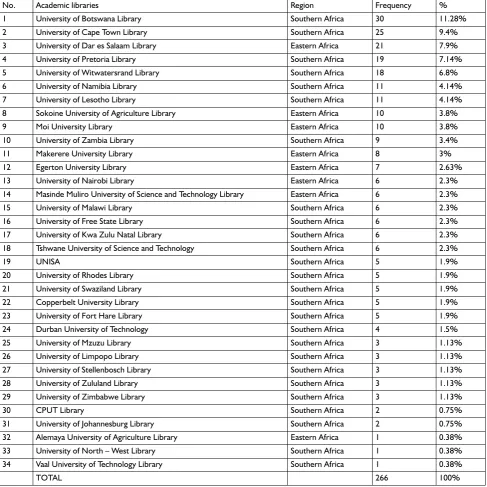
The University of Botswana Library in southern Africa topped the list with 30 publications (11.28 %). The next nine academic libraries, in descending order, were the University of Cape Town in southern Africa (25; 9.4 %); the University of Dar es Salaam in eastern Africa (21; 7.9 %); the University of Pretoria in southern Africa (19; 7.14 %); the University of Witwatersrand in southern Africa (18; 6.8%); the University of Namibia and the University of Lesotho in southern Africa (11; 4.14 % each); the Sokoine University of Agriculture and Moi University in eastern Africa (10; 3.80.% publications each, the University of Zambia in southern Africa (9; 3%) [see Table 1].
The top universities are more established, older and are probably more stable than other universities in terms of research funding and research tradition. Some of these institutions were also the first academic institutions of higher learning in their countries, e.g. the University of Botswana, University of Dar es Salaam, and the University of Namibia. Another factor worth noting is that three of the academic libraries from South Africa that featured in the top ten were from universities that had been designated as ‘white-only’ during the apartheid era. These are the University of Cape Town, University of Pretoria and the University of Witwatersrand. However, academic libraries from universities that were designated ‘black-only’ performed relatively poorly, such as the University of the Western Cape and University of Venda with no publication indexed in the dabases during the period of this study. It is most probable that competition for library positions is more rigorous in established universities because of their high profile and location in large urban centres where most people would like to live and work. Interestingly, there was no direct link between top ranked universities in Africa (http://www.webometrics.info) and most productive academic libraries. We however noted among the top 10 African universities according to this ranking, University of Cape Town (rank 1),University of Pretoria (rank 2), University of Witswatersrand (rank 4) libraries also came top in this study.
Eastern Africa’s Sokoine University of Agriculture Library probably made the top ten because it is in an agricultural-based university and therefore enjoys the funding that goes with the importance placed on agriculture in the region. The same applies to the Egerton University Library, which took twelfth position with 7 (2.63 %) publications.
SA Jnl Libs & Info Sci 2010, 76(1)
4.4 Distribution of publications by academic librarian
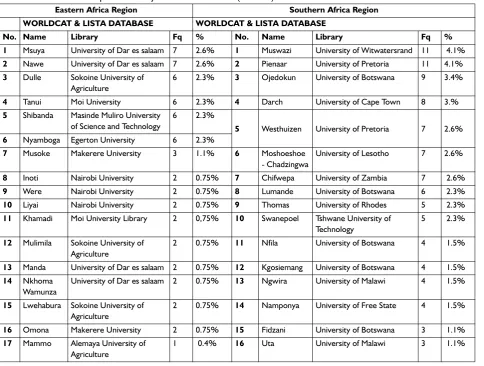
Data from Table 2 indicates that 32 academic librarians from eastern Africa contributed a total of 75 publications (approximately 2.3 publications per librarian). In southern Africa, 89 academic librarians contributed 191 publications (approximately 2.1. publications per librarian). Evidently, there was no significant difference between numbers of publication per librarian when the two regions are compared. Two academic librarians from southern Africa emerged as the most prolific in the two regions, namely Muswazi from the University of Witwatersrand Library and Pienaar from the University of Pretoria Library, each with 11 publications (4.1%). In eastern Africa, academic librarians who recorded more than five publications were Msuya and Nawe, both from the University of Dar es Salaam with 7 (2.6%) publications each; and Dulle from the Sokoine University of Agriculture, Tanui from Moi University, and Nyamboga from Egerton University produced 6 (2.3%) publications each.
Academic librarians from southern Africa who recorded more than five publications, other than Muswazi and Pienaar, were Ojedokun from the University of Botswana Library (9; 3.4%), Darch from the University of Cape Town (8;3%), and Westhuizen from the University of Pretoria (7;2.6%). They were followed by Moshoeshoe–Chadzingwa from the University of Lesotho and Chifwepa from the University of Zambia (7; 2.6% each); Lumande from the University of Botswana (6; 2.3%); and Thomas from Rhodes University and Swanepoel from the Tshwane University of Technology (5;
Table 1 Distribution of publications by academic libraries (N=266)
No. Academic libraries Region Frequency %
1 University of Botswana Library Southern Africa 30 11.28%
2 University of Cape Town Library Southern Africa 25 9.4%
3 University of Dar es Salaam Library Eastern Africa 21 7.9%
4 University of Pretoria Library Southern Africa 19 7.14%
5 University of Witwatersrand Library Southern Africa 18 6.8%
6 University of Namibia Library Southern Africa 11 4.14%
7 University of Lesotho Library Southern Africa 11 4.14%
8 Sokoine University of Agriculture Library Eastern Africa 10 3.8%
9 Moi University Library Eastern Africa 10 3.8%
10 University of Zambia Library Southern Africa 9 3.4%
11 Makerere University Library Eastern Africa 8 3%
12 Egerton University Library Eastern Africa 7 2.63%
13 University of Nairobi Library Eastern Africa 6 2.3%
14 Masinde Muliro University of Science and Technology Library Eastern Africa 6 2.3%
15 University of Malawi Library Southern Africa 6 2.3%
16 University of Free State Library Southern Africa 6 2.3%
17 University of Kwa Zulu Natal Library Southern Africa 6 2.3%
18 Tshwane University of Science and Technology Southern Africa 6 2.3%
19 UNISA Southern Africa 5 1.9%
20 University of Rhodes Library Southern Africa 5 1.9%
21 University of Swaziland Library Southern Africa 5 1.9%
22 Copperbelt University Library Southern Africa 5 1.9%
23 University of Fort Hare Library Southern Africa 5 1.9%
24 Durban University of Technology Southern Africa 4 1.5%
25 University of Mzuzu Library Southern Africa 3 1.13%
26 University of Limpopo Library Southern Africa 3 1.13%
27 University of Stellenbosch Library Southern Africa 3 1.13%
28 University of Zululand Library Southern Africa 3 1.13%
29 University of Zimbabwe Library Southern Africa 3 1.13%
30 CPUT Library Southern Africa 2 0.75%
31 University of Johannesburg Library Southern Africa 2 0.75%
32 Alemaya University of Agriculture Library Eastern Africa 1 0.38%
33 University of North – West Library Southern Africa 1 0.38%
34 Vaal University of Technology Library Southern Africa 1 0.38%
1.9% each). Academic librarians from southern Africa were on the lead. and all of them came from older and better established universities. High mobility of some productive academic librarians in search for better employment opportunities or ‘greener pastures’ must have influenced better or poor publication output in particular libraries as we noted earlier about the exodus of African professionals overseas (Mutula 2009). For example, Muswazi moved from the University of Swaziland to the University of Witwatersrand, and Shibanda moved from Moi University to the Masinde Muliro University of Science and Technology. Many such changes are noted.
Unexpectedly, only 23 library directors from the 46 academic libraries found in this study published their research in visible publication outlets indexed by the two databases. Some of these directors were: Nawe, Tanui, Dulle, Mwanzilo, Musoke, Shibanda, Mammo, Rapp, Thomas, Tise, Ubogu, Sander, Swanepoel, Namhila, Phiri, Uta, Larney, Chuene, Lungu, Buchanan, Moshoeshoe–Chadzingwa, Chikonzo and Namponya.The study also confirms a study by Yatiz and Zainab (2007:41) who established that most academic librarians are one time contributors. Of the 32 academic librarians in eastern Africa, half (16) were one time contributors, while in southern Africa, 51 out of the 89 academic librarians were one time contributors.
4.5 Distribution of publications by sources
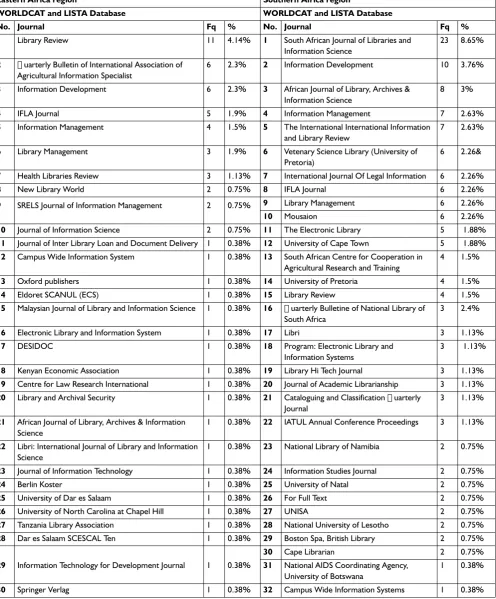
The number of times any academic librarian’s publication had appeared in a journal was determined. In eastern Africa, academic librarians published in 35 journals. The calculations are based on 266 publications originating from 115 journals. Most (11; 4.14 %) of the librarians in this region preferred publishing in Library Review, followed by the Quarterly Bulletin of International Association of Agricultural Information Specialist and the Information and Development Journal, both in second place with 6 (2.3 %) publications. The IFLAJournal generated 5 (1.88 %) publications.
Southern African academic librarians published in 80 journals. Most (23; 8.65 %) of the articles were in the South Africa Journal of Libraries and Information Science, which was also leading in a recent study by Ocholla and Ocholla (2007). Others were Information Development (10; 8%); the African Journal of Library, Archives and Information Science (8; 3.8%); and Information Management and the International Information and Library Review, both with 7 (2.63%) publications. Seven journals published a total of 6 (2.3 %) publications each, namely Veterinary Science Library, International Journal of Legal Information, IFLA Journal, Library Management, Mousaion, and University of Cape Town and The Electronic Librarian. These
Table 2 Distribution of publication by academic librarians (N=266)
Eastern Africa Region Southern Africa Region WORLDCAT & LISTA DATABASE WORLDCAT & LISTA DATABASE
No. Name Library Fq % No. Name Library Fq %
1 Msuya University of Dar es salaam 7 2.6% 1 Muswazi University of Witwatersrand 11 4.1%
2 Nawe University of Dar es salaam 7 2.6% 2 Pienaar University of Pretoria 11 4.1%
3 Dulle Sokoine University of Agriculture
6 2.3% 3 Ojedokun University of Botswana 9 3.4%
4 Tanui Moi University 6 2.3% 4 Darch University of Cape Town 8 3.%
5 Shibanda Masinde Muliro University of Science and Technology
6 2.3%
5 Westhuizen University of Pretoria 7 2.6%
6 Nyamboga Egerton University 6 2.3%
7 Musoke Makerere University 3 1.1% 6 Moshoeshoe
- Chadzingwa
University of Lesotho 7 2.6%
8 Inoti Nairobi University 2 0.75% 7 Chifwepa University of Zambia 7 2.6%
9 Were Nairobi University 2 0.75% 8 Lumande University of Botswana 6 2.3%
10 Liyai Nairobi University 2 0.75% 9 Thomas University of Rhodes 5 2.3%
11 Khamadi Moi University Library 2 0,75% 10 Swanepoel Tshwane University of
Technology
5 2.3%
12 Mulimila Sokoine University of Agriculture
2 0.75% 11 Nfila University of Botswana 4 1.5%
13 Manda University of Dar es salaam 2 0.75% 12 Kgosiemang University of Botswana 4 1.5%
14 Nkhoma
Wamunza
University of Dar es salaam 2 0.75% 13 Ngwira University of Malawi 4 1.5%
15 Lwehabura Sokoine University of Agriculture
2 0.75% 14 Namponya University of Free State 4 1.5%
16 Omona Makerere University 2 0.75% 15 Fidzani University of Botswana 3 1.1%
17 Mammo Alemaya University of
Agriculture
SA Jnl Libs & Info Sci 2010, 76(1)
results suggest that academic librarians in southern Africa prefer publishing in domestic journals as opposed to those from East Africa who prefer publishing in foreign journals. Further analysis reveals that even in southern Africa academic librarians from South Africa largely publish in domestic LIS journals. We assume that publication in foreign professional and academic journals largely occurs when there is lack of good local (domestic) or regional journals in a discipline. For example, South Africa has 200 listed scholarly journals including six in LIS such as South African Journal of Library and Information Science, Mousaion, ESARBICA, Innovation, Indilinga and South African Journal of Information Management among several other non scholarly journals thereby offering more opportunities for domestic publishing.
Table 3 Distribution of publications in sources (N = 266)
Eastern Africa region Southern Africa region
WORLDCAT and LISTA Database WORLDCAT and LISTA Database
No. Journal Fq % No. Journal Fq %
1 Library Review 11 4.14% 1 South African Journal of Libraries and
Information Science
23 8.65%
2 Q uarterly Bulletin of International Association of Agricultural Information Specialist
6 2.3% 2 Information Development 10 3.76%
3 Information Development 6 2.3% 3 African Journal of Library, Archives &
Information Science
8 3%
4 IFLA Journal 5 1.9% 4 Information Management 7 2.63%
5 Information Management 4 1.5% 5 The International International Information
and Library Review
7 2.63%
6 Library Management 3 1.9% 6 Vetenary Science Library (University of
Pretoria)
6 2.26&
7 Health Libraries Review 3 1.13% 7 International Journal Of Legal Information 6 2.26%
8 New Library World 2 0.75% 8 IFLA Journal 6 2.26%
9 SRELS Journal of Information Management 2 0.75% 9 Library Management 6 2.26%
10 Mousaion 6 2.26%
10 Journal of Information Science 2 0.75% 11 The Electronic Library 5 1.88%
11 Journal of Inter Library Loan and Document Delivery 1 0.38% 12 University of Cape Town 5 1.88%
12 Campus Wide Information System 1 0.38% 13 South African Centre for Cooperation in
Agricultural Research and Training
4 1.5%
13 Oxford publishers 1 0.38% 14 University of Pretoria 4 1.5%
14 Eldoret SCANUL (ECS) 1 0.38% 15 Library Review 4 1.5%
15 Malaysian Journal of Library and Information Science 1 0.38% 16 Q uarterly Bulletine of National Library of South Africa
3 2.4%
16 Electronic Library and Information System 1 0.38% 17 Libri 3 1.13%
17 DESIDOC 1 0.38% 18 Program: Electronic Library and
Information Systems
3 1.13%
18 Kenyan Economic Association 1 0.38% 19 Library Hi Tech Journal 3 1.13%
19 Centre for Law Research International 1 0.38% 20 Journal of Academic Librarianship 3 1.13%
20 Library and Archival Security 1 0.38% 21 Cataloguing and Classification Q uarterly
Journal
3 1.13%
21 African Journal of Library, Archives & Information Science
1 0.38% 22 IATUL Annual Conference Proceedings 3 1.13%
22 Libri: International Journal of Library and Information Science
1 0.38% 23 National Library of Namibia 2 0.75%
23 Journal of Information Technology 1 0.38% 24 Information Studies Journal 2 0.75%
24 Berlin Koster 1 0.38% 25 University of Natal 2 0.75%
25 University of Dar es Salaam 1 0.38% 26 For Full Text 2 0.75%
26 University of North Carolina at Chapel Hill 1 0.38% 27 UNISA 2 0.75%
27 Tanzania Library Association 1 0.38% 28 National University of Lesotho 2 0.75%
28 Dar es Salaam SCESCAL Ten 1 0.38% 29 Boston Spa, British Library 2 0.75%
29 Information Technology for Development Journal 1 0.38%
30 Cape Librarian 2 0.75%
31 National AIDS Coordinating Agency, University of Botswana
1 0.38%
4.6 Distribution of publications by type of document
This study confirms that journals are still the dominant source for research publications may be because they are also readily indexed in the mainstream indexing databases such as the two used for this study. Out of the 266 publications, 200(75%) were journal articles. These were followed by books (31; 11.7%), conference proceedings (17; 6.4), theses (11; 4.14%), book reviews (9; 3.38%) and microform (1). The largest share of publications in all the categories originated from southern Africa
4.7 Research trends in eastern and southern Africa
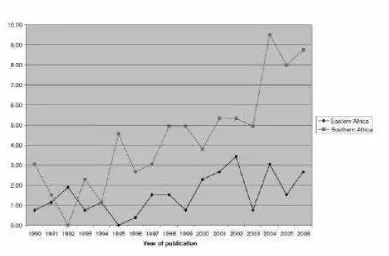
The publication trends of the two regions under study (see Figure 3) show that from 1990 to 2006 there was inconsistency in the publications showed by deep rise and falls. Southern Africa’s publication output was only steady once from 1998 to 1999, where the number of publications remained at 13 (4.9%). Eastern Africa had a steady publication trend from 1997 to 1998, where the publication output was 4 (1.5%). In 1992 and 1995, there was no publication output registered in the two databases in southern Africa and in eastern Africa. We cannot explain why this occurred but observe that during this period South Africa was undergoing political transition to the current new democratic dispensation. While this could have affected South Africa, the same may not have necessarily applied to the region to such magnitude in terms of publication output. Whether there is any relationship between elections and referendums that were common in the region during this period, and research output as a whole and by librarians in particular is unknown.
4.8 Most researched subject
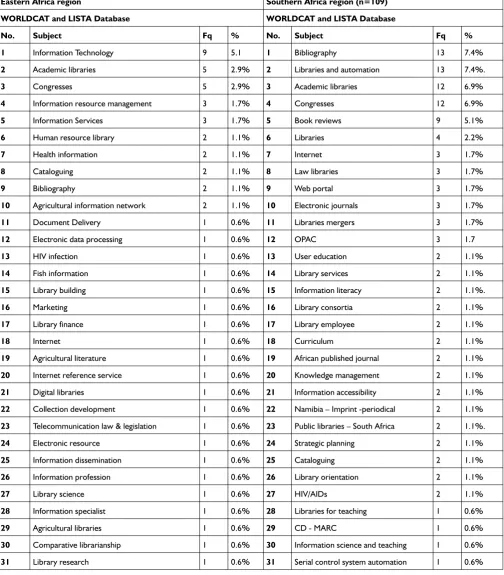
We identified 178 subject areas that academic librarians covered the most in their publications without using any standard thesauri. The results are illustrated in Table 4. In eastern Africa, a total of 69 subjects were identified. The most researched subject was Information Technology (9; 5.14%) followed by Academic Libraries and Congresses (5; 2.9%).
In southern Africa, a total of 109 subjects were identified. Bibliography and Library Automation were the most covered subjects, each with a total of 13 (7.4%) publications, followed by Academic Libraries and Congresses (12; 6.9%) publications each. Book Reviews were in third place (9; 5%) publications.
Academic librarians from both regions published more on ICT and library automation(18;10.2%) related subjects possibly because the period from 1990 to 2006 saw more libraries moving away from manual to automated library systems. This was followed by publications on academic libraries and on congresses (17; 9.7%), bibliography (13; 7.4%) and book reviews(9; 5.1%). In both regions the ICT related subjects tended to focus on aspects of library automation probably because of more familiarity with the academic library environment.
SA Jnl Libs & Info Sci 2010, 76(1)
4.9 Nature of collaboration among academic librarians
This study has found out that out of 266 publications analysed, 165(62%) were single authored and only 101(37%) were co-authored. Research collaboration is highly recommended because of its benefits. Among them (Katz & Martin 1997; Ocholla & Ocholla 2007:115 citing Katz & Martin) includes: collaboration enables researchers to share skills and techniques, and is one way of transferring knowledge (especially tacit knowledge); through clashing views it may bring about the cross-fertilisation of ideas, which may in turn generate new insights or perspectives that individuals, working on their own, would not have grasped; collaboration provides intellectual companionship (i.e. within a practising community); collaboration plugs the researcher into a wider contact network in the scientific community; and it enhances
Table 4 Distribution of publications by subject (N = 175)
Eastern Africa region Southern Africa region (n=109)
WORLDCAT and LISTA Database WORLDCAT and LISTA Database
No. Subject Fq % No. Subject Fq %
1 Information Technology 9 5.1 1 Bibliography 13 7.4%
2 Academic libraries 5 2.9% 2 Libraries and automation 13 7.4%.
3 Congresses 5 2.9% 3 Academic libraries 12 6.9%
4 Information resource management 3 1.7% 4 Congresses 12 6.9%
5 Information Services 3 1.7% 5 Book reviews 9 5.1%
6 Human resource library 2 1.1% 6 Libraries 4 2.2%
7 Health information 2 1.1% 7 Internet 3 1.7%
8 Cataloguing 2 1.1% 8 Law libraries 3 1.7%
9 Bibliography 2 1.1% 9 Web portal 3 1.7%
10 Agricultural information network 2 1.1% 10 Electronic journals 3 1.7%
11 Document Delivery 1 0.6% 11 Libraries mergers 3 1.7%
12 Electronic data processing 1 0.6% 12 OPAC 3 1.7
13 HIV infection 1 0.6% 13 User education 2 1.1%
14 Fish information 1 0.6% 14 Library services 2 1.1%
15 Library building 1 0.6% 15 Information literacy 2 1.1%.
16 Marketing 1 0.6% 16 Library consortia 2 1.1%
17 Library finance 1 0.6% 17 Library employee 2 1.1%
18 Internet 1 0.6% 18 Curriculum 2 1.1%
19 Agricultural literature 1 0.6% 19 African published journal 2 1.1%
20 Internet reference service 1 0.6% 20 Knowledge management 2 1.1%
21 Digital libraries 1 0.6% 21 Information accessibility 2 1.1%
22 Collection development 1 0.6% 22 Namibia – Imprint -periodical 2 1.1%
23 Telecommunication law & legislation 1 0.6% 23 Public libraries – South Africa 2 1.1%.
24 Electronic resource 1 0.6% 24 Strategic planning 2 1.1%
25 Information dissemination 1 0.6% 25 Cataloguing 2 1.1%
26 Information profession 1 0.6% 26 Library orientation 2 1.1%
27 Library science 1 0.6% 27 HIV/AIDs 2 1.1%
28 Information specialist 1 0.6% 28 Libraries for teaching 1 0.6%
29 Agricultural libraries 1 0.6% 29 CD - MARC 1 0.6%
30 Comparative librarianship 1 0.6% 30 Information science and teaching 1 0.6%
the potential visibility of the work. Despite all these benefits research collaboration in Africa is weak (Onyancha 2007, Ocholla & Ocholla 2007). Despite the benefits, collaborative research output is relatively low in library and information profession (Ocholla 2008) and hindered by several factors in Africa. Among them is lack of willingness to collaborate, poor networking, lack of collaborative research funding and insufficient joint research work between post graduate student and supervisor that should normally culminate into a research publication particularly during the early part of this period of study.
5 Conclusion and recommendations
Literature on the topic would suggest that academic librarians publish mainly because of the recognition they receive, to add to the body of knowledge that goes into creating professional literature, for improved ratings, and for better chances at promotion. We generally observed that academic librarians need to diversify the subject areas they research beyond the areas identified in the study. Other topics worth considering include user education and information literacy, research methods, information retreival, records management and information services. Academic librarians from both regions preferred publishing on their own and less through collaboration, which could facilitate knowledge sharing, lead to improvements in the quality of research, and support their lobbying for funding.
There were significant disparities in the publication output of libraries, countries and regions. We were concerned that libraries based in the following public universities do not seem to demonstrate any visible publication, seeing as they had no publications: Somalia National University, Kenya’s Kenyatta University, Tanzania’s Mzumbe University, the Open University of Tanzania, University of Khartoum, and Zimbabwe’s Midlands State University. The same applies to the following universities in South Africa: University of Venda, Mangusuthu University of Technology, and Central University of Technology, Nelson Mandela Metropolitan University, and the University of the Western Cape. Although it was noted that southern Africa performed fairly well in terms of production, the following countries within this region did not feuture that well: Zambia, Zimbabwe, Namibia, Swaziland, Lesotho and Botswana. In eastern Africa, Uganda, Sudan, Ethiopia and Somalia performance is not impressive.
The study recommends that all the academic librarians from both regions should be encouraged to engage in research and publish regularly by making research and publication a criterion for the promotion of professional library staff as this would also strengthen their professional and research recognition in the academic community. Similar research in other regions where studies of this nature have not been done in order to establish, among other things, why many academic librarians do not publish, problems faced by academic librarians who publish, and what can be done to make it possible
SA Jnl Libs & Info Sci 2010, 76(1)
for them to publish need to be conducted. Further research is also recommended on countries such as Angola, Burundi, Rwanda and Mozambique, and universities in the two studied regions that did not provide essential data such as the names of their academic librarians on university websites.
While this study has tried to be as accurate and comprehensive as possible, minor omissions largely due to website errors, incompleteness and omissions; inconsistency in author names during retrieval; absence of academic library websites and mobility of authors from one institution to another were noted and regretted.
References
Aceto, L. 2005. The importance of research for a modern university. [Online]. http://www.icetcs.ru.is/luca/slides/importance-of-research.pdf. Accessed 8 June 2008.
Aina, L.O. & Mabawonku, L.M. 1998. Manuscripts submitted for publication in the information profession in Africa: a comparative analysis of rejected and accepted papers. Journal of Documentation, 54:(2):250 -255.
Aina, L.O. & Mabawonku, L.M. 1997. The literature of the information profession in Anglophone Africa: characteristics, trends and future directions. Journal of Information Science, 23(4):321-326.
Aina, L.O. & Mooko, N.R. 1999. Research and publication patterns in library and information science. lnformation Development, 15(2): 114-1198.
Alemna, A. A. 1996. The periodical literature of library and information science in Africa: 1990- 1995. International Information and Library Review, 28(2):93- 103.
Alemna, A. A. 2001. The periodical literature of library and information in Africa: 1996-2000. Information Development, 17(4):257-261.
Alemna, A.A. & Badu, E. 1994. The nature and trends in research and journal literature in English speaking Africa. International Information and Library Review, 26(1):19-31.
Bahr, A. H. and Zemon, M. 2000. Collaborative authorship in the journal literature: perspectives for academic librarians who wish to publish. [Online]. http://www.ala.org/ala/acr/acrlpubs/acr/journal/backissue2000bSeptember2/bahr.pdf. Accessed 2 October 2006.
Boon, J.A. & van Zyl, E.R. 1990. State of the art of research in library and information science in South Africa: a macroanalysis. South African Journal of Library and Information Science, 58(2):155-166.
Career focus. 2006. Career review part 3: the importance of research. [Online]. http://www.nwpgmd.nhs.uk/Careers/Documents/ Career%20review%20part3.pdf. Accessed 8 June 2008.
Curran, S. 1990. How to write a book and get it published: a complete guide to the publishing maze. Thorsons: Harper Collins. DEST HERDC Specification for the collection of 2006 data. n.d. [Online]. http://www.research.qut.edu.au/data/pubcollections/
dest/nw-definition of .php. Accessed 27 July 2007.
Goddard, W. and Melville S. 2001. Research methodology: an introduction. 2nd ed.Lansdowne: Juta
Gregory, G. M. 2005. The successful academic librarian: winning strategies from library leaders. Medford, N.J.: Information Today, Inc.
Hart, R. L. 1996. Scholarly publication by university librarians: a study of Penn State. [Online]. http://www.ala.org/a/ala/acrl/acr/ pubs/cr/journal/backissues1996/September99/hart.pdf. Accessed 2 October 2006.
Kadiri, J. 2001. Library literature in Ghana, 1950-1994. African Journal of Library, Archives and Information Science, 11(2):89-95. Kartz, J.S. & Martin, B.R. 1997. What is research collaboration? Research Policy, 26(1):1-18
Mabawonku, I. 2001.Trends in library and information science research in Africa, 1991 -2000. African Journal of Library, Archives, and Information Science, 11(2):79-88.
Library Connect. 2003. How to get published in LIS journals: a practical guide. [Online]. http://www.elsevier.com/ frameworklibrarians/libraryConnect/Icpamphlet2.pdf. Accessed 8 June 2008.
Majorie, F. 2000. Publish or perish! What’s a librarian to do? [Online]. http://www.dowling.edu/library/papers/marje/ DASLOGPublishPerishArt.doc. Accessed 8 June 2008.
Mutula, S. 2009. Challenges of doing research in sub-Saharan African universities: digital scholarship opportunities. Inkanyiso.Journal of Humanities and Social Science, 1(1):1-11.
Neuman, W.L. 2006. Social research methods: qualitative and quantitative approaches. 6rd ed. Boston: Allyn and Bacon.
Ngulube, P 2005a. Improving the quality of research output in higher education through knowledge sharing and collaboration: A case study. Mousaion, 23(1):39-41.
Ngulube, P 2005b. Research procedures used by master of Information Studies students at the University of Natal in the period 1982-2002 with special reference to their sampling techniques and survey response rates. A methodological discourse.International Information and Library Review, 37(1): 127 -143.
Ocholla, D.N. 2008. The current status and challenges of collaboration in library and information science (LIS) education and training in Africa. New Library World, 109(9/1):466-479.
Ocholla, D.N. 2000. Research capacity in library and information science in South Africa. 66 IFLA General Conference, 13-18 August, Jerusalem, Israel (Also see http://www.ifla.org/IV/if1a66/papers/054-127e.htm).
Ocholla, DN. 2001. An informetric analysis of research capacity in library and information science in South Africa. Proceedingsof the International Sciencetometric and Informetric Conference vol.2 Sydney, Australia 16 - 20 July, UNSW, pp. 867-869.
Ocholla, D. N. and Ocholla L. 2007. Research in library and information science in South Africa: an analysis of journals research output from 1993-2006. South African Journal of Libraries and Information Science, 73(2):109-118.
Onyancha, B. 2007. LIS research in Africa: how much is it worth? A citation analysis of the literature, 1986-2006. South African Journal of Libraries and Information Science, 73(2):95-108.
Sitienei, G.C. 2009. A comparison of research and publication patterns and output among academic librarians in eastern and southern Africa between 1990 -2006. University of Zululand( Masters Dissertation). [Online] http://www.lis.uzulu.ac.za/ index.php/etds/44-etds-masters/86-a-comparison-of-research-and-publication-patterns-and-output-among-academic-librarians-in-eastern-and-southern-africa-between-1990-to-2006. Accessed 10 November 2009.
Stover, M. 1996. The librarian as a publisher: a case study of a World Wide Web publishing project. [Online]. http:// www.library.ucsb.edu/untangle/stover.html. Accessed 26 July 2007.
Twining, J. 2001. Bibliometrics: an overview. [Online]. http://www.du.edu/-jtwining/LIS4326/bibliometrics.htm. Accessed 8 June 2008.
Verzosa, F.A. 2007. Research in librarianship: challenges, competencies, and strategies. [Online]. http://eprints.rclis.org/archive/ 00012918/01/Research_in_Librarianshipkeynote_speech.pdf. Accessed 8 June 2008.
Wilkinson, D. and Birmingham, P. 2003. Using research instruments: a guide for researchers, London: RoutledgeFalmer.