SETTING SCIENCE AGENDAS FOR EUROPE
Annual Report
2006
75
75
Mission Statement
The European Science Foundation provides a common platform for its Member Organisations in order to:
• Advance European research
• Explore new directions for research at the European level
Through its activities, the European Science Foundation serves the needs of the European research community in a global context.
Values
The European Science Foundation’s mission is guided by shared values that characterise its specific organisational culture. These values are :
• Excellence:the gatekeeper criterion for all scientific activities; it will also drive the management philosophy and operating procedures;
• Openness: to all scientists and disciplines; no barriers between disciplines; open sharing of results; transparency to stakeholders and partners;
• Responsiveness:in its procedures and structure;
• Pan-European:rising above national interests to the benefits of science in the whole of Europe;
• Ethical awareness and human values:sensitive to societal and ethical considerations in all its activities; attention to gender aspects.
Contents
2006 Highlights 7
Ian Halliday, ESF President 8
Bertil Andersson, ESF Chief Executive 10
Highlights from the 2006 General Assembly 12
European Latsis Prize 15
EURYI / ESF Fortifies its Foundation 16
EuroBioFund 17
Prague Peer Review Conference 18
Out of Europe 19
ESF’s new logo / EMRC Chair 20
ESF in the news 21
EUROCORES Programmes 22
Exploratory Workshops 34
Forward Looks 39
ESF Policy Briefings 41
ESF Research Conferences 42
Research Networking Programmes 43
ESF Member Organisations in 2006 50
ESF Governing Bodies and Committees Membership 56
COST 71
Finance 72
Human Resources 76
Publications in 2006 80
Changes within the ESF
It was also a year of major changes for the organisation with its General Assembly taking the decisions to discontinue the Executive Board, make the Governing Council the meeting place for the leadership of national research organisations and to establish an independent Science Advisory Board. For more information on the 2006 General Assembly’s highlights see page 12.
Further ESF – COST Synergy
In 2006, ESF has further cemented its on-going working relationship with the European Cooperation in Science and Technology (COST). Both parties have agreed ESF to act as the implementing agent for the office of COST during the seventh Framework Programme. See page 71 for more COST highlights.
2006 European Latsis Prize – Social & Migration issues
The ESF awarded 2006’s European Latsis Prize to Professor Rainer Bauböck from the Institute of European Integration Research in Austria for his contribution and in-depth research on migration issues. See page 15.
Life Science, Funders convergence – EuroBioFund’s 1st annual EuroBioForum
The 1st annual EuroBioFund’s EuroBioForum was held in Helsinki in December 2006, an annual event that aims to match cutting-edge pan-European research with life sciences funders. See page 17.
The Evaluation of Science – Prague Peer-review Conference
Some 150 experts from the European scientific community and institutions throughout the world (including China, Japan and Korea) convened in Prague in October 2006 to discuss the growing need for access to the best quality expert reviewers. See page 18.
Out of Europe – ESF’s Japanese link
In another sign of how ESF’s activities are breaking geographic barriers, the organisation signed an extended Memorandum of Understanding with the Japan Society for the Promotion of Science (JSPS) in May 2006 for the facilitation of interaction between young and experienced researchers from both continents. See page 19.
New Research Conferences in a diverse range of disciplines
In 2006, ESF organised 17 research conferences and two summer schools with 11 partners. See page 42.
2006 Highlights
Although engaged with the ESF for many years as a member of PESC (Standing Committee for the Physical and Engineering Sciences) and the Governing Council this has been my first year as President. This has meant a steep learning curve of people, committees, organisations and far-flung sciences. I would like to start by thanking everyone for their patience, goodwill in explanation and occasional tough arguments about ESF; its aims and indeed, budget.
2006 was a year where the alignment of ESF structures with the Strategy document produced in 2005 took lead position. There was widespread consultation and discussion about the governance of the ESF. In broad-brush terms there were three real issues: the membership, the way in which Member Organisations could feel confident that they had influence on the programmes of ESF and finally the connections between the Governing Council and the Standing Committees needed improvement.
My first real surprise as President was that the membership issue turned out to be non controversial. Professor Reijo Vihko (the former president of EUROHORCs and the former head of the Academy of Finland) traversed Europe taking soundings and integrating the Member Organisation inputs and reported a general wish that the membership remained inclusive. This was verified at a member consultation meeting. I thank Reijo for his great efforts in this area. The other two issues could be summarised under the heading of integrating ESF and making it a more coherent and transparent body. I think the main effect of the Governance reforms will be to improve the transparency and level of trust between the different parts of the ESF: Member Organisations, Office and Scientists. The major change will only come about if the three parts engage seriously with each others agendas.
Here I would like to thank all concerned for their inputs, arguments and, in the last resort, good humour as we attempted to square the circle of the individual desires of 78.
Norden and Dr. Kai Simons). They and their committees set a standard of peer review and general engagement that was a model to Europe. The growing prevalence of ERA-NET and ERA-NET+ schemes will pose a challenge to national structures. This too is an area where various ESF committees have played a strong role.
Thus, in a Europe of change, a major question for ESF has been to place itself in a distinctive position where both its strengths and weaknesses are taken into account. In the 2005 Strategic Plan great emphasis has been placed by our members on the policy role for ESF. One manifestation of this would be to produce effective and influential Forward Looks. In this context I was very impressed by the way that the Nanomedecine Forward Look influenced Commission policy and various national debates. This is an area where we particularly need engagement by Member Organisations. The best scientists will only engage and carry out the hard graft necessary for a good Forward Look if they believe that the effort will produce results in influencing policy and finance.
As well as committees and compromises ESF also brings moments of exhilaration and intellectual stimulation: hearing Professor Rainer Bauböck of explain his European Latsis Prize work on Immigration and Social Cohesion in Modern Societies (See page 15), seeing EMRC Chair Professor Liselotte Højgaard’s amazing department of Clinical Physiology, Nuclear Medicine & PET at Copenhagen’s Rigshospitalet with the tight alignment of nuclear physics, radiation treatment, PET scans and IT systems all integrated to deliver best treatment, discussing all the tensions of science funding at the Max Planck Society’s Ringberg symposium, being provoked by Commissioner Janez Potocnik to think radical thoughts about European Science beyond Framework 7 and so on.
At the end of the year we heard that our CEO Bertil Andersson would be leaving us. We will celebrate Bertil’s total ESF achievements in 2007 but I cannot leave this Annual Report without acknowledging the help Bertil has given me in my first year. His energy, enthusiasm and commitment have shone through. His astonishing achievements collecting support for the ESF conference scheme and the EuroBioFund are noteworthy.
Professor Ian Halliday
2006 was a year to put the Strategic Plan 2006-2010to action. In other words, we went from Talking to Doing. It was also a year to change the governing structure and a year to deal with the complicated membership issues that have been lurking in the back for quite some times. We have managed nevertheless.
The emphasis of theStrategic Plan 2006-2010is to be more aligned with the Member Organisations (MOs). That is already been done. While being more aligned with the MOs there is also the demand of the MOs to step out and to ask things from ESF – to be an active owner of the ESF. Otherwise this synergy between the two will not work. So ESF has to do its part and the MOs have to do theirs.
The changed governance is quite an impressive task considering the complexity of our memberships. ESF now has a governing structure that is simpler and more streamlined and as I see it, more operational. This change is extremely important for an organisation with the size and scope such as the ESF. I hope this would make ESF even more action oriented in order to take quicker decisions.
For this past year we have successfully settled the contract with COST (The European Cooperation in Science and Technology) – It has been possible to get everything paid for by the 7thFramework Programme
for the new COST contract – with €210 million guarantee and the possibility to go up to €250 million. This is definitely a success story for the ESF as back in 2003 when we were taking on COST many were skeptical about whether we have the muscles to manage such vast undertaking – in both the administrative and the academic sides. Professor Francesco Fedi (President of the COST Committee of Senior Officials (CSO) and the CSOs), implemented reforms such as the new domain structure and the new procedures that would ensure higher quality of the COST actions. We have also managed to run COST office from an administrative point of view despite the extreme complexity of the contract.
ESF is now much bigger in size with the addition of COST. And we now have an office in Brussels with the relocation of our Conferences Unit there in 2006, situated besides the COST office. But rather than just being bigger I hope that ESF is actually better. ESF is strived to become more client-oriented. It is important that ESF actually is a service to the Member Organisations and to the European science community.
Also in 2006 we have raised the level of awareness on peer review quite considerably after our event in Prague with more than 150 experts from the European scientific community and institutions throughout the world (including China, Japan and Korea). A major concern addressed in the discussions was the growing need for access to the best quality expert reviewers. Now many MOs have turned to us to seek to do European peer review for them. In my mind, that could be a task for the ESF to take on in the future. (See page 18). Although the European Commission has a lot of money within its Framework Programmes, which maybe being perceived as dominating the scene, independent organisations such as the ESF still have an instrumental role in taking initiatives for the ever-changing European research funding scene. ESF’s Member Organisations from 30 European countries, be they research funding agencies, research performing organisations or learned societies, with a total annual budget for over €20 billion are responsible for a substantial part of research funding at national level.
On a more personal note for my decision to leave the organisation I am going to miss the wine and the food in France and I am going to miss Strasbourg and the region around it. As for ESF most of all I am going to miss the people of the organisations, the scientists, the science policy makers from Europe and the rest of the world.
Professor Bertil Andersson
Chief Executive
A New Dawn for the ESF
Longevity is something that every organisation strives to have. To achieve this goal merely having the right talents is not enough. Changing with the time is also essential.
For an organisation such as the ESF, which covers all aspects of science, making changes requires deep thinking, as any decision that it makes could significantly impact the research funding of Europe. The ESF’s Member Organisations, which comprise of most national research funding agencies and research performing organisations from 30 European countries, are responsible for the delegation of about €20 billion of European research funding.
The 32nd annual General Assembly of the ESF in
December 2006 cast approving votes on a series of measures that will ensure ESF’s status as a high-level policy interaction platform for its Member Organisations. These measures also aim to safeguard and develop science instruments for the organisation that has devoted itself to promoting excellence in European science since 1974. More importantly, these amendments are purposefully allowing wider participation from the ESF’s Member Organisations. In other words – enabling them to become “an active owner of the ESF.”
A number of milestone decisions were made during the Assembly. They are related to a number of important changes regarding the governance of the ESF and its scientific committee structure. One of them is the restructuring of the Governing Council, allowing only the Heads of Organisations within the ESF Membership to participate. The Assembly also passed a vote to simplify the Governance by discontinuing the Executive Board.
“We are witnessing a time of great change in Europe with the advent of the European Research Council (ERC). What we need to be asking ourselves here at the ESF is how do we improve the interaction between scientists and governance mechanisms?” ESF President Ian Halliday
commented. “External pressures are not declining. They are becoming more and more visible. We see this as both a setback and as a challenge.” The Council will now decide on which areas would benefit from a Forward Look; which topics for EUROCORES (European Collaborative Research Programmes) are of strategic importance to them and to the scientific community; in which areas Member Organisations should come together to develop joint actions or strategies, for example in peer review, research infrastructure or research integrity.
Composition of the ESF Governing Council
The Governing Council now consists of (i) the President of the Foundation, (ii) two Vice-Presidents, and (iii) a such a number of members to allow each National Group of Member Organisations to occupy one seat. Such members will be appointed by National Groups of Member Organisations and will be Heads of organisations within the ESF membership.
Science Advisory Board
Additionally, there was an agreement among the Member Organisations for the creation of a Science Advisory Board, composed of high-level scientists to cope with the demands of increasing interdisclipinarity within science, which will also play a key role in overseeing the quality of ESF’s scientific procedures. It has been decided that the Board will not be involved in the governance issues.
The Science Advisory Board will advise the Chief Executive in the following areas:
• Overseeing overall science quality of ESF’s activities, including peer review, and safeguarding interdisciplinarity of the instruments
• High level scientific advice to the CEO: ideas for new science actions and instruments; analyses of the evolving European and global science and science policy context.
Assembly 2007 Programme Committee and hosting of Assembly 2008
The decision was taken to change the format of the Assembly, extending the strategic element and focusing debate on European and global science and science policy issues. A small Programme Committee for the 2007 Assembly will be established.
It was also decided that the Assembly could be hosted on a rotational basis by Member Organisations. Therefore expressions of interest to host the 2008 Assembly were invited. The Assembly normally takes place in late November/early December.
New membership policy of the European Science Foundation
In an effort to strengthen its links with the different groups of possible Member Organisations the ESF adopted an inclusive policy with membership from research funding organisations, research performing organisations and academies, both with research institutes and learned societies, operating nation wide or at the European level, with no differentiation in membership rights. This new policy will strengthen ESF’s role as the European platform for policy debate and action by its members in investigator driven research.
Also the possibility was opened for science organisations at a European level, such as the ERC, to join the ESF membership.
New leadership for 2007
During the Assembly Member Organisations have voiced their support for Dr. John Marks to take over the position of Chief Executive starting from 1 April 2007 after the departure of Professor Bertil Andersson on 31 March 2007. Professor Andersson took up the post of Rector of the Nanyang Technological University of Singapore. Marks will be in place as the Chief Executive until a replacement will take office.
ESF awards 2006 European Latsis Prize
to Professor Rainer Bauböck, Visionary in
Migration Issues.
The European Science Foundation awarded 2006’s European Latsis Prize to Professor Rainer Bauböck from the Institute of European Integration Research in Austria for his contribution and in-depth research on migration issues.
The European Latsis Prize, valued at 100,000 Swiss francs (€65,000) is financed by the Geneva-based Latsis Foundation and awarded by the ESF to an individual or group who, in the opinion of their peers, has made the greatest contribution to a particular field of European research. The chosen field for the 2006 prize was Immigration and Social Cohesion in Modern Societies.
Professor Bauböck received the European Latsis Prize in a ceremony held at ESF’s annual General Assembly in Strasbourg on 30 November 2006. “How I feel? On a scale from one to 10, I am at 11,” he commented afterward.
Despite the public policy debate in which migration issues are constantly embroiled, the studying of the issue is often at the margin of scientific disciplines, according to Professor Bauböck. Devoting the European Latsis Prize to this theme contributes to strengthening its recognition as an academic field. “Since 1999, the European Latsis Prize has rewarded researchers who have made outstanding progress in European research. Professor Bauböck is at the forefront of the migration field and his contribution to this area is unprecedented,” said ESF President Ian Halliday, who presented the prize. “Professor Bauböck’s works have not only affected how European societies relate to each other they have also become a critical but
Bauböck, who is a political scientist and senior researcher at the Austrian Academy of Sciences’ Institute for European Integration Research, acknowledged the European Latsis Prize is by far the “strongest recognition” for his work. “I suspect that people who choose an academic career are generally driven by a strong desire for recognition by their peers. This is what the European Latsis Prize means to me personally,” said Bauböck. Bauböck is also the vice-chair of the Commission for Migration and Integration Research at the Academy of Sciences in Austria. His research interests are in normative political theory and comparative research on democratic citizenship, European integration, migration, nationalism and minority rights.
His works have been focusing on the question of how migration challenges and changes conceptions and boundaries of democratic citizenship. His effort has combined comparative research of migrants’ legal status and rights with a political theory of citizenship and the boundaries of political community.
From 1986 to 1999 Bauböck was assistant professor at the Institute for Advanced Studies, Vienna. He has taught at the Universities of Vienna and Innsbruck and is a recurrent visiting professor at Central European University Budapest. He has also been a visiting academic at Yale University, the University Pompeu Fabra in Barcelona, the University of Bristol, University of Malmö, the Institute for Advanced Study, Princeton, and the University of Warwick. In 2003-2005, Rainer Bauböck was president of the Austrian Association of Political Science.
Bauböck started a new position at the European University Institute in Florence in January 2007 where he was offered a chair in social and political theory.
2006 European Latsis Prize
Immigration and Social Cohesion in Modern Societies
European Science
Foundation fortifies its
foundation
The European Science Foundation has
further cemented its more than
three-decade old foundation at the City of
Strasbourg by refurbishing its main
building in 2006.
Nobel Laureate Jean-Marie Lehn, the Mayor of Strasbourg Mme Fabienne Keller and the President of the Urban Community of Strasbourg, M. Robert Grossmann were all there to witness the official inauguration of the ESF’s newly refurbished Marnésia building in a ceremony held on 22 September 2006.
Community of Strasbourg, the Regional Council, and the Departmental Council, the ESF now boasts state-of-the-art meeting rooms, sleek and modern office facilities, full disability access and a recently re-laid garden. In addition, since 2004, a second building was made available to the ESF on Rue du Parchemin.
The European Science Foundation is proud to continue its collaboration and positive interaction with the City of Strasbourg which has supported us since our inception in 1974,” commented ESF Chief Executive Professor Bertil Andersson at the ceremony.
“With its deserved reputation as the Capital of Europe, Strasbourg is the ideal location for an organisation such as ours whose mission is to promote pan-European co-operation in all aspects of scientific endeavour”.
The ESF’s story began since 1974, the former head of Finance Jean-Pierre Roth – who also attended the ceremony, made the case for an organisation that would act as a catalyst for the advancement of European science by bringing together the continent’s leading scientists and funding agencies. Thanks to the largesse of former Strasbourg Mayor Pierre Pflimlin, the dream soon became a reality. Under his direction, the Municipality of Strasbourg donated part of the historic Marnésia building for the nascent scientific organisation to occupy rent-free, alongside offices for the City of Strasbourg.
2006 European Young
Investigator Award (EURYI)
At the 3
rdEuropean Young Investigator Award
(EURYI) Ceremony, 25 young researchers from
across Europe met in the Czech
Republic to receive a diploma and
a guarantee of project funding of
as much as
€1.25 million for their
ideas which have the potential to
have a significant impact on our
everyday lives.
The brightest and most creative young minds in science were gathering in Prague on 13 October 2006 to receive recognition for their untapped potential in creating the European science’s future and for their breakthrough research ranging from voice recognition applications to the world’s smallest in vivo biofuel cell.
EURYI, which is coordinated by the ESF on behalf of the European Heads of Research Councils (EUROHORCs), awarded these young researchers
ESF’s newly refurbished Marnésia building
€897,500 to €1,250,000, comparable in size to the Nobel Prize. The youngest researcher from the group is 30 years of age.
“Cultivating ground-breaking scientific discoveries in Europe has always been the goal for the ESF, and EURYI has fittingly become the perfect vehicle to realise it,” commented Professor Bertil Andersson, Chief Executive of the ESF. “The Award also signifies what these young researchers could possibly accomplish with their scientific careers.”
The First Call of the EURYI scheme was launched in September 2003, and resulted in 25 awards being made in July 2004. A further 25 awards were made in 2005 after the Second Call.
The list of this 2006’s awardees includes researchers who will be based in 11 countries. The EURYI Awards are offered by 20 European national research organisations in an open competition with no “juste retour”. Candidates are selected on the basis of their future potential and their academic and research excellence. Competition has been intense, with 457 applications received for 2006.
Candidates are selected by a two-stage process, firstly at the national level by the relevant Participating Organisation and secondly at the international level by highest-level scientific panels managed by the ESF.
EURYI Awardees were being presented with their diploma by the Nobel Laureate Torsten Wiesel. Pictures: www.scienceundmedia.de/EURYI2006/
EuroBioFund -
1
stAnnual EuroBioForum
To match cutting-edge pan-European
research with life sciences funders,
EuroBioFund, which is supported by the
ESF and the European Commission,
organised its first annual EuroBioForum
in Helsinki in December 2006.
Professor Bertil Andersson, Chief Executive of the ESF, called the two-day event that took place on 14-15 December in the capital city of Finland “an experiment” to bring together researchers and various types of funders from across Europe. High-level representatives from public/private funding foundations, research funding organisations, national innovation agencies, academies, intergovernmental agencies and the bioscience
industry participated in the event which was kicked off by the Finnish Minister of Social Affairs and Health, Tuula Haatainen.
“We are now setting the ball rolling and there needs to be follow-up action,” Professor Andersson told the audience. The next EuroBioForum is scheduled to take place in Lisbon, Portugal in December 2007.
In his remarks about life sciences in Europe to the some 160 participants, Professor Andersson recommended there should be a higher degree of coordination between national public funders and those who are working at the European level. He also mentioned joint efforts among various types of life sciences funders and the need for a coordinated/stronger strategy for research infrastructure in Europe.
He noted that Europe needs to be more competitive with the U.S. and Asia. Currently R & D investment is fragmented among numerous funding bodies across Europe. It continues to lag behind Asia and the US in research funding, a fact that many observers warn is crippling the region's economic competitiveness. Efforts to correct this imbalance are urgently needed. EuroBioForum is expected to increase Europe's scientific presence and stimulate research and technology development in the life sciences field.
During the conference, 10 research consortia presented their pioneering research programmes on topics ranging from the production of hydrogen via artificial photosynthesis (SOLAR-H) to learning how to survive without water (DryLife).
Wouter Spek, EuroBioFund Director commented “Crosslinking of networks and bridging the gap between research and public/private funders is our main goal and there is still room for improvement in Europe. This first EuroBioForum has been an interesting and stimulating two days and follow-up actions to develop several of the research consortia presented have already been planned. We are definitely going to facilitate this in 2007.”
EuroBioFund, which was launched in June 2006, is aimed “to promote and coordinate interaction among European life sciences researchers and funders.”
Prague Peer Review
Conference
-The Quality of Science Evaluation
More than 150 experts from the European
scientific community and institutions
throughout the world (including China,
Japan and Korea) convened in Prague on
12-13 October 2006 to analyse
contemporary trends in the evaluation of
research, to examine how the peer review
process is understood and performed,
and to consider its future modifications in
response to the requirements of research
in the 21st century.
This conference was also a launching
event for the ESF Member Organisation
Forum on Peer Review.
Some experts have raised the concern that peer review, the internationally accepted form of scientific critique, may no longer be receptive to the novel approaches that lead to valuable scientific advances.
Speaking at the two-day international conference organised by the ESF, the Czech Science Foundation (Grantová agentura Ceské republiky, GACR), and the European Heads of Research Councils (EUROHORCs), John O’Reilly, the Chief Executive of the U.K.’s Engineering and Physical Sciences Research Council (EPSRC) said: “The current system of peer review can at times be considered ‘tyrannical’ in its approach and it needs to evolve.”
It was agreed that overall, peer review remains the best method of judging scientific quality both in research proposals and publications, but that its inherent subjectivity and variability can cause problems.
To remedy this, issues of harmonisation of procedures and practices; across Europe and globally; education of reviewers and research management were discussed.
To aid harmonisation, the creation of guidelines and methods of best practice to be shared throughout the research community was suggested. A document already produced by Quality Assurance Netherlands Universities setting standard evaluation protocol for public research organisations was held up as an example of such guidelines.
It was concluded that problems of the contemporary peer review need a strategic evaluation at a more conceptual level, not of a specific mechanism, but of the underlying principles and ideas.
Concluding remarks put a great deal of focus on the opportunities that Europe has to work together. The president of the ESF, Ian Halliday, stressed that peer review could be strengthened by the provision of a platform for European countries to share scientific expertise.
“I can see a case now for all of the bids within one scientific field from across the whole of Europe being dealt with in one place at one time,” he said. “This way we could share European expertise but the money would remain national. I think that this would be a suitable alternative to current European schemes which try to share common European funding.”
When the conference concluded, Halliday spoke about the potential for the ESF to coordinate the new European panels that he proposed. “This is the kind of deal that we are in the position to set up to run,” he said.
For the ESF, this conference plays a key role in direct engagement with their member organisations. This will continue in the form of a Member Organisation Forum on peer review, to other activities which members have already been invited to participate and contribute. Further workshops and exchange experience and develop best practices across Europe are scheduled to take place in 2007.
Out of Europe: ESF,
Japan Society for
Promotion of Science
sign agreement
In another sign of how ESF’s activities are
breaking geographic barriers, the
organisation signed an extended
Memorandum of Understanding with the
Japan Society for the Promotion of
Science (JSPS) in May 2006 for the
facilitation of interaction between young
and experienced researchers from both
continents.
The memorandum has further sealed the close cooperation between the two organisations on the “Frontier Science Meeting Series for Young Researchers”, which bring about 80 young researchers from both Europe and Japan together with senior scientists to debate and exchange views on key topics at the cutting edge of research. These conferences, led by eminent researchers from Europe and Japan, normally take place each year, alternately in Europe and Japan. The document was formally signed by Professor Bertil Andersson, Chief Executive of the Foundation, and Professor Motoyuki Ono, President of JSPS. The agreement provides for Follow-up Workshops to be held about 2 to 3 years after each conference to allow for the subject to be explored further in the light of new advances. Participation in the Follow-up Workshops is principally by young researchers who took part in the first conference and who can demonstrate significant progress in their research and who have, ideally, developed collaborative projects with their colleagues from the partner region/country.
European Science
Foundation adopts
new logo for
increased visibility
The European Science Foundation (ESF)
unveiled its new logo in July 2006,
marking a new era for the more than
three-decade old organisation that
devotes itself in promoting and
influencing European science agenda.
The new logo was poised to reflect the organisation’s values and objective to enhance its visibility in a global context, and add a recognisable identity.
“It is part of our mission to be more visible and identifiable” said Bertil Andersson, ESF Chief Executive, who launched the new logo on 18 July 2006, during the ESOF (EuroScience Open Forum) in Münich, Germany. “We do work with a large number of scientists from all over Europe; we aim at acting as a unique interface with the European scientific community, and such a renewed and progressive symbol will improve our exposure.” The European Science Foundation's mission is guided by shared values that characterise its specific organisational culture. These values are excellence, openness, responsiveness; pan-European, and ethical awareness and human values.
New Chair of the EMRC
The European Science Foundation has
named Professor Liselotte Højgaard from
University of Copenhagen as the Chair of
the European Medical Research Councils
(EMRC).
Liselotte Højgaard is Head of The Department of Clinical Physiology, Nuclear Medicine & PET Center at Rigshospitalet, and professor in Medical Technology at The University of Copenhagen. She has held various distinguished positions: she was Editor-in-Chief for the Danisk Medical Journal from 1996 to 2002, as the first woman to hold this position in the publication’s long history dating back to 1837. She was the first female Editor-in-Chief being member of “The Vancouver Group” – The International Committee of Medical Journal Editors. She was until recently chair of The ESFRI Expert Group in Clinical and Translational Medical Research.
Her research interests are in pathophysiology, nuclear medicine and Positron Emission Tomography (PET). Professor Højgaard is a widely published author, and a well known international key-note speaker at congresses and scientific societies on PET and oncology. Her work has been covered in some 140 peer review publications. The aim of the new EMRC Chair is to create the “best R&D set-ups” in Europe. This will stop the outflow of talented scientists from Europe. She is the advocacy of inter disciplinary collaborations; and will work with the newly established European Research Council (ERC) to promote and to achieve excellence in European medical research.
ESF in the news
Here is the breakdown of the news
coverage on ESF and its related
programmes in 2006.
Activities such as EURYI, Nanotechnology, Food Industry Research, Solar Energy Task Force, Research Strategy on Rheumatic Diseases, The History of Shells, Peer Review, EuroBioFund all proved to be popular with the press as reflected in the months of March, June, July and in November (see figures below).
1/06 2/06 3/06 4/06 5/06 6/06 7/06 8/06 9/06 10/06 11/06 12/06
0 20 40 60 80
100 Number of new clips
The European Collaborative Research
(EUROCORES) scheme allows research
funding organisations in Europe and
beyond to support top-class research
across all scientific areas, by matching
the needs articulated by the scientific
community with their strategic priorities.
The scheme provides a flexible
framework for researchers from Europe
to address questions which are best
addressed in larger-scale collaborative
research programmes, it allows working
“at the bench” in collaborative research
projects by excellent researchers from
different countries and when appropriate
including colleagues from, for example,
the U.S. The EUROCORES scheme is
currently supported by the EC Sixth
Framework Programme under Contract
no. ERAS-CT-2003-980409.
For national research funding or performing agencies the attraction of EUROCORES is the possibility of supporting trans-national research projects involving several partners by simply synchronising funding decisions, without the need to transfer money into a common pot. It also offers the possibility for them to develop collaborative research in areas of common strategic priority. The high-quality international peer review operated by ESF, which is the basis for the national funding decisions, creates a quality benchmark for national research projects.
More information:
www.esf.org/eurocores
From the Open Call for Theme Proposals in 2006, the ESF Standing Committees and the EUROCORES Committee have recommended to publishing the Calls for proposals for the following 6 EUROCORES Programmes:
The themes selected are
Standing Committee for European
Medical Research Councils (EMRC)
Stress and Mental Health (EuroSTRESS)
Repetitive and uncontrollable stress is known to be
a powerful risk factor for mental disorders. Whether an individual will respond adaptively or maladaptively
to a stressor is defined by his/her genetics, developmental history and the environment in adulthood. In particular traumatic experiences in early life, notably neglect or abuse during childhood, could considerably add to the risk of subsequent psychiatric illnesses including major depression, psychosis and post traumatic stress disorder. The societal and economic burden of these stress-related illnesses is enormous. Hence it is of great importance to come to a better understanding of these influences of stress on mental health.
The EUROCORES Programme EuroSTRESS will focus on two theme priorities in an interdisciplinary fashion:
• How can early life experience and genetic background in concert evoke lasting changes in signalling pathways within the brain, resulting in altered behaviour and increased vulnerability to negative effects of stress in adulthood?
• How can periods of repetitive stress or traumatic events in adulthood (against a background of life history and genetic vulnerability) disrupt brain function such that the chances on precipitation of specific psychiatric disorders are increased? A call for outline proposals has been published and will be open until 21 May 2007. (www.esf.org/activities/eurocores/programmes/ eurostress.html)
More information: www.esf.org/eurostress
Standing Committee for the
Humanities (SCH)
Modelling intelligent interaction – Logic in the Humanities, Social and Computational sciences (LogICCC)
a general framework for analyzing intelligent interaction – and the key notions which it naturally brings with it, namely, communication, cognition and computation.
To achieve this goal, researchers from a wide variety of disciplines are invited to team up. Some of these researchers may be logicians, others may not. But what all participants in LogICCC projects have in common is their interest in understanding interaction, pursued with the common language and models provided by logic in its modern, pluriform, and outward-looking guise. In this way, new ideas will flow symmetrically between many disciplines, enriching logic itself in the process. In addition, the EUROCORES Programme LogICCC is looking for a balance between fundamental theoretical advances and innovative applications of logical models in the thematic areas of interaction, communication, computation, and cognition.
The Call for Outline Proposals was launched in mid-March 2007 and the deadline for submission of outline proposals is 11 May 2007.
More information: www.esf.org/logic
Standing Committee for the Life,
Earth and Environmental Sciences
(LESC)
4-D Topography Evolution in Europe: Uplift, Subsidence and Sea Level Change (TOPO-EUROPE)
TOPO-EUROPE Programme is concerned with the geoscience of coupled deep Earth and surface processes and their effects on the evolution of the topography of continents and their margins. In addition to addressing world-class issues of Earth-System sciences, TOPO-EUROPE has considerable societal relevance, since topography directly affects humanity as a result of secular landscape changes that have a direct bearing on environmental change and geohazards. TOPO-EUROPE intends to investigate the 4-D topography evolution of the European continent, its margins, and adjacent parts of North Africa, Asia and the Middle East. This requires a interdisciplinary approach that integrates research in the subdisciplines of geomorphology, geochronology, geology, tectonics, geochemistry, petrology,
geophysics, hydrology, geodesy, remote sensing and various branches of geotechnology.
This ESF EUROCORES initiative is a unique opportunity to establish a world-class programme based on Europe’s strengths in integrated Solid-Earth sciences. We would like to thank the funding organisations who agreed to provide their support for this initiative.
More information: www.esf.org/topoeurope
Standing Committee for the Physical
and Engineering Sciences (PESC)
Friction and Adhesion in Nanomechanical Systems (FANAS)
Everyday operations on a broad range of scales, from nanometer and up, depend upon the smooth and satisfactory functioning of countless tribological systems. Friction is intimately related to both adhesion and wear, and all three require an understanding of highly non-equilibrium processes occurring at the molecular level to determine what happens at the macroscopic level.
The fast development, over last decades, of micro-and nano-mechanics brought up the need for a more basic understanding of the origins and behavior of friction. Standard lubrication techniques used for large objects are expected to be less effective or even not applicable in the nano-world. Novel methods for control of friction and manipulation of nanoscale objects are therefore needed. A better understanding of triboprocesses has also a major impact for the protection of the environment (reduction of lubricant and energy consumption).
The Call for Proposals was launched in March 2007 and the launch of this programme is expected in 2008.
More information: www.esf.org/fanas
Quantum Standards and Metrology (EuroQUASAR)
Precision measurements are at the heart of testing our physical models, they provide a strong motivation in physics and applied sciences for developing new methods and have an important place in our modern technology based society, where techniques such as GPS guide many of our day-to-day activities. The foundation for a new area of precision was laid by the latest Nobel-prize awarded achievements such as laser cooling, Bose-Einstein Condensation and precision metrology (optical comb generators). European scientists have had a significant share of contributions in realizing these achievements. EuroQUASAR will build on European expertise to develop a new generation of quantum standards with unprecedented performance. The programme will form a cohesive platform for utilizing the latest developments such as quantum metrology and novel techniques of quantum engineering. EuroQUASAR will help paving the way for the achievement of future optical clocks and inertial sensors of record precision as well as novel fundamental tests based on atomic and molecular quantum systems with well defined, unique and perpetual features.
The Call for Outline Proposals was launched in mid-March and the deadline for submission of Outline Proposals is 11 May 2007.
More information: www.esf.org/euroquasar
Standing Committee for the Social
Sciences (SCSS)
Cross-national and Multi-level Analysis of Human Values, Institutions and Behaviour (HumVIB)
The EUROCORES Programme HumVIB seeks to systematically analyse the now available ESS and other cross-national survey data in an innovative and comparative way on a European scale. It is the
overarching objective to realise the concept of Europe as a natural laboratory for the social sciences in which the diversity of institutions, practices, histories, and resources enable researchers to analyze how human values, attitudes and behaviour are affected by the characteristics of the multi-level systems or contexts in which they occur.
The HumVIB EUROCORES Programme is designed to combine the unprecedented individual-level data resources now available in Europe and typified by the European Social Survey (ESS), the comprehensive system-level and contextual data, appropriate new methods of multi-level analysis as well as the testing of carefully elaborated theories of the effects of institutions and structures or, more generally, contextual factors on individual attitudes and behaviour.
The Call for Outline Proposals was launched in mid-March and the deadline for submission of outline proposals is 14 May 2007.
More information : www.esf.org/humvib
Other current EUROCORES programmes
EMRC ESF Standing Committee for the
European Medical Research Councils
SCH ESF Standing Committee for the
Humanities
LESC ESF Standing Committee for the Life, Earth and Environmental Sciences
PESC ESF Standing Committee for the Physical and Engineering Sciences
SCSS ESF Standing Committee for the Social Sciences
(Detailed programme’s description for joint activity is stated under lead unit only. Lead unit is in BOLD)
Standing Committee for European
Medical Research Councils (EMRC)
Development of a Stem Cell Tool Box (EuroSTELLS)
Box (EuroSTELLS). The EuroSTELLS Programme aims at generating fundamental knowledge on stem cell biology, setting up the bases for comparative analyses of stem cells of different origins, and their clinical application in the future. The ability to isolate, culture and manipulate stem cells ex vivo is a critical step towards elucidating their biological properties and developing their biotechnological and therapeutic potential.
EuroSTELLS promotes and supports networking activities, contributing to create a critical mass of expertise in the stem cell field in Europe. The conference on “General Biology of Stem Cell Systems” held in Venice on 19-21 March 2006 fostered innovative and multidisciplinary collaborations as well as synergy with other European and international stem cell initiatives. Training activities, such as the workshop on “Exploring Chromatin in Stem Cells” held in Montpellier on 22-24 January 2007, allow harmonisation of research tools, definitions and protocols in stem cell biology and increase quality assurance.
Dissemination of EuroSTELLS activities, including a discussion of developments in the stem cell field and their impact on quality of life and public health, generated wide media impact and were covered by over twenty-eight international websites.
More information: www.esf.org/eurostells
Pan-European Clinical Trials (ECT)
ECT is a unique programme that coordinates funding for pan-European non-commercial, investigator-driven clinical trials addressing questions that have a strong impact in the quality of life, morbidity and mortality of the European population. The ECT Programme provides a
framework for the implementation of pan-European clinical trials in compliance with current National legislation and European regulations. Two pan-European clinical trials aimed at rare diseases and the paediatric population are funded under this programme: EURAMOS (a randomised trial of the European and American Osteosarcoma Group to optimise treatment strategies for resectable osteosarcoma based on histological response to pre-operative chemotherapy that involves 150 clinical centres in 11 European countries, U.S. and Canada) and PROFIDYS (a trial aimed at reducing bone morbidity using an oral bi-phosphonate in fibrous dysplasia of bone that involves clinical centres in five European countries).
By promoting and supporting networking, the ECT Programme fosters synergy with other European and international initiatives. Training activities have contributed to the development of the necessary expertise for the implementation and management of multi-centre, pan-European academic clinical trials, ensuring patient safety in compliance with Good Clinical Practice and current National and European legislation. Dissemination activities have brought together clinicians, ethicists, legal experts, policy makers, charities and funding bodies, representatives from regulatory agencies, professional associations and patient organisations to discuss current regulatory and ethical issues to ensure patient safety in the conduct of academic clinical trials. The impact of this conference is evidenced by the wide coverage in the media and specialised publications.
More information: www.esf.org/ect
Science of Protein Production for Functional and Structural Analysis (EuroSCOPE)
Joint activity with LESC
The EUROCORES Programme EuroSCOPE bridges this gap by bundling resources within Europe to accelerate research on protein production through scientific innovation and collaboration. The Programme addresses the major stumbling blocks in the production of proteins for functional and structural analysis. With the focus on the basic understanding of the mechanisms underlying protein production, targeting, folding and stability, which eventually may result in the improvement of existing and the design of new expression systems. The detailed subfields of research include bottlenecks in gene expression; targeting the synthesised protein to a specific cellular location; and folding and stability of expressed proteins.
More information: www.esf.org/euroscope
Standing Committee for the
Humanities (SCH)
BOREAS: Histories from the North – Environments, Movements, Narratives
The circumpolar North is now widely accepted as a unique early warning system for changing relations between society and the environment.
This region, which includes the Arctic and the sub-Arctic, has moved to the centre of global debates on environmental change, human adaptation, new cold-war partnerships and issues of post-colonial governance and strategy. However, much Arctic research has been dominated by natural science agendas, looking at the region as a natural ‘laboratory’.
Inhabitants of the Arctic are often seen as natural variables, while their understandings of the natural, cultural and spiritual processes that have shaped
Arctic civilisations have not been adequately taken into account.
For political and other reasons, the circumpolar region has only recently re-emerged as “one” area, revealing past connections and current common problems and pointing to future challenges, such as the relationships between communities and the modern state (whether Soviet, post-Soviet or Welfare), NGOs and the global economy.
The involvement of local populations as research partners is very advanced in the North, and BOREAS offers a unique opportunity for scholars to explore the intersections of Southern (or ‘Western’) ways of knowing the environment and their local counterparts. BOREAS can redefine the geography of knowledge in Northern Europe and relate it to circumpolar regions worldwide, by moving beyond South-North dichotomies and centre-periphery models, as well as by crossing disciplinary and national boundaries. BOREAS also invites the research community to reflect upon their own approaches to studying the North.
More information: www.esf.org/boreas
Consciousness in a Natural and Cultural Context (CNCC)
Until recently, many scientists considered consciousness to be an unsuitable topic for scien-tific research. Prompted by technological develop-ments (including brain imaging techniques) as well as conceptual changes, this attitude has shifted, and scientific interest in consciousness has greatly increased during the past decade. Currently, the explanation of consciousness is considered by many to be one of the major unsolved problems of modern science.
The CNCC Programme aims to meet this need by fostering top-quality consciousness research in Europe. Given the wide variety of phenomena which fall under the
Empirical data can serve to challenge and validate theoretical analyses, while conceptual analysis can provide directions and tools for the empirical scientists.
The CNCC Programme aims to support the emergence of an integrated and truly interdisciplinary science of consciousness, within the humanities and between the humanities and the social, natural, and biomedical sciences. The Programme encourages research that explicitly addresses the natural and cultural dimension of consciousness.
More information: www.esf.org/cncc
Inventing Europe: Technology and the Making of Europe, 1850 to the Present
This EUROCORES Programme aims at establishing robust transnational research teams that develop novel perspectives on the mutual shaping of transnational technology developments and the process of European integration. Inventing Europe thus looks at the processes and perceptions of technological change as an important arena for constructing Europe on the material, institutional, and discursive levels. The Programme places the history of European integration within a broader transnational history of Europe, and seeks to transcend the range of national histories of Europe. From this perspective, European integration began in the latter part of the 19th century and unfolded unevenly across the 20th century through a range of multilayered and contested transnational processes in which technology was deeply implicated, alongside as much as within the political arena.
More information: www.esf.org/inventingeurope
The Evolution of Cooperation and Trading (TECT)
Joint activity with LESC SCSS
A number of disciplines have adopted a common theoretical framework for explaining biological and cultural evolution that emphasises the properties of interacting, goal-directed agents, e.g. behavioural economics, evolutionary game theory in political science and economics, evolutionary approaches in cognitive, social psychology and neuroscience, replicator chemistry, population dynamic accounts of cultural evolution within anthropology, and the
continued importance of evolution in our understanding of cooperative relationships between all kinds of organisms.
Methodological advances provide crucial new information about the properties of agents and their interactions. Examples include new tools from molecular genetics for inferring evolutionary relationships, new experimental work in economics, the development of neuroimaging methods, the continuing development of methods in cognitive science, and the renaissance of quantitative cross-cultural and comparative research.
The overall goal of TECT is to build a multidisciplinary research framework that encourages collaborative research into the evolution of cooperation and trading both within and between human, social, life and natural sciences.
More information: www.esf.org/tect
The Origin of Man, Language and Languages (OMLL)
Language may be considered as one of the defining characteristics of the human species. The development of linguistic and cognitive skills in the prehistoric past can be studied nowadays with reasonable expectations of success thanks to new perspectives which have been developed through the collaboration of several disciplines, including genetics, linguistics, evolutionary and palaeo-anthropology, archaeology, neurophysiology, cognitive sciences and artificial intelligence studies. Comparative maps of genetic and linguistic human families suggest interesting correlations between the distribution of genetic diversities and of linguistic groups. How the development of linguistic skills can be linked to the evolution of the brain and of its cognitive strategies – both in phylogenetic and ontogenetic perspectives – can now be explored by empirical studies and modelling tools alike. The OMLL Programme supports collaborative research in this area.
Challenges of Marine Coring Research (EuroMARC)
The EuroMARC (Challenges of Marine Coring Research) Programme focuses on three major science themes: Earth’s surface environmental change, processes and effects; the deep biosphere & sub-seafloor ocean; solid Earth cycles & geodynamics. Obtaining key cores from the sub-seafloor is crucial to progress in the Earth and environmental sciences because the oceans regulate climate, cover the sites of fundamental geodynamic, geochemical and biological processes and preserve high-resolution records of the Earth history. Over the past 30 years, European researchers have played a leading role in international marine coring that has been central to most of the important advances in global dynamics science with far-reaching implications for the Earth and environmental sciences. They have contributed markedly to important scientific discoveries such as the operation of plate tectonics and the accretion of the oceanic lithosphere. Recent scientific advances in the field include the study of deep microbial communities, the discovery of frozen methane (gas hydrates) below the sea floor, the high-resolution evidence of past extreme and rapid climate variations, the establishment of new models for passive margin evolution, the understanding and quantification of oceanic biogeochemical cycling, and the discovery of large igneous provinces associated with continental break-up at volcanic margins.
EuroMARC is an essential enabling tool to boost European leadership in the planning of marine drilling and coring expeditions and the execution of European proposals, hence ensuring the effective exploitation of research opportunities. EuroMARC is also an important contribution to the European participation in both the International Marine Past Global Change Study (IMAGES/PAGES), and the Integrated Ocean Drilling Program (IODP), in liaison with the European Consortium for Ocean Research Drilling (ECORD).
More information: www.esf.org/euromarc
Standing Committee for the Life,
Earth and Environmental Sciences
(LESC)
Challenges of Biodiversity Science (EuroDIVERSITY)
The aim of the EuroDIVERSITY Programme is to support the emergence of an integrated biodiversity science based on an understanding of fundamental ecological and social processes that drive biodiversity changes and their impacts on ecosystem functioning and society. Ecological systems across the globe are being threatened or transformed at unprecedented rates from local to global scales due to the ever-increasing human domination of natural ecosystems. In particular, massive biodiversity changes are currently taking place, and this trend is expected to continue over the coming decades, driven by the increasing extension and globalisation of human affairs. The EuroDIVERSITY Programme meets the research need triggered by the increasing human footprint worldwide with a focus on generalisations across particular systems and on the generation and validation of theory relevant to experimental and empirical data.
The Programme was launched in April 2006 and includes 10 international, multidisciplinary collaborative research projects, which are expected to contribute to this goal by initiating or strengthening major collaborative research efforts. Some projects are dealing primarily with microbial diversity (COMIX, METHECO, MiCROSYSTEMS), others try to investigate the biogeochemistry in ecosystems (BEGIN, BioCycle), the landscape and community ecology of biodiversity changes (ASSEMBLE, AGRIPOPES, EcoTRADE), and others focus on the diversity in freshwater (BIOPOOL, MOLARCH). In 2007, the EuroDIVERSITY Programme will integrate the different European research teams involved with collaborative field work campaigns over Europe, international workshops and conferences, as well as joint peer-review publications.
Climate Variability and the Carbon Cycle – Past, Present and Future (EuroCLIMATE)
The climate for the next century, and thereafter, is expected to be largely different from the present and the recent past. CO2concentration is expected
to reach levels unequalled over the past millions of years. Temperature is also rising rapidly. The last 150 years of meteorological observations and the reconstruction over the last millennium display a quite uniform climate. Only the reconstruction of paleoclimates extending much further back in time can help build a database with a broader climatic diversity. Such a database will, in addition, offer the possibility to test the reliability and robustness of the models used for future climate scenarios and thus to better understand how the climate system works.
EuroCLIMATE focuses both on reconstructing past climates using different well-dated and calibrated proxy records and on modelling climate and climate variations for a better understanding of the underlying physical, chemical and biological processes involved.
More information: www.esf.org/euroclimate
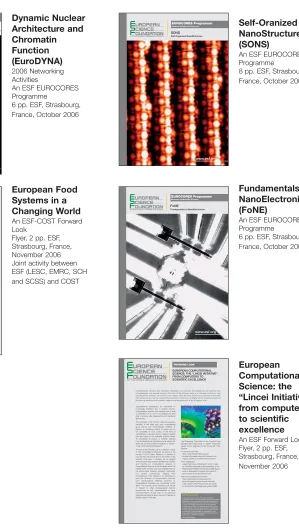
Dynamic Nuclear Architecture and Chromatin Function (EuroDYNA)
One of the major challenges in biology is to understand how the genome orchestrates gene expression of the many thousand genes it encodes. To tackle this issue, the ESF together with national funding agencies from eight European countries have set the stage for 40 research groups to coordinate their efforts across Europe within the framework of the European Collaborative Research (EUROCORES) Programme EuroDYNA.
EuroDYNA aims at advancing our knowledge of the control of gene expression in nuclear organisation. To do this the programme gathers and combines expertise in different fields such as dynamic chromatin structure and nuclear architecture, regulation of gene expression, RNA processing and transport as well as genome surveillance. Latest technologies in molecular biology and biochemistry are employed together with advanced microscopy, structural analysis and computational approaches in order to gain a deeper insight into how the nucleus operates. Detailed knowledge on the principles and mechanisms underlying the control of gene expression is vital for understanding the cause of many diseases and for developing rational procedures for genomic engineering, including gene therapy and stem cell engineering, and for many biotechnology applications.
There are nine Collaborative Research Projects (CRPs) under the umbrella of EuroDYNA which started their research in 2005. In addition to its multidisciplinary character, the programme offers a wide range of networking opportunities to the entire EuroDYNA community; providing training possibilities and establishing a platform to stimulate new research initiatives between scientists with related yet slightly different scientific interests, and to promote collaboration with other national and European initiatives.
More information: www.esf.org/eurodyna
Ecosystem Functioning and Biodiversity in the Deep Sea (EuroDEEP)
The deep sea is the largest environment on the planet, the least well known and one of the least studied. It contains extremely large, continuous habitats such as the millions of km2 of abyssal
plains and the 65,000 km long mid-oceanic ridge system. At the same time, it encloses relatively small (hundreds of km2to only a few m2), localised
The launch of this multidisciplinary EuroDEEP Programme is foreseen in June 2007 aiming at the exploration and identification of the different deep-sea habitats, assessing both the abiotic and biotic processes that sustain and maintain deep-sea communities in order to interpret variations of biodiversity within and between deep-sea habitats and the interactions of the biota with the ecosystems in which they live. The resulting scientific data are a prerequisite for the sustainable use and the development of management and conservation options aiming at the sustainable use of marine resources that will benefit society as a whole.
EuroDEEP is a Programme for deep-sea biology and ecology that strongly depends and requires collaboration between taxonomists, microbiologists, ecologists, physical and chemical oceanographers and geologists.
More information: www.esf.org/eurodeep
European Mineral Sciences Initiative (EuroMinScI)
Joint activity with PESC
The chemistry of the crust/mantle/core depends on elements partitioning between minerals, and phenomena, such as plasticity or super-elasticity in minerals, could have a direct impact on large scale geological processes. Major advances in the use of physics-based experimental techniques and atomistic computer simulation now make it possible to understand the relation between the structure of minerals and their physical properties. At the same time, measurements of many minerals properties in situ at extreme conditions of temperature and pressure corresponding to those existing in the earth’s interior are now feasible.
EuroMinScI draws together different experimental techniques and computational activities into integrated research projects. Sometimes it calls for separate “computer experiments” while at other
times computer simulation is needed even to interpret the experimental data uniquely. It also addresses the need for young researchers with an academic background in Earth sciences to be trained more in the physics-based techniques, where the methods are very different from traditional Earth sciences.
More information: www.esf.org/eurominsci
Processes in the Passive Continental Margins (EUROMARGINS)
The nations of Europe share one of the world's longest passive margin systems and one of the most distinctive morphological features of the world's ocean basins. A remaining frontier for natural resources, passive margins mark the complex transition between continental and oceanic crust, with large sedimentary accumulations. In addition, passive continental margins, associated with unstable slopes, represent a major source of natural hazards, especially to the coastal communities of Europe. The EUROMARGINS Programme provides the international framework for promoting innovative, interdisciplinary work for the imaging, monitoring, reconstruction and modelling of the physical, chemical, and biological processes in the European passive continental margins. It encourages the development of new technologies and conceptual models aiming at the advancement of integrated research into the mechanisms responsible for continental break-up and the world ocean margin formation. The pooling of human resources, training of a new generation of interdisciplinary geoscientists, and optimal sharing of observational platforms or analytical and modelling facilities are considered important value-added ingredients of the EUROMARGINS Programme.
More information: www.esf.org/euromargins
Quality Control of Gene Expression – RNA Surveillance (RNAQuality)
This EUROCORES Programme is intended to promote European collaborative research projects that aim to uncover processes that act as quality control checkpoints in gene expression and understand how these function at the molecular level.