Review Article
Dietary fat and cholesterol and risk of diabetes in older adults
Ahmad Alqadheb
1*, Noor Alsalman
2, Alaa Noor Elahi
3, Mohammed Alobaidan
4, Sarah Shams
5,
Moeid Alharthi
6, Ghadeer Banjar
7, Reham Alasiri
8, Rzaz Yamani
9, Rana Al-Rasheed
10INTRODUCTION
Type 2 diabetes is a major global public health issue, and the rapid increase in prevalence over the past decades is expected to continue.1 estimated to affect 350 million people by 2030.2 Distinguishing modifiable elements, for example, dietary components, that can impact the risk of type 2 diabetes could be essential for lessening the illness burden. Dietary factors, for example, eggs intake can impact the danger of creating type 2 diabetes. Eggs are
rich in dietary cholesterol and protein, and prospective examinations have discovered positive relationship of protein and cholesterol consumption with type 2 diabetes hazard.3,4
Egg is additionally a rich source of numerous possibly advantageous dietary segments, for example, minerals, vitamins, and carotenoids. Regardless of determined efforts to decrease risk factors between diabetic patients, 65% of people with diabetes mellitus will die of
ABSTRACT
Type 2 diabetes is a major global public health issue, and the rapid increase in prevalence over the past decades is expected to continue. The present analysis aimed to investigate the relation between egg consumption and type 2 diabetes risk in older adults. We conducted this meta-analysis using a comprehensive search of MEDLINE, PubMed, EMBASE, Cochrane Database of Systematic Reviews, and Cochrane Central Register of Controlled Trials till 01 February 2018 for prospective observational studies that assessed the relationship of the dietary fat and cholesterol and risk of diabetes in older adults. We identified 15 prospective studies that could be included in the meta-analysis. When comparing the highest with the lowest category of egg intake, pooled multivariate RRs of incident diabetes mellitus were 1.25 (95% CI: 1.13, 1.44) using a fixed-effect model and 1.12 (95% CI: 1.01, 1.56) using a random-effect model. There was evidence for heterogeneity (I2=75.8%, p<0.001). Our meta-analysis shows no relation between infrequent egg consumption and diabetes mellitus risk but suggests a modest elevated risk of diabetes mellitus with ≥3 eggs/wk that is restricted to US studies.
Keywords: Dietary fat, Cholesterol, Diabetes, Meta-analysis, Eggs
1Department of Family Medicine, Security Forces Hospital, Riyadh, KSA 2
Almaarefa Colleges, Riyadh, KSA
3Alamal Complex, Jeddah, KSA
4Prince Saud Bin Jalawi Hospital, Alhasa, KSA 5East Jeddah Hospital, Jeddah, KSA
6
King Abdullaziz University, Jeddah, KSA
7Primary Health Care Ministry of Health, Jeddah, KSA Makkah,
8Primary Health Care Centre, King Abdullah Medical Complex, Jeddah, KSA 9Primary Health Care Ministry of Health, Makkah, KSA
10
King Fahd Medical Research Centre, King Abdul-Aziz University, Jeddah, KSA
Received: 07 May 2018
Accepted: 25 May 2018
*Correspondence:
Dr. Ahmad Alqadheb,
E-mail: [email protected]
Copyright: © the author(s), publisher and licensee Medip Academy. This is an open-access article distributed under the terms of the Creative Commons Attribution Non-Commercial License, which permits unrestricted non-commercial use, distribution, and reproduction in any medium, provided the original work is properly cited.
cardiovascular disease.5 Stroke and coronary artery disease are the primary sources of death and for which elevated LDL cholesterol is a major factor.6
Epidemiological evidence for an association between egg consumption and risk of type 2 diabetes is inconsistent. Thus, we conducted this meta-analysis of presently obtainable prospective cohort studies to evaluate the relation of egg consumption and risk of type 2 diabetes.
METHODS
Data sources and searches
We conducted this meta-analysis using a comprehensive search of MEDLINE, PubMed, EMBASE, Cochrane Database of Systematic Reviews, and Cochrane Central Register of Controlled Trials till 01 February 2018 for prospective observational studies that assessed the relationship of the dietary fat and cholesterol and risk of diabetes in older adults. Both semi parametric and parametric methods were used. No language restrictions were imposed. We followed the standard guidelines for conducting and reporting meta-analyses of observational studies.7
Selection criteria
Studies were included in this meta-analysis if they satisfied the following criteria: the study design was prospective, the exposure of interest was dietary fat and cholesterol and risk of diabetes, the outcome was diabetes mellitus, and the investigators reported relative risks (RRs) with 95% CI. If study populations were reported more than once, we used the result with the longest follow-up duration. Flow diagram showing the selection criteria of assessed studies.8
Data extraction
Two reviewers independently reviewed studies, abstracted data, and resolved disagreements by consensus. Studies were evaluated for quality. A review protocol was followed throughout. We extracted the following data from each study: year of publication, authors, study location, study name, years of follow-up, sample size (number of participants and incident cases), and relative risk (95% confidence interval).
Statistical analysis
The present meta-analysis utilized Stata version 12.0 software for statistical analysis. Mean Difference (MD) were calculated for continuous variables. Pooled odds ratios (OR) were calculated for discrete variables. Heterogeneity amongst the trials was determined by means of the Cochran Q value and quantified using the I2 inconsistency test with a significance set at the p value <0.10 or I2 score >50%.9 For studies that stratified analyses by gender, we considered each gender as an
independent study. Whenever it was possible, results were evaluated either considering all the included studies or considering only the randomized trials. Random-effects model were calculated using summary relative risks of egg consumption for patients with diabetes compared with patients without diabetes.10 Fitted cubic splines with knots at the 5th, 35th, 65th, and 95th percentile of egg distribution (corresponding to 0, 1, 2.7, and 8.6 eggs/wk). Flow diagram showing the selection criteria of assessed studies.11
RESULTS
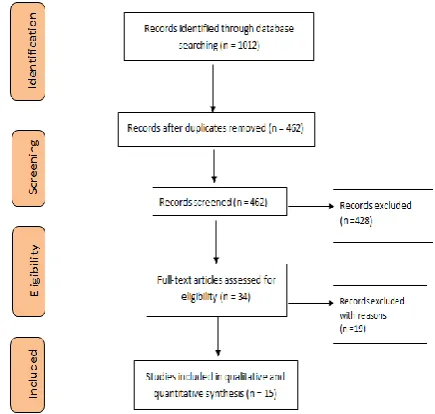
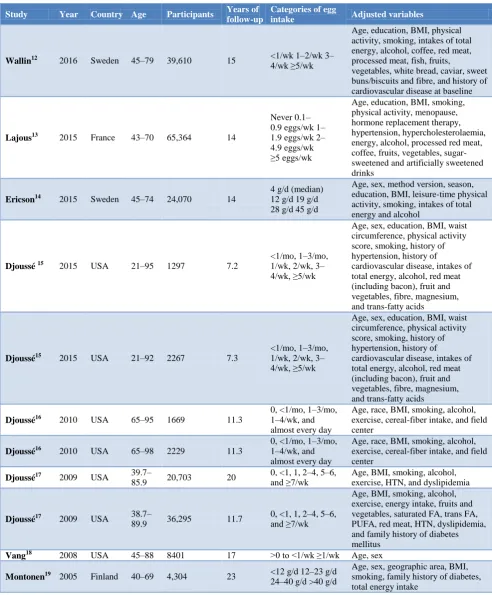
We recognized 1012 citations using the search strategy. Of these, we excluded 462 after examining the title and abstract including removal of duplicates. We retrieved and evaluated 34 articles in more detail, of which 19 articles were excluded, leaving 15 studies that were eligible for inclusion (Figure 1). Major characteristics of included studies have been summarized in Table 1.
Figure 1: Flow diagram showing the selection criteria of assessed studies.11
Seven studies were conducted in the United States, two in Sweden, two in Finland, two in Japan and one each in Spain and France.
using the fixed-effect model, p<0.001 when comparing US with non-US studies). There was evidence for heterogeneity (I2=75.8%, p<0.001). When stratified by geographic area, there was a 39% higher risk of diabetes mellitus (95% CI: 21%, 60%) comparing highest with lowest egg consumption in US studies (I2=44.3%, p=0.087) and no elevated risk of diabetes mellitus with
egg intake in non-US studies (RR=1.05; 95% CI: 0.94, 1.22 using the fixed-effect model, p<0.001 comparing US with non-US studies). In a dose-response assessment using cubic splines, elevated risk of diabetes mellitus was observed in US studies among people consuming ≥3 eggs/wk but not in non-US studies.
Table 1: Characteristics of included studies.
Study Year Country Age Participants Years of follow-up
Categories of egg
intake Adjusted variables
Wallin12 2016 Sweden 45–79 39,610 15 <1/wk 1–2/wk 3–4/wk ≥5/wk
Age, education, BMI, physical activity, smoking, intakes of total energy, alcohol, coffee, red meat, processed meat, fish, fruits,
vegetables, white bread, caviar, sweet buns/biscuits and fibre, and history of cardiovascular disease at baseline
Lajous13 2015 France 43–70 65,364 14
Never 0.1– 0.9 eggs/wk 1– 1.9 eggs/wk 2– 4.9 eggs/wk ≥5 eggs/wk
Age, education, BMI, smoking, physical activity, menopause, hormone replacement therapy, hypertension, hypercholesterolaemia, energy, alcohol, processed red meat, coffee, fruits, vegetables, sugar-sweetened and artificially sugar-sweetened drinks
Ericson14 2015 Sweden 45–74 24,070 14
4 g/d (median) 12 g/d 19 g/d 28 g/d 45 g/d
Age, sex, method version, season, education, BMI, leisure-time physical activity, smoking, intakes of total energy and alcohol
Djoussé 15 2015 USA 21–95 1297 7.2
<1/mo, 1–3/mo, 1/wk, 2/wk, 3– 4/wk, ≥5/wk
Age, sex, education, BMI, waist circumference, physical activity score, smoking, history of hypertension, history of
cardiovascular disease, intakes of total energy, alcohol, red meat (including bacon), fruit and vegetables, fibre, magnesium, and trans-fatty acids
Djoussé15 2015 USA 21–92 2267 7.3
<1/mo, 1–3/mo, 1/wk, 2/wk, 3– 4/wk, ≥5/wk
Age, sex, education, BMI, waist circumference, physical activity score, smoking, history of hypertension, history of
cardiovascular disease, intakes of total energy, alcohol, red meat (including bacon), fruit and vegetables, fibre, magnesium, and trans-fatty acids
Djoussé16 2010 USA 65–95 1669 11.3
0, <1/mo, 1–3/mo, 1–4/wk, and almost every day
Age, race, BMI, smoking, alcohol, exercise, cereal-fiber intake, and field center
Djoussé16 2010 USA 65–98 2229 11.3
0, <1/mo, 1–3/mo, 1–4/wk, and almost every day
Age, race, BMI, smoking, alcohol, exercise, cereal-fiber intake, and field center
Djoussé17 2009 USA 39.7–
85.9 20,703 20
0, <1, 1, 2–4, 5–6, and ≥7/wk
Age, BMI, smoking, alcohol, exercise, HTN, and dyslipidemia
Djoussé17 2009 USA 38.7–
89.9 36,295 11.7
0, <1, 1, 2–4, 5–6, and ≥7/wk
Age, BMI, smoking, alcohol, exercise, energy intake, fruits and vegetables, saturated FA, trans FA, PUFA, red meat, HTN, dyslipidemia, and family history of diabetes mellitus
Vang18 2008 USA 45–88 8401 17 >0 to <1/wk ≥1/wk Age, sex
Montonen19 2005 Finland 40–69 4,304 23 <12 g/d 12–23 g/d 24–40 g/d >40 g/d
Study Year Country Age Participants Years of follow-up
Categories of egg
intake Adjusted variables
Virtanen20 2015 Finland 42–60 2332 19.3 <14 g/d 14–26 g/d 26–45 g/d >45 g/d
Age, examination year, education, family history of type 2 diabetes, BMI, leisure-time physical activity, smoking, hypertension, serum long-chain n-3 PUFAs, and intakes of total energy, alcohol, linoleic acid, fibre, fruit, berries, and vegetables
Kurotani21 2014 Japan 45–75 27,248 5 11, 21, 33, and 64 g/d
Age, BMI, smoking, alcohol, physical activity, energy, dietary variables, public health center area, HTN, and family history of diabetes mellitus
Kurotani21 2014 Japan 45–75 36,218 5 10, 19, 29, and 56 g/d
Age, BMI, smoking, alcohol, physical activity, energy, dietary variables, public health center area, HTN, and family history of diabetes mellitus
Zazpe22 2013 Spain 20–90 15,956 6.6 <1, 1, 2–4, and >4/wk
Age, sex, BMI, smoking, alcohol, exercise, adherence to Mediterranean food pattern, energy intake, CVD, HTN, dyslipidemia, and family history of diabetes mellitus
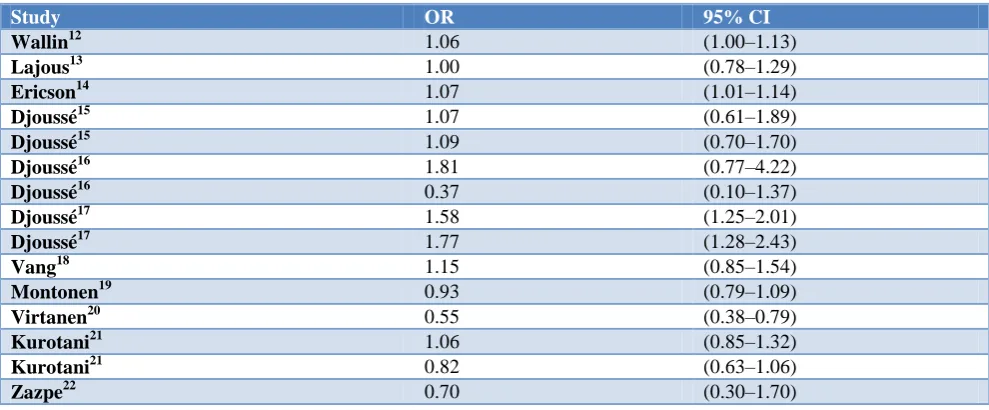
Table 2: Relationship of egg consumption with diabetes risk.
Study OR 95% CI
Wallin12 1.06 (1.00–1.13)
Lajous13 1.00 (0.78–1.29)
Ericson14 1.07 (1.01–1.14)
Djoussé15 1.07 (0.61–1.89)
Djoussé15 1.09 (0.70–1.70)
Djoussé16 1.81 (0.77–4.22)
Djoussé16 0.37 (0.10–1.37)
Djoussé17 1.58 (1.25–2.01)
Djoussé17 1.77 (1.28–2.43)
Vang18 1.15 (0.85–1.54)
Montonen19 0.93 (0.79–1.09)
Virtanen20 0.55 (0.38–0.79)
Kurotani21 1.06 (0.85–1.32)
Kurotani21 0.82 (0.63–1.06)
Zazpe22 0.70 (0.30–1.70)
DISCUSSION
In the present meta-analysis of 15 prospective cohort studies, we found that consumption of <4 eggs/wk was not linked with the risk of diabetes mellitus. Nevertheless, a stratified analysis presented a higher risk of diabetes mellitus with consumption of ≥3 eggs/wk between US studies but no eminent risk between non-US studies (P-difference <0.001). There was no indication of publication bias or influential study. Notwithstanding the set number of distributed examinations on egg utilization with diabetes mellitus hazard, this meta-analysis gives vital data on the dosage reaction connection. To start with, our outcomes are reliable with no raised danger of diabetes mellitus with rare egg utilization, paying little
A few studies have recommended that trimethylamine-N-oxide (TMAO) a metabolite of choline found in eggs along with seafood could support to clarify the positive association of eggs with DM.23 Another study presented a positive relationship between egg intake and TMAO concentration.24 It is possible that TMAO increases LDL oxidation and endorses inflammation, thus leading to an intensified risk of DM.25 Nevertheless, specified the limited amount of TMAO produced from eggs when compared with other sources, it is more averse to be the capable intermediary. The absence of prospective investigations of TMAO and DM hazard keeps us from affirming earlier guess on the connection of TMAO with DM. Furthermore, few of the examinations meta-analysis balanced for pertinent dietary components or dietary examples to additionally clarify this issue. This recommends impenetrable by dietary examples remains a feasible and likely clarification of the perceived positive connection of ≥3 eggs/wk with DM hazard in US studies. It is vital for future investigations to represent general dietary examples as well as nutrients consumed with by eggs that may increase the danger of DM to additionally clarify this subject.
Limitations of the present meta-analysis comprise the observational nature of studies pooled that cannot exclude unmeasured or residual confounding as a partial or complete source of explanation for observed results. Furthermore, it was impossible to capture all forms of egg consumption or method of preparation in most studies. Self-reported egg consumption could have led to misclassification of egg consumption.
CONCLUSION
The present meta-analysis presented no relation between infrequent egg consumption and diabetes risk, however, recommends a diffident elevated risk of diabetes with consumption of ≥3 eggs/wk. Egg consumption traditions and related overall dietary patterns might vary among populaces and might possibly clarify inconsistencies among the described results. To confirm these results, further studies should be made to make a better understanding of the potential biological mechanisms. Large-scale and long-term randomized controlled trials in various populations must be carried out in future studies to deliver more significant evidence.
Funding: No funding sources Conflict of interest: None declared Ethical approval: Not required
REFERENCES
1. Whiting DR, Guariguata L, Weil C, Shaw J. IDF diabetes atlas: global estimates of the prevalence of diabetes for 2011 and 2030. Diabetes Res Clin Pract. 2011;94:311–21.
2. Wild S, Roglic G, Green A, Sicree R, King H. Global prevalence of diabetes: estimates for the year
2000 and projections for 2030. Diabetes Care 2004;27:1047–53.
3. Ericson U, Sonestedt E, Gullberg B, Hellstrand S, Hindy G, Wirfält E, et al. High intakes of protein and processed meat associate with increased incidence of type 2 diabetes. Br J Nutr. 2013;109:1143–53.
4. Salmeron J, Hu FB, Manson JE, Stampfer MJ, Colditz GA, Rimm EB, et al. Dietary fat intake and risk of type 2 diabetes in women. Am J Clin Nutr. 2001;73:1019–26.
5. Mozaffarian D, Benjamin EJ, Go AS, Arnett DK, Blaha MJ, Cushman M, de Ferranti S, et al. Heart disease and stroke statistics—2015 update: a report from the American Heart Association. Circulation 2015;131:e29–322.
6. National Cholesterol Education Program (NCEP) Expert Panel on Detection. Third Report of the National Cholesterol Education Program (NCEP) Expert Panel on Detection, Evaluation, and Treatment of High Blood Cholesterol in Adults (Adult Treatment Panel III) final report. Circulation. 2002;106:3143–21.
7. Stroup DF, Berlin JA, Morton SC, , Olkin I, Williamson GD, Rennie D, et al. Meta-analysis of observational studies in epidemiology: a proposal for reporting. Meta-analysis Of Observational Studies in Epidemiology (MOOSE) group. JAMA 2000;283:2008–12.
8. Moher D, Liberati A, Tetzlaff J, Altman DG. Preferred reporting items for systematic reviews and meta-analyses: the PRISMA statement 2007. 9. Higgins JP, Thompson SG, Deeks JJ. Altman DG.
Measuring inconsistency in meta-analyses 2008. 10. DerSimonian R, Laird N. Meta-analysis in clinical
trials. Controlled Clinical Trials. 1986;7(3):177-88. 11. Moher D, Liberati A, Tetzlaff J, Altman DG.
Preferred reporting items for systematic reviews and meta-analyses: the PRISMA statement 2007. 12. Wallin A, Forouhi NG, Wolk A, Larsson SC. Egg
consumption and risk of type 2 diabetes: a prospective study and dose–response meta-analysis. Diabetologia. 2016;59:1204-13.
13. Lajous M, Bijon A, Fagherazzi G, Balkau B, Boutron-Ruault MC, Clavel-Chapelon F. Egg and cholesterol intake and incident type 2 diabetes among French women. Br J Nutr. 2015;114:1667– 73.
14. Ericson U, Hellstrand S, Brunkwall L, Schulz CA, Sonestedt E, Wallström P, et al. Food sources of fat may clarify the inconsistent role of dietary fat intake for incidence of type 2 diabetes. Am J Clin Nutr. 2015;101:1065–80.
15. Djoussé L, Petrone AB, Hickson DA, Talegawkar SA, Dubbert PM, Taylor H, et al. Egg consumption and risk of type 2 diabetes among African-Americans: The Jackson Heart Study. Clin Nutr. 2016;35(3):679-84.
and risk of type 2 diabetes in older adults. Am J Clin Nutr. 2010;92:422–7.
17. Djoussé L, Gaziano JM, Buring JE, Lee IM. Egg consumption and risk of type 2 diabetes in men and women. Diabetes Care. 2009;32:295–300.
18. Vang A, Singh PN, Lee JW, Haddad EH, Brinegar CH. Meats, processed meats, obesity, weight gain and occurrence of diabetes among adults: findings from Adventist Health Studies. Ann Nutr Metab. 2008;52:96–104.
19. Montonen J, Jarvinen R, Heliovaara M, Reunanen A, Aromaa A, Knekt P. Food consumption and the incidence of type 2 diabetes mellitus. Eur J Clin Nutr. 2005;59:441–8.
20. Virtanen JK, Mursu J, Tuomainen TP, Virtanen HE, Voutilainen S. Egg consumption and risk of incident type 2 diabetes in men: the Kuopio Ischaemic Heart Disease Risk Factor Study. Am J Clin Nutr. 2015;101:1088–96.
21. Kurotani K, Nanri A, Goto A, Mizoue T, Noda M, Oba S, et al. Cholesterol and egg intakes and the risk of type 2 diabetes: The Japan Public Health Center-based Prospective Study. Br J Nutr. 2014;112:1636–43.
22. Zazpe I, Beunza JJ, Bes-Rastrollo M, Basterra-Gortari FJ, Mari-Sanchis A, Martinez-Gonzalez MA. Egg consumption and risk of type 2 diabetes in a Mediterranean cohort; the sun project. Nutr Hosp. 2013;28:105–11.
23. Zeisel SH, Mar MH, Howe JC, Holden JM. Concentrations of choline-containing compounds and betaine in common foods. J Nutr 2003;133:1302–7.
24. Tang WH, Wang Z, Levison BS, Koeth RA, Britt EB, Fu X, et al. Intestinal microbial metabolism of phosphatidylcholine and cardiovascular risk. N Engl J Med. 2013;368:1575–84.
25. Julia C, Czernichow S, Charnaux N, Ahluwalia N, Andreeva V, Touvier M, et al. Relationships between adipokines, biomarkers of endothelial function and inflammation and risk of type 2 diabetes. Diabetes Res Clin Pract. 2014;105:231–8.