Original Research Article
Prevalence of overweight and obesity among medical
college students, Bengaluru
Kishore S. Gudegowda, Subathra Vengatesan*, Ranganath T. Sobagiah
INTRODUCTION
Overweight and obesity are recognized as an "escalating epidemic" affecting both developed and developing countries.1 Many low- and middle-income countries are now facing a "double burden" of disease. Globally there are more people who are obese than underweight – this occurs in every region except parts of sub-Saharan Africa and Asia.2 Obesity is perhaps the most prevalent form of malnutrition.3 In 2014, more than 1.9 billion (39%) adults, 18 years and older, were overweight. Of these over 600 million (13%) were obese. Overall, about 13%
of the world’s adult population was obese in 2014. Worldwide obesity has more than doubled since 1980. Overweight and obesity are linked to more deaths worldwide than underweight.2 Overweight and obesity are the fifth leading risk factors for global death.4 Worldwide, at least 2.8 million people die each year and an estimated 35.8 million (2.3%) of global DALYs are caused by overweight or obesity.5 Overweight and obesity has been recognized as public health problem
worldwide.6 Increasing trend of obesity among
adolescents is a worldwide phenomenon and considered as one of the major public health challenge of the 21st century.7
ABSTRACT
Background: Worldwide obesity has more than doubled since 1980. Stress is the major factor which contributes to
obesity. Medical education is highly stressful. Even though medical students should be extra conscious about overweight and obesity, its prevalence was found out to be high among them. So this study was done with the aim to estimate the prevalence of overweight and obesity among the Medical College students and also to assess the factors influencing it.
Methods: A cross-sectional study was conducted among second and third year medical students of Bangalore
Medical College and Research Institute, Bengaluru, from July- September 2014. Informed written consent was obtained from the study participants after explaining the purpose of study. Out of 494 students, 424 had willingly participated in the study. Data was collected using a pre-tested, semi-structured, self administered questionnaire. Anthropometric measurements were taken. Descriptive statistics was used to analyze the data.
Results: The prevalence of overweight and obesity were 14.6% and 11.3%. Overweight and obesity were more
observed in boys (9.7%, 6.8%) than girls (5%, 4.5%). 25.9% girls & 11.1% boys were considered to have central obesity. 74.5% overweight/obese often feel stress at time of exams and 56.0% among them eat more during exams.
Conclusions: The prevalence was found to be high among medical college students which were contributed by
various factors. This can be reduced by modifying their diet, engaging in regular physical activity.
Keywords: Obesity, Overweight, Prevalence, Stress, Medical students
Department of Community Medicine, Bangalore Medical College and Research Institute (BMCRI), Bengaluru, Karnataka, India
Received: 09 February 2018
Accepted: 06 March 2018
*Correspondence:
Dr. Subathra Vengatesan,
E-mail: [email protected]
Copyright: © the author(s), publisher and licensee Medip Academy. This is an open-access article distributed under
the terms of the Creative Commons Attribution Non-Commercial License, which permits unrestricted non-commercial use, distribution, and reproduction in any medium, provided the original work is properly cited.
Obesity is one of biggest challenges that Indians need to overcome because we are genetically predisposed to weight gain. The prevalence of overweight and obesity was 9.4% and 2.4% among Indians which was based on global body mass index (BMI) cut off values.8 India has been experiencing a nutritional transition in food choices from typical Indian diet into the fast- food pattern particularly affecting young adults which in turn results in development of overweight and obesity.5,9 Obesity in combination with unhealthy life style, such as smoking and physical inactivity, may increase the risk of chronic diseases.10 Overweight/obesity among college going students is an important issue as height by age is stabilized. This age group is very important to inculcate the importance of physical exercise and healthy eating.11 Obesity in adolescence is a significant risk factor for developing serious non-communicable diseases in adulthood such as cardiovascular diseases, diabetes mellitus, stroke, osteoarthritis, gall bladder diseases, cancers, psychosocial problems and increased risk of mortality.7 This affect the individual’s life expectancy and the national productivity on the long run.6 In India only little attention has been paid to childhood and adolescent obesity until recently.9
The causes of adult obesity include a variety of factors like diet, genetic predisposition, lack of physical activity and other behavioral factors.4 Stress is a very important factor which contributes to obesity because it lead to irregularity in diet, lack of exercise and addiction, each being considered as an independent factor leading to obesity. The professional students, including medical students are in a high risk when obesity is concerned. This is mainly because medical education is stressful. The amount of material to be absorbed, social isolation,
pressure of examination, discrepancies between
expectation and reality all can be anticipated to bring psychological stress.10 Apart from that due to the very demanding course and time schedules of the medical degree, medical students are known to be involved in less physical activity and more sedentary life style. This may be reflected in their BMI status.6 The social implications of obesity are a major problem area that is often neglected. The obese, do less well academically, have poorer job prospects and lower self-esteem.9
Since this obesity becomes an alarming sign it is necessary to prevent this by young adult based approaches like changes in life style and health education. Before starting a health education programme to our students we want to assess the burden of the problem in our Institution. Hence this study was carried out with the objectives of estimating the prevalence of overweight and obesity among the students of our Institution and assessing the factors influencing the development of obesity and overweight.
METHODS
A cross-sectional study was conducted among second and third year Medical students of Bangalore Medical College and Research Institute (BMCRI), Bengaluru, from July-September 2014. Informed written consent was obtained from the study participants after explaining the purpose of study and before collecting the information. Utmost care was taken to maintain privacy and confidentiality. Students were assured that results of this study will not have any impact on their academics. After explaining these details, out of 494 students, 424 had willingly participated in the study. Data was collected using a pre-tested, semi-structured, self-administered questionnaire which consisted of information regarding socio-demographic data and other variables such as diet, frequency of consumption of junk foods, mobile and computer usage, physical activity, family history of obesity, stress and eating pattern during exams. Anthropometric measurements such as height, weight, waist circumference was taken. BMI is the simple index of weight for height which provides the most useful measurement of overweight and obesity as it is the same for both sexes and for all ages of adults. So using the anthropometric measurements, BMI was calculated and graded according to WHO Asia-pacific guidelinesand it was used for further analysis regarding influence of various factors on body weight.12 The data collected was coded and entered in Microsoft Excel version 2007 and analyzed using SPSS version 17.0 software. Descriptive statistics was used for data analysis and the data was represented in the form of percentages, mean and standard deviation. The results were presented in the form of charts, tables, figures wherever necessary.
RESULTS
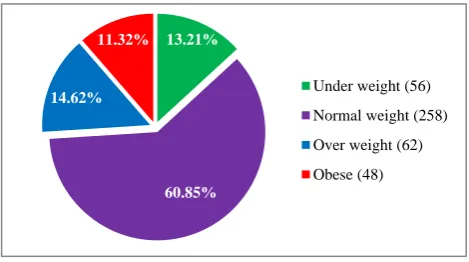
Out of the total 424 students studied, 62 (14.6%) were overweight and 48 (11.3%) were obese (Figure 1).
Figure 1: Prevalence of overweight and obesity according to BMI.
The mean age of the study participants were 20.47±0.74. Overweight [35 (8.3%)] and obesity [28 (6.6%)] were seen more among 21-22 years age group. Most of them were males [240 (56.6%)], overweight [41 (9.7%)] and
13.21%
60.85% 14.62%
11.32%
of them [400 (94.3%)] belongs to a nuclear family, overweight [58 (13.7%)] and obesity [46 (10.8%)] were seen more among them. 24 (5.7%) and 21 (5%) students who were overweight and obese did not do any physical exercises and most of them [282 (66.5%)] consume mixed diet among whom 44 (10.4%) were overweight and 33 (7.8%) were obese (Table 1). 125 out of 424
students had family history of obesity and 23 (37%) were overweight, 20 (41%) were obese among them (Table 2).
150 out of 424 students had used their mobile phones and computer for >20 hours/week among whom 30 (48.4%) were overweight and 28 (58.3%) were obese (Table 3).
Table 1: Distribution of socio-personal characteristics according to BMI (n=424).
Variable Category Subjects (%) Underweight (%) Normal (%) Overweight (%) Obese (%)
Age* 19-20 years 203 (47.9) 32 (07.5) 124 (29.3) 27 (06.4) 20 (04.7)
21-22 years 221 (52.1) 24 (05.7) 134 (31.5) 35 (08.3) 28 (06.6)
Sex Male 240 (56.6) 24 (05.7) 146 (34.4) 41 (09.7) 29 (06.8)
Female 184 (43.4) 32 (07.5) 112 (26.4) 21 (05.0) 19 (04.5)
Type of family Nuclear 400 (94.3) 50 (11.8) 246 (58.0) 58 (13.7) 46 (10.8)
Joint 024 (05.7) 06 (01.5) 012 (02.8) 04 (00.9) 02 (00.5)
Physical exercise
Yes 299 (70.5) 44 (10.4) 190 (44.7) 38 (09.0) 27 (06.4)
No 125 (29.5) 12 (02.8) 068 (16.0) 24 (05.7) 21 (05.0)
Type of diet Vegetarian 142 (33.5) 14 (03.3) 095 (22.4) 18 (04.3) 15 (03.5)
Mixed 282 (66.5) 42 (9.9) 163 (38.4) 44 (10.4) 33 (7.8)
*AGE: Mean age of the study participants (Years±SD)= 20.47±0.74
Table 2: Family history of obesity and BMI.
Variable Under-weight Normal weight Over weight Obese Total
History of obesity in
Family 12 (21%) 70 (27%) 23 (37%) 20 (41%) 125
Table 3: BMI and duration of mobile and computer (in hrs/week).
BMI <20 (%) >20 (%)
Under weight (56) 032 (57.1) 024 (42.9)
Normal (258) 190 (73.6) 068 (26.4)
Over weight (62) 032 (51.6) 030 (48.4)
Obese (48) 020 (41.7) 028 (58.3)
Total (n=424) 274 150
Table 4: BMI and eating pattern (n=424).
Category Eat snacks between meal (%) Eat pizza in a week (%) Eat chats in week (%)
Under weight (56) 036 (64.3) 024 (42.9) 030 (53.6)
Normal weight (258) 170 (65.9) 141 (54.7) 160 (62.0)
Over weight (62) 045 (72.6) 038 (61.3) 044 (70.9)
Obese (48) 040 (83.3) 029 (60.4) 036 (75.0)
Among 62 students who were overweight, 45 (72.6%) ate snacks between meal, 38 (61.3%) ate pizza in a week and 44 (70.9%) ate chats in a week whereas among 48 students who were obese, 40 (83.3%) ate snacks between meal, 29 (60.4%) ate pizza in a week and 36 (75.0%) ate chats in a week (Table 4). Among those 291 students who ate snacks between meals, most of them prefer to eat chats [67 (23%)], chocolates [58 (20%)] and ice-cream [55 (19%)] (Figure 2).
74.5% of overweight/obese often feel stress during exam time and 56.0% among them eat more during exams (Figure 3).
Figure 2: Preference of snacks.
Figure 3: Comparison between stress and eating pattern among overweight/obese.
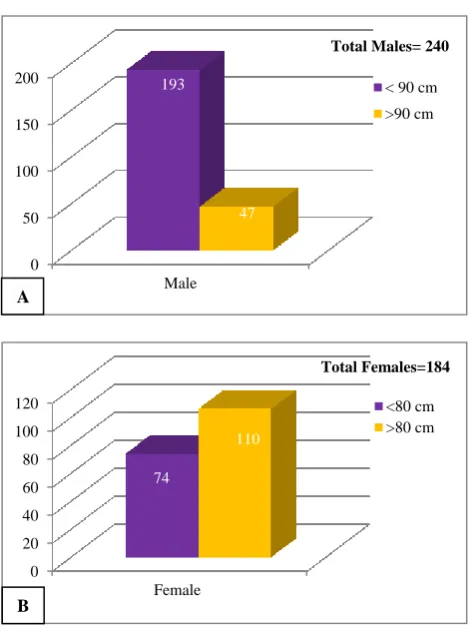
Figure 4 (A and B): Waist circumference of study
DISCUSSION
In the present study, we found that the prevalence of overweight and obesity was 14.62% and 11.32% among
the medical students. These findings regarding
prevalence are in accordance with the findings found on other studies done among medical students by Adhikari et al in Kolkata in 2014 which showed the prevalence of overweight and obese to be 18% and 2%, by Manojan KK et al in Kerala in 2013 showed the prevalence to be 24.57% and 25.71% and by Gupta et al in Paschim Medinipur in 2007 showed the prevalence to be 17.5% and3.4% respectively.8,10,13 These all studies were based on WHO Asia-Pacific guidelines.
In this study, we observed that out of the total prevalence of 26%, 14.9% were among the students aged 21-22 years which was comparatively more than the prevalence (11.1%) seen among the students aged 19-20 years. Similar trend was elicited in a study conducted by Varadappa et al in Bangalore among 15-19 year old students where the prevalence was higher in the age group of 17-19 years compared to the students in 15-16 years age group.7 This could be due to the fact that, in the later part of adolescence, the chance of obesity increases due to high burden of college work and academic competitiveness, which decreases the participation in sports and other forms of physical activities. This trend shows that obesity in later part of adolescence may pass on to adulthood and can cause serious metabolic derangement and cardiovascular diseases leading to premature death.
In this study, out of the total 424 students studied 240 (56.6%) were males and 184 (43.4%) were females thus constituting male: female ratio to be 1.3:1. Out of the total prevalence, 16.5% were males which was comparatively higher than the females (9.5%). Similar findings were reported by Adhikari et al and Gupta et al.10,13 This could be due to the reason that males were proportionately higher than the females in the study group.
In the present study, 24.5% who were overweight/obese belong to nuclear family and out of the total 424 students, 125 students had family history of obesity among whom 37% were overweight and 41% were obese. Among those who did not have family history of obesity, only 13% and 9.4% developed overweight and obesity. This finding is in agreement with other studies done by Varadappa et al, Tiwari et al and Adhikari et al.7,4,10 This shows that family history of obesity is a strong factor which influences the development of overweight and obesity among adolescents which could be due to the dominant genes involved. So it can be used as a screening tool for the identification of high risk adolescents for obesity.
In the present study, we found that 5.7% and 5% of students who were overweight and obese did not do any 23%
12%
19% 20%
2% 8%
14% 2%
Chats (67) Aerated drinks (35) Ice Cream (55) Chocolates (58) Condiments (6) Sweets (23) Fruits (41) others (6)
Total=291
0% 10% 20% 30% 40% 50% 60% 70% 80% 90% 100%
Feel stressed during exams
Eat more during exams
74.50% 56.00%
25.50%
44.00%
No Yes
N=424
0 50 100 150 200
Male 193
47
< 90 cm >90 cm
Total Males= 240
0 20 40 60 80 100 120
Female 74
110
<80 cm >80 cm
Total Females=184 A
done by Adhikari et al, Padmasree et al, Selvaraj et al and Gupta et al, the students were not doing any exercises apart from their routine sedentary day to day activities.1,9,10,13 Rest of the students also did only some sort of exercises. Sedentary behavior and physical activity may be predictive of body mass in later life. Researchers have reported that addition of exercise to dietary restriction can promote greater reduction in weight than change in diet alone.13 So at the college level, compulsory physical exercise in the form of jogging, gymnasium, aerobics should be undertaken. The students should be counseled and encouraged to undertake such activities.
The present study revealed that out of the total prevalence of overweight/obesity, 18.2% of students consumed mixed diet. Similarly in a study done by Padmasree et al in 2012 in Andhra Pradesh showed that more number of overweight and obese students consumed mixed diet.1 We also observed the eating pattern in our study which showed that 72.6% and 83.3% among overweight and obese individuals ate snacks between meals, 61.3% and 60.4% ate pizza in a week, 70.9% and 75.0% ate chats in a week and among those students who ate snacks, majority of them i.e. 23%, 20% and 19% had preferred chats, chocolates and ice-creams. Thus, this study revealed the unhealthy dietary habits and life style of medical students, who represent a significant community of future health practitioners. Similarly the other studies done by Manojan et al, Fernandez et al and Padmasree et al showed that the students who were obese consumed more junk foods, fried snacks.1,8,11 This may be due to the busy schedule of college hours with less time for lunch/breakfast which predisposes them to these habits. But these junk foods contain more amount of fat than carbohydrate and protein which finally results in obesity or overweight. Diet and lifestyle have a great influence on overweight and obesity. So these students should be educated and counseled on life-style and diet modification.
In this study, we found that among those students (150) who had used their mobile phones and computer for >20
hours/week, 48.4% and 58.3% were overweight and
obese. In this study, 74.5% of overweight/obese often feel stress during exam time and 56.0% among them eat more during exam. Similarly the other studies done by Adhikari et al and Gupta et al showed that the students had stress.10,13 Medical students have to pass through different stressful situation, which in turn contributes physical as well as psychological problem including overweight and obesity. Taking care of stress precipitating factors could improve the health of the medical students.
This study showed that 70% of females had central obesity which was comparatively higher than males (30%) according to the waist circumference. Similar findings were reported by Varadappa et al and Selvaraj et al.7,9 This could be due to gender related genetic
predisposition to the accumulation of visceral fat. But this central obesity is considered as a significant causative factor in the development of metabolic syndrome and cardiovascular diseases.
Limitations
First, the sample used in this study was a convenient sample and thus findings need to be interpreted with caution. Second, self-reported weight is likely to be an underestimation in the overweight and an overestimation in the underweight sample.
CONCLUSION
The prevalence of overweight and obesity among medical students was nearly one-fourth of the study population which tends to be high. This should be an alert signal because medical students are the future doctors, health leaders and role models to the community.Therefore it is of utmost importance to have early intervention programmes to prevent non-communicable diseases
among these future doctors. Necessary health
promotional activities are suggested to adopt healthy life style including regular physical exercises from young adulthood itself as these medical students are pillars of future Nation. BMI, waist circumferences were useful reliable indicators for regular screening of overweight and obesity which is a valuable approach in obesity prevention and development of complications.
ACKNOWLEDGEMENTS
We express our sincere and heart full gratitude to the opportunity and support provided by Director cum Dean, Bangalore Medical College & Research Institute, Bengaluru. We are extremely thankful for the support provided by the other faculties and Post-graduates of
Department of Community Medicine, BMCRI,
Bengaluru.Last but the most we thank all the students of second and third year MBBS, BMCRI, Bengaluru for their cooperation without whom this study would not be possible.
Funding: No funding sources Conflict of interest: None declared
Ethical approval: The study was approved by the Institutional Ethics Committee
REFERENCES
1. Padmasree D, UUU. Influence of Certain Factors on
Overweight and Obesity among Undergraduate Medical Students at Vizianagaram. Int J Recent Trends Sci Tech. 2012;5(1):38-42.
2. World Health Organization. Obesity and
3. Park K. Park’s textbook of preventive and social medicine. 23rd ed. Jabalpur: Banarasidas Bhanot Publishers; 2015. Chapter 6, Epidemiology of chronic non-communicable diseases and conditions; 2015: 397.
4. Tiwari R, Jain V, Rajput AS, Bhagwat AK, Goyal M, Tiwari S. A study to assess prevalence of obesity among medical students of G.R. medical college, Gwalior, M.P, India. Int J Res Med Sci. 2014;2(4):1412-6.
5. Narahari P, Rao PNS, Sharma N, Navukkarasu S, Navaneeth A, Prakash MO, et al. Predictors of overweight and obesity among medical students. Int J Scientific Res Public. 2014;4(12):1-5.
6. Amatya M, Khanal B, Yadav SR. Body Mass Index
of Nepalese medical students: a cross-sectional study. IJDR. 2014;4(3):746-8.
7. Varadappa TS, Prakash PKS, Gangaboraiah, Raju
RMN, Subbanna LY. Prevalence of obesity among college students in rural area of Bangalore. Natl J Community Med. 2014;5(1):42-5.
8. Manojan KK, Benny PV, Bindu A. Prevalence of obesity and overweight among medical students based on new Asia-Pacific BMI guideline. Int J Prevent Therap Med. 2014;2(1):1-3.
9. Selvaraj K, Sivaprakasam P. A Study on the
Prevalence of Overweight and Obesity among
Medical Students of Kanchipuram District. NJRCM. 2013;2(2):140-4.
10. Adhikari A, Dey I, Mandal NK. A Study on
Overweight & Obesity and its Risk Factors among Undergraduate Students of a Medical College in Kolkata. J Comprehensive Health. 2015;3(2):42-51. 11. Fernandez K, Singru SA, Kshirsagar M, Pathan Y. Study regarding overweight/obesity among medical students of a teaching hospital in Pune, India. Med J DY Patil Univ. 2014;7(3):279-83.
12. World Health Organization. The Asia-Pacific
perspective: redefining obesity and its treatment.
2000. Available at: http://www.wpro.who.int/
nutrition/documents/docs/Redefiningobesity.pdf. Accessed on 22 September 2016.
13. Gupta S, Ray TG, Saha I. Overweight, Obesity and
Influence of Stress on Body Weight among
Undergraduate Medical Students. Indian J
Community Med. 2009;34(3):255-7.
Cite this article as: Gudegowda KS, Vengatesan S,