16 |
P a g e
Peak-To-Average Power Ratio (PAPR) Reduction In OFDM
Systems Using Dummy Signal Hybrid SLM-PTS Technique
K. Mohan Krishna1, V. Sudharani2
1(Mtech. Dsce, Sreenidhi Institute Of Science And Technology, India) Email: [email protected]
2(Assoc. Professor ECE, Sreenidhi Institute Of Science And Technology, India ) Email: [email protected]
ABSTRACT
OFDM is a promising technique for the present generation communication systems where high data rate and fading channels are of major concern. However still some challenging issues remain unresolved in the design of OFDM systems. One of the major problem is high PAPR. The high PAPR of transmitted systems reduces the system efficiency and hence increases the cost of Radio Frequency(RF) Power Amplifier and also degrades the BER. In this paper, a Dummy Signal Hybrid (DH) SLM-PTS scheme is proposed to obtain the better PAPR reduction performance with reduced computational complexity. The simulation results are examined with other hybrid schemes and found that DH scheme provides better PAPR reduction performance compared to other hybrid schemes but at the cost of computational speed, because each time it compares the PAPR of the signal with threshold value and generates dummy signal accordingly with reduced PAPR.
Keywords:
CCDF, OFDM, PAPR, PTS, SLM.1.Introduction
Orthogonal Frequency Division Multiplexing (OFDM) is a promising solution for high data rate transmission because it has high spectral efficiency and is robust against Frequency Selective Fading channels. Hence is the most preferred multicarrier modulation technique for the future generation mobile communications systems [1]. However, some drawbacks are still unresolved in the design of OFDM system. A major drawback of OFDM is the high Peak-to-Average-Power-Ratio (PAPR) of transmitted signal. When the signals of all the sub-carriers are added constructively, the peak power can be the number of sub-sub-carriers times the average power. When a high PAPR OFDM signal passes through a nonlinear device, it may cause in-band distortion and undesired spectral spreading. Thus, handling occasional large peaks leads to low power efficiency. Therefore, how to find a solution to reduce high PAPR effectively is one of the most important implementation issues in OFDM communications. [2][3]
To deal with this problem, many PAPR reduction schemes have been proposed, such as block Coding, Clipping, Companding transform schemes, Selective Mapping (SLM) and Partial Transmit Sequence (PTS)[4]. Among all the above techniques SLM-PTS are most widely used techniques.
1.1. Selected mapping (SLM) And Partial Transmit Sequence (PTS) Techniques
In SLM technique, the transmitter generates a set of sufficiently different candidate data blocks, all representing the same information as the original data block, and selects the most favorable for transmission.[5][6]
In PTS technique, each input data block is partitioned into a number of disjoint sub-blocks, and then the inverse FFT of all the sub-blocks are optimally combined to form a low PAPR OFDM signal transmission.[5][6]
17 |
P a g e
2.System Description
2.1. OFDM System Model
A discrete-time OFDM model with N sub-carriers is considered. With the linearity property of the N narrow sub-carriers, the discrete-time OFDM signal can be written as:
x n = 1
N X k e
j2πkn N
n−1
k=0
(1)
where, n= 0,1,...,N-1. For simplicity we can have x=IFFT(X), where X = [X(0), . . . , X(N − 1)]T.
2.2. PAPR And Complementary Cumulative Distributive Function
PAPR of a signal can be defined as:
PAPR =0≤n≤𝑁−1max x(n) 2
E x(n) 2 (2)
where E{.} denotes expectation operator.
As, PAPR is a random variable, an adequate statistics is needed to characterize it. The CCDF is one of the most regularly used parameters, which is used to measure efficiency of any PAPR techniques [7]. CCDF is used to measure the PAPR of certain data block exceeds the given threshold PAPR0, that is the CCDF of PAPR can be written as :
𝐶𝐶𝐷𝐹 𝑃𝐴𝑃𝑅0 = 𝑃𝑅 𝑃𝐴𝑃𝑅 > 𝑃𝐴𝑃𝑅0 (3)
In general, for OFDM systems with Gaussian time domain samples, the CCDF of PAPR can be written as : 𝑃𝑟(𝑃𝐴𝑃𝑅 > 𝑃𝐴𝑃𝑅0) = 1 − (1 − 𝑒−𝑃𝐴𝑃𝑅0)𝑁 (4)
3.Papr Reduction Using Hybrid Slm-Pts Techniques
3.1. Conventional Hybrid Scheme
Conventional Hybrid scheme (CH) is the PAPR reduction technique, where SLM AND PTS schemes are combined. In this method the original OFDM symbol is multiplied with U phase rotation sequences, and then each of the new OFDM symbol is partitioned into V pair wise disjoint sub-blocks. These OFDM sub-blocks values are calculated by each optimization of PTS blocks. In general, for simplicity V is considered to be 2. Each signal x (𝑢), where u=1,...U, with lowest PAPR is selected by each optimization block [8]. They can be written as:
b 1(𝑢), b 2(𝑢) = argmin
𝑏1(𝑢 ),𝑏2(𝑢 )
𝑏𝑉(𝑢)x𝑉(𝑢)
2
𝑉=1
(5)
x (𝑢)= 𝑏 𝑉(𝑢)x𝑉(𝑢) 2
𝑉=1
18 |
P a g e
where, 1≤ u ≤ U. By the selection block, the relative low PAPR can be obtained from those lowest PAPR values of each PTS block. The CCDF of the CH scheme can be written as:𝐶𝐶𝐷𝐹𝐶𝐻 = 𝑃𝑟 𝑃𝐴𝑃𝑅𝑃𝑇𝑆 > 𝑃𝐴𝑃𝑅0 𝑈
(7)
In order to recover the transmitted data information, the receiver must have the knowledge of side information. Therefore the required side information bits can be written as:
𝑁𝐶𝐻 = 𝑙𝑜𝑔2𝑈 + 𝑉 − 1 𝑙𝑜𝑔2𝑊 (8)
where, w is the number of allowed phase rotation factors. In the above equation the first and the second term represents the SLM and PTS required side information bits.
3.2. Additional hybrid scheme
PAPR reduction is improved in CH scheme, by generating a large number of alternative OFDM signal sequences without increasing the number of IFFT to avoid high computational complexity. Here a new additional hybrid (AH) scheme by combining the modified SLM scheme with CH scheme. The system performance is not compromised.[8]
Clearly, the first U signal x (𝑢), where 𝑢 = 1, … . , 𝑈, are the same as the signal in the CH scheme. Furthermore, the alternative OFDM signal sequence are generated by the linear combination of the sub-block signal from different PTS blocks after IFFT operation. Using the linear property of Fourier transform, the linear combination of these sequence can be obtained by:
x𝑣(𝑢)= 𝑐(𝑖)x𝑣(𝑖)+ 𝑐(𝑘)x𝑣(𝑘) (9)
Where 𝑈 + 1 ≤ 𝑢 ≤ 𝑈2, 1 ≤ 𝑖, 𝑘 ≤ 𝑈, 1 ≤ 𝑣 ≤ 2, and 𝑐(𝑖) and 𝑐(𝑘)are some coefficient to be chosen later. That is to
say, if we have OFDM signal sequence x𝑣(𝑖) and x𝑣(𝑘), alternative OFDM signal sequence is obtained without performing IFFT operation. Now, we would investigate how to make each element of x𝑣(𝑖) and x𝑣(𝑘) to have Unit magnitude under the condition that each element of the phase sequence 𝑃(𝑖) and 𝑃(𝑘) has unit magnitude. Basically
the element of the sequence 𝑋𝑣(𝑖) and 𝑋𝑣(𝑘) have unit magnitude if the following condition are satisfied:
𝑐(𝑖)= ±(1 2) and 𝑐(𝑘)= ±(1 2)𝑗 and
Each element of 𝑃(𝑖) and 𝑃(𝑘) takes the value in ±1.
Since 𝑐(𝑖) = 𝑐(𝑘) 2= 1 2, the average power of x
𝑣(𝑢) is equal to one half of the sum of average power of x𝑣(𝑖) and
x𝑣(𝑘)..From U binary phase rotation sequences, we can obtain 2 𝑈2 excessive pair sub-block sequences thus, there are
total 𝑈2 excessive pair sub-blocks sequence for AH schemes. Then the alternative OFDM signal of lowest PAPR in
AH scheme can be written as :
𝑏1(𝑢), 𝑏2(𝑢) = 𝑎𝑟𝑔𝑚𝑖𝑛 𝑏1(𝑢), 𝑏2(𝑢) 𝑏1
(𝑢)x
1(𝑢)+ 𝑏1(𝑢)x2(𝑢) (10)
x (𝑢)= 𝑏
1(𝑢)x1(𝑢)+ 𝑏 1(𝑢)x2(𝑢) (11)
Where 𝑈 + 1 ≤ 𝑢 ≤ 𝑈2.
19 |
P a g e
x1(𝑢), … , x𝑣(𝑢) after each optimization operation. The number of required side information bits for transmitter can bewritten as :
𝑁𝐴𝐻= log2𝑈2+ 𝑉 − 1 log2𝑊 (12)
3.3. Switching hybrid scheme
Instead of generating alternative OFDM sequence with linear combination , a new switching hybrid (SH) scheme by combining the switching technique with the CH scheme.[8] The system performance is desirable that the number of IFFT is reduced but the PAPR reduction performance is not compromised.
By the switching block, we can use original U pairs x1 𝑢 , x2 𝑢 to generate excessive 2 𝑈2 pairs of OFDM
sequences without increasing the number of IFFT units. Thus, there are total 𝑈2 pairs {x 1 (𝑢) , x
2(𝑢) , . . . , x1(𝑢
2)
, x2(𝑢2)} are operated by each optimization unit. Obviously, the first U signals x (𝑢), where 𝑢 = 1, . . . , 𝑈 are the same as the signals in the CH scheme. After the optimization blocks, the other alternative OFDM sequences with lowest PAPR x (𝑢) can be written as:
𝑏1(𝑢), 𝑏2(𝑢) = 𝑎𝑟𝑔𝑚𝑖𝑛 𝑏1(𝑢), 𝑏2(𝑢) 𝑏1
(𝑢)x
1(𝑖)+ 𝑏1(𝑢)x2(𝑘) (13)
x (𝑢)= 𝑏
1(𝑢)x1(𝑖)+ 𝑏 2(𝑢)x2(𝑘) (14)
where U + 1 ≤ u ≤ U2, 1 ≤ i, k ≤ U and i ≠ k. In(14), x𝑣(𝑖) and x𝑣(𝑘) , i ≠ k come from different PTS blocks, which are
generated by different phase rotation sequences, so that 𝑃(𝑖)and 𝑃(𝑘), where 1 ≤ i, k ≤ U, i ≠ k, can obtain differently alternative OFDM sequences with the minimum PAPR. Noteworthy, the number of required side information bits can be written as:
𝑁𝑆𝐻= log2𝑈2+ 𝑉 − 1 log2𝑊 (15)
3.4. Modified hybrid scheme
In order to further improve the PAPR reduction performance without increasing the number of IFFT, the modified hybrid (MH) algorithm is proposed by combining AH and SH schemes to generate more and more alternative OFDM sequences [8]. Those x1(𝑢), x2(𝑢) pairs, where1 ≤ 𝑢 ≤ 𝑈, are the signal inputs of the additional block and switching block respectively and simultaneously.
Using the linear property of Fourier transform, the linear combination of 𝑈 phase rotation sequences can obtain excessive 2 𝑈2 alternative OFDM sequences. After optimization blocks, those overall lowest PAPR x (𝑢) can
be written as the same as (11). Using the switching technique among PTS blocks, the signals of U phase rotation sequences can obtain excessive 2 𝑈2 alternative OFDM sequences.
In the MH scheme, if V = 2 and U phase rotation sequences are considered, the original signals x𝑣(𝑢) can generate excessive 2 𝑈2 pairs of sequences respectively and simultaneously by either additional block or switching block. Therefore, there are total 2𝑈2− 𝑈 OFDM sequences with the lowest PAPR in the MH scheme. In order to recover the transmitted data information, the number of required side information bits can be obtained by:
20 |
P a g e
4. Dummy Signal Hybrid Scheme
In this method, first the original OFDM symbol is multiplied with the U phase rotation sequences and then the complex valued dummy signals are generated and added to the vector of data sub-carriers[9]. The new vector is then constructed from K-data and L-dummy subcarriers in the frequency domain. L can be any number less than k. The new vector s is given by:
𝑆 = 𝑋𝑘, 𝑊𝑙 (17)
Where 𝑋𝑘= [𝑋𝑘,0, 𝑋𝑘,1… … . . , 𝑋𝑘,𝑁−𝐿−1], k = 1,2,...K is the data subcarrier vector and
𝑊𝑙 = [𝑊𝑙,0, 𝑊𝑙,1… … . . , 𝑊𝑙,𝐿−1], l = 1,2,...L is the dummy signals vector.
figure 1: block diagram of dummy signal hybrid scheme
Now, this new OFDM vector is partitioned into V pair disjoint sub-blocks. Those OFDM sub-blocks values are calculated by each optimization of PTS blocks. After the generation of the optimum OFDM signal, the PAPR is checked with the acceptable threshold that is predefined before. If the PAPR value is less than the threshold, the original OFDM signal will be transmitted otherwise the dummy signal is again generated with the feedback as shown in Fig.1 This process is one iteration. The number of iterations can be increased to achieved the desired PAPR .
𝑋 = 𝑎𝑟𝑔𝑚𝑖𝑛 𝑠{𝑈}′ 2
𝑉=1
(18)
𝑆 𝑈 ′ = x 𝑉 (𝑈)
. 𝑏 𝑉(𝑈)
2
𝑉=1
(19)
In the DH scheme, if V = 2 and U phase rotation sequences are considered, the original signals x𝑣(𝑢) can generate excessive 2 𝑈2 pairs of sequences respectively and simultaneously by either additional block or switching block. Therefore, there are total 2𝑈2− 𝑈 OFDM sequences with the lowest PAPR in the DH scheme. In order to recover the transmitted data information, the number of required side information bits can be obtained by
𝑁𝐷𝐻= log2 2𝑈2− 𝑈 + 𝑉 − 1 log2𝑊 (20)
21 |
P a g e
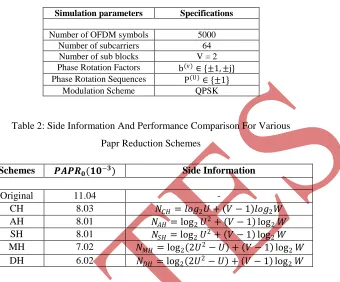
Table 1: Simulation ParametersTable 2: Side Information And Performance Comparison For Various
Papr Reduction Schemes
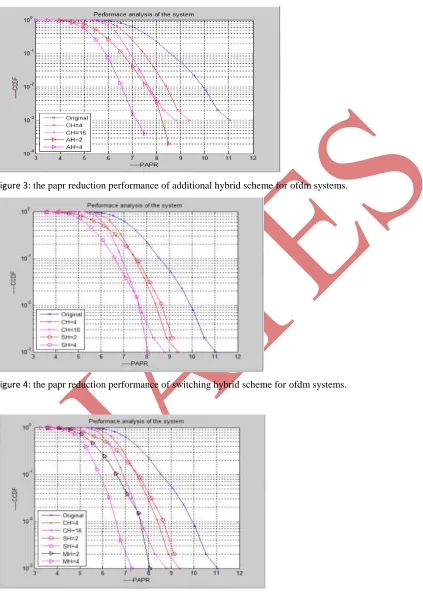
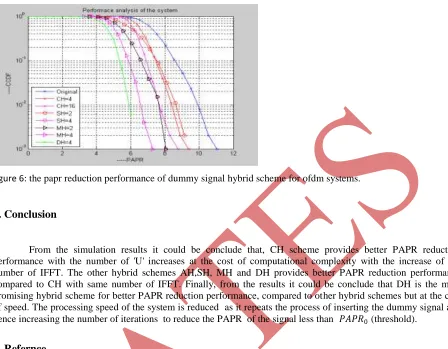
Table I specifies the system parameters for comparative simulations. Fig. 2,3,4,5,6 shows the PAPR reduction performance with CH, AH, SH, MH and DH for various values of 'U'. It can be observed that as the number of 'U' increases from U=2,4,16,..., the PAPR reduction performance becomes better and also it could be observed that AH, SH, MH and DH shows better PAPR reduction performance compared to the CH scheme for the same value of 'U'. In table II, PAPR reduction performance and side information of various schemes is discussed.
figure 2: the papr reduction performance of conventional hybrid scheme for ofdm systems. Simulation parameters Specifications
Number of OFDM symbols 5000
Number of subcarriers 64
Number of sub blocks V = 2
Phase Rotation Factors b(v)∈ {±1, ±j} Phase Rotation Sequences P(U)∈ {±1}
Modulation Scheme QPSK
Schemes 𝑷𝑨𝑷𝑹𝟎(𝟏𝟎−𝟑) Side Information
Original 11.04 -
CH 8.03 𝑁𝐶𝐻= 𝑙𝑜𝑔2𝑈 + 𝑉 − 1 𝑙𝑜𝑔2𝑊
AH 8.01 𝑁𝐴𝐻 = log2𝑈2+ 𝑉 − 1 log2𝑊
SH 8.01 𝑁𝑆𝐻 = log2𝑈2+ 𝑉 − 1 log2𝑊
22 |
P a g e
figure 3: the papr reduction performance of additional hybrid scheme for ofdm systems.
figure 4: the papr reduction performance of switching hybrid scheme for ofdm systems.
23 |
P a g e
figure 6: the papr reduction performance of dummy signal hybrid scheme for ofdm systems.
6. Conclusion
From the simulation results it could be conclude that, CH scheme provides better PAPR reduction performance with the number of 'U' increases at the cost of computational complexity with the increase of the number of IFFT. The other hybrid schemes AH,SH, MH and DH provides better PAPR reduction performance compared to CH with same number of IFFT. Finally, from the results it could be conclude that DH is the most promising hybrid scheme for better PAPR reduction performance, compared to other hybrid schemes but at the cost of speed. The processing speed of the system is reduced as it repeats the process of inserting the dummy signal and hence increasing the number of iterations to reduce the PAPR of the signal less than 𝑃𝐴𝑃𝑅0 (threshold).
7. Refernce
[1] Pankaj Kumar Sharma, and R.K. Nagaria, ʻʻ An SLM based PAPR Reduction Method Using New Volterra Predistorter Model In The OFDM System ʼʼ, WSEAS transactions on communications, Issue 10, Vol. 11, October 2012, pp. 367-374.
[2] Lin Chen, and Xuelong HU, ʻʻ Research On PAPR Reduction In OFDM Systems ʼʼ, JOFCIS, December 2010, pp. 3919- 3927.
[3] Sheng-Ju Ku, and Chin-Liang Wang, ʻʻ A Reduced Complexity PTS Based PAPR Reduction Scheme For OFDM Systems, IEEE transactions on wireless, Vol. 9,NO.8,August 2010, pp. 2455-2460.
[4] Jun Hou, Jianhua Ge and Jing Li, ʻʻ Peak -To -Average Power Reduction In OFDM Signals Using PTS Scheme With Low Computational Complexity ʼʼ, IEEE transactions on broadcasting, Vol.57, NO.1, March 2011, pp. 143-148.
[5] Swami Parmanand, and Maharshi Markandeshwar, ʻʻ Signal Scrambling Techniques For PAPR Reduction in OFDM Systems ʼʼ, IJECS, Issue 1, Vol. 2, January 2013, pp. 311- 317.
[6] Gagandeep Kaur, and Rajbir Kaur, ʻʻ An Overview Of PAPR Reduction Techniques For An MC-CDMA Systems ʼʼ, IJARCET, Issue 4, Vol. 1, June 2012, pp. 461-470.