609 | P a g e
TEXTURE CLASSIFICATION BY USING
STRUCTURAL TEXTURE SIMILARITY MATRICES
Rane C.V
1, Patil Vaishnavi
2, Kulkarni Priyanka
3, Kadam Megha
41,2,3,4
Dept. of E&TC, Pune University, Pune (India)
ABSTRACT
We are creating new metrics for texture similarity that describe for human visual perception and the random
nature of textures. The metrics depend entirely on local image statistics and allow essential point-by-point
deviations between textures that based on human evaluation are basically identical. These metrics offer the
ideas of structural similarity and to lead research in texture analysis-synthesis. They are working by using a
steerable filter decomposition and incorporate a brief set of sub band statistics, calculate globally or in sliding
windows. We will do systematic tests to examine metric performance in the context of “known-item search,” the
retrieval of textures that are “identical” to the query texture. This eliminates the need for not easily managed
subjective tests, thus to make comparisons with human performance on a large database. This indicate that the
proposed metrics outperform peak signal-to-noise ratio (PSNR), structural similarity metric (SSIM) and its
variations, as well as state-of- the-art texture classification metrics, using standard statistical measures.
Keywords - Image retrieval, perceptual quality, statistical models, Similarity Matching
.INTRODUCTION
Digital images play an important role in our everyday life. In many areas of science, commerce and government
images are daily acquired and used. During the past decades we have been observing a permanent increase of
image data, leading to huge storage. The national geographic imagery collection of the United States currently
has a size in the range of Petabytes (PB) and daily grows by several Terabytes (TB).The rapid evolution
indicates the demand of qualitative and quantitative image retrieval systems. To date, various commercial
systems and Internet search engines feature keyword-based image retrieval. Usually, the results are not
satisfactory due to the high complexity of images that can not easily be described by words. Therefore,
content-based image retrieval achieved in importance during the past decade.
The development of objective metrics for texture similarity differs from that of traditional image
similarity metrics, which are often referred to as quality metrics, because essentialy visible point-by-point
deviations are possible for textures that according to human judgment are essentially identical. Employing
metrics that are insensitive to such deviations is particularly important for natural textures, the stochastic nature
of which requires statistical models that gives an understanding of human perception. we are presenting new
610 | P a g e We have developed a method that represents the global structure of an image, as well as the local structure of
perceptual groups and their connectivity. The relations between perceptual groups are evaluate under the usage
of Euclidean distance matrices. The features are invariant against similarity transformations and robust against
changes in illumination. The method can be applied to a broad range of applications.
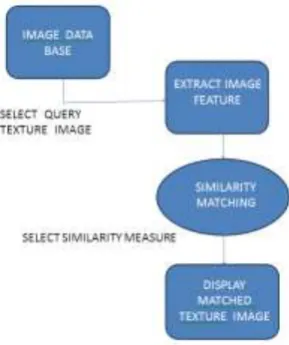
FIG 1. PROPOSED BLOCK DIAGRAM
II.RELATED WORK
In this section we are giving a idea of related structure-based feature extraction methods in the area of
image classification and content-based image retrieval. The most used features are the Structure-based
features which are frequently used for image representation, classification and content-based image
retrieval tasks [2]. Further the authors in [3] have successfully included texture with structure and
colour features. The review of the literature shows that,to extract observable and important features
for CBIR applications an image’s structure can be used.
III.STRUCTURAL SIMILARITY
The structural similarity (SSIM) is a method for measuring the similarity between two images. The
SSIM index is a full reference metric,In other words, distortion-free image or uncompressed image is
used as reference for measuring the image quality between two images. SSIM is designed to improve
on traditional methods like peak signal-to-noise ratio (PSNR) and mean squared error (MSE), which
have proven to be unpredictable with human eye perception.
The SSIM metric is calculated on various windows of an image. The measure between two windows
and of common size N×N is:
611 | P a g e (2μxμy+c1)(2бxy+c2)
SSIM(x,y) =
(μx^2+μy^2+c1)(бx^2+бy^2+c2)
with
µx the average of x;
µy the average of y;
σx
2
the variance of x;
σy
2
the variance of y;
σxy the covariance of x and y two variables to stabilize the division with weak denominator;
l the dynamicrange of the pixel-values (typically this is2 # per pixe -1);
k1=0.01 and k2=0.03 by default.
SSIM TEST RESULT
If two texture images are different the output is SSIM OUTPUT=0.2023
If two texture images are same the output is SSIM output=1
IV.EUCLIDEAN DISTANCE MATRIX
An Euclidean Distance Matrix (EDM) is a two-dimensional array.EDM consist of distances taken
from a set of coordinates or points from a feature space. Thus,an EDM includes knowledge about
612 | P a g e Euclidean space is a set of points which consistof coordinates.Specifically,an Euclidean Distance
Matrix is a real valued n × n matrix E containing the squared distances of pairs of points from a table
of n points (Xk, Yk), with {k = 1, 2, . . . n}. An EDM is defined as
e11 e12 ···e1n
E= e21 e22 ···e2n
en1 en2 ···enn
where
eij = √(Xi-Xj)2+(Yi-Yj) 2
withi,j ={1,2,. . . ,n},
(Xi − Xj)2 + (Yi − Yj)2, with i,j ={1,2,. . . ,n}, (4.1)
describes the Euclidean distance between the feature points i and j.
An EDM E inherits the following properties from the norm k · k2:
1. eij≥ 0, i 6= j non-negativity
2. eij = 0, i = 0 self-distance
3. eij = eji symmetry
4. eij≤ eik + ekj , i 6= k 6= j triangle inequality.
V.DATABASE CONSTRUCTION
613 | P a g e
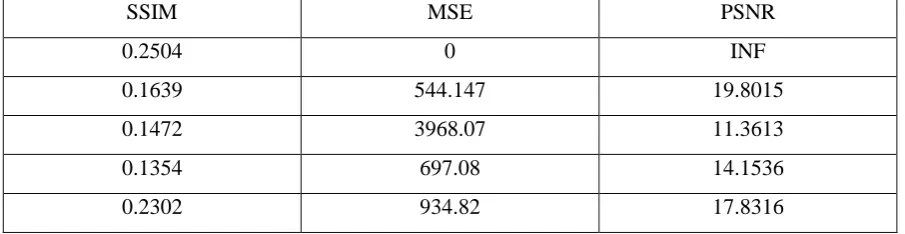
Table 1. Experimental Results
SSIM MSE PSNR
0.2504 0 INF
0.1639 544.147 19.8015
0.1472 3968.07 11.3613
0.1354 697.08 14.1536
0.2302 934.82 17.8316
VI. CONCLUSION
We have developed a structure-based feature extraction method which is capable of representing the
global structure of an image, as well as the local structure of perceptual groups and their connectivity.
The metrics allow substantial point-by-point deviations between textures that according to human
judgment are essentially identical. This eliminates the need for subjective tests, thus enabling
comparisons with human performance on a large database.
REFERENCES
[1] Jana Zujovic, Thrasyvoulos N. Pappas, and David L. Neuhoff, “ STRUCTURAL TEXTURE
SIMILARITY MATRICS FOR IMAGE ANALYSIS AND RITRIEVAL” JULY-13.
[2] Q. Iqbal and J. K. Aggarwal. Combining structure, COLOR AND TEXTURE FOR IMAGE
RETRIEVAL: A performance evaluation. In Proceedings of the International Conference on
Pattern Recognition, volume 3, Quebec, Canada, pages 438–443, 2002.
[3] Q.Iqbal and J. K. Aggarwal.”RETRIEVAL BY CLASSIFICATION OF IMAGES CONTAINING
LARGE MAN-MADE OBJECTS USING PERCEPTUAL GROUPING”. Pattern Recognition,
35:14631479, July 2002
[4] Abir Gallas, WalidBarhoumi, Ezzeddine Zagrouba“IMAGE RETRIEVAL BASED ON
WAVELET SUB-BANDS AND FUZZY WEIGHED REGIONS” JAN-12.
[5] ManimalaSingha and K.Hemachandran “CONTENT BASED IMAGE RETRIEVAL USING