In-School Neurofeedback Training for ADHD: Sustained
Improvements From a Randomized Control Trial
WHAT’S KNOWN ON THIS SUBJECT: An estimated 9.5% of children are diagnosed with attention-deficit/hyperactivity disorder (ADHD), which affects academic and social outcomes. We previously found significant improvements in ADHD symptoms immediately after neurofeedback training at school.
WHAT THIS STUDY ADDS:This randomized controlled trial included a large sample of elementary school students with ADHD who received in-school computer attention training with neurofeedback or cognitive training. Students who received neurofeedback were reported to have fewer ADHD symptoms 6 months after the intervention.
abstract
OBJECTIVE:To evaluate sustained improvements 6 months after a 40-session, in-school computer attention training intervention using neurofeedback or cognitive training (CT) administered to 7- to 11-year-olds with attention-deficit/hyperactivity disorder (ADHD).
METHODS:One hundred four children were randomly assigned to receive neurofeedback, CT, or a control condition and were evaluated 6 months postintervention. A 3-point growth model assessed change over time across the conditions on the Conners 3–Parent Assessment Report (Conners 3-P), the Behavior Rating Inventory of Executive Function Parent Form (BRIEF), and a systematic double-blinded classroom observation (Behavioral Observation of Students in Schools). Analysis of variance assessed community-initiated changes in stimulant medication.
RESULTS: Parent response rates were 90% at the 6-month follow-up. Six months postintervention, neurofeedback participants maintained significant gains on Conners 3-P (Inattention effect size [ES] = 0.34, Executive Functioning ES = 0.25, Hyperactivity/Impulsivity ES = 0.23) and BRIEF subscales including the Global Executive Composite (ES = 0.31), which remained significantly greater than gains found among children in CT and control conditions. Children in the CT condition showed delayed improvement over immediate postintervention ratings only on Conners 3-P Executive Functioning (ES = 0.18) and 2 BRIEF subscales. At the 6-month follow-up, neurofeedback participants maintained the same stimulant medication dosage, whereas participants in both CT and control conditions showed statistically and clinically significant increases (9 mg [P= .002] and 13 mg [P,.001], respectively).
CONCLUSIONS: Neurofeedback participants made more prompt and greater improvements in ADHD symptoms, which were sustained at the 6-month follow-up, than did CT participants or those in the control group. Thisfinding suggests that neurofeedback is a promising attention training treatment for children with ADHD.Pediatrics 2014;133:483– 492
AUTHORS:Naomi J. Steiner, MD,aElizabeth C. Frenette,
MPH,aKirsten M. Rene, MA,aRobert T. Brennan, EdD,band
Ellen C. Perrin, MDa
aThe Floating Hospital for Children at Tufts Medical Center,
Department of Pediatrics, Boston, Massachusetts; andbHarvard
School of Public Health, Boston, Massachusetts
KEY WORDS
ADHD, neurofeedback, biofeedback, cognitive training, growth model
ABBREVIATIONS
ADHD—attention-deficit/hyperactivity disorder BOSS—Behavioral Observation of Students in Schools BRIEF—Behavior Rating Inventory of Executive Function CompAT—computer attention training
Conners 3-P—Conners 3–Parent Assessment Report CT—cognitive training
RA—research assistant
Dr Steiner conceptualized and designed the study, drafted the initial manuscript, and approved thefinal manuscript as submitted. Ms Frenette and Ms Rene carried out the initial analyses, reviewed and revised the manuscript, and approved thefinal manuscript as submitted. Dr Brennan carried out the growth model analyses, reviewed and revised the manuscript, and approved thefinal manuscript as submitted.
This trial has been registered at www.clinicaltrials.gov (identifier NCT01583829).
www.pediatrics.org/cgi/doi/10.1542/peds.2013-2059
doi:10.1542/peds.2013-2059
Accepted for publication Dec 18, 2013
Address correspondence to Naomi J. Steiner, MD, Floating Hospital for Children at Tufts Medical Center, 800 Washington St, Box 334, Boston, MA 02111. E-mail: nsteiner@tuftsmedicalcenter. org
PEDIATRICS (ISSN Numbers: Print, 0031-4005; Online, 1098-4275).
Copyright © 2014 by the American Academy of Pediatrics
FINANCIAL DISCLOSURE:The authors have indicated they have nofinancial relationships relevant to this article to disclose.
FUNDING:All phases of this study were supported by an Institute of Education Sciences grant (R305A090100).
Attention-deficit/hyperactivity disorder (ADHD) is a neurodevelopmental dis-order with core symptoms of inatten-tion, hyperactivity, and/or impulsivity and has a prevalence of 9.5% for 4- to 17-year-olds in the United States.1 Execu-tive functioning is typically impaired in children with ADHD, affecting their ac-ademic achievement.2Medication and
behavior therapy are both viable treat-ment options for ADHD,3but they both
have limitations. These limitations, along with the pervasiveness of ADHD symptoms in school, highlight the im-portance of researching alternative treatments that can be implemented in the classroom setting. Computer atten-tion training (CompAT) is an umbrella term used to describe many computer interventions that appear to be effec-tive4and that might be possible to
im-plement on a large scale in school. Based on theories of operant condi-tioning and brain plasticity, the goal of CompAT interventions is to decrease ADHD symptoms and improve executive functioning skills. CompAT interventions may provide sustainable benefits even after the intervention is terminated through its conditioning and general-ization components. Two types of CompAT interventions were evaluated in the cur-rent study: neurofeedback and cognitive training (CT).
EEG patterns in children with ADHD have shown more theta wave activity and increased theta:beta ratio in the frontal cortex, compared with children without ADHD.5–7 Beta Waves in the frontal
cortex are associated with sustaining attention and thinking, whereas theta waves are prevalent when drowsy or daydreaming. However, other studies have not confirmed the finding that children with ADHD have elevated theta:beta ratios when compared with controls.8,9The authors of these
stud-ies hypothesized that children in control conditions also have elevated theta: beta ratios than has been observed in
the past, potentially due to decreased sleep (among other factors), making the 2 groups look more alike. When training attention, neurofeedback pro-vides children with immediate auditory and visual feedback regarding their level of attention during each exercise. Changes are enabled because of brain plasticity of the frontal brain, which continues to develop throughout child-hood and into early adultchild-hood.10
Neu-rofeedback therefore trains users to monitor and change their brainwave patterns, leading to behavioral changes.11
Some studies have found that neuro-feedback can decrease symptoms of ADHD,12–17including improved attention,18
behavior,19and cognitive improvements20
up to 6 months postintervention as well as at 2 years postintervention.21 How-ever, the evidence for its sustainability remains unclear, because there are limited studies examining follow-up data, and those that do have small sample sizes or no control condition.13–15
In contrast, CT uses specifically de-signed exercises to train attention, working memory, and impulsivity through ongoing feedback to reinforce correct responses. Several studies suggest that CT improves performance on working memory tasks and decreases inatten-tiveness, hyperactivity, and disruptive behaviors.22–26 The largest such trial
included only 44 children diagnosed with ADHD, ages 7 to 12 years, and re-ported results 3 months after com-pleting a 20-session intervention.26
Gevensleben et al18 examined
neuro-feedback and CT after 6 months and found that improvements in the neuro-feedback condition on parent-reported behavior scales were significantly su-perior and sustained compared with the CT condition. Unfortunately, significant attrition makes this study’s generaliz-ability unclear. A recent meta-analysis regarding nonpharmacologic inter-ventions for ADHD concluded that in-creased evidence is needed for both
neurofeedback and CT interventions before they can be supported as treatments for ADHD.27
The current study is novel for several reasons. The research team conducted thefirst in-school translational efficacy trial comparing neurofeedback, CT, and control conditions. Previous studies have mostly been conducted in labo-ratories or in clinical settings. This
ef-ficacy trial targeted a precise age range of children 7 to 11 years of age, as opposed to previous studies that in-cluded diverse developmental age ranges. Many studies are smaller without a control group and failed to
find group differences. Last, very few studies reported follow-up results.
Pre- to postintervention, we found sig-nificantly greater improvements in ADHD symptoms, including attention and executive functioning, among neurofeedback participants compared with the control and CT conditions.28In
the present article, we report outcomes 6 months after the conclusion of the in-tervention. We hypothesized that partic-ipants receiving neurofeedback would maintain improvements in attention and executive functioning compared with control or CT conditions and that med-ication dosage would remain stable.
METHODS Participants
serious mental illness (eg, psychosis) and (2) an IQ measured by the Kaufman Brief Intelligence Test ,80, to limit confounding factors and requirements of extensive amendments to the inter-vention protocol that could affect stan-dardized implementation. The study was located in schools, and investigators had no clinical responsibility for the children’s medical care. Therefore, children were included on the basis of their clinician’s diagnosis of ADHD, and were included regardless of whether they were taking medications for ADHD. Parents of all participants were in-formed that they should continue to adhere to scheduled clinician visits and standard community treatments (including counseling and medication management) independent of study participation, and medication use was not suspended for treatments or as-sessments. The study was approved by the Tufts Medical Center Institutional Review Board, and written informed consent and child assent were obtained.
Enrollment of thefirst cohort occurred from May to September 2009 and from May to September 2010 for the second cohort. All preintervention assessments were conducted in October, and inter-ventions were initiated in November of each year. For each cohort, the research coordinator balanced participants on the basis of school district, gender, and medi-cation status, and then assigned them via a computer random number generator into 3 conditions (neurofeedback, CT, and control). Before enrollment, parents were told their child would be randomly assigned into 1 of these 3 conditions, and were informed of their child’s group status after assignments were made.
Interventions
Participants received in-school 45-minute intervention sessions 3 times per week, monitored by a trained re-search assistant (RA), for 40 sessions over 5 months. The same protocol was used for both intervention conditions.
RAs received a standardized 2-week training to administer neurofeedback and CT, followed by a posttraining test and direct observation assessments. RAs filled out a standardized session checklist for each child at every session to monitor implementationfidelity.
The specific neurofeedback system used (Play Attention, Unique Logic and Tech-nology, Fletcher, NC) detects 2 frequency ranges, 1 in the low-frequency theta brainwave range (4–8 Hz) and another in the high-frequency beta brainwave range (12–15 Hz).29The brainwaves are
measured by an EEG sensor embedded in a standard bicycle helmet centrally located on the top of the skull, and 2 other EEG sensors one a grounding sensor and the other a reference, on the chin straps located bilaterally on the mastoids. Through practice, partic-ipants learn to manipulate thefigures on the screen, resulting in suppression of theta and an increase in beta activity. As the theta:beta ratio changes, an al-gorithm is used so that participants score points on the computer program and learn how to improve attention on the 6 different exercises.
The specific CT intervention used (Cap-tain’s Log, BrainTrain, North Chesterfield, VA) comprises exercises that train dif-ferent areas of cognition, which may be designed into personalized exercise protocols. The system is well designed for large-scale delivery, because there is automatic level advancement after each exercise.30 The standardized protocol
developed for this study is composed of 14 auditory and visual exercises tar-geting areas of attention and working memory. Each exercise is interactive and lasts∼5 minutes. Both systems are commercially available.
Primary Outcome Measures
Outcome measures included parent reports of ADHD symptoms and executive functioning, medication use, and sys-tematic classroom observations of
behavior. All outcome measures were obtained pre- and postintervention, and 6 months later.
The Conners 3–Parent Assessment Re-port (Conners 3-P; Multi-Health Sys-tems Inc, North Tonawanda, NY) is a validated and standardized instrument to assess ADHD symptoms,31including
9 subscales comprising 2 summary scales summed together as a Global Index. The Behavior Rating Inventory of Executive Function (BRIEF) (PAR Inc, Lutz, FL) is a validated and standard-ized instrument that assesses execu-tive functioning,32including 8 subscales
comprising 2 indices summed together in the Global Executive Composite. Both parents, if available, completed the Conners 3-P and BRIEF.
The Behavioral Observation of Students in Schools (BOSS; Pearson Education, Inc, New York, NY)33 is a systematic interval recording observation system for coding classroom behavior and reports on engagement (active or pas-sive) and off-task behaviors (motor, verbal, and passive). Data output from observations are objective quantitative assessments, which can help reduce observer bias, and consist of raw data as well as the percentage of intervals the participant was recorded as en-gaged or off-task. The BOSS has been found to be reliable between observ-ers,34to differentiate between children with ADHD and their typically developing peers,35and to be sensitive to treatment effects.36 The BOSS was completed 3 times at each time point (ie, before the intervention, immediately after the tervention, and 6 months after the in-tervention) for all study participants by trained RAs37who were unaware of the
participants’randomization conditions. The participants were unaware that they were being observed.
consultation regarding medication was discussed with parents, who were en-couraged to continue their regularly scheduled visits with their clinician. Stimulant medications were converted into methylphenidate equivalencies by the research team to compare dosage over time. The reliability of parent reports was assessed by comparing name and dosages of medication at each time point. Ambiguous responses were clarified by direct communication with parents and clinicians.
Data Analysis
Analysis of variance was conducted to assess baseline differences in de-mographic data between randomiza-tion condirandomiza-tions. Missing items within multiitem scales were resolved by using expectation maximization imputation,38
which is an iterative imputation method suitable for low-frequency missing data and/or when SEs are not of primary concern.39When a full questionnaire was missing, it was dropped from the analy-sis and addressed directly through the analytic strategy described below. Be-cause this study investigated whether the 2 CompAT interventions are superior to community treatment alone, and whether neurofeedback is superior to CT, this randomized controlled trial is con-sidered a superiority trial and analyses are presented with 1-tailed tests.40–42
The central focus of these analyses was to evaluate whether the observed changes in core ADHD symptoms be-tween the start and end of the treatment period were sustained at the 6-month follow-up. Changes in parent-reported and classroom observation measures were investigated by 3-point growth models by using a multilevel approach to assess change over the 3 time points (preintervention, postintervention, and 6-month follow-up) to compare neuro-feedback and CT with the control.43–45
Our approach used all available data, including the reports from 2 parents when available at all 3 time points.
These models allow for the estimation of reliability of measurement and change within the overall estimation, and can flexibly accommodate un-balanced data, so a participant can be included at a time point even if only 1 parent questionnaire was available at any or all of the time points. For the BOSS, 3 observations at all 3 time points were used to estimate re-liability.46This linear model estimates
the best-fitting line to the 3 time points. Comparisons between neurofeedback and CT were undertaken using mul-tivariate general linear hypothesis tests.47For ease in interpretation and
comparison with other studies, ap-proximate effects sizes (expressed as standardized mean differences, Cohen’sd) were computed from the neurofeed-back and CT coefficients from the growth models; however, to the best of our knowledge, no other study of Com-pAT reports growth coefficients and, furthermore, standard calculations do not accommodate all of the parameters estimated in a multilevel model.48 All
growth models were estimated by using HLM version 7.0.42All other analyses and
data treatment were conducted by us-ing SYSTAT version 13.0.49
Pairedttests were conducted to eval-uate stimulant medication differences in methylphenidate equivalencies within randomization conditions between pre-intervention and the 6-month follow-up. An analysis of covariance was con-ducted to evaluate medication dosage differences among the randomization conditions at 6-month follow-up, con-trolling for preintervention stimulant medication dosages.
RESULTS
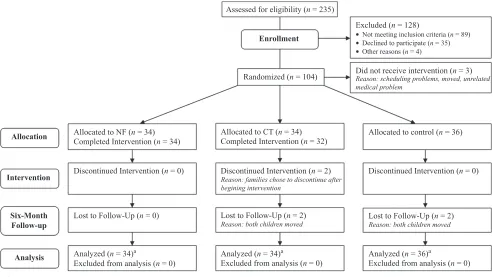
Of the 104 children in the study, 102 completed the intervention. Of these, only 4 did not complete the 6-month follow-up assessment (n= 98) (Fig 1). The mean response rates of the parent questionnaires for pre- and postinter-vention data were 94% for the primary
parent and 77% for the secondary par-ent. At the 6-month follow-up, response rates were 90% for the primary parent and 82% for the secondary parent. The BOSS was completed 3 times for each participant at preintervention, post-intervention, and 6-month follow-up for 100% of participants. At baseline, 95% of participants showed clinically signifi -cant scores$65 on theDiagnostic and Statistical Manual of Mental Disorders, Fourth Edition, ADHD Inattention and/or ADHD Hyperactive-Impulsive subscales. At baseline, 49% of participants were taking medication. There were no sta-tistically significant differences be-tween randomization conditions at baseline with regard to gender, family income, race, medication use, or base-line ADHD symptoms (Table 1). There were no significant differences between par-ticipants who completed or who did not complete the intervention, or between randomization conditions at 6-month follow-up regarding gender, family in-come, or race. There were no adverse side effects in neurofeedback or CT interventions reported on the session checklists.
Growth Model Analysis
The majority of distributions for the measures at each time point and the changes were approximately symmet-rical and tailed, but normality could not be assumed for all scales, so we relied on the robust SEs available in HLM42in
the assessment of hypotheses in the Conners 3-P, BRIEF, and BOSS models. The slopes of the primary scales of research interest on the Conners 3-P, BRIEF, and BOSS are displayed to show change over time by condition.
Parent-Reported Measures
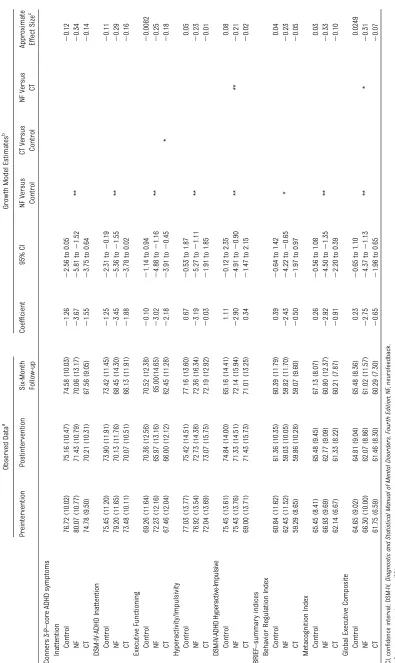
as well as in 4 of 6 general behavior subscales (Table 2 and Supplemental Table 4) and on all 3 BRIEF summary in-dex scales as well as 7 of 8 BRIEF subscales
(Table 2 and Supplemental Table 5). Par-ticipants in the CT condition showed significant improvements over time compared with the control on only 1 of
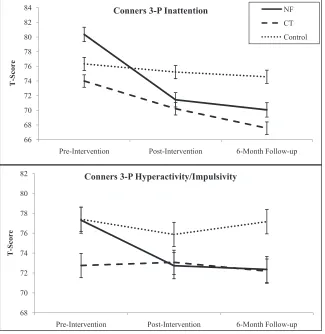
the 5 Conners 3-P subscales (Table 2) and on 2 of 8 BRIEF subscales (Sup-plemental Table 5). Furthermore, par-ticipants in the neurofeedback condition showed significant improvements over time compared with the CT condition on 6 Conners 3-P subscales (Supple-mental Table 4) and on 6 BRIEF sub-scales (Supplemental Table 5). See Fig 2 for observed participant mean scores across the 3 study time points by condition in core ADHD and execu-tive functioning areas.
Classroom Observation
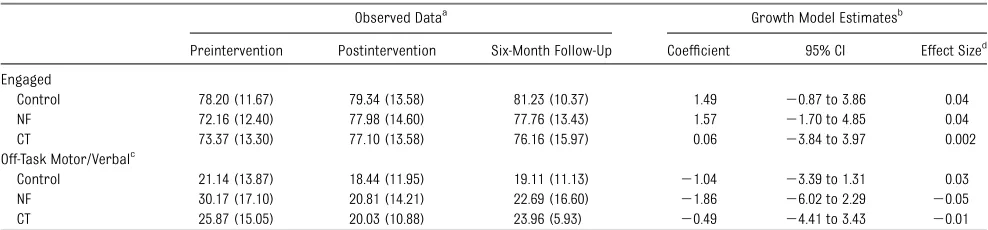
Results from the linear growth model did not show sustained change; how-ever, the linear model was not a goodfit for Off-task Motor/Verbal, therefore a quadratic model was estimated and significant improvements were found in the neurofeedback condition compared with the control (P= .04). There were no differences found between neurofeed-back and CT conditions on classroom observation measures (Table 3). FIGURE 1
CONSORT (Consolidated Standards of Reporting Trials) diagram.aIn a small number of cases, parent or teacher data were missing; therefore, sample sizes
may be somewhat smaller than is indicated here.
TABLE 1 Participant Characteristics
NF CT Control
n 34 34 36
Age, mean (SD), y 8.4 (1.1) 8.9 (1.0) 8.4 (1.1)
Male gender,n 23 22 25
Race,n
White 23 24 29
Black or African American 3 1 3
Asian 7 8 4
Fourth gradea
,n 21 28 22
Family income#$74 999,n 13 12 12
Suburban school district,n 24 25 27
IQ, mean (SD)
IQ composite 106.6 (13.9) 108.4 (14.3) 108.9 (15.4)
Verbal IQ 101.3 (16.7) 103.9 (19.4) 105.1 (16.3)
Nonverbal IQ 109.6 (12.5) 110.2 (12.1) 109.7 (17.7)
ADHD medication,n 15 14 20
Medication MPH equivalentb, mean (SD) 28.9 (14.4) 24.2 (10.2) 25.1 (15.9)
Counseling (private),n 9 7 8
School services: IEP/504 Plan,n 27 22 21
Conners 3-P Global Index, mean (SD) 75.77 (13.46) 70.89 (10.83) 74.61 (12.08) BRIEF Global Executive Composite, mean (SD) 66.30 (10.00) 61.75 (6.59) 64.65 (9.02) BOSS Engaged, mean (SD) 72.16 (12.40) 73.37 (13.30) 78.20 (11.67) BOSS Off-Task, mean (SD) 30.17 (17.10) 25.87 (15.05) 21.14 (13.87)
IEP, Individualized Education Plan; MPH, methylphenidate; NF, neurofeedback. aSignificant difference between conditions.
Medication Analysis
Among participants receiving stimulant medication, the mean dosage change in the neurofeedback condition from pre-intervention to 6-month follow-up was a 0.70-mg methylphenidate-equivalent increase (P= .44). In both CT and con-trol conditions, parents reported sig-nificant increases: 13.08 mg for CT (P= .02) and 9.14 mg for the control (P, .001). No between-group dosage differ-ence was found at 6-month follow-up, controlling for preintervention (P= .08).
DISCUSSION
The outcomes of these analyses are promising. Parents of children in the neurofeedback condition reported sus-tained improvements 6 months after the intervention, compared with those in the control condition. In the CT condition,
areas of executive functioning that did not show statistically significant change immediately after the intervention showed a significant change by the 6-month follow-up assessment compared with the control condition. Even after the intervention had stopped, parents continued to notice improvements in response to both interventions. Al-though similar to the Arns et al12
meta-analysis, improvements seen in the hyperactivity/impulsivity-related scales in the neurofeedback condition are sur-prising, because hyperactivity was not directly targeted in the intervention. Nevertheless, thesefindings suggest that when children’s focus increases, phys-ical activity level is reduced.
Clinician’s management of medication was conducted independently of the study protocol. It is noteworthy that par-ticipants in the neurofeedback condition
showed maintenance of stimulant med-ication dosage while presumably ex-periencing the same physical growth and increased school demands as CT and control condition peers, whose med-ication dosage increased clinically and statistically (9- to 13-mg methylphenidate-equivalent units).
This study used multiple sources and types of data including questionnaires from parents, systematic classroom observations of behavior, and medication. Because children had a different teacher at pre- and postintervention compared with the 6-month follow-up, teacher re-ports were not included in these anal-yses. The inclusion of the systematic classroom observations provided a valid double-blinded representation of the children’s behavior in the classroom.
Randomization of subjects to treatment conditions, as applied in this study, is the gold standard for clinical trials. Even though stratified by gender, school sys-tem, and medication status and well balanced regarding demographic char-acteristics across all 3 randomized conditions, the participants in the 3 conditions appeared to differ in the se-verity of baseline ADHD symptoms. How-ever, none of these differences reached significance, and it is unclear how these differences in baseline severity might have affected the results. Furthermore, we relied on growth models to isolate change over time, not status at post-treatment or follow-up; our time coding, which centered time at posttreatment, was selected to reduce the correlation of initial status and change.
Parents were aware of the type of in-tervention their child received, which was unavoidable, because 1 of the sys-tems uses a helmet and the other does not. Parents were informed that the 2 interventions were both commercially available and had achieved similarly encouraging results in previous studies at the time of enrollment. At postin-tervention, we found no differences in FIGURE 2
satisfaction with the intervention be-tween parents with participants in the neurofeedback condition and parents with participants in the CT condition, sug-gesting that parent bias most likely did not affect their reporting of the measures.
CONCLUSIONS
Neurofeedback participants showed significant improvements that were sustained 6 months after the interven-tion compared with those in the control and CT conditions, as reported by the parents consistently on all of the core ADHD subscales and executive func-tioning scales. Participants in the CT condition showed significant improve-ment 6 months after the intervention period on 2 executive functioning sub-scales. Medication dosage was sustained among participants in the neurofeed-back condition, whereas for CT and control conditions it was increased. The
finding that neurofeedback was supe-rior to CT on multiple scales further supports its efficacy as a treatment of children with ADHD. Effects were
reported earlier in the neurofeedback condition than in the CT condition and were also stronger at the 6-month follow-up period, showing the promise of neurofeedback as a treatment with sustained gains for children with ADHD.
This is thefirst large randomized con-trolled trial to evaluate the long-term efficacy of in-school CompAT. Despite the paucity of scientific data, both neurofeedback and CT training systems are currently being used in school systems across the United States,29,30
underlining the importance of sys-tematic studies of their effectiveness. The direct impact of attention deficits on academic progress makes schools an ideal setting for such an interven-tion, because all children with ADHD in all communities could potentially have access to these services on an ongoing basis. A next important step will be to assess individual participant differ-ences to evaluate which factors might be associated with the most progress on the respective interventions and to study older developmental age cohorts.
ACKNOWLEDGMENTS
We thank Tahnee Sidhu and Katie Tom-asetti from Tufts Medical Center for their extensive contributions to this re-search project. We appreciate the assis-tance of Dr David Gotthelf, PhD, of the Newton Public Schools, Principal Simon Ho and Zhen Su of the Boston Public Schools, and the administrators and teachers of both school systems. Dr R. Chris Sheldrick, PhD, provided wise advice from the beginning of the pro-ject. We also acknowledge the following former RAs affiliated with Tufts Medical Center for their hard work on this study: Susan Mangan, Minakshi Ratkalkar, Lauren Rubin, Wendy Si, Melissa Arbar, Stefanie Moynihan, Neena Schultz, Eliz-abeta Bourchtein, Kolleen Burbank, Heather Bentley, Amanda Civiletto, Joyce Kao, and Jessica Charles, as well as stu-dents Cathryn Magielnicki and Lisa Ngu from Tufts University and Jessica Ben-nett and Jessica Chen from Northeast-ern University. We also acknowledge all of the participants and their families.
REFERENCES
1. Visser SN, Bitsko RH, Danielson ML, Perou R & Blumberg SJ, et al. Increasing prevalence of parent-reported attention-deficit/hyperactivity disorder among children—United States 2003 and 2007. Morbidity and Mortality
Weekly Report, 2010;59(44):1439–1443
2. Biederman J, Monuteaux MC, Doyle AE, et al. Impact of executive function deficits and attention-deficit/hyperactivity dis-order (ADHD) on academic outcomes in children.J Consult Clin Psychol. 2004;72(5): 757–766
3. The MTA Cooperative Group. Multimodal Treatment Study of Children with ADHD: a 14-month randomized clinical trial of treatment strategies for attention-deficit/ hyperactivity disorder. Arch Gen Psychia-try. 1999;56(12):1073–1086
TABLE 3 BOSS Results
Observed Dataa Growth Model Estimatesb
Preintervention Postintervention Six-Month Follow-Up Coefficient 95% CI Effect Sized
Engaged
Control 78.20 (11.67) 79.34 (13.58) 81.23 (10.37) 1.49 20.87 to 3.86 0.04
NF 72.16 (12.40) 77.98 (14.60) 77.76 (13.43) 1.57 21.70 to 4.85 0.04
CT 73.37 (13.30) 77.10 (13.58) 76.16 (15.97) 0.06 23.84 to 3.97 0.002
Off-Task Motor/Verbalc
Control 21.14 (13.87) 18.44 (11.95) 19.11 (11.13) 21.04 23.39 to 1.31 0.03
NF 30.17 (17.10) 20.81 (14.21) 22.69 (16.60) 21.86 26.02 to 2.29 20.05
CT 25.87 (15.05) 20.03 (10.88) 23.96 (5.93) 20.49 24.41 to 3.43 20.01
CI, confidence interval; NF, neurofeedback. aData are presented as means (SD).
bThe growth model estimates a coefficient representing a change in the slope between the intervention conditions and the control condition over the 3 time points. cQuadratic model also estimated (see text); results of the linear model shown.
4. Steiner NJ, Sheldrick RC, Gotthelf D, Perrin EC. Computer-based attention training in the schools for children with attention deficit/hyperactivity disorder: a prelimi-nary trial.Clin Pediatr (Phila). 2011;50(7): 615–622
5. Loo SK, Barkley RA. Clinical utility of EEG in attention deficit hyperactivity disorder.
Appl Neuropsychol. 2005;12(2):64–76
6. Loo SK, Makeig S. Clinical utility of EEG in attention-deficit/hyperactivity disorder: a re-search update. Neurotherapeutics. 2012;9 (3):569–587
7. Monastra VJ, Lynn S, Linden M, Lubar JF, Gruzelier J, LaVaque TJ. Electroencephalo-graphic biofeedback in the treatment of attention-deficit/hyperactivity disorder.Appl
Psychophysiol Biofeedback. 2005;30(2):
95–114
8. Liechti MD, Valko L, Müller UC, et al. Di-agnostic value of resting electroencepha-logram in attention-deficit/hyperactivity disorder across the lifespan.Brain Topogr. 2013;26(1):135–151
9. Arns M, Conners CK, Kraemer HC. A decade of EEG theta/beta ratio research in ADHD: a meta-analysis.J Atten Disord. 2013;17(5): 374–383
10. Giedd JN, Rapoport JL. Structural MRI of pediatric brain development: what have we learned and where are we going?Neuron.
2010;67(5):728–734
11. Heinrich H, Gevensleben H, Strehl U. Anno-tation: neurofeedback—train your brain to train behavior.J Child Psychol Psychiatry. 2007;48(1):3–16
12. Arns M, de Ridder S, Strehl U, Breteler M, Coenen A. Efficacy of neurofeedback treat-ment in ADHD: the effects on inattention, impulsivity and hyperactivity: a meta-analysis.Clin EEG Neurosci. 2009;40(3):180– 189
13. Moriyama TS, Polanczyk G, Caye A, Bana-schewski T, Brandeis D, Rohde LA. Evidence-based information on the clinical use of neurofeedback for ADHD.Neurotherapeutics. 2012;9(3):588–598
14. Arns M, Drinkenburg W, Leon Kenemans J. The effects of QEEG-informed neurofeed-back in ADHD: an open-label pilot study.
Appl Psychophysiol Biofeedback. 2012;37
(3):171–180
15. Hodgson K, Hutchinson AD, Denson L. Non-pharmacological treatments for ADHD: a meta-analytic review. J Atten Disord. 2012; doi: 10.1177/1087054712444732. 16. Gevensleben H, Holl B, Albrecht B, et al. Is
neurofeedback an efficacious treatment for ADHD? A randomised controlled clinical trial.J Child Psychol Psychiatry. 2009;50(7): 780–789
17. Williams JM. Does neurofeedback help re-duce attention-deficit hyperactivity
disor-der?J Neurother. 2010;14(4):261–279
18. Gevensleben H, Holl B, Albrecht B, et al. Neurofeedback training in children with ADHD: 6-month follow-up of a randomised controlled trial.Eur Child Adolesc Psychia-try. 2010;19(9):715–724
19. Strehl U, Leins U, Goth G, Klinger C, Hin-terberger T, Birbaumer N. Self-regulation of slow cortical potentials: a new treatment for children with attention-deficit/hyperactivity disorder. Pediatrics. 2006;118(5). Available at: www.pediatrics.org/cgi/content/full/118/ 5/e1530
20. Leins U, Goth G, Hinterberger T, Klinger C, Rumpf N, Strehl U. Neurofeedback for chil-dren with ADHD: a comparison of SCP and theta/beta protocols. Appl Psychophysiol
Biofeedback. 2007;32(2):73–88
21. Gani C, Birbaumer N, Strehl U. Long term effects after feedback of slow cortical potentials and of theta-beta amplitudes in children with attention-deficit/hyperactivity disorder (ADHD). Int J Bioelectromagn. 2008;10(4):209–232
22. Rabiner DL, Murray DW, Skinner AT, Malone PS. A randomized trial of two promising computer-based interventions for students with attention difficulties.J Abnorm Child
Psychol. 2010;38(1):131–142
23. Holmes J, Gathercole SE, Place M, Dunning DL, Hilton KA, Elliott JG. Working memory deficits can be overcome: impacts of training and medication on working mem-ory in children with ADHD.Appl Cogn Psy-chol. 2010;24(6):827–836
24. Loo SK, Barkley RA. Clinical utility of EEG in attention deficit hyperactivity disorder.Appl
Neuropsychol. 2005;12(2):64–76
25. Monastra VJ, Lynn S, Linden M, Lubar JF, Gruzelier J, LaVaque TJ. Electroencephalo-graphic biofeedback in the treatment of attention-deficit/hyperactivity disorder. J
Neurother.2005;9(4):5–34
26. Klingberg T, Fernell E, Olesen PJ, et al. Computerized training of working memory in children with ADHD—a randomized, controlled trial.J Am Acad Child Adolesc
Psychiatry. 2005;44(2):177–186
27. Sonuga-Barke EJS, Brandeis D, Cortese S, et al; European ADHD Guidelines Group. Nonpharmacological interventions for ADHD: systematic review and meta-analyses of randomized controlled trials of dietary and psychological treatments.Am J Psychiatry. 2013;170(3):275–289
28. Steiner NS, Frenette EC, Rene KR, Brennan RT, Perrin EC. Neurofeedback and cognitive attention training for children with attention
deficit/hyperactivity disorder in schools.J Dev
Behav Pediatr. 2013;35:18–27
29. Play Attention [home page on the Internet]. Available at: www.playattention.com. Accessed August 22, 2013
30. BrainTrain [home page on the Internet]. Available at: www.braintrain.com. Accessed August 21, 2013
31. Conners CK, Wells KC, Parker JD, Sitarenios G, Diamond JM, Powell JW. A new self-report scale for assessment of adolescent psychopathology: factor structure, re-liability, validity, and diagnostic sensitivity.
J Abnorm Child Psychol. 1997;25(6):487–
497
32. Mahone EM, Cirino PT, Cutting LE, et al. Validity of the behavior rating inventory of executive function in children with ADHD and/or Tourette syndrome.Arch Clin
Neu-ropsychol. 2002;17(7):643–662
33. Shapiro ES.Academic Skills Problems.4th Ed. Workbook. New York, NY: The Guilford Press; 2011
34. Swanson JM. School-Based Assessments
and Interventions for ADD Students. Irvine,
CA: KC Publishing; 1992
35. DuPaul GJ, Volpe RJ, Jitendra AK, Lutz JG, Lorah KS, Gruber R. Elementary school students with AD/HD: predictors for aca-demia achievement.J Sch Psychol. 2004;42: 285–301
36. Volpe R, DiPerna J, Hintze J, Shapiro E. Observing students in classroom settings: a review of seven coding schemes.School
Psych Rev. 2005;34(4):454–474
37. Steiner NJ, Sidhu TK, Rene KM, Tomasetti KM, Frenette EC, Brennan RT. Development and testing of a direct observation code training protocol for elementary aged stu-dents with attention deficit/hyperactivity disorder.Educ Asse Eval Acc. DOI 10.1007/ s11092-013-9166-x
38. Dempster AP, Laird NM, Rubin DB. Maximum likelihood from incomplete data via the EM algorithm. J R Stat Soc Series B Stat
Methodol. 1977;39(1):1–38
39. Enders C. A primer on maximum likelihood algorithms available for use with missing data. Struct Equ Modeling. 2001;8(1):128– 141
40. Sackett DL. Superiority trials, non-inferiority trials, and prisoners of the 2-sided null hypothesis. Evid Based Med. 2004;9(2): 38–39
41. Piaggio G, Elbourne DR, Altman DG, Pocock SJ, Evans SJ; CONSORT Group. Reporting of noninferiority and equivalence randomized trials: an extension of the CONSORT state-ment.JAMA. 2006;295(10):1152–1160 42. Raudenbush S, Bryk A, Congdon R.HLM 7:
Skokie, IL: Scientific Software International; 2011
43. Goldberg AE, Sayer A. Lesbian couples’ re-lationship quality across the transition to parenthood. J Marriage Fam. 2006;68(1): 87–100
44. Goldberg AE, Smith JZ. The social context of lesbian mothers’anxiety during early par-enthood.Parent Sci Pract. 2008;8(3):213–239
45. Goldberg AE, Smith JZ. Stigma, social con-text, and mental health: lesbian and gay couples across the transition to adoptive parenthood. J Couns Psychol. 2011;58(1): 139–150
46. Raudenbush SW, Brennan RT, Barnett RC. A multivariate hierarchical model for study-ing psychological change within married couples.J Fam Psychol. 1995;9(2):161
47. Raudenbush SW, Bryk AS.Hierarchical Lin-ear Models: Applications and Data Analysis
Methods. Thousand Oaks, CA: Sage; 2002
48. Wilson DB. Effect size calculator. Available at: www.campbellcollaboration.org/escalc/ html/EffectSizeCalculator-Home.php. Accessed August 22, 2013
49. Systat Software, Inc. SYSTAT 13.0. Rich-mond, CA: CA Systat Software, Inc; 2008
ADULT TASTES:Last week I was at the frozen food section of the supermarket
staring at rows of frozen desserts and practically rendered immobile by in-decision. I was looking for a special frozen dessert for a friend of mine who likes dessert and specifically chocolate ones. Of course, there were many varieties of chocolate, chocolate chip, and chocolate fudge ice creams. However, I was drawn to the gelatos, possibly because of my culinary experiences while traveling in Italy, but also because of gelato’s remarkableflavors. I could choose from Ar-gentine caramel, Belgium milk chocolate, and German Chocolate Cake. I even-tually settled on a pint of Sea Salt Caramel gelato despite the fact that it cost more than a half-gallon of ice cream. Evidently, I am not the only adult captivated by the richflavors found in gelato and willing to pay a bit more for the experience. As reported inThe Wall Street Journal(Life & Culture: November 12, 2013), sales of gelato in the US jumped almost 90% in 2012 while sales of ice cream and ice cream products remainedflat. Gelato and premium ice cream makers have been attempting to lure adults into buying more for themselves by introducing more complex and exoticflavors. The interest in more obscureflavors may be due to the spread of the food culture through TV shows and social media. Occasionally, theflavors do not work out well. For example, tasters found a peach-champagne sorbetto (a non-dairy gelato) with mint to be too intense and the line was dropped. As for me, I am thrilled with all the newflavors. Still, I tend to gravitate to the caramel gelatos which for at least one company have become the top selling gelatos–selling even more than vanilla. As for my friend, she was very pleased with my selection, as was I.
DOI: 10.1542/peds.2013-2059 originally published online February 17, 2014;
2014;133;483
Pediatrics
Ellen C. Perrin
Services
Updated Information &
http://pediatrics.aappublications.org/content/133/3/483
including high resolution figures, can be found at:
References
http://pediatrics.aappublications.org/content/133/3/483#BIBL
This article cites 34 articles, 1 of which you can access for free at:
Subspecialty Collections
s_sub
http://www.aappublications.org/cgi/collection/biomedical_informatic Biomedical Informatics
chnology_sub
http://www.aappublications.org/cgi/collection/health_information_te Health Information Technology
http://www.aappublications.org/cgi/collection/autism:asd_sub Autism/ASD
al_issues_sub
http://www.aappublications.org/cgi/collection/development:behavior Developmental/Behavioral Pediatrics
following collection(s):
This article, along with others on similar topics, appears in the
Permissions & Licensing
http://www.aappublications.org/site/misc/Permissions.xhtml
in its entirety can be found online at:
Information about reproducing this article in parts (figures, tables) or
Reprints
http://www.aappublications.org/site/misc/reprints.xhtml
DOI: 10.1542/peds.2013-2059 originally published online February 17, 2014;
2014;133;483
Pediatrics
Ellen C. Perrin
Naomi J. Steiner, Elizabeth C. Frenette, Kirsten M. Rene, Robert T. Brennan and
Randomized Control Trial
In-School Neurofeedback Training for ADHD: Sustained Improvements From a
http://pediatrics.aappublications.org/content/133/3/483
located on the World Wide Web at:
The online version of this article, along with updated information and services, is
http://pediatrics.aappublications.org/content/suppl/2014/02/11/peds.2013-2059.DCSupplemental
Data Supplement at:
by the American Academy of Pediatrics. All rights reserved. Print ISSN: 1073-0397.