ERP INSTITUTIONALISATION- A QUANTITATIVE DATA ANALYSIS USING THE INTEGRATIVE FRAMEWORK OF IS THEORIES
Azadeh Pishdad
School of Information Technology and Mathematical Science University of South Australia
Adelaide, Australia
Email: [email protected]
Andy Koronios
School of Information Technology and Mathematical Science University of South Australia
Adelaide, Australia
Email: [email protected]
Blaize Horner Reich Beedie School of Business
Simon Fraser University Vancouver, Canada Email: [email protected]
Gus Geursen
School of Information Technology and Mathematical Science University of South Australia
Adelaide, Australia Email: [email protected]
ABSTRACT
There is a wide agreement that IT projects have disappointing success rates and often generate less value than originally promised. In the context of ERP systems, the same statistical reports exist which demonstrate an overwhelming number of failures in ERP implementations. A thorough review of IS literature, however, leads us to believe that organisations that broadly deploy and routinise IT (in particular, ERPs) into their day-to-day work procedures realise the greatest productivity benefit and business values, and in return perceive to be more successful. The stage wherein ERP is fully assimilated, widely accepted and routinised is also referred to as institutionalised ERP in the extant IS literature of institutional theory. As a result, the authors of this paper believe that studying the influence of various social, environmental, technological and organisational factors on ERP institutionalisation has significant potential in improving the chance of successful ERP projects. In doing so, this paper introduces an integrative framework of IS theories based on an in-depth review of IS literature. The survey instrument is developed to gather data on possible impacts of factors derived from each theory on ERP institutionalisation. The gathered data is then analysed using quantitative data analysis methods to shape the final hypothetical inferences. Finally, based on the data analysis results, this paper proposed valuable suggestions to business and IT managers to improve the chance of ERP success in their organisations.
INTRODUCTION
Enterprise resource planning (ERP) system allows for streamlined processing of business data and cross-functional integration among a wide range of software products supporting day-to-day business operations and decision-making tasks (Bajwa et al. 2004; Dezdar and Sulaiman 2009). ERP systems have emerged as an enabling technology about two decades ago and still are very important elements for modern business organisations. Nevertheless, the extent IS literature shed light on the fact that despite the critical role of ERP and its related activities in bringing value to the business, there is no doubt that many organisations are still struggling with it (Chatterjee et al. 2002; Xue et al. 2004; Dezdar and Sulaiman 2009; Gartner 2014). This justifies the importance of studying various factors which are influencing successful ERP implementation and use.
At the same time, the extensive review of information system (IS) literature suggests that researchers typically study the process of technology adoption, implementation and assimilation, and thus, little attention has been given to study technology institutionalisation process. This process is the result of fully assimilated and integrated technology which occurs when technology usage becomes stable, routinised and embedded within the organisation’s work processes and its value chain activities. Studying technology institutionalisation, therefore, is value worthy for two reasons. First, it is a recent phenomenon in IS domain. Second, a thorough analysis of IS literature suggests that the significant effects of information technologies (IT) on productivity of organisations will only be realised if, and when, they are widely spread, utilised and institutionalised in the organisation (Purvis et al. 2001; Liang et al. 2007; Baptista 2009). Nevertheless, institutionalisation of complex technologies (like ERPs) is never easy and a myriad of environmental, social, organisational, and technological elements blend together to influence how potential adopters make sense out of technology, assimilate its use, and finally institutionalise it (Soh et al. 2000; Purvis et al. 2001; Xue et al. 2004; Pollock and Williams 2008).
This paper aims to study the effect of most cited theories in technology adoption, implementation, and assimilation on IT/IS (in particular, ERP) institutionalisation. For this purpose, first, various theoretical/empirical literatures were searched and systematically organised. These activities lead us to propose an integrative framework of IS theories for studying ERP institutionalisation. The validity of this framework is then tested using quantitative data analysis methods (i.e., factor analysis and regression) on the gathered survey/questionnaire data. This analysis leads us to shape the final quantitative hypothetical inferences of this paper.
LITERATURE REVIEW
ERP Assimilation
Most of the researchers to a large extent agree that technology assimilation process extends from initial awareness to full utilisation and usage of the technology within organisation (see for example, Cooper and Zmud 1990; Chatterjee et al. 2002; Rogers 2003; Bajwa et al. 2004; Zhu et al. 2006; Liang et al. 2007). This research concurs with Zhu et al. (2006) who suggest initiation, adoption, and routinisation as the core elements of IT assimilation process. These three steps embody the pre-implementation, implementation, and post-implementation stages of ERP assimilation, and thus, provide a more comprehensive foundation for this process. Looking at the temporal relationship of these stages, implementation (physical installation) takes between one to three years (21 months on average), with benefits starting to accrue in an average of 31 months (post-implementation stage) (Chatterjee et al. 2002; Liang et al. 2007; Saraf et al. 2013). Later in the literature review section, ERP institutionalisation is introduced as a result of fully assimilated ERP system (it takes about five to six years for an ERP module to become completely ingrained, routinised, and institutionalised).
Theoretical Background Used in Development of the Survey Instrument
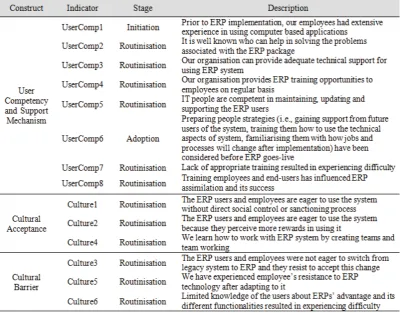
Many theories have been developed and used in IS research (Larsen et al. 2014). The theoretical focus of this research, however, is on theories about technology adoption, implementation, and assimilation. In this section, the most cited IS theories such as social shaping of technology (Mackenzie and Wajcman 1985), socio-technical theory (Latour 2005), diffusion of innovation (Rogers 2003), task-technology fit theory (Goodhue and Thompson 1995), technology-organisation-environment framework (Tornatzky and Fleischer 1990), and institutional theory (DiMaggio and Powell 1983) are reviewed. These theories shape the main pillars of survey instrument developed for doing this research. In the elaboration of each theory, the details of predictors (or indicators) used to study the effect of that theory on ERP institutionalisation also have been discussed. These predictors describe various initiation, adoption, and routinisation stages of ERP assimilation. For example, the push from government, suppliers or customers of an organisation in decision to adopt ERP is a coercive mechanism through initiation stage, however, the same pressures in using ERP is related to routinisation stage. Finally, the extensive review of IS theories is concluded with a subsection on the definition of ERP institutionalisation.
Table 1. Factors Influencing ERP Institutionalisation- Theory of Social Shaping of Technology
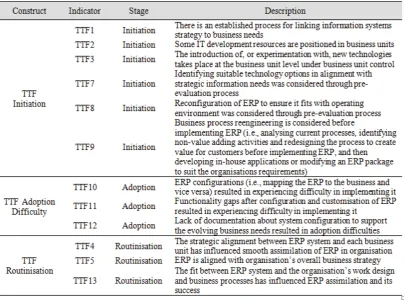
(e.g., configuration issues, functionality gaps, and lack of documentation), and TTF routinisation (e.g., strategic alignment between ERP and each business unit and ERP system’s alignment with organisation’s overall business strategy) [refer to table 2].
Table 2. Factors Influencing ERP Institutionalisation- Task-Technology Fit Theory
of consumer goods). Nevertheless, innovation attributes also play an important role in adoption of IS technologies by organisations (Cooper and Zmud 1990; Zhu et al. 2006). In this research, the influence of DOI theory on ERP institutionalisation was measured through the survey instrument comprising of three attributes; automation capability, compatibility, and ease of use [refer to table 3].
Table 3. Factors Influencing ERP Institutionalisation- Theory of Diffusion of Innovation
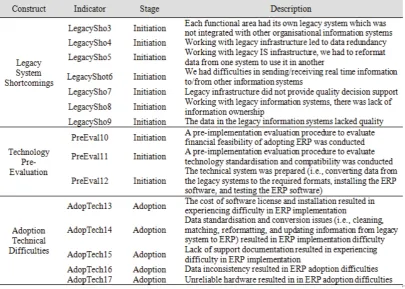
Table 4. Factors Influencing ERP Institutionalisation- Technological Aspect of TOE Framework
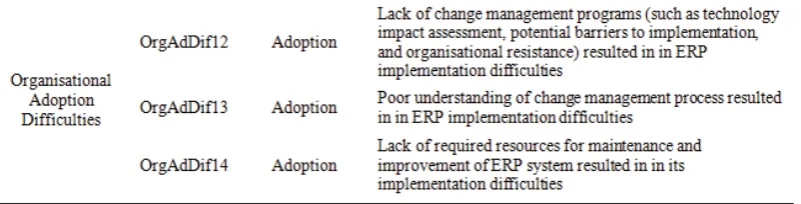
Table 5. Factors Influencing ERP Institutionalisation- Organisational Aspect of TOE Framework
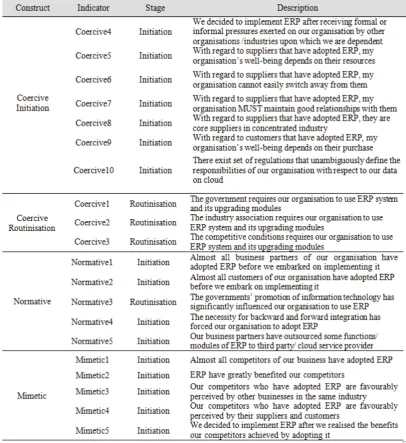
Finally, the environmental dimension of TOE framework was measured using institutional theory which comprises of two elements: institutional effects and institutionalisation process (Mignerat and Rivard 2009). Institutional effects are processes in which institutions affect other institutions, organisations or organisational entities. According to institutional effects, the relationship of an organisation within its institutional environment causes some set of organisations to become more similar over time through resemblance of a focal organisation to other organisations in its environment (DiMaggio and Powell 1983; Scott 2001; Mignerat and Rivard 2009). DiMaggio and Powell (1983) introduced three sources of institutional effects to explain how archetypes become similar over time, i.e., coercive, normative, and mimetic. Coercive mechanisms arise from the legal environment of the organisation. It occurs through the formal and informal pressures which can be imposed by structures upon which the focal organisation is dependent such as governmental agencies or headquarters. Normative mechanisms mostly concern the moral and pragmatic aspects of legitimacy by assessing whether the organisation plays its role correctly and in a desirable way. Finally, mimetic mechanisms can be defined as rational or ritualistic imitation of a superior organisation. Organisations pursue mimetic behaviour to achieve legitimacy, maintain competitive parity or limit rivalry. In this research, the influence of environmental factors on ERP institutionalisation is measured through studying the impact of the institutional effects [as shown in table 6].
Table 6. Factors Influencing ERP Institutionalisation- Institutional Theory (Environmental Aspect of TOE)
ERP Institutionalisation
remains institutionalised (Tolbert and Zucker 1999; Rogers 2003; Jennings and Greenwood 2003; Baptista 2009). Since researchers typically study the process of technology adoption, implementation and assimilation, technology institutionalisation is a recent phenomenon. It is the result of fully assimilated and integrated technology which occurs when technology usage becomes stable, routinised and embedded within the organisation’s work processes and its value chain activities. It is similar to institutionalisation stage of the institutionalisation process suggested by Jennings and Greenwood (2003) or sedimentation stage suggested by Tolbert and Zucker (1999). Institutionalised technology becomes ingrained and absorbed into the work life of the organisation which influences the realisation of the higher productivity benefit, business values, and success (Purvis et al. 2001; Chatterjee et al. 2002; Liang et al. 2007; Peppard et al. 2007). To conclude, in the normal progression of events, ERP technology is first implemented, then assimilated, and once its usage becomes routinised and embedded within the organisations’ work processes and value chain activities, its use will be taken for granted by various system stakeholders and users (Tolbert and Zucker 1999; Rogers 2003; Teo et al. 2003; Baptista 2009; Maheshwari et al. 2010; Saraf et al. 2013). This taken-for-grantedness represents the institutionalisation of ERP.
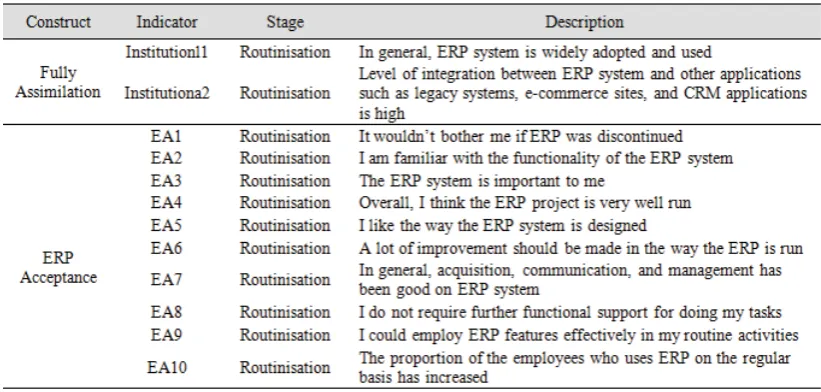
In this research, ERP institutionalisation was measured by the extent to which this technology is widely used (fully assimilated or widely adopted within the organisation) and become part of everyday life of its users (the extent of ERP acceptance). These factors as illustrated in table 7.
Table 7. Factors Used to Measure ERP Institutionalisation
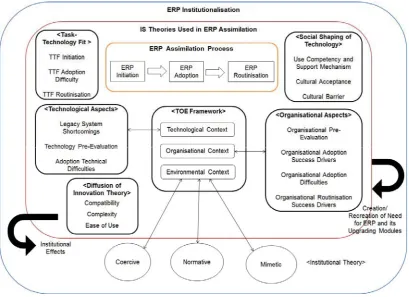
ERP INSTITUTIONALISATION FRAMEWORK
and technological contexts of the organisation (considering all different pre-implementation, implementation and post-implementation stages of ERP assimilation process).
Figure 1. Integrative ERP Institutionalisation Framework
RESEARCH METHODOLOGY
This paper adopts a quantitative positivist approach. The research framework explained in previous section was validated using statistical techniques, i.e., factor analysis and regression methods. For this purpose, a survey instrument was initially developed and distributed (either electronically or in person) in four Australian ERP-adopting organisations who have embarked on ERP implementation at least five to six years ago and have both success and failure stories to share (the organisational type includes private utility distributor, privatised public telecommunication, public energy provider, and governmental state based public health care organisation). The questionnaire/survey comprises of four sections which each section aims to study particular measures derived from IS theories regarding ERP institutionalisation. Furthermore, the pilot study was mastered to ensure that content of questionnaire is understandable to target respondents prior to gathering data.
A total of 78 surveys were distributed wherein only 30 respondents were returned answered. The response rate was approximately 40% and the sample size used for this study was thirty. Various tests was conducted to make sure that despite the relatively small sample size utilised in this study, it is acceptable for drawing preliminary conclusions. The results confirmed that variables under study did not violate normality (the variables derived from factor analysis had acceptable skewness value of between positive and negative 1 or the result of dividing skewness value by std. error of skewness is between positive and negative 1.96), regression models were normally distributed (the histograms of relationship between dependent and independent variable were normally distributed), and factors retrieved through factor analysis had high level of communality (greater than 0.7). The respondents also were chosen from various system users. The demographic of interviewees are including chief/head information/technology officer (10%), IT/business/knowledge manager/director/specialist (33%), enterprise/solution architect (20%), business/corporate strategy developer/consultant (10%), system/business support/service manager (10%), and project manager/director (17%).
QUANTITATIVE DATA ANALYSIS RESULTS
This section aims to discuss the results of quantitative data analysis conducted in this study based on the suggested research framework. As discussed earlier, various IS theories shape the main pillars of developed survey instrument for doing this research [the details of predictors/indicators have been explained in the study of each theory]. The goal of this section is to find emerging themes in explaining ERP institutionalisation (i.e., dependent variable) using well known theories such as institutional theory, social shaping of technology, TOE framework, diffusion of innovation, and task technology fit (as independent variables). Towards this goal (quantitative data analysis), the following steps have been taken,
1. Factor analysis to select the items (by reducing the number of variables- statistical conclusion validity)
2. Cronbach alpha to confirm inter-correlation among test items which shows internal consistency or reliability- also called internal validity.
3. Average the items and regress the average against the applicable dependent variable. This helps us to understand how the typical value of the dependent variable (i.e., ERP institutionalisation) varies when any one of the independent variables is changing.
Table 8. Loadings of Key Independent Variables (Indicators Derived from IS Theories)
Table 9. Loadings of Key Dependent Variable (ERP Institutionalisation)
As discussed before, step 3 of the process of quantitative data analysis involves applying regression method to understand how the typical value of the dependent variable (ERP institutionalisation) varies when any one of the independent variables are changing (various IS theories). For doing this step, a set of research hypotheses was initially defined. Then, the regression was applied to find whether the research hypothesis is supported or not. The analysis of regression models also confirm that the sample under study is normally distributed. The rest of this section discusses the final results of quantitative data analysis for each theory. These quantitative inferences further can be utilised as managerial guidelines which aim at improving the organisational readiness over various stages of ERP assimilation and its institutionalisation, i.e., when an ERP introduces, starts to use, becomes dominant, maintained and improved within organisation. The next section concludes the key remarking points of this paper and suggests four major managerial principles for enhancing the chance of ERP success in the modern business organisations.
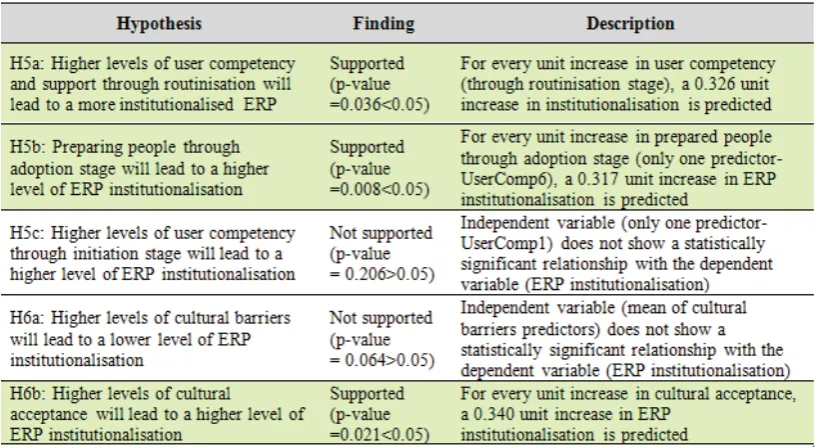
Social Shaping of Technology
critical determinants in assessing the success of ERP project. On the other hands, cultural acceptance of this technology is required for successful ERP institutionalisation. Therefore, managers need to constantly assess the capabilities of ERP users in using this technology without direct social control or sanctioning process as well as their capabilities in taking maximum advantage of ERP’s suggested features in order to achieve more successful efficient results.
Table 10. Hypothesis Testing (Social Shaping of Technology)
Technology-Organisation-Environment Framework
Table 11. Hypothesis Testing (TOE Framework)
Institutional Theory
Table 12. Hypothesis Testing (Institutional Theory)
Task-Technology Fit Theory
Table 13. Hypothesis Testing (Task Technology Fit Theory)
Theory of Diffusion of Innovation
The quantitative inferences in regards to this theory (shown in table 14) lead us to believe that positive perceptions of technology attributes (such as relative advantage, ease of use, and compatibility) increase the chance of successful ERP institutionalisation. This result re-emphasises the critical role of attributes of IT innovations in the context of organisational adoption of complex technologies like ERP system. This influence, however, is not only restricted to the initial decision to adopt this technology, but also the ease of going through later stages of adoption such as ERP implementation, adaptation, and routinisation.
Table 14. Hypothesis Testing (Diffusion of Innovation)
Figure 2. Diagram of Supported Hypotheses (Dependent Variable: ERP Institutionalisation)
CONCLUSIONS
major goals of this research is to study various factors which are influencing efficient successful ERP institutionalisation.
This research is based in Australian settings where there have been no previous studies of institutionalisation of technology. This paper contributes to the extant technology implementation literature by using a set of well-known IS theories to construct the proposed ERP institutionalisation framework. Diffusion of innovation, task-technology fit, TOE framework, social shaping of technology and institutional theory are the set of theories used to form the suggested research framework. It emphasises the character, shaping, and use of ERP technology through continuous interfacing with technological, organisational, social/cultural, managerial, environmental, and institutional effects. Moreover, this framework embraces the pre-implementation, implementation and post-implementation stages of ERP assimilation into an integrated structure in order to achieve an institutionalised IT infrastructure. Using this framework, the authors studied the influence of various factors derived from IS theories on ERP institutionalisation. Methodologically, this paper adopts a quantitative positivism approach to validate the research framework and to shape the final quantitative inferences/results of the study. These results further direct this paper to conclude a list of managerial principles which can guide them to fully assimilate ERP into their daily working practices as well as to achieve a full realisation of ERP benefits, as are listed below:
9 ERP success is more a post-live socio-technical challenge: the major benefits of ERP are available when business managers and users are continuously trained and engaged to support its wide spread usage (mainly through physical implementation of ERP and precisely when it is in use). Besides, the various attributes of ERP (like ease of use and compatibility) show off their major influence in post-live through their mutual interactions with system users. Thus, technical advantages of ERP are more likely to cause efficient results if business people and managers show positive behaviour towards their usage.
9 Some immediate negative outcomes of ERP implementation are inevitable and should not be considered as hurdle to its success: ERP success is a long-term goal, wherein some immediate negative outcomes (such as employee’s resistance) may appear. These negative outcomes, however, are not always a hurdle to success, since some of them are initially natural and unavoidable and some can be utilised in the process of improving organisational learnings. 9 A comprehensive task-technology fit assessment plan need to be available on an on-going
basis: TTF efforts need to be started right from initial project kick off (in development of business case) and continues forever to make sure all the initial expected and change benefits have been achieved.
9 The various technological, organisational, and environmental challenges of ERP implementation are growing with the evolution of this technology in the organisation: Top management need to constantly master continuous standardised benefit realisation plans to control ERP outcomes and to fully internalise the benefits of this technology. The best technological selection of the first day may finally end up with unmanageable solution which is difficult to control its use (precisely in post-adoption) predominantly because of underestimating the various post-influential aspects of such this decision.
principles will bring more tangible and intangible implications for all functional, managerial, strategic and organisational areas of contemporary business organisations.
REFERENCES
Bajwa, D. S., Garcia, J. E., and Mooney, T. (2004). An integrative framework for the assimilation of enterprise resource planning systems: phases, antecedents, and outcomes. Journal of Computer Information Systems, 44(3), 81-90.
Baptista John, J. (2009). Institutionalisation as a process of interplay between technology and its organisational context of use, Journal of Information technology, 24(4), 305-319.
Chatterjee, D., Grewal, R., and Sambamurthy, V. (2002). Shaping up for e-commerce: institutional enablers of the organisational assimilation of web technologies, MIS Quarterly, 26 (2), 65-89.
Cooper, R. B., and Zmud, R. W. (1990). Information technology implementation research: a technological diffusion approach. Management science, 36(2), 123-139.
DiMaggio, P.J., and Powell, W.W. (1983). The Iron Cage Revisited: institutional isomorphism and collective rationality in organisational fields, American sociological review, 48(2), 147-160.
Dezdar, S. and Sulaiman, A. (2009). Successful enterprise resource planning implementation: taxonomy of critical factors, Industrial Management & Data Systems, 109 (8), 1037–1052.
Gartner (2014), Working Smarter, Not Harder, Is the Key to Business Success With ERP, Analyst : Derek Prior, Carol Hardcastle, Heather Keltz.
Goodhue, Dale L. and Thompson, Ronald L. (1995). Task-technology fit and individual performance. MIS Quarterly, 19(2), 213-236.
Jennings, P. D. and Greenwood, R. (2003). Constructing the Iron Cage: Institutional Theory and Enactment, in R. Westwood and S. Clegg (eds.), Debating organisation, Malden, MA, Blackwell.
Larsen, K. R., Allen, G., Vance, A., Eargle, D. (Eds.) (2014). Theories Used in IS Research Wiki. from http://istheory.byu.edu
Latour, B. (2005). Reassembling the social: An introduction to actor-network-theory. Oxford, UK: Oxford University Press.
Liang, H., Saraf, N., Hu, Q., Xue, Y. (2007). Assimilation of enterprise systems: The effect of institutional pressures and the mediating role of top management. MIS quarterly, 31(1), 59-87.
MacKenzie, D. and Wajcman, J. (1985). The Social Shaping of Technology: How the Refrigerator Got Its Hum (Open University Press, Milton Keynes).
Maheshwari, B., Kumar,V. , and Kumar. U. (2010). Delineating the ERP institutionalisation process: go-live to effectiveness. Business Process Management Journal, 16(4), 744-771.
Mignerat, M., and Rivard, S. (2009). Positioning the institutional perspective in information systems research. Journal of Information Technology, 24(4), 369–391.
Orlikowski, W. J. (2007). Sociomaterial practices: Exploring technology at work. Organisation Studies, 28(9), 1435-1448.
Peppard, J., Ward, J., and Daniel, E. (2007). Managing the realization of business benefits from IT investments. MIS Quarterly Executive, 6(1), 1-11.
Purvis, R. L., Sambamurthy, V., and Zmud, R. W. (2001). The assimilation of knowledge platforms in Organisations: An empirical investigation. Organisation Science, 12(2), 117-135
Rogers, E. M. (2003). Diffusion of Innovations, 5th ed. Free Press, New York.
Saraf, N., Liang, H., Xue, Y., and Hu, Q. (2013). How does organisational absorptive capacity matter in the assimilation of enterprise information systems?, Information Systems Journal, 23(3), 245-267.
Scott, W. R. (2001). Institutions and organisations (2nd ed.). Thousand Oaks, CA: Sage.
Seddon, P. B., Calvert, C., Yang, S. (2010). A multi-project model of key factors affecting organisational benefits from enterprise systems. MIS quarterly, 34(2), 305-328.
Soh, C., Kien, S. S., & Tay-Yap, J. (2000). Enterprise resource planning: cultural fits and misfits: is ERP a universal solution?. Communications of the ACM, 43(4), 47-51.
Teo, H. H., Wei,K. K., and Benbasat, I. (2003). Predicting intention to adopt interorganisational linkages: An institutional perspective. MIS Quarterly, 27(1), 19–49.
Tolbert, P. S., and Zucker, L. G. (1999). The institutionalization of institutional theory. Studying Organisation. Theory & Method. London, Thousand Oaks, New Delhi, 169-184.
Tornatzky, L.G., and Fleischer, M. (1990).The processes of technological innovation. Lexington Books, Lexington, Massachusetts.
Xue, Y., H. Liang, Boulton W.R., and Snyder C.A. (2004).ERP implementation failures in China: case studies with implications for ERP vendors. International journal of production economics, 97(3), 279-295.
Zhu, K., Kraemer, K. L., and Xu, S. (2006). The process of innovation assimilation by firms in different countries: A technology diffusion perspective on E-business. Management Science, 52(10), 1557-1576.
Zigurs, I., and Khazanchi, D. (2008). From profiles to patterns: A new view of task-technology fit. Information Systems Management, 25(1), 8-13.