ZERO-DELAY LARGE SIGNAL CONVOLUTION USING
MULTIPLE PROCESSOR ARCHITECTURES
Nicholas Jillings
1, Joshua D. Reiss
2, and Ryan Stables
11
Digital Media Technology Lab, Birmingham City University, Birmingham UK ,
[email protected], [email protected]
2
Centre for Digital Music, Queen Mary University of London, London, UK,
[email protected]
Abstract
Zero latency convolution typically uses the Direct Form approach, requiring a large amount of computational sources for every additional sample in the impulse re-sponse. A number of methods have been developed to reduce the computational cost of very large signal convo-lution. However these all introduce latency into the sys-tem. In some scenarios this is not acceptable and must be removed. Modern computer systems hold multiple pro-cessor architectures, with their own strengths and weak-nesses for the purpose of convolution. This paper shows how correctly combining these processors can lead to a powerful system which can be deployed for real-time, zero-latency large signal convolution.
1
Introduction
Convolution is used to perform a range of computational processes in audio production, including the application of digital filters, or reverberation effects [1]. This is traditionally implemented as Direct Form (Eq. 1), but its computational cost increases dramatically as the im-pulse length increases [2], illustrated in Figure 1. Sev-eral methods have been proposed to reduce the per-sample computational cost. The major breakthroughs are multi-block uniform partitions (MBUP) [3], multi-multi-block non-uniform partitions (MBNUP) [4] and the Gardner method [5]. These algorithms generally trade computational
effi-ciency for system latency or complexity. Ideally however, a desirable system will reduce computational cost without introducing system latency.
y[n] =x[n]∗h[n] =
M−1
X
m=0
x[n]h[m−n] (1)
The convolution process is traditionally executed on the computers’ CPU [6], where vector instruction sets can im-prove performance [7]. Modern GPU processors however, can also perform general purpose computing work in ad-dition to image and video rendering [8]. Many aspects of computational research have been accelerated by in-troducing GPUs, such as image processing [9], machine learning [10, 11] and audio processing [12], offloading work from CPUs. This however, is only useful for certain scenarios as system latency is introduced [13, 14].
Computational tasks on the GPU only benefit if there is sufficient parallelism to saturate a GPU processor [13, 14, 15]. GPUs can have significant latencies waiting for shared resources, such as memory access. The host interface bus and GPU architecture can add extra limita-tions and latencies [14]. Tasks which do not meet these criteria may under-perform compared to a CPU [14, 15].
0 100 200 300 400 500 600 700 800 900 1000
Impulse Length (M)
0 50 100 150 200 250 300 350 400 MAD D O p e ra ti o n s p e r Sa mp le s
Cost per sample of Convolution Techniques
Direct Form Single Block MBUP N=32 MBUP N=128 MBNUP N=32 MBNUP N=128 FDL N=32 FDL N=128
Figure 1: Operation counts for a number of convolution algorithms with increasing partition size, as outlined in [16]. These calculations assumed an FFT factor ofk = 2.0.
2
Convolution Methods
Direct Form convolution (as shown in Eq. 1) requiresM
multiplications and M −1 additions per sample, where
M is the length of the impulse response. This quickly becomes expensive to implement on modern hardware as shown in Figure 1.
Early methods to lower the cost, without inducing large latencies or resampling [17], involve partitioning a long impulse response into smaller individual sub-filters [3, 18, 19]. The impulse signal his divided into a set of sub-filtershk, with lengths equal to the partition sizeN, where
1≤N ≤M. Here,hkis defined as a subset ofh, where
h[n]∈hk, andN k≤n < N(k+ 1). The same process
is applied to the input signalxto give two sets of vectors: [h0, h1, ..., hj]and[x0, x1, ..., xj]. These frames are then
processed in the frequency domain, as shown in Eq. 2, which is typically more efficient than the Direct Form, but requires buffering.
yj =IFFT K X
k=0
HkFFT(xj−k) !
(2)
Shorter partitions require fewer samples to buffer, de-creasing the latency, but inde-creasing computation as the smaller FFT sizes are less efficient (see Figure 1 - MBUP). The resulting frames are then summed and passed through an IFFT to getyj. This function can be further optimised
by performing the FFT and storing the frequency domain
xj DFT H0 P
IFFT yj
Z−1 H1 P
Z−1 Hk P
Xj Yj0
Xj−1 Yj0−1
Xj−k Yj0−k P
Figure 2: Block diagram of the frequency delay line
H0 X0 X1 X2 X3 X4 X5 X6 X7 . . .
H1 X0 X1 X2 X3 X4 X5 X6 . . .
H2 X0 X1 X2 X3 X4 X5 . . .
Figure 3: Uniform Partition with three sub-partitions [3].
information, giving it the term Frequency-domain Delay Line (FDL) [6, 20], shown in Figure 2.
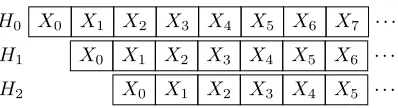
Partitioning the signal in this way simplifies parallel processing [20, 21] since certain computations can be per-formed ahead of time. In Eq. 2, only a convolution with
xj will require a delay, as xj−1 and xj−2 are already
stored in memory. Figure 3 outlines the process schedul-ing for a uniform partition. In practice, all schedulschedul-ing happens at once and the intermediary result is stored to ensure real-time execution. This also has a uniform exe-cution profile since the same number of frames are pro-cessed and every frame is the same size.
Nonuniform partition scheduling (illustrated in Figure 4) benefits from the low latency of small partitions and the efficiency of large partitions [4]. By doubling the partition size every time the cost drops, the same signal length can be covered in fewer partitions. Therefore the system latency is equal to the size of the first partition. However, the computational load is nonuniform, mean-ing a new frame may not need to be processed by every sub-filter every time. But each sub-filter must still be pro-cessed withinNk/fsseconds, whereNkis the length of
thekth partition. By processing small partitions first, it
is then feasible to perform a Direct Form convolution for
H0and a nonuniform method for the rest [5], as shown in
H0 X0 X1 X2 X3 X4 X5 X6 X7 . . .
H1 X0X1 X2X3 X4X5 . . .
H2 X0X1X2X3 . . .
Figure 4: Nonuniform Partition with three sub-partitions[4].
H0 x0 x1 x2 x3 x4 x5 x6 x7 . . .
H1 X0 X1 X2 X3 X4 X5 X6 . . .
H2 X0X1 X2X3 X4X5 . . .
H2 X0X1 X2X3 . . .
Figure 5:Gardnertechnique with four sub-partitions [5].
3
Methodology
Three convolution algorithms (Uniform Partitions [3], Nonuniform Partitions [4] and Gardner [5]) were tested on a set of mobile, consumer-level processors (Tables 1 and 2), spanning several CPU and GPU generations and architectures. On the CPUs, the algorithms were com-piled as C functions using available instruction extensions (SSE, AVX and FMA). For the GPUs, the algorithms used OpenCL (AMD, Intel) and CUDA (nVidia) compiled ker-nels. The processes used single precision floating points as consumer GPUs do not have hardware for double preci-sion calculations. The algorithms were executed off-line to obtain the maximum throughput of the processors for a wide range of impulse response lengths (32≤M ≤224)
and partition sizes (32≤N ≤M). Each combination of
M andN executed for 10 seconds. During this time pe-riod, the number of samples processed is observed, pro-viding the throughput assamples per second. If this is greater than the sample rate fs then the system can be
considered real-time.
102 103 104 105 106 107
Impulse Resonse Length (M) 100
102 104
106 108
T
h
ro
u
g
h
p
u
t
(sa
mp
le
s/
s)
Direct Form on all processors
i7-720QM i7-2635MQ i7-4700MQ GTX 260M GTX 780M AMD 6490M HD 4600 Real-Time (44.1kHz)
Figure 6: Throughput of all processors operating the Di-rect Form.
4
Individual
Processor
Perfor-mance
4.1
Direct Form
The performance of the Direct Form algorithm for all pro-cessors is shown in Figure 6. The red line is the minimum throughput for a system to be real-time. Above this, the processor can be used in a real-time system. The figure shows only the tested CPUs are able to meet this con-straint. CPUs execute this with a multiply-accumulation loop, giving a nearly linear response; doublingM halves the throughput. Generational differences vary the maxi-mum signal that can be computed. Here, the CPUs were affected by the cache [22], where each experienced a drop in performance whenM exceeded half the size of the L3 cache.
Test Machine Alienware M15x MacBook Pro 2011 Alienware 17 Package Name Intel Core i7-720QM Intel Core i7-2635QM Intel Core i7-4700MQ
Code Name Nehalem Clarksfield Sandy Bridge Haswell-MB
Cores (Phy/Vir) 4 (8) 4 (8) 4 (8)
Base Clock (Turbo) 1.6GHz (2.8GHz) 2.0GHz (2.9GHz) 2.4GHz (3.4GHz)
Memory Capacity 8GB 4GB 16GB
L1/L2/L3 Cache 32KB / 256KB / 6MB 32KB / 256KB / 6MB 32KB / 256KB / 6MB
Vector Instructions SSE4.2 SSE 4.2, AVX SSE4.2, AVX, AVX2, FMA
Table 1: Specifications of the CPU packages tested
Test Machine Alienware M15x MacBook Pro 2011 Alienware 17
Package Name nVidia GTX 260M AMD Radeon HD 6490M Intel HD 4600 nVidia GTX 780M
System Interface PCI-E v1 x16 PCI-E v2 x16 SoC Interconnect PCI-E v3 x16
Package RAM 1024MB 256MB 0MB 4096MB
Language CUDA 1.1 OpenCL 1.2 OpenCL 1.2 CUDA 3.0
Table 2: Specifications of the GPU packages tested
N i7-720Q i7-2635QM i7-4700MQ GTX 260M GTX 780M Intel HD 4600 AMD HD 6490M
64 796 756 1,288 1,569 3,471 811 455
256 804 616 1,395 1,593 3,623 1,041 618
1024 696 546 1,265 1,346 3,348 942 543
16384 493 338 969 438 2,193 414 255
100 101 102 103 104 105 106 107 108
Impulse Length (M)
104
105
106
107
108
T
h
ro
u
g
h
p
u
t
(sa
m/
s)
Uniform Partion (i7-4700MQ)
N=8 N=32 N=64
N=223
AVX ST
Real-Time Fs=44100 N=16
Figure 7: Intel i7-4700MQ operating uniform-partition test of various partition sizes (N) compared with the same processor executing the Direct Form using AVX (black line)
4.2
Uniform Partitions
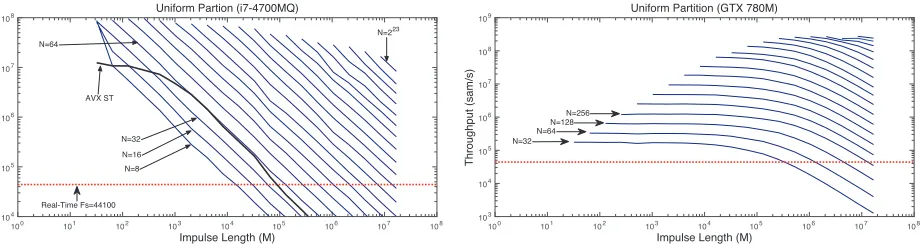
The uniform partition is the simplest way to efficiently parallelise the convolution algorithm [3]. Table 3 gives the number of frames processed per second for each pro-cessor, where multiplying the frames per second with the partition sizeNgives the throughput value. For the CPUs, if the partition size doubles the throughput roughly dou-bles, since the number of processed frames is fairly con-sistent. Table 3 shows that increasingN by a factor of 256 (64 to 16,384) only drops the number of frames by an average factor of 1.73. Figure 7 shows an example of this using the i7-4700MQ CPU.
The discrete GPUs could all process real-time, even with a smallN, due to the increased efficiency from trans-ferring frames of audio less frequently. When the number of filter coefficients is less than the number of workers, the processor is under-utilised. In this state, adding more work does not decrease the processor throughput. Fig-ure 8 provides an example of this using the GTX 780M, however all other tested GPUs exhibit similar behaviour. When the GPUs are fully saturated they exhibit similar performance gains to the CPUs, where doublingN does not significantly reduce the frames processed per second, shown in Table 3 . The integrated HD 4600 GPU had in-stability in testing, likely caused by the CPU consuming resources.
100 101 102 103 104 105 106 107 108
Impulse Length (M)
103 104 105 106 107 108 109
T
h
ro
u
g
h
p
u
t
(sa
m/
s)
Uniform Partition (GTX 780M)
N=32 N=64
N=128 N=256
Figure 8: GTX 780M operating FDL test of various par-tition sizes (N). The red line is 44100 samples/second, above this line the system is real-time.
N0 i7-720Q i7-2635QM i7-4700MQ
64 31,231 27,129 63,531 256 9,676 7,953 20,151 1024 3,156 2,540 6,566
Table 4: Audio frames processed per second operating the nonuniform partition convolution for various initial parti-tion sizes (N0) withM=65,536.
4.3
Nonuniform partitions
Nonuniform partitioning was the most efficient method of operation on the CPU as shown in Table 4, compared with Table 3. The nonuniform method can run with zero-delay by operating the first partition in the time domain, rather than the frequency domain [5]. It is not possible to execute the non-uniform method on a GPU due to the varying partition sizes. The GPUs execute the FFT as a series of identical transforms, processing several vectors at once (batch execution). It would be inefficient to use the GPU for several, non-uniform transforms. Equally it would be complex to map the shared memory of non-uniform blocks onto fixed worker pool sizes.
5
Multi-Processor Convolution
with Direct Form as the first partition. The results show the CPU is the only processor type capable of performing the Direct Form in real-time (Figure 6). The results also show the GPU outperforms the CPU in the partitioned al-gorithms (Table 3). A system which achieves both zero-latency for large signal convolution using both the CPU and GPU in the same processing chain is proposed.
In this sectionMCandMGare the impulse lengths the
CPU and GPU can process individually (M = MC +
MG). N0is the length of the first partition, executed on
the CPU and NG is the length of the partitions on the
GPU.
5.1
Maximize convolution size
The first architecture outlines how to maximize the convo-lution size that can be processed on a system whilst meet-ing real-time constraints. The first filter partition must be processed using the Direct Form on the CPU. All CPUs have a point where the Direct Form becomes more ex-pensive than the frequency domain convolution [5]. This point is the ‘cross over’ between the two methods. To al-low a partition-based system to operate ahead of schedule, guaranteeing real-time performance [5], the Direct Form computation must be double this value.
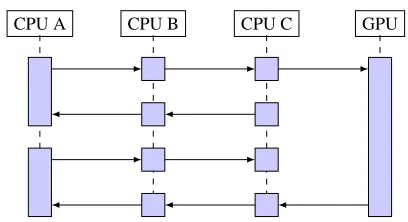
The remaining CPU cores can perform the FDL (see Figure 2) or the nonuniform partition to cover more of the signal. Each core can operate larger partition sizes than the previous since its processing time can be masked by the combined length of the previous cores. For in-stance, if two cores process a total of 1,024 samples then the third core can operate at a partition size of up to 512 samples. The GPU then processes the remainder of the signal using an FDL, the most efficient type investigated. The GPU can select a partition size up to half of the entire impulse length covered by the CPU (NG= 0.5MC).
Fig-ure 9 gives a simplified overview of the communication and synchronising between the processors.
As an example, the Alienware 17 platform (see Tables 3 and 4) can process 133,777,344 samples per second us-ing this method. One CPU core operates a Direct Form of
N0 = 128, its tested cross-over point. The next core
op-erates an nonuniform partition up to the testedM = 224
with a first partition size ofN0/2 = 64. This gives the
CPU a theoretical processing length ofMC= 128 + 224.
The HD 4600 processor could also operate high volumes,
CPU A CPU B CPU C GPU
Figure 9: Example cycle of the multiprocessor schedul-ing. CPU A performs the Direct Form with CPUs B and C operating the frequency delay line at half frame size. The combined delays allows the GPU to process four times the frame length per invocation
however it will reduce CPU throughput since it is on-chip, so is unused. The GTX 780M could use any tested par-tition rate, limited only by the amount of RAM on-board (4096MB, orMG = 1.17×10⁸). The total number of
samples then equals M = MC+MG = 128 + 224+
1.17×10⁸which equals 3,033.5s (atfs= 44100).
5.2
Minimize CPU load
The CPU is a heavily shared resource, having to maintain other software tasks on a modern machine. It is there-fore undesirable to operate the CPU at 100%. As with the previous method, one CPU core must operate the Direct Form at double the cross-over point. The GPU can then perform an FDL with a partition size up toNG=MC/2.
If more samples are needed, the CPU can perform limited FDLs to extend the total length of time.
To provide an example, the Alienware 17 platform’s CPU can operate a very small fraction of the total impulse response. The CPU must still perform a Direct Form at
N0= 128, the calculated efficiency cross-over. Therefore
MC =N0since it only performs this task. At this level
the GTX 780M can actually perform a very high through-put (see Table 2), achievingMG = 221. In this case the
total convolution lengthM is 2,097,280 samples (47.55s atfs= 44100). This is significantly shorter than the
6
Conclusion
This paper has introduced a novel method for processing large convolution kernels in real-time with zero system latency. It has outlined the existing methods for perform-ing low-latency convolution on discrete signals. These methods were executed on a number of modern system architectures and their effectiveness were evaluated. Any weaknesses were identified, such as CPU code efficien-cies and GPU memory communication latenefficien-cies. The proposed method combines the CPU and GPU in a pro-cessing chain, outlining a method for maximum perfor-mance using the CPU and GPU at full capacity. It also shows the GPU can offload the majority of this work, al-lowing for large signal convolution of over 2 million sam-ples with a theoretical CPU usage of under 1%.
References
[1] V. Valimaki, J. D. Parker, L. Savioja, J. O. Smith, and J. S. Abel, “Fifty years of artificial reverber-ation,” IEEE Transactions on Audio, Speech, and Language Processing, vol. 20, no. 5, pp. 1421–1448, July 2012.
[2] J. O. Smith III,Mathematics of the Discrete Fourier Transform (DFT), with Audio Applications, 2nd ed. http://www.w3k.org/books/: W3k Publishing, 2007, ISBN 978-0-9745607-4-8.
[3] C. Burrus, “Block realization of digital filters,”
IEEE Transactions on Audio and Electroacoustics, vol. 20, no. 4, pp. 230–235, Oct 1972.
[4] G. P. M. Egelmeers and P. C. W. Sommen, “A new method for efficient convolution in frequency do-main by nonuniform partitioning for adaptive fil-tering,” IEEE Transactions on Signal Processing, vol. 44, no. 12, pp. 3123–3129, Dec 1996.
[5] W. G. Gardner, “Efficient convolution without in-put/output delay,” inProc. of the 97th Audio Engi-neering Society Convention. San Francisco, CA, USA: Audio Engineering Society, Nov. 1994.
[6] E. Battenberg and R. Avizienis, “Implementing real-time partitioned convolution algorithms on conven-tional operating systems,” inProceedings of the 14th
International Conference on Digital Audio Effects. Paris, France, 2011.
[7] T. Kite, “IIR filters for audio test and measurement: Design, implementation, and optimization,” in
Audio Engineering Society Convention 137, Oct 2014. [Online]. Available: http://www.aes.org/e-lib/ browse.cfm?elib=17507
[8] J. D. Owens, D. Luebke, N. Govindaraju, M. Harris, J. Krger, A. E. Lefohn, and T. J. Purcell, “A survey of general-purpose computation on graphics hardware,” Computer Graphics Forum, vol. 26, no. 1, pp. 80–113, 2007. [Online]. Available: http: //dx.doi.org/10.1111/j.1467-8659.2007.01012.x
[9] J. Ao, S. Mitra, and B. Nutter, “Fast and efficient lossless image compression based on cuda parallel wavelet tree encoding,” in2014 Southwest Sympo-sium on Image Analysis and Interpretation, April 2014, pp. 21–24.
[10] D. Ciregan, U. Meier, and J. Schmidhuber, “Multi-column deep neural networks for image classifica-tion,” in2012 IEEE Conference on Computer Vision and Pattern Recognition, June 2012, pp. 3642–3649.
[11] D. Steinkraus, I. Buck, and P. Y. Simard, “Using GPUs for machine learning algorithms,” in Eighth International Conference on Document Analysis and Recognition (ICDAR’05), Aug 2005, pp. 1115– 1120 Vol. 2.
[12] N. Tsingos, W. Jiang, and I. Williams, “Using programmable graphics hardware for acoustics and audio rendering,” J. Audio Eng. Soc, vol. 59, no. 9, pp. 628–646, 2011. [Online]. Available: http://www.aes.org/e-lib/browse.cfm?elib=15979
[13] L. Savioja, V. V¨alim¨aki, and J. O. Smith, “Audio signal processing using graphics processing units,”
JAES, vol. 59, no. 1/2, pp. 3–19, Jan/Feb 2011. [Online]. Available: http://www.aes.org/e-lib/ browse.cfm?elib=15772
Convention. Los Angeles, CA, USA: Audio En-gineering Society, Oct. 2014.
[15] R. Vuduc, A. Chandramowlishwaran, J. Choi, M. Guney, and A. Shringarpure, “On the limits of GPU acceleration,” in Proceedings of the 2nd USENIX conference on Hot topics in parallelism, vol. 13. USENIX Association, 2010.
[16] G. Garcia, “Optimal filter partition for efficient con-volution with short input/output delay,” inProc. of the 113th Audio Engineering Society Convention. Los Angeles, CA, USA: Audio Engineering Society, Oct. 2002.
[17] D. A. Burgess, “Techniques for low cost spa-tial audio,” in Proceedings of the 5th Annual ACM Symposium on User Interface Software and Technology, ser. UIST ’92. New York, NY, USA: ACM, 1992, pp. 53–59. [Online]. Available: http://doi.acm.org/10.1145/142621.142628
[18] A. Torger and A. Farina, “Real-time partitioned con-volution for ambiophonics surround sound,” in Pro-ceedings of the 2001 IEEE Workshop on the Appli-cations of Signal Processing to Audio and Acoustics (Cat. No.01TH8575), 2001, pp. 195–198.
[19] C. Mller-Tomfelde, “Low-latency convolution for real-time applications,” in Audio Engineering So-ciety Conference: 16th International Conference: Spatial Sound Reproduction, Mar 1999.
[20] F. Wefers and J. Berg, “High-performance real-time FIR-filtering using fast convolution on graph-ics hardware,” in Proc. of the 13th Conference on Digital Audio Effects, Grax, Austria, Sep. 2010.
[21] J. A. Belloch, A. Gonzalez, F. J. Mart´ınez-Zald´ıvar, and A. M. Vidal, “Real-time massive convolution for audio applications on gpu,” The Journal of Supercomputing, vol. 58, no. 3, pp. 449–457, 2011. [Online]. Available: http: //dx.doi.org/10.1007/s11227-011-0610-8
[22] T. Ilmonen and T. Lokki, “Extreme filters-cache-efficient implementation of long iir and fir filters,”
![Figure 5: Gardner technique with four sub-partitions [5].](https://thumb-us.123doks.com/thumbv2/123dok_us/995594.1599277/3.612.87.287.130.182/figure-gardner-technique-with-four-sub-partitions.webp)