International Journal of Computer Information Systems and Industrial Management Applications. www.mirlabs.net/ijcisim/index.html
Flat Splicing Array Grammar Systems Generating
Picture Arrays
G. Samdanielthompson1, N. Gnanamalar David1, Atulya K. Nagar2and K.G. Subramanian2 1Department of Mathematics, Madras Christian College,
Tambaram, Chennai 600059 India {samdanielthompson,ngdmcc}@gmail.com
2Department of Mathematics and Computer Science, Faculty of Science, Liverpool Hope University, Liverpool, L16 9JD, UK
[email protected],[email protected]
Abstract: While studying the recombinant behaviour of DNA molecules, Head (1987) introduced a new operation, called splicing on words or strings, which are finite sequences of sym-bols. There has been intensive research using the concept of splicing on strings in the context of DNA computing, establish-ing important theoretical results on computational universality. A particular class of splicing, known as flat splicing on strings was recently considered and this operation was extended to pro-vide picture array generating two-dimensional models. Making use of the operation of flat splicing on arrays, we propose here a grammar system, called flat splicing regular array grammar system (FSRAGS), as a new model of picture generation. The components of a FSRAGS generate picture arrays working in parallel using the rules of a two-phase grammar called 2RLG and with two different components of the FSRAGS communi-cating using the array flat splicing operations on columns and rows of the arrays. We establish some comparison results bring-ing out the generative power of FSRAGS and also exhibit the power of FSRAGS in generating certain “floor designs”.
Keywords: Flat splicing, Picture array, Picture language, Formal languages, Grammars, Grammar systems
I. Introduction
In the quest for creating alternatives for the classical silicon-based computing, the field of DNA computing [13, 14], besides others, was born with Adleman solving a small instance of Hamilton path problem [1] based on the use of DNA molecules and operations on DNA sequences. In the study of modelling the DNA recombination process under the action of restriction enzymes and a ligase, Head [8] abstracted this phenomenon in his seminal paper on a formal model of the recombinant behaviour of DNA molecules and defined the operation of splicing of words, which are strings of symbols. This operation of splicing of two wordsu = u1u2 andv = v1v2 involves “cutting”u, betweenu1 andu2 and v,between v1 and v2, as dictated by certain rules known as “splicing rules” and “pasting” the prefixu1 of uwith the suffixv2 of v yielding a new word
w=u1v2.Subsequently, this opened up several theoretical investigations [6, 10, 11] giving rise to important and deep
language-theoretic results in the area of formal language theory, which is widely accepted to be the backbone [5, 12] of theoretical computer science.
Based on the fact that DNA occur in circular form, Head [9, 10] introduced the operation of splicing on circular words. Motivated by a specific form of splicing on circular words, recently, a different form of splicing, called flat splicing on words has been introduced in [2]. The operation of flat splicing on a pair of words(α, β)involves “cutting”
αand “inserting”β into it, as directed by a rule, called flat splicing rule.
Inspired by problems in image processing, several gen-erative models of two-dimensional picture arrays based on language theory, have been proposed and studied (see, for example, [7, 15, 16, 21, 24]). Recently, the operation of flat splicing on words has been extended to picture arrays [23] and an array flat splicing system(AF S)has been defined to describe picture array languages.
On the other hand, the notion of a grammar system consisting of several grammars or other language identifying mechanisms cooperating according to some well-defined protocol, was introduced as a formal framework for mod-elling distributed complex systems [3]. Based on different motivations, a variety of grammar system models have been proposed and intensively investigated. A different type of grammar system, called Splicing Grammar System was introduced in [4] with the component grammars working in parallel and communication between components being done by the bio-inspired operation of splicing on strings of symbols introduced by Head [8]. This system was extended to arrays in [22] by introducing splicing array grammar system.
phase grammar 2RLG [7, 19] working in parallel and the array flat splicing operation [23] is used for communication among two different components in terms of “insertion” of an array generated in a component into an array generated in a different component. We establish some comparison results bringing out the power of (F SRAGS). We also exhibit the use of (F SRAGS)in generating certain “floor designs”. A preliminary version of this paper appears in [18].
II. Preliminaries
For notions and results related to formal string languages and array languages, we refer to [7, 17].
A linear word or simply, a word w = a1a2· · ·an is a finite sequence of symbolsai,1≤i≤n, taken from a finite alphabetΣ. The empty word with no symbols, is denoted by λ.The set of all words over Σis denoted by Σ∗. The length|w|of a wordwis the number of symbols in the word, including repetitions of symbols. For example,the length of the wordabaabis 5. For any wordw, we denote bytwthe wordwwritten vertically. For example, ifw =abbabover {a, b},then
tw=
a b b a b .
A picture array or simply, an arrayM of sizem×nover an alphabetΣis a rectangular array withmrows andncolumns and is of the form
M =
a11 · · · a1n ..
. . .. ...
am1 · · · amn
where each symbol aij ∈ Σ,1 ≤ i ≤ m,1 ≤ j ≤ n. We denote by |M|r and|M|c,the number of rows and the number of columns ofM respectively. The set of all rectan-gular arrays overΣis denoted byΣ∗∗, which includes also the empty array λwith no symbols. Σ++ = Σ∗∗ − {λ}. A picture language is a subset ofΣ∗∗. The column catena-tion X◦Y of an arrayX of sizep×qand an arrayY of
r×sis defined only whenp=rand likewise the row cate-nationX Y is defined only whenq = s. In other words, in column catenationX◦Y,Y is attached to the right ofX
while in row catenationXY,Y is attached belowX. Also
X◦λ=λ◦X =Xλ=λX =X, for every arrayX. For example, if
X =
a a b b a b a b b a b a
, Y =
a b b a b a b a b
, Z = b b a
a a b
then
X◦Y =
a a b b a b b a b a b a b a b a b a b a b
, YZ=
a b b a b a b a b b b a a a b
,
An array grammar model of the non-isometric variety gen-erating rectangular arrays of symbols is the two-dimensional right-linear grammar (originally called 2D matrix grammar [19]), which we call here as a two-dimensional right-linear grammar, consistent with the terminology used in [7]. Definition 1 A two-dimensional right-linear grammar (2RLG) [7, 19] is
G = (Vh, Vv, Vi, T, S, Rh, Rv)where Vh, Vv, Vi are finite sets of symbols, respectively called as horizontal nonter-minals, vertical nonterminals and intermediate symbols;
Vi ⊂Vv;T is a finite set of terminals;S ∈ Vhis the start symbol; Rh is a finite set of horizontal rules of the form
X → AY, X → A X, Y ∈ Vh, A ∈ Vi; Rv is a finite set of vertical rules of the form X → aY or X → a, X, Y ∈Vi, a∈T∪λ.
There are two phases of derivation in a2RLG. In the first horizontal phase, starting with S the horizontal rules are applied (as in a regular grammar) generating strings over intermediates, which act as terminals of this phase. In the second vertical phase each intermediate in such a string serves as the start symbol for the second phase. The vertical rules are applied in parallel in this phase for generating the columns of the rectangular arrays over terminals. In this phase at a derivation step, either all the rules applied are of the form X → aY, a ∈ T or all the rules are of the form X → Y or all the rules are the terminating vertical rules of the form X → a, a ∈ T or all of the form X → λ. When the vertical generation halts, the array obtained over T, is collected in the picture language generated by the 2RLG. Note that the picture language generated by a 2RLG consists of rectangular arrays of symbols. We denote byL(2RLG)the family of array lan-guages generated by two-dimensional right-linear grammars. We illustrate the working of2RLGwith an example. Example 1 Consider the2RLG GLwith regular horizontal rulesS → AX, X → BX, X → B where A, B are the intermediate symbols and the vertical rulesA →aA, A→
a, B →bB, B →awherea, bare the terminal symbols. In the first phase, as in a string grammar, the horizontal rules generate words of the formABn, n ≥ 1.For example, the generation ofAB3is as given below:
S⇒AX⇒ABX⇒ABBX⇒ABBB=AB3
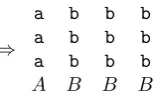
on applying the three horizontal rules one after another, with the rule X → BX applied twice. In the second phase every symbol in such a word ABn is rewritten in paral-lel either by using the rulesA → aA, B → bB in which case the derivation can be likewise continued adding rows of the formab· · ·b or by using the rulesA → a, B → a
in which case the derivation terminates adding a row of the formaa· · ·a,thus generating picture arrays, one member of which is shown in Fig. 1. In fact, for this picture array, the derivation in the second phase is as follows:
A B B B ⇒ a b b b
A B B B ⇒
a b b b a b b b
⇒
a b b b a b b b a b b b
A B B B
on applying the nonterminal rulesA→aA, B→bB.When the terminal rulesA → a, B → bB, B → aare applied together, derivation terminates yielding the array in Fig. 1.
a b b b a b b b a b b b a a a a
Figure. 1: A picture array generated in Example 1 An extension of the 2RLG, which we call here as two-dimensional tabled right-linear grammar (2T RLG) (originally referred to as 2D tabled matrix grammar in [20]) was introduced in [20] to generate picture languages that cannot be generated by any 2RLG. A 2T RLG is defined similar to a 2RLG with the following difference: In the second phase, the right-linear rules are grouped into different sets, called tables such that i) all the rules in a table are nonterminal rules of the form eitherA→aBonly or A → B only or ii) all are terminal rules of the form eitherA→ aonly orA→ λonly and at a time rules from only one table are used in the second phase. We denote byL(2T RLG)the family of array languages generated by two-dimensional tabled right-linear grammars.
As an illustration, we give an example of a2T RLG.
Example 2 Consider the2T RLG GHwith regular horizon-tal rulesS → AX, X → BX, X → BY, Y → Awhere
A, Bare the intermediate symbols and the tables of vertical rules aret1={A→aA, B→bB},t2={A→aC, B→
cD},t3 ={C → aC, D→ bD},t4 ={C → a, D →b} wherea, b, care the terminal symbols. In the first phase, the horizontal rules generate words of the formABnA, n ≥1. In the second phase every symbol in such a wordABnAis rewritten in parallel by using the tables of rules. Application of the tablet1certain number of times, followed byt2once which is then followed byt3 again certain number of times and finally terminating the derivation in this second phase, generates picture arrays, one member of which is shown in Fig. 2.
a b b b b a a b b b b a a b b b b a a c c c c a a b b b b a a b b b b a
Figure. 2: A picture array generated in Example 2 An operation, called flat splicing on linear words, is consid-ered by Berstel et al. [2]. A flat splicing ruleris of the form
(α|γ−δ|β), whereα, β, γ, δare words over a given alphabet
Σ. For two wordsu = xαβy, v = γzδ, an application of the flat splicing ruler= (α|γ−δ|β)to the pair(u, v)yields
the wordw=xαγzδβy. In other words, the second wordv
is inserted betweenαandβin the first worduas a result of applying the ruler.
The notion of flat splicing on words [2] has been ex-tended to arrays in [23], by introducing two kinds of flat splicing rules, called column flat splicing rule and row flat splicing rule and thus a new model of picture gen-eration, called array flat splicing system is introduced in [23]. Definition 2 [23] LetV be an alphabet.
(i) A column flat splicing rule is of the form
(t(a1a2)|t(x1x2) − t(y1y2)|t(b1b2)) where
a1, a2, b1, b2 ∈ Σ ∪ {λ} with |a1| = |a2| and |b1|=|b2|, x1, x2, y1, y2 ∈ Σ∪ {λ}with|x1|=|x2| and|y1|=|y2|.
(ii) A row flat splicing rule is of the form
(c1c2|u1u2−v1v2|d1d2)where
c1, c2, d1, d2 ∈ Σ ∪ {λ} with |c1| = |c2| and |d1|=|d2|, u1, u2, v1, v2 ∈ Σ∪ {λ}with|u1|=|u2| and|v1|=|v2|.
(iii) Letr1, r2,· · ·, rm−1be a sequence of(m−1)column flat splicing rules given by
ri= (t(αiαi+1)|t(γiγi+1)−t(δiδi+1)|t(βiβi+1)),
for1 ≤i≤(m−1). LetX, Y be two picture arrays, each withmrows, for somem≥1, and given by
X =X1◦t(α1α2· · ·αm)◦t(β1β2· · ·βm)◦X2,
Y =t(γ1γ2· · ·γm)◦Y0◦t(δ1δ2· · ·δm), where X1, X2, Y0 are arrays over Σ with m rows,
αi, βi,∈ Σ∪ {λ} (1≤i≤m),with|α1|=|α2|= · · · = |αm|,|β1| = |β2| = · · · = |βm|, γi, δi,(1 ≤
i ≤ m), ∈ Σ∪ {λ}with|γ1| =|γ2| = · · · = |γm|, |δ1|=|δ2|=· · ·=|δm|. An application of the column flat splicing rulesr1, r2,· · · , rm−1to the pair of arrays
(X, Y)yields the array Z
=X1◦t(α1α2· · ·αm)◦t(γ1γ2· · ·γm)◦
Y0◦t(δ
1δ2· · ·δm)◦t(β1β2· · ·βm)◦X2.
The pair (X, Y) yielding Z is then denoted by
(X, Y)`cZ.
(iv) Lets1, s2,· · ·, sn−1be a sequence of(n−1)row flat splicing rules given by
sj = (ηjηj+1|(µjµj+1)−(νjνj+1)|θjθj+1),
for1 ≤j ≤(n−1).LetU, V be two picture arrays, each withncolumns, for somen≥1,and given by
U =U1(η1η2· · ·ηn)(θ1θ2· · ·θn)U2,
whereU1, U2, V0 are arrays overΣ withn columns,
ηj, θj,(1 ≤ j ≤ n),∈ Σ∪ {λ}with|η1| =|η2| = · · · = |ηn|,|θ1| = |θ2| = · · · = |θn|, µj, νj,(1 ≤
j ≤ n),∈ Σ∪ {λ}with|µ1| = |µ2| = · · · = |µn|, |ν1| = |ν2| = · · · = |νn|.An application of the row flat splicing ruless1, s2,· · ·, sn−1to the pair of arrays
(U, V)yields the array W
=U1(η1η2· · ·ηn)(µ1µ2· · ·µn)V0 (δ1δ2· · ·δn)(θ1θ2· · ·θn)U2.
The pair (U, V) yielding W is then denoted by
(U, V)`rW.
(v) An array flat splicing rule is either a column flat splic-ing rule or a row flat splicsplic-ing rule. The notation` de-notes either`cor`r.
(vi) For a picture languageL ⊆Σ∗∗ and a setRof array flat splicing rules, we define
f(L) ={M ∈Σ∗∗|(X, Y)`M,forX, Y ∈L,
and some rule inR}.
(vii) An array flat splicing system (AF S) is A = (Σ, M, Rc, Rr)whereΣis an alphabet,M is a finite set of arrays overΣ, called initial set, Rc is a finite set of column flat splicing rules andRris a finite set of row flat splicing rules. The picture languageL(A)
generated byAis iteratively defined as follows:
f0(M) =M; For i≥0,
fi+1(M) =fi(M)∪f(fi(M));
L(A) =f∗(M) =∪i≥0fi(M).
The family of picture languages generated by array flat splicing systems is denoted byL(AF S).
An illustration of the application of column and row flat splicing rules as well as the working of an array flat splicing system is given in the following example.
Example 3 Consider the array flat splicing system AR with alphabet {a, b} and the initial set consisting of the
array M = { a b
a b }. The column flat splicing rule is
c where c = ( a
a | a a −
b b |
b
b ). The row flat splicing
rules are r1, r2, r3 where r1 = (aa|aa −aa|aa), r2 =
(ab|ab−ab|ab), r3= (bb|bb−bb|bb).
The column flat splicing rule c is applicable to the pair (M, M). Note that both the components in the pair being the same initial array M, the requirement of equal number of rows for the application of column flat splicing rulecis satisfied. Also the second array in the pair begins
with the column a
a and ends with the column b b , as
required in the rulec. The first array is “cut” between the
columns a
a and b
b while the second array is “inserted”
between them, yielding the array a a b b
a a b b . On the
other hand, the row flat splicing rulesr1, r2can be used to expand the array rowwise. For example, the sequence of rulesr1, r2, r3 could be applied to the pair of arrays with
both components having the same array a a b b
a a b b .
Again note that both the components in the pair being the same array, the requirement of equal number of columns for the application of a sequence of row flat splicing rules, is satisfied. In fact, the first array is “cut” between the first row a a b b and the second row which is also
a a b b . The second array satisfies the require-ments of the sequence of rules r1, r2, r3.The second array therefore can be “inserted” into the first array to yield the
array
a a b b a a b b a a b b a a b b
. Proceeding like this, we compute the
successive termsf0(M), f1(M),· · ·. In fact
f0(M) =M ={ a b
a b },
f1(M) =M∪f(M) ={ a b
a b ,
a a b b a a b b ,
a b a b a b a b
,},
· · · .
Thus the picture languageL(AR) =f∗(M)consists of rect-angular arrays of even side length over the symbolsa, b.Also if the number of columns in such an array is2n,then the first
ncolumns are overawhile the nextncolumns are overb.
a a a b b b a a a b b b a a a b b b a a a b b b
Figure. 3: A member of the language ofAR
One such picture array is shown in Fig. 3.
III. Flat Splicing Regular Array Grammar
System
We now introduce a new model of picture generation, called flat splicing array gramnmar system.
Definition 3 A flat splicing regular array grammar system
(F SAGS)is a construct
Gas = (Vh, Vv, Vi, T,(S1, Rh1, Rv1), ...,(Sn, Rhn, Rvn), F) whereVh, Vv, Viare respectively, the finite sets of horizontal, vertical and intermediate nonterminals; Vi ⊆ Vv;T is the terminal alphabet; Si,1 ≤ i ≤ n is the start symbol of the corresponding component; Rh
i,1 ≤ i ≤ nis a finite set of horizontal rules, which are regular of the forms
X → AY, X → A, X, Y ∈ Vh, A ∈ Vi;Rvi,1 ≤ i ≤ n is a finite set of right-linear vertical rules of the forms
two phases as follows :
Each component grammar generates a word called in-termediate word, over inin-termediates starting from its own start symbol and using its horizontal rules ; the derivations in this phase are done with the component grammars working in parallel.
In the second phase any of the following steps can take place:
(i) each component grammar can rewrite as in a two di-mensional matrix grammar using the vertical rules, starting from its own intermediate word generated in the first phase. (The component grammars rewrite in par-allel and the rules are applied together). Note that the component grammars together terminate with all rules used in the formA→aor together continue rewriting in the vertical direction with all rules used either in the formA→aBor in the formA→B.
(ii) At any instant the picture array X generated in the
ith component for some i,1 ≤ i ≤ n and the pic-ture arrayY generated in thejthcomponent for some
j, 1≤j≤ncan be flat spliced using array flat splicing rules, either column or row flat splicing rules as in defi-nition 2, thus yielding picture arrayZinithcomponent. In any other component (other thanithcomponent), the arrays generated at this instant will remain unchanged during this flat splicing process.
There is no priority between steps (i) and (ii).
The language Li(Gas) generated by the ith compo-nent ofGasconsists of all picture arrays, generated overT, by the derivations described above. This language will be called the individual picture array language of the system and we may choose this to be the language of the first com-ponent. The family of individual picture array languages generated by F SRAGS with at most n components is denoted byLn(F SRAGS).
We illustrate the working ofF SRAGSwith an example. Example 4 Consider theF SAGS G1with two components given by
({S1, S2, X, Y},{A, C, D},{A, C, D},{a, c, d},
(S1, Rh1, R v
1),(S2, Rh2, R v 2), F)
where
R1h={S1→AX, X→CX, X →A,},
Rh2 ={S2→Z, Z→DZ, Z→D},
Rv1={A→aA, C →cC, A→a, C →c},
Rv2={A→aA, D→dD, A→a, D→d}
andFconsists of the column flat splicing rule
c1= (
a a |
d d −
d d |
c c ).
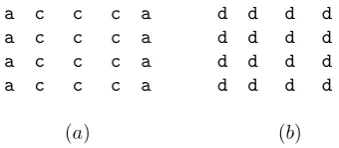
a c c c a a c c c a a c c c a a c c c a
(a)
d d d d d d d d d d d d d d d d
(b)
Figure. 4: (a) Picture array generated in the first component ofG1(b) Picture array generated in the second component
ofG1
a d d d d c c c a a d d d d c c c a a d d d d c c c a a d d d d c c c a
Figure. 5: A picture array generated byG1
Starting from S1, the horizontal regular rules in the first component generate a word of the formACn−1Aon apply-ing the ruleS1 → AXonce followed by the application of the ruleX→CX(n−1)times and finally the ruleX→A
once, terminating the derivation in the first component in the horizontal phase. At the same time in the second component derivations in the horizontal phase take place in parallel starting fromS2and applying the ruleS2→Zonce followed by the application of the rule Z → DZ (n−1)
times and finally the ruleZ → Donce, yielding the word
Dnfor the samen.
In the second phase vertical derivations in both the components take place in parallel. In the first component an m×(n+ 1) picture array as in Fig. 4(a) is generated while in the second component an m×npicture array as in Fig. 4(b) is generated. At this point, using the column flat splicing rule c1 as many times as needed, the array in Fig. 4(b) is inserted in the array in Fig. 4(a) between the first column ofa0sand the second column ofc0sto yield a picture array of the form as in Fig. 5.
Theorem 1
L2(F SRAGS)\L(AF S)6=∅.
Proof 1 The picture array language L generated by the
F SRAGS G1 in Example 4 consists of picture arrays M each of which has the following propertyP :M has exactly two columns of a0swith one, the leftmost column and the other, the rightmost column, besides other columns made of eitherc0sord0s. ButLcannot be generated by any AF S
since the flat splicing rules will “insert” one array ofLinto another, thereby yielding picture arrays which will violate the property mentioned above.
Theorem 2
L(2RLG) =L1(F SRAGS)⊂L2(F SRAGS).
can be applied only when there are at least two compo-nents. The picture array language Lof Example 4, is gen-erated by a F SRAGS with two components. An array of L has the property that there are (n + 1) consecutive columns ofd0s(starting from the second column) followed byncolumns ofc0s.But this property which involves a
pro-portion in the number of columns ofc0sand the number of
columns ofd0s(analogous to the context-free string language {d(n+1)cn|n ≥ 1}) cannot be maintained by regular hori-zontal rules of a2RLGand henceLcannot be generated by any2RLG.Since L(2RLG) = L1(F SRAGS)it follows that any F SRAGS with only one component cannot gen-erate the picture array languageL. This proves the proper inclusionL1(F SRAGS)⊂L2(F SRAGS).
Theorem 3 L2(F SRAGS)\L(2T RLG)6=∅
Proof 3 As noted in the proof of Theorem 2, the picture array language L of Example 4, which is generated by a
F SRAGSwith two components, has the feature that an ar-ray ofLinvolves a proportion in the number of columns of
c0sand the number of columns ofd0s.This property cannot be handled by any2T RLGas the rules in the first phase of a
2T RLGare only regular rules. ThusLcannot be generated by any2T RLG.
In [20], analogous to2T RLG,a two-dimensional grammar, here called two-dimensional tabled context-free grammar
2T CF G(originally called 2D tabled CF matrix grammar) was considered in [20] and this 2D grammar has context-free grammar kind of rules in the first phase while the second phase has tables of right-linear rules as in a2T RLG. Deriva-tions are done as in a2T RLG.We denote byL(2T CF G),
the family of picture array languages generated by2T CF G.
Also, when there are exactly two tables in the second phase of a 2T CF G,with one table consisting of all right-linear rules of the formA → aB and another table consisting of all terminal rules of the formA→ a,whereA, B are non-terminals andais a terminal symbol, the2T RLGis indeed a2RLG.We now show that the familyL3(F SRAGS)of picture languages generated by flat splicing regular array grammar systems with three components,contains picture languages that cannot be generated by any2T CF G.
Theorem 4 L3(F SRAGS)\L(2T CF G)6=∅
Proof 4 Consider the picture array languageL2whose ele-ments are picture arrays with two rows of the forms
M1=
a · · · a b · · · b e d a · · · a b · · · b e d
or
M2=
a · · · a b · · · b c · · · c e d a · · · a b · · · b c · · · c e d
with the columns ofa0sbeing equal in number to the columns ofb0sin the former array while this number also equals the number of columns of c0s in the latter array. This kind of picture language cannot be generated by any2T CF Gas the feature present in the arrays of the formM2,namely, equal number of columns of a0s, b0s andc0sis analogous to the context-sensitive string language{anbncn|n≥1}cannot be handled by the context-free kind of rules in the first phase of a2T CF G.
But the languageL2is generated by the followingF SRAGS
G2with three components: Define
G2= (Vh, Vv, Vi, T,(S1, R1h, R v 1),
(S2, R2h, Rv2),(S3, Rh3, R3v), F)
where
T ={a, b, c, d, e, f}, Vh={S1, S2, S3, X, Y, Z},
Vi={A, D, B, E, C, F},
Vv ={A, D, B, E, C, F, A0, D0, B0, E0, C0, F0,
A00, D00, B00, E00, C00, F00}. Rh1 ={S1→AS1, S1→AX, X→D},
Rh2 ={S2→BS2, S2→BY, Y →E},
Rh3 ={S3→CS3, S3→CZ, Z→F},
Rv1 ={A→
a A0 , D→
d
D0 , A0→A00, B0 →B00,
D0→D00, E0 →E00, A00→a, B00→b, D00→d, E00→e, C00→c, F00→f}
Rv2 ={B→ b
B0 , E→ e E0 , B0 →B00, E0 →E00, B00→b, E00→e}
Rv3={C→ c
C0 , F → f F0 , C0→C00, F0→F00, C00→c, F00→f}
Fconsists of the following column flat splicing rules:
( a
A0 | b B0 −
e E0 |
d D0 ),(
b B00 |
c C00 −
f F00 |
e E00 )
Derivations in the three components take place in parallel with the application of the horizontal rulesS1→AS1, S1→
AX, X → D in the first component yielding the word
AnD for somen ≥ 1, while, likewise, in the second and third components, the horizontal rules yield respectively the wordsBnE andCnF.At a time all three words derived
in-volve the same n. If the vertical rules A → a
A0 , D → d
D0 in the first component are applied, an array of the
form a
A0 · · · a A0
d
D0 is generated in the first
compo-nent while, likewise, application of similar rules in the sec-ond and third components genrate the arrays respectively
of the forms b
B0 · · ·
b B0
e E0 and
c C0 · · ·
c C0
f F0 .If
at this stage, the column flat splicing rule ( a
A0 | b B0 − e
E0 | d
D0 ) is applied, then the array obtained is of the
form a
A0 · · · a A0
b B0 · · ·
b B0
e E0
d
D0 If now the
Figure. 6: A floor design
Figure. 7: Primitive Patterns
into double primed symbols are applied followed by the ap-plication of terminal rules, then picture arrays of the form
a a · · ·
a a
b b · · ·
b b
e e
d d
are generated which are collected in the picture language of
G2. On the otherhand, prior to the application of the
ter-minal rules, if the column flat splicing rule( b
B00 | c C00 − f
F00 |
e
E00 )is applied and the double primed symbols are
changed into terminals by the application of terminal rules, then arrays of the form
a a · · ·
a a
b b · · ·
b b
c c · · ·
c c
f f
e e
d d
are generated and are also collected in the picture language ofG2.
IV. Application to Generation of Floor Designs
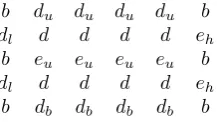
Generation of certain picture patterns, such as “floor de-signs” (see, for example, Fig. 6), using array generating grammar models has been done [19]. The idea is to consider the picture pattern as an array over certain terminal symbols and generate the array with an array grammar. Then substitute for each symbol some relevant primitive pattern of the picture to be generated, yielding the pattern. Here we explain how to construct aF SRAGSwith two components to generate the collection of floor designs, one member of which is shown in Fig. 6. The primitive patterns involved in this floor design are shown in Fig. 7. The picture array encoding the floor design is given in Fig. 8. The picture array language consisting of picture arrays such as the one given in Fig. 8, along with picture arrays as the one given
b du du du du b du du du du b
dl d d d d eh d d d d dr
b eu eu eu eu b eu eu eu eu b
dl d d d d eh d d d d dr
b db db db db b db db db db b
Figure. 8: A picture array generated byGF using array flat splicing
b du du du du b
dl d d d d eh
b eu eu eu eu b
dl d d d d eh
b db db db db b
Figure. 9: A picture array generated byGF
in Fig. 9, can be generated by a F SRAGS GF with two components. We do not give the formal details of GF but informally describe the idea.
The idea is to allow the first component generate the left half of the picture array (with the rightmost column made of only eh) while the second component generates the second half and array flat splicing rules are created to concatenate the “right half” to the right of the “left half”, yielding the picture array of the form in Fig. 8. When the relevant primitive patterns are substituted for the corresponding symbols, this yields the floor design patterns as in Fig. 6.
V. Conclusion and Discussion
We have considered here a grammar system that involves regular rules as defined in the two-phase 2RLG and array flat splicing rules introduced in [23]. One could also con-sider in the flat splicing array grammar system, CF horizon-tal rules as in the two-phase two-dimensional grammar called context-free matrix grammar considered in [19], and exam-ine the generative power of the resulting system, which might help describe more complex floor designs. In fact it will be of interest to explore the theoretical model proposed here for other possible applications in terms of experimental studies.
Acknowledgments
The authors are grateful to the reviewers for their very useful comments.
References
[1] Adleman, L.M.: Molecular Computation of Solu-tions to Combinatorial Problems, Science New Series, 266(5187) (1994) 1021-1024.
[2] Berstel, J., Boasson, L., Fagnot, I. : Splicing systems and the Chomsky hierarchy. Theoret. Comput. Sci. 436, 2 -22 (2012).
distri-bution and cooperation. Gordon and Breach Science Publishers, 1994.
[4] Dassow, J., Mitrana, V.: Splicing grammar systems. Computers and Artificial Intell. 15, 109-122 (1996). [5] Esik, Z., Martin-Vide, C., Mitrana, V. (Eds.):
Re-cent Advances in Formal Languages and Applica-tions, Studies in Computatioinal Intelligence, Springer-Verlag, 2006.
[6] Freund, R., Kari, L., P˘aun, Gh.,: DNA Computing Based on Splicing: The Existence of Universal Com-puters. Theory Comput. Syst. 32(1): 69-112 (1999) [7] Giammarresi, D., Restivo, A.: Two-dimensional
lan-guages. In: [7], Vol. 3, pp. 215-267 (1997).
[8] Head, T.: Formal language theory and DNA: an anal-ysis of the generative capacity of specific recombinant behaviours. Bull. Math. Biol. 49, 735-759 (1987). [9] Head, T., Circular suggestions for DNA Computing,
In: Pattern Formation in Biology, Vision and Dynam-ics(Ed. Carbone, A. et al.), World Scientific, (2000) 325-335.
[10] Head, T., P˘aun, Gh., Pixton, D. : Language theory and molecular genetics: generative mechanisms suggested by DNA recombination, In: [7], Vol. 2, pp. 295-358, 1997.
[11] Head, T., Pixton, D.: Splicing and Regularity. Recent Advances in Formal Languages and Applications 2006: 119-147
[12] Martin-Vide, C., Mitrana, V., P˘aun, Gh. (Eds.): Formal Languages and Applications. Springer-Verlag, 2004 [13] P˘aun, Gh.: DNA computing based on splicing:
uni-versality results. Theor. Comput. Sci. 231(2): 275-296 (2000)
[14] P˘aun, Gh., Rozenberg, G., Salomaa, A. : DNA Com-puting - New ComCom-puting Paradigms. Texts in Theo-retical Computer Science. An EATCS Series, Springer 1998.
[15] A. Rosenfeld, Picture Languages. Academic Press, Reading, MA, 1979.
[16] A. Rosenfeld, R. Siromoney, Picture languages – a sur-vey, Languages of Design, 1 (1993) 229-245.
[17] Rozenberg, G., Salomaa, A. (Eds.): Handbook of For-mal Languages Vol. 1–3, Springer, Berlin, (1997). [18] Subramanian, K.G., Samdanielthompson, G., David,
N.G., Nagar, A.K. : Generating Picture Arrays Based on Grammar Systems with Flat Splicing Operation,In: V. Snel et al. (eds.), Innovations in Bio-Inspired Com-puting and Applications, Advances in Intelligent Sys-tems and Computing 424,Springer International Pub-lishing Switzerland 2016, 251-261.
[19] Siromoney, G., Siromoney, R., Krithivasan, K. : Ab-stract families of matrices and picture languages. Com-put. Graph. Imag. Process. 1, 284-307 (1972).
[20] Siromoney, R., Subramanian, K.G., Rangarajan, K. : Parallel/Sequential rectangular arrays with tables. Int. J. Comput. Math., 6A, 143-158 (1977)
[21] Subramanian, K.G., Ali, R.M., Geethalakshmi, M., Na-gar, A.K. : Pure 2D picture grammars and languages. Discrete Appl. Math. 157 (2009) 3401-3411.
[22] Subramanian, K.G., Roslin Sagaya Mary, A., Der-sanambika, K.S. : Splicing Array Grammar Systems, Proc. International Colloquium Theoretical Aspects of Computing 2005, Lecture Notes in Computer Science 3722, Springer 125-135 (2005).
[23] Subramanian, K.G., Nagar, A.K., Pan, L. : A Pic-ture Array Generating Model Based on Flat Splicing Operation, Proc. of the 10th International Conference on Bio-inspired Computing:Theories and Applications (BICTA), (2015).
[24] Subramanian, K.G., Rangarajan, K., Mukund. M. (Eds.): Formal Models, Languages and Applications. Series in Machine Perception and Artificial Intell. Vol. 66, World Scientific Publishing, 2006.
Author Biographies
G. Samdaielthompson was born on March 13, 1990. He is pursuing his PhD programme from January 2015 in the Department of Mathematics, Madras Christian College, In-dia with Prof. N. Gnanamalar David as his supervisor. He received his M.Phil degree in the year 2014. His research in-terests include DNA computing, picture languages and graph languages.
His research is multi-disciplinary with expertise in Nonlin-ear Mathematics, Natural Computing, Bio-Mathematics and Computational Biology, Operations Research, and Control Systems Engineering. He has edited volumes on Intelligent Systems, and Applied Mathematics. He is the Editor-in-Chief of the International Journal of Artificial Intelligence and Soft Computing (IJAISC) and serves on editorial boards for a number of prestigious journals such as the Journal of Universal Computer science. He has more than 200 pub-lications in prestigious publishing outlets and journals such as the Journal of Applied Mathematics and Stochastic Anal-ysis, the International Journal of Advances in Engineering Sciences and Applied Mathematics, the International Journal of Foundations of Computer Science, the IEEE Transactions on Systems, Man, and Cybernetics, Discrete Applied Math-ematics, Fundamenta Informaticae, IET Control Theory and Applications and others.