A consistent four-body CDCC model of
low-energy reactions: Application to
9
Be+
208Pb
M. S. Hussein1,2,3, P. Descouvemont4 and L. F. Canto5,6
1 Departamento de F´ısica Matem´atica, Instituto de F´ısica, Universidade de
S˜ao Paulo, C.P. 66318, 05314-970, S˜ao Paulo, SP, Brazil
2 Instituto de Estudos Avan¸cados, Universidade de S˜ao Paulo, C.P. 72012,
05508-970, S˜ao Paulo, SP, Brazil
3 Departamento de F´ısica, Instituto Tecnol´ogico de Aeron´autica, CTA,
S˜ao Jos´e dos Campos, S˜ao Paulo, SP, Brazil
4 Physique Nucl´eaire Th´eorique et Physique Math´ematique, C.P. 229,
Universit´e Libre de Bruxelles (ULB), B 1050 Brussels, Belgium
5 Instituto de F´ısica, Universidade Federal do Rio de Janeiro, C.P. 68528,
21941-972 Rio de Janeiro, RJ, Brazil
6 Instituto de F´ısica, Universidade Federal Fluminense, Av. Gal. Milton
Tavares de Souza s/n, Niter´oi, RJ, Brazil
Abstract
We investigate the 9Be+208Pb elastic scattering, breakup and fu-sion at energies around the Coulomb barrier. The three processes are described simultaneously, with identical conditions of calculations. The 9Be nucleus is defined in an α+α+n three-body model, using the hyperspherical coordinate method. We first analyze spectroscopic properties of9Be, and show that the model provides a fairly good de-scription of the low-lying states. The scattering with 208Pb is then studied with the Continuum Discretized Coupled Channel (CDCC) method, where the α+α+n continuum is approximated by a dis-crete number of pseudostates. Optical potentials for theα+208Pb and
elastic-1
Introduction
Many experiments have been performed with the 9Be nucleus, used as a target or as a projectile [1]. Although9Be is stable, it presents a Borromean structure, as the well known halo nucleus 6He. None of the two-body sub-systemsα+norα+α is bound in9Be, which has important consequences on the theoretical description of this nucleus. Precise wave functions must include the three-body nature of9Be. The hyperspherical formalism [2] is an ideal tool to describe three-body Borromean systems, as it does not assume a specific two-body structure, and considers the three particlesα+α+non an equal footing.
In the present work [3], we aim at investigating9Be scattering and fusion on a heavy target. The reaction framework is the Continuum Discretized Coupled Channel (CDCC) method (see Ref. [4] for a recent review), which is well adapted to weakly bound projectiles since it allows to include breakup channels. Going from two-body projectiles (such as d=p+n or 7Li=α+t) to three-body projectiles, however, strongly increases the complexity of the calculations, even if both options eventually end up with a standard coupled-channel system.
Many data have been obtained for 9Be+208Pb elastic scattering [5, 6] and fusion [7, 8]. These experimental data provide a good opportunity to test 9Be wave functions. No assumption should be made about the cluster structure, and α+208Pb as well as n+208Pb optical potentials are available in the literature.
2
Three-body model of
9Be
The determination of the 9Be wave functions is the first step for the
9Be+208Pb CDCC calculation. For a three-body system, the Hamiltonian
is given by
H0=
3
i=1 p pp2i
2mi + 3
i<j=1
Vij(rrri−rrrj), (1)
whererrri andpppi are the space and momentum coordinates of the three par-ticles with masses mi, and Vij a potential between nuclei iand j. For the
With these potentials, the 9Be ground state is too bound (−3.12 MeV, while the experimental value is −1.57 MeV with respect to the α+α+n
threshold). We have therefore introduced a phenomenological three-body force which reproduces the experimental binding energy of the 3/2− ground state. The r.m.s. radius, the quadrupole moment, and the magnetic moment are√r2 = 2.36 fm, Q(3/2−) = 4.96 e.fm2, andμ=−1.33 μN, respectively. These values are in fair agreement with experiment (2.45±0.01 fm, 5.29± 0.04e.fm2 and −1.18 μN, respectively)
3
The CDCC method
We present here a brief outline of the CDCC method, and we refer to Ref. [11] for specificities of three-body projectiles. The CDCC method is based on approximate solutions of the projectile Hamiltonian (1)
H0Φjmπk =E0jπ,kΦjmπk , (2)
wherekare the excitation levels in partial wavejπ. Solutions withE0jπ,k<0
correspond to bound states of the projectile, whereas E0jπ,k > 0 correspond to narrow resonances or to approximations of the three-body continuum. These states cannot be associated with physical states, and are referred to as pseudostates. The 9Be spectrum used in the present model is shown in Fig. 1.
The Hamiltonian of the projectile + target system is written as
H(RRR, xxx, yyy) =H0(xxx, yyy)− ¯h
2
2μP TΔR+V(R, xRR xx, yyy) (3)
where μP T is the reduced mass of the system, and RRR the relative coordi-nate. The Jacobi coordinatesxxx and yyy are proportional torrrBe−n and rrrα−α, respectively. The potential term reads
V(RRR, xxx, yyy) =V1t(RRR, yyy) +V2t(RRR, xxx, yyy) +V3t(RRR, xxx, yyy) (4)
where the three components Vit are optical potentials between fragment i
and the target.
In order to solve the Schr¨odinger equation associated with (3), the total wave function with angular momentumJ and parity Π is expanded as
0 2 4 6 8 12
-2
͵Ȁʹି ͷȀʹି ͳȀʹା 10
ܧǡ
గ ሺ
ሻ
Figure 1: Pseudostate energies (defined from theα+α+nthreshold) for the dom-inant partial wavesj= 3/2−,5/2−,1/2+.
whereω is the entrance channel, and where the channel wave functions are given by
ϕJMjπkLΠ(ΩR, xxx, yyy) =iL
Φjπk (xxx, yyy)⊗YL(ΩR) JM
. (6)
The radial functions gJcΠ(R) (we use the notation c = (j, π, k, L)) are ob-tained from the system
−2μ¯h2
P T
d2
dR2 +Ec−E
gJc(Πω)(R) + c
Vc,cJΠ(R)gcJΠ(ω)(R) = 0, (7)
whereE is the c.m. energy, and where the coupling potentials are given by matrix elements
Vc,cJΠ(R) =ϕcJMπ|V|ϕJMπc + ¯h
2
2μP T
L(L+ 1)
R2 δcc. (8)
4
Application to the
9Be+
208Pb system
4.1 Elastic scattering
The calculations are performed with thejπ = 3/2±,5/2±,1/2±partial waves on9Be, and the cutoff energy is 12.5 MeV. Figure 2 shows9Be+208Pb elastic cross sections at two typical energies (the data are taken from Refs. [5, 13]). In contrast with optical-model calculations [5], no renormalization of the potential is needed. The absorption is simulated by the imaginary parts of the α−208Pb and n−208Pb interactions, and by the α+α+n discretized continuum. Calculations involving only the 3/2− ground state are shown as dashed lines, and the full calculations as solid lines. From Fig. 2, it appears that continuum couplings are more important at low energies. At
E = 38 MeV, the single-channel calculation, limited to the 9Be ground state is significantly different from the data. This confirms the conclusion of a previous work [14] which suggests that continuum couplings are more important at low energies.
ܧൌ ͵ͺ
ܧൌ Ͳ
ߠሺሻ
ߪȀ
ߪோ
4.2 Fusion
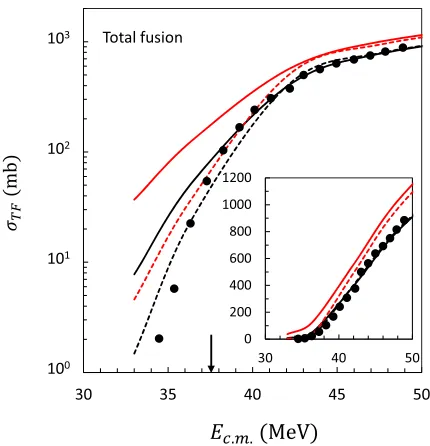
The 9Be+208Pb fusion reaction has been studied theoretically by several groups (see Ref. [15] and references therein). Data about the various mech-anisms (total TF, complete CF and incomplete ICF fusion) are also available in the literature [7, 8, 16].
30 35 40 45 50
Total fusion
ߪ்ி
ሺሻ
103
100 101 102
ܧǤǤሺሻ
0 200 400 600 800 1000 1200
30 40 50
Figure 3: Total fusion cross sections with (black lines) and without (red lines) removal of the neutron capture. The dashed lines represent the single-channel calculations, and the solid lines represent the full calculations. The Coulomb barrier energyVB is indicated by a vertical arrow.
cross sections differ by the neutron absorption which, owing to the lack of a Coulomb barrier, may be quite large.
The CDCC calculation can be adapted to the experimental conditions by using an equivalent definition of the fusion cross section, and by removing the neutron-target imaginary potential. The results obtained in this way are shown in Fig. 3 as black lines. By excluding the neutron capture, we obtain an excellent agreement with experiment aboveEcm≈40 MeV. This is more clearly shown in the inset, drawn in a linear scale. We confirm previous CDCC calculations [15, 21] which conclude that the influence of breakup channels increases at sub-barrier energies. Below the Coulomb barrier, the single-channel calculation is in better agreement with experiment, and the full calculation overestimates the data. This discrepancy is common to most CDCC fusion calculations (see, for example, Fig. 1 of Ref. [15]), and deserves further investigation.
5
Conclusion
We have applied the CDCC formalism to the 9Be+208Pb system. In a first step, we have computed 9Be wave functions in a three-bodyα+α+n
model. These calculations were performed for low-lying states, but also for pseudostates, which represent positive-energy approximations of the contin-uum. The main advantage of the hyperspherical approach is that it treats the three-body continuum without any approximation concerning possible
8Be +nor5He +α cluster structures, which are in fact strictly equivalent.
The three-body model of 9Be relies on α+α and α+n(real) interac-tions, which reproduce very well the elastic phase shifts. With these bare interactions, the 9Be ground state is slightly too bound. We therefore in-troduce a phenomenological three-body force to reproduce the experimental ground-state energy. The spectroscopic properties of low-lying states is in fair agreement with experiment.
We used first the 9Be wave functions in a CDCC calculation of the
9Be+208Pb elastic scattering at energies close to the Coulomb barrier. As
expected, including continuum channels improves the theoretical cross sec-tions. A fair agreement with the data is obtained.
References
[1] N. Keeley et al., Prog. Part. Nucl. Phys. 63, 396 (2009)
[2] M.V. Zhukov et al., Phys. Rep. 231, 151 (1993)
[3] P. Descouvemont et al., Phys. Rev. C91, 024606 (2015)
[4] M. Yahiro et al., Prog. Theor. Phys. Supp. 196, 87 (2012)
[5] R.J. Woolliscroft et al., Phys. Rev. C69, 044612 (2004)
[6] S.K. Pandit et al., Phys. Rev. C 84, 031601 (2011)
[7] M. Dasgupta et al., Phys. Rev. Lett.82, 1395 (1999)
[8] M. Dasgupta et al., Phys. Rev. C 70, 024606 (2004)
[9] B. Buck, H. Friedrich, C. Wheatley, Nucl. Phys. A275, 246 (1977)
[10] H. Kanada et al., Prog. Theor. Phys. 61, 1327 (1979)
[11] M. Rodr´ıguez-Gallardo et al., Phys. Rev. C77, 064609 (2008)
[12] P. Descouvemont, D. Baye, Rep. Prog. Phys.73, 036301 (2010)
[13] N. Yu et al., J. Phys. G37, 075108 (2010)
[14] T. Druet, P. Descouvemont, Eur. Phys. J. A48, 147 (2012)
[15] V. Jha, V.V. Parkar, S. Kailas, Phys. Rev. C89, 034605 (2014)
[16] M. Dasgupta et al., Phys. Rev. C 81, 024608 (2010)
[17] L.F. Canto et al., Phys. Rep.424, 1 (2006); Phys. Rep. 596, 1 (2015)
[18] K. Hagino, N. Takigawa, Prog. Theor. Phys.128, 1001 (2012)
[19] L.F. Canto, M.S. Hussein,Scattering Theory of Molecules, Atoms and Nuclei (World Scientific Publishing, Singapore, 2013)
[20] A. Diaz-Torres, I.J. Thompson, Phys. Rev. C65, 024606 (2002)