R E S E A R C H
Open Access
Quality-of-service in cloud computing:
modeling techniques and their applications
Danilo Ardagna
1, Giuliano Casale
2*, Michele Ciavotta
1, Juan F Pérez
2and Weikun Wang
2Abstract
Recent years have seen the massive migration of enterprise applications to the cloud. One of the challenges posed by cloud applications is Quality-of-Service (QoS) management, which is the problem of allocating resources to the application to guarantee a service level along dimensions such as performance, availability and reliability. This paper aims at supporting research in this area by providing a survey of the state of the art of QoS modeling approaches suitable for cloud systems. We also review and classify their early application to some decision-making problems arising in cloud QoS management.
Keywords: Quality of service; Cloud computing; Modeling; QoS management
1 Introduction
Cloud computing has grown in popularity in recent years thanks to technical and economical benefits of the on-demand capacity management model [1]. Many cloud operators are now active on the market, providing a rich offering, including Infrastructure-as-a-Service (IaaS), Platform-as-a-Service (PaaS), and Software-as-a-Service (SaaS) solutions [2]. The cloud technology stack has also become mainstream in enterprise data centers, where private and hybrid cloud architectures are increasingly adopted.
Even though the cloud has greatly simplified the capac-ity provisioning process, it poses several novel challenges in the area of Quality-of-Service (QoS) management. QoS denotes the levels of performance, reliability, and avail-ability offered by an application and by the platform or infrastructure that hosts ita. QoS is fundamental for cloud users, who expect providers to deliver the advertised qual-ity characteristics, and for cloud providers, who need to find the right tradeoffs between QoS levels and opera-tional costs. However, finding optimal tradeoff is a diffi-cult decision problem, often exacerbated by the presence of service level agreements (SLAs) specifying QoS targets and economical penalties associated to SLA violations [3].
*Correspondence: [email protected]
2Department of Computing, Imperial College London, 180 Queens Gate, London SW7 2AZ, UK
Full list of author information is available at the end of the article
While QoS properties have received constant attention well before the advent of cloud computing, performance heterogeneity and resource isolation mechanisms of cloud platforms have significantly complicated QoS anal-ysis, prediction, and assurance. This is prompting several researchers to investigate automated QoS management methods that can leverage the high programmability of hardware and software resources in the cloud [4]. This paper aims at supporting these efforts by providing a survey of the state of the art of QoS modeling approaches applicable to cloud computing and by describing their initial application to cloud resource management.
Scope. Cloud computing is an operation model that integrates many technological advancements of the last decade such as virtualization, web services, and SLA man-agement for enterprise applications. Characterizing cloud systems thus requires using diverse modeling techniques to cope with such technological heterogeneity. Yet, the QoS modeling literature is extensive, making it difficult to have a comprehensive view of the available techniques and their current applications to cloud computing prob-lems.
Methodology. The aim of this survey is to provide an overview of early research works in the cloud QoS modeling space, categorizing contributions according to relevant areas and methods used. Our methodology attempts to maximize coverage of works, as opposed to
reviewing specific technical challenges or introducing readers to modeling techniques. In particular, we focus on recent modeling works published from 2006 onwards focusing on QoS in cloud systems. We also discuss some techniques originally developed for modeling and dynamic management in enterprise data centers that have been successively applied in the cloud context. Further-more, the survey considers QoS modeling techniques for interactive cloud services, such as multi-tier applications. Works focusing on batch applications, such as those based on the MapReduce paradigm, are therefore not surveyed.
Survey Organization.This survey covers research efforts inworkload modeling,system modeling, and their applica-tionsto QoS management in the cloud.
• Workload modeling involves the assessment or pre-diction of the arrival rates of requests and of the demand for resources (e.g., CPU requirements) placed by applications on an infrastructure or platform, and the QoS observed in response to such workloads. We review in Section 2 cloud measurement studies that help characterize those properties for specific cloud systems, followed by a review of workload character-izations and inference techniques that can be applied to QoS analysis.
• System modeling aims at evaluating the performance of a cloud system, either at design time or at run-time. Models are used to predict the value of specific QoS metrics such as response time, reliability or avail-ability. We survey in Section 3 formalisms and tools employed for these analyses and their current applica-tions to assess the performance of cloud systems.
• Applications of QoS models often appear in rela-tion to decision-making problems in system manage-ment. Techniques to determine optimized decisions range from simple heuristics to nonlinear program-ming and meta-heuristics. We survey in Section 4 works on decision making for capacity allocation, load balancing, and admission control including research works that provide solutions for the management of a cloud infrastructure (i.e., from the cloud provider perspective) and resource management techniques for the infrastructure user (e.g., an application provider aiming at minimizing operational expenditure, while providing QoS level guarantees to the end users).
Section 5 concludes the paper and summarizes the key findings.
2 Cloud workload modeling
The definition of accurate workload models is essential to ensure good predictive capabaility for QoS models. Here, we survey workload characterization studies and related modeling techniques.
2.1 Workload characterization
Deployment environment. Several studies have attempted to characterize the QoS showed by cloud deployment environments through benchmarking. Statistical charac-terizations of empirical data are useful in QoS modeling to quantify risks without the need to conduct an ad-hoc measurement study. They are vital to estimate realistic values for QoS model parameters, e.g., network band-width variance, virtual machine (VM) startup times, start failure probabilities. Observations of performance variability have been reported for different types of VM instances [5-7]. Hardware heterogeneity and VM inter-ference are the primary cause for such variability, which is also visible within VMs of the same instance class. Other works characterize the variability in VM startup times [7,8], which is correlated in particular with oper-ating system image size [8]. Some studies on Amazon EC2 have found high-performance contention in CPU-bound jobs [9] and network performance overheads [10]. A few characterization studies specific to public and private PaaS hosting solutions also appeared in the litera-ture [11,12], together with comparisons of cloud database and storage services [13-16]. Also, a comparison of dif-ferent providers on a broad set of metrics is presented in [17].
Cloud application workloads. While the above works focus on describing the properties of the cloud deploy-ment environdeploy-ment, users are often faced with the addi-tional problem of describing the characteristics of the workloads processed by a cloud application.
Blackbox forecasting and trend analysis techniques are commonly used to predict web traffic intensity at different timescales. Time series forecasting has been extensively used for web servers for almost two decades. Autoregres-sive models in particular are quite common in applica-tions and they are already exploited in cloud application modeling, e.g., for auto-scaling [18]. Other common techniques include wavelet-based methods, regression analysis, filtering, Fourier analysis, and kernel-based methods [19].
future workload variations. Di et al. [21] defines a Bayesian algorithm for long-term workload prediction and pat-tern analysis, validating results on data from a Google data center. The authors define nine key features of the workload and use a Bayesian classifier to estimate the posterior probability of each feature. The experiments are based on a large dataset collected from a Google data center with thousands of machines. Gmach et al. [22] applies pattern recognition techniques to data cen-ter and cloud workload data. The authors propose a workload demand prediction algorithm based on trend analysis and pattern recognition. This approach aims at finding a way to efficiently use the resource pool to allo-cate servers to different workloads. The pattern and trend are first analyzed and then synthetic workloads are cre-ated to reflect future behaviors of the workload. Zhu and Tung [23] uses a Kalman filter to model the interfer-ence caused when deploying applications on virtualized resources. The model accounts for time variations in VM resource usage, and it is used as the basis of a VM consol-idation algorithm. The consolconsol-idation algorithm is tested and shown to be highly competitive. As the problem of workload modeling is far from trivial, [24] proposes a best practice guide to build empirical models. Important issues are treated, such as the selection of the most rele-vant data, the modeling technique, and variable-selection procedure. The authors also provide a comparative study that highlights the benefits of different forecasting approaches.
2.2 Workload inference
The ability to quantify resource demands is a pre-requisite to parameterize most QoS models for enterprise appli-cations. Inference is often justified by the overheads of deep monitoring and by the difficulty of tracking exe-cution paths of individual requests [25]. Several works have investigated over the last two decades the problem of estimating, using indirect measurements, the resource demand placed by an application on physical resources, for example CPU requirements. From the perspective of cloud providers and users, inference techniques provide a means to estimate the workload profile of individual VMs running on their infrastructures, taking into account hidden variables due to lack of information.
Regression Techniques. A common workload inference approach involves estimating only the mean demand placed by a given type of requests on the resource [26-28]. In [26] a standard model calibration technique is introduced. The technique is based on comparing the performance metrics (e.g., response time, throughput and resource utilization) predicted by a performance model against measurements collected in a controlled experimental environment. Given the lack of control over
the system workload and configuration during operation, techniques of this type may not be applicable to produc-tion systems for online model calibraproduc-tion. These methods exploit queueing theory formulas to relate the mean val-ues of a set of performance metrics (e.g., response times, throughputs, or resource utilizations) to a mean demand to be estimated, e.g., CPU demand. Regression techniques can exploit these formulas to obtain demand estimates from system measurements [29-33].
Zhang et al. [32] presents a queueing network model where each queue represents a tier of a web application, which is parameterized by means of a regression-based approximation of the CPU demand of customer transac-tions. It is shown that such an approximation is effective for modeling different types of workloads whose transac-tion mix changes over time.
Liu et al. [33] proposes instead service demand esti-mation from utilization and end-to-end response times: the problem is formulated as quadratic optimization pro-grams based on queueing formulas; results are in good agreement with experimental data. Variants of these regression methods have been developed to cope with problems such as outliers [34], data multi-collinearity [35], online estimation [36], data aging [37], handling of mul-tiple system configurations [38], and automatic definition of request types [39,40].
Kalbasi et al. [35] proposes the Demand Estimation with Confidence (DEC) approach to overcome the problem of multicollinearity in regression methods. DEC can be iteratively applied to improve the estimation accuracy.
Cremonesi et al. [38] proposes an algorithm to estimate the service demands for different system configurations. A time based linear clustering algorithm is used to iden-tify different linear clusters for each service demands. This approach proves to be robust to noisy data. Extensive validation on generated dataset and real data show the effectiveness of the algorithm.
Cremonesi et al. [39] proposes a method based on clus-tering to estimate the service time. The authors employ density based clustering to obtain clusters of service times and CPU utilizations, and then use a cluster-wise regres-sion algorithm to estimate the service time. A refinement process is conducted between clustering and regres-sion to get accurate clustering results by removing out-liers and merging the clusters that fit the same model. This approach proves to be computationally efficient and robust to outliers.
Casale et al. [34] presents an optimization-based infer-ence technique that is formulated as a robust linear regres-sion problem that can be used with both closed and open queueing network performance models. It uses aggregate measurements (i.e., system throughput and utilization of the servers), commonly retrieved from log files, in order to estimate service times.
Pacifici et al. [37] considers the problem of dynami-cally estimating CPU demands of diverse types of requests using CPU utilization and throughput measurements. The problem is formulated as a multivariate linear regression problem and accounts for multiple effects such as data aging. Also, several works have shown how combining the queueing theoretic formulas used by regression meth-ods with the Kalman filter can enable continuous demand tracking [41,42].
Regression techniques have also been used to correlate the CPU demand placed by a request on multiple servers. For example, linear regression of average utilization mea-surements against throughput can correctly account for the visit count of requests to each resource [32].
Stepwise linear regression [43] can also be used to iden-tify request flows between application tiers. The knowl-edge of request flow intensities provides throughputs that can be used in regression techniques.
3 System models
Workload modeling techniques presented in Section 2 are agnostic of the logic that governs a cloud system. Explicit modeling of this logic, or part of it, for QoS prediction can help improving the effectiveness of QoS management.
Several classes of models can be used to model QoS in cloud systems. Here we briefly review queueing models, Petri nets, and other specialized formalisms for reliabil-ity evaluation. However, several other classes exist such as stochastic process algebras, stochastic activity networks, stochastic reward nets [44], and models evaluated via probabilistic model checking [45]. A comparison of the pros and cons of some popular stochastic formalisms can be found in [46], where the authors highlight the issue that a given method can perform better on some system model but not on others, making it difficult to make absolute recommendations on the best model to use.
3.1 Performance models
Among the performance models, we survey queueing systems, queueing networks, and layered queueing net-works (LQN). While queueing systems are widely used to model single resources subject to contention, queueing networks are able to capture the interaction among a number of resources and/or applications components. LQNs are used to better model key interaction between application mechanisms, such as finite connection pools, admission control mechanisms, or synchronous request
calls. Modeling these feature usually require an in-depth knowledge of the application behavior. On the other hand, while closed-form solutions exist for some classes of queueing systems and queueing networks, the solu-tion of other models, including LQNs, rely on numerical methods.
Queueing Systems.Queueing theory is commonly used in system modeling to describe hardware or software resource contention. Several analytical formulas exist, for example to characterize request mean waiting times, or waiting buffer occupancy probabilities in single queue-ing systems. In cloud computqueue-ing, analytical queuequeue-ing formulas are often integrated in optimization programs, where they are repeatedly evaluated across what-if sce-narios. Common analytical formulas involve queues with exponential service and arrival times, with a single server (M/M/1) or with k servers (M/M/k), and queues with generally-distributed service times (M/G/1). Scheduling is often assumed to be first-come first-served (FCFS) or processor sharing (PS). In particular, the M/G/1 PS queue is a common abstraction used to model a CPU and it has been adopted in many cloud studies [47,48], thanks to its simplicity and the suitability to apply the model to multi-class workloads. For instance, an SLA-aware capacity allocation mechanism for cloud applications is derived in [47] using an M/G/1 PS queue as the QoS model. In [48] the authors propose a resource provi-sioning approach of N-tier cloud web applications by modeling CPU as anM/G/1 PS queue. TheM/M/1 open queue with FCFS scheduling has been used [49-51] to pose constraints on the mean response time of a cloud application. Heterogeneity in customer SLAs is handled in [52] with an M/M/k/k priority queue, which is a queue with exponentially distributed inter-arrival times and service times, k servers and no buffer. The authors use this model to investigate rejection probabilities and help dimensioning of cloud data centers. Other works that rely on queueing models to describe cloud resources include [53,54]. The works in [53,54] illustrate the for-mulation of basic queueing systems in the context of discrete-time control problems for cloud applications, where system properties such as arrival rates can change in time at discrete instants. These works show an example where a non-stationary cloud system is modeled through queueing theory.
An example of cloud management solutions exploiting queueing network models is [55], where the cloud service center is modeled as an open queueing network of mul-ticlass single-server queues. PS scheduling is assumed at the resources to model CPU sharing. Each layer of queues represents the collection of applications supporting the execution of requests at each tier of the cloud service cen-ter. This model is used to provide performance guarantees when defining resource allocation policies in a cloud plat-form. Also, [56] uses a queueing network to represent a multi-tier application deployed in a cloud platform, and to derive an SLA-aware resource allocation policy. Each node in the network has exponential processing times and a generalized PS policy to approximate the operating system scheduling.
Layered Queueing Networks.Layered queueing networks (LQNs) are an extension of queueing networks to describe layered software architectures. An LQN model of an application can be built automatically from software engi-neering models expressed using formalisms such as UML or Palladio Component Models (PCM) [57]. Compared to ordinary queueing networks, LQNs provide the abil-ity to describe dependencies arising in a complex work-flow of requests and the layering among hardware and software resources that process them. Several evaluation techniques exist for LQNs [58-61].
LQNs have been applied to cloud systems in [62], where the authors explored the impact of the network latency on the system response time for different system deploy-ments. LQNs are here useful to handle the complexity of geo-distributed applications that include both transac-tional and streaming workloads.
Jung et al. [63] uses an LQN model to predict the perfor-mance of the RuBis benchmark application, which is then used as the basis of an optimization algorithm that aims at determining the best replication levels and placement of the application components. While this work is not spe-cific to the cloud, it illustrates the application of LQNs to multi-tier applications that are commonly deployed in such environments.
Bacigalupo et al. [64] investigates a prediction-based cloud resource allocation and management algorithm. LQNs are used to predict the performance of an enter-prise application deployed on the cloud with strict SLA requirements based on historical data. The authors also provide a discussion about the pros and cons of LQNs identifying a number of key limitations for their practical use in cloud systems. These include, among others, diffi-culties in modeling caching, lack of methods to compute percentiles of response times, tradeoff between accuracy and speed. Since then, evaluation techniques for LQNs that allow the computation of response time percentiles have been presented [61].
Hybrid models. Queueing models are also used together with machine learning techniques to achieve the benefits of both approaches. Queueing models use the knowledge of the system topology and infrastructure to provide accu-rate performance predictions. However, a violation of the model assumptions, such as an unforeseen change in the topology, can invalidate the model predictions. Machine learning algorithms, instead, are more robust with respect to dynamic changes of the system. The drawback is that they adopt a black-box approach, ignoring relevant knowl-edge of the system that could provide valuable insights into its performance.
Desnoyers et al. [43] studies the relations between work-load and resource consumption for cloud web applica-tions. Queueing theory is used to model different compo-nents of the system and data mining and machine learning approaches ensure dynamic adaptation of the model to work under system fluctuations. The proposed approach is shown to achieve high accuracy for predicting workload and resource usages.
Thereska et al. [65] proposes a robust performance model architecture focusing on analyzing performance anomalies and localizing the potential source of the discrepancies. The performance models are based on queueing-network models abstracted from the system and enhanced by machine learning algorithms to cor-relate system workload attributes with performance attributes.
A queueing network approach is taken in [66] to provi-sion resources for data-center applications. As the work-load mix is observed to fluctuate over time, the queueing model is enhanced with a clustering algorithm that deter-mines the workload mix. The approach is shown to reduce SLA violations due to under-provisioning in applications subject to to non-stationary workloads.
3.2 Dependability models
Petri nets, Reliability Block Diagrams (RBD), and Fault Trees are probably the most widely known and used for-malisms for dependability analysis. Petri nets are a flexible and expressive modeling approach, which allows a gen-eral interactions between system components, including synchronization of event firing times. They also find large application also in performance analysis.
RBDs and Fault Trees aim at obtaining the overall sys-tem reliability from the reliability of the syssys-tem compo-nents. The interactions between the components focus on how the faulty state of one or more components results in the possible failure of another components.
a resurgence of interest in service-oriented systems to describe service orchestrations [67].
In the context of cloud computing, we have more application examples of Petri nets nets for dependability assessment, than for performance modeling. Applica-tions to cloud QoS modeling include the use of SPNs to evaluate the dependability of a cloud infrastructure [68], considering both reliability and availability. SPNs provide a convenient way in this setting to represent energy flow and cooling in the infrastructure. Wei et al. [69] proposes the use of GSPNs to evaluate the impact of virtualization mechanisms, such as VM consolidation and live migration, on cloud infrastructure dependability. GSPNs are used to provide fine-grained detail on the inner VM behaviors, such as separation of privileged and non-privileged instructions and successive handling by the VM or the VM monitor. Petri nets are here used in combination with other methods, i.e., Reliability Block Diagrams and Fault Trees, for analyzing mean time to failure (MTTF) and mean time between failures (MTBF).
Reliability Block Diagrams. Reliability block diagrams (RBDs) are a popular tool for reliability analysis of com-plex systems. The system is represented by a set of inter-related blocks, connected by series, parallel, and k-out-of-Nrelationships.
In [70], the authors propose a methodology to evaluate data center power infrastructures considering both reli-ability and cost. RBDs are used to estimate and enforce system reliability. Dantas et al. [71] investigates the benefits of a warm-standby replication mechanism in Eucalyptus cloud computing environments. An RBD is used to evaluate the impact of a redundant cloud archi-tecture on its dependability. A case study shows how the redundant system obtains dependability improvements. Melo et al. [72] uses RBDs to design a rejuvenation mech-anism based on live migration, to prevent performance degradation, for a cloud application that has high avail-ability requirements.
Fault Trees. Fault Trees are another formalism for reli-ability analysis. The system is represented as a tree of inter-related components. If a component fails, it assumes the logical valuetrue, and the failure propagation can be studied via the tree structure. In cloud computing, Fault Trees have been used to evaluate dependencies of cloud services and their effect on application reliability [73]. Fault Trees and Markov models are used to evaluate the reliability and availability of fault tolerance mechanisms. Jhawar and Piuri [74] uses Fault Trees and Markov models to evaluate the reliability and availability of a cloud system under different deployment contexts. Based on this eval-uation, the authors propose an approach to identify the best mechanisms according to user’s requirements. Kiran
et al. [75] presents a methodology to identify, mitigate, and monitor risks in cloud resource provisioning. Fault Trees are used to assess the probability of SLA violations.
3.3 Black-box service models
Service models have been used primarily in optimising web service composition [76], but they are now becoming relevant also in the description of SaaS applications, IaaS resource orchestration, and cloud-based business-process execution. The idea behind the methods reviewed in this section is to describe a service in terms of its response time, assuming the lack of any further information con-cerning its internal characteristics (e.g., contention level from concurrent requests).
Non-parametric blackbox service models include meth-ods based on deterministic or average execution time val-ues [77-81]. Several works instead adopt a description that includes standard deviations [76,82,83] or finite ranges of variability for the execution times [84,85]. Parametric service models instead assume exponential or Markovian distributions [86,87], Pareto distributions to capture heavy-tailed execution times [88], or general distributions with Laplace transforms [89].
Huang et al. [90] presents a graph-theoretic model for QoS-aware service composition in cloud platforms, explicitly handling network virtualization. Here, the authors explore the QoS-aware service provisioning in cloud platforms by explicitly considering virtual network services. A sys-tem model is demonstrated to suitably characterize cloud service provisioning behavior and an exact algorithm is proposed to optimize users’ experience under QoS requirements. A comparison with state of the art QoS routing algorithms shows that the proposed algorithm is both cost-effective and lightweight.
Klein et al. [91] considers QoS-aware service composi-tion by handling network latencies. The authors present a network model that allows estimating latencies between locations and propose a genetic algorithm to achieve network-aware and QoS-aware service provisioning.
The work in [92] considers cloud service provision-ing from the point of view of an end user. An eco-nomic model based on discrete Bayesian Networks is presented to characterize end-users long-term behavior. Then the QoS-aware service composition is solved by Influence Diagrams followed by analytical and simulation experiments.
3.4 Simulation models
[94] is an extension of CLOUDSIMthat allows the mod-eling of geographically-distributed workloads served by applications deployed on a number of virtualized data centers.
EMUSIM [95] builds on top of CLOUDSIMby adding an emulation step leveraging the Automated Emulation Framework (AEF) [96]. Emulation is used to understand the application behavior, extracting profiling information. This information is then used as input for CLOUDSIM, which provides QoS estimates for a given cloud deploy-ment.
Some other tools have been developed to estimate data center energy consumption. For example, GREEN -CLOUD [97], which is an extension of the packet-level simulator NS2 [98], aims at evaluating the energy con-sumption of the data center resources where the appli-cation has been deployed, considering servers, links, and switches.
Similarly, DCSIM [99] is a data center simulation tool focused on dynamic resource management of IaaS infras-tructures. Each host can run several VMs, and has a power model to determine the overall data center power consumption.
GROUDSIM [100] is a simulator for scientific appli-cations deployed on large-scale clouds and grids. The simulator is based on events rather than on processes, making it a scalable solution for highly parallelized applications.
Research Challenges A threat to workload inference on IaaS clouds is posed by resource contention by other users, which can systematically result in biased readings of per-formance metrics. While some bias components can be filtered out (for example using the CPU steal metric avail-able on Amazon EC2 virtual machines), contention on resources such as cache, memory bandwidth, network, or storage, is harder or even impossible to monitor for the final user. Research is needed in this domain to under-stand the impact of such contention bias on demand estimation.
Major complications arise in workload inference on PaaS clouds, where infrastructure-level metrics such as CPU utilization are normally unavailable to the users. This is a major complication for regression methods which all depend on mean CPU utilization measurements. Meth-ods based on statistical distributions do not require CPU utilization, but they are still in their infancy. More work and validations on PaaS data are required to mature such techniques.
4 Applications
A prominent application of QoS models is optimal decision-making for cloud system management. Problem areas covered in this section include capacity allocation,
load balancing, and admission control. Several other rel-evant decision problems exist in cloud computing, e.g., pricing [101], resource bidding [102], and provider-side energy management [103].
We classify works in three areas using, for compara-bility, a taxonomy similar to the one appearing in the software engineering survey of Aleti et al. [104], which also covers design-time optimization studies, but does not focus on cloud computing. Our classification dimensions follow from these questions:
Perspective: is the study focusing on the perspective of the infrastructure user or or on the perspective of the provider?
Dimensionality: is the study optimizing a single or mul-tiple objective functions?
Solution: is the presented solution centralized or dis-tributed?
Strategy: is the optimization problem tackled by an exact or approximate technique?
Time-scale: is the time-scale for the performed adapta-tions, which can be short (seconds), medium (minutes), or long (hours/days)?
Discipline: is the management approach based on con-trol theory, machine learning or operations research (i.e., optimization, game theory, bio-inspired algorithms)?
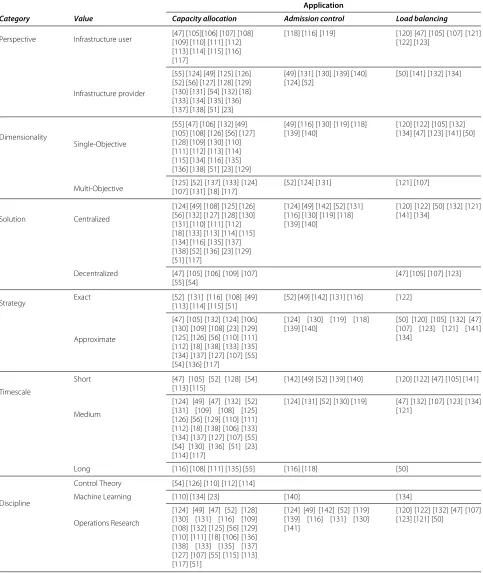
Table 1 provides a taxonomy of the papers reviewed in the next sections, organized according to the above criteria. Few remarks are needed to clarify the methodology used to classify the papers:
• In thePerspective dimension, a public PaaS or SaaS service built on top of a public IaaS offering is classified as a user-side perspective.
• Under Dimensionality, we treat studies that weight multiple criteria into a single objective as Multi-Objective methods.
Finally, the following observations on the Discipline dimensions must also be made.
• Control theory has the advantage of guaranteeing the stability of the system upon workload changes by modeling the transient behavior and adjusting system configurations within a transitory period [143].
• Machine learning techniques, instead, use learning mechanisms to capture the behavior of the system without any explicit performance or traffic model and with little built-in system knowledge. Nevertheless, training sessions tend to extend over several hours [144] and retraining is required for evolving work-loads.
Table 1 Decision-making in the cloud - a taxonomy
Application
Category Value Capacity allocation Admission control Load balancing
Perspective Infrastructure user [47] [105][106] [107] [108][109] [110] [111] [112] [113] [114] [115] [116] [117]
[118] [116] [119] [120] [47] [105] [107] [121] [122] [123]
Infrastructure provider
[55] [124] [49] [125] [126] [52] [56] [127] [128] [129] [130] [131] [54] [132] [18] [133] [134] [135] [136] [137] [138] [51] [23]
[49] [131] [130] [139] [140] [124] [52]
[50] [141] [132] [134]
Dimensionality
Single-Objective
[55] [47] [106] [132] [49] [105] [108] [126] [56] [127] [128] [109] [130] [110] [111] [112] [113] [114] [115] [134] [116] [135] [136] [138] [51] [23] [129]
[49] [116] [130] [119] [118] [139] [140]
[120] [122] [105] [132] [134] [47] [123] [141] [50]
Multi-Objective [125] [52] [137] [133] [124][107] [131] [18] [117] [52] [124] [131] [121] [107]
Solution Centralized
[124] [49] [108] [125] [126] [56] [132] [127] [128] [130] [131] [110] [111] [112] [18] [133] [113] [114] [115] [134] [116] [135] [137] [138] [52] [136] [23] [129] [51] [117]
[124] [49] [142] [52] [131] [116] [130] [119] [118] [139] [140]
[120] [122] [50] [132] [121] [141] [134]
Decentralized [47] [105] [106] [109] [107] [55] [54]
[47] [105] [107] [123]
Strategy Exact [52] [131] [116] [108] [49][113] [114] [115] [51] [52] [49] [142] [131] [116] [122]
Approximate
[47] [105] [132] [124] [106] [130] [109] [108] [23] [129] [125] [126] [56] [110] [111] [112] [18] [138] [133] [135] [134] [137] [127] [107] [55] [54] [136] [117]
[124] [130] [119] [118] [139] [140]
[50] [120] [105] [132] [47] [107] [123] [121] [141] [134]
Timescale
Short [47] [105] [52] [128] [54] [113] [115]
[142] [49] [52] [139] [140] [120] [122] [47] [105] [141]
Medium
[124] [49] [47] [132] [52] [131] [109] [108] [125] [126] [56] [129] [110] [111] [112] [18] [138] [106] [133] [134] [137] [127] [107] [55] [54] [130] [136] [51] [23] [114] [117]
[124] [131] [52] [130] [119] [47] [132] [107] [123] [134] [121]
Long [116] [108] [111] [135] [55] [116] [118] [50]
Discipline
Control Theory [54] [126] [110] [112] [114]
Machine Learning [110] [134] [23] [140] [134]
Operations Research
[124] [49] [47] [52] [128] [130] [131] [116] [109] [108] [132] [125] [56] [129] [110] [111] [18] [106] [136] [138] [133] [135] [137] [127] [107] [55] [115] [113] [117] [51]
[124] [49] [142] [52] [119] [139] [116] [131] [130] [141]
[120] [122] [132] [47] [107] [123] [121] [50]
metrics. Typically, this approach consists of a per-formance model embedded within an optimization program, which is solved either globally, locally, or heuristically.
4.1 Capacity allocation
4.1.1 Infrastructure-provider capacity allocation
applications on a suitable number of VMs, which in turn has to be executed on appropriate physical servers. The rationale is to assign resource shares trying to mini-mize management costs (formed mainly by costs associ-ated with energy consumption), while guaranteeing the fulfilment of SLAs stipulated with the customers. Bin packing is a common modeling abstraction [51], but its NP-hardness calls for heuristic solutions. In [127] the capacity allocation problem is solved by means of a dynamic algorithm, since static allocation policies and pricing usually lead to inefficient resource sharing, poor utilization, waste of resources and revenue loss when demands and workloads are time varying. The paper presents a Minimum Cost Maximum Flow (MCMF) algo-rithm and compares it against a modified Bin-Packing formulation; the MCMF algorithm exhibits very good performance and scalability properties. An autoregres-sive process is used to predict the fluctuating incoming demand.
In [137], autoscaling is modeled as a modified Class Constrained Bin Packing problem. An auto-scaling algo-rithm is provided that automatically classifies incoming requests. Moreover, it improves the placement of appli-cation instances by putting idle machines into standby mode and reducing the number of running instances in condition of light load.
Tang et al. [133] proposes a fast heuristic solution for VM placement over a very large number of servers in a IaaS data center to equally balance the CPU load among physical machines, taking into account also mem-ory requirements of running applications.
In [125] is proposed a framework for VM deployment and reconfiguration optimization, with the aim at increas-ing profits of IaaS providers. The authors reduce costs considering the balance of multi-dimensional resources utilization and building up an optimization method for resource allocation; as far as reconfiguration is concerned, they propose a strategy for VM adjustment based on time-division multiplex and on VM live migration.
In [55] a VM placement problem for a PaaS is solved at multiple time-scales through a hierarchical optimization framework. Authors in [132] provide a solution for traffic-aware VM placement minimizing also network latencies among deployed applications. The work presents a two-tier approximate algorithm able to successfully solve very large problem instances. Moreover, a formulation for the considered problem is presented and its hardness is proven.
A capacity allocation problem is also studied in [136], in which a game-theoretic method is used to find approxi-mated solutions for a resource allocation problem in the presence of tasks with multiple dependent subtasks. The initial solution is spawned by a binary integer program-ming method; then, evolutionary algorithms are designed
to achieve a final optimized solution, which minimizes efficiency losses of participants.
Goudarzi et al. [56] provides a solution method for a multi-dimensional capacity allocation problem in a IaaS system, while guaranteeing SLA requirements to cus-tomers running multi-tiers applications. An improved solution is obtained starting from an initial configuration based on an upper bound; then, a force-directed search is adopted to increase the total profit. Moreover, a closed-form closed-formula for calculating the average response time of a request and a unified framework to manage different levels of SLAs are provided.
Zaman et al. [138] considers an online mechanism for computing resource allocation to VMs subject to limited information. The algorithm evaluates allocation and rev-enues as the users place requests to the system. Further-more, the authors prove that their approach is incentive compatible; they also report extensive simulation experi-ments.
Wang et al. [135] considers capacity allocation subject to two pricing models, a pay-as-you-go offering and peri-odic auctions. An optimal capacity segmentation strategy is formulated as a Markov decision process, which is then used to maximize revenues. The authors propose also a faster near-optimal algorithm, proven to asymptotically approach the optimal solution, and show a significantly lower complexity with respect to the optimal method.
Roy et al. [18] proposes a model-predictive resource allocation algorithm that auto-scales VMs, with the aim of optimizing the utility of the application over a limited prediction horizon. Empirical results demonstrate that the proposed method satisfies application QoS requirements, while minimizing operational costs.
Dutta et al. [126] develops a resource manager that uses a combination of horizontal and vertical scaling to optimize both resource usage and the reconfiguration cost. Finally, the solution is tested using real production traces.
Zhu et al. [23] builds a VM consolidation algorithm that makes use of an inference model that considers the effect of co-located VMs to predict QoS metrics. In this method, the workload is modeled by means of a Kalman filter, while the resource usage profile is estimated with a Hidden Markov Model. The proposed method is tested against SPECWeb2005.
Hwang et al. [129] also considers the VM consolidation problem by modeling the VM resource demands as a set of correlated random variables. The result is a multi-capacity stochastic bin packing problem, which is solved by means of a simple, scalable yet effective heuristic.
the VM resource requirements (e.g., CPU, memory, and network).
Finally, in [134] a framework that automatically recon-figures the storage system in response to fluctuations in the workload is presented. The framework makes use of a performance model of the system obtained through statis-tical machine learning. Such model is embedded into an effective Model-Predictive Control algorithm.
4.1.2 Infrastructure-user capacity allocation
From the user perspective, capacity allocation arises in IaaS and PaaS scenarios where the user is in charge with the control of the number of VMs or application con-tainers running in the system. In this context the user is generally a SaaS provider, which wants to maximize her revenues providing a service that meets a certain QoS. Then, the problem to be addressed is to determine the minimum number of VMs or containers needed to fulfill the target QoS, pursuing the best trade-off between cost and performance.
From the user side, capacity allocation is often implemented through auto-scaling policies. Mao and Humphrey [111] defines an auto-scaling mechanism to guarantee the execution of all jobs within given dead-lines. The solution accounts for workload burstinesses and delayed instance acquisition. This approach is com-pared against other techniques and it shows cost savings from 9.8% to 40.4%. Maggio et al. [110] compares sev-eral approaches for decision-making, as part of an auto-nomic framework that allocates resources to a software application.
Patikirikorala et al. [112] proposes a multi-model control-based framework to deal with the highly nonlin-ear nature of software systems. An extensible meta-model and a class library with an initial set of five models are developed. Finally, the presented approach is endorsed against fixed and adaptive control schemes by means of a campaign of experiments.
In [108] an optimal resource provisioning algorithm is derived to deal with the uncertainty of resource advance-reservation. The algorithm reduces resources under- and over-provisioning by minimizing the total cost for a cus-tomer during a certain time horizon. The solution meth-ods are based on the Bender decomposition approach to divide the problem into sub-problems, which can be solved in parallel, and an approximation algorithm to solve problems with a large set of scenarios.
On-demand and reserved resources are considered in the model proposed in [107] to define a bio-inspired self-adapting solution for cloud resource provisioning with the aim of minimizing the number of required virtual machines while meeting SLAs.
A decentralized probabilistic algorithm is also described in [106], which focuses on federated clouds. The proposed
solution has the aim to take advantage of a Cloud federation to avoid the dependence on a single provider, while still minimizing the amount of used resources to maintain a good QoS level for customers. The solution provides an effective decentralized algorithm for deploy-ing massively scalable services and it is suitable for all the situations in which a centralized solution is not feasible.
Ali-Eldin et al. [114] aims at dynamic resource pro-visioning exploiting horizontal elasticity. Two adaptive hybrid controllers, including both reactive and proactive actions, are employed to decide the number of VMs for a cloud service to meet the SLAs. The future demand is predicted by a queueing-network model.
A key-value store is presented in [115] to meet low-latency Service Level Objectives (SLOs). The proposed middleware achieves high scalability by using replication, providing more predictable response times. An analyt-ical model, based on queueing theory, is presented to describe the relation between the number of replicas and the service level, e.g., the percentage of requests processed according to SLOs.
A capacity allocation problem in presented in [113] that exploits both horizontal and vertical elasticity. An integer linear problem is used to calculate an optimized new configuration able to deal with the current workload. However, reconfiguration is executed if the associated overhead cost calculated on a expected stability duration is lower than a certain minimum benefit defined by a human decision maker.
In [117] two multi-objective customer-driven SLA-based resource provisioning algorithms are proposed. The objectives are the minimization of both resource and penalty costs, as well as minimizing SLA violations. The proposed algorithms consider customer profiles and quality parameters to cope with dynamic workloads and heterogeneous cloud resources.
Finally, a profile-based approach for scalability is des-cribed in [109], the authors propose a solution based on the definition of platform-independent profiles, which enable the automation of setup and scaling of application servers in order to achieve a just-in-time scalability of the execution environment, as demonstrated with a case study presented in the paper.
4.2 Load balancing
4.2.1 Infrastructure-provider load balancing
some optimality guarantees, typically proven by analytical models.
The research literature has investigated both central-ized and decentralcentral-ized load balancing mechanisms for providers.
Among centralized approaches, [122] introduces an offline optimization problem for geographical load bal-ancing among data centers, explicitly considering SLAs and dynamic electricity prices. This is complemented with an online algorithm to handle the uncertainty in electric-ity prices. The proposed algorithm is compared against a greedy heuristic method and it shows significant cost savings (around 20-30%).
A load balancer is presented in [50] to assign VMs among geographically-distributed data centers consider-ing predictions on workload, energy prices, and renewable energy generation capacities. Two complementary meth-ods are proposed: an offline deterministic optimization method to be used at design time and an online VM placement, migration and geographical load balancing algorithm for runtime. The authors studied the behav-ior of both online and offline algorithms by means of a simulation campaign. The results demonstrate that online version of the algorithm performs 8% worse than the offline one because it deals with incomplete information. On the other hand, the analysis also shows that turning on the geographical load balancing has a strong impact on quality of the solutions (between 27% and 40%) of the online algorithm.
Spicuglia et al. [141] proposes an online load balanc-ing policy that considers the inherent VM heterogeneity found in cloud resources. The load balancer uses the num-ber of outstanding requests and the inter-departure times in each VM to dispatch requests to the VM with the short-est expected response time. The authors demonstrate that their solution is able to improve the variance and per-centiles of response times with respect to a built-in policy of the Apache web server.
Decentralized methods are considered in [107], which proposes a self-organizing approach to provide robust and scalable solutions for service deployment, resource provisioning, and load balancing in a cloud infra-structure. The algorithm developed has the additional benefit to leverage Cloud elasticity to allocate and deal-locate resources to help services to respect contractual SLAs.
Another example is the cost minimization mechanism for data-intensive service provisioning proposed in [121]. Such mechanism uses biological evolution concepts to manage data application services and to produce opti-mal composition and load balancing solutions. A multi-objective genetic algorithm is described in detail but a systematic experimental campaign is planned as future work.
4.2.2 Infrastructure-user load balancing
In the studies considered in the previous section, the load balancer is installed and managed transparently by the cloud provider. In some cases, the user can decide to install its own load balancer for a cloud application. This may be helpful, for instance, to jointly tackle capacity allocation and load balancing.
For example, [47] considers a joint optimization prob-lem on multiple IaaS service centers. A non-linear model for the capacity allocation and load redirection of multiple request classes is proposed and solved by decomposition. A comparison against a set of heuristics from the liter-ature and an oracle with perfect knowledge about the future load shows that the proposed algorithm overcomes the heuristic approaches, without penalizing SLAs and it is able to produce results that are close to the global optimum. Anselmi and Casale [120] provides a simple heuristic for user-side load-balancing under connection pooling that is validated against an IaaS cloud dataset. The main result is that the presented approach is able to provide tight guarantees on the optimality gap and exper-imental results show that it is at the same time accurate and fast.
Hybrid clouds are considered in [116]. The authors formulate an optimization problem faced by a cloud pro-curement endpoint (a module responsible for provision-ing resources from public cloud providers), where heavy workloads are tackled by relying on public clouds. They present a linear integer program to minimize the resource cost, and evaluate how the solution scales with the differ-ent problem parameters.
In [123] a structured peer-to-peer network, based on distributed hash tables, is proposed to support ser-vice discovery, self-management, and load-balancing of cloud applications. The effectiveness of the peer-to-peer approach is demonstrated through a set of experiments executed on Amazon EC2.
Finally, [105] proposes an adaptive approach for com-ponent replication of cloud applications, aiming at find-ing a cost-effective placement and load balancfind-ing. This is a distributed method based on an economic multi-agent model that achieves high application availability guaranteeing at the same time service availability under failures.
4.3 Admission control
4.3.1 Infrastructure-provider admission control
rejects all new sessions favoring the service of requests from already admitted sessions.
In cloud computing, several works on admission control have emerged in IaaS. Khazaei et al. [130] develops an ana-lytical model for resource provisioning, virtual machine deployment, and pool management. This model predicts service delay, task rejection probability, and steady-state distribution of server pools.
The availability of resources and admission control is also discussed in [131]. The work uses a probabilistic approach to find an optimized allocation of services on virtualized physical resources. The main requirement of this system is the horizontal elasticity. In fact, the proba-bility of requesting more resources for a service is at the basis of the formulated optimization model, that consti-tutes a probabilistic admission control test.
Almeida et al. [49] proposes a joint admission control and capacity allocation algorithm for virtualized IaaS sys-tems minimizing the data center energy costs and the penalty incurred for request rejections and SLA viola-tions. SLAs are expressed in terms of the tail distribution of application response times.
Agostinho et al. [124] optimizes the allocation and scheduling of VMs in federated clouds using a genetic algorithm. The solution is composed by two parts: First, servers selection in a data-center is performed by using a search based bio-inspired technique; then, data cen-ters are selected within the cloud federation by using a shortest path algorithm, according to the available band-width of links connecting the domains. The aim of the paper is to exploit resources in domains with low alloca-tion costs and, at the same time, achieve better network performance among cloud nodes.
Ellens et al. [52] allows service providers to reserve a certain amount of resources exclusively for some cus-tomers, according to SLAs. The proposed framework helps to stipulate a realistic SLA with customers and sup-ports dynamic load shedding and capacity provisioning by considering a queueing model with multiple priority classes. The main performance metric being optimized is the rejection probability, which has to guarantee the value stipulated in the SLA.
The work in [139] proposes an admission control pro-tocol to prevent over-utilization of system resources, classifying applications based on resource quality require-ments. It uses an open multi-class queueing network to support a QoS-aware admission control on heterogeneous resources to increase system throughput.
In order to control overload in Database-as-a-Service (DaaS) environments, [140] proposes a profit-aware admission control policy. It first uses nonlinear regres-sion to predict the probability for a query to meet its requirement, and then decides whether the query should be admitted to the database system or not.
4.3.2 Infrastructure-user admission control
From the cloud-user perspective, the admission control mechanism is used as an extreme overload mechanism, helpful when additional resources are obtained with some significant delay. For example, during a cloud burst (i.e., when part of the application traffic is redirected from a private to a public data center to cope with a traffic inten-sity that surpasses the capacity of the private infrastruc-ture), if the public cloud resources are not provided timely, one can decide to drop new incoming request to pre-serve the QoS for users already in the system (or at least part of them, e.g., gold customers), avoiding application performance degradation.
Three different admission control and scheduling algo-rithms are proposed in [119] to effectively exploiting pub-lic cloud resources. The paper takes the perspective of a SaaS provider with the aim of maximizing the profit by minimizing cost and improving customer satisfaction levels.
Leitner et al. [118] introduces a client-side admission control method to schedule requests among VMs, looking at minimizing the cost of application, SLA violations and IaaS resources.
5 Discussion and conclusion
In recent years, cloud computing has matured from an early-stage solution to a mainstream operational model for enterprise applications. However, the diversity of tech-nologies used in cloud systems makes it difficult to ana-lyze their QoS and, from the provider perspective, to offer service-level guarantees. We have surveyed current approaches in workload and system modeling and early applications to cloud QoS management.
From this survey, a number of insights arise on the current state of the art:
• The number of works that apply white-box system modeling techniques is quite limited in QoS manage-ment, albeit popular in the software performance engi-neering community. This effectively creates a divide between the knowledge that can be made available for an application by its designers and the techniques used to manage it. A research question is whether the availability of more detailed information about appli-cation internals can provide significant advantages in QoS management. Indeed, a trade-off exists between available information, QoS model complexity, compu-tational cost of decision-making, and accuracy of pre-dictions. This trade-off requires further investigation by the research community.
requirements of the applications. However, the cloud measurement studies in Section 2.1 have identified performance variability as a major issue in today’s offerings, calling for more comprehensive models that can describe also the variability in CPU requirements, in addition to mean requirements. Such extension has been explored in black-box system models (e.g., QoS in web services), but it is far less understood in white-box and gray-box modeling.
• Quite surprisingly, we have found a limited amount of work specific to workload analysis and inference techniques in the cloud. Most of the techniques used for traffic forecasting, resource consumption estima-tion, and anomaly detection have received little or no validation in a cloud environment. As such, it remains to establish the robustness of current tech-niques to noisy measurements typical of multi-tenant cloud environments.
• Another observation arising from our survey is that the literature is rich in works focusing on IaaS systems, often deployed on Amazon EC2, at present the market leader in this segment.
• If we consider the resource management mechanisms for applications QoS enforcement provided by pub-lic clouds, they are quite simplistic if compared to current research proposals. Indeed, such mechanisms are mainly reactive and are triggered by thresholds violations (related to response times, as in Google App Engine, or CPU utilization or other low level infrastructure metrics, as in Amazon EC2.) Vice versa, integrating workload characterisation, system mod-els and resource management solutions, pro-active systems, may help to prevent QoS degradation. The development of research prototypes that are transfer-able in commercial solutions seems to remain an open point.
• Finally, in cloud systems an important role is played by resource pricing models. There is a growing inter-est towards understanding better cloud spot markets, where bidding strategies are developed for procur-ing computprocur-ing resources. Approaches are currently being proposed to automate dynamic pricing and cloud resources selection. We expect that, in upcom-ing years, these models will play a bigger role than today in capacity allocation frameworks.
Summarizing, this survey shows that the literature has already a significant number of works in cloud QoS management, but their focus leaves open several research opportunities in the areas discussed above.
Endnote
a Throughout this paper, we mainly focus on QoS
aspects pertaining to performance, reliability and
availability. Broader descriptions of QoS are possible (e.g., to include security) but they are not contemplated in the present survey.
Competing interests
The authors declare that they have no competing interests.
Authors’ contributions
All authors read and approved the final manuscript.
Acknowledgment
The research reported in this article is partially supported by the European Commission grant FP7-ICT-2011-8-318484 (MODAClouds,
www.modaclouds.eu).
Author details
1Dipartimento di Elettronica, Informazione, e Bioingegneria Politecnico di
Milano, Piazza Leonardo da Vinci 32, Milan 20133, Italy.2Department of Computing, Imperial College London, 180 Queens Gate, London SW7 2AZ, UK.
Received: 5 February 2014 Accepted: 12 August 2014
References
1. Armbrust M, Fox A, Griffith R, Joseph AD, Katz R, Konwinski A, Lee G, Patterson D, Rabkin A, Stoica I, Zaharia M (2010) A view of cloud computing. Commun ACM 53(4):50–58
2. Zhang Q, Cheng L, Boutaba R (2010) Cloud computing: state-of-the-art and research challenges. J Internet Serv Appl 1(1):7–18
3. Ardagna D, Panicucci B, Trubian M, Zhang L (2012) Energy-aware autonomic resource allocation in multitier virtualized environments. IEEE Trans Serv Comput 5(1):2–19
4. Petcu D, 0 Macariu G, Panica S, Craciun C (2013) Portable cloud applications - from theory to practice. Future Generation Comput Syst 29(6):1417–1430
5. Farley B, Juels A, Varadarajan V, Ristenpart T, Bowers KD, Swift MM (2012) More for your money: Exploiting performance heterogeneity in public clouds. In: Proceedings of the 2012 Third ACM Symposium on Cloud Computing, SoCC ’12, San Jose, CA, USA, pp 1–14
6. Ou Z, Zhuang H, Nurminen JK, Ylä-Jääski A, Hui P (2012) Exploiting hardware heterogeneity within the same instance type of amazon ec2. In: Proceedings of the 4th USENIX Conference on Hot Topics in Cloud Ccomputing, HotCloud’12, Boston, MA, USA, pp 4–4
7. Schad J, Dittrich J, Quiané-Ruiz J-A (2010) Runtime measurements in the cloud: Observing, analyzing, and reducing variance. Proc VLDB Endowment 3(1–2):460–471
8. Mao M, Humphrey M (2012) A performance study on the VM startup time in the cloud. In: Proceedinngs of the 2012 IEEE Fifth International Conference on Cloud Computing, CLOUD ’12, Honolulu, HI, USA, pp 423–430
9. Xu Y, Musgrave Z, Noble B, Bailey M (2013) Bobtail: Avoiding long tails in the cloud. In: Proceedings of the 10th USENIX Conference on Networked Systems Design and Implementation, NSDI ’13, Lombard, IL, USA, pp 329–342
10. Wang G, Ng TSE (2010) The impact of virtualization on network performance of amazon ec2 data center. In: Proceedings of the 29th Conference on Information Communications, INFOCOM’10, San Diego, CA, USA, pp 1163–1171
11. Hill Z, Li J, Mao M, Ruiz-Alvarez A, Humphrey M (2011) Early observations on the performance of Windows Azure. Sci Program 19(2–3):121–132 12. Li Z, O’Brien L, Ranjan R, Zhang M (2013) Early observations on
performance of Google compute engine for scientific computing. In: Proceedings of the 2013 IEEE 5th International Conference on Cloud Computing Technology and Science, volume 1 of CloudCom 2013, Bristol, United Kingdom, pp 1–8
14. Kossmann D, Kraska T, Loesing S (2010) An evaluation of alternative architectures for transaction processing in the cloud. In: Proceedings of the 2010 ACM SIGMOD International Conference on Management of Data, SIGMOD ’10, Indianapolis, IN, USA, pp 579–590
15. Wada H, Fekete A, Zhao L, Lee K, Liu A (2011) Data consistency properties and the trade-offs in commercial cloud storage: the consumers’ perspective. In: Proceedings of the 5th Biennial Conference on Innovative Data Systems Research, CIDR 2011, Asilomar, CA, USA, pp 134–143 16. Liu S, Huang X, Fu H, Yang G (2013) Understanding data characteristics
and access patterns in a cloud storage system. In: Proceedings of the 2013 13th IEEE/ACM International Symposium on Cluster, Cloud and Grid Computing, CCGrid 2013, Delft, Nederlands, pp 327–334
17. Li A, Yang X, Kandula S, Zhang M (2010) Cloudcmp: comparing public cloud providers. In: Proceedings of the 10th ACM SIGCOMM conference on Internet measurement. ACM, pp 1–14
18. Roy N, Dubey A, Gokhale A (2011) Efficient autoscaling in the cloud using predictive models for workload forecasting. In: Proceedings of the 2011 IEEE International Conference on Cloud Computing, CLOUD ’11, Washington, DC, USA, pp 500–507
19. Gasquet C, Witomski P (1999) Fourier analysis and applications: filtering, numerical computation, wavelets, volume 30 of Texts in applied mathematics. Springer, New York, USA
20. Khan A, Yan X, Shu T, Anerousis N (2012) Workload characterization and prediction in the cloud: A multiple time series approach. In: Proceedings of the 2012 IEEE Network Operations and Management Symposium, NOMS 2012, Maui, HI, USA, pp 1287–1294
21. Di S, Kondo D, Walfredo C (2012) Host load prediction in a google compute cloud with a Bayesian model. In: Proceedings of the International Conference for High Performance Computing, Networking, Storage and Analysis, SC12, Salt Lake City, Utah,USA, pp 1–11
22. Gmach D, Rolia J, Cherkasova L, Kemper A (2007) Workload analysis and demand prediction of enterprise data center applications. In: Proceedings of the 2007 IEEE 10th International Symposium on Workload
Characterization, IISWC ’07, Boston, MA, USA, pp 171–180
23. Zhu Q, Tung T (2012) A performance interference model for managing consolidated workloads in QoS-aware clouds. In: Proceedings of the 2012 IEEE Fifth International Conference on Cloud Computing, CLOUD ’12, Honolulu, HI, USA, pp 170–179
24. Hoffmann GA, Trivedi KS, Malek M (2007) A best practice guide to resource forecasting for computing systems. IEEE Trans Reliability 56(4):615–628 25. Anandkumar A, Bisdikian C, Agrawal D (2008) Tracking in a spaghetti bowl:
Monitoring transactions using footprints. In: Proceedings of the 2008 ACM SIGMETRICS International Conference on Measurement and Modeling of Computer Systems. ACM Press, Annapolis, Maryland, USA, pp 133–144 26. Menascé D, Almeida V, Dowdy L (1994) Capacity planning and
performance modeling: from mainframes to client-server systems. Prentice-Hall, Inc. NJ, USA
27. Rolia J, Vetland V (1995) Parameter estimation for performance models of distributed application systems. In: In Proc. of CASCON. IBM Press, Toronto, Ontario, Canada, p 54
28. Rolia J, Vetland V (1998) Correlating resource demand information with ARM data for application services. In: Proceedings of the 1st international workshop on Software and performance. ACM, Santa Fe, New Mexico, USA, pp 219–230
29. Liu Y, Gorton I, Fekete A (2005) Design-level performance prediction of component-based applications. IEEE Trans Softw Eng 31(11):928–941 30. Sutton CA, Jordan MI (2008) Probabilistic inference in queueing networks.
In: Proceedings of the 3rd conference on Tackling computer systems problems with machine learning techniques. USENIX Association, Berkeley, CA, US, p 6
31. Sutton CA, Jordan MI (2010) Inference and learning in networks of queues. In: International Conference on Artificial Intelligence and Statistics, Sardinia, Italy, pp 796–803
32. Zhang Q, Cherkasova L, Smirni E (2007) A regression-based analytic model for dynamic resource provisioning of multi-tier applications. In: Proc. of the 4th ICAC Conference, Jacksonville, Florida, USA, pp 27–27
33. Liu Z, Wynter L, Xia C, Zhang F (2006) Parameter inference of queueing models for it systems using end-to-end measurements. Perform Eval 63(1):36–60
34. Casale G, Cremonesi P, Turrin R (2008) Robust workload estimation in queueing network performance models. In Proc. of Euromicro PDP:183–187
35. Kalbasi A, Krishnamurthy D, Rolia J, Dawson S (2012) DEC: Service demand estimation with confidence. IEEE Trans Softw Eng 38(3):561–578 36. Kalbasi A, Krishnamurthy D, Rolia J, Richter M (2011) MODE: Mix driven
on-line resource demand estimation. In: Proceedings of the 7th International Conference on Network and Services Management. International Federation for Information Processing, pp 1–9 37. Pacifici G, Segmuller W, Spreitzer M, Tantawi A (2008) CPU demand for
web serving: Measurement analysis and dynamic estimation. Perform Eval 65(6):531–553
38. Cremonesi P, Sansottera A (2012) Indirect estimation of service demands in the presence of structural changes. In: Proceedings of Quantitative Evaluation of Systems (QEST). IEEE, London, UK, pp 249–259
39. Cremonesi P, Dhyani K, Sansottera A (2010) Service time estimation with a refinement enhanced hybrid clustering algorithm. In: Analytical and Stochastic Modeling Techniques and Applications. Springer, pp 291–305 40. Sharma AB, Bhagwan R, Choudhury M, Golubchik L, Govindan R, Voelker
GM (2008) Automatic request categorization in internet services. ACM SIGMETRICS Perform Eval Rev 36(2):16–25
41. Wu X, Woodside M (2008) A calibration framework for capturing and calibrating software performance models. In: Computer Performance Engineering. Springer, pp 32–47
42. Zheng T, Woodside CM, Litoiu M (2008) Performance model estimation and tracking using optimal filters. IEEE Trans Softw Eng 34(3):391–406 43. Desnoyers P, Wood T, Shenoy PJ, Singh R, Patil S, Vin HM (2012) Modellus:
Automated modeling of complex internet data center applications. TWEB 6(2):8
44. Longo F, Ghosh R, Naik VK, Trivedi KS (2011) A scalable availability model for Infrastructure-as-a-Service cloud. In: Proceedings of the 2011 IEEE/IFIP 41st International Conference on Dependable Systems Networks, DSN 2011, Hong Kong, China, pp 335–346
45. Calinescu R, Ghezzi C, Kwiatkowska MZ, Mirandola R (2012) Self-adaptive software needs quantitative verification at runtime. Commun ACM 55(9):69–77
46. Chung M-Y, Ciardo G, Donatelli S, He N, Plateau B, Stewart W, Sulaiman E, Yu J (2004) Comparison of structural formalisms for modeling large markov models. In: Parallel and Distributed Processing Symposium, 2004 Proceedings. 18th International, Santa Fe, New Mexico, USA, p 196 47. Ardagna D, Casolari S, Colajanni M, Panicucci B (2012) Dual time-scale
distributed capacity allocation and load redirect algorithms for cloud systems. J Parallel Distributed Comput 72(6):796–808
48. Xiong P, Wang Z, Malkowski S, Wang Q, Jayasinghe D, Pu C (2011) Economical and robust provisioning of n-tier cloud workloads: A multi-level control approach. In: Proceedings of the 31st IEEE International Conference on Distributed Computing Systems (ICDCS), Minneapolis, Minnesota, USA, pp 571–580
49. Almeida J, Almeida V, Ardagna D, Cunha I, Francalanci C, Trubian M (2010) Joint admission control and resource allocation in virtualized servers. J Parallel Distributed Comput 70(4):344–362
50. Goudarzi H, Pedram M (2013) Geographical load balancing for online service applications in distributed datacenters. In: Proceedings of the 2013 IEEE Sixth International Conference on Cloud Computing, CLOUD ’13, Santa Clara, CA, USA, pp 351–358
51. Zhang Q, Zhu Q, Zhani MF, Boutaba R (2012) Dynamic service placement in geographically distributed clouds. In: Proceedings of the 2012 IEEE 32Nd International Conference on Distributed Computing Systems, ICDCS ’12, Macau, China, pp 526–535
52. Ellens W, Zivkovic M, Akkerboom J, Litjens R, van den Berg H (2012) Performance of cloud computing centers with multiple priority classes. In: Proceedings of the 2012 IEEE 5th International Conference on Cloud Computing, CLOUD ’12, Honolulu, HI, USA, pp 245–252
53. Kusic D, Kandasamy N (2006) Risk-aware limited lookahead control for dynamic resource provisioning in enterprise computing systems. In: Proceedings of the 2006 IEEE International Conference on Autonomic Computing, ICAC ’06, Dublin, Ireland, pp 74–83