Review Article
SUSTAINED RELEASE
DOSAGE FORM: A
CONCISE REVIEW
Darandale Abhishek S1. Ghule Prashant J2
Aher Abhijit A1, Narwate B.M1. 1. MES's College Of Pharmacy Sonai 2. Mula Rural Institute of Pharmacy Sonai
Date Received: 13th April 2017; Date accepted:
29th April 2017; Date Published: 2nd May 2017
Abstract
Now days as the expense and complications volved in marketing new drug entities are in-creased, with concomitant recognition of the the-rapeutic advantages of controlled drug delivery, greater attention has been focused on development of sustained or controlled release drug delivery systems (DDS). Hence we will change the area of focusing it is suitable to designing sustained drug delivery is to reduce the frequency of dosing or to increase the effectiveness of the drug by localiza-tion at the site of aclocaliza-tion, reducing the dose re-quired or providing uniform drug delivery. The design of oral sustained release DDS depends on various factors such as, physicochemical properties of drug, type of delivery system, disease being treated, and patient condition, and treatment dura-tion, presence of food, gastrointestinal motility, and co-administration of other drugs.
Keywords: Sustained release drug delivery system, Dose frequency, Biological half-life, physicochemi-cal properties of drugs.
Introduction
Sustained release, sustained action, prolonged ac-tion controlled release, extended release, depot release these are the various terms used to identify drug delivery systems that are designed to achieve a prolonged therapeutic effect by continuously releasing medication over a long period of time after administration of a single dose of drug. The
goal in designing sustained release delivery sys-tems is to reduce frequency of dosing or to increase effectiveness of the drug by localization at the site of the action, reducing dose required or providing uniform drug delivery.The ideal drug delivery sys-tems have two things would be required first it would be a single dose the duration of treatment whether it is for days or week, as with infection, or for the life time of the patient, as in hypertension or diabetes. Second it should deliver the active entity directly to the site of the action, thereby minimiz-ing side effects.1
DISADVANTAGES OF CONVENTIONAL DO-SAGE FORMS
1. Poor patient compliance, increased chances of missing the dose of a drug with short half-life for which frequent administration is necessary.
2. The unavoidable fluctuations of drug concentra-tion may lead to under medicaconcentra-tion or over medica-tion.
3. A typical peak-valley plasma concentration time profile is obtained which makes attainment of steady-state condition difficult.
4. The fluctuations in drug levels may lead to pre-cipitation of adverse effects especially of a drug with small Therapeutic Index whenever over me-dication occur [1, 6, 7].
ADVANTAGES OF SUSTAIN RELEASE DO-SAGE FORMS
1. Reduction in frequency of intakes.
2. Reduce side effects.
3. Uniform release of drug over time.
4. Better patient compliance [1, 5, 8].
DISADVANTAGES OF SUSTAINED RELEASE DRUG DELIVERY
1. Increased cost.
2. Toxicity due to dose dumping.
3. Unpredictable and often poor in vitro-in vivo cor-relation.
5. Increased potential for first- pass clearance.
6. Need for additional patient education and coun-seling [9-11].
CLASSIFICATION OF ORAL SUSTAINED OR CONTROLLEDRELEASE SYSTEMS
The controlled release systems for oral use are mostly solidsand based on dissolution, diffusion or a combination of bothmechanisms in the control of release rate of drug. Dependingupon the manner of drug release, these systems areclassified as fol-lows:
1. Continuous release systems
2. Delayed transit and continuous release systems
3. Delayed release systems
1. Continuous release systems
Continuous release systems release the drug for aprolonged period of time along the entire length of
gastrointestinal tract with normal transit of the dosageform. The various systems under this cate-gory are asfollow:
A. Diffusion controlled release systems
B. Dissolution controlled release systems
C. Dissolution and diffusion controlled releasesys-tems
D. Ion exchange resin- drug complexes
E. pH-independent formulation
A. Diffusion controlled release systems
In this type of systems, the diffusion of dissolved drugthrough a polymeric barrier is a rate limiting step. Thedrug release rate is never zero-order, since thediffusional path length increases with time as the insolublematrix is gradually depleted of drug. Diffusion of a drugmolecule through a polymeric membrane forms the basisof these controlled drug delivery systems.Similar to the dissolution-controlled systems, the diffusiondissolution-controlleddevices are manufactured either byencapsulating the drug particle in a polymeric membraneor by dispersing the drug in a polymeric matrix. Unlikethe dissolu-tion-controlled systems, the drug is madeavailable as a result of partitioning through the polymer.In the case of a reservoir type diffusion controlled
device,the rate of drug released (dm/dt) can be calculatedusing the following equation:
Dm/dt=ADK∆C/1
Where,
A = Area
D = Diffusion coefficient
K = Partition coefficient of the drug between the
drug core and the membrane
L = Diffusion path length and
C = Concentration difference across the membrane
In order to achieve a constant release rate, all of theterms on the right side of equation must be held constant.It is very common for diffusion controlled devices toexhibit a non-zero-order release rate due to an increasein diffusional resistance and a de-crease in effectivediffusion area as the release proceeds. Anotherconfiguration of diffusion-controlled systems includesmatrix devices, which are very common because of easeof fabrication. Diffusion control involves dispersion ofdrug in either a water-insoluble or a hydrophilic poly-mer.The release rate is dependent on the rate of drugdiffusion through the matrix but not on the rate of soliddissolution.
The two types of diffusion-controlled release are:
a. Matrix diffusion controlled systems
b. Reservoir devices
B. Dissolution-controlled release systems[1]
The drug present in such system may be the one:
a. Having high aqueous solubility and dissolution rate
b. With inherently slow dissolution rate e.g. Gri-seofulvin and Digoxin
c. That produces slow dissolving forms, when it comes in contact with GI fluids
diffusion across the aqueous boundary layer. The solubility of the drug provides the source of energy for drug release, which is countered by the stag-nant-fluid diffusional boundary layer.
The rate of dissolution (dm/dt) can be approx-imated by following equation:
dm
dt = ADS
h
Where,
A = Surface area of the dissolving particle
or tablet
D = Diffusivity of the drug
S = Aqueous solubility of the drug
h = Thickness of the boundary layer
The two types of dissolution-controlled release are:
A. Matrix (or monolith) dissolution controlled sys-tems
B. Reservoir dissolution controlled systems
C. Dissolution and diffusion controlled release systems [6]
In such systems, the drug core is encased in a par-tially soluble membrane. Pores are thus created due to dissolution of parts of the membrane which permit entry of aqueous medium into the core and hence drug dissolution and allow diffusion of dis-solved drug out of the system.
D. Ion exchange resin-drug complexes [8]
It is based on formulation of drug resin complex formed when ionic solution is kept in contact with ionic resins. The drug from this complex gets ex-changed in gastrointestinal tract and released with excess of Na+ and Cl- present in gastrointestinal tract. This system generally utilize resin compound of insoluble cross linked polymer. They contain salt forming function group in repeating position on a polymer chain.
E. pH-independent formulation [19]
Most of the drug are either weak acid or weak base, therelease from sustain release formulation is pH dependent.However, buffer such as salt of
ci-tric acid, amino acid,tartaric acid can be added to the formulation, to help tomaintain to constant pH their by retarding Phindependent drug release. A buffer sustain releaseformulation is prepared by mixing a basic or acidic drugone or more buffering agent, granulating withappropriate excipients and coating with gastrointestinalfluid permeable film forming polymer. Whengastrointestinal fluid per-meates through the membrane, the buffering agent adjusts the fluid inside to suitableconstant pH there by rendering a constant rate of drugrelease.
F. Osmotic pressure controlled systems [7]
A semi permeable membrane is placed around the-tablet, particle or drug solution that allows trans-port ofwater into tablet with eventual pumping of drug solutionout of the tablet through the small delivery aperture intablet core. Two type of osmot-ic pressure controlledsystems are:
a. Type 1 contains an osmotic core with drug
b. Type 2 contains the drug in flexible bag withos-motic core surroundingBy optimizing formulation and processing factor, it ispossible to develop os-motic system to deliver the drug ofdiverse nature at preprogrammed rate.
2. Delayed transit and continuous release systems [1, 4]
These systems are designed to prolong their resi-dence inthe GI tract along with their release. Often the dosageform is fabricated to detain in the sto-mach and hence thedrug present therein should be stable to gastric pH.Systems included in this cate-gory are mucoadhesivesystems and size based sys-tems.
3. Delayed release systems [1]
The design of such systems involves release of drug onlyat specific site in the GIT. The drugs con-tained in such asystem are those that are:
a. Known to cause gastric distress
b. Destroyed in the stomach or by intestinalen-zymes.
c. Meant to extent local effect at a specific GI site
d. Absorbed from a specific intestinal site
The two types of delayed release systems are:
2. Colonic release systems
Rationale of controlled drug delivery system
The basic rationale for controlled drug delivery is to alter the pharmacokinetics and pharmacody-namics of pharmacologically active moieties by using novel drug delivery systems or by modifying the molecular structure and/or physiological pa-rameters inherent in a selected route of administra-tion. Thus, optimal design of controlled release systems necessitates a thorough understanding of the pharmacokinetics and pharmacodynamics of drug [15].
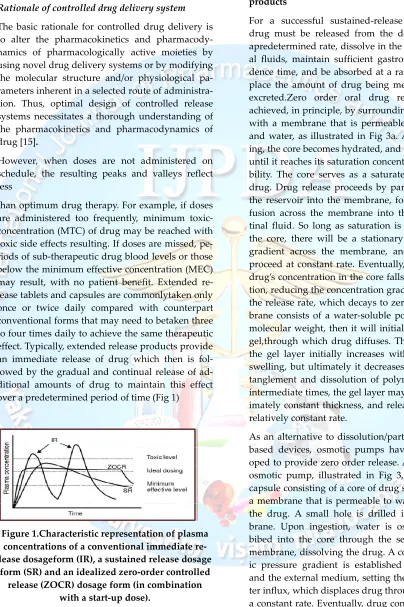
However, when doses are not administered on schedule, the resulting peaks and valleys reflect less
than optimum drug therapy. For example, if doses are administered too frequently, minimum toxic-concentration (MTC) of drug may be reached with toxic side effects resulting. If doses are missed, pe-riods of sub-therapeutic drug blood levels or those below the minimum effective concentration (MEC) may result, with no patient benefit. Extended re-lease tablets and capsules are commonlytaken only once or twice daily compared with counterpart conventional forms that may need to betaken three to four times daily to achieve the same therapeutic effect. Typically, extended release products provide an immediate release of drug which then is fol-lowed by the gradual and continual release of ad-ditional amounts of drug to maintain this effect over a predetermined period of time (Fig 1)
Figure 1.Characteristic representation of plasma concentrations of a conventional immediate re-lease dosageform (IR), a sustained rere-lease dosage
form (SR) and an idealized zero-order controlled release (ZOCR) dosage form (in combination
with a start-up dose).
Drug-candidates suitable for sustained release products
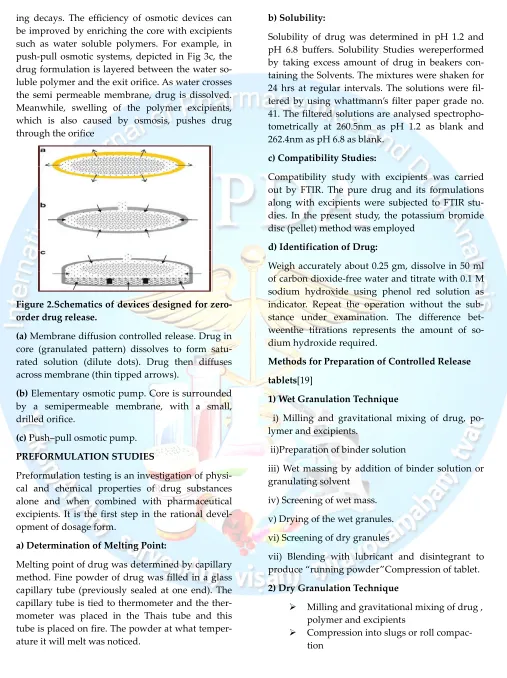
For a successful sustained-release product, the drug must be released from the dosage form at apredetermined rate, dissolve in the gastrointestin-al fluids, maintain sufficient gastrointestingastrointestin-al resi-dence time, and be absorbed at a rate that will re-place the amount of drug being metabolized and excreted.Zero order oral drug release can be achieved, in principle, by surrounding a core tablet with a membrane that is permeable to both drug and water, as illustrated in Fig 3a. After swallow-ing, the core becomes hydrated, and drug dissolves until it reaches its saturation concentration or solu-bility. The core serves as a saturated reservoir of drug. Drug release proceeds by partitioning from the reservoir into the membrane, followed by dif-fusion across the membrane into the gastrointes-tinal fluid. So long as saturation is maintained in the core, there will be a stationary concentration gradient across the membrane, and release will proceed at constant rate. Eventually, the dissolved drug’s concentration in the core falls below satura-tion, reducing the concentration gradient andhence the release rate, which decays to zero. If the mem-brane consists of a water-soluble polymer of high molecular weight, then it will initially swell into a gel,through which drug diffuses. The thickness of the gel layer initially increases with time due to swelling, but ultimately it decreases due to disen-tanglement and dissolution of polymer chains. At intermediate times, the gel layer may be of approx-imately constant thickness, and release occurs at a relatively constant rate.
pump-ing decays. The efficiency of osmotic devices can be improved by enriching the core with excipients such as water soluble polymers. For example, in push-pull osmotic systems, depicted in Fig 3c, the drug formulation is layered between the water so-luble polymer and the exit orifice. As water crosses the semi permeable membrane, drug is dissolved. Meanwhile, swelling of the polymer excipients, which is also caused by osmosis, pushes drug through the orifice
Figure 2.Schematics of devices designed for zero-order drug release.
(a) Membrane diffusion controlled release. Drug in core (granulated pattern) dissolves to form satu-rated solution (dilute dots). Drug then diffuses across membrane (thin tipped arrows).
(b) Elementary osmotic pump. Core is surrounded by a semipermeable membrane, with a small, drilled orifice.
(c) Push–pull osmotic pump.
PREFORMULATION STUDIES
Preformulation testing is an investigation of physi-cal and chemiphysi-cal properties of drug substances alone and when combined with pharmaceutical excipients. It is the first step in the rational devel-opment of dosage form.
a) Determination of Melting Point:
Melting point of drug was determined by capillary method. Fine powder of drug was filled in a glass capillary tube (previously sealed at one end). The capillary tube is tied to thermometer and the ther-mometer was placed in the Thais tube and this tube is placed on fire. The powder at what temper-ature it will melt was noticed.
b) Solubility:
Solubility of drug was determined in pH 1.2 and pH 6.8 buffers. Solubility Studies wereperformed by taking excess amount of drug in beakers con-taining the Solvents. The mixtures were shaken for 24 hrs at regular intervals. The solutions were fil-tered by using whattmann’s filter paper grade no. 41. The filtered solutions are analysed spectropho-tometrically at 260.5nm as pH 1.2 as blank and 262.4nm as pH 6.8 as blank.
c) Compatibility Studies:
Compatibility study with excipients was carried out by FTIR. The pure drug and its formulations along with excipients were subjected to FTIR stu-dies. In the present study, the potassium bromide disc (pellet) method was employed
d) Identification of Drug:
Weigh accurately about 0.25 gm, dissolve in 50 ml of carbon dioxide-free water and titrate with 0.1 M sodium hydroxide using phenol red solution as indicator. Repeat the operation without the sub-stance under examination. The difference bet-weenthe titrations represents the amount of so-dium hydroxide required.
Methods for Preparation of Controlled Release
tablets[19]
1) Wet Granulation Technique
i) Milling and gravitational mixing of drug, po-lymer and excipients.
ii)Preparation of binder solution
iii) Wet massing by addition of binder solution or granulating solvent
iv) Screening of wet mass.
v) Drying of the wet granules.
vi) Screening of dry granules
vii) Blending with lubricant and disintegrant to produce “running powder”Compression of tablet.
2) Dry Granulation Technique
Milling and gravitational mixing of drug , polymer and excipients
Milling and screening of slugs and com-pacted powder
Mixing with lubricant and disintegrant Compression of tablet.
3) Sintering Technique
Sintering is defined as the bonding of ad-jacent particle surfaces in a mass of powder, or in a compact, by the applica-tion of heat.
Conventional sintering involves the heat-ing of a compact at a temperature below the meltingpoint of the solid constituents in a controlled environment under at-mospheric pressure.
The changes in the hardness and disinte-gration time of tablets stored at elevated temperatureswere described as a result of sintering.
The sintering process has been used for the fabrication of sustained release matrix tablets for the stabilization of drug re-lease.
Evaluation Parameters
1) Pre Compression Parameters:
A. Bulk density (Db):
It is the ratio of powder tobulk volume. The bulk density depends on particle sizedistribution, shape and cohesiveness of particles.Accurately weighed quantity of powder was carefullypoured into graduated measuring cylinder throughlarge funnel and volume was measured which is calledinitial bulk volume. Bulk density is expressed in gm/ccand is given by,
Db = M / Vo
Where,
Db = Bulk density (gm/cc)
M = mass of powder (g)
Vo= bulk volume of powder (cc)
B. Tapped density (Dt):
Ten grams of powder wasintroduced into a clean, dry 100ml measuring cylinder.The cylinder was then tapped 100 times from aconstant height and tapped volume was read. It isexpressed in gm/cc and is given by,
Dt = M / Vt
Where,
Dt = Tapped density (gm/cc)
M = mass of powder (g)
Vt=tapped volume of powder (cc)
C. Compressibility index:
The compressibility of thepowder was determined by the Carr’s compressibilityindex.
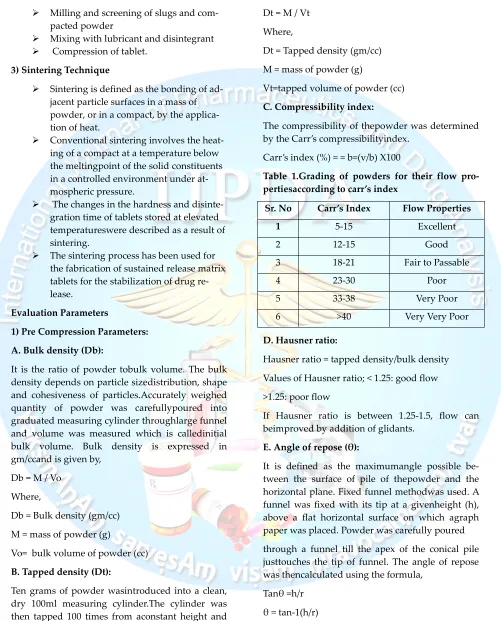
Carr’s index (%) = = b=(v/b) X100
Table 1.Grading of powders for their flow pro-pertiesaccording to carr’s index
Sr. No Carr’s Index Flow Properties
1 5-15 Excellent
2 12-15 Good
3 18-21 Fair to Passable
4 23-30 Poor
5 33-38 Very Poor
6 >40 Very Very Poor
D. Hausner ratio:
Hausner ratio = tapped density/bulk density
Values of Hausner ratio; < 1.25: good flow
>1.25: poor flow
If Hausner ratio is between 1.25-1.5, flow can beimproved by addition of glidants.
E. Angle of repose (θ):
It is defined as the maximumangle possible be-tween the surface of pile of thepowder and the horizontal plane. Fixed funnel methodwas used. A funnel was fixed with its tip at a givenheight (h), above a flat horizontal surface on which agraph paper was placed. Powder was carefully poured
through a funnel till the apex of the conical pile justtouches the tip of funnel. The angle of repose was thencalculated using the formula,
Tanθ =h/r
θ = tan-1(h/r)
h = height of pile,
r = radius of the base of the pile.
Table 2.Comparison between angles of reposes and flowproperty
Sr. No. Angle of repose Flow properties
1 <25 Excellent
2 25-30 Good
3 30-40 Passable
4 >40 Very Poor
F. Total Porosity: Total porosity was determined bymeasuring the volume occupied by a selected weight ofa powder (Vbulk) and the true volume of the powderblend (The space occupied by the powder exclusive ofspaces greater than the inter-molecular spaces, V).
Porosity (%) =Vbulk-V/Vbulkx 100
G. Flow rate:
Flow rate of granules influences thefilling of die cavity and directly affects the weight of thetablets produced.
2. Post Compression Parameters
A. Thickness and diameter:
Control of physical dimension of the tablet such asthickness and diameter is essential for consume-racceptance and tablet uniformity. The thickness anddiameter of the tablet was measured using Verniercalipers. It is measured in mm.
B. Hardness:
The Mansanto hardness tester was used to deter-minethe tablet hardness. The tablet was held be-tween afixed and moving jaw. Scale was adjusted to zero; loadwas gradually increased until the tab-let fractured. The value of the load at that point gives a measure ofhardness of the tablet. Hardness was expressed inKg/cm2.
C. Friability (F):
Tablet strength was tested by Friabilator USP EF-2. Preweighed tablets were allowed for 100 revolu-tions(4min), taken out and were dedusted. The percentageweight loss was calculated by rewriting the tablets. The% friability was then calculated by,
D. Weight variation test :
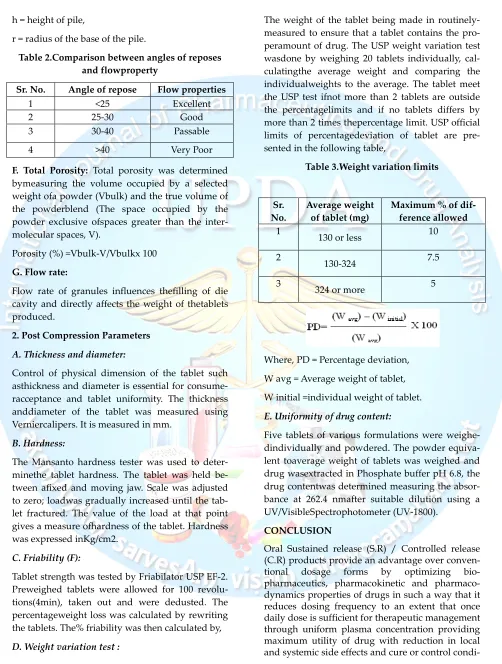
The weight of the tablet being made in routinely-measured to ensure that a tablet contains the pro-peramount of drug. The USP weight variation test wasdone by weighing 20 tablets individually, cal-culatingthe average weight and comparing the individualweights to the average. The tablet meet the USP test ifnot more than 2 tablets are outside the percentagelimits and if no tablets differs by more than 2 times thepercentage limit. USP official limits of percentagedeviation of tablet are pre-sented in the following table,
Table 3.Weight variation limits
Sr. No.
Average weight of tablet (mg)
Maximum % of dif-ference allowed
1
130 or less 10
2
130-324 7.5
3
324 or more 5
Where, PD = Percentage deviation,
W avg = Average weight of tablet,
W initial =individual weight of tablet.
E. Uniformity of drug content:
Five tablets of various formulations were weighe-dindividually and powdered. The powder equiva-lent toaverage weight of tablets was weighed and drug wasextracted in Phosphate buffer pH 6.8, the drug contentwas determined measuring the absor-bance at 262.4 nmafter suitable dilution using a UV/VisibleSpectrophotometer (UV-1800).
CONCLUSION
Oral Sustained release (S.R) / Controlled release (C.R) products provide an advantage over
conven-tional dosage forms by optimizing
condi-tion in shortest possible time by smallest quantity of drug to assure greater patient compliance. This review describes the various factors influencing
the design and performance of
sus-tained/controlled release products along with suitable illustrations.
References:
1. Jantzen GM, Robinson JR. Sustained and con-trolled release drug delivery system. In Bank-erGS, Rhodes CT, editors. Modern pharmaceu-tics. 3rd edition New york: Marcel
dekke-rInc;1996.p.575-09
2. Brahmankar D.M. and Jaiswal S.B. (1995): “Bi-opharmaceuticsand Pharmacokinetics” a Trea-tise. VallabhPrakashan, FirstEdition; 336-337. 3. Lachman Leon, Lieberman Herbert A., Kanig
Joseph L. (1996)“The theory and practice ofin-dustrial pharmacy” Secondedition, Varghese publishing house; Bombay, 171-196.
4. Gilbert S, Banker ; Christopher T; Rhodes; “ ModernPharmaceutical 3rd Edition” :576-578 5. Chein Y.W. Oral Drug delivery and delivery
systems. In: Noveldrug delivery systems. Mar-cel Dekker, Inc., New York, 2002;50; 3rd edi-tion: 139-96.
6. Lachman Leon, Lieberman Herbert A. Com-pression coatedand layer tablets. In: Pharma-ceutical Dosage Forms: Tablets.Marcel Dekker, Inc., New York, 2002; vol 1; 2nd edition: 247-84.
7. Gennaro Alfonso R. Extended Release Dosage Forms. In:Remington: The Science and Practice of Pharmacy. LippincottWilliams and Wilkins, U.S.A, 2000; vol 1; 20th edition: 660-63.
8. Vyas S,P, KharRK.Controlled Drug delivery: Concepts andAdvances .Concepts and Ad-vances.1st ed.vallabhprakashan,2002,p,156-189.
9. ShargelL,Yu ABC. Modified release drug products. In: AppliedBiopharmaceutics and Pharmacokinetics.4th
ed.McGrawHill.1999;169-171.
10. Welling P. G. and Dobrinska M. R., Dosing considerationand bioavailability assessment of
controlled drug deliverysystem, Chapter 7, Controlled drug delivery; fundamentalsand applications, 2nd edition, Robinson J.R. and Lee V. H. L.(Eds.), Marcel Dekker Inc., New York, 1978, 29,p. 254, 373
11. Ansel C.H., Pharmaceutical Dosage Forms and DrugDelivery Systems, 6th edition, B.I. Waver-ly Pvt. Ltd., NewDelhi, 1995, p. 213.
12. Parmar N. S. and Shivprakash, “Biopharma-ceutical andpharmacokinetic consideration in development of controlledrelease drug prod-uct”, Chapter 1, Controlled and Novel Drug-Delivery, 1st edition, Jain N. K. (Ed.), CBS Pub-lisher andDistributor, New Delhi, 1997, p.1. 13. Vyas S.P. and Khare R. K., Controlled Drug
Delivery Conceptand Advances 1st edition, VallabhPrakashan, New Delhi,2000, p.1, 54,155.
14. Chein Y.W. Oral Drug delivery and delivery systems. In: Noveldrug delivery systems. Mar-cel Dekker, Inc., New York, 2002;50; 3rd edi-tion: 139-96.
15. Lachman Leon, Lieberman Herbert A. Com-pression coatedand layer tablets. In: Pharma-ceutical Dosage Forms: Tablets.Marcel Dekker, Inc., New York,2002; vol 1; 2nd edition: 247-84. 16. Robinson J.R, Lee V.H.L. Controlled drug de-livery andfundamentals applications. 2nd ed; 1987: 7.
17. Remington. The science and practice of phar-macy. 20th ed;vol.1: 2000; 903.
18. Ansel H.C, Allen L.V, Popovich N.G. Pharma-ceutical dosageforms and drug delivery sys-tems. 7th ed; 2000: 230.
19. Indian pharamacopeia. Government of India Ministry Healthand Family Welfare. Delhi: Controler of publication;2010
20. Subrahmanyam CVS. Textbook of physical pharmaceutics.2nd ed.Delhi: Vallaba praka-shan;2003.p.180-234.