Iris Recognition Using Image Processing and
Neural Network
Rashid khan1 Nuzhat Naqvi1 M Shujah Islam1
1
National Engineering Laboratory for Speech and Language Information Processing(NELSLIP), Department of Electronic Engineering & Information Science,
University of Science and Technology of China(USTC) {Rashidkhan, nuzhatnaqvi, mshujahislam }@mail.ustc.edu.cn
Muhammad Waheed2,M Mattah Islam Sameem3
2
Department of computer engineering Near East University Cyprus 3
Sarhad University of Science & Information Technology Peshawar, Pak. {muhammadwaheed2015}2 {m.mattahislamsameem}[email protected]
Abstract—This research paper is aimed to design an iris recognition system. we describe two main steps to verify the goal. First, applying image processing techniques on the picture of an eye for data preparation. Second, applying Neural Networks techniques for identification. The image processing techniques display the steps for getting a very clear iris image necessary for extracting data from the acquisition of eye image -in standard light-ing and focus-ing-. This picture contains the entire eye (iris, pupil and lashes). So, the localization of the iris is very important. Locating the Iris is done by following the darkness density of the pupil. The new picture has iris with pupil -in its narrow size- and this picture is not perfectly clear. Therefore, it should be enhanced to bring out the pattern. The enhanced picture is segmented into 100 parts, then a standard Deviation (STD) can easily be computed for every part. These values will be used in the neural network for the identification. In this paper Neural network techniques explain two ways for comparisons, Linear Associative Memory Neural Network and Back Propagation Neural Network. The Back Propagation Neural Network succeeded in identification and getting best results because it attained to Recognition Rate equal to90%, while the Linear Associative Memory Network attained to Recognition Rate equal to 80%.
Keywords—Back Propagation Neural Network, Linear Associative Memory Neural Network Artificial neural network, Near infrared.
I. INTRODUCTION
Since the last century, several biometric techniques were used for identification of humans. These techniques are Iris recognition, Face recognition, Fingerprint recognition, Voice recognition, etc. Each of these techniques has number of real life applications [1]. Iris Recognition refers to the automated method of verifying a match between two irises of human. Irises are one of many forms of biometrics used to identify individuals and verify their identity [1]. The aim of this paper is design iris recognition system using Linear
Associative Memory and Back Propagation Neural Network. Iris recognition system is divided into two main stages.
The first one is used to extract the features from the iris image, and the second stage is used for classification of patterns. Feature extracting is a very important step in iris recognition system. This thesis touches on two major classes of algorithms used for extraction of the features of face images. The recognition rate of the system depends on the meaningful data that are extracted from the iris image. So, important feature should be extracted from the images. If the features belong to the different classes and the distance between these classes are big then these Features are important for given image. The flexibility of the class is also important. There can never be exact match between the images of the same iris even if they were from the same person. Iris recognition techniques are considered which involves Linear Associative Memory and Back Propagation Neural Network. The general purpose is the high confidence recognition of an individual’s identity by a mathematical analysis of the random patterns that are scanned for the iris of an eye [6]. Reliable automatic recognition of persons has long been an attractive goal [9]. The goal is to achieved through following steps. First one is by applying image processing techniques for clarifying iris image necessary for extracting data by using iris acquisition, iris localization, iris enhancement and iris segmentation. The second step involves Neural Network techniques for comparison and identification, which focuses on Linear Associative Memory (LAM) and Back Propagation Neural Network (BPNN).
in order to perform different tasks corresponding to different patterns of node firing activity [1].
A. Principles of ANN
The transmission of signals in biological neurons through synapses is a complicated chemical process in which specific transmitter substances are released from the sending side of the synapse. The effect is to raise or lower the electrical potential inside the body of the receiving cell. The neuron fires if the potential reaches a threshold. This neuron model is widely used in ANN with some variations.
Figure 1 inputs to the neuron is assigned a weight.
The artificial neuron presented in the above “fig 1” has n inputs, denoted as x1, x2… xn. Each line connecting these inputs to the neuron is assigned a weight, denoted as w1, w2... wn , respectively.
The action, which determines whether the neuron is to be fired or not, is given by the formula:
𝑎 = ∑ (𝑤𝑗𝑥𝑗) 𝑛
𝑗=1 (1) The output of the neuron is a function of its action:
Y=f (a) (2) Originally the neuron output function f(a) was a
threshold function. However, linear, ramp and sigmoid functions are also widely used today. An ANN system consists of a number of artificial neurons and a huge number of interconnections among them. According to the structure of the connections [10,11].
ANN can be roughly categorized into two types in terms of their learning features: supervised learning algorithms, where networks learn to fit known inputs to known outputs, and unsupervised learning algorithms, where no desired output to a set of input is defined [7].
B. Activation functions
Activation function (or sometimes called a threshold function) transforms the summed up input signal, received from the summation function, into an output. The activation function can be either linear or non-linear. The type of activation function characterizes the neural network [14]. Multilayer networks often use the log-sigmoid activation function. This function is illustrated in “Fig 2”
a = logsig(n)
Figure 2 Log-sigmoid activation function [7]
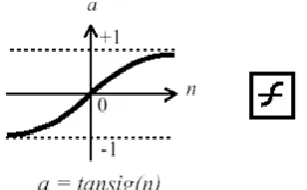
This activation function generates outputs between 0 and 1 as the neuron’s net input goes from negative to positive infinity. Alternatively, multilayer networks may use the tan-sigmoid activation function. See “Fig 3”.
Figure 3 Tan-sigmoid activation function [7]
Occasionally, the linear activation function is used in BPN.
Figure 4 activation function a = purelin(n)
If the last layer of a multilayer network has sigmoid neurons, then the outputs of the network are limited to a small range. If linear activation functions are used in the output neurons, the network outputs can take on any value [12].
C. Momentum Technique
Convergence is sometimes faster if a momentum term is added to the weight update formulas. In order to use momentum, weight updates from one or more previous training patterns must be saved. For example, in the simplest form of BPN with momentum, the new weights for training step t+1 are based on the weights at training steps t and t-1. The weight update formulas for BPN with momentum are:
w (t +1) =w (t)+z + [w (t) -w (t-1)] jk jk k j jk jk αδμ (3) or
w (t 1) z w (t) jk k j jk Δ + = αδ+μ Δ (4) and
v (t 1) =v (t)+x + [v (t) -v (t -1)] ij ij j i ij ij αδμ (5) or
v (t 1) x v (t) ij j i ij Δ + = αδ+μ Δ (6)
Where the momentum parameter μ is constrained to be in the range from 0 to 1, exclusive of the end points. When using momentum, the net is proceeding not in the direction of the gradient, but in the direction of a combination of the current gradient and the previous direction of weight correction [13]. In identification, a LAM network and BPNN are used each one alone. A linear activation function used in LAM network and a tan-sigmoid activation functions with momentum technique are used in BPNN.
III. IMAGEPROCESSING
The acquired image always contains not only the ‘useful’ parts (iris), but also some ‘irrelevant’ parts (e.g. eyelid, pupil etc.). Besides, under some conditions, the brightness is not uniformly distributed. For the purpose of analysis, the captured image needs to be preprocessed [2]. To capture the rich details of iris patterns, an imaging system should resolve a minimum of 50 pixels in iris radius [11]. This chapter explains the steps of image preprocessing starting from data acquisition which consists of sharpened image and converting to an intensity image, after that image localization which consists of histogram equalization image, low pass filtered image, converting to a binary image, morphological dilation process and extracting the iris image, then image enhancement which consists of average filtered image, enhancement contrast filtered image and histogram equalization image. Finally, image segmentation for data pattern extraction.
A. Image acquisition
The essential step in iris recognition system is the proper acquisition of the eye image. Since iris is small in size and dark in color (especially for Asian people), it is difficult to acquire good images for analysis using the standard CCD camera and ordinary lighting. Therefore, a device for image acquisition must be designed, which can deliver iris image of sufficiently high quality [2]. The process of measurement should be fast, comfortable for the person under test [6].The original iris image has low contrast and may have
non-uniform illumination caused by the position of the camera light source. These may impair the result of the texture analysis [2]. So, there is a need for preprocessing operations. The image will be captured like a photo from windows movie maker software. The image acquisition is the first and important part of standard iris recognition systems. A box of alumina is established in front of a digital video camera and holding by a stand carrier. It is an effective way for eye image acquisition because it provides standard functions which are curtaining any external lights, aligning the human's eye against the camera lens and avoiding human's head or camera vibration and providing a suitable camera movement.
B. Iris localization
Compared with the other parts of the eye, the pupil is much darker. To locate the iris in eye image, it can be followed the darkness density of the pupil. Darkness density pupil method is more efficient than other method to locate the iris [2]. Other method, like integro-differantial operators that are sensible to the spectacular spot reflection of the non-diffused artificial light pointing to the center of the user's eye. This detection strategy consists in using firstly an edge calculation technique to approximate the position of the eye in the global image (center of the pupil), and secondly integro-differential operators to search more precisely pupil boundary, iris center and iris boundary. So, whenever this spot takes place in the pupil near from the iris/pupil frontier, the detection of the inner boundary of the iris fails [5]. It is easy to detect the inner boundary between the pupil and the iris, but the outer boundary of the iris is more difficult to detect because NIR makes low contrast between the two sides of the boundary [2].
C. Image enhancement
The previous image needs to reduce the effect of non-uniform distortion and illumination. In addition, it needs to make the texture more precise and clearer. Then the iris texture will be able to extract the data which are important for comparison.
1: Average filter: An averaging filter is useful for removing distortion from the iris image pattern, because each pixel gets set to the average of the pixels in their neighborhood. Local variations caused by grain are reduced when calculating the average in the output image by using equation
2: Enhancement contrast filter: Morphological Top-hat and bottom-hat filtering can be used together to en hance contrast in an image [8]. This is done by the following steps:
First, by creating a flat disk-shaped structuring element, with R equal to 3,
Finally, by adding the top-hat image to the original image, and then subtracting the “bottom-hat” image from the result, the texture details will be deeper and clearer.
3- Histogram equalization: It is the final step for image analysis and it is important to equalize the values of the previous texture image and the output image will contain a uniform distribution of intensities.
IV. NEURALNETWORK
For the purpose of identification and comparisons, two ways are used in neural network techniques: Linear Associative Memory method, Back propagation Neural Network method. The networks are trained for pattern classification. The training process requires a set of examples of proper network behavior (network inputs p and target outputs t). During training, the weights and biases of the network are iteratively adjusted to minimize the network performance for feed forward [12].
A. Iris Localization
Locating the Iris can be done by following the darkness density of pupil by dilation processes. As mentioned in Chapter Three, this method is more efficient to locate the iris than the other method where the location is found by integro-differantial operators [9]. To get the best way for following the darkness density of the pupil the low pass filter was used. But for choosing the effected mask of low pass filter, the coefficients in the mask may be biased.
This is typically for application-specific reasons. The effected mask may be weighted the center pixel, or the diagonal pixels more heavily than the other pixels. These types of masks are often multiplied by 1/N to get one, where N is the sum of the mask coefficients. This is the equivalent of linearly remapping the image data after the convolution [9]. Figure 6.3shows the common types of low pass filter masks with their frequency responses.
B. Neural networks results
Two types of neural network were used for the recognition LAN& BPNN. The number of Iris images used in training for the two types are 50 samples. The input data used for training is the STD of each iris segment:
C. LAM method:
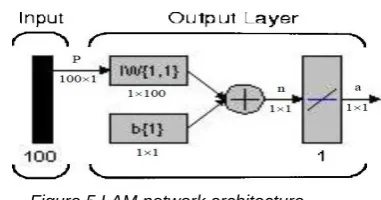
The LAM network topology, as shown in “Fig 5” is a single-layer consisting of 100 nodes for input and 1 node for output. It has 100 weights to be in the database file. The data input stream is parallel for each iris image. By using this network in the system, an execution time is about 45 seconds or less for iris image training due to the parallel feed for word data stream.
Figure 5 LAM network architecture
This LAM network topology attained Recognition rate 80%. These rates are imputed to the normalization for image data, because the division by parameter (AA) in equation 3.5 may give too close results for two different images. Table 1 shows samples for weights which are extracted from different iris patterns, these weights differ from one image to another and when tested iris input to the system each STD data value will multiply to its weight in these
Iris trained images. Thus when tested iris image is the same trained iris image. Each STD detain fact is close equal to its weight value.
D. BPNN method
The BPNN topology, as shown in “Fig 6” is a multiple-layer consisting of 100 nodes for input, 3 nodes for hidden and 1 node for output. It has 307 weights and biases to be stored in the database file. The data input stream is parallel for each iris image. By using this network in the system, an execution time is about 35 seconds or less for iris mage training due to the feedback word in BPNN learning algorithm.
Figure 6. BPNN architecture
This BPN topology attained recognition rate 90%. These rates are imputed to the tan-sigmoid transfer function which is used in the output layer. In below Table shows samples for weights extracted from different iris patterns. These weights may be used in image testing. Then, the output of BPN checked to define the person.
V. COMPARISONS
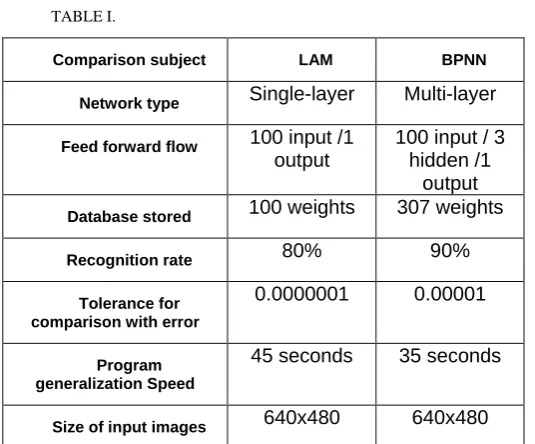
shows the differences between these two used methods
TABLE I.
Comparison subject LAM BPNN
Network type Single-layer Multi-layer
Feed forward flow 100 input /1
output
100 input / 3 hidden /1
output
Database stored 100 weights 307 weights
Recognition rate 80% 90%
Tolerance for comparison with error
0.0000001 0.00001
Program generalization Speed
45 seconds 35 seconds
Size of input images 640x480 640x480 TABLE 1 DIFFERENCE BETWEEN THE TWO NEURAL NETWORKS METHODS:
In Linear Associative Memory Neural Network, we use only single layer network but in Back Propagation Neural Network we use multi-layer network, in LAM we have 100 inputs and one output but in BPNN we have 100 inputs layer 3 hidden layers and one output, the recognition rate of BPNN is more than the LAM for the iris tested images, the size of the images is same in the both networks. BPNN topology used is more accurate than the LAM network topology used in recognition because of its recognition percentages for the iris tested images, but it need more execution time for learning.
VI. RESULTS
The simulation results of the Iris recognition system are obtained using LAM and BPNN feature extraction techniques. I am going to perform the simulations in three different experiments. In first experiment, 138 images of about 23 persons are taken. In image database each person has 6 different images. The number of noisy tested images in this experiment is 46. Using LAM 40 images was recognized successfully and recognition rate was 86.9%. Using BPN about 42 images was recognized successfully and recognition rate was 91.3%. In the second experiment, 231 images are taken. In database these images are belonging to 33 persons. Each person has 7 different images. Number of noisy tested images that is used in this experiment was 99. Using LAM, 91 images were recognized successfully with recognition accuracy 91.9%. Using BPNN, 92 images was recognized successfully with recognition Accuracy is 92.9%. In the third experiment, 320 images are taken. These images are belonging to 40 persons and each person has 8 different images. Number of noisy tested images that are used in this experiment was 80. Using LAM, 71
images were recognized successfully with recognition accuracy 88.7%. Using BPNN, 75 images was recognized successfully with recognition accuracy 93.8%.
TABLE II.
Subjects Tested
Tested iris
Iris in database
LAM BPNN
R.R E.R R.R E.R
23 46 138 86.9
% 13. 1%
91. 3%
8.7%
33 99 231 91.9
% 8.1
% 92. 1%
7.9%
40 80 320 88.7
% 11. 3%
99. 5%
0.5%
TABLE :2 COMPRESSION OF LAM AND BPNN
VII. COMPARINGWITHTHE EXICTING
Now-a-days there are large numbers of researches are on the internet for the identification of irises, and one of them is neural network. It uses the CASIA database which is one of the largest data base available in the public domain. The database contains 756 images of 108 different persons. Experiments are performed in two different stages iris segmentation and iris identifications [15]. At first stage rectangular area algorithm is used for the localization of the iris. The average time for the detection of inner and outer boundary of the iris images was 0.14sec. The accuracy was 98.62%. In the meantime, the proposed system used the darkness density pupil and the average time for the detection of inner and outer boundary was 7sec and the accuracy rate was 97%. At the second stage the recognition of irises is performed using the Neural Network techniques. 50 person’s images are selected for the iris database for the classification. The detected irises after normalization and enhancements are scaled by using averaging. This help to reduce the size of the neural network. The images are represented by the matrices. The matrices are the input signal for the neural network. The output of the neural network is classes of iris pattern. For each set of iris images, the two patterns are used for the training and other two are used for the testing. The recognition rate for the Neural Network is 99.25%. In the same time, the proposed system uses the same CASIA database. 50 person’s images are taken and each has four different images, two of them are used for the testing and two of them are used for the identifications. The algorithm used for the proposed system shows the result of 97.50% which is shown in below table 3.
TABLE III.
Methodology Accuracy rate Average time
Daughman 57.7% 90S
Wildes 86.49% 110S
Proposed 97.50% 7S
VIII. CONCLUSIONS
In this work, an iris recognition system has been designed. The system hardware consists of Digital video camera (type: Sony DCR-TRV265E) with alumina box holding by a stand carrier and complete computer system (having speakers, SVGA card, USB controller, etc.), and some of images I took online. The software built program consists of two stages, image processing stage for getting an enhancement iris pattern image and neural network stage for recognition by utilizing the data of the iris pattern. The neural network stage consists of two phases: training phase for human iris identifying and testing phase for deciding whether the human iris exists on the database or not. Two methods of neural network have been used in this thesis LAM method and BPNN method. The latter yielded the best results compared with the other method. NIR light is very important to clarify the details of iris pattern, and the white light is important for constricting the pupil to its narrow size. Dealing with JPEG type of pictures
proved to be successful. Getting the iris location is performed by following the darkness density of pupil. Data equalization is obtained by using histogram equalization at the beginning and at the end of image analysis. Iris image can be converted to the matrix for STD values instead of pixels’ intensity. STD values attained good results. ANN has fast mathematical methods for identification. Back propagation Neural Network can be used for iris pattern classification. Momentum technique with multiple activation function in Back Propagation has advantages in speed and accuracy. LAM network is a fast way for identification but it has high rate of percentage error compared with the other employed methods. The iris recognition system designed is general, easy to use, fast and compatible with different computers. The proposed system compared with many other recent researches and this system achieved higher recognition and speed.
IX. FUTUREWORK
There are some ideas for future work and
recommendations to improve this
research, the following points display these ideas:
The system may be interfaced with control
system on the organization entrance door.
Identification report can be created for
each tested person by the system. This report may have: name, job, address etc.
Multi-online person’s recognitions system
can be designed.
The iris picture can be captured at
suitable distance by using high
performance camera.
Iris and retina patterns recognition can be
designed and implemented in one
combinational system.
REFERENCES
[1] R. A. Mohammed, N. B. Ibrahim, A. S. Nori, "Iris Identification Software (IIS)", Raf. Jour.Sci., Vol. 15, No. 1Comp., Math. & Stati., Special Issue, pp. 1-10, 2004.
[2] Y. Zhu, T. Tan, Y. Wang, "Biometric Personal Identification Based on Iris Patterns", Proc. Int. Conf. on Pattern Recognition, Vol. 2, pp. 801-804, 2000.
[3] C. Tisse and et. al. "Person identification technique using human iris recognition",
[4] J. Daugman, "How Iris Recognition Works", IEEE transactions on circuits and systems for video technology, Vol. 14, No.1, January 2004.
[5] J. Daugman, "The importance of being random: statistical principles of iris recognition", The journal of the pattern recognition society, Pattern Recognition 36 (2003), 279 – 291.
[6] T. Burghardt, "Inside Iris Recognition", Master course in global computing and multimedia, university of Bristol, November 2002.
[7] H. A. Al-Sumaidaee, "Off-Line Handwritten Signature Verification Using Back Propagation Neural Network", M. Sc. Thesis, Technical college, Mosul/Iraq, January 2005.
[8] The MathWorks Inc., "Image Processing Toolbox for Use with MATLAB", Ver. 6.5, 2008, MA, USA.[229] S. E. Umbaugh, "Computer vision and image processing: A practical approach using CVIPtools", Prentice Hall PTR, 2008.
[9] N. Shindala, "Speaker Recognition using neuro-fuzzy method", M. Sc. Thesis, ComputerEngineering college, university of Mosul/Iraq, 2004.
[10] E. Gelenbe, H. U., "Lecture Notes on Neural Networks", METU, 2004.
[11] The Math Works Inc., "Neural Network Toolbox, For Use with MATLAB", Ver. 6.5, 2008, MA, USA.
[12] L. Fausett, "Fundamental of Neural Networks, Architectures, Algorithms and Applications", Printice Hall Int. Snc., 2004.
[13] E. Istook, T. Martinez,"Improved backpropagation learning in neural networks with windowed momentum", International journal of neural systems, vol. 12, no. 3&4, pp.303-318, 02.