Int. J. of Engg. Sci. & Mgmt. (IJESM), Vol. 5, Issue 3: July-Sep: 2015, 98-104
INTERNATIONAL JOURNAL OF ENGINEERING SCIENCES
&
MANAGEMENT
ANALYSIS OF TRANSIENT HEAT CONDUCTION OF MULTIDIMENSIONAL IN
CYLINDRICAL SHAPE
Noorul Haque
1and Amitesh Paul
1*Faculty of Master of Technology, R.K.D.F. University, Bhopal (M.P.)-India
Abstract
Present work deals with the analytical solution of unsteady state 1D, 2D & 3D dimensional heat conduction and temperature variation problems. The method of separation variable has been adopted to predict the variation of temperature in long cylindrical shape bar. The method of separation of variables to solve the transient conduction equations for the cylindrical geometry. A variety of models including a number of guess temperature profiles have been assumed to obtain a generalized solution. Based on the analysis, a modified Biot number and Fourier number has been proposed that predicts the temperature variation irrespective the geometry of the problem. In all the cases, a closed form solution is obtained between temperature, Biot number, heat source parameter and time. The result of the present analysis by analytical solution (method of separation variable) has been compared by using Matlab software. A good agreement has been obtained between the present analysis and the available data.
Key-Words: lumped model, method of separation of variables, polynomial approximation method, transient, conduction and modified biot number.
Introduction
Heat transfer is thermal energy stored in temperature-dependent motion of particles. The exchange of kinetic energy of particles through the boundary between two systems which are at different temperatures from each other or from their surroundings. Heat transfer always occurs from a region of high temperature to another region of lower temperature. Heat transfer changes the internal energy of both systems involved according to the Thermodynamics. The Second Law of Thermodynamics defines the concept of thermodynamic entropy measurable. Heat transfer is the study of thermal energy transport within a medium or among neighboring media by molecular interaction, fluid motion, and electro-magnetic waves, resulting from a spatial variation in temperature. This variation in temperature is governed by the principle of energy conservation, which when applied to a control volume or a control mass, states that the sum of the flow of energy and heat across the system, the work done on the system, and the energy stored and converted within the system, is zero.
* Corresponding Author E. mail: [email protected] 9098702687
Heat transfer finds application in many important areas, namely design of thermal and nuclear power plants including heat engines, steam generators, condensers and other heat exchange equipments, catalytic convertors, heat shields for space vehicles, furnaces, electronic equipments etc, internal combustion engines, refrigeration and air conditioning units, design of cooling systems for electric motors generators and transformers, heating and cooling of fluids etc. in chemical operations, construction of dams and structures, minimization of building heat losses using improved insulation techniques, thermal control of space vehicles, heat treatment of metals, dispersion of atmospheric pollutants. A thermal system contains matter or substance and this substance may change by transformation or by exchange of mass with the surroundings. To perform a thermal analysis of a system, we need to use thermodynamics, which allows for quantitative description of the substance. This is done by defining the boundaries of the system, applying the conservation principles, and examining how the system participates in thermal energy exchange and conversion.
Transient state is also called unsteady state.
If the temperature of a body does not vary with time, it is said to be in a steady state. Transient state the temperature of a body
Int. J. of Engg. Sci. & Mgmt. (IJESM), Vol. 5, Issue 3: July-Sep: 2015, 98-104
Conduction of heat in unsteady state refers to the transient conditions wherein the heat flow and the temperature distribution at any point of the system vary continuously with time.
The transient state can be classified in two groups are:
(a) Periodic variation.
In periodic transient state, temperature undergoes periodic changes which are either regular or irregular but definitely ‘cyclic’.
The temperature change in repeated cycles and the conditions get repeated after some fixed time interval.
Examples: The temperature variations in Cylinder of I.C. engine. Building during a period of 24 hours. Surface of earth during a period of 24 hours. etc.
(b) Non-periodic variation
In a non-periodic transient state, the temperature at any point within the system varies non-linearly with time.
Examples: Heating of an ingot in a furnace. Cooling of bars etc.
Methods
Method of separation of variable (developed by J.fourier)
The method of separation is based on expanding an arbitrary function in terms of Fourier series. The method is applied by assuming the dependent variable to be a product of a number of functions, each being a function of a single independent variable. This reduces the partial differential equation to a system of ordinary differential equations, each being a function of a single independent variable. In the case of transient conduction in a plain wall, for example, the dependent variable is the solution function θ(X, F0), which is expressed as θ(X, F0) = F(X)G(t), and the application of the method results in two ordinary differential equation, one in X and the other in F0. Now we demonstrate the use of the method of separation of variables by applying it to the one-dimensional transient heat conduction problem given in Eqs. (1). First,
Dimensionless differential equation:
= eq(1a)
Boundary conditions: = 0
And -k = h [T(L,t) –Ta]
eq(1b)
Dimensionless initial condition: θ(X, 0) = 1 eq(1c) Where Dimensionless temperature
θ(X, F0) =
Dimensionless heat transfer Bi =
coefficient (Biot number)
Dimensionless time (fourier number) F0 or (τ) =
Bi > 0.1, in case
θ = (X, Bi, F0) eq(2) We express the dimensionless temperature function θ (X, F0) as a product of a function of X only and a function of Fo only as
θ(X,F0) = F(X)G(F0) eq(3)
Substituting Eq.(3) into Eq. (1a) and dividing by the product FGgives
= eq(4)
Observe that all the terms that depend on Xare on the left-hand side of the equation and all the terms that depend on t are on the right-hand side. That is, the terms that are function of different variables are separated (and thus the name separation of variables). The left-hand side of this equation is a function of X only and the right-hand side is a function of only F0. Considering that both Xand F0 can be varied independently, the equality in Eq. 4 can hold for any value of X and F0 only if Eq. 4 is equal to a constant. Further, it must be a negativeconstant that we will indicate by – ² since a positive constant will cause the function G(F0) to increase indefinitely with time (to be infinite), which is unphysical, and a value of zero for the constant means no time dependence, which is again inconsistent with the physical problem. Setting Eq. 4 equal to - ² gives
= 0 & + ²G = 0
eq(5) Whose general solutions is F = C1cos( x) + C2sin( x)
And G = C3 eq(6)
And θ = FG = C3 [C1cos( x) +
C2sin( x)]
θ = [A cos( x) + B sin( x)] eq(7)
Where A = C1C3
And B = C 2C3 are arbitrary constants.
Int. J. of Engg. Sci. & Mgmt. (IJESM), Vol. 5, Issue 3: July-Sep: 2015, 98-104
= 0[A sin0+B cos0] = 0 Boundary condition. B = 0,
θ = A cos( x)
= - Bi θ (1,F0)
- A sin = - BiA cos
Than tan = Bi
But tangent is a periodic function with a period of , and the equation tan = Bi has the root 1 between 0 and , the root 2 between and 2 , the root n between (n-1) and n , etc. To recognize that the transcendental equation tan = Bi has an infinite number of roots, it is expressed as
n tan n = Bi eq(8)
Eq. (8) is called the characteristic equation or Eigen function, and its roots are called the characteristic values or Eigen values. The characteristic equation is implicit in this case, and thus the characteristic values need to be determined numerically. Then it follows that there are an infinite number of
solutions of the form A cos( x), and the solution of this linear heat conduction problem is a linear combination of them,
θ
= eq(9)
The constants Anare determined from the initial condition, Eq. (1c)
θ(X,0) = 1
eq(10) This is a Fourier series expansion that expresses a constant in terms of an infinite series of cosine functions. Now we multiply both sides of Eq.10 by cos( m X), and integrate from X = 0 to X
= 1. The right-hand side involves an infinite
number of integrals of the form ( m
X)cos( n X) dx. It can be shown that all of these integrals vanish except when n = m, and the coefficient Anbecomes
( nX)dx =
An 2( m X) dx.
An
eq(11)
This completes the analysis for the solution of one-dimensional transient heat conduction problem in a plane wall. The analytical
solution of transient conduction problem typically involves infinite series, and thus the evaluation of an infinite number of terms to determine the temperature at a specified location and time. Therefore, the evaluation of the first few terms of infinite series is usually adequate to determine the dimensionless temperature θ.
APPROXIMATE ANALYTICAL AND GRAPHICAL SOLUTIONS
The analytical solution obtained above for one-dimensional transient conduction in a plane wall involves infinite series and implicit equation, which are difficult to evaluate. Therefore, is clear motivation to simplify the analytical solutions to present the solution in graphical form using simple relations.
The solutions for one dimensional transient conduction in a wall of thickness 2L, subjected to convection from all surface.
Plane wall
=
eq(12)
The dimensionless quantities defined above for a plane wall can also be used for a cylinderor sphereby replacing the space variable x by rand the half-thickness Lby the outer radius r0. Note that the characteristic length in the definition of the Biot number is taken to be the half-thickness L for the plane wall, and the radius rofor the long cylinder and sphere instead of V/A used in lumped system analysis. We mentioned earlier that the terms in the series solutions in equation (12) and thus it is very convenient to express the solution using this one-term approximation
Plane wall: θwall = =
A1 cos( ₁,x⁄L) eq(13) Where the constants A1 and λ1 are functions of the Bi number only, and their values are listed in Table 4–2 against the Bi number for all three geometries. The function J0 is the zeroth-order Bessel function of the first kind, whose value can be determined from Table 3.2.Noting that cos (0) = J0(0) = 1 and the limit of (sin x)/xis also 1, these relations simplify to the next ones at the center of a plane wall:
Center of plane wall (x=0): θ0, wall =
= A1
eq(14)
Int. J. of Engg. Sci. & Mgmt. (IJESM), Vol. 5, Issue 3: July-Sep: 2015, 98-104
TRANSIENT TEMPERATURE IN
MULTIDIMENSIONAL SYSTEM OF CYLINDRICAL SHAPE The transient temperature charts and analytical solutions presented earlier can be used to determine the temperature distribution and heat transfer in one-dimensional heat conduction as associated with a large plane wall, a long cylinder, a sphere, and a semi-infinite medium. Using a superposition approach called the product solution. These charts and solutions can be used to solutions for two-dimensional transient heat conduction problems encountered in geometries such as a short cylinder, a long rectangular bar, a semi-infinite cylinder or plate, and even three-dimensional problems associated with geometries such as a rectangular prism or a semi-infinite rectangular bar, provided all surface of the solid are subjected to convection to the same fluid at temperature Ta (or T∞),with the same heat transfer coefficient h, and the body involve no heat generation. The solution in such multidimensional geometries can be expressed as the product of the solutions for the one-dimensional geometries whose intersection is the multi-dimensional geometry.
The transient temperature distribution for cylindrical bar in one- dimensional solution are denoted by
plane wall = θwall(x,t) eq(18)
The transient temperature distribution for cylindrical bar in two- dimensional solution are denoted by
Cylindrical bar = θwall(x,t)θwall(r,t)
eq(19)
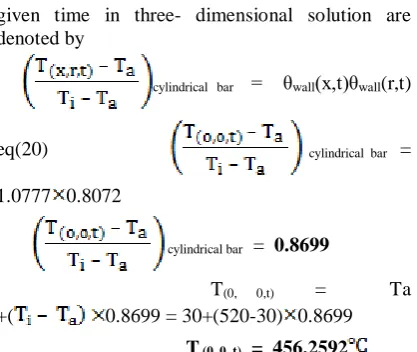
The transient temperature distribution for cylindrical bar in three- dimensional solution are denoted by
Cylindrical bar = θwall(x,t)θwall(r,t)
eq(20)
θcyl(r,t)θwall(x,t) Fig.3-3. 3D Cylindrical Parallelepiped
The solution of two- dimensional problem and three-dimensional problem have same solution .
The experiment data collection from MSP Steel & Power Plant Raigarh. A long cylindrical billet of mild steel having 100mm 100mm cross-section and 3.2 m long is initially at a uniform temperature Ti= 520 . The cylindrical billet is brought in atmospheric air at 30 where heat transfer takes placed by natural convection.
Table 4-1 Properties data for cylindrical slab (mild steel)
Mass of cylindrical billet (m) = 448 kg
Thermal conductivity (k) = 38.78 w/m K
Specific volume of billet (V) = 0.032 m3
Density of billet (ρ) = m/V = 14000 kg/m3 Specific heat of billet
(CP) = 465 J/kg K
Thermal diffusivity ( ) = 5.956 10-6 m2/s
Initial temperature of billet (Ti or Ts) = 520
Atmospheric
temperature(Ta or T∞)=30
The initial time period is 1hour to analysis the temperature change and transient heat Transfer of cylindrical slab in multi-dimension.
t = 3600 second. h= 8.001 w/m2 , k= 38.78 w/m2 k, = 5.956 10-6 m2/s.
Ti = 520 , Ta = 30 .
θwall(x,t) the dimensionless temperature at the center of the plane wall
θwall(x,t) = = A1
L = 1.6m, Bi = = 0.3301, F0 = = 8.376 10
-3, (Bi)2 F0 = 9.127 10-4,
From table 3-1 with respect to biot number (Bi) is λ1 = 0.7780, A1 = 1.0778.
θwall (x,t) = = 1.0777
Similarly: θwall(r,t) the dimensionless temperature at the center of the plane wall
θwall(r,t) = = A1
L = = 0.05m, Bi = = 0.0103, F0 = = 8.576,
(Bi)2 F0 = 9.09 10-4,
From table 3-1 with respect to biot number (Bi) is λ1 = 0.15869, A1 = 1.0017.
θwall(r,t) = = 0.8072
Int. J. of Engg. Sci. & Mgmt. (IJESM), Vol. 5, Issue 3: July-Sep: 2015, 98-104
given time in three- dimensional solution aredenoted by
cylindrical bar = θwall(x,t)θwall(r,t)
eq(20) cylindrical bar =
1.0777 0.8072
cylindrical bar = 0.8699
T(0, 0,t) = Ta +( 0.8699 = 30+(520-30) 0.8699
T (0, 0, t) = 456.2592
This is the temperature at the center of the cylindrical billet after 1 hours in atmospheric condition is 456.2592
Table 4-2 Temperature variation in cylindrical slab of different time periods
Matlab Coding And Result clear all;
t=input('Insert Time');3600 Ti=520;Ta=30;o=10^-6; %%%For x Axis Ax=1.0778; gamax=0.0778; alpha = 5.956.*o; %alpha
Lx=1.6
f0x=(alpha*t)/(Lx*Lx); %f0x
w=(gamax^2)*f0x; w1=w*(-1);
dimlessx=Ax*exp(w1); dimlessx
%%% End of axis %%% for r axis Lr=0.05;
F0r=(alpha*t)/(Lr^2); %F0r
Ar=1.0017; gamar=0.15869; w2=(gamar^2)*F0r; w3=w2*-1;
dimlessr=Ar*exp(w3); dimlessr
%%% End of axis
dimxr=dimlessx*dimlessr; tempxr=dimxr*(Ti-Ta)+Ta Insert Time = 3600 Lx = 1.6000 dimlessx = 1.0777 dimlessr = 0.8071 tempxr = 456.2363 Result
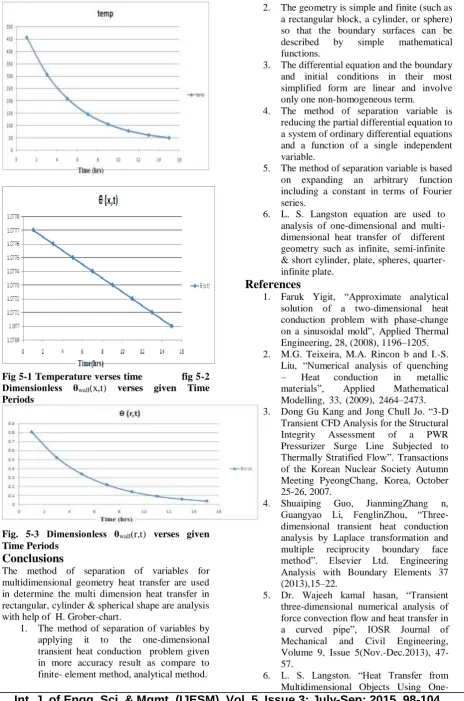
The method of separation variable is used to analysis of transient heat transfer of the cylindrical slab. The slab is exposed in atmospheric condition and temperature of the slab is variation with respect to the time. The fig.5-1 is show given time period
temperature is identified. Serial
Number
Time Hours
Time (t) Seconds
θwall(x,t) θwall(r,t) T(0,0,0,t)
1 1 3600 1.0777 0.8072 456.2592
2 3 10800 1.0776 0.5240 306.7030
3 5 18000 1.0775 0.3402 209.6332
4 7 25200 1.0774 0.2209 146.6121
5 9 32400 1.0773 0.1434 105.6976
6 11 39600 1.0772 0.0931 79.1408
7 13 46800 1.0771 0.0605 61.9306
Int. J. of Engg. Sci. & Mgmt. (IJESM), Vol. 5, Issue 3: July-Sep: 2015, 98-104
Fig 5-1 Temperature verses time fig 5-2 Dimensionless θwall(x,t) verses given Time Periods
Fig. 5-3 Dimensionless θwall(r,t) verses given Time Periods
Conclusions
The method of separation of variables for multidimensional geometry heat transfer are used in determine the multi dimension heat transfer in rectangular, cylinder & spherical shape are analysis with help of H. Grober-chart.
1. The method of separation of variables by applying it to the one-dimensional transient heat conduction problem given in more accuracy result as compare to finite- element method, analytical method.
2. The geometry is simple and finite (such as a rectangular block, a cylinder, or sphere) so that the boundary surfaces can be described by simple mathematical functions.
3. The differential equation and the boundary and initial conditions in their most simplified form are linear and involve only one non-homogeneous term.
4. The method of separation variable is reducing the partial differential equation to a system of ordinary differential equations and a function of a single independent variable.
5. The method of separation variable is based on expanding an arbitrary function including a constant in terms of Fourier series.
6. L. S. Langston equation are used to analysis of one-dimensional and multi-dimensional heat transfer of different geometry such as infinite, semi-infinite & short cylinder, plate, spheres, quarter-infinite plate.
References
1. Faruk Yigit, “Approximate analytical solution of a two-dimensional heat conduction problem with phase-change on a sinusoidal mold”, Applied Thermal Engineering, 28, (2008), 1196–1205. 2. M.G. Teixeira, M.A. Rincon b and I.-S.
Liu, “Numerical analysis of quenching – Heat conduction in metallic materials”, Applied Mathematical Modelling, 33, (2009), 2464–2473. 3. Dong Gu Kang and Jong Chull Jo. “3-D
Transient CFD Analysis for the Structural Integrity Assessment of a PWR Pressurizer Surge Line Subjected to Thermally Stratified Flow”. Transactions of the Korean Nuclear Society Autumn Meeting PyeongChang, Korea, October 25-26, 2007.
4. Shuaiping Guo, JianmingZhang n, Guangyao Li, FenglinZhou, “Three-dimensional transient heat conduction analysis by Laplace transformation and multiple reciprocity boundary face method”. Elsevier Ltd. Engineering Analysis with Boundary Elements 37 (2013),15–22.
5. Dr. Wajeeh kamal hasan, “Transient three-dimensional numerical analysis of force convection flow and heat transfer in a curved pipe”, IOSR Journal of Mechanical and Civil Engineering, Volume 9, Issue 5(Nov.-Dec.2013), 47-57.
One-Int. J. of Engg. Sci. & Mgmt. (IJESM), Vol. 5, Issue 3: July-Sep: 2015, 98-104
Dimensional Solutions for Heat Loss.”International Journal of Heat and Mass Transfer 25 (1982), 149–50.
7. Komesh Sahu and, Dr.Y.P Banjare, “Analysis of Transient Heat Conduction of