Volume 3, issue 1 (2014),47-56
International Journal of Pharmaceutical Research &
Allied Sciences
47
Optimization and Characterization of Biosurfactant Producing
Microbes and Expression of Biosurfact Producing Genes in Non
Biosurfactant Producing Miocrobes
*1Amit Pandey, 2Mansi Mishra and 2Vineeta Rai
MRD LifeSciences Pvt Ltd, Lucknow (UP),226010
*
Subject: Microbiology
Abstract
The present study is carried out by isolation and characterization of bio surfactant producing bacteria and expression of bio surfactant producing genes in non bio surfactant producing bacteria. The soil samples were collected from different regions of Lucknow and isolation as well as screening was done by using serial dilution and shake flask method respectively. According to Bergey’s manual the 5 cultures were characterized they were- M.luteus, B.cereus, S.aureus, Neisseria and Alcaligens. The Bio surfactant activity was measured till 7 days and further optimization was done to get best carbon source, nitrogen source, pH and metal ions. Further the plasmids were isolated and restriction digestion, ligation were performed and the E.coli competent cells were used for transformation of bio surfactant producing genes in non bio surfactant producing bacteria.
Key words
: Bio surfactant, shake flask method and transformationIntroduction
Life in our planet is sustained in a fragile biological balance; microorganisms play an important role on nutritional chains that are an important part of this biological balance. Adapting several abilities, microorganisms have become an important influence on the ecological systems, making them necessary for superior organisms life in this planet. Ability of microorganisms to transform and degrade many types of pollutants in different matrixes (soil, water, sediments and air) has been widely recognized during the last decades. Soil contamination with hydrocarbons causes extensive damage of local ecosystems since accumulation of pollutants in animals and plants tissues, may cause progeny’s death or mutation. In Mexico, an endless number of contaminated sites exists as a result of more than 60 years of oil petroleum activity; in recent years this problem has motivated researches to recover these contaminated sites [1] .
Biosurfactant or surface-active compounds are a heterogeneous group of surface active molecules produced by microorganisms, which either adhere to cell surface or are excreted extracellulary in the growth medium. These molecules reduce surface tension and Critical Micelle Dilution (CMD) in both aqueous solutions and hydrocarbon mixtures [2],[3]. The majority of known bio surfactants are synthesized by microorganisms grown on water immiscible hydrocarbons, but some have been produced on such water- soluble substrates as glucose, glycerol and ethanol . Chemically-synthesized surfactants have been used in the oil
industry to aid clean up of oil spills, as well as to enhance oil recovery from oil reservoirs.
These compounds are not biodegradable and can be toxic to environment [4]. Oil spills are major hazards to the environment as they damage the surrounding ecosystems. Petroleum fuel spills as a result of pipeline ruptures, tank failure, various production storage and transportation accidents are considered as the most frequent organic pollutant of soil and aquatic environment and are classified as hazardous wastes due to their cytotoxic, mutagenic and carcinogenic effects on human Microorganisms are equipped with metabolic machinery to use petroleum as a carbon and energy sources [5][6]. They are involved in degrading a considerable number of organic pollutants that are involved in oil including: aliphatic compounds, n-alkanes, diesel fuel and tetrachloroethylene, monoaromatic compounds, toluene, benzene, xylene, ethylbenzene and polycyclic aromatic hydrocarbons[7][8].
The objective of the project is optimization, production and characterization of oil degrading microbes isolated from oil contaminated soil and expression of oil degrading genes in E.coli.
Materials and Methods
Sample collection:
Samples were collected from various sources- Soil sample from Lucknow region
• Unnao petrol pump
48
• Lucknow Automobile shopIsolation of biosurfactant producing microbes from oil contaminated soil:
Serial dilution:
This method is used on the principle that when soil sample or water sample along with bacterial colonies taken, the result obtained in the form of reduce number of colonies. The microbes are having importance in the industries for enzyme as well as antibiotic production.
Dilution = volume of the sample/ total volume of the sample and the diluents.
Identification and Morphology Characterization of Pathogens:
The subculturing and pure culturing was done by streaking methods.
To check Biosurfactant activity (on small scale): Three oil samples
• Vegetable oil • Used vegetable oil • Petrol
Biosurfactant activity on small scale
• By agar well diffusion method in which oil sample was spread over agar plates and wells were made in which cultures were inoculated and incubated overnight.
• Nutrient agar media was prepared and autoclaved and petriplates were also autoclaved. • After autoclave, media was poured into the
plates and oil samples- petrol, vegetable oil and used vegetable oil was spread over different nutrient agar plates.
• Wells were made in the plates and the isolated cultures were loaded into the wells.
• The plates were then incubated at 37ºC for overnight.
Biosurfactant activity on large scale:
Biosurfactant activity on large scale was checked as follows:
• 35ml NB was prepared for each of the isolated culture in a conical flasks and 15ml of the oil sample was poured into it and the flasks were autoclaved.
• After autoclave, the broth was inoculated with the culture into the flasks and the flasks were incubated.
• The bio surfactant activity was observed by degradation of the oil layer.
Identification through Bergey,s manual:
Different types of biochemical tests were performed according to Bergey,s manual. It
included Gram staining of bacteria, Catalase test, Endospore staining, Carbohydrate test.
Also some confirmatory tests were performed [9].
Mannitol test:
Mannitol is a carbohydrate that can be fermented by desired bacteria.One way to test for Mannitol fermentation ability is by using a Phenol Red-Mannitol broth. This culture medium is just like the PR-Glucose, Lactose, and Sucrose tubes, except that Mannitol is the fermentable organic compound. Mannitol broth contains phenol-red as a pH indicator. If Mannitol is fermented, the broth will turn yellow. If Mannitol is not fermented, the broth will remain red.
Oxidase Test:
This test is used for the confirmation of desired bacteria. Cytochrome Oxidase is an enzyme found in some bacteria that transfer electrons to oxygen. Presence of cytochrome Oxidase can be detected through the use of an Oxidase reagent (Gorden – Mcleod reagent) which acts as an electron donor to cytochrome Oxidase. If the bacteria oxidize the reagent it turns dark purple due to formation of indophenols blue indicating positive reaction.
Alkaline Denaturation Method of Plasmid Isolation
Plasmid is an extra chromosomal, circular, double stranded and self replicated DNA. For plasmid isolation three buffers were used:
P1: Resuspension buffer or TE Buffer, P2: Lysis
Buffer, P3: Neutralization Buffer
Agarose gel Electrophoresis:
Electrophoresis is a process in which separation of charged particles will take place which is based on charge/mass ratio and this process will be done in presence of electric field.
Agarose is a linear polysaccharide which acts as solidifying agent.
Competent cells preparation
Competent cells are the cells which are ready to uptake foreign DNA and for transformation, cells should be competent.
Transformation
Transfer of genetic material from one cell to other with the help of plasmid which act as a vector.2 X LB broth was prepared for the transformation.
Growth Kinetics Curve of the Culture:
49
shown below is associated with simplisticconditions known as a batch culture. It refers to a single bacteria culture introduced into & growing in a fixed (limited) amount of nutrient .[10]
Optimization parameters:
Effect at different concentration of media components on growth:
This test is used or performed for media optimization at different concentration of N.B.
Effect of carbon sources:
• Five test tubes were taken and 5 ml N.B and 1% of carbon sources and one test tube was used as a blank having NB without carbon source.
• 0.1% of Glucose, Dextrose, Sucrose, Maltose and Beef extract were added and the test tubes were autoclaved.
• After autoclave each of these test tubes except blank were inoculated with 10µl culture and were incubated at 37ºC for overnight.
• After incubation, O.D was taken at 620nm.
Effect of Nitrogen sources :
• Five test tubes were taken and 5 ml N.B and 1% of nitrogen sources and one test tube was used as a blank having NB without nitrogen source. • 0.1% of KNO3, peptone, NH4Cl, Urea were
added and the test tubes were autoclaved. • After autoclave each of these test tubes except
blank were inoculated with 10µl culture and were incubated at 37ºC for overnight.
• After incubation, O.D was taken at 620nm.
Effect of pH:
• To get the more defined pH value, suitable for growth, growth of the microbes was further recorded at different pH. This test was performed for pH optimization.
• Nutrient broth was prepared with the pH of 5.0, 7.0, 9.0 and 11.0 in separate test tubes and one test tube was used as a blank having only NB. • After this, the culture was inoculated in each test
tube except in blank and was incubated at 37°C for overnight.
• Take O.D at 620nm.
Effect of metal ions:
The effects of metals are both stimulatory and inhibitory on microorganisms. This test was performed to check the growth of microbes.
• Five test tubes were taken and 5 ml of N.B with 0.2% of metal ions was added and one test tube was used as a blank having NB without metal ions. • 0.2% of MgSO4, CaCl2, FeSO4, Pb(NO3)2 ,
ZnCl2were added and the test tubes were
autoclaved.
• After autoclave each of these test tubes except blank were inoculated with 10µl culture and were incubated at 37ºC for overnight.
• After incubation, O.D was taken at 620nm.
Biosurfactant activity under optimized conditions
Biosurfactant activity of microbes was done under optimized conditions such as suitable carbon source( glucose, sucrose, dextrose, maltose, beef extract), nitrogen source( urea, peptone, KNO3, NH4Cl),
metal ion( Pb, Zn, Fe, Ca, Mg) and pH(5,7,9,11). • 35ml of NB was prepared and 1% carbon source,
1%nitrogen source, 0.2% metal ion and pH was added obtained after optimized conditions for each bacterial culture in a flask and autoclaved.
• After autoclaving the isolated bacterial cultures was 0.5ml of bacterial culture was inoculated into it and incubated at 37ºC in shaker incubator for overnight. • After bacterial growth 15ml of oil sample was
poured into the flask and incubated at the shaker incubator. biosurfactant activity was then observed.
Results
A total 12 cultures of bacteria were isolated from 4 different areas of Lucknow and Unnao out of 12 isolates there were 6 cultures detected for their industrial uses and that cultures were maintain for optimization of carbon sources, nitrogen sources, metal ions and pH were performed.
Serial dilution:
The serial dilution method was performed in ordered to get pure and reduced number of bacterial colonies and there were total 12 isolates were found and out of 12 cultures 6 cultures were used for further work.
50
S1- Kathauta Petrol Pump, S2-Unnao Petrol Pump, S3 –Vibhutikhand Automobile shop, S4-Alambagh Automobile shop.Sub culturing:
The procedure of transfer of microorganisms from their parent growth source to a fresh one or from one medium to another.
Fig 2: Sub culture plates of Sample 1, 2, 3 and 4:
Biosurfactant activity on small scale (Agar Well method):
Fig 3: Agar well plates showing oil degrading capacity of isolated micro-organisms.
All oil samples: Vegetable oil, Used Vegetable Oil and Petrol were degraded by isolated micro-organisms but used Vegetable Oil shows the best result.
Biosurfactant activity (on large scale):
51
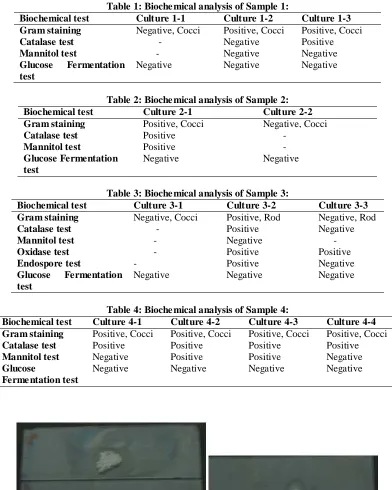
Biochemical analysis of isolated bacterial culture according to Bergey’s manual:Table 1: Bioche mical analysis of Sample 1:
Biochemical test Culture 1-1 Culture 1-2 Culture 1-3 Gram staining Negative, Cocci Positive, Cocci Positive, Cocci Catalase test - Negative Positive Mannitol test - Negative Negative Glucose Fermentation
test
Negative Negative Negative
Table 2: Bioche mical analysis of Sample 2: Biochemical test Culture 2-1 Culture 2-2 Gram staining Positive, Cocci Negative, Cocci Catalase test Positive -
Mannitol test Positive -
Glucose Fermentation test
Negative Negative
Table 3: Bioche mical analysis of Sample 3:
Biochemical test Culture 3-1 Culture 3-2 Culture 3-3 Gram staining Negative, Cocci Positive, Rod Negative, Rod
Catalase test - Positive Negative
Mannitol test - Negative -
Oxidase test - Positive Positive
Endospore test - Positive Negative
Glucose Fermentation test
Negative Negative Negative
Table 4: Bioche mical analysis of Sample 4:
Biochemical test Culture 4-1 Culture 4-2 Culture 4-3 Culture 4-4 Gram staining Positive, Cocci Positive, Cocci Positive, Cocci Positive, Cocci Catalase test Positive Positive Positive Positive Mannitol test Negative Positive Positive Negative Glucose
Ferme ntation test
Negative Negative Negative Negative
52
Fig 7: Carbohydrate fermentation test Fig 8: Mannitol test
Here Fig 7 shows No colour change shows glucose is not fermented but oxidized & Fig 8 shows Mannitol test shows Positive result as there is colour change from red to yellow.
Fig 9: Oxidase test result showing the Positive result forming a blue stain when the culture grown in BHI agar me dia mixed with McLeod reagent.
Plasmid Isolation:
Alkaline denaturation method was performed for plasmid isolation.
Fig 10: Plasmid isolation for culture C1-1, C2-2, C3-2, C3-3, C4-1 and C4-4.
Transformation:
53
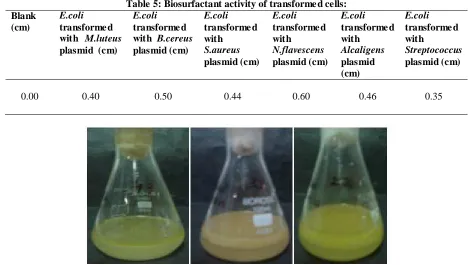
Table 5: Biosurfactant activity of transforme d cells:Blank (cm)
E.coli
transforme d with M.luteus plasmid (cm)
E.coli
transforme d with B.cereus plasmid (cm)
E.coli
transforme d with
S.aureus
plasmid (cm)
E.coli
transforme d with
N.flavescens
plasmid (cm)
E.coli
transforme d with
Alcaligens
plasmid (cm)
E.coli
transforme d with
Streptococcus
plasmid (cm)
0.00 0.40 0.50 0.44 0.60 0.46 0.35
Fig 12: Shows oil degradation in E.coli with plasmid of Streptococcus, N.flavescens and Alcaligens after transformation.
Fig 13: Shows oil degradation in E.coli with plasmid of M.luteus , B.cereus and S.aureus after transformation.
Optimization parameter:
Table 6: Effect of carbon sources
Carbon source M.luteus B.cereus S.aureus Nisseria Alcaligens
Glucose 0.19 0.01 0.00 0.26 0.26
Dextrose 0.16 0.48 0.01 0.17 0.23
Sucrose 0.32 0.05 0.01 0.32 0.62
Maltose 0.19 0.21 0.12 0.17 0.65
Beef extract 0.38 0.34 0.13 0.03 0.58
54
Table 7: Effect of Nitrogen sourcesTable shows the best nitrogen sources for all the 5 isolates.
Table 8: Effect of metal ions
Table shows the best metal ion for all the 5 isolates.
Table 9: Effect of pH
Table shows the best pH for all the 5 isolates.
Biosurfactant activity under Optimized conditions
Fig 14: Production me dia of N.flavescens
Fig 15: Production me dia of M. luteus
Fig 16: Production me dia of B.cereus
Fig 17: Production me dia of Alcaligens Nitrogen sources M.luteus B.cereus S.aureus Nisseria Alcaligens
Peptone 0.28 0.30 0.19 0.34 0.48
NH4Cl 0.00 0.05 0.00 0.01 0.36
Urea 0.25 0.22 0.00 0.26 0.42
KNO3 0.33 0.27 0.03 0.41 0.01
Metals ions M.luteus B.cereus S.aureus Nisseria Alcaligens
Pb 0.59 0.93 0.60 2.00 0.70
Zn 0.16 0.17 0.14 0.17 0.13
Fe 0.87 0.96 1.12 0.95 1.26
Ca 0.27 0.33 0.27 0.38 0.54
Mg 0.25 0.41 0.25 0.34 0.51
pH M.luteus B.cereus S.aureus Nisseria Alcaligens
pH5 0.16 0.17 0.01 0.01 0.39
pH7 0.21 0.23 0.19 0.23 0.38
pH9 0.09 0.22 0.08 0.17 0.41
55
Fig 18: Production me dia of StreptococcusFig 14-18 shows the production of culture in optimized media for degradation of oil.
Discussion
Bioremediation is a process in which the environment can cleanup through microbes. There are so many types of microbes which used to eliminate contamination in seawater. The contamination can be in the form of oil or some chemicals. This type of contamination may lead to adverse effect on the organisms, animals as well as plants mainly found in sea water.
The present study is carried out by isolation, production and characterization of oil degrading microbes from oil contaminated soil and also expression oil degrading genes from oil degrading microbes to non-oil degrading microbes. The various types of soil sample were collected from different regions of Unnao and Lucknow. The soil was contaminated with oil because of this reason there are chances to get oil degrading microbes.
Total 12 cultures were isolated through serial dilution method out of which 6 cultures were characterized through Bergey’s manual. These cultures were tested for oil degradation by agar well diffusion method in small scale and flask method in large scale method. The oil samples which were used: used vegetable oil, vegetable oil and petrol. The best results were obtained for all these cultures against used vegetable oil. The identified cultures were: Steptococcus, M.luteus, S.aureus, Alcaligens, B.cereus, N.flavescens.[11]. Further plasmid isolation was done by alkaline denaturation method and transformation process was completed by heat shock treatment. The host cells used as E.coli which was not oil degrading microbes and after transformation compared with E.coli (transformed) the oil degrading capacity was developed which shows positive results and also optimization was done to enhance the capacity of oil degrading microbes. The optimization parameters include carbon source (glucose, dextrose, maltose, sucrose, beef extract), nitrogen source( urea, peptone, KNO3, NH4Cl), metal ion(
Pb, Zn, Fe, Ca, Mg) and pH(5,7,9,11)[12] [13]. The best conditions for cultures like suitable carbon source, nitrogen source, metal ion and pH was provided in the production media to get best results. For S.aureus suitable carbon source
is beef extract, nitrogen source is peptone, metal ion is Fe and pH is 7. For B.cereus suitable carbon source is dextrose, nitrogen source is peptone, metal ion is Fe and pH is 7. For M.luteus suitable carbon source is beef extract, nitrogen source is KNO3, metal ion is Fe and pH is 7. For
N.flavescens suitable carbon source is sucrose, nitrogen source is KNO3, metal ion is Pb and pH is
7. For Alcaligens suitable carbon source is maltose, nitrogen source is peptone, metal ion is Fe and pH is 9. For Steptococuus suitable carbon source is dextrose, nitrogen source is KNO3, metal ion is Fe
and pH is 7.
Conclusion
At last in the study/experiment it was identified that out of all the 12 bacterial cultures isolated from various types of soil isolated from different regions of Unnao and Lucknow by serial dilution method 6 cultures were used. Small scale biosurfactant activity was checked by agar well diffusion method and large scale biosurfactant activity was checked by flask method using 3 oil samples: used vegetable oil, petrol and vegetable oil. All 6 isolates were characterized throughBergey”s manual these cultures were : Srteptococcus, Alcaligens, B.cereus, M.luteus, S.aureus, N.flavescens. Plasmid isolation is done by alkaline denaturation method. Expression of oil degrading genes from oil degrading microbe to E.coli which is used as a host cell having no oil degrading gene was done through transformation process by heat shock treatment. The transformed cell showed good results for biosurfactant activity on large scale which showed positive result for transformation. Optimization for the isolated cultures was done with suitable carbon source( glucose, sucrose, dextrose, maltose, beef extract), nitrogen source( urea, peptone, KNO3, NH4Cl), metal ion( Pb, Zn,
Fe, Ca, Mg) and pH(5,7,9,11). Biosurfactant activity under optimized conditions was checked by large scale flask method in which used vegetable oil showed the best result.
Future Prospects
56
The ability of microbes to degrade oil i.e to cleanup the environment can also be enhanced by changing the genes by the help of Bioaugmentation and can used as industrial application such as production of antibiotics, hormones etc. In future this project can also be used to carry out various processes such as Bioremediation, Bioaugmentation, Biomagnification and Phytoremediation etc. to clean the environment.
Bioaugme ntation is the introduction of a group of natural microbial strains or a genetically engineered variant to treat contaminated soil or water. Bioaugmentation is commonly used in municipal wastewater treatment to restart activated sludge bioreactors. Most cultures available contain a research based consortium of Microbial cultures, containing all necessary microorganisms
Biomagnification, also known as bioamplification or biological magnification, it is the increase in concentration of a substance that occurs in a food chain as a consequence of:
Persistence (can't be broken down by environmental processes)
Food chain energetics
Low (or nonexistent) rate of internal degradation/excretion of the substance (often due to water-insolubility)
Phytoremediation describes the treatment of environmental problems (bioremediation) through the use of plants that mitigate the environmental problem without the need to excavate the contaminant material and dispose of it elsewhere. Phytoremediation is an energy efficient, aesthically pleasing method of remediating sites with low to moderate levels of contamination and it can be used in conjuction with other more traditional remedial methods as a finishing step to the remedial process.
“Cite this article”
A. Pandey, M. Mishra, V. Rai “Optimization and Characterization of Biosurfactant Producing Microbes and Expression of Biosurfact Producing Genes in Non Biosurfactant Producing Miocrobes” Int. J. of Pharm. Res. & All. Sci.2014;3(1),47-56
References
1. Anandaraj.B and Thivakaran. P, 2010 “Isolation And Production Of Biosurfactant Producing Organism From Oil Spilled Soil”, j Biosci Tech, 1 (3):120‐126.
2. Aparna.A, Srinikethan. G. and Hegde. S, 2011 “Effect of Addition of Biosurfactant Produced by Pseudomonas sps. On Biodegradation of Crude Oil”, 2nd International Conference on
Environmental Science and TechnologyIPCBE, 6.
3. Ganesh. A and Lin.J, 2009 “Diesel degradation and biosurfactant production by Gram-positive isolates”, African Journal of Biotechnology, 8 (21): 5847-5854.
4. Hamamura. N, Olson. S H, Ward. D M, and Inskeep. W P, 2006 “Microbial Population Dynamics Associated with Crude-Oil Biodegradation in Diverse Soils”, Applied And Environmental Microbiology ,72(9): 6316– 6324.
5. Kosaric. N, 1992 “Biosurfactants in industry”,Pure &Appl.Chern., 64(11),1731-1737.
6. Padmapriya. B, Rajeswari. T, Suganthi. S, Rajeswari. T And Jayalakshmi. S, 2011 “ Biosurfactant Production And Plasmid Isolation From Newly Isolated Hydro carbonoclastic Bacteria Proteus inconstans”, International Journal of Pharmaceutical & Biological Archives2(2): 784-790.
7. Kostka. J E, Prakash. O, Overholt. W A, Green . S J, Freyer. G, Canion. A, Delgardio. J, Norton. N, Hazen. T C, Huettel. M, 2011 “Hydrocarbon-Degrading Bacteria and the Bacterial Community Response in Gulf of Mexico Beach Sands Impacted by the Deepwater Horizon Oil Spill”, Appl. Environ. Microbiol. 77 (22): 7962-7974
8. Priya. T and Usharani. G, 2009 “Comparative Study for Biosurfactant Production by Using Bacillus subtilis and Pseudomonas aeruginosa”,Botany Research International2 (4): 284-287.
9. Aneja. KR. Experiment in microbiology, plant pathology and biotechnology, 2003.
10. Guo-liang. Z; Yue-ting. WU; Xin-ping. Q and Qin. M. Biodegradation of Crude oil by Pseudomonas aeruginosa in the presence of Rhamnolipids. Journal of Zhejiang University science, 2005, 6B (8): 725-730.
11. Malik. ZA; and Ahmed. S. Degradation of petroleum hydrocarbons by oil field Isolated bacterial consortium. Journal of Biotechnology, 2012, 11(3): 650-658.
12. Mittal. A and Singh. P. Isolation of Hydrocarbon degrading bacteria from soil contaminated with crude oil spills. Journal of Experimental Biology, 2009, 47: 760-765. 13. Nwaogu. LA; Onyeze. GOC and Nwabueze.
RN. Degradation of Diesel oil in a polluted soil using Bacillus subtilis. Journal of Biotechnology, 2008, 7(12): 1939-1943.