Page 274 www.ijiras.com | Email: [email protected]
Optimisation Of Conventional Process Control System By Applying
Hybrid Technique Of Soft Computing
Bakul .S. Chandel
PG Student, Department Of Industrial Engineering, Mahakal Institute of Technology, Ujjain M.P
M. Shinde
Professor, Department of Mechanical Engineering, Mahakal Institute of Technology, Ujjain M.P
I. INTRODUCTION
Soft Computing is the fusion of methodologies that were designed to model and enable solutions to real world problems, which are not modeled or too difficult to model, it aims to exploit tolerance for imprecision, uncertainty, and partial truth to achieve robustness, tractability, and low cost. SC provides an attractive opportunity to represent the ambiguity in human thinking with real life uncertainty. Fuzzy logic (FL), neural networks (NN), and evolutionary computation (EC) are the core methodologies of soft computing. However, FL, NN, and EC should not be viewed as competing with each other, but synergistic and complementary instead. SC has been theoretically developed for the past decade, since L. A. Zadeh proposed the concept in the early 1990s. Soft computing is causing a paradigm shift (breakthrough) in engineering and science fields since it can solve problems that have not been able to be solved by traditional analytic methods [tractability (TR)]. In addition, SC yields rich knowledge represen-tation (symbol and pattern), flexible knowledge acquisition (by ma-chine learning from data and by interviewing experts), and flexible knowledge
processing (inference by interfacing between symbolic and pattern knowledge), which enable intelligent systems to be con-structed at low cost [high machine intelligence quotient (HMIQ)].
Soft computing is still in its initial stages of crystallization. Soft computing techniques, in comparison with hard computing employ different methods which are capable of representing imprecise, uncertain and vague concepts. Soft computing techniques are able to handle non-linearity and offers computational simplicity.
Fuzzy logic is a universal approximator of any multivariate function because it can be used for modelling highly non-linear, unknown or partially known controllers, plants or processes. Fuzzy logic helps an engineer for solving non-linear control problems in process control applications. It emulates human reasoning and provides an intuitive way to design functional block for an intelligent control system.
Genetic algorithms (GAs) have emerged as potentially robust optimization tools in the last decades. Genetic algorithms (GAs) are a search heuristic that mimics the process of natural evolution. Genetic algorithms (GAs) can be applied to the process controllers for their optimization using
Abstract: Soft computing is a consortium of methodologies that works synergistically and provides, in one form or another, flexible information processing capability for handling real-life ambiguous situations. Its aim is to exploit the tolerance for imprecision, uncertainty, approximate reasoning and partial truth in order to achieve tractability, robustness and low-cost solutions. Process control is an important application of any industry for controlling the complex system parameters, which can greatly benefit from such advancements. Conventional control theory is based on mathematical models that describe the dynamic behaviour of process control systems.Here in this paper we are going to develop intelligent controllers by applying a new technique from soft computing byhybridIzing fuzzy logic with genetic algorithm,which are far more superior then conventional controllers. From the result it is very clear that intelligent controllers have better control over processess then our conventional controllers.
Page 275 www.ijiras.com | Email: [email protected] natural operators viz. mutation and crossover. Well established
methodologies have been discussed in literature for integrating soft computing techniques to realize synergistic or hybrid models with which better results could be obtained.
Simulation is the computational realization of a model. They are executable, live representation of models that can be as meaningful as the real experiments. Simulation allows an engineer to reason if a model makes sense or not and how the model behaves for the certain parameter variations. Simulations can be carried out for designing and implementation of conventional proportional integral derivative (PID) controllers, fuzzy logic controllers (FLC) and hybrid fuzzy logic genetic algorithms (HFLGA) controllers. Simulation applications can dynamically adjust the various process control parameters at running state of the plant.
II. GENETIC ALGORITHM
The basic concepts were developed by Holland , while the practicality of using the GA to solve complex problems was demonstrated in. Genetic Algorithms (GAs) is a soft computing approach. Gas are general-purpose search algorithms, which use principles inspired by natural genetics to evolve solutions to problems. As one can guess, genetic algorithms are inspired by Darwin's theory about evolution. They have been successfully applied to a large number of scientific and engineering problems, such as optimization, machine learning, automatic programming, transportation problems, adaptive control.
GA starts off with population of randomly generated chromosomes, each representing a candidate solution to the concrete problem being solved and advances towards better chromosomes by applying genetic operators based on the genetic processes occurring in nature. So far, GAs had a great measure of success in search and optimization problems due to their robust ability to exploit the information accumulated about an initially unknown search space. Particularly GAs specialize in large, complex and poorly understood search spaces where classic tools are inappropriate, inefficient or time consuming.
As mentioned, the GA's basic idea is to maintain a population of chromosomes. This population evolves over time through a successive iteration process of competition and controlled variation. Each state of population is called generation. Associated with each chromosome at every generation is a fitness value, which indicates the quality of the solution, represented by the chromosome values. Based upon these fitness values, the selection of the chromosomes, which form the new generation, takes place. Like in nature, the new chromosomes are created using genetic operators such as crossover and mutation.
III. FUZZY LOGIC
FUZZY logic is a form of multi-valuedlogic to deal with reasoning that is approximate rather then precise values .It attempts to systematically and mathematically emulate human reasoning and decision making. It provides an intuitive way to
implement control systems, decision making and diagnostic systems in various branches of industry. Fuzzy logic represents an excellent concept to close the gap between human reasoning and computational logic. Variables like intelligence, credibility, trustworthiness and reputation employ subjectivity as well as uncertainty. They cannot be represented as crisp values, however their estimation is highly desirable. fuzzy logic introduced in the 1965 by Lotfi A. Zadeh, he said: As the complexity of a system increases, it become more difficult and eventually impossible to make a precise statement about its behavior, eventually arriving at apoint of complexity where the fuzzy logic method born in humans is the only way to getat the problem.
Fuzzy systems are emerging technologies targeting industrial applications and added a promising new dimension to the existing domain of conventional control systems. Fuzzy logic allows engineers to exploit their empirical knowledge and heuristics represented in the IF-THEN rules and transfer it to a functional block. Fuzzy logic systems can be used for advanced engineering applications such as intelligent control systems, process diagnostics, fault detection, decision making and expert systems.
IV. CONVENTIONAL CONTROLLERS
Many industries are using conventional controllers to control their processes, The PI controller is one of the most popular controller, because of their robust performance over a wide range of operating conditions and functional simplicity. The main purpose of process control systems are-
To manipulate the final control element in order to bring
the process measurement to the set point whenever the set point is altered, and to keep the process measurement at the set point by changing the final control element.
The control algorithm should be designed so as to quickly
respond to changes in the set point (usually caused by the operator action) and to changes in the loads (disturbances).
The design of the control system should be able to prevent
the loop from becoming unstable (caused due to oscillating).
There are varieties of control actions that are used, in
order to achieve the desired response from the designed process satisfactorily and efficiently.
The traditional and easiest approach to the controller design problem for non-linear systems involves linearising the modeling equations around a steady state and applying linear controller theory results. However, the controller performance will deteriorate as the process moves further away from the steady state around which it was linearised. Therefore application of PI controller becomes more attractive for controlling tool wear.
Page 276 www.ijiras.com | Email: [email protected] Figure 1: Conventional PID controller
V. NEED FOR THE ADVANCED SYSTEM
As we know that the biggest problem we face while operating conventional control systems is that, it suffer from transient and steady state problems like overshoot, settling time and rise time. Various technologies and modifications have been employed to overcome these difficulties, which includes:
Auto tuning of proportional integral derivative (PID)
controller.
Adaptive techniques.
Compensation techniques.
Automatic tuning procedures are required for satisfactory control of controller parameters. The concept of evolving intelligent techniques was established as a synergy between conventional systems, fuzzy systems and genetic algorithms as the structures for representation of information and real time methods for machine learning. Soft computing methodologies have shown to be well suited to deal with significant uncertainties and vagueness, that may encounter in solving real world problems. Hybridization of the controller structures comes to one’s mind immediately to exploit the beneficial sides of the two categories of soft computing techniques. This paper is intended to design a process control system using conventional proportional integral derivative , controllers to a very improved performance in both the transient and steady state can be achieved, when compared to the system response obtained when either classical proportional integral derivative (PID), fuzzy logic controller, or hybridized fuzzy logic genetic algorithm controller is implemented.
VI. FUZZY LOGIC CONTROLLERS
Analytical studies on transient response, stability and reliability gives dynamical performance of conventional proportional integral derivative (PID) controllers in normal operating conditions, that the conventional controllers have large overshoots and long settling times. Also, optimizing time for control parameters, especially PID controllers, is very long and the parameters are not calculating exactly what they are supposed to be meant. Also, it has been known that conventional controllers generally do not work well for non-linear, higher order and time-delayed non-linear, and particularly complex, vague, for the systems which so many uncertainities and for those do not have precise mathematical models.
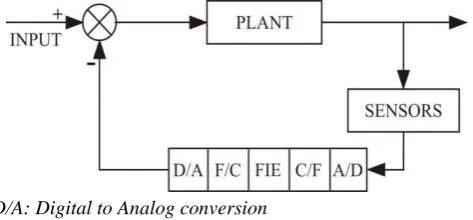
According to many researchers, there are some reasons for the Present popularity of fuzzy logic control: First, fuzzy logic can easily be applied to most industrial applications in industry, the capacity of conventional controllers is significantly reduced when applied to systems with non-linearities. Fuzzy systems can improve the performance of conventional proportional integral derivative (PID) controllers. A self-organizing fuzzy controller can automatically refine an initial approximate set of fuzzy rules. Application of fuzzy controller increases the quality factor A number of approaches have been proposed and implemented fuzzy control systems for controlling the process. The aim of incorporating fuzzy techniques in process control systems is to get ahead of the limits of conventional techniques and to improve the existing tools by optimizing the dynamical performances. Fuzzy control is a versatile and effective approach to deal with non-linear and uncertain system. A fuzzy control process can be performed by fuzzification, fuzzy inference and defuzzification components as shown in figure 2
Figure 2: Schematic of fuzzy logic control
A typical fuzzy control system as applied to a plant comprises of sensory data which is applied for analog to digital conversion followed by crisp to fuzzy conversion which is further given to an inference engine. On the other hand, fuzzy to crisp conversion followed by digital to analog conversion takes place, which is applied as an input to control the plant with fuzzy means. The process is shown in figure3.
D/A: Digital to Analog conversion A/D: Analog to digital conversion C/F: Crisp to fuzzy
F/C: Fuzzy to Crisp
FIE: Fuzzy Inference Engine
Page 277 www.ijiras.com | Email: [email protected] stability and functionality beyond the capabilities of traditional
processes. Fuzzy systems and fuzzy control logics have added a new dimension to control systems engineering. The more recent and rigorous approaches to fuzzy control theory, make it an integral part of modern control theory. A fuzzy logic controller can produce arbitrary non-linear control law and the lack of systematic procedure for the configuration of its parameters remains the main obstacle in practical applications. The design of fuzzy logic controllers has been controlled with genetic algorithms to further optimize the controller parameters.
VII. GENETIC ALGORITHMS CONTROLLERS
Analytical Genetic algorithms (GAs) are deployed for optimal selection of antecedents and consequents in fuzzy systems. Genetic algorithms (GAs) have been proven to be powerful in optimization, design and real time implementation. Basically, GA consists of three main stages:
Selection. Crossover. Mutation.
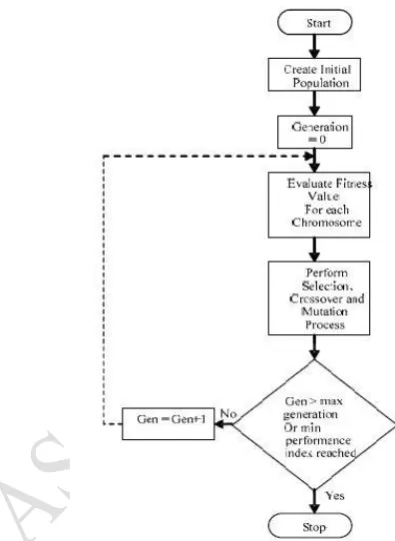
The application of these three basic operations allows the creation of new individuals which may be better than their parents. This algorithm is repeated for many generations and finally stops when reaching individuals that represent the optimum solution to the problem. Genetic algorithms (GAs) which are modelled on natural evolutionary strategies are a methodology that has been introduced as a leaning and optimization technique for solving complex problems. , it can deal with intrinsic uncertainties by changing controller parameters. Finally, it is appropriate for rapid applications. Therefore, fuzzy logic has been applied to the industrial systems as a controller. Human experts prepare linguistic descriptions as fuzzy rules, which are obtained based on step response experiments of the process, error signal, and its time derivative [8]. Determining the controller parameters with these rules, the fuzzy gain scheduling proportional, integral and differential controller (FGPID) is formed. Fuzzy logic shows experience and preference through membership functions, which have different shapes Furthermore, genetic algorithm (GAs) search has inherent parallelism which enables rapid identification of high performance regions of complex domains without experiencing problems with high dimensionality. Thus, genetic algorithms (GAs) have found exponential growth in many control applications especially while integrating the fuzzy logic, where they have applied to the process of learning control rules, selection of rules and their membership functions. The theory of genetic algorithms (GAs) is based upon initialization of chromosomes, giving fitness value to the chromosome according to their performance criteria, reproduction based on probability, crossover which divides the binary coding of each parent into two or more segments and then combines to give a new offspring that has inherited part of its coding from each parent, mutation process in which the coding of offsprings is done with low probability.
These optimization algorithms perform a stochastic search by iterations of populations of solutions according to their
fitness. In control applications, fitness is related to performance measures of the process controllers. Performance of fuzzy logic controllers can be improved if fuzzy reasoning model is supplemented by genetic algorithm mechanism. The genetic algorithm enables us to generate an optimal set of parameters for the fuzzy logic model.
Figure 4: Implementation of Genetic Algorithm based controller
VIII. HYBRIDIZATION OF SOFT COMPUTING TECHNIQUES
Page 278 www.ijiras.com | Email: [email protected] New applications to real world problems of hybrid integrated
systems are found to achieve better results than standalone techniques. After many years of efforts towards augmenting fuzzy systems with learning and adaptation capabilities, evolutionary computing has resulted in the emergence of fuzzy genetic hybrid system with the adaptation capabilities of evolutionary algorithms. Fuzzy systems have demonstrated the ability to formalize the approximate reasoning typical of humans in computational efficient manner. Genetic algorithms, on the other hand, constitute a robust technique in complex optimization, identification, learning and adaptation problems. This leads to increase capabilities for the design and optimization of fuzzy systems. The primary goal of artificial intelligence is to produce intelligent machines which simulate and emulate human beings intelligence.
The parameters of fuzzy system are specified by human designer. Following their successful application to a variety of learning and optimization problems, genetic algorithms have been proposed as a learning method that can enable automatic generation of optimal parameters for fuzzy controllers, based on some objective criteria. Genetic algorithm can be applied with fuzzy in three ways. In the first case, linguistic rules of fuzzy controller are fixed and their membership functions are to be optimized. In the second case the membership functions of linguistic values are fixed and the optimal sets of rules for the problem are determined by genetic algorithms. In the third approach, the rules and membership functions are adjusted simultaneously.
Ever since fuzzy logic was introduced by Professor Lotfi A. Zadeh in mid sixties and genetic algorithms (GAs) Professor John Holland in early seventies, these two fields are widely been a very important area of research around the world. During the last few years, they have been noticing extremely rapid growth in industrial world, and considered genetic algorithm and fuzzy logic as very effective tools for solving real-world problems. The genetic algorithms (GAs) are an efficient and robust approach for generating fuzzy rules.
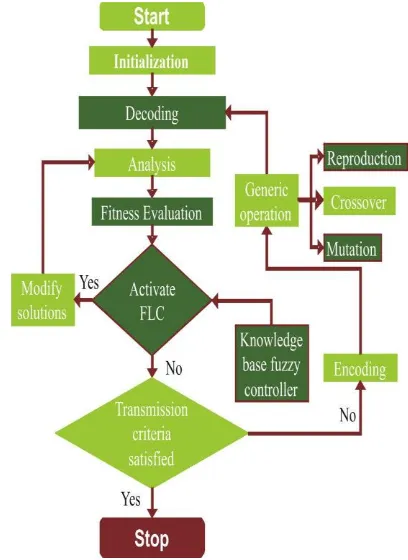
The integration of fuzzy logic theory with genetic algorithms (GAs) have two functions:
genetic algorithms (GAs) are used to optimize the parameters of fuzzy logic
secondly fuzzy logic automatically modifies genetic parameters such as mutation, crossover rate during the optimization process.
The algorithm for performing the fuzzy logic genetic algorithm regression can be summarized as follows:
STEP I
Mapping solution space into search space, that is, binary strings. Construct fuzzy fitness function using an objective function.
STEP II
Create initial random population, that is, a population of fuzzy regression coefficient which is randomly specified.
STEP III
Evaluate each chromosome in the population in terms of its fitness value.
STEP IV
If termination conditions exist, go to step VIII.
STEP V
Generate new population using selection methods, which randomly selects the Chromosomes from the current population.
STEP VI
Create new chromosomes by mating randomly selected chromosomes. The resulting Offspring replaces the original parent chromosome in the population.
STEP VII
Mutate some randomly selected chromosomes with their specified possibility.
STEP VIII
Stop, return the best chromosome and translate it into fuzzy coefficients.
The stop criteria may be maximum or minimum number of generations. This interactive process can be used to obtain the improved performance of fuzzy coefficient. The block diagram for hybrid fuzzy logic genetic algorithm approach on the basis of the above algorithm is shown in Figure 4.
Page 279 www.ijiras.com | Email: [email protected] Initial population has to be produced by selection and
encoding techniques and the computation is performed with genetic operators to evaluate the fitness function with respect to an objective function. As a result, computing time and the risk of premature convergence is remarkably reduced. Thus artificial intelligence is to produce intelligent machines which simulate and emulate human beings intelligence. Hybridization of fuzzy logic with genetic algorithms can optimize the controller parameters.
IX. APPLICATION OF HYBRID FUZZY GENETIC ALGORITHM TECHNIQUE ON GAS TURBINE
SPEED CONTROL SYSTEM
Gas turbines are non linear plants with multiple inputs and multiple outputs. Due to high rotational and high temperature of gas turbines, operational parameters have to be closely maintained and tuned. Turbine speed control system is taken up to be controlled with artificial intelligent techniques because it is often encountered in refineries in the form of steam turbine that uses hydraulic governor to control the speed of turbine. A conventional proportional integral derivative (PID) controller can be used to control the turbine compressor system. It is a feedback control system, the purpose of which is to measures the output variable and sends the control signal to the controller.
Due to high transient response in proportional integral derivative (PID) controller, output is greatly distorted and the efficiency of the plant is considerably reduced. The fuzzy proportional integral derivative (PID) controllers are the natural extension of their conventional version, which preserve their linear structure of proportional integral derivative (PID) controller. The fuzzy proportional integral derivative (PID) controllers are designed using fuzzy logic control principle in order to obtain a new controller that possesses analytical formulas very similar to digital proportional integral derivative (PID) controllers. In this experimental study, classic interpretation of Mamdani logic operations is applied. The fuzzy logic controller (FLC) gives much lower overshoot, settling time and peak time than the conventional proportional integral derivative (PID) controlle rGenetic algorithms (GAs) are intelligent optimization technique that relies on the parallelism found in nature, in particular its searching procedures which are based on the mechanics of natural selection and genetics. Genetic algorithms, with a population size of 20 chromosomes, run for 50 generations. Roulette wheel method is used for selection of chromosomes, with a two point crossover, having mutation probability 0.01.
The step response of hybrid fuzzy genetic algorithms (HFLGA) system shows that the transient response parameters are better optimized than fuzzy logic controller (FLC) and conventional proportional integral derivative (PID) controller. This shows the superiority of hybrid fuzzy genetic algorithms (HFLGA) over conventional controllers and standalone fuzzy controller.
The comparison of the error performance parameters integral of absolute error (IAE) and integral of time and absolute error (ITAE) of proportional integral derivative (PID)
controller, fuzzy logic controller (FLC) and hybrid fuzzy genetic algorithm (HLFGA) controller shows the superiority of hybrid controllers over stand alone and conventional proportional integral derivative (PID) controllers. The integral of absolute error (IAE) and integral of time and absolute error (ITAE) of hybrid fuzzy genetic algorithm (HLFGA) controller is, which is remarkably less and shows the optimized control of the hybrid controllers on the errors of the gas turbine.
X. CONCLUSION AND FUTURE SCOPE
The stability analysis of fuzzy logic and genetic algorithms based non-linear controllers is discussed in this paper work. Speed control of a typical turbine compressor system for controlling the outlet of gas is performed by using fuzzy logic strategy and hybrid fuzzy logic genetic algorithm techniques. When compared to conventional controllers, fuzzy logic provides better control on transient and steady state errors and the incorporation of genetic algorithms with fuzzy logic further optimizes the controller parameters. Conventional controller system is optimized using fuzzy logic and hybrid fuzzy logic genetic algorithm techniques. The novel fuzzy logic and hybrid fuzzy logic genetic algorithm techniques outperform the conventional approach in terms of minimization of transient and steady state errors.
Abridged, it is evident from the study that the soft computing techniques are a great deal of research for tackling non-linear complex process control systems. A conclusion can be drawn that the fuzzy logic is most robust and systematic approach for controlling the process. And combining it with genetic algorithm make this more advance in every way. Many research work on this advanced technique is going on in almost every field, whether it is medical, engineering aeronautical, transportation, refineries etc and it is proved that fuzzy genetic algorithm has demonstrated its effectiveness to generate better results than standard genetic algorithm and other traditional heuristic approaches.
REFERENCES
[1] Kumar K., Sakthibala D. and Palaniswami S., (2010), “Efficiency optimization of Induction Motor Drive using Soft computational techniques,” International Journal of Computer Applications, 3(1), pp.6-12.
[2] Arulmozhiyal R. and Baskaran K. , (2009), “Speed control of induction Motor using Fuzzy PI and Optimized using Genetic Algorithms,” International Journal of Recent Trends in Engineering , 2(5),pp.43-47.
[3] Pujar J.H and S.F. Kodad, (2009), “Digital Simulation of Direct Torque Fuzzy Control of PMSM Servo System” International Journal of Recent Trends in Engineering, 2(2), pp. 89-93.
Page 280 www.ijiras.com | Email: [email protected] anesthesia using fuzzy soft computation applied to EEG
features,” Intelligent data Analysis 12, pp. 393-407. [6] Nagraj B., Subha S. and Rampriya B., (2008), “Tuning
Algorithm for PID controller using soft computing Techniques,” International Journal of Computer Science and network Security, 8(4), pp. 278-281.
[7] Yakhchali S. H. and Ghodsypour S. H.,(2008), “A Hybrid Genetic Algorithms for Computing the Float of an Activity in Networks with Imprecise Durations”, Proceedings of the IEEE International Conference on Fuzzy Systems ,FUZZ-2008, pp.1789-1794.
[8] Yakhchali S. H. and Ghodsypour S. H., (2008), “A Hybrid Genetic Algorithms for Computing the Float of an Activity in Networks with Imprecise Durations”, Proceedings of the IEEE International Conference on Fuzzy Systems, FUZZ-2008, pp.1789-1794.
[9] Rouabah Z., Zidani F. and Abdelhadi B., (2008), “Efficiency Optimization of Induction Motor Drive using Fuzzy Logic and Genetic Algorithms,” IEEE International Symposium on Industrial Electronics, pp. 737-742. [10] Toufouti R. Meziane S., (2006), “Direct torque control for
Induction Motor using Fuzzy Logic,” ACSE Journal, 6(2), pp. 19-26.
[11] Gang Feng, (2006), “A Survey on Analysis and Design of Model-Based Fuzzy Control Systems,” IEEE Transactions on Fuzzy Systems, 14 (5), pp. 676 – 697. [12] Vasudevan M., Argumugan R. and Paramasivam S. ,
(2005), “High- performance Adaptive Intelligent Direct torque schemes for Induction Motor Drives,” Serbian Journal of Electrical Engineering , 2(1), pp. 93-116. [13] Changliang X., Peijian G., Tingna S. and Mingchao W.,
(2004), “Speed control of brushless DC motor using genetic algorithm based fuzzy controller”, Proceedings of the International Conference on Intelligent Mechatronics and Automation Chengdu,China, pp.460-464.
[14] Rekioua T. and Rekioua D., (2003), “Direct torque control strategy of permanent magnet synchronous machines,” IEEE Bologna on Power Tech Conference Proceedings, 6(2), pp.6 -12.
[15] Behzad M., Mahdi J. and Farhad B., (2003) , “Application of Fuzzy Sliding Mode Based on Genetic Algorithms to Control of Robotic Manipulators”, Proceedings of IEEE Conference on Emerging Technologies and Factory Automation, Vol.2, pp.169- 172.
[16] Yansheng Yang and Junsheng Ren, (2003), “Adaptive fuzzy robust tracking controller design via small gain approach and its application,” IEEE Transactions on Fuzzy Systems, 11 (6), pp.783 – 795.
[17] Gang Feng, (2003), “Controller synthesis of fuzzy dynamic systems based on piecewise Lyapunov functions and bilinear matrix inequalities,” The 12th IEEE International Conference on Fuzzy Systems, 2003, FUZZ-03, vol.2, pp.1327 – 1332.
[18] Chang Wook Ahn and Ramakrishna, R.S., (2002), “A genetic algorithm for shortest path routing problem and the sizing of populations,” IEEE Transactions on Evolutionary Computation, 6(6), pp. 566-579.
[19] Chia-Feng Juang, (2002), “A TSK-type recurrent fuzzy network for dynamic systems processing by neural network and genetic algorithms,” IEEE Transactions on Fuzzy Systems, 10 (2), pp. 155-170.
[20] Changliang X., Peijian G., Tingna S. and Mingchao W., (2004), “Speed control of brushless DC motor using genetic algorithm based fuzzy controller”, Proceedings of the International Conference on Intelligent Mechatronics and Automation Chengdu,China, pp.460-464.
[21] Rekioua T. and Rekioua D., (2003), “Direct torque control strategy of permanent magnet synchronous machines,” IEEE Bologna on Power Tech Conference Proceedings, 6(2), pp.6 -12.
[22] Behzad M., Mahdi J. and Farhad B., (2003) , “Application of Fuzzy Sliding Mode Based on Genetic Algorithms to Control of Robotic Manipulators”, Proceedings of IEEE Conference on Emerging Technologies and Factory Automation, Vol.2, pp.169- 172.
[23] Yansheng Yang and Junsheng Ren, (2003), “Adaptive fuzzy robust tracking controller design via small gain approach and its application,” IEEE Transactions on Fuzzy Systems, 11 (6), pp.783 – 795.
[24] Gang Feng, (2003), “Controller synthesis of fuzzy dynamic systems based on piecewise Lyapunov functions and bilinear matrix inequalities,” The 12th IEEE International Conference on Fuzzy Systems, 2003, FUZZ-03, vol.2, pp.1327 – 1332.
[25] Chang Wook Ahn and Ramakrishna, R.S., (2002), “A genetic algorithm for shortest path routing problem and the sizing of populations,” IEEE Transactions on Evolutionary Computation, 6(6), pp. 566-579.
[26] Chia-Feng Juang, (2002), “A TSK-type recurrent fuzzy network for dynamic systems processing by neural network and genetic algorithms,” IEEE Transactions on Fuzzy Systems, 10 (2), pp. 155-170.
[27] Ganguli R., (2002), “Fuzzy Logic Intelligent System for Gas Turbine Module and System Fault Isolation”, Journal of Propulsion and Power, 18(2), pp. 1-6.
[28] Kewley R. and Embrechts J. and Kewley, R.H., Embrechts, M.J., (2002), “Computational military tactical planning system,” IEEE Transactions on Systems, Man, and Cybernetics, Part C: Applications and Reviews, 32(2), pp.161- 171.