ISSN (Online): 2320-9364, ISSN (Print): 2320-9356
www.ijres.org Volume 3 Issue 8 ǁ August. 2015 ǁ PP.33-42
The application of product innovation design based on Tacit
Knowledge
Zhang Jianmin, Zhou Jun
College of Mechanical Engineering, Shanghai University of Engineering Science, Shanghai 201620,China
ABSTRACT
: With the advent of the era of knowledge economy, the knowledge of the traditional product design cannot meet the needs of the users for the product. Improving the quality of product design is the primaryway to maximize the benefits, however, product innovation design is the main way to improve the core
competitiveness of enterprises and tacit knowledge is the source of product innovation design. Therefore, this
paper proposes a application of tacit knowledge in product innovation design. Under the premise of
understanding the concept of tacit knowledge, attain tacit knowledge in the mind of the user access from the
product, and transform the tacit knowledge through improved Kano model and analytic hierarchy process
method to the user’s functional requirements to the product, so as to obtain a product of the specific function
and function structure chart, completing product innovation design. Finally, the method is applied to the product
innovation design of the small advertising cleaning machine to prove the feasibility of the method.
Keywords
: product innovation design; tacit knowledge; the improved Kano model; analytic hierarchy processI.
INTRODUCTION
With the continuous development of technology, the focus of researching and developing products not only
depends on technology or principles to realize product innovation, but drives product innovation from the
knowledge. Service object of product is the users, we only fully exploit the users’ emotional and experience
(tacit knowledge) so as to make the product meet the users further.
At present, domestic and foreign experts have begun to focus on the users' tacit knowledge, and it is widely
used in product design, for example: Japanese knowledge management expert Ikujiro Nonaka introduced the
SECI process of the conversion between explicit knowledge and tacit knowledge and solved the conversion
problem between explicit knowledge and tacit knowledge; OSGOOD put forwards a semantic difference method that made consumers’ mental responses performanced in the Likert scale and then used the relevant mathematical methods to process and analysis by learning object’s semantics (including the color of product, the shape of product, etc.), and provided a reliable method for the product conceptual design[1]; Luo Shijian, Pan Yunhe, Zhu Shang shang proposed that in product design, knowledge representation based on tacit knowledge of
thinking illustrations provided an important way for externalization of tacit knowledge [2]; Liu Zheng, LU Na, Sun Lingyun, put forward tacit knowledge acquisition method for the process of concept design, which
expressed the tacit knowledge with the method of oral report and sketch explanation[3];Chen Youling, Xiao Yingjiao proposed tacit knowledge acquisition of product-oriented design, and the concept of "knowledge
cells",at the same time, they completed efficient acquisition of tacit knowledge by means of artificial neural
networks[4]. At present, domestic and foreign scholars’ research on the tacit knowledge primarily in tacit knowledge acquisition method and tacit knowledge applied to product modeling design. The nature of the
of tacit knowledge on product innovation design is not yet mature.
Therefore, this paper presents the application of product innovation design on tacit knowledge, it mainly
solves the function and structure innovation of product. First selecting the adjectives of emotional evaluation
related with Product function semantics by consultants and designers, and using the improved Kano model and
AHP(analytic hierarchy process) with questionnaires to make the users’ tacit Knowledge transform into the
users’ demand for the product function and make functional design of the product, and finally the establish
product function - structure chart to get the final program . At the same time, this study can be used as a
reference of the peers of knowledge management, product design.
II.
TACIT KNOWLEDGE AND PRODUCT DESIGN
2.1 The concept of tacit knowledge
Tacit knowledge is the concept which is proposed by Michael • Polanyi in 1958 from the philosophy
proposed [5,6]. He believes that, in a particular situation, tacit knowledge is people-carrier and exists in the
human brain and it is the knowledge which is difficult to express in words .It is an important part of the
knowledge innovation, mainly originates from the individual's emotion, cognitive or experience.
2.2 Tacit knowledge in product design
Product design services for users, the user’s demand, awareness and evaluation for the product is very
important, and these are the tacit knowledge which, at the beginning, must be understood by every designer to
design products, which we called users’ tacit knowledge. Before the users know the product, "impression" will
appear in the brain based on past experience and knowledge such as "what functions it should have,""what does
it looks like " and other such the problem of 4W1H (what, when, who, where, how); when receiving product
information, users typically make use of a certain adjectives, such as "normal", "delicate", "lightweight",
"simple" to describe it [7]. Perceptual evaluation of these adjectives is composed to user tacit knowledge. At the same time, users have expressed tacit knowledge for product which is often the experience or ability of using
product, it is particularly important for product innovation design.
III.
TACIT KNOWLEDGE’S ACQUISITION AND DOMINANCE
This paper, firstly, selects the tacit knowledge factor (adjectives) related with product function semantics
with the way of consulting experts and product designers. For the acquisition of tacit knowledge factor, it must
be explicit by a tool, in order to apply it to product innovation design. Therefore, we introduced an improved
Kano model and AHP.
3.1 Acquisition and expression of tacit knowledge based on improved Kano model and AHP 3.1.1 Kano model
Kano model was proposed by the Japanese Quality Management experts Kano, which was a model of
customer satisfaction related with product performance. Using this model can identify the user's needs, and
classify users; requirements [8].Kano model has two important tools: one is a quality characteristic evaluation
table; the other is the classification table of evaluation results of kano model.
3.1.2 Improved kano model
In order to meet the needs of the users’ tacit knowledge becomes dominant better, and express the users’
deeper functional requirements of the product, we will change the positive issues and negative issues related
expressed by a positive adjective and a negative adjective which consists of product quality characteristic
evaluation table, as shown in table 1, where a1 is positive adjective, a1’ is the reverse; the traditional
classification table of evaluation results of kano model is merely a tool to distinguish users’ needs, but it does
not clearly express the extent of the users’ demand of product. and the users’ demands of product are actually a
variety of product functional demands, according to primary and secondary order of product, product function
can be divided into the basic function and additional functions[9]. Since any product has its basic functions, such
as: the basic function of the bicycle is a means of transport, the basic function of mobile phones is make a phone
call and so on, and this basic function will not be changed in a certain period of time, so we should focus on
consideration for additional function. The additional function of the product is the core of product innovation
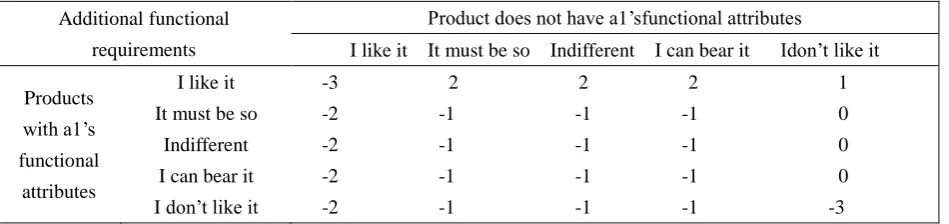
design. So, we will make a assignment to six demands which are divided in kano model: A shows exciting
demand, O shows expected demand, M shows basic demand, I shows irrelevant demand, R shows opposite
demand, Q shows problem demand,their values are in turn: 2, 1, 0, -1, -2, -3, in the actual operation, if its value
is -3 and -2, then it is an unreasonable demand which can not be considered. As shown in Table 2.
Table 1: Product function demand evaluation table
Positive issue
Having a1’s function, how do you evaluate? □I like it □It must be so □Indifferent □I can bear it □I don’t like it
Negative issue
Not having a1’s function, how do you evaluate? □I like it □It must be so □Indifferent □I can bear it □I don’t like it
Table 2: Kano Model Product Extrademands score table
Additional functional
requirements
Product does not have a1’sfunctional attributes I like it It must be so Indifferent I can bear it Idon’t like it
Products with a1’s functional
attributes
I like it
It must be so
Indifferent
I can bear it
I don’t like it
-3 2 2 2 1
-2 -1 -1 -1 0
-2 -1 -1 -1 0
-2 -1 -1 -1 0
-2 -1 -1 -1 -3
The users’ demand for additional function of product is based on the use of the adjectives (a1 and a1') to
evaluate, so only one kind of functional requirements will exist. The results in Table 1 and Table 2: users think
the score of products with a1 (positive adjective) functional requirements is 0 to 2, then a1 '(reverse adjective)
functional requirements do not need to be tested; if the results are -1 to 0, then a1 '(reverse adjective) functional
requirements need to be retested to determine their specific scores.
Using improved Kano model to make explicit tacit knowledge can quantify user’ additional function
demand for products, but for several additional functions, if their scores are the same ,it is difficult to determine
which additional function is more important, then we need to calculate the weight, so we introduce AHP.
3.1.3 Analytic Hierarchy Process
Identify the characteristics items to be determined--the number of properties of each case, the same to the above
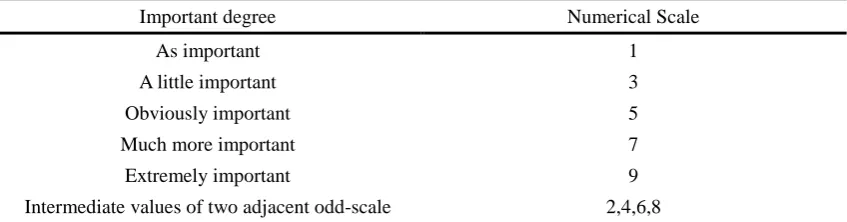
is n; ② the relative importance of identify the pairwise important degree between the two feature items, and measure it with the number in table 3;③ Analysis experimental data, according to the satisfaction consistency test of judgment matrix ,we can determine that the required feature weight is available or not.
Table 3 1~9 scale method and its meaning
Important degree Numerical Scale
As important 1
A little important 3
Obviously important 5
Much more important 7
Extremely important 9
Intermediate values of two adjacent odd-scale 2,4,6,8
(1) Get the coefficient matrix of the important degree of the feature items
Each case hasjfeature items. Comparing with every two feature items which can get the coefficient
matrixAof the important degree of the feature items:
nn n n n n n kha
a
a
a
a
a
a
a
a
A
...
...
...
...
...
...
...
...
1 2 22 21 1 12 11 (1) kha represents the first k case feature items which is relative to the importance of the firsthcases feature
items, and it meets ahk1akh, the value is a certain value in Table 1, while at the same time,if hk,then
1
hk
kh a
a .
(2) To determine the weight of each feature item
n h n g gh kh ka
a
n
1 11
, nk1,2,..., (2)
(3) To calculate the maximum eigenvalue
All calculated weights consisted of weight vectorW, the weight vector met matrix calculation formula:
T T
W
AW
m ax (3)Among them, max is the largest eigenvalue of matrixA, according to the equation (3),we know that:
(4) Consistency test
To test the consistency of judgment matrixA, we will establish the consistency index of the judgment
matrix:
1
1
m ax
n
CI
(5)
When the judgment matrix has full consistency, thenCI0.In order to measure whether n-order judgment
matrix has the satisfied consistency, the average random targetsRI of the judgment matrix are introduced. The
values of RI are shown in Table 4.
Table 4 The values ofRI
Order RI Order RI
1 0 6 1.24
2 0 7 1.32
3 0.58 8 1.41
4 0.90 9 1.45
5 1.12 … …
In accordance with the values of CI and RI , the consistency of judgment matrix A:
RI
CI
CR
(6)
If CR0.1, then we can think that judgment matrixAhas its consistency.
IV.
PRODUCT INNOVATION DESIGN MODEL BASED ON TACIT KNOWLEDGE
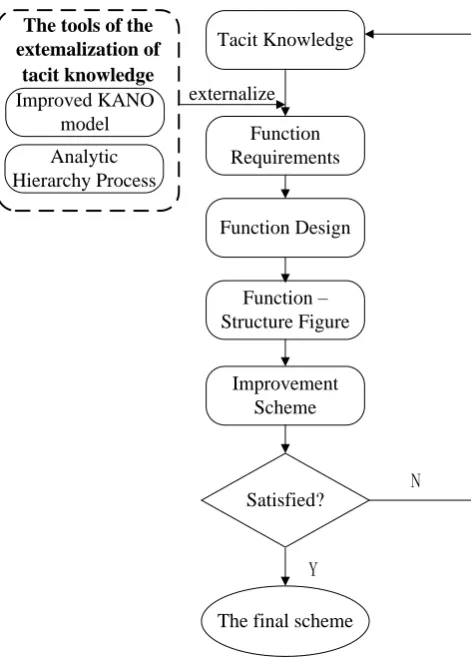
This paper used the improved Kano model and AHP with questionnaires to make users’ tacit knowledge
explicit. Explicit knowledge is users’ additional functional requirements for the product and function design is
needed, and the product scheme should be expressed by the way of function-structure chart, and then complete
Tacit Knowledge
Function Requirements
Function Design
Function – Structure Figure
The final scheme externalize
Y
Analytic Hierarchy Process
The tools of the extemalization of
tacit knowledge
Satisfied? Improvement
Scheme
N
Improved KANO model
Figure 1 Product innovation design model based on tacit knowledge
Acquisition and expression of users’ tacit knowledge: This paper selected n couple of tacit knowledge factors (adjectives) related to the product functional semantics by consulting experts and product designers. For the
acquired tacit knowledge factors, we use the improved Kano model and AHP to make them explicit.
Externalized knowledge is the users’ demands for additional functional requirements of products.
The application of tacit knowledge in product innovation design: Transform the users’ additional functional requirements for the products into specific product functions, and decompose the functions by the way of
function-structure chart until getting the product structures, and finally the concrete product improvement
program was acquired.
The evaluation of the scheme of product innovation design: Designers can compare the acquired scheme of product improvement design to the former product scheme. If the current scheme is more innovative and
practical, then output it; or, retest it.
V.
EXPERIMENT
5.1 Acquisition and expression of users’ tacit knowledge
This paper took small ads. cleaning machine as an example. Due to the current small ads gradually spread, a
such as small blades, shovel etc. to clean up the small ads, so that the prospect of using small ads. cleaning
machine is very large, but the basic function of small ads. cleaning machine is to clear the paper of the wall, so,
this paper will focus on the study of its additional functions.
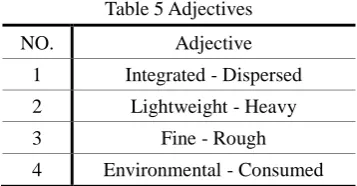
Prior to the testing, pre-set 20 groups of adjectives related to product function semantics by consulting
experts, and after a comprehensive analysis of the designer, we selected the following four groups of adjectives
as the users’ evaluation vocabularies, as shown in Table 5:
Table 5 Adjectives
NO. Adjective
1 Integrated - Dispersed
2 Lightweight - Heavy
3 Fine - Rough
4 Environmental - Consumed
This part of the test got the users’ evaluation by the way of questionnaires.
Subjects were selected: randomly selected 50 city workers with more than 3 years experience, including
male 30, female 20;
Test materials: one small ads cleaning machine, four groups of adjectives;
Test requirements: Introduce to the subjects about the relations between adjectives and product function
semantics, and remove the nameplate of small ads cleaning machine, subjects were asked to complete it
independently based on their own emotion and experiences to select; the questionnaire is shown as Table 6:
Table 6 Questionnaire (section)
Positive issue
Having integrated function, how do you evaluate? □I like it □It must be so □Indifferent
□I can bear it □I don’t like it
Negative issue
Not having integrated function, how do you evaluate? □I like it □It must be so □Indifferent
□I can bear it □I don’t like it
Test results: To the choice of the functional requirements for integration, there were 28 people chose
additional function requirement of two points, 12 people chose 1 point, 5 people chose 0, and 5 people chose -3
and -2.
Data processing: Firstly, remove the unreasonable requirements of -3 points and -2 points, and other
numbers were averaged, the results: integrated functional requirement is 1.51 points. So the requirement for
dispersed function will no longer be investigated and analyzed.
For reasons of space, we will not analyze in detail. Other scores of functional requirements: lightweight
functional requirement is 1.83 points; fine functional requirement is 0.83 point; environmental functional
requirement is 0.83 point. Because of the same score between fine functional requirement and environmental
functional requirement, then, we will need to calculate the weights of the two kinds of requirements, the results
are: the weight of environmental functional requirement is W1 = 0.6; the results are: the weight of fine functional requirement is W2 = 0.4, so when designing functions and a collision occurs, additional functional
5.2 Product innovation design based on tacit knowledge 1. Function design
According to the Obtained four kinds of functional requirements of the users for a small ad cleaning
machine, we can carry out specific function design as shown in Figure 2: arrows represent calculated scores and
weights, when product design, if a collision occurs, priorities should be considered.
Additional function requirements: lightweight Additional function requirements: Integrated Additional function requirements: environmental Additional function requirements:fine
Hand pushing function, Retractable function
Clear confetti, Softening confetti, Confetti recovery
Environmental function Anti-skid function,Support function,Shockproof function Mapping Mapping Mapping Mapping
Figure 2 The mapping model of function requirements to function design
2. Function–Structure chart
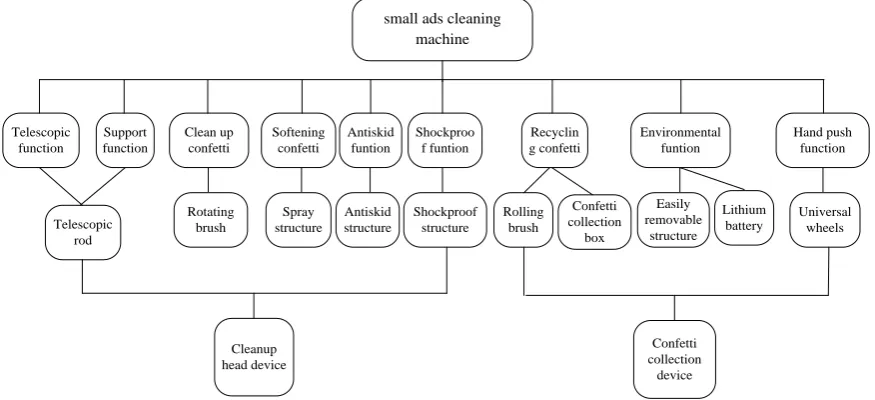
From the functions of small ads cleaning machine and its function–structure chart, we can get the specific
structures and components of small ads cleaning machine , as shown in Figure 3:
small ads cleaning machine Hand push function Telescopic function Clean up confetti Softening confetti Recyclin g confetti Environmental funtion Support function Antiskid funtion Shockproo f funtion Telescopic rod Rotating brush Spray structure Rolling brush Confetti collection box Universal wheels Easily removable structure Lithium battery Antiskid structure Shockproof structure Cleanup head device Confetti collection device
Figure 3 The Function–Structure chart of small ads cleaning machine
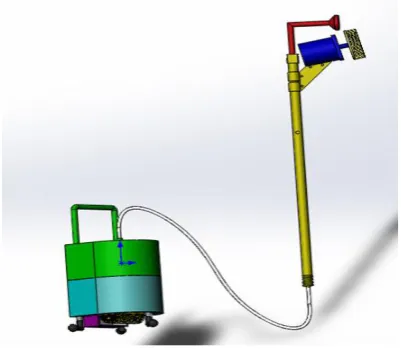
The assembly drawing of multi-function small ads cleaning machine is shown in Figure 4: This machine
consists of two parts: the head of this machine, and confetti collection device. The head of this machine includes
a telescopic rod to, rotating brush, spray structure and the antiskid structure and shockproof structure which
were fixed in the telescopic rod which can advoid Vibration and loose generated by the rotating brush at work,
the telescopic rod is made of a hollow aluminum alloy and it can connect with water pipe, elastic, the top of
to disassemble; Confetti collection device includes universal wheels, Rolling brush, confetti collection box and
geared motor and lithium battery, the geared motor which directly made the rolling brush rotate and collect
confetti by moving the universal wheels. Complete the innovation design of small ads cleaning machine.
Figure 4 The assembly drawing of multi-function small ads cleaning machine
3. Scheme Evaluation
You can compare the design scheme of ads cleaning machine to the former, and we can know that this
scheme has the functions of cleaning up confetti, softening confetti and recycling confetti, thus in order to avoid
secondary pollution problem caused by cleaning up confetti. So we can think that this scheme has a certain
innovation.
VI.
CONCLUSION
In order to improve the quality of product design fundamentally, we propose a method of the application of
product innovation design based on tacit Knowledge. Now this article will be summarized in the following two
areas:
(1) The tacit knowledge is an important source of product innovation design. By selecting the city workers as
subjects, determining the emotional adjectives related to product function semantics and using the questionnaire
of improved Kano model, in order to select his product function requirements, according to the users’ emotion
and experiences, and calculating the same score of function requirements with AHP, thus so as to get the users’
function requirements for product.
(2) And then we will transform the obtained the users’ function requirements for product into specific product
functions which will be transformed into the function-structure chart of product and finally get the specific
structures and components of product, and complete the innovative design of small ads cleaning machine, And
after demonstrated ,that the scheme has a certain innovation.
Reference
[1] OSGOOD C E, SUCI CJ, TANNENBAUM PH. The measurement of meaning[M]. Urbana: university of Illinois press, 1957. [2] Luo Shijian, Pan Yunhe, Zhu Shangshang.Tacit knowledge expression based on graphic thinking in product design [J]. JOURNAL
OF MECHANICAL ENGINEERING,2007,43(6):93-98.
[3] Liu Zheng, Lu Na, SUN Lingyun. Tacit Knowledge Acquisition Method for the Process of Concept Design [J].JOURNAL OF MECHANICAL ENGINEERING, 2011,47(14):184-191.
technological progress and Countermeasures,2011, 28(19):121-124.
[5] Jacqueline Senker.The Contribution of Tacit Knowledge to Innovation [J].AI&Soc, (1993) 7:208-224.
[6] Jan Andreasik. A Case-Base Reasoning System for Predicting the Economic Situation of Enterprises—Tacit Knowledge Capture Process[J]. Computer Recognition Systems, 2007, 45, 718-730.
[7] Luo Shijian, Zhu Shangshang, Ying Fangtian. Research status and progress of user's tacit knowledge in product design[J].Computer Integrated Manufacturing Systems,2010,16(4):673-688.
[8] Li Yan.Theory and method of product innovation design [M].Beijing: Science Press, 2010. [9] Liu Meihua.Product design principle [M].Beijing: Beijing University Press, 2008.
[10] Zhang Xiaoli, Li Xin. Research on intelligent design method of mechanical product based on CBR [J].Journal of Dalian