Design and Development of Stepper Motor
Position Control using Arduino Mega 2560
Shailesh J. Parmar Mital S. Zala
Student Student
Department of Electrical Engineering Department of Electrical Engineering Dr. Subhash Technical Campus, Junagadh, Gujarat, India.
Pin-362001, India
Dr. Subhash Technical Campus, Junagadh, Gujarat, India. Pin-362001, India
Ishita S. Thaker Ketan M. Solanki
Student Professor
Department of Electrical Engineering Department of Electronics & Communication Engineering Dr. Subhash Technical Campus, Junagadh, Gujarat, India.
Pin-362001, India
Dr. Subhash Technical Campus, Junagadh, Gujarat, India. Pin-362001, India
Abstract
A stepper motor controller capable of both independent as well as synchronized control of a multiple number of stepper motors is discussed. Arduino ATmega2560 microcontroller provides fast and reliable control operations. Furthermore, as a feedback element rotary encoder is used to count detents of stepper motor with high resolution. The Arduino controller includes 54 digital I/O pins of which 14 provide PWM output. For instance, it can be used to control a robot having two directional freedom. The controller tested with a simultaneous control (synchronous) of two stepper motors for precision trajectory control applications. The objective of this project is to design Arduino controller based Stepper Motor controller for position control that will smoothly control the rotation of a stepper motor taking into account the physical constraints. This project describes the method by which a controlling circuit for stepper motor is being designed using Arduino Mega 2560 Controller.
Keywords: Stepper Motor, Arduino Mega 2560, Rotary Encoder, Position Control
________________________________________________________________________________________________________
I. INTRODUCTION
Stepper motors are mainly used in open loop position control system. But open loop control of stepper motor can causes loss of steps or slip of steps. We designed the closed loop position control to overcome this problem. If any wrong position of stepper motor have been achieved, it will try to solve that problem [1].
Here system is described by micro-controller program which can control the position of two stepper motor together [1]. Arduino Mega 2560 controller of microcontroller family is used in control circuit. It provides to set the position of the stepper motor angle. It count the step value and display in LED. This system should be used in automatic gauges, machine tooling, automated production equipment, medical scanners, robotics, bidirectional position control etc.
A stepper motor can moves one step at a time, unlike those conventional motors, which rotate continuously. If we give command a stepper motor to move some exact number of steps, it rotates incrementally that many number of steps and stops. Because of this basic nature of a stepper motor, it is generally used in low cost, open loop position control systems [2].
Open loop control means, there is no feedback information about the position is required. It eradicates the need for expensive sensing and feedback devices, such as optical encoders. Motor position is recognized simply by keeping track of the number of input step pulses. A stepper motor controller which we have use capable of independent control as well as synchronized control. Stepper motor is built around an Arduino Mega 2560 ATmega2560 to provide fast as well as reliable control operations [3]. The controller also includes 54 digital input/output pins. This has wide applications in manufacturing, robotics, actuators used in industrial and position of various laboratory systems, etc.
Positioning systems have traditionally been implemented using DC motors, AC servo motors, Synchronous motors, Stepper motors, etc. DC motors are relatively easy to control. However it has disadvantages in using such motors for positioning systems like overheating of the armature windings. Also the torque to inertia is relatively low [4].
For the above reasons positioning systems are now being implemented using stepper motors. Usually stepper motors were designed to provide precise positioning control within an integer number of steps. They have stable open loop operation to an y step position and consequently no feedback is needed to control them [5]. The following are some of the applications in different fields.
Robots in Industry - Automobile, Laboratories, Military, Mining, etc.
Industrial applications - Material Handling, Material transfer, spot welding, etc. Mechanical equipment - Lath machines
Medical robots - Robotic assistant for micro surgery
A precision stepper motor controller capable of both independent and synchronized control of 2 stepper motors is built around an Arduino Mega 2560 ATmega2560 to provide fast and reliable control operations. The controller also includes 54 digital input/output pins. This has wide applications in manufacturing, robotics, actuators used in industrial and position of various laboratory systems, etc. [5].
II. HARDWARE
Arduino Mega 2560
The Arduino Mega 2560 is a microcontroller board based on the ATmega2560 datasheet [6]. It has 54 digital input/output pins in which 14 pins can be used as PWM (Pulse Width Modulation) outputs, 16 Analog inputs, 4 UARTs (Hardware serial ports), a power jack, a 16 Mega Hertz crystal oscillator, an ICSP header, a USB connection, and a reset button. It contains everything needed to support the microcontroller; simply we have to connect it to a computer with a USB data cable or power it with an AC-DC adapter or battery to get started [6].
M542 Stepper Driver
The M542 is an economical patented technology based micro-stepping driver. It is suitable for driving two phase and four phase stepper motors. By using the advanced bipolar constant current chopping technique, it can output more speed and torque from the same motor compared with other traditional drivers like L/R drivers. Its 3-state current control technology allows coil currents to be well controlled and with relatively small current ripple, so less motor heating is achieved [7].
Fig. 4: LCD (LM016L) [9]
Fig. 5: Rotary Encoder | circuit-diagram.com
Rotary Encoder
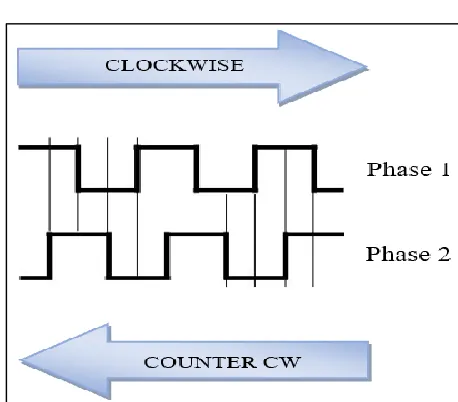
Incremental rotary encoders provide a pair of digital signals that allow a microcontroller to determine the speed and direction of a shaft’s rotation. They can be used to monitor motors and mechanisms, or to provide a control-knob user interface. The best-known application for rotary encoders is the mouse, which contains two encoders that track the x- and y-axis movements of a ball in the device’s underside [8].
LCD (LM016L):
III. OUTPUT WAVE OF ENCODER
Fig. 6: Quadrature waveforms from a rotary encoder contains directional information [8]
Fig. 7: Sequence of two-bit numbers output by the phase of a rotary encoder [8]
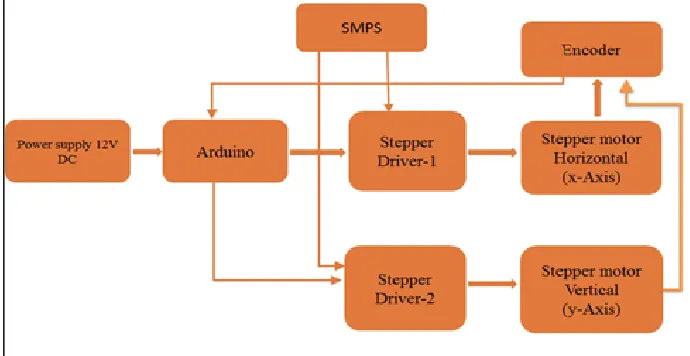
Here system is described by Arduino program which can control the position of two stepper motor. The micro controller used is Arduino. Simply Stepper motor is an open loop control system but in this implementation, closed loop control of stepper motor is used. Here as a feedback element rotary encoder is used. Rotary encoder count the number of detents when stepper motor rotates. Here LCD (LM016L) is a 16×2 pixels display will displays the speed of stepper motor and also display number of detents counts, Initial and Old position of the motor’s shaft.
V. ARDUINO PROGRAMMING
Program for encoder testing: #include <RotaryEncoder.h> RotaryEncoder encoder(A2, A3); void setup()
{
Serial.begin(57600);
Serial.println("SimplePollRotator example for the RotaryEncoder library."); }
void loop() {
static int pos = 0; encoder.tick();
int newPos = encoder.getPosition(); if (pos != newPos) {
Serial.print(newPos); Serial.println(); pos = newPos; }
}
Program for motor testing: #include <Stepper.h>
const int stepsPerRevolution = 1600;
VI. IMPLEMENTATION
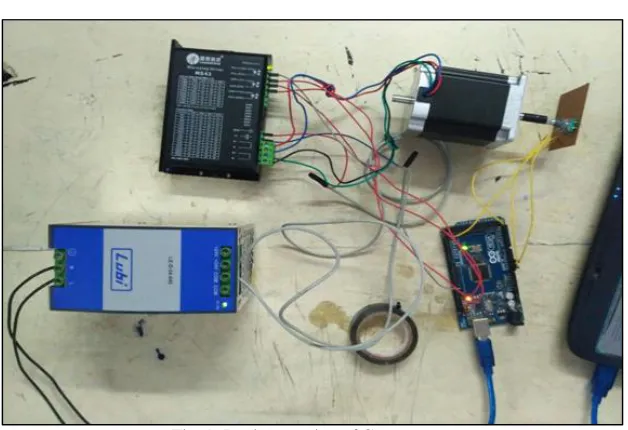
Fig. 9: Implementation of Components
VII.CONCLUSION
Arduino mega 2560 controller is good controller of micro controller family which can be used for high resolution and high accuracy result and will reduce the step loss or slip of stepper motor. If any wrong position of stepper motor have been achieved then it will give the feedback signal and finally error will be solved. It is economical compared to IR-sensor based feedback control.
VIII. FUTURE WORK
we have decide that if we use this technique in two motor configuration and by using feedback element (encoder) to give the feedback signal to the Arduino mega 2560, We get accurate results and we can implement in number of applications of industries as well as others, so in the future we will made a working model of two stepper motor operation with position control of both motors.
REFERENCES
[1] Pabitra Kumar Nandi, “Design and Development Stepper Motor Position Control System Using Atmel 85c51 Microcontroller” International Journal of Emerging Research in Management &Technology Vol. 2, Issue 12, December 2013
[2] Archan Patel, K. S. Denpiya, A. N. Patel “Novel Microstepping Technique for Disc Rotor Type Stepper Motor Drive” 978-1-4244-7398-4/10/$26.00 ©2010 IEEE.
[3] D. P. Mital, C. T. Chai & T. Myint from School of Electrical and Electronics Engineering Nanyang Technological Institute Singapore, “A precision stepper motor controller for robotic applications”
[4] R. R. Dodake, S. Subbaraman, R. K. Gurav “Design and Development of Portable Insulin Syringe using Low Power Embedded Systems” Vol. 2 Issue 10, October - 2013 International Journal of Engineering Research & Technology (IJERT)
[5] “Stepper motor speed and position control - the GMU ECE Department” by Subash Anigandla, Hemanth Rachakonda, Bala Subramanyam Yannam and Sri Divya Krovvidi http://www.ece.gmu.edu/
[6] Datasheet of Arduino Mega 2560 (AT mega 2560) https://www.arduino.cc/en/Main/arduinoBoardMega2560/ [7] M542 Economical Micro stepping Driver Leadershine technology Co., Ltd. http://www.leadshine.com/ [8] “Reading Rotary Encoders PIC Application Notes” http://emerald.tufts.edu/
![Fig. 2: M542 Stepper Driver [7]](https://thumb-us.123doks.com/thumbv2/123dok_us/7805774.1661498/2.612.143.473.311.725/fig-m-stepper-driver.webp)
![Fig. 4: LCD (LM016L) [9]](https://thumb-us.123doks.com/thumbv2/123dok_us/7805774.1661498/3.612.171.440.198.505/fig-lcd-lm-l.webp)