An Approach to Interactive Affective Learning
Algorithms
Chong Su
College of Information Science and Technology, Beijing University of Chemical Technology, Beijing 100029, China Email: [email protected]
Hongguang Li
College of Information Science and Technology, Beijing University of Chemical Technology, Beijing 100029, China Email: [email protected]
Abstract
—
To solve multi-objective decision-making problems without explicit mathematical description for objective functions, traditional interactive evolutionary computing approaches are usually limited in searching ability and vulnerable to human’s subjectivity. Motivated by this observation, a novel affective computing and learning solution adapted to human-computer interaction mechanism is explicitly proposed. Therein, a kind of stimulating response based affective computing models (STAM) is constructed, along with quantitative relations between affective space and human's subjective preferences. Thereafter, affective learning strategies based on genetic algorithms are introduced which are responsible for gradually grasping essentials in human’s subjective judgments in decision-making, reducing human’s subjective fatigue as well as making the decisions more objective and scientific. To exemplify applications of the proposed methods, test functions are suggested to case studies, giving rise to satisfied results and showing validity of the contribution.Index Terms—Interactive evolutionary computing (IEC), affective computing, affective learning
I. INTRODUCTION
Interactive evolutionary computation (IEC) [1, 2] has
been recognized as an effective approach to accommodate complex decision-making relevance, where the objectives involved are usually far from completely structured and quantified, or implicitly expressed due to the uncertainty associated with decision makers' preferences. As a kind of evolutionary algorithms demanding human direct participation, its prominent features lie in the fact that human may influence the evolutions by directly evaluating individual performances. For example, Lai& Chang (2009) [3] put forward a method
to solve image segmentation problems using interactive evolutionary computation under genetic algorithms frameworks. John etc. (2010) [4] introduced hierarchical
concepts into interactive evolutionary computing, separating global and local searching thereby solving regional nonlinear optimization problems involved in video working environments. Nonetheless, IEC suffers human’s limitations in discriminating abilities that account for slow convergence, even if the individuals are in the vicinity of the optimum solutions. In other terms, IEC usually reveals weakness in local searching capability as well as in overcoming human’s subjective deviation for quantitatively evaluating excellent solutions.
Alternatively, affective computing becomes a new emerging research issue that targets the emotion of computer agents to improve their autonomy, adaptability, and social interactive ability. Currently, majority of related researches are concerned with theoretical relevance and simulation issues. Specifically, hidden Markov chain models (HMM) (Picard, 1997) [9] have
been adapted to represent human’s spontaneous transitions with certain external stimuli added. Therein, adjustable parameters could be modified to manage the speed and amplitude associated with transitions. Additionally, approaches to assign affective matrix are available for personality based OCC models (Onony et al,1998) [10], which could effectively express human’s affective changes when externally stimulated. Besides, conceptual affective entropy, energy, strength and threshold were provided by some researchers (Wang and Zhao, 2001) [11] as well. Whereas, it turns out that the above-cited models are confined by specific models in terms of applications. For instance, hidden Markov chain models are adapted to the spontaneous transitions driven by singular external stimulus only, which inevitably discourages the applications in human-computer interactive environments. It is conceivable that the problem of how quantitatively describe affective transitions impacted by persistent external stimuli still represents a challenge.
In contrast to the achievement of affective computing, relatively few attentions have been paid on affective learning ever since. In the descriptions of virtual affective models, Aard et al (2000) [12]addressed affective learning
problems but rarely covered them in detail. Ishihara Corresponding author: Hongguang Li; Tel.: 86-10-64434797; Fax:
&Fukuda (2000) [13] employed affective algorithms to
deal with traffic signal systems. Owing to simple affective models employed, they only described affective responses to a certain external stimulus, rarely taking into account of shifted external stimuli. Hongguang li & Chong Su (2011) [16]introduced a method of affective
computing and gave an approach to multi-objective fitness index computing, but they didn’t introduce how to make computer learn from human’s affective rule in interactive multi-objective decision-making.
Motivated by getting rid of human’s participation in IEC thereby reducing the impacts of subjective judgments on decision-making, this paper proposes an approach to affective computing adapted to human-computer interactive mechanism. Successively, a kind of interactive affective learning models is presented, along with enabling algorithms, aiming at grasping essentials in human’s affective preferences towards multi-objective decision-making. The proposed methodologies are applied to numerical examples, leading to satisfactory results.
The remainder of this paper is organized as follows. Section 2 presents a method of affective computing with continuous external stimuli. This is followed in Section 3 by an in-depth investigation on interactive affective learning philosophies as well as enabling algorithms. Section 4 provides case studies consisting in test functions. Section 5 concludes the article and assesses the future perspectives.
The remainder of this paper is organized as follows. Section 2 presents a method of affective computing with continuous external stimuli. This is followed in Section 3 by an in-depth investigation on interactive affective learning philosophies as well as enabling algorithms. Section 4 provides case studies consisting in test functions. Section 5 concludes the article and assesses the future perspectives.
II. AFFECTIVE COMPUTING MODELS
In order to quantitatively compute the affective transitions driven by affective stimulus persistently, an improved affective computing model, STAM (stimulated transferring affect model), is suggested as follows.
Definition 1(Affective stimulus):
A shifted external environment which human could feel and response emotionally refers to an affective stimulus.
Step 1: According to [9、10、11], Picard [9] mainly did
much research in human’s negative affect, such as “negative、 frustration、 boredom、confusion”. Here, we pay attention to human’s common affect, such as "happiness", "calmness" and "sadness".
specify an affective space as n
{
n n n}
s
=
s
1,
s
2,
s
3Φ
(1) where, the components,s
in(
i
=
1
,
2
,
3
)
, represent theaffective strengths associated with "happiness" , "calmness" and "sadness", respectively, constrained by ( 1n
+
2n+
3n=
0
s
s
s
) similar to that of HMM. It is notedthat, at any time, only the affective component with positive and largest absolute value takes effect.
Step 2: The affective changing quantity driven by affective stimuli is characterized by: s
n s n
s
=
Φ
p
ΔΦ
(2) wherep
s(3×3) denotes the affective stimulating matrix. Thus, the changes of affective space driven by affective stimuli are described as:n
s n
s n
s
=
Φ
+
ΔΦ
Φ
+1 (3)Step 3: Consider an artificial psychological stress
model x
A
y
=
ϖ
[9] as the affective stimulus description of STAM, whose output,y
, changes with affective stimuli.Step 4: In order to measure the affective changes,
ϖ
is suggested as the standard quantitative parameter of shifted affective stimuli, i.e.ϖ
=
∂
n−
∂
n−1 , wheren
∂
corresponds to the affective stimulus at timescale n (n=1, 2 …). Therefore, we have xn n
A
y
=
(
∂
−
∂
−1)
.Step 5: According to Eq. (3), we get the affective space expression as follows.
n s x n s n s n s n
s
=
Φ
+
y
Φ
=
Φ
+
AB
Φ
Φ
+1n s x n n n
s
+
A
∂
−
∂
Φ
Φ
=
(
−1)
(4)The affective components correspond to
n i x n n n
i n i x n
i n
i
s
AB
s
s
A
s
s
+1=
+
=
+
(
∂
−
∂
−1)
⋅
(5) whereA
andx
are used as adjustable parameters responsible for human’s different personalities in response to affective stimuli.In what follows, we present two fundamental properties associated with STAM.
Property 1 (Uniqueness):
Only one component of the affective space accounts for the terminal state of affective transitions driven by a certain affective stimulus.
Property 2 (Boundness):
Components of the affective space should take values in the range
[ ]
−
1
,
1
, i.e. n∈
[
−
1
,
1
]
k
s
.III.AFFECTIVE LEARNING ALGORITHMSS A. Affective Learning
Affective learning is aiming at gradually imitating human’s affective preferences in decision-making by means of adjusting parameters of corresponding affective computing models. Consequently, during the period of human-computer interactive decision-making, computer could gradually replace the human’s subjective participation, lessening human’s subjective fatigue and promoting more scientific implementations.
Definition 2(Affective preferences):
Human’s affective satisfaction degrees for achieved objectives in decision-making refer to affective preferences.
In multi-objective-attribute decision-making, changes of objective-attributes may create affective stimuli, leading to a shifted affective space, where the strengths of "happiness"(
S
1n, which is defined in formula (1)) in the terminal response could be mapped into affective preferential membership degrees.In the presence of that
S
1(
x
)
∈
[
a
,
b
]
and]
1
,
0
[
)
(
x
∈
μ
are specified as the strengths of"happiness" and affective preferential membership degrees with respect to objective-attribute
x
, respectively,the linear mapping 1
(
)
(
x
)
a
b
a
x
S
μ
=
−
−
could be
employed to convert affective space into affective preferential membership.
According to the affective computing models, affective learning problems can be formulated as a constrained nonlinear programming, described as follows.
)
,
,
1
(
)]
(
)
(
[
min
1 2 'n
i
x
x
n i ii
−
=
L
∑
=
μ
μ
.
.
n≤
1
happyS
t
s
(6)where, for objective-attribute
x
i ,))
(
(
f
x
ig
corresponds to the mapping relationship from strength of "happiness" into membership degrees of affective preferences,μ
(
x
i)
corresponds to the desired preferential membership functions. Genetic algorithms can be invoked to solve this optimization problemB. Multi-objective Assessment
Initially, the relative importance of an objective-attribute needs to be particularly considered. We postulate that a set of objective-attributes is expressed as
n)
1,2
}(i
p
p
,
{p
Set
-Property
=
1 2L
L
i=
L
(7)where,
p
i(
i
=
1
,
2
,...
n
)
signify the values of objective-attributes, n is the number of the objective-attributes.Definition 3(Multi-objective fitness index):
Specify a multi-objective fitness index as:
∑
==
n i i ik
1ϕ
λ
(8)where
λ
i is defined as the relative importance degrees ofattribute
p
i which are constrained by1
1
=
∑
= n i iλ
.Obviously, k ≤ 1 implies that the objective is perfectly achieved.
Definition 4(Fitness of objective attribute):
A parameter
ϕ
i is introduced to measure the fitness of attributep
i, which is defined as%
100
'
p
i×
=
∧ i ip
ϕ
, (9)where
p
′
iandp
∧iare the actual and admissible values ofi
p
at the current time period, respectively.Algorithm 1(Multi-objective attribute weight):
According to fuzzy AHP [15], the relative importance
of each objective-attribute can be identified as follows: Step1: Establish priority relation matrix
F
=
(
f
ij)
n×n, where,⎪
⎩
⎪
⎨
⎧
<
>
=
=
)
(
)
(
,
0
.
0
)
(
)
(
,
0
.
1
)
(
)
(
,
5
.
0
j
s
i
s
j
s
i
s
j
s
i
s
f
ij , (10))
(
i
s
ands
(
j
)
indicate the importance degrees off
iandf
j(i,
j
=
1,2
L
n)
, respectively.Step2: Transform the priority relation matrix F as follows:
∑
==
=
n k iki
f
k
n
r
1,
,
2
,
1
,
L
,
0
.
5
2
+
−
=
n
r
r
r
ij i j (11)where
R
=
(
r
ij)
n×n refer to fuzzy consistent matrix. Step3: Compute importance degrees as follows:∑
==
−
=
n j iji
r
i
n
l
1,
,
2
,
1
,
5
.
0
L
(12)To normalize
l
iwe eventually obtain the importance degrees as[
n
n
]
i
n
l
ii
=
2
/
(
−
1
)
,
=
1
,
2
,...,
λ
(13)C. Interactive Evolutionary Computing (IEC)
Step 1: Initiate
t
=
0
and create initialpopulation
x
l(
t
)
−
of multi-objective decision-making solutions randomly over the global searching space; Step 2: Specify an importance degree for each objective-attribute, and, in regard to every individual, calculate corresponding objective fitness index K based on multi-objective assessment;
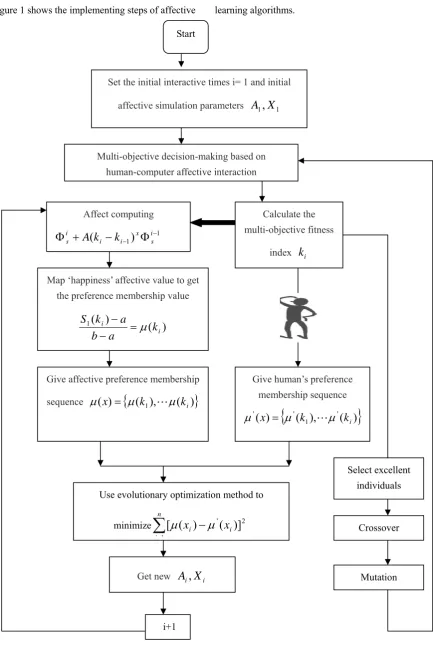
Step 3: Aided by computers, human operators evaluate the excellent individuals of multi-objective decision-making solutions in terms of objective fitness index K. At the same time, computers perform affective computing and learning algorithms, generating affective evaluations of individuals for human references;
Step 4: Select excellent individuals based on human-computer interaction;
Step 5: Perform crossover and mutation operations to generate the offspring;
Figure 1 shows the implementing steps of affective learning algorithms.
Figure 1 .Affective learning algorithms based on IEC frame Start
Calculate the multi-objective fitness
index
k
iAffect computing
1 1
)
(
−−
Φ
−
+
Φ
is x i i i
s
A
k
k
Give affective preference membership sequence
μ
(
x
)
=
{
μ
(
k
1),
L
μ
(
k
i)
}
Give human’s preference membership sequence
{
(
),
(
)
}
)
(
'1 ' '
i
k
k
x
μ
μ
μ
=
L
Use evolutionary optimization method to
minimize
∑
−
n
i
i
i
x
x
1
2 '
(
)]
)
(
[
μ
μ
i+1
Set the initial interactive times i= 1 and initial affective simulation parameters
A
1,
X
1Map ‘happiness’ affective value to get the preference membership value
)
(
)
(
1
i i
k
a
b
a
k
S
=
μ
−
−
Get new
A
i,
X
iMulti-objective decision-making based on human-computer affective interaction
Crossover
Mutation Select excellent
IV. CASE STUDIES
Consider a multi-objective-attribute decision-making problem consisting in three test functions characterized by following equations.
⎪
⎪
⎩
⎪⎪
⎨
⎧
+
=
+
+
=
+
−
=
+)
sin(
3 2 1
e
bx
a
y
d
a
x
b
y
c
a
y
x b(14)
Specifically, decision-makers would like to attain a largest y1, a smallest y2 and a most steady y3 within a specific range of x. It is noticed apparently that the three objective-attributes may turn out somewhat conflicting due to the commonly used parameters, a, b, c, d and e.
We establish an objective-attribute[16]set as
slow}
low
,
{high
Set
-Property
=
,
(15)and an objective fitness index (algorithm 1) as
n n
n n
k
=
0
.
5
•
ϕ
1+
0
.
167
•
ϕ
2+
0
.
333
•
ϕ
3 ,Where ,
=
∧n n
p
1n 1 1
p
ϕ
,=
∧n n
p
2n 2 2
p
ϕ
and=
∧n n
p
3n 3 3
p
ϕ
correspond to the ratios of current values with respect to desired values associated with three objective-attributes, respectively.
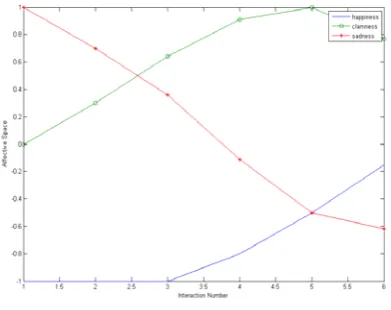
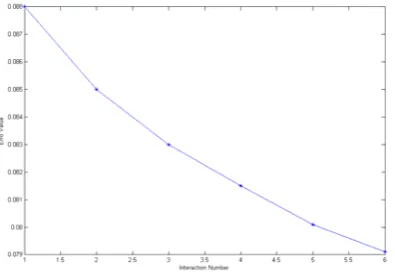
Along with affective learning algorithms, human-computer interactive evolutions are being performed. The performances of initial and last generation are shown in Figures 2 and 3 respectively. In addition, Figures 4 and 5 show the profiles of affective space and average fitness K with evolutions going on. To help get access to affective learning metrics, Figures 6 and 7 show approximations and approximating offsets with respect to human’s affective preferential membership functions, respectively. Accordingly, Figures 8 and 9 show the evolutions of adjustable parameters associated with affective computing models, A and x
Figure 2 .Objective-attributes of the initial population
Figure 3. Objective-attributes of the last population
Figure 4. Affective computing curves
Figure 6 . Approximations of the affective preferences
Figure 7. Approximating offsets of the affective preferences
Figure 8. Evolutions of affective parameter A
Figure 9. Evolutions of affective parameter x
V. CONCLUSIONS
Under the framework of IEC, compatible affective computing and affective learning philosophies have been extensively investigated along with enabling algorithms. In contrast to traditional IEC, the proposed approaches are recognized able to gradually grasp essentials in human’s subjective judgment in decision-making, reducing human’s subjective fatigue and making the decisions more objective and scientific. To exemplify their applications in industrial process further, we particularly provided an affective interactive evolutionary solution for test function which is a kind of intractable and time-consuming task. Case studies demonstrate the effectiveness and promising potentials of these contributions. Nonetheless, it should be pointed out that this research remains rather fundamental currently, which is in desperate need of further in-depth investigations on certain key issues. For example, study on problems of how to attain more appropriate subjective preferential structures in evolutions would be a potentially useful avenue for future research.
REFERENCES
[1] ZITZLER E, THIELE L, LAUMANNS M, et a1. Performance assessment of multi-objective optimizers: an
analysis and review. IEEE Trans on Evolutionary Computation, 17(2003), pp. 117-132.
[2] HAO Peng, XIANG Ling. Optimal design approach for the plate-fin heat exchangers using neural networks cooperated with genetic algorithms. Applied Thermal Engineering,28(2008), 28, pp. 642-650.
[3] CHIH-CHIN LAI, CHUAN-YU CHANG. A hierarchical evolutionary algorithm for automatic medical image segmentation. Expert Systems with Applications, 36(2009),
pp. 248-259.
[4] VIJAY JOHN, EMANUELE TRUCCO, SPELA IVEKOVIC. Markerless human articulated tracking using hierarchical particle swarm optimization. Image and Vision Computing, 28(2010), pp. 1530-1547.
[5] J.K. BURGOON, et al. Interactivity in human-computer interactive: a study of credibility, understanding, and influence. Computers in Human Behavior, 16(2000), pp.
553-574.
[6] JAIMES A and SEBE N. Multimodal human-computer interactive: A survey. Computer Vision and Image Understanding, 108(2005), pp. 116-134.
[7] SERENKO A. Are interface agents scapegoats? Attributions of responsibility in human-agent interactive.
Interacting with Computers,19(2007), pp. 293-303.
[8] ST. AMANT R, A.R. FREED and F.E. RITTER. Specifying ACT-R models of user interactive with a GOMS language. Cognitive Systems Research,6(2005), pp. 71-88.
[10]ONONY A, CLORE G.L. and COLLINS A. The Cognitive Structure of Emotions. Cambridge, UK: Cambridge University Press, 1988.
[11]WANG Zhiliang, ZHAO Yanling. An Expert System of Commodity Choose Applied with Artificial Psychology.
IEEE International Conference on Systems, Man and Cybernetics, 2001, pp. 2326-2330.
[12]VAN KESTEREN A-J, AKKER O D, POLE M, et al. Simulation of Emotions of agents in Virtual Environments using neural networks. In: Proceedings of the Twenty Workshop on Language Technology 18. Enschede, 2000,
pp. 137-147.
[13]ISHIHARA H, FUKUDA T. Traffic signal networks simulator with learning emotional algorithm. IEEE/RSJ International Conference on Intelligent Robots and Systems.2000, pp. 2274-2279.
[14]VENAYAGAMOORTHY G.K., HARLY R.G. Two separate continually online-trained neurocontrollers for excitation and turbine control of a turbo generator. IEEE Trans: Industry Applications, 38(2002), pp. 887-893.
[15]MIKHAILOV L and TSVETINOV P. Evaluation of services using a fuzzy analytic hierarchy process. Applied Soft Computing, 5(2004), pp. 23-33.
[16] LI Hong-guang, SU Chong ,Affective Interactive agents with Applications in Control Performance Assessment ,Computer Integrated Manufacturing System,11(2011), pp. 2438-2446..
Chong Su was born in Tianjin, P. R. China in 1983. He is the full time Ph. D. candidate and Lecturer in Beijing University of Chemical Technology. His research interests are intelligent applications, affect computing and human-computer interaction.