DEATH AND PAPERWORK REDUCTION
ADAM M.SAMAHA†
ABSTRACT
How does government value people’s time? Often the valuation is implicit, even mysterious. But in patches of the federal administrative state, paperwork burdens are quantified in hours and often monetized. When agencies do monetize, they look to how the labor market values the time of the people faced with paperwork. The result is that some people’s time is valued over ten times more than other people’s time. In contrast, when agencies monetize the value of statistical life for cost-benefit analysis, they look to how people faced with a risk of death subjectively value its reduction. In practice, agencies assign the same value to every statistical life saved by a given policy.
This Article establishes these patterns of agency behavior and suggests that there is no satisfying justification for them. Welfarist and egalitarian principles, along with the logic of statistical life valuation, lean against the use of market wages to monetize a person’s time doing government paperwork. The impact of this practice might be limited, given the modest ambition of today’s paperwork reduction efforts. But time-related burdens—and benefits—are key consequences of government decisions in countless contexts. If we want to scale up a thoughtful process for valuing people’s time in the future, we will need new foundations.
TABLE OF CONTENTS
Introduction ... 280 I. Paperwork Law ... 284 A. Structure ... 286
Copyright © 2015 Adam M. Samaha.
B. Standards ... 289
II. Paperwork Practices... 294
A. Agencies ... 294
B. OIRA ... 306
C. Politics ... 309
III. Paperwork Principles ... 315
A. Life and Time ... 315
B. Time and Money ... 319
1. Welfare ... 319
2. Hourly wages ... 328
3. Equality ... 338
Conclusion ... 344
INTRODUCTION
In an odd corner of the federal government at this moment, a mid-level agency official is busy making educated guesses about how much time a particular government initiative will cost. Not how much money people will pay, but how much time they will spend, in units of hours. Sometimes lots of hours. The Internal Revenue Service (IRS) estimated that individual taxpayers would spend 1.9 billion hours preparing their federal tax returns in 2015.1
The Office of Information and Regulatory Affairs (OIRA) reports that annual federal paperwork burdens exceed 9.4 billion hours, all told,2
which amounts to a full workweek of time for each adult in the United States if the burden were spread evenly.3
In fact, as shown below, numerous federal officials are now obligated to estimate how many hours of our lives will be devoted to following the law or to showing that we deserve the law’s entitlements, benefits, and exemptions.
1. See Proposed Collection; Comment Request for Form 1040, 79 Fed. Reg. 24,498, 24,499 tbls. 1–2 (Apr. 30, 2014).
2. OFFICE OF INFO. & REGULATORY AFFAIRS, EXEC. OFFICE OF THE PRESIDENT, INFORMATION COLLECTION BUDGET OF THE UNITED STATES GOVERNMENT 3 (2014) [hereinafter 2014 OIRA REPORT], http://www.whitehouse.gov/sites/default/files/omb/inforeg/ icb/icb_2014.pdf [http://perma.cc/SJP3-3ENL] (regarding FY2013).
But government efforts at time quantification are neither comprehensive nor uniform. These efforts occur only in segments of the bureaucracy with respect to slices of policy effects. For instance, paperwork associated with litigation is excluded from OIRA’s time count,4
and time spent commuting or waiting around seems to be left out as well.5 Moreover, quantification methods are not standardized despite White House oversight. Sometimes agencies count hours without converting those time burdens into dollar costs.6 When agencies do translate hours into dollars, the monetized costs typically depend on how the labor market values the time of those who will do the paperwork and not on a universal figure for everyone. The resulting variance is remarkable: by using hourly wages to value time spent doing paperwork, some people’s time gets counted as over ten
times more valuable than other people’s time.7 New data, introduced
below, shows this. A society concerned with inequality should not ignore it.
In some ways, death is different. Leading federal agencies make well-known, routinized efforts to quantify the value of human life— more precisely, the value people assign to reducing small risks of death. This value comes in dollars, not hours. Indeed, Office of Management and Budget (OMB) guidance for cost-benefit analysis (CBA) has long recommended monetizing a value for the number of statistical lives saved by proposed regulations.8 But this dollar value is not based on hourly wages; and each agency assigns the same value to each statistical life saved by a given risk-reducing policy. The global number is now $9.2 million at the Department of Transportation, for example.9 By converting the benefit of statistical lives saved into
4. See infra note 32 and accompanying text.
5. For instances of an agency including commuting time in an information collection request, see infra note 111.
6. See infra notes 116–19, Figure 1, Figure 2, and accompanying text. 7. See infra notes 121–24, Figure 3, and accompanying text.
dollars, officials can easily compare projected regulatory costs, which usually come in dollars.
When officials estimate the number of hours expended without converting those units of time into dollars, however, there is no obvious way to integrate those time estimates into an overall evaluation of the proposal. Of course it is possible to conclude that a person’s dollars and time are incommensurable—and so too for life, limbs, liberty, and other things. It is also possible to conclude that a person’s dollars, time, life, and so on are all sufficiently commensurable for purposes of policymaking, by converting each to the same metric of value—dollars, happiness, or whatever. Our government adopts neither of these positions. Instead, the administrative state is basically determined to convert risks to people’s lives, but not always losses of their time, into dollars; and when government does convert our time into dollars, our wages are used to produce large disparities in valuation.
In this Article, I establish these patterns and then suggest that there is no satisfying reason for them. My point of departure is the Paperwork Reduction Act,10
which surely has had an effect on federal agency practice. Untold numbers of information collections are prevented by the Act’s own paperwork demands, and we can hope that many of these foregone collections were not worthwhile. In some respects, however, the statute has been a miserable failure. The Act offered tall talk and weird numerical benchmarks for reducing a subset of all time-related burdens. Neither careful cost-benefit analysis nor much scholarly attention followed.11 In fact, even if the
Value per Statistical Life: Transferring Estimates Between High and Low Income Populations, 2 J.BENEFIT-COST ANALYSIS 1, 6–7 (2011) (explaining that federal agencies do not use different VSL for different subpopulations, but do adjust VSL over time based on real income changes for the overall population). Agencies have not fully converged on their VSLs but there is a bounded range. See ENVT’L PROT. AGENCY, GUIDELINES FOR PREPARING ECONOMIC ANALYSES B-1toB-2 (2010) (recommending $7.4 million in 2006 dollars based on surveys and wage-risk data);CURTIS W.COPELAND, CONG.RESEARCH SERV.,HOW AGENCIES MONETIZE “STATISTICAL LIVES”EXPECTED TO BE SAVED BY REGULATIONS 10–17 (2010); Hammitt & Robinson, supra, at 4 (“Most U.S. agencies use central values . . . between about $5 million and $8 million when expressed in 2007 dollars.”). Agency reporting of the value of a statistical life year (VSLY) and quality-adjusted life years (QALY) complicates matters, but begins to link lives saved to time lost. See infra Part III.A.
10. Paperwork Reduction Act, 44 U.S.C. §§ 3501–3521 (2012 & Supp. I 2014).
Act’s fight-paperwork-with-paperwork strategy is effective, the very mission of paperwork reduction might look passé. We live in a digital world of big-data analytics, crowdsourcing, and high-tech surveillance—new tools for information collection beyond old school routines of bureaucrats posing one-way questions on photocopied forms.12
So the Act might be a failure, but it is a provocative failure. It implicates foundational questions for government, which needs reliable information to function well and yet must value people’s time appropriately to deserve their respect. Understanding the Act’s shortfalls can inspire us to better measure and evaluate time-related burdens in a wider range of settings, or at least to wonder whether, why, where, and how government cares about our time.
Part I examines the law of federal paperwork, explaining the structure and standards for approving information collection requests. Part II investigates agency practices and presents data on how agencies actually quantify individual time burdens. Part III is normative. It links the goals of saving lives and saving time, and suggests that monetizing people’s time using wage rates is unattractive from social welfarist and egalitarian perspectives. There is room for disagreement over the best way forward, the notion of civic duty will come into play for some burdens,13 and time burdens faced by organizations are special.14
But today’s practices should draw few cheers. Time-related burdens—and benefits—are key
cf. Cass R. Sunstein, The Office of Information and Regulatory Affairs: Myths and Realities, 126 HARV.L.REV. 1838, 1840 nn.1–2 (2013) (noting scholarship on CBA but generalizing that OIRA is an “information aggregator”).
On the Act generally, see William F. Funk, The Paperwork Reduction Act: Paperwork Reduction Meets Administrative Law, 24 HARV.J.LEGIS. 1 (1987) (offering background from the 1940s to the 1980s); Andrew L. Levy, The Paperwork Reduction Act of 1980: Unnecessary Burdens and Unrealized Efficiency, 14 J.L.&COM. 99, 113, 115–20 (1994) (complaining that agencies violate the Act and recommending assertive judicial review); Jeffrey S. Lubbers,
Paperwork Redux: The (Stronger) Paperwork Reduction Act of 1995, 49 ADMIN.L.REV. 111 (1997) (explaining the new statute). On the situation in Europe, see Jonathan B. Wiener, Better Regulation in Europe, 59 CURRENT LEGAL PROBS. 447, 447–49, 498–501 (2006). An ambitious effort to think about administrative burdens within ordinary households is Elizabeth F. Emens,
Admin, 103 GEO.L.J.1409, 1464 (2015).
12. On the transition away from direct questions, see Adam M. Samaha & Lior J. Strahilevitz, Don’t Ask, Must Tell—And Other Combinations, 103 CALIF.L.REV. 919, 919, 922, 975–80 (2015). The Paperwork Reduction Act and OIRA do encourage electronic filings and dissemination, by the way. See infra notes 24 & 48.
13. See infra Part III.B.1.c.
consequences of government policies in countless contexts. If we want to scale up a thoughtful process for valuing people’s time in the future, we will need new foundations.
I. PAPERWORK LAW
Modern government, like any institution, requires information. Data is a cause and a product of institutional capacity. Hence government officials ask questions or otherwise collect data to enforce legal norms that people would otherwise ignore, to allocate benefits that people desperately need, and to confirm eligibility for regulatory exemptions that people deserve. But of course these efforts cost somebody something. Resistance to bureaucratic “red tape” and “wasted time” accompany government’s information-collection efforts. The New Deal illustrated the conflict. Fighting a global depression and a world war triggered major increases in federal information collection, not just regulation and conscription.15 Those increases were followed by administrative and legislative initiatives to moderate the burden and target the government’s collection efforts.16
The federal government’s “appetite for data” was never “insatiable,” as the Supreme Court once suggested,17 but information collection does cost us. An effort to regulate government data collections, and make them sensitive to those costs, is entirely logical.18
15. See Funk, supra note 11, at 7–8 (discussing the backdrop against which action was taken).
16. For more history, see U.S. COMM’N ON FED.PAPERWORK,HISTORY OF PAPERWORK REFORM EFFORTS 1, 11–16, 24–25 (1977); Funk, supra note 11, at 7–70; Anne Marie Lyons, A Social History of Paperwork Reform Efforts 11–13 (Dec. 2004) (unpublished manuscript) (on file with the author).
17. Dole v. United Steelworkers of Am., 494 U.S. 26, 32 (1990) (adding “seemingly” to “insatiable”).
18. See Michael Lipsky, The Rationing of Services in Street-Level Bureaucracies, in
The Paperwork Reduction Act as we know it was built from several bills with punchy titles, along with the less conspicuous Federal Reports Act of 1942.19
There was the Paperwork Reduction Act of 1980,20 followed by the Paperwork Reduction Reauthorization Act of 1986,21
and the Paperwork Reduction Act of 1995.22
These legislative efforts were not enough to win the war on government paperwork. Others followed, including the Economic Growth and Regulatory Paperwork Reduction Act of 1996,23 the too-good-to-be-true Government Paperwork Elimination Act of 1998,24
and the Small Business Paperwork Relief Act of 2002.25 Congress is not alone in the effort. For his part, President Obama has tried to instigate and publicize agency efforts to make major paperwork cuts.26 Recently the President ordered each agency that imposes relatively high paperwork burdens to identify initiatives that will reduce at least two million hours of annual burden.27
Such missions must seem attractive to mainstream voters if not to every interest group. The extent to which the statutes and directives make a difference in government operations is another question, the answer to which partly depends on the structure and standards within today’s version of the Act.
(asserting customer sophistication and sensitivity to speed-related options across market competitors). For an indication of slow yet significant improvement in paperwork processing by competitors, see the case studies on administrative bottlenecks in Joseph D. Blackburn, Time-Based Competition: White-Collar Activities, 34 BUS.HORIZONS, no. 4, 1992, at 96, 96–101.
19. Federal Reports Act of 1942, Pub. L. No. 77-841, 56 Stat. 1078. 20. Paperwork Reduction Act of 1980, Pub. L. No. 96-511, 94 Stat. 2812.
21. Paperwork Reduction Reauthorization Act of 1986, Pub. L. No. 99-500, 100 Stat. 3341-335 to -340 (Title VIII, sections 801–820 of the Continuing Appropriations Resolution).
22. Paperwork Reduction Act of 1995, Pub. L. No. 104-13, 109 Stat. 163 (rewriting 44 U.S.C. §§ 3501–3520).
23. Economic Growth and Regulatory Paperwork Act of 1996, Pub. L. No. 104-208, 110 Stat. 3009 (codified in scattered titles of the U.S. Code).
24. Government Paperwork Elimination Act of 1998, Pub. L. No. 105-277, §§ 1701–1710, 112 Stat. 2681, 2749–51 (codified at 44 U.S.C. § 3504 (2012)) (involving electronic submissions).
25. Small Business Paperwork Relief Act of 2002, Pub. L. No. 107-198, 116 Stat. 729 (codified in scattered sections of 44 U.S.C.).
26. See 2014OIRAREPORT, supra note 2, at 15–18; Exec. Order No. 13,610 § 3, 77 Fed. Reg. 28,469, 28,470 (May 10, 2012) (ordering agencies to prioritize “initiatives that will produce significant quantifiable monetary savings or significant quantifiable reductions in paperwork burdens” (emphasis added)).
A. Structure
The Paperwork Reduction Act generates paperwork, actually. The Act mandates bureaucratic sensitivity to paperwork burdens by creating a bureaucracy that does paperwork on paperwork.28 Federal agencies must hire Chief Information Officers and underlings who will implement procedures to regulate agency information collections directed at ten or more persons.29
Regulated “collections” include not only information sent to the federal government (e.g., tax forms and benefits applications), but also recordkeeping by private parties (e.g., workplace accident reports) and disclosures between private parties (e.g., food labeling).30
Agency collections are regulated “whether such collection of information is mandatory, voluntary, or required to obtain or retain a benefit.”31
In other ways, however, the statute is notably narrow. Targeted federal investigations and civil and criminal litigation are explicitly carved out of the Act’s concern,32
even though these burdens can be extremely heavy for the persons involved. In addition, a variety of time-related consequences are apparently beyond the Act’s requirements. True, the statute is written to make agencies sensitive to resources expended reviewing instructions, searching for data, completing and reviewing forms, and transmitting information.33 But these activities do not necessarily include other time-related burdens, such as learning about regulations, traveling to a government office if necessary, waiting in line, and other items within a broad
28. A few federal agencies are exempt from the structure described here. See 44 U.S.C. § 3502(1) (2012) (excluding the Federal Election Commission, the Government Accounting Office, the D.C. government, territorial governments, and “[g]overnment-owned contractor-operated facilities, including laboratories engaged in national defense research and production activities”); Kuzma v. U.S. Postal Serv., 798 F.2d 29, 32 (2d Cir. 1986) (holding that the U.S. Postal Service, as opposed to the Postal Rate Commission, is exempt from the Act).
29. 44 U.S.C. §§ 3502(3)(A)(i), 3506(a)(2)–(3) (2012).
30. See id. § 3502(3)(A) (defining “collection of information” as “the obtaining, causing to be obtained, soliciting, or requiring the disclosure to third parties or the public, of facts or opinions by or for an agency, regardless of form or format”); Action All. of Senior Citizens v. Sullivan, 930 F.2d 77, 83 (D.C. Cir. 1991) (including grant recipients’ required self-evaluations regarding Age Discrimination in Employment Act compliance within the OMB review process, even though this paperwork would not necessarily be sent to the federal government).
31. 5 C.F.R. § 1320.3(c) (2014); see also infra notes 191–93 and accompanying text (discussing the usefulness of estimating time burdens that are thought to be associated with conditions on government benefits).
32. 44 U.S.C. § 3502(3)(B) (2012) (referencing § 3518(c)(1)–(2) and recognizing that most “general investigations” are not covered by the Act).
understanding of “compliance costs.”34
An agency might have the will and authority to investigate these other time burdens—OMB guidance for cost-benefit analysis is nicely inclusive on this score35
— but the Act does not explicitly regulate them.
When the Act does cover an agency collection, however, it triggers a formidable-looking screening procedure.36
The process ordinarily takes months. First, an information collection request typically will be subject to public notice and comment.37
If the agency wants to go forward, the proposal must be reviewed and approved by OIRA in a clearance process. Someone at the agency completes an OMB form,38 writes a supporting statement,39 and assembles supporting documents, and then someone at OIRA reviews the agency’s paperwork.40 This clearance process is accompanied by a second round of public notice and comment, along with an opportunity for individual challenges directed at OMB.41
Moreover, OMB cannot authorize a collection for longer than three years.42
These automatic sunsets are then followed by further
34. Some of these uncovered activities allow for multitasking, which is a complication I leave aside for now. Cf. Robert A. Pollak, Notes on Time Use, MONTHLY LABOR REV.,Aug. 1999, at 7, 8 (describing “simultaneous activities,” divided into “parallel” activities like driving while listening to the radio and “on call” situations like cooking while being responsible for a sleeping child). Also note privacy concerns as a cost, which are covered by other laws.
35. See infra note 126 and accompanying text (discussing CBA guidance). IRS’s 2011 survey on taxpayer burdens mentioned “researching tax law changes” in the instructions, and the survey form listed “[r]esearching strategies to reduce the taxes you owe” and “[g]athering IRS tax forms, instructions, or publications.” INTERNAL REVENUE SERV., U.S. DEP’T OF TREASURY,INDIVIDUAL TAXPAYER BURDEN SURVEY,ati, 12 (2011), http://www.reginfo.gov/ public/do/DownloadDocument?objectID=25585501 [http://perma.cc/LJ86-GSUN].
36. See generally 44 U.S.C. § 3507(a)(1)(D), (a)(2)–(3), (b)–(c) (2012) (covering Paperwork Reduction Act standards and procedural requirements); id. § 3508 (same); 5 C.F.R. § 1320.10 (2014) (reiterating and elaborating on same).
37. See 44 U.S.C. § 3506(c)(2)(A) (2012).
38. See OFFICE OF MGMT.&BUDGET,EXEC.OFFICE OF THE PRESIDENT,PAPERWORK REDUCTION ACT SUBMISSION (OMBFORM 83-I) 1 (2004), http://www.whitehouse.gov/sites/ default/files/omb/inforeg/83i-fill.pdf [http://perma.cc/S6AK-2Z4F].
39. See OFFICE OF MGMT.&BUDGET,EXEC.OFFICE OF THE PRESIDENT,PAPERWORK REDUCTION ACT SUBMISSIONS (SUPPORTING STATEMENT INSTRUCTIONS) 6–7 (1995) [hereinafter OMBSUPPORTING STATEMENT INSTRUCTIONS], http://www.whitehouse.gov/sites/ default/files/omb/inforeg/83i-fill.pdf [http://perma.cc/FG8X-A94B].
40. See Lubbers, supra note 11, at 115. The Act refers to OMB but OIRA does the job in practice.
rounds of request, notice, comment, and review for information collections that still matter to agencies.43 There is a different procedure when an information collection is bundled with a proposed regulation, in which OIRA participates in the comment process.44 But those collections are likewise subject to automatic sunset and then stand-alone requests to OIRA. In addition, agencies must advertise estimated burdens to those who suffer them,45
and OIRA reports annually to Congress on agency progress in reducing the public burden of information collection.46
To be sure, all of this procedure might be completed without much hardship. The latest IRS proposal for individual income tax forms drew a grand total of zero public comments after notice in the
Federal Register.47 Moreover, agencies may now use a menu-driven
website to submit information collection requests to OIRA.48
If OMB fails to act within sixty days, approval may be inferred and the agency may go ahead and collect the information for a year.49
OMB offers expedited review in emergencies.50 Courts are largely absent from the process, so the expected litigation burden is modest.51
And OMB may
43. See Lewis v. Comm’r, 523 F.3d 1272, 1276 n.8 (10th Cir. 2008) (discussing IRS Form 1040).
44. See 5 C.F.R. § 1320.11 (2014) (clarifying OMB’s role in filing public comments); see also
44 U.S.C. §§ 3506(c)(2)(B), 3507(d)(4)(C) (2012) (allowing OMB to reject “unreasonable” agency rejections of OMB comments).
45. See 44 U.S.C. § 3506(c)(1)(B)(iii)(III) (2012); see also id. § 3506(c)(1)(B)(iii)(I) (requiring stated reasons).
46. See id. § 3514(a)(2)(A).
47. See U.S. DEP’T OF TREASURY,U.S.INDIVIDUAL INCOME TAX RETURN:SUPPORTING STATEMENT 21 (2014), http://www.reginfo.gov/public/do/DownloadDocument?objectID=4713 0100 [http://perma.cc/YH6Y-CLSP].
48. The new “ROCIS” platform replaced a mainframe in 2006, and it offers the older data plus several new search options and easy public access to agency supporting documents. See Information Collection Review Data on Reginfo.gov, REGINFO.GOV,http://www.reginfo.gov/ public/jsp/PRA/ICR_info.jsp [http://perma.cc/L54U-Z8XL] (indicating that the old data system has records back to the 1970s, but that supporting data for agency requests was not saved in the system until 1995). The manual for the information collection review module is 123 pages long.
See REGULATORY INFO.SERV.CTR.,ROCISHOW TO GUIDE FOR AGENCY USERS OF THE INFORMATION COLLECTION REQUEST (ICR)MODULE (2013) [hereinafter ROCISHOW TO GUIDE], https://www.rocis.gov/rocis/jsp3/common/ROCIS_HOW_TO_Guide_for_AGENCY_ Users_of_ICR_Module-08272013.pdf [http://perma.cc/ZQU7-NN2Y].
49. See 44 U.S.C. § 3507(c)(3) (2012). 50. See 5 C.F.R. § 1320.13 (2014).
delegate its review authority to trusted officials, such as the Federal Reserve’s Board of Governors and the Federal Communication Commission’s Managing Director.52
Still, every lawful information request comes with a stack of (electronic) paper, and therefore the trade-offs associated with added process.53
To the extent the Act has an independent effect on agencies that are sensitive to procedural costs, we can expect the statute’s procedures to reduce the number of information collections, to increase the government cost of performing the surviving collections, and, hopefully, to increase the quality of those collections by enhancing deliberation and participation by people from multiple perspectives.54
But we can wonder exactly which collections survive and which are screened out by the process. Other statutory provisions are merely suggestive on those questions, as we shall see.
B. Standards
The Act does call on agencies to pay attention to burdens. Each agency must operate an internal process that yields “a specific, objectively supported estimate of burden” for each information collection.55 And each agency is supposed to certify that each collection “reduces to the extent practicable and appropriate the burden on persons who shall provide information to or for the agency.”56
As the entity with global oversight authority,57
OMB is
does provide a defense to penalties for failing to comply with an agency information request that unlawfully omits a valid OMB control number. See 44 U.S.C. § 3512 (2012); 5 C.F.R. § 1320.6 (2014) (covering, as well, agency failure to inform respondents that they are not required to respond absent such a display, with an exception for the tax code, 26 U.S.C. § 6011(a)); United States v. Hatch, 919 F.2d 1394, 1398 (9th Cir. 1990) (confirming this defense in a criminal case). But courts have denied that the Act offers a private right of action. See, e.g., Sutton v. Providence St. Joseph Med. Ctr., 192 F.3d 826, 844 (9th Cir. 1999). In any event, complaining and commenting, let alone litigating, are not worth it for most people.
52. See 44 U.S.C. § 3507(i) (2012); 5 C.F.R. §§ 1320.16(d), 1320 app. A (2014).
53. See Adam M. Samaha, Undue Process, 59 STAN.L.REV. 601, 616–20 (2006) (discussing decision costs, error rates, and so on).
54. Who gains and who loses is not entirely clear. The Act might shift information collection burdens from the private sector to the federal government—then back to the private sector, depending on who pays for these government operations. This prospect of cost shifting should prompt the question whether we might go further, and “in-source” within government more information collection and dissemination duties.
55. 44 U.S.C. § 3506(c)(1)(A)(iv) (2012).
supposed to set and oversee standards for estimating collection burdens,58 and also “minimize the [f]ederal information collection burden, with particular emphasis on those individuals and entities most adversely affected.”59 The Act directs attention at the benefits of information, too. Agencies are supposed to evaluate the “need” for the information,60 and OMB shall “maximize the practical utility of and public benefit from information collected.”61
Thus the statute makes room for, if not requires, a cost-benefit protocol for information demands—language such as “to the extent practicable and appropriate” and “practical utility” suggests as much.62
In addition, the Act is, or was, weirdly precise about how much burden reduction should happen. The 1995 legislation contained percentage goals, albeit of unknown origin. The statute instructed OMB to consult with agency heads and “set an annual [g]overnmentwide goal for the reduction of information collection burdens by at least 10 percent during each of fiscal years 1996 and 1997 and 5 percent during each of fiscal years 1998, 1999, 2000, and
maximum extent practicable, uses information technology to reduce burden and improve data quality, agency efficiency and responsiveness to the public”).
57. See id. § 3504(c)(1) (stating that the OMB Director shall review and approve proposed collections).
58. See id. § 3504(c)(5). 59. Id. § 3504(c)(3).
60. See id. § 3506(c)(1)(A)(i); see also id. § 3508 (“Before approving a proposed collection of information, the [OMB] Director shall determine whether the collection . . . is necessary . . . .”).
61. Id. § 3504(c)(4); see also id. § 3508 (similar). Left unspecified is “public benefit” for OMB purposes in Section 3504(c)(4), and “practical utility” is unhelpfully defined as “the ability of an agency to use information, particularly the capability to process such information in a timely and useful fashion.” Id. § 3502(11).
2001.”63
OIRA has reported that, almost without exception, the federal government failed to meet these numerical goals.64 But before allocating blame, we should recognize that OIRA’s confession depends on a choice of metrics, and this choice is not dictated by the statute.
The Act is remarkably open about how to count paperwork burdens. The statute defines “burden” as “time, effort, or financial resources expended by persons to generate, maintain, or provide information to or for a [f]ederal agency.”65 So when agencies try to estimate the “burden” of an information collection objectively, it is not fully clear what they are supposed to be objective about. And when agencies and OMB try to appropriately minimize information collection “burden,” it is not fully clear what is supposed to be minimized, let alone who counts as “most adversely affected” and the extent to which the utility of the collection may justify its burdens. Nor does the statute describe whether and how to convert estimated burdens of time, effort, and money into the same metric. Similar uncertainties surround OMB’s rule that each agency show that “it has taken every reasonable step to ensure that the proposed collection of information . . . is the least burdensome necessary for the proper performance of the agency’s functions to comply with legal requirements and achieve program objectives.”66
Least burdensome on which metric?
The simplest interpretation appears to be that OMB and the agencies choose metrics: they should somehow estimate and minimize time, effort, or financial resources; and while they must strive to be objective in their estimates, the statute seems not to make particular choices of how to quantify these burden types. A reading like this would follow the ordinary distinction between the disjunctive “or” and the conjunctive “and.”67 Moreover, it would make space for
63. See 44 U.S.C. § 3505(a)(1) (2012); cf. Wiener, supra note 11, at 500–01 (reporting percentage targets in the European Union that seem no better grounded). The conference report to this Act suggests that the baseline for each goal was the preceding fiscal year, see H.R. Conf. Rep. 104-99, at 32 (1995), but the report is uninformative about the proper metric(s) for burden.
64. See OFFICE OF INFO.®ULATORY AFFAIRS,EXEC.OFFICE OF THE PRESIDENT, MANAGING INFORMATION COLLECTION AND DISSEMINATION:FISCAL YEAR 2002, at 1 (2002).
65. 44 U.S.C. § 3502(2) (2012) (emphasis added). 66. 5 C.F.R. § 1320.5(d)(1)(i) (2014).
targeted judgments on suitable measurement within the jumble of information collection efforts—from the census and customer satisfaction surveys to blood tests and tax forms—but also unifying judgments that allow the use of comparable metrics for collection burdens and benefits. Not every information collection presents the same estimation issues, as the statute’s ecumenical language seems to recognize, and yet the statute channels agency requests into a central oversight body with a mission of reducing burdens while enhancing utility. This set up is unlike, say, the Inspector General Act,68
which lacks an executive coordinator for the agency-level struggle against waste, fraud, and abuse.69
OMB is statutorily tasked with making paperwork assessments government-wide. A credible effort to improve information collection globally needs flexibility as well as universal metrics of some kind. The statute itself presents no test for making such concrete choices, and instead lists nearly a dozen rival purposes.70
An alternative reading would understand “or” differently and would require that all three kinds of burden be estimated and minimized.71 Perhaps the Act’s definitional provision, in context, is best interpreted such that a paperwork “burden” can be any of these things and none should ever be ignored. As the 1980 Act was being drafted, President Carter regulated agency information collections by
contrary.”)); ANTONIN SCALIA & BRYAN A.GARNER, READING LAW 116, 122–23 (2012) (following similar reasoning and making room for contextual judgments).
68. Inspector General Act of 1978, 5 U.S.C. App. 3 §§ 1–13 (2012).
69. See Nat’l Aeronautics & Space Admin. v. Fed. Labor Relations Auth., 527 U.S. 229, 240 (1999) (setting aside the President and agency heads, and explaining that “[t]here is no ‘OIG–OIG’”).
70. See 44 U.S.C. §§ 3501(1)–(11) (2012) (reciting various purposes including lower costs and higher benefits from information collections); cf. Paperwork Reduction Act of 1995, H.R. Rep. No. 104-37, at 22–23 (1995) (quoting an interest group’s conversion of hours to dollars, but remaining unclear on how burden-reduction goals should be tallied). I am not discussing these interpretive issues in terms of Chevron deference, see Chevron U.S.A., Inc. v. Natural Res. Def. Council, Inc., 467 U.S. 837, 842–45 (1984); see also United States v. Mead Corp., 533 U.S. 218, 229–31 (2001) (discussing eligibility for Chevron deference), because courts are out of the picture. See supra note 51. If need be, there is a good case for judicial deference to (reasonable) OMB/OIRA decisions to choose one or another metric for burdens. The Paperwork Reduction Act charges OMB with establishing and overseeing “standards and guidelines by which agencies are to estimate the burden to comply with a proposed collection of information.” 44 U.S.C. § 3504(c)(5) (2012). Even without formal promulgation of metrics under that provision, agencies have responsibility to administer processes for evaluating and moderating paperwork burdens under the statute, see id. § 3506(c)(1)(A)(iv), as overseen by OIRA.
executive order; the OMB-review component of this initiative focused on hours, not dollars or anything else.72 We might understand the Act by contrast to that limited notion of burden. However, a broad concept of burden does not cut sharply between conjunctive and disjunctive interpretations of the statute’s definitional provision, nor does it indicate how much discretion officials should have. Furthermore, it is not obvious how officials could minimize respondent time, money, and effort all at once. These metrics can point in different directions. For instance, simplifying government forms can prompt individuals to substitute do-it-yourself (DIY) solutions in place of contracting out the paperwork, thereby increasing respondent burden hours while decreasing their out-of-pocket expenditures.73
OMB might have tried to resolve these issues by regulation,74 but it has not. OMB rules from 1995 define burden in nearly the same language as the statute,75
followed by a more detailed list of included activities: burden means “total time, effort, or financial resources” from activities such as reviewing instructions, searching data sources, training personnel, and using technology to collect information.76 The rules do not instruct when burdens should be measured or minimized in time, money, or anything else. Protocols for showing agency need, estimating the utility of information, and comparing these to the burdens of collection are at least equally undefined. Formal law
72. Although President Carter’s order directed agencies to minimize the paperwork burden on people outside the federal government in terms of “the time and costs entailed,” he ordered agencies to prepare annual paperwork budgets based on “an estimate of the total number of hours required to comply with requests for information.” Exec. Order No. 12,174, §§ 1-101, 1-104, 44 Fed. Reg. 69,609, 69,609 (Nov. 30, 1979) (ordering the Director of the OMB to review proposed agency paperwork budgets and subsequent requests for increases); see also
Controlling Paperwork Burdens on the Public, 45 Fed. Reg. 2586, 2594 (Jan. 11, 1980) (proposing, in § 1320.41(i), to define burden solely in terms of time).
73. Cf. Stanley Veliotis, Sweating the Small Stuff: The Cost of Immaterial Tax Law Provisions, 3 WM.&MARY POL’Y REV. 36, 54–55 (2011) (suggesting that tax code complexity helps explain increased use of paid tax preparers and tax software).
74. See 44 U.S.C. § 3504(c)(5) (2012) (regarding the OMB’s duty to set standards and guidelines for burden estimates); id. § 3516 (granting the Director rulemaking authority). 75. 5 C.F.R. § 1320.3(b)(1) (2014) (“[T]he total time, effort, or financial resources expended by persons to generate, maintain, retain, or disclose or provide information to or for a Federal agency.” (emphases added)); see Controlling Paperwork Burdens on the Public, 60 Fed. Reg. 44,978, 44,985 (Aug. 29, 1995) (including this definition).
76. 5 C.F.R. § 1320.3(b)(1)(i)–(ii), (vi), (vii) (2014) (emphasis added); see also id.
certainly does present agencies with procedural cost whenever they ponder an information collection, but provides no algorithm for evaluating those collections. Agency evaluation is importantly decentralized.
II. PAPERWORK PRACTICES
Indications of agency and OIRA routines are other sources of understanding, but the patterns are not ready-made. A jump into the trenches of the federal paperwork process shows that different agencies have different practices for quantifying information collection burdens. OIRA oversight is not rigid enough to produce uniform standards even in the field of burden quantification, to say nothing of need, benefits, and ultimate determinations of whether and how to collect information. For now, we can try to understand better how agencies evaluate burdens. What follows is a discussion of interesting examples, some suggested patterns and aggregate data, plus an initial search for positive explanations—which seem neither simple nor self-evident.
A. Agencies
On significant occasions, agencies estimate burdens in hours and without dollar conversions. Consider the constitutionally mandated decennial census.77 For 2010, the Census Bureau estimated that U.S. households would need about 24 million hours—and zero dollars—to complete census forms at five or ten minutes a piece.78 The Bureau explained that “[t]here is no cost to respondents, except for the time it takes to respond to the questions.”79 (The cost of collection to the federal government was estimated in dollars: about $8.5 billion.80
) It is true, of course, that people do not pay out-of-pocket to fill out this fairly brief survey, with answers often immediately known to the respondent. But we may still ask why an agency would not convert its time estimate into a dollar estimate, and the Bureau offered no answer to that question. True, census surveys are not large time
77. See U.S.CONST. art I, § 2, cl. 3 (requiring an “actual Enumeration” but in some legally directed “Manner”).
78. See U.S.CENSUS BUREAU, 2010CENSUS:SUPPORTING STATEMENT PART AREVISED 25–26 tbl.1 (2008), http://www.reginfo.gov/public/do/DownloadDocument?objectID=18128501 [http://perma.cc/2A59-LHUW].
burdens for each one of us individually, and we get ten years off between them. Many respondents might think that filling out census forms is a little bit fun, or at least a fulfilling civic duty that yields interesting information about life in the United States. Perhaps we should shrug off the census example as a low-stakes issue with understandably restrained agency effort to quantify burdens.
Tax forms are orders of magnitude more significant than the census in terms of respondent burden,81
and yet agency quantification practices are similar. For the millions of households legally obliged to file a tax return, the burden probably is the largest they undertake for the federal government. IRS predicts for various classes of taxpayers how much time they will spend filling out an individual tax return, such as a Form 1040-EZ or 1040 with Schedules. This estimate is in hours, ranging from four to twenty-four.82
In addition, IRS estimates average out-of-pocket costs—pegged at $207 per taxpayer and $31.7 billion in total for tax year 2014. But IRS explains that those dollar figures are separate economic expenditures on top of the estimated cost in hours.83
It makes sense to count up dollar costs to hire a tax preparer along with time costs that an individual needs to prepare their own tax forms, whether the taxpayer is reporting income as required by law or seeking deductions that are legally optional. Good policymaking depends on all of this information.84
The question, again, is why IRS would estimate time costs without converting those costs into dollar figures, and again the agency offered no answer. Not converting time to dollars is an especially remarkable omission in this context, where people are aware of a vibrant market for tax preparation. Low stakes and taxpayer enjoyment are not good explanations for the absence of a dollar conversion.
What about a pattern related to civic duty? People will disagree about the precise scope of our civic duties, properly understood, but perhaps agencies refuse to monetize hours spent on tasks that are
81. See 2014OIRAREPORT, supra note 2, at iii (estimating that Treasury accounted for 75 percent of total hours tallied).
82. See Proposed Collection; Comment Request for Form 1040, 79 Fed. Reg. 24,498, 24,499 Exs. 1–2 (Apr. 30, 2014). Some individual filers are “business filers,” and the estimated time burden is higher for the latter.
83. See id. at 24,498–99 (“Time spent and out-of-pocket costs are presented separately. . . . Out-of-pocket costs include . . . tax return preparation and submission fees, postage and photocopying costs, and tax preparation software costs.”). Presumably IRS reduces the estimated time burden for those who hire a tax preparer.
easily associated with legal or societal obligations of good citizenship. Military draft registration shows up on the list of nonmonetized paperwork burdens,85
as it happens, which might sit comfortably alongside census forms and tax returns as civic duties.86 This potential pattern is unsettled with additional study, however. One complication is that, as administered, the decennial census collects more data than necessary to make a constitutionally required actual enumeration.87 This should make us wonder whether census responses go beyond the best notion of civic duty, even if Congress is entirely free under the law to pose these questions. Paperwork needed to claim various tax deductions, such as for home mortgage interest, also presents difficulties for a public duty characterization even if allowing such deductions is good public policy. Any civic duty pattern is upset further once we scan a wider range of paperwork burdens tracked by the administrative state. In the following discussion we will see that many applications for government benefits do not prompt agency monetization (Social Security Administration paperwork, for instance, in curious contrast to Veterans Administration paperwork, which is monetized),88
while mandatory reporting requirements for regulated industries are typically monetized (the Environmental Protection Agency’s Acid Rain Program, for instance).89
Either the notion of civic duty at work is irreducibly mysterious, or civic duty does little or no work in monetization decisions.
Searching further, reporting hours without dollars surely is not the most common agency practice but it happens in smatterings of significant places. Examples from established programs include the Department of Education’s online Free Application for Federal
Student Aid—which, according to the agency, is free in dollar terms
85. See U.S. SELECTIVE SERV. SYS., SELECTIVE SERVICE REGISTRATION FORM: SUPPORTING STATEMENT 3–4 (2011), http://www.reginfo.gov/public/do/DownloadDocument? objectID=31028501 [http://perma.cc/FE3W-KLDR] (not monetizing time to complete selective service forms).
86. For more on civic duty, see infra Part III.B.1.c.
87. SeeThe Questions on the Form,U.S.CENSUS 2010, http://www.census.gov/2010census/ text/text-form.php [http://perma.cc/E364-CSCH] (listing and explaining the questions on the 2010 standard form, including questions about age, sex, race, and Hispanic origin for purposes of funding programs, monitoring antidiscrimination law compliance, and academic research);
see also U.S. CENSUS BUREAU, THE AMERICAN COMMUNITY SURVEY: SUPPORTING STATEMENT 16–17 (2013), http://www.reginfo.gov/public/do/DownloadDocument?objectID= 41990401 [http://perma.cc/N3JH-P7CU] (not monetizing time to complete annual census surveys voluntarily answered by samples of households).
88. See infra Figure 2.
and burdensome only in hours (26 million hours, that is).90
Similarly, application burdens for people seeking disability benefits from the Social Security Administration are totaled in hours, not dollars.91
The burden on medical professionals who evaluate applicant disability is likewise left in hours.92
The foregoing examples could indicate an older view about how to count paperwork burdens, locked into renewal requests by past practice. But several recent agency requests also use hours without conversion to dollars, including new collections in which the estimated burden exceeds one million hours.93
90. SeeOFFICE OF FED.STUDENT AID,U.S.DEP’T OF EDUC., 2014-15FEDERAL STUDENT AID APPLICATION:SUPPORTING STATEMENT 10,14(2013), http://www.reginfo.gov/public/do/ DownloadDocument?objectID=42690801 [http://perma.cc/2YBA-GMTJ]. A challenge for this hours estimate is predicting participation rates, which depend on many factors including paperwork burdens.
91. See SOC. SEC. ADMIN., SOCIAL SECURITY BENEFITS APPLICATION: SUPPORTING STATEMENT 6 (2013), http://www.reginfo.gov/public/do/DownloadDocument?objectID=4017 8702 [http://perma.cc/SR2X-7AR4]. The same goes for the forms agencies use to evaluate applicant disability. See SOC. SEC. ADMIN., DISABILITY REPORT—ADULT: SUPPORTING STATEMENT 4 (2013), http://www.reginfo.gov/public/do/DownloadDocument?objectID=3227 5801 [http://perma.cc/JL8L-KA6B] (estimating 3.5 million applicant hours without a dollar conversion: “[t]his figure represents burden hours, and we did not calculate a separate cost burden”).
92. See SOC. SEC. ADMIN., REQUEST FOR EVIDENCE FROM DOCTOR OR HOSPITAL: SUPPORTING STATEMENT 3 (2014), http://www.reginfo.gov/public/do/DownloadDocument? objectID=45102101 [http://perma.cc/R5RS-TF75].
At the same time, many agency requests do convert hours to dollars. Consider a humble telephone survey on public feelings about libraries, conducted by the Institute of Museum and Library Services. Not knowing who would be randomly selected for the survey,94 the agency used the national average per capita income of about $20 per hour to convert respondent time into dollar cost.95 More targeted is the $15 per hour figure used by the Department of Health and Human Services (HHS) to estimate a dollar cost of filling out the basic Medicare reimbursement form.96
This number seems to be an average hourly wage for clerical staff at medical facilities. The Food and Drug Administration (FDA) did something similar at the upper end of the wage scale. For new drug applications, the agency estimated a single average industry loaded wage rate of $75 per hour, and multiplied that number by the estimated total burden hours.97 In other requests, the dollar conversions are even more calibrated to subgroups. For its acid rain regulations, the Environmental Protection Agency estimated hourly wage rates of $66 for company technicians and $102 for company managers.98 Or take a recent request by the Commodity Futures Trading Commission. Under existing regulations, an investment fund can avoid the hassle of shareholder votes on accountants if the fund has an independent audit committee. Creating such a committee takes time at a board meeting, so the agency
http://www.reginfo.gov/public/do/DownloadDocument?objectID=47897901 [http://perma.cc/ LG3A-L5K3] (reporting a 3.5 million hour burden on federal grant recipients with real property in which the federal government holds an interest, without conversion to dollars).
94. See U.S.INST. OF MUSEUM &LIBRARY SERVS.,PUBLIC NEEDS FOR LIBRARY AND MUSEUM SERVICES (PNLMS)SURVEY:SUPPORTING STATEMENT 4 (2013), http://www.reginfo. gov/public/do/DownloadDocument?objectID=48758101 [http://perma.cc/N33Q-9MYT]. 95. See id. at 9 (relying on 2011 per capita income of $41,560, then assuming full-time work).
96. The electronic version takes one minute to complete, HHS estimated, but 966 million claims in a year add up to over 16 million hours (and supposedly over $300 million in respondent costs for both electronic and dwindling paper filings). SeeCTRS. FOR MEDICARE & MEDICAID SERVS.,U.S.DEP’T OF HEALTH &HUMAN SERVS.,HEALTH INSURANCE COMMON CLAIMS FORM: SUPPORTING STATEMENT 11 (2012), http://www.reginfo.gov/public/do/ DownloadDocument?objectID=36407101 [http://perma.cc/5SXU-ZWNL].
97. See FOOD &DRUG ADMIN.,U.S.DEP’T OF HEALTH &HUMAN SERVS.,NEW DRUG APPLICATION:SUPPORTING STATEMENT 18 (2011), http://www.reginfo.gov/public/do/Download Document?objectID=24273701 [http://perma.cc/EEV7-B95W]. FDA did not explain how it estimated the loaded rate (e.g., overhead, training, leave, taxes).
estimated an hour burden for this task and then valued paralegal time at $175 per hour and director time at $500 per hour.99
Agencies might put a positive dollar value on a person’s time even when the person is unemployed. Consider the Department of Agriculture’s recent request to adjust ongoing information collections for the Women, Infants, and Children (WIC) program. The program provides food and education to low-income pregnant women, new mothers, and their children.100
Running WIC effectively and in accord with federal law depends on information from vendors, state and local officials, and applicants—including reports on applicant income and a nutrition risk assessment.101 But unlike vendors and officials, many applicants may not have an established market value for their time.102 When paperwork burdens hit such people, agencies that are committed to monetization seem to rely on the minimum wage. The Department used the federal minimum wage of $7.25 per hour103 to calculate an annual dollar cost of $4.4 million to nine million applicants.104 The Supplemental Nutrition Assistance Program
99. See U.S. COMMODITY FUTURES TRADING COMM’N, CLEARING EXEMPTION FOR SWAPS BETWEEN CERTAIN AFFILIATED ENTITIES:SUPPORTING STATEMENT 4–6 & 10 nn.8–9 (2013), http://www.reginfo.gov/public/do/DownloadDocument?objectID=41160101 [http:// perma.cc/ZX9A-QTRT] (using a figure of eight directors on average and aggregated board of directors cost of $4000/hour); see also Securities Offering Reform, 70 Fed. Reg. 44,722, 44,788– 90, 44,794 nn.625 & 630 (Aug. 3, 2005) (reporting a dollar conversion in the CBA section in which CFTC calculated issuer personnel time at $125 per hour and outside professional time at $300 per hour).
100. See Comment Request—WIC Program Regulations, 77 Fed. Reg. 50,457, 50,458 (Aug. 21, 2012).
101. See FOOD & NUTRITION SERV., U.S. DEP’T OF AGRIC., WIC PROGRAM REGULATIONS:SUPPORTING STATEMENT 6(2014), http://www.reginfo.gov/public/do/Download Document?objectID=44959401 [http://perma.cc/A2HM-Y8JZ] (noting program changes prompting the request).
102. Cf. Laura Tiehen & Alison Jacknowitz, Why Wait?: Examining Delayed WIC Participation Among Pregnant Women, 26 CONTEMP. ECON. POL’Y 518, 523 tbl.1 (2008) (estimating that 63 percent of pregnant WIC participants were employed in the year before giving birth).
103. See FOOD &NUTRITION SERV., supra note 101, at 16 tbl.A.12.1 (estimating 615,829 total annual burden hours for applicants); see also id. (setting state and local staff hourly wages at $23.54 and vendor staff hourly wages at $12.55).
(SNAP, formerly Food Stamps) operates on similar estimates. In 2013, the Department estimated that nearly eleven million people would spend about twenty minutes each to apply for these benefits, and translated the resulting 3.5 million hour burden into $25 million of cost to applicants at $7.25 per hour.105
We lack comprehensive data on agency quantification practices. Often it is difficult to tell how agencies estimate the time needed to understand and complete government forms, how they choose a universal or particular wage rate, or how they adjust wage data to include costs borne by employers of respondents.106
Assuming that officials seek to avoid process costs, we might expect agencies to estimate burdens on others quickly and cheaply. Indeed OIRA instructs agencies to economize here, generally recommending “[c]onsultation with a sample (fewer than 10) of potential respondents.”107 One obvious explanation for a nine-respondent limit is avoiding another round of Paperwork Reduction Act process costs.108 This default rule for gathering burden information will cap the quality of those investigations, and scattered public comments will only add so much knowledge.
For a burden estimate that seems wildly off, consider WIC applications. The agency asserts that applicants need three minutes on average to complete the application,109 even though eligibility certification requires recorded data or documentation on residency,
105. See FOOD &NUTRITION SERV.,U.S.DEP’T OF AGRIC.,SUPPLEMENTAL NUTRITION ASSISTANCE PROGRAM (SNAP)FORMS EXTENSION:BURDEN TABLE, at row 3 (2013), http:// www.reginfo.gov/public/do/DownloadDocument?objectID=38398701 [http://perma.cc/XUL6-9AZ6].
106. Sometimes agencies bump up hourly wage figures by estimating hourly fringe benefits—a form of loaded wage estimate. For a collection involving disclosure of manufacturer payments to physicians and their families, HHS identified a physician hourly wage of $103, then “applied a 33 percent increase to this amount to account for change overtime and fringe benefits” to provide a likely maximum estimate of $137 per hour. CTRS. FOR MEDICARE & MEDICAID SERVS.,U.S.DEP’T OF HEALTH &HUMAN SERVS.,REGISTRATION,ATTESTATION, ASSUMPTIONS DOCUMENT AND DATA RETENTION REQUIREMENTS FOR OPEN PAYMENTS: SUPPORTING STATEMENT 7–8 (2014), http://www.reginfo.gov/public/do/DownloadDocument ?objectID=43307402 [http://perma.cc/WP5L-6LY2] (doing the same for support staff and other affected parties).
107. OMB SUPPORTING STATEMENT INSTRUCTIONS, supra note 39, at 6 (for item 12); see also id. at 6–7 (suggesting reliance on the public comment period and existing CBA for item 13). 108. The Act is triggered when ten people are asked the same question. See supra note 29 and accompanying text.
income, diet, and blood work.110
Surely most applicants take far more time than this to document eligibility, especially the first time around. OIRA instructs agencies to count not only the time needed to fill out a benefits application, but also “the time that an individual or entity spends reading and understanding a request for information, as well as the time spent developing, compiling, recording, reviewing, and providing the information.”111
For WIC, the Department must be estimating how long it takes applicants to hand over blood tests and other documents already in their hands—not a broader understanding of “compiling” and “providing” information that could include obtaining the documents, traveling to a local WIC agency, waiting for service, and participating in a nutrition assessment interview.112 “One way the poor pay for government aid is with their time,” Kathryn Edin and Luke Shaefer remind us.113 On the other hand, some agencies do study hourly burdens thoroughly and broadly. An example is IRS’s random sample surveys and complex Individual
110. See 7 C.F.R. § 246.7 (2014) (detailing information that must be gathered on recipients);
id. § 246.7(e)(1)(i)(A), (ii)(B) (regarding required tests for anemia).
111. 2014OIRAREPORT, supra note 2, at 1; see also 44 U.S.C. § 3502(2)(D)–(F) (2012) (defining “burden” to include “searching data sources” and “completing and reviewing the collection of information”); 5 C.F.R. § 1320.3(b)(1)(vii)–(ix) (2014) (same). The agency received no public comments on the WIC collection request. An accurate count of the above-mentioned burdens would still underestimate total applicant burdens, on a broader understanding of time burdens for CBA. See infra Part II.B. Applicants travel to local WIC agencies, often wait before being served, may spend time receiving instructions and questions about nutrition, and they had to learn about the program in the first place. I thank Ellen Teller and Geri Henchy at the Food Research and Action Center for helping me understand WIC applicant requirements and burdens.
For examples of agency requests that do estimate respondent travel time, see U.S. DEP’T OF STATE,BIRTH AFFIDAVIT:SUPPORTING STATEMENT 3–4 (2014), http://www.reginfo. gov/public/do/DownloadDocument?objectID=48139601 [http://perma.cc/2PDW-NTXE]; CTRS. FOR MEDICARE & MEDICAID SERVS., U.S. DEP’T OF HEALTH & HUMAN SERVS., EVALUATION OF THE MULTI-PAYER ADVANCED PRIMARY CARE PRACTICE (MAPCP) DEMONSTRATION:FOCUS GROUP INTERVIEW GUIDES:SUPPORTING STATEMENT 8–9 (2013), http://www.reginfo.gov/public/do/DownloadDocument?objectID=42215001 [http://perma.cc/9W EX-ASRF]; U.S.CONSUMER FIN.PROT.BUREAU,QUALITATIVE TESTING OF MORTGAGE SERVICING RELATED MODEL FORMS AND DISCLOSURES:SUPPORTING STATEMENT 6 (2012), http://www.reginfo.gov/public/do/DownloadDocument?objectID=30716901 [http://perma.cc/6K XP-7BCM].
112. Telephone Interview with Amy M. Herring, Senior Program Analyst, Supplemental Food Programs Div., Food & Nutrition Serv. (Sept. 19, 2014) (summarizing how the 0.05 hours estimate was reached).
Taxpayer Burden Model.114
But we cannot expect consistently high-quality burden estimates, let alone firmly grounded cost-benefit analysis, given limited agency resources.115
Moreover, agencies vary in their commitment to monetization. Agencies regularly monetize time burdens on organizations, it appears.116
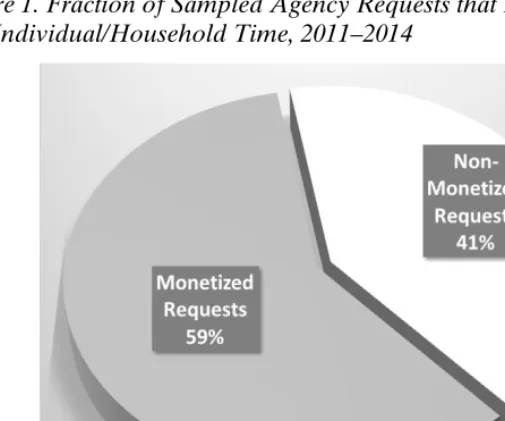
For time burdens borne by individuals, agency practice is divided. Although we lack official statistics, we can get a sense of monetization practices from a random sample of more than 160 information collection requests that reported burdens on individuals or households and for which OIRA completed review during a recent three-year period.117 In this sample, under 60 percent of agency requests monetized individual or household time burdens while over 40 percent did not (Figure 1, Figure 2). These statistics do rest on some judgment calls. Three agency requests are counted as “monetized” when they used $0.00 as the value for time spent by unemployed students, unemployed seniors, and recipients of disability benefits.118 Also, the fraction of monetized requests is not the same measure as the fraction of monetized hours. Recall that IRS
114. The Model was developed with the assistance of IBM, and it combines survey data with respondents’ tax forms to extrapolate time and out-of-pocket costs for all taxpayers and for new tax law proposals. See John L. Guyton, John F. O’Hare & Michael P. Stavrianos, Estimating the Compliance Cost of the U.S. Individual Income Tax, 56 NAT’L TAX J. 673, 674–81 (2003); Janet Holtzblatt, Measuring Compliance Burdens: Issues Raised by the Individual Taxpayer Burden Model, in PROCEEDINGS: ANNUAL CONFERENCE ON TAXATION AND MINUTES OF THE ANNUAL MEETING OF THE NATIONAL TAX ASSOCIATION 366, 367 (2004).
115. Cf. Improving Implementation of the Paperwork Reduction Act, 74 Fed. Reg. 55,269, 55,270 (Oct. 27, 2009) (reporting OIRA’s recognition of varying quality of agency burden estimates, with the IRS Model held out as a careful effort).
116. This is my impression based on a review of dozens of information collection requests from the past three years.
generates a uniquely large share of the reported federal paperwork burden, taking into account all tax forms used to report income, exemptions, and deductions whether legally optional or not, but IRS does not monetize time expended by individuals on their tax forms. The basic individual tax forms happen not to be in this sample;119
if they were, those nonmonetized hours would basically swamp the hours monetized in this or any other sample. Either way, agencies certainly do vary in their willingness to monetize time.
Figure 1. Fraction of Sampled Agency Requests that Monetized Individual/Household Time, 2011–2014
*As discussed in the text, the Treasury Department and its Internal Revenue Service account for most of the total hours currently counted by agencies, whatever the quality of those counts, but they account for far less than half of the total number of information collection requests. The one request in the sample from Treasury that monetized hours was generated by the Office of the Comptroller of the Currency, for a customer complaint form regarding bank practices.120
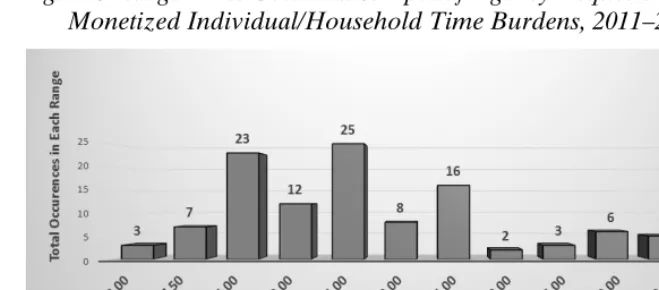
For agency requests that do convert individual and household time into dollars, invariably wage rates are used. But this metric yields variation anyway because agencies are not committed to a universal wage rate for everyone. Very different monetary values are assigned to similar paperwork burdens based on how the labor market values the jobs that the respondents ordinarily do (Figure 3). Ignoring the three $0.00 values, the range in agency valuation of people’s time is easily more than tenfold in our sample and in the specific examples discussed above—$7.25 per hour imputed to unemployed people seeking nutrition and other benefits,121 over $80 per hour for professionals such as doctors answering questions,122
and over $250 per hour for the highest-income outliers such as nuclear
120. See OFFICE OF THE COMPTROLLER OF THE CURRENCY,U.S.DEP’T OF TREASURY, CUSTOMER COMPLAINT FORM:SUPPORTING STATEMENT 1–2 (2012), http://www.reginfo.gov/ public/do/DownloadDocument?objectID=34765001 [http://perma.cc/EN7A-EE5D].
121. See, e.g., U.S.DEP’T OF HEALTH &HUMAN SERVS.,SUBSIDIZED AND TRANSITIONAL
EMPLOYMENT DEMONSTRATION (STED) AND ENHANCED TRANSITIONAL JOBS
DEMONSTRATION (ETJD):SUPPORTING STATEMENT 36 (2013), http://www.reginfo.gov/public/ do/DownloadDocument?objectID=39889201 [http://perma.cc/3WMS-8ZHP].
scientists seeking government jobs.123
The sample’s distribution does clump in the $10 to $15 range, which seems to reflect clerical wages, and again in the $20 to $35 range, which reflects national median hourly income plus occasional augmentation for overhead and fringe benefits.124
Even so, significant variance in time valuation is undeniable.
Figure 3. Wage Rates Used in a Sample of Agency Requests that Monetized Individual/Household Time Burdens, 2011–2014
B. OIRA
Agency variance in monetizing time is not the result of a White House directive, but wage rates do show up in OMB guidance. OMB instructions for agencies going back to 1995 call for estimates of out-of-pocket dollar costs as well as hour burdens, and for a conversion of the hour burdens into dollars, “identifying and using appropriate wage rate categories.”125
More generally, OMB has encouraged agency monetization of people’s time—but without the commitment to hourly wages—since at least 2003. Circular A-4 on cost-benefit analysis suggests that agencies tally time costs in dollars, and this guidance indicates a broad understanding of time-related burdens beyond filling out forms. The Circular explains that agencies should
123. See NUCLEAR REGULATORY COMM’N,NRCFORM 354,DATA REPORT ON SPOUSE: SUPPORTING STATEMENT 4 (2011), http://www.reginfo.gov/public/do/DownloadDocument? objectID=27489401 [http://perma.cc/9MFZ-WDKX].
124. On the link between loaded wage rates and an employer perspective on paperwork burdens, see infra note 233.
125. See OMBSUPPORTING STATEMENT INSTRUCTIONS, supra note 39, at 6 (explaining that, for item 12, out-of-pocket costs should exclude the cost of any hour burden); see also id.
estimate the monetary value of significant effects including “inconvenience costs and benefits” as well as “[g]ains or losses of time in work, leisure and/or commuting/travel settings.”126
OMB does not exactly advertise the conversion of hours into dollars. The dollar value of these hours does not appear on OMB forms or in a searchable format on Reginfo.gov.127
Confirming an agency translation of hours into dollars requires downloading a supporting statement or searching the Federal Register. And OIRA treated monetization as a controversial issue worth revisiting in a 2009 request for public comments. Ideas on “[w]hether and how burden hours should be monetized” were solicited, including whether a universal dollar figure should be used for all information collections.128 Also, OIRA’s annual reports nearly always count hourly burdens without attempting to translate hours into dollars,129 plus the President’s recent initiative to cut federal paperwork burdens called for new burden-reduction ideas in hours, not dollars.130
Of course, neither OMB nor OIRA are hiding burden information.131 OIRA made a real contribution to transparency in 1995 when it began posting agency supporting statements online. Anyone can make their own hours-to-dollars conversions using easily accessible hour estimates.
More important, the foregoing cannot reveal exactly how serious agencies are about estimating, monetizing, and integrating time burdens with other considerations when they judge whether and how
126. CIRCULAR NO. A-4, supra note 8, at 37. This guidance applies to information collections bundled with proposed rules.
127. See OFFICE OF MGMT.&BUDGET,EXEC.OFFICE OF THE PRESIDENT,PAPERWORK REDUCTION ACT SUBMISSION (INSTRUCTIONS FOR COMPLETING OMBFORM 83-I) 3 (1995), http://www.whitehouse.gov/sites/default/files/omb/inforeg/83i-fill.pdf [http://perma.cc/VYF2-4L5P] (item 14);ROCISHOW TO GUIDE, supra note 48, at 40.
128. Improving Implementation of the Paperwork Reduction Act, 74 Fed. Reg. 55,269, 55,271–72 (Oct. 27, 2009). No policy change appears to have followed this solicitation.
129. An exception is the 2011 report: “We have not attempted to monetize this number of hours, but it is clear that the monetary equivalent would be very high. For example, if each hour is valued at $20, the monetary equivalent would be $176 billion.” OFFICE OF INFO. & REGULATORY AFFAIRS, EXEC. OFFICE OF THE PRESIDENT, INFORMATION COLLECTION BUDGET OF THE UNITED STATES GOVERNMENT 2011, at 1 (2011).
130. See supra notes 26–27 and accompanying text.
131. See generally 5 C.F.R. § 1320.14(a) (2014) (regarding public access to OMB paperwork docket files, with exceptions for trade secrets and other risks to lawful collection of information). An encouraging view of OMB oversight on VSL for CBA is John D. Graham,
to collect information. The relevant officials are operating under partially vague standards and very scarce resources. OIRA employs fewer than fifty people to perform a range of duties, including review of the costs and benefits of proposed regulations. These regulatory proposals often implicate much higher stakes than information collections within what agencies take to be the ambit of the Paperwork Reduction Act.132
From the summer of 2013 until the summer of 2014, OIRA’s small staff reviewed nearly 3,900 information collection requests.133
Unsurprisingly, agency explanations of their collection requests tend not to be elaborate,134 and OIRA does not offer in-depth public explanations for its conclusions.135
132. See Sunstein, supra note 11, at 1845 n.26 (reporting that OIRA has about forty-five employees, mostly career staff, and reviews upwards of 700 regulatory actions per year, although noting help from others outside the office); see also Jennifer Nou, Agency Self-Insulation Under Presidential Review, 126 HARV.L.REV. 1755, 1800 (2013) (reporting that twenty to thirty OIRA staff “consistently engage in regulatory review”).
133. Based on searches on the “Search of Information Collection Review” page at
Reginfo.gov restricted to “Concluded” OIRA actions between July 30, 2013 and July 29, 2014, OIRA approved 3,041 requests without change, plus 839 requests with changes, encountered 47 withdrawals, and denied 2 requests.
134. As the Securities and Exchange Commission (SEC) warned in a recent request, “The estimated burden hours are made solely for the purpose of the Paperwork Reduction Act. The hours are not derived from a comprehensive or even representative survey or study of the hours to comply with Commission rules and forms.” U.S. SEC. & EXCH. COMM’N, RULE 173: SUPPORTING STATEMENT 2 (2014), http://www.reginfo.gov/public/do/DownloadDocument? objectID=47864701 [http://perma.cc/XVB8-9FVF].
135. See, e.g., OFFICE OF MGMT.&BUDGET,EXEC.OFFICE OF THE PRESIDENT,NOTICE OF ACTION:RULE 173,at 1 (2014), http://www.reginfo.gov/public/do/DownloadNOA?requestID= 258033 [http://perma.cc/ARB2-A8PN] (approving SEC’s request without comment); OFFICE OF MGMT.&BUDGET,EXEC.OFFICE OF THE PRESIDENT,NOTICE OF ACTION:FDAAPPROVAL TO MARKET A NEW DRUG 1 (2014), http://www.reginfo.gov/public/do/DownloadNOA?request ID=259847 [http://perma.cc/KB6H-DTM8] (approving FDA’s request with a warning that the scope of approval is limited by the supporting statement); cf. 5 C.F.R. § 1320.10(b) (2014) (“OMB shall notify the agency involved of its decision to approve, to instruct the agency to make a substantive or material change to, or to disapprove, the collection of information, and shall make such decision publicly available.” (emphasis added)). An exception to the rule of reticence is the process for OMB participation in public comment when an agency bundles a proposed information collection into a proposed rule, see 5 C.F.R. § 1320.11(c) (2014), and subsequent review after publication of any final rule, see id. § 1320.11(i) (“If OMB disapproves
or instructs the agency to make substantive or material change to the collection of information, it shall make the reasons for its decision publicly available.” (emphases added)); see alsoid.