A Permission based Multilevel Parallel Solution
for Distributed Mutual Exclusion
Mohammad Ashiqur Rahman
†and M. Mostofa Akbar
‡ †Dept of Software and Information Systems, University of North Carolina Charlotte, USA ‡
Dept of Computer Science and Engineering, Bangladesh University of Engineering and Technology, Bangladesh Emails: [email protected], [email protected]
Abstract—Due to the growing application of peer-to-peer computing, the distributed applications are continuously spreading over an extensive number of nodes. To cope with this large number of participants, various cluster based hierarchical solutions have been proposed. Cluster or group based solutions are scalable for a large number of participants. All of these solutions exploit the idea of coordinators, leaders or proxies of the clusters. If any such node fails, the election of a new one is required. Thus, fault tolerance of these algorithms is low. Again, as the number of participating nodes increases every day, it is necessary to devise highly scalable distributed mutual exclusion algorithms. This research presents a permission based parallel solution of distributed mutual exclusion by modeling a multilevel clustered network, where clusters are formed at different hierarchies. This technique enhances the scalability by reducing the cluster size, as it requires consensus from only one cluster at each level. As the algorithm has no use of coordinators, it possesses high fault tolerance. The paper also addresses the problem of achieving optimal level of clustering in a network for distributed mutual exclusion.
Index Terms—Distributed algorithm, cluster, consensus, multilevel, mutual exclusion, parallel
I. INTRODUCTION
In distributed systems, different processes run on different nodes of a network and they often need to access shared data and resources, or need to execute some common events. These processes should be consistent and the access to these shared entities should be mutually exclusive. The portion of an event or application, where any shared component or common events are accessed, is the Critical Section (CS). Mutual Exclusion (ME) algorithms ensure the consistent execution of the CS. As the shared memory is absent in distributed systems the solutions of the ME problem is not straightforward. Due to the enormous importance of ME and the difficulty of its solution, it has been an active research area for the last three decades. The classic algorithms for Mutual exclusion that have been proposed for fixed networks can be classified in two types: centralized and distributed approaches. In the centralized solutions, a node is designated as the coordinator to deliver permission to the other nodes to access their CS, while in the distributed solutions the permission is obtained from consensus among all network nodes.
Distributed mutual exclusion algorithms are mainly
classified into two categories: token based and permission based [1]. In permission based ME algorithms [7][8][9][10], a requesting node is required to receive permissions from other nodes (a set of nodes or all other nodes). In the token based ME algorithms [2][3][4][5][6] [12], a unique token is shared among the set of nodes. A node must own the unique token (sometimes cited as privilege message) before entering the CS. Though token based algorithms incur low message cost, they suffer from poor failure resiliency, because complex token regeneration protocols [11] must be executed if the node holding the token fails.
In permission-based algorithms, a node needs to have permissions usually only from a set of nodes, known as a quorum. Quorum formation algorithms must satisfy that any two possible quorums have a nonempty intersection. Quorum based algorithms [10] are resilient to node and communication failures and network partitioning. Communication cost of these algorithms is proportional to the quorum size. Therefore, these algorithms try to achieve two goals: small quorum size and a high degree of fault tolerance. Efficient quorum based ME algorithms take logarithmic cost [9] in best cases, where n is the number of nodes. However, the cost increases rapidly with the increase of node failures.
At present, the number of distributed nodes has become very large. With the emergence of peer-to-peer computing [26] and grid computing [27], the distributed applications have been spread over a large number of nodes. The performance of these distributed applications depends on the number of participating nodes and the latency gaps among nodes. But, the classical ME algorithms do not consider these matters. There are some two-layer hierarchical algorithms proposed during the last decade, which consider these issues to some extent. In these algorithms [13][14] [15], the nodes in the network are usually divided into several groups where each group is often called a cluster. Since these algorithms are mainly token based (used in one or both of upper and lower layers), they suffer due to token failures. We also presented a two-layer but fully permission based algorithm in [34], where the coordinators (named as message routers) of the clusters form the upper layer. These above mentioned cluster based algorithms use two levels of network hierarchy. They run ME algorithm inside the cluster and among the clusters so that mutually exclusive access prevails.
Chubby [37] and Zookeeper [38] are very well known distributed locking services, especially in case of web service data centers. These services are intended mainly for coarse-grained synchronization – for example, to elect a master among a set of candidates, which would then handle all access to a data for a considerable time, perhaps hours or days. Among the masters a quorum-based algorithm, typically majority quorum [17], is executed to have write access for a node, while read access is controlled by corresponding master alone. They provide a mechanism similar to hierarchical namespace.
Though the number of participating nodes is reduced to an extent in the above mentioned approaches, further reduction is achievable for extra large networks with higher levels of hierarchy. So, we extended our algorithm of [34] for multilevel clustered network in [25] where subclusters are formed inside the clusters. Chubby [37] and Zookeeper [38] are also extensible to multilevel hierarchy. However, the main problem of these algorithms is the failures of coordinators/masters. Any failed coordinator has to be replaced using a leader election algorithm, which adds significant overhead.
This paper proposes a multilevel clustered network architecture and presents a generalized parallel distributed ME solution based on this multilevel network. Our proposed solution is fully permission based. It improves the performance by reducing participating nodes in each cluster. Running existing ME algorithms in the clusters is not sufficient to achieve the mutual exclusion in a network of hierarchical clusters. Customization of existing classical algorithms is necessary to execute at different hierarchical levels. The consensuses inside the clusters must be collected and combined in a hierarchical order to achieve the global mutual exclusion. A distributed algorithm is required to execute this process for coordination among the clusters of different levels. Our proposed distributed ME solution incorporates this coordination where ME algorithm is executed parallelly in clusters of different levels. But for coordination, no fixed coordinator is used for a particular cluster. The absence of a fixed coordinator increases the fault tolerance. The parallel running of the algorithm in different hierarchical levels improves the performance. In this research, we also present necessary mechanisms to maintain the correctness of our mutual exclusion algorithm in case of node failures. The preliminary part of the research work is published in [35], which considers
only single level of clustering. This is the extended version for multilevel clustered network.
The following sections of this paper are organized as follows. In Section II we describe the multilevel-clustered network architecture for ME algorithm. In Section III, the ME solution is illustrated followed by its theoretical analyses for optimal clustering. Detailed observation along performance comparison with simulation results are described in Section IV. Section V presents the critical evaluation of the proposed algorithm and the last section concludes the paper by summarizing the major contributions and future research directions.
II. NETWORK MODEL
In this section, we describe the network model that we assume in our proposed mutual exclusion solution. First we describe the system with the necessary assumptions. Then we propose a logical hierarchical network topology by introducing ℓ level of clustering. Our proposed ME solution works upon this hierarchical topology.
A. Description of the System
We consider an asynchronous distributed system, which follows the model proposed in [29]. Each pair of nodes is connected through a communication channel. The message delays for communication and processing are finite. No assumption is made for the relative processing speeds of the nodes. A node may fail by stopping or crashing in accordance with fail-stop model [19]. However, a failed node may restart afterwards (after a reasonably long time), which is referred to as recovery. When a process fails, it loses the values of its states and variables used in the algorithm except for a few values, which are necessary for maintaining the correctness of the algorithm after recovery. So, it uses local stable storage to keep such crucial information.
B. Proposed Network Architecture
The nodes in a network are logically partitioned into several nonintersecting groups. Each group is called a cluster. In multilevel clustering, some smaller clusters can form a larger cluster again and so forth.
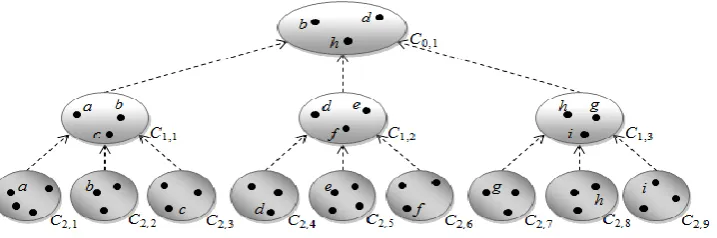
We propose ℓ level of clustering where ℓ can be any positive integer number. A collection of nodes forms a Level ℓ cluster. In this way, a number of nonintersecting Level ℓ clusters are formed. Next Level ℓ1 clusters are Fig. 1. A network with 2 level of clustering.
formed such that a group of Level ℓ clusters are associated with a Level ℓ1 cluster. The number of Level
ℓ1 clusters is equal to the number of groups of Level ℓ clusters, where the groups are nonintersecting. So, the number of Level ℓ1 clusters is smaller than that of Level
ℓ clusters. In this way, the clusters are formed from Level
ℓ to Level 0. There is only one cluster at Level 0 and it is associated with all Level 1 clusters. Note that, each node is a member of a Level ℓ cluster; so each member of an upper layer cluster is also a member of one or more clusters of the lower levels. Also note that, no node is member of more than one cluster at any particular level.
To have a guideline of cluster formation, we follow the following rules for ℓ level of clustering: All nodes are divided into a number of nonintersecting Level ℓ clusters. Then taking an arbitrary node from each of the clusters of a collection of Level ℓ clusters (be identified as child clusters) a Level ℓ1 cluster (be identified as parent cluster) is formed. Thus, the number of nodes of a Level
ℓ1 parent cluster is equal to the number of its Level ℓ child clusters. Similarly a Level ℓ2 cluster is formed from a collection of Level ℓ1 clusters. In this way, all clusters are formed at each Level. According to this guideline, a member of a Level k (0 ≤ k < ℓ) cluster, it is also a member of a cluster at each level from Level ℓ to Level k+1.
There is only one cluster at Level 0 and this is the topmost cluster. So it can be called as the root cluster. Level ℓ clusters are the bottommost clusters and can be called as leaf clusters. If ℓ is 0, then there is only one cluster with all nodes of the network. In this case, no clustering is done in the network.
Fig. 1 shows the topology for 2 level of clustering (ℓ = 2). To specify a cluster in the figure, we use Ci,j which
denotes the jth cluster at Level i. All C2,j (1 ≤ j ≤ 9) are
the bottommost level (Level 2) clusters. Taking three arbitrary member a, b and c of C2,1, C2,2 and C2,3 respectively a Level 1 cluster C1,1 is formed. Similarly other two Level 1 clusters C1,2 and C1,3 are formed from another two different collections of Level 2 clusters. C0,1, the only Level 0 cluster, is formed by taking an arbitrary member from each of the Level 1 clusters. It is to be noted that b, a member of C0,1, is also members of C1,1, a Level 1 cluster, and C2,1, a Level 2 cluster.
Each member of a Level k (0 ≤ k ≤ ℓ) cluster knows the identifications of the members of its Level k cluster and the upper level (Level k1, 0 < k ≤ ℓ) parent cluster. As the memberships to the clusters remain unchanged throughout the program, a node keeps these data in stable storage, so that it can retrieve them after recovery if fails. For cluster formation, any suitable clustering algorithm [23][24] can be used.
III. PROPOSED SOLUTION
In this section, we propose an algorithm for distributed mutual exclusion. At first we write the brief outline of the algorithm. Next we describe the messages and states, which are required for the algorithm. Then we present our algorithm in detail, which is followed by the safety and
liveness proofs. We present a detailed analysis of the proposed solution, in which we find the optimal ℓ level of clustering. At the end, we propose a maintenance algorithm in order to keep our solution continuing correctly in case of a node failure.
A. Brief Outline
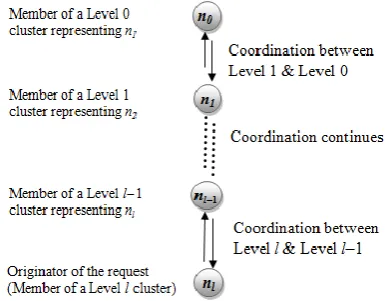
Our proposed network model creates a logical connection among the clusters of different levels. It represents a tree of clusters with parent-child relationship among the clusters. We propose a distributed multilevel ME solution that hierarchically executes the ME algorithm in clusters at different levels (Fig. 2). To collect consensus inside the clusters as well as to coordinate among the hierarchical executions, we extend quorum based ME algorithm [8][9].
Multiple layers of nodes participate in our proposed algorithm: the members of Level ℓ to Level 0 clusters. In all layers, we use the tree-quorum algorithm [9] for quorum creation. When a node x wants to access the CS, first it requires the consensus from the nodes inside its Level ℓ cluster. Then it needs to have permission from the upper layer (Level ℓ1) cluster. To get this permission, x
selects an arbitrary node y among the members of the upper layer cluster as its representing node. To y, x is identified as the represented node. At the upper layer y
executes the ME algorithm similarly to x. In this way consensus is sought at each layer up to Level 0. If y gets consensus from its (Level ℓ1) cluster and its upper layer (Level ℓ2) cluster, it informs x about the consent. At this point, the node x has the total consensus, i.e., permissions from all layers, and can use the CS safely. In Section III.C, the proposed solution will be discussed in detail.
B. Messages and States
The messages required for our proposed ME algorithm depend on the classic ME algorithm applied to the clusters. As we apply quorum based ME algorithm [8][9] inside the clusters, our ME algorithm uses Request, Reply,
Release, Inquire and Yield messages. Since a node can be members of clusters at several levels, Level number is added to the contents of these messages to identify the level of the cluster executing ME algorithm.
The communication between a represented node, a
Fig. 2. Coordination between different levels in l level of clustering
member of a Level k cluster, and its corresponding representing node, a member of a Level k−1 cluster, is
done through PreCRequest, CRequest, CReply and
CRelease messages. Functions of these messages are briefly described below:
When a node x starts to execute ME algorithm in its Level k (0 < k ≤ ℓ) cluster, it selects an arbitrary node y among the members of its Level
k−1 parent cluster as its representing node y at Level
k−1 and sends a PreCRequest message to y.
When x gets the consensus from the quorum of its Level k cluster, it sends CRequest message to y to process the request at Level k−1.
y sends a CReply message to x, if it has the total permission, i.e., permission inside its Level k−1
cluster as well as the permission from the upper level (Level k−2) parent cluster (if k−2 ≥ 0).
x sends a CRelease message to y to propagate the release message to the upper levels (Level k−1 to
Level 0).
All the messages except Request have the same structure: Message {source, level}. First element source
is the identification number of the node, which sends the message to a destination node, while the second element
level is the number indicating the level of the cluster in which the sender node resides. Request message has another element called timestamp. It is the global logical time [16] when the message has been sent. It is used for ordering the requests to avoid deadlock and starvation. As multiple requests can come from different fellow nodes to a single node at a level, a node often needs to keep them in a queue to process afterward. If a node is a member of a Level k (0 ≤ k ≤ ℓ) cluster, it maintains a minimum priority queue, be identified as queue, at this level to keep the incoming Request messages in order of their timestamps. If timestamps of two Request messages are equal, then node identification numbers are used for determination of order. This ordering is crucial for avoiding deadlock and starvation. A member node of Level k (0 ≤ k < ℓ) cluster also maintains a in first-out queue, be identified as fifo, for CRequest messages.
Each node might have different roles in different levels. As a result, each node might have different states for different levels. To represent the proposed system we define following array of states. Each element of the array represents the state of the node at a particular level. Throughout the paper we use the word ‘set’ for a state to denote that the state is true. On the other hand, the word ‘reset’ is used to denote false.
REQUESTING [0…ℓ]: This state at a level is set when a node sends Request messages to the fellow nodes of its cluster at Level k.
LOCKED [0…ℓ]: This state at Level k is set when a node sends Reply to a REQUESTING fellow node, from which it has received a Request.
BUSY [0…ℓ]: When a requesting node at Level
k receives consensus inside its Level k (0 ≤ k ≤ ℓ) cluster and from its Level k−1 (if k > 0) parent cluster, it enters into BUSY state at this level. If k < ℓ, it is obvious that it has already received CRequest
from a node of its Level k+1 child clusters.
BUSYWAITING [0…ℓ]: When a node at Level
k gets a PreCRequest from a node of its Level k+1 child clusters, it starts processing of collecting consensus inside its Level k cluster as well as from its Level k−1 (if k>0) parent cluster. If, afterward, it receives consensus from both of its cluster and the parent cluster, before receiving CRequest from any node of the child clusters, this state at Level k is set.
CREQUESTING [0…ℓ]: When a requesting
node at Level k (if k>0) gets necessary consensus in its cluster of this level, it sends CRequest to its representing node at Level k−1 for the consensus of
that level, and so sets its CREQUESTING state at this level.
INQUIRING [0…ℓ]: If a node x at Level k gets a request from a fellow node y that has a timestamp earlier than that of a previously received request from a node z, which has been replied already, then
x sends an Inquire message to z, as well as, sets the
INQUIRING state at this level.
C. Algorithm
Following variables are used in our ME algorithm:
queue [0…ℓ]: Each entry is a min-priority queue to keep the Request messages at Level k (0 ≤
k ≤ ℓ−1). Priority is measured using timestamps of the messages.
fifo [0…(ℓ−1)]: A first-in first-out queue for each level to keep the CRequest messages at Level k
(0 ≤ k ≤ ℓ−1).
replies [0…ℓ]: Storage to keep the received
Reply messages at Level k (0 ≤ k ≤ ℓ).
representing-node [1…ℓ]: if representing-node[k]>0, it represents the representing node at Level k−1.
represented-node [0…(ℓ−1)]: if represented-node[k]>0, it represents the represented node at Level k+1.
num-of-PreCRequest-pending [0…(ℓ−1)]: It is
the number of pending PreCRequest messages at Level k (0 ≤ k ≤ ℓ−1).
locking-node [0…ℓ]: It represents the locking node at Level k (0 ≤ k ≤ ℓ).
We use ‘Send Message to destination’ command in
order to send a message (Message) to a node (destination). The proposed algorithm consists of different key procedures, pseudocodes of which are shown below. Each node in the system executes the algorithm according to its role. Except for the first four procedures, each function is invoked by a node when an associated message is received.
Procedure Do-Request (k)
1 REQUESTING[k] TRUE
2 ifk > 0
3 representing-node[k]Select a representing
node at k–1
4 SendPreCRequest{id, k} torepresenting-node[k]
5 Select a quorum within its cluster
6 SendRequest{id, k, current time} to all members of the quorum
7. Initialize replies[k]
Procedure Do-CS-Request
1 Do-Request(ℓ)
Procedure Process-Use-CS
1 BUSY[ℓ] TRUE
2 /* Use of the CS */
3 BUSY[ℓ] FALSE 4 ifℓ > 0
5 SendCRelease{id, ℓ} torepresenting-node[ℓ]
6 representing-node[ℓ] 0
7 SendRelease{id, ℓ} message to all members of quorum
Procedure Time-Out-BUSYWAITING (k)
1 BUSYWAITING[k] FALSE
2 num-of-PreCRequest-pending[k] 0
3 ifk > 0
4 SendCRelease{id, k} torepresenting-node[k]
5 SendRelease{id, ℓ} message to all members of quorum
Procedure Process-Request (request)
1 krequest.level
2 ifLOCKED[k] = FALSE andINQUIRING[k] = FALSE
3 LOCKED[k] TRUE
4 locking-node[k] request.source
5 SendReply{id, k} tolocking-node[k]
6 else
7 Insert request into queue[k]
8 ifLOCKED[k] = TRUE andrequest has higher
priority than the request of locking-node[k]
9 LOCKED[k] FALSE
10 INQUIRING[k] TRUE
11 SendInquire{id, k} tolocking-node[k]
Procedure Process-Reply (reply)
1 kreply.level
2 Insert reply into replies[k]
3 ifreplies[k] possesses Reply messages from all
members of a requesting quorum
4 REQUESTING[k] FALSE
5 ifk = 0 6 ifk = ℓ
7 Process-Use-CS() 8 else
9 ifrepresented-node[k] ≠ 0
10 BUSY[k] TRUE
11 SendCReply{id, k} torepresented-node[k]
12 else
13 BUSYWAITING[k] TRUE
14Timer for Time-Out-BUSYWAITING(k) starts
15 else
16 CREQUESTING[k] TRUE
17 SendCRequest{id, k} torepresenting-node[k]
Procedure Process-Release (release)
1 krelease.level
2 LOCKED[k] FALSE
3 INQUIRING[k] FALSE
4 ifqueue[k] is not empty
5 request Extract from queue[k]
6 LOCKED[k] TRUE
7 locking-node[k] request.source
8 SendReply{id, k} tolocking-node[k]
Procedure Process-CRequest (cRequest)
1 kcRequest.level – 1
2 ifrepresented-node[k] ≠ 0
3 Insert cRequest into fifo[k] 4 else
5 represented-node[k] cRequest.source
6 ifBUSYWAITING[k] TRUE
7 BUSY[k] TRUE
8 BUSYWAITING[k] FALSE
9 SendCReply{id, k} torepresented-node[k]
10 else ifREQUESTING[k] = FALSE and
CREQUESTING[k] = FALSE
11 Do-Request (k)
Procedure Process-PreCRequest (preCRequest)
1 kpreCRequest.level – 1
2 num-of-PreCRequest-pending[k]
num-of-PreCRequest-pending[k] + 1
3 ifrepresented-node[k] = 0 and REQUESTING[k] =
FALSE andCREQUESTING[k] = FALSE
4 num-of-PreCRequest-pending[k]
num-of-PreCRequest-pending[k] – 1
5 Do-Request (k)
Procedure Process-CReply (cReply)
1 kcReply.level + 1
2 CREQUESTING[k] FALSE
3 ifk = ℓ
4 Process-Use-CS () 5 else
6 ifrepresented-node[k] ≠ 0
7 BUSY[k] TRUE
8 SendCReply{id, k} torepresented-node[k]
9 else
10 BUSYWAITING[k] TRUE
11 Timer for Time-Out-BUSYWAITING(k) starts
Procedure Process-CRelease (cRelease)
1 kcRelease.level – 1
2 BUSY[k] FALSE
3 represented-node[k] 0
4 iffifo[k] is not empty
5 cRequest Extract from fifo[k]
6 represented-node[k] cRequest.source
7 BUSY[k] TRUE
8 SendCReply{id, k} torepresented-node[k]
9 ifnum-of-PreCRequest-pending[k]>0
10 num-of-PreCRequest-pending[k]
num-of-PreCRequest-pending[k] – 1
11 else 12 ifk > 0
13 SendCRelease{id, k} torepresenting-node[k]
14 representing-node[k] 0
15 SendRelease{id, k} message to all members of
quorum
16 ifnum-of-PreCRequest-pending[k]>0
17 num-of-PreCRequest-pending[k]
num-of-PreCRequest-pending[k] – 1
18 Do-Request (k)
The points below describe our algorithm. We also utilize Fig. 1 along to explain the algorithm.
Basic Multilevel ME Algorithm:
Requests for the CS are generated at Level ℓ cluster (Do-CS-Request). These requests are processed in different levels- Level ℓ to Level 0- sequentially. For example, the clusters C2,4, C1,2 and C0,1 in Fig. 1 represent the participating
clusters if a member of C2,4 places a request for the CS.
A CS requesting node x first starts ME algorithm (Do-Request) in its Level ℓ cluster. It selects a quorum ql and sends a Request message to
each of the quorum members. Now, its
REQUESTING[l] state is set (State transition 1). If its request is granted within the cluster, it selects an arbitrary node y among the members of its Level
ℓ1 parent cluster, as its representing-node at Level ℓ1, and sends CRequest to it (Process-Reply
at lines 3-11). At this point, x’s REQUESTING[l] state is reset and CREQUESTING[l] state is set. To
y, x is identified as the represented-node at Level ℓ. When y gets CRequest from x, it executes ME algorithm in its Level ℓ−1 cluster ( Process-CRequest at lines 10-11). If y gets consensus here, then it sends CRequest to its Level ℓ−2 parent cluster. This process continues until Level 0 is reached.
When a node of a Level k (0 ≤ k ≤ ℓ) cluster makes a request, it needs the permission or consensus from two sides in two sequential steps: firstly from the nodes of its cluster and secondly from the upper level (Level k−1) parent cluster
through the representing node. If there is no upper level (k = 0), then only the consensus from its cluster is required. After getting the total consensus, a node of a Level k cluster sends CReply downward to its represented node, a member of a Level k+1 cluster (Process-Reply at line 5, and Process-CReply at lines 6-8). At this point, it resets its
CREQUESTING[k] state (if k>0) and sets its
BUSY[k] state. In this way, when the requesting node at the bottommost level (k = ℓ), the originator of the request, gets the total consensus ( Process-Reply at lines 3-7, and Process-CReply at lines 3-4), it executes the CS exclusively (Process-Use-CS).
After execution of the CS, the requesting node resets BUSY[l] state and sends Release messages to the nodes inside its cluster, a Level ℓ cluster (Process-Use-CS at line 7). If ℓ>0, it also sends
CRelease message to its representing node at Level
ℓ−1 (Process-Use-CS at lines 4-6). When the representing node at Level k (0 ≤ k < ℓ) cluster gets
CRelease from its represented node at Level k+1, it resets its BUSY[k] state and sends Release
messages to the member nodes of its Level k
cluster (Process-CRelease at line 15). If k>0, it also sends CRelease message to its representing node at Level k−1 (Process-CRelease at lines 12-14). In this way, consensus is released up to Level 0.
A node at Level k, if it is not in LOCKED[k] or
INQUIRING[k] state, sends a Reply message, as its permission, to the requesting node and sets its
LOCKED[k] state (Process-Request at lines 1-5). Otherwise it inserts the Request message into
queue[k]. When it receives the release message, a node resets its LOCKED[k] state and chooses the request residing at top of its queue[k], if it is not
empty, for next processing (Process-Release).
It is possible for a node of a Level k (0 ≤ k < ℓ) cluster to be selected as representing node by multiple nodes of different Level k+1 child clusters. For example, h, a node of C0,1, is selected as representing node at Level 0 simultaneously by e
and g, two nodes of two different Level 1 child clusters C1,1 and C1,2 respectively. So, h will receive CRequest messages from both of e and g. If
h receives these messages at the same time, then it serves the CRequest message that comes first. So, it keeps pending CRequest messages into fifo
(Process-CRequest at lines 2-3). When a node get consensus for the currently serving CRequest, it also serves all other CRequest messages with this consensus one after one until its queue becomes empty (Process-CRelease at lines 4-10). Let, h has received CRequest of e before that of g. So, h is serving the request of e, which is now the represented node of h, while the request of g is waiting in the queue. When h receives consensus from C0,1, it sends CReply to e. After a while, when
h gets CRelease from e, it does not release the consensus; rather it sends CReply to g, which is now the represented node of h. This process continues until h gets CRelease from its represented node and finds out that its CRequest
queue is empty. Then it releases the consensus in its cluster and sends CRelease upward to its representing node if any upper level exists (Process-CRelease at lines 12-15).
According to the above description of the algorithm, the progression of the algorithm is sequential since consensus must be ensured in a Level k+1 cluster before processing starts in a Level k cluster. Now we discuss how this sequential behavior is significantly reduced by incorporating parallelism.
Parallel Execution of ME Algorithm:
When a node x begins to execute ME algorithm in its associated Level k (0 < k ≤ ℓ) cluster, it also sends PreCRequest to its arbitrarily selected representing node y at Level k−1 (Do-Request at lines 2-4). After getting PreCRequest from x, y
starts to execute ME algorithm in its Level k−1
cluster without setting its represented node (Process-PreCRequest at lines 3-5). If x gets consensus within its Level k cluster, it places
CRequest to y. When y gets the CRequest, it sets its represented node to x. Within the time y may have already received consensus in its Level k−1 cluster.
Otherwise, y has reached a point towards getting consensus.
o If y gets consensus before receiving
CRequest from a node of its Level k child clusters, it sets its BUSYWAITING state and waits for a threshold period for the request (Process-Reply at lines 12-14, and Process-CReply at lines 9-11). Within this threshold
time, if any CRequest come, y accepts the requesting node as its represented node and gets into BUSY state. It time expires, y will release this consensus so that other competing nodes need not to wait any longer and
BUSYWAITING is reset (
Time-Out-BUSYWAITING).
It is common and usual to have other nodes besides x in the corresponding Level k child clusters to be competing in order to get consensus. Obviously, each of those nodes will send
PreCRequest to their representing nodes. It is quite possible for y to be selected as the representing node at Level k−1 by more than one nodes of Level k. Since y can process only one in-advance request, at a time, if y is already processing of such a request, whether it is CRequest or PreCRequest, it will not process any additional PreCRequest until the current processing finishes. It only counts the pending in-advance requests for later processing (Process-PreCRequest at line 2).
o Let x and z (in the same or different Level k clusters) both are requesting for consensus, which are child clusters of a Level
k−1 cluster. Both of the nodes have selected y, a member of that Level k−1 cluster, as their
representing nodes. y is running ME algorithm in the cluster in response to x’s PreCRequest, since the request of x has reached y earlier than that of z. However, z gets consensus (in its cluster) before x. So, z sends CRequest to y. Now y sets z as its represented node at Level k
and ongoing ME algorithm continues (Process-CRequest).
o After receiving CRelease from z, y
begins advance processing again, since its counter shows that there is still one
PreCRequest to serve (Process-CRelease at lines 16-18). At this time, x may get consensus in its Level k cluster and then it will send
CRequest to y.
Inquire and Yield messages works to avoid deadlock, similarly as in [7][8][35]. The pseudocodes of the processes, which are invoked when a node receivesthese messages, are not mentioned here due to space limitation. Deadlock avoidance procedure is described below.
Deadlock Avoidance Algorithm:
Let a node u, at some Level k, receives a request from a node v that possesses a timestamp earlier than the request of a node w currently being processed; to which it has already sent a Reply
message. Then u puts the request of v into queue[k] and sends an Inquire message to w and waits for either a Yield or Release message from w ( Process-Request at lines 8-11). At this time, its LOCKED[k] state is reset and INQUIRING[k] state is set.
When w receives the Inquire message from u, it relinquishes the consensus of u as well as sends a
Yield message to u if and only if it has not received all replies from its requested quorum members. If
w has already acquired all necessary replies to access the CS and may be already executing the CS, then it simply ignores the Inquire message and proceeds normally, that is, it continues to execute the CS. After finishing the execution, it sends a
Release message to the inquiring node u.
When u receives the Yield message, it resets it
INQUIRING[k] state and puts back the request of w
into its queue[k]. Now it pop out the request from the top of queue[k] and accordingly sends a Reply
message to the corresponding node and gets into
LOCKED[k] state again. In the mean time if no
Request with earlier timestamp has come, the
Request of v is the selected request message. If u
receives Release message instead of Yield message from w, it does the same except for reinserting the request of w into queue[k] (Process-Release at line 3), since the request has been served already. Necessary proofs for the new ME solution are given in following Subsection. The solution is also theoretically analyzed in Subsection II.F for computing optimal level of clustering. Since failures of nodes disrupt any ongoing process of our ME algorithm, an algorithm is presented in Subsection II.G for maintaining the proper execution of the ME algorithm.
D. Proof
Correctness of our ME algorithm is guaranteed by proving two properties: safety and liveness.
1) Safety
A mutual exclusion solution is said to be safe if no more than one node gets access to the CS at a time. For quorum based algorithms, this condition holds, if there is at least one common node between any two quorums for accessing the CS [18]. For ℓ level of clustering, we must get consensus at each level. A quorum of our solution can be defined as
l k
k k
l q q q
q q
1
0 ,
Here qk is a quorum formed from the nodes of a Level
k cluster.
Similarly, another quorum could be
l k
k k
l p p p
p p
1
0 , where pk is a quorum formed from the nodes of a Level k cluster. Now,
) ( ) ( )
(p q p1 q1 p0 q0
q
p l l
Here, p0q0, as these are the quorums of the only cluster in Level 0 and inside the cluster classical quorum formation algorithms are used, which ensure the intersection between any two quorums [9]. So, pq. Thus, the solution must maintain mutual exclusion in entering the CS.
2) Liveness
To prove the liveness, we need to show that any request is served after a finite period of time. Let the C
nodes of a Level k cluster be N1, N2, … …, NC. Consider
the worst-case scenario, where the requests are queued at
Ni from each of the fellow nodes. The timestamps of the
queued requests at Ni are T1, T2, … …, TC. The request
sent by Nm contains the maximum timestamp. Thus,
Tcurrent > Tm > Ti; where Tcurrent is the current time and
m
i . Let, the timestamp of the next request coming from any node Nj (after completion of its earlier request
with timestamp Tj) is denoted byTjnext. Definitely, next j
T ≥
Tcurrent. Hence, Tjnext > Tm. Therefore, the request from Nm
must be served within a finite duration (after C–1
outstanding requests are served) as it has the timestamp earlier than that of the next group of requests.
For ℓ level of clustering, we must have consensus at all levels. After getting consensus from a Level k (ℓ ≤ k < 0) cluster, we send request (CRequest) to the representing node at Level k–1 as we need further consensus from
Level k–1 to Level 0. At this moment, the representing
node’s execution of ME algorithm at its Level k–1 cluster
may be already in a position close to getting consensus due to PreCRequest message. After receiving CRequest, the representing node continues the ME execution, if the process is ongoing, otherwise it starts the processing. As,
CRequest message will reach all levels up to Level 0, ME algorithm is executed in a cluster at each level. Since any request must be served within a finite period in a cluster, ultimately we must get consensus at all levels (ℓ ≤ k ≤ 0) after a finite time. So, liveness is proved. Note that, in the worst case a request needs to wait for the completion of (ℓ+1) × (C−1) other requests.
E. Analysis
The analysis of the proposed solution is presented in this section considering tree-quorum algorithm [9] running in the clusters of each level. According to tree-quorum algorithm the expected tree-quorum size for a network with size n is expressed as
) 2 )( 1 ( ) 1
( 1 1
h h
h f c f c
c , where f is the availability
of a node in a quorum (probability of a node being available or alive) and hlog2n (height of the binary tree formed by n nodes). Note that, according to [9], f
denotes the fraction of the quorums that include the root of the tree of level ℓ+1. It is actually the probability that the root is included in the quorum when all the quorums are equally probable. In this research, we assume that the root is included in the quorum if it is available. Thus, f is equivalent to the probability that the root is available. In the recursive equation of expected quorum size, each node becomes a root in a particular level of the cluster. That is why f is denoted as the probability that a node is available at a particular instant. The message cost is the average number of messages needed for (a single request from) a node to enter the CS and this is proportional to the quorum size,
c
h. Hence, thisc
h represents the cost function. Solving this recurrence, following equation is found:
1 when , 1 ) 2 ( 1 when , 1 f f f f f h h hc
... (1)As the time requirement in a distributed algorithm is
almost proportional to the number of messages, the following analysis will also be applicable for average time requirement.
1) Optimal Cluster Size
Let level of clustering be 1. So, there are two levels of clusters: a number of Level 1 clusters and a Level 0 cluster. We consider two parameters: n, the number of nodes in the network, and C, cluster size of each Level 1 cluster assuming all clusters are of the same size. Therefore, the number of Level 1 clusters is n/C. This is the cluster size of Level 0 cluster since taking one arbitrary node from each of the Level 1 clusters forms the Level 0 cluster.
The height of the tree formed by the nodes of a Level 1 cluster is h1log2C. Similarly, the height of the tree formed in Level 0 cluster is
1 0 2 2 0 2 0 log log ) / ( log h h h C n h C n h
Therefore, total cost of the proposed solution:
c = c0 + c1 + Coordination cost between Level 0 and Level 1 Here, c0 and c1 are the costs of executing tree-quorum algorithm at Level 0 and Level 1 respectively. Coordination cost is proportional to the number of representing nodes doing coordination. Here, only one representing node does the coordination between Level 0 and Level 1.
Hence, 1
1 ) 2 ( 1 ) 2
( 1 1
f f f f f f c h h h
Taking the derivative of c with respect to h1 and equating it to zero, we get the following condition of optimal clustering: n C n C h h 2 2 1 log log 2 2
That is, the optimal cluster size for a network with single level of clustering is the square root of the network size. The number of Level 1 clusters (i.e., the Level 0 cluster size) is n/C = n/√n = √n. Therefore, the cluster sizes of all of the clusters of both the levels are the same. This is proved for 1 level of clustering where tree-quorum algorithm is used within the clusters. We can easily derive the following results by extending the result of 1 Level of clustering:
“For optimality, the cluster sizes of different levels of clusters are equal for ℓ level (ℓ≥1) of clustering when tree-quorum algorithm is used inside the clusters”.
It is worth mentioning that, we have not considered the heterogeneity of the network, i.e., the heterogeneity of the communication and the heterogeneity of the clusters. Rather, for convenience of analysis we determine optimality based on the message costs.
2) Optimal Level of Clustering
In order to obtain the optimal message cost for ℓ level of clustering of n nodes we find n = Cl+1. This can be explained as: at first n nodes are partitioned into several clusters where each of them has size C. So, total number of clusters is n/C. Now new clusters of another level are
generated by taking C number of clusters of the previous level. Thus, this level contains n/C2 clusters. This clustering process will continue up to ℓ+1 times. At last, topmost level will contain only a single cluster. Now we will determine the optimal value of ℓ if the tree-quorum algorithm is applied in each level. Remember that, inside any cluster of any level, only C number of nodes participate in the ME algorithm.
Now, let h is the height of the tree formed by the whole network of n nodes. Then h1, the height of the tree formed in each cluster by C participating nodes, is
) 1 (
1
l h
h .
Thus, the total cost c can be expressed as follows:
l f
f l f l
c
f f f c
l h l l
h
1
) 1 ( ) 2 )( 1 (
Cost on Coordinati Level
to Level 1
) 2 (
1 1
1
1
Taking dc/dl = 0, the optimal value for ℓ can be expressed as:
1 1
) 2 ( log
k f e h
l ... (2)
Here k is a dummy parameter taken to solve the equation. An equation-solving tool named ‘DeadLine’ [28] is used to find the value of k from an intermediate equation. A rough estimate of the value of k can be represented by (0.27846(1f)f) for f ≠1. The optimal value of ℓ is 0 for f =1, i.e., theoretically no clustering is needed where all the nodes are available in the system.
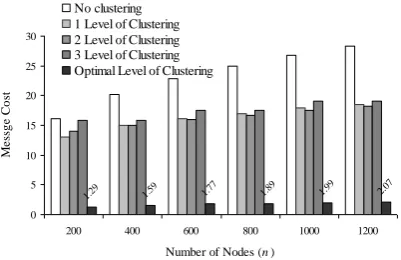
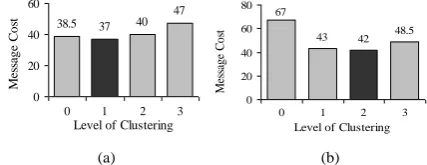
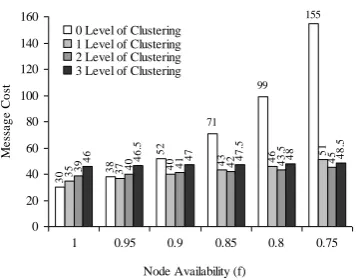
Fig. 3 and Fig. 4 show theoretical message cost for different levels of clustering. Optimal level of clustering for a particular n and f is determined by Equation (2). Optimal level of clustering is shown in both of the figures at the rightmost of the message cost bars. Note that, the message costs shown in these graphs are actually (accumulation of) expected quorum sizes at different levels. Following are the observations considering the message cost from the presented figures:
Clustering is very much effective for large n
and low f. If f=1, no clustering is required irrespective of the network size.
Clustering reduces the message cost up to a
certain level of clustering, which is defined as the optimal level of clustering. Further clustering increases the message cost.
For a particular f if n increases, higher level of clustering performs better than lower level of clustering. Similarly for a particular n if f decreases, higher level of clustering performs better than lower level of clustering.
These graphs are plotted using the equations derived from the theoretical analysis. In Section IV, we will verify this theoretical result with the simulation result.
3) Minimum Delay for a Request to Satisfy
Let q is the average quorum size of a cluster of any level, T is the average transmission time and P is the average processing time. We make two assumptions: (i) at least one quorum is available in a cluster; (ii) there is only a single request for CS in the system to process and no other request will be issued until its processing completes.
The processing time for q number of Request messages is qP, that is, the q’th message is sent after qP delay. Thus, the time for the last message to reach the destination node is qP + T. In the mean time, earlier messages must have reached their destinations. Now, in Level ℓ−1 cluster the request is reached through a PreCRequest. Time for the
PreCRequest to reach the representing node at the next upper level is P + T. As a result, all nodes of a quorum at Level ℓ−1 will receive a Request message within (P + T) + qP + T. In this way, the time needed for PreCRequest
to reach the representing node of Level 0 is ℓ (P + T) and consequently the last Request message in this level reaches its destination at ℓ (P + T) + qP + T.
When a node receives a Request, it sends Reply
immediately if it is free (i.e., it is not LOCKED and no other requests is in its queue). Since we have assumed that, only a single CS request exists in the system, after receiving a Request, a Reply will be sent just incurring the processing time. Thus at Level ℓ, total time until the last
Reply reached to the requesting node is qP + T + (P + T). Similarly at Level 0, the requesting node receives the last
Reply on ℓ(P + T) + qP + T + (P + T), i.e., (ℓ + 1)(P + T) + qP + T.
After getting the consensus, CReply is sent to downward. It takes (P + T) time to reach from Level k to Level k+1. In this way, CReply will be reached from Fig. 3. Comparison among different levels of clustering hierarchy
for the networks with different sizes and fixed f = 0.8. 2.07 1.99 1.89 1.77 1.59 1.29 0 5 10 15 20 25 30
200 400 600 800 1000 1200
Number of Nodes (n)
M
e
ss
g
e
Co
st
No clustering 1 Level of Clustering 2 Level of Clustering 3 Level of Clustering Optimal Level of Clustering
Fig. 4. Comparison among different levels of clustering for different f in a network with 1200 nodes.
0 1.46 2.29 2.81 3.17 3.45 0 10 20 30 40
0.75 0.8 0.85 0.9 0.95 1
Availability of a Node (f)
M
e
ss
a
g
e
Co
st
No Clustering 1 Level of Clustering 2 Level of Clustering 3 Level of Clustering Optimal Level of Clustering
Level 0 to the CS requesting node in ℓ(P + T) time. So, the total time for the CS requesting node needs from requesting (i.e., start processing the first Request to be sent) to getting consensus (i.e., receiving CReply) is (ℓ + 1) (P + T) + qP + T + ℓ(P + T), that is, (2l + 1) (P + T) +
qP + T.
We know that q is a function of the number of participating nodes, which is the cluster size C, and it varies from log2C to C/2 depending on the f, the availability of a node. It is worth mentioning that, the delay for request satisfaction in case of no clustering is
qP + T + (P + T), where q varies from log2n to n/2. Here,
n is the number of nodes in the system. 4) Availability of a Quorum
The probability that a node is available at any time is f. According to the tree quorum algorithm [9], the availability of a quorum in a cluster is computed by formulating a recurrence relation. The recurrence relation is in terms of the availabilities of forming quorums in the subtrees of a binary tree. Let Ai be the availability of
forming a quorum in a tree of height i. Thus, Ai+1, the availability of forming a quorum in a tree of height i + 1 is given as
Ai+1 = Probability (root is up) × Availability (Left subtree) × Availability (Right subtree)
+ Probability (root is up) × Unavailability (Left subtree) × Availability (Right subtree)
+ Probability (root is up) × Availability (Left subtree) × Unavailability (Right subtree)
+ Probability (root is down) × Availability (Left subtree) × Availability (Right subtree). Using f as the probability of the root being up, Ai as
the availability of a subtree of height i, and 1 – Ai as the
unavailability of a subtree of height i we can write the above expression as follows:
Ai+1 = fA2i + f(l – Ai) Ai + fAi (l – Ai) + (1 – f)A2i
= 2fAi + (1 – 2f) A2i.
Note that the availability of a quorum in a tree with a single node (height 0) is f, i.e., A0 = f.
In our proposed solution, the number of nodes in the system is n and the number of nodes in a cluster (i.e., cluster size) is C. For optimal solution, all clusters have the same size C. Letting the height of the binary tree formed by C nodes as h1, the availability of a quorum in a
cluster is A 1
h = 2fAh11 + (1 – 2f) A 2
1 1
h .
A quorum q of our solution is defined as 0
q q
ql k or
l k k q 1, where qk is a quorum formed from the nodes of a Level k cluster. So the availability of a quorum in our solution is an aggregation of the availabilities of ℓ + 1 quorums. As each cluster has size C, i.e., height h1, the availability is as follows:
A
h
= A 1h
× A1
h
× …… up to (ℓ + 1) times = (A 1h
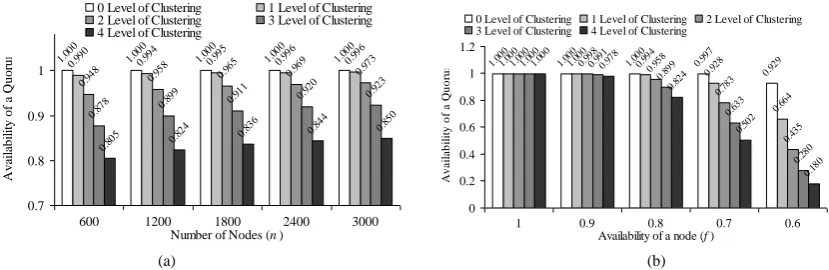
)ℓ+1 Fig. 5(a) and 5(b) show the availability of a quorum for different level of clustering varying number of nodes (n) and availability of a node (f) respectively. For higher level of clustering and lower values of f, availability of a quorum reduces significantly. It is to be noted that availability should be considered with message cost in order to choose optimal level of clustering, so that no node starves when it requires using the CS. However, to calculate optimal level of clustering, we do not consider availability of a quorum assuming that at any instance at least a quorum is available.F. An Extension to our Proposed Algorithm
A node of a Level k (0 ≤ k < ℓ) cluster gets
PreCRequest messages from different requesting nodes of its Level k+1 child clusters. At a time, it does in-advance processing for a single PreCRequest message; so, it maintains a counter to keep the number of pending
PreCRequest messages, for which it will do processing after the completion of the current one. So, when it gets a
CRelease message from a member node of its Level k+1 cluster and its fifo is empty, it may get into
BUSYWAITING state for a threshold time, be identified as THRESHOLD2, with the hope that, within THRESHOLD2 a CRequest will come from a requesting node of its Level k+1 child clusters.
Usefulness of this technique depends on the counter of pending PreCRequest messages and the value of k. If a requesting node at Level k gets consensus without executing ME algorithm at upper levels starting from Level k−1 to Level 0, message cost is reduced and time is
shortened. So, for larger values of the counter and k, this technique is more beneficial. We apply this extended technique by following the guidelines below:
1.When the counter value of pending
PreCRequest messages is zero, then this technique
(a) (b)
Fig. 5. Availability of a quorum for different levels of clustering by (a) varying n with f=0.8 and (b) varying f with n=1200. 1.00 0 1.00 0 1.00 0 1.00 0 1.00 0 0.99 0 0.99 4 0.99 5 0.99 6 0.99 6 0.94 8 0.95 8 0.96 5 0.96 9 0.97 3 0.87
8 0.899 0.91 1 0.92 0 0.92 3 0.80
5 0.824 0.83 6 0.84 4 0.85 0 0.7 0.8 0.9 1
600 1200 1800 2400 3000 Number of Nodes (n)
A va il abi li ty of a Q uo rum
0 Level of Clustering 1 Level of Clustering 2 Level of Clustering 3 Level of Clustering 4 Level of Clustering
1.00 0 1.00 0 1.00 0 0.99 7 0.92 9 1.00 0 1.00 0 0.99 4 0.92 8 0.66 4 1.00 0 0.99 8 0.95 8 0.78 3 0.43 5 1.00 0 0.99 1 0.89 9 0.63 3 0.28 0 1.00 0 0.97 8 0.82 4 0.50 2 0.18 0 0 0.2 0.4 0.6 0.8 1 1.2
1 0.9 0.8 0.7 0.6
Availability of a node (f)
A v a il a b il it y o f a Q u o ru m
0 Level of Clustering 1 Level of Clustering 2 Level of Clustering 3 Level of Clustering 4 Level of Clustering
is not applied.
2.If the counter value is not zero, then according to a probability, be identified as PROBABILITY, on the counter value, this technique is applied. We can use higher PROBABILITY in case of Level k+1 (0 ≤ k < ℓ−1) clusters than in case of Level k clusters, because cost saving is higher in case of the levels having higher depth from the top. PROBABILITY can have value 1 to 0. If it is 0, then extended technique will not be applied at all. In case of high PROBABILITY, the fairness among the competing requesting nodes with respect to time-requirement of getting consensus (delay for a request to satisfy) becomes low. If PROBABILITY is reduced in case of consecutive application of this extended technique by a representing node, the fairness will increase.
G. Maintenance Algorithm
Maintenance algorithm maintains the correctness of our mutual exclusion algorithm in case of failures of the nodes that are executing or participating in the ME algorithm. It is assumed that when a node x is interrelated with another node y because of the execution of ME algorithm, then if y fails, x can detect the failure [30][31][32]. When x detects such a failure it executes the maintenance algorithm. This algorithm has two parts. One part works in case of node failure while another part handles the case of node recovery. The algorithm along with its correctness proof is illustrated below with the help of Fig. 6.
1) In case of Node Failure
Let x be the failed node. It is a member of a Level k
cluster Ck,1. As a representing node, it might be processing the CRequest of y, a member of a Level k+1 cluster Ck+1,1, in Ck,1. Some nodes of Cluster Ck,1 can be in the locked state due to this request processing. Some nodes of Ck,1 can have Request message of x waiting in their QUEUEs at Level k. Nodes of Cluster Ck−1,1 can also be in similar situations due to the processing of the
CRequest issued by x to w, representing node of x at Level k−1. More nodes of different clusters in the hierarchy might be engaged with this request. How the maintenance algorithm cancels the engagement of the nodes with x is described as follows:
A node z in Level k cluster Ck,1 is in LOCKED state by the failed node x: When the locked node z
detects that its locking node x has failed, it withdraws its consensus after waiting for a long enough time to ensure that there is no node downward in the hierarchy in BUSY state. Node z is now free to give consent to any pending request.
In Level k cluster Ck,1, z has Request from x waiting in its QUEUE: After detecting x’s failure, z
discards the request from the QUEUE.
Representing node w at Level k−1 is processing the CRequest of its represented node x: If w is in
BUSY state, it waits for a long enough time to ensure that there is no node downward in the hierarchy in busy state. Otherwise, no waiting is necessary. Now it sends Release messages to all the nodes of Cluster
Ck−1,1 to which it has sent requests. w also sends a
CRelease message to its representing node at Level
k−2 (if k−2 ≥ 0), if it has already sent a CRequest
message to it. Following two points are raised in this case:
o A node u at Level k is not in LOCKED
state for a node v but receives Release message from v: This occurs when v’s Request is pending in u’s QUEUE at Level k. u just discards the request from its QUEUE.
o A node u at Level k is not in BUSY state but receives CRelease message from a node v, member of a Level k+1 child cluster: If v is the represented node of u, actions differ depending on u’s FIFO at Level k. If the FIFO is not empty,
u takes the next CRequest in the FIFO to process. As processing is ongoing, it just replaces v as its represented node with the sender of CRequest. Otherwise, u sends Release messages to all the nodes of Cluster Ck−1,1 to which it has sent requests. It also sends CRelease to it representing node at Level k−1, if it has already
sent a CRequest to the representing node. If v is not the represented node of u, v’s CRequest is awaiting in its FIFO. This time, u discards the
CRequest from its FIFO.
Represented node y sent CRequest to its representing node x at Level k: If y is in
CREQUESTING state, i.e., waiting for CReply from
x, it selects another representing node at Level k (an arbitrary member of Ck,1) and sends CRequest to its new representing node.
2) In case of Node Recovery
Let, x recovers after its failure. Now it can participate in ME solution starting with an IDLE state. But at the time of failure it could be in LOCKED state giving consensus to a fellow node z. If z is still using the consensus of x, no way x can give consensus to any other fellow node. Again, as a representing node, x might be in
BUSY state at the time of its failure by sending CReply to
y. So, after recovery, x should take care whether y is still using its consensus. How the maintenance algorithm handles the correctness of the algorithm in these scenarios is described below:
Fig. 6. An l level of clustered network showing only three levels (Level k+1 to k-1).
x′ x y z z′ x z
w
Level k
Level k-1
Level k+1
Ck+1, 1 Ck+1, 2 Ck+1, 3
Ck, 1
Ck−1, 1