R E V I E W
Open Access
Electrical stimulation as a novel tool for
regulating cell behavior in tissue
engineering
Cen Chen
1,2, Xue Bai
1, Yahui Ding
3,4and In-Seop Lee
5*Abstract
Recently, electrical stimulation as a physical stimulus draws lots of attention. It shows great potential in disease treatment, wound healing, and mechanism study because of significant experimental performance. Electrical stimulation can activate many intracellular signaling pathways, and influence intracellular microenvironment, as a result, affect cell migration, cell proliferation, and cell differentiation. Electrical stimulation is using in tissue engineering as a novel type of tool in regeneration medicine. Besides, with the advantages of biocompatible conductive materials coming into view, the combination of electrical stimulation with suitable tissue engineered scaffolds can well combine the benefits of both and is ideal for the field of regenerative medicine. In this review, we summarize the various materials and latest technologies to deliver electrical stimulation. The influences of electrical stimulation on cell alignment, migration and its underlying mechanisms are discussed. Then the effect of electrical stimulation on cell proliferation and differentiation are also discussed.
Keywords:Electrical stimulation, Tissue engineered materials, Regenerative medicine
Background
Regenerative medicine and tissue engineering are new scientific and technological undertakings of biomedicine that combine aspects of medicine, cell, and molecular biology, materials science and bioengineering, to regen-erate, repair or replace tissues or organs [1,2]. The three key factors of regenerative medicine and tissue engineer-ing include seed cell, scaffold, and stimulatengineer-ing factor [3]. Tissue engineering scaffold could deliver specific cells to the damaged site and as a medium to provide stimuli, with the help of an appropriate structure, similar com-position to natural tissue. Scaffold mimic nature tissue’s mechanical properties and desired biological properties, to ensure in vivo support, optimum diffusion of nutri-ents, and encourage cellular communication [4, 5], which is an indispensable part of tissue engineering. Seed cell include non-stem cells and stem cells. The non-stem cells includes: Schwann cells (SCs), osteo-blasts, fibroblast, and endothelial cells (ECs); the stem
cells can be divided into two types: (1) adult stem cell: Adipose derived stem cells and muscle derived stem cells; and (2) non-adult stem cell: Embryonic stem cells (ESCs), neural stem cells (NSCs) and bone mesenchymal stem cells (BMSCs) [6]. Stem cells that possess strong self-renewal and multilineage differentiation potential [7], in cases better than non-stem cells. A cell-seeded scaffold is implanted in the patient, and then the cell will produce the new tissue, is the pillars of tissue engineer-ing [8,9]. Providing seed cell for damaged or lost organs and tissues are the core of tissue engineering [10]. Rapid and complete regeneration of tissue or organs is a very challenging problem because transplanted cells are easily lost in host tissues and have low survival rates [11, 12]. Furthermore, if defective cells migrating to the wound site will lead to a more severe condition [13]. The loss of cellular function at the donor site and uncontrollable differentiation are limitations for the use of stem cell transplantation in regenerative medicine [13–15]. Thus they require the manipulation of cell behavior in vitro and in vivo, including cell proliferation, migration, differ-entiation, and other cellular processes [16, 17]. The choice of scaffold material, the surface topography of the
© The Author(s). 2019Open AccessThis article is distributed under the terms of the Creative Commons Attribution 4.0 International License (http://creativecommons.org/licenses/by/4.0/), which permits unrestricted use, distribution, and reproduction in any medium, provided you give appropriate credit to the original author(s) and the source, provide a link to the Creative Commons license, and indicate if changes were made. The Creative Commons Public Domain Dedication waiver (http://creativecommons.org/publicdomain/zero/1.0/) applies to the data made available in this article, unless otherwise stated.
* Correspondence:[email protected]
5Institute of Natural Sciences, Yonsei University, 134 Shinchon-dong,
Seodaemoon-gu, Seoul 03722, Republic of Korea
scaffold, and the additional stimulating factors can ma-nipulate cell behavior [18–21].
To date, several studies have demonstrated that both biochemical and biophysical cues could influence cell behaviors [17,22,23]. Different forms of stimulating fac-tors can induce cell proliferation, differentiation, to complete tissue repair, inappropriate ES could cause cell death or no effect [24]. As a result select suitable stimu-late factor could maximize the repair effect [25]. Bio-chemical cues include supplying Bio-chemical reagents [26] and performing chemical surface modification on scaf-folds [27]. On the one side, adding growth factors, surface-immobilised biosignals, cytokines, and small molecule drugs would be immediately diluted by blood or metabolized by organisms. On the other side, the sur-face fixation methods of chemical reagents is also not perfect, methods such as silanization or co-precipitation are complexity and low efficiency, requiring more sur-face treatment to improve connection efficiency [28] and increasing the deposition rate [29]. Biophysical cues in-volve surface topography, substrate stiffness, compres-sion and stretching, electric or magnetic fields, ultrasound stimulation, and photostimulation [30–34].
Biophysical cues have the advantages of
cost-effectiveness, long life, easy to characterize, and high re-producibility, which is facilitated for a large-scale oper-ation. As a biophysical cue, electrical stimulation (ES) has been shown to effectively relieve pain, promote blood circulation, reduce vascular and skeletal muscle tension, and promote reabsorption of edema and joint fluid in the clinic [35]. Also, many studies show that ES could effectively manipulate cell behaviors in vitro and in vivo. For example, Jaatinen et al. [36] demonstrated that the mouse myoblast cell line undergoes dramatic changes in cell morphology, viability, cell structure, and cell adhesion under pulsed monophasic currents. Kumar et al. [37] showed that the cell proliferation and osteo-genic differentiation of preosteoblast could favourably be regulated under dynamic electric field conditions. Be-sides, with the specific parameter of ES, the neurite out-growth of NSCs could be improved [19], and the differentiation of NSCs could also be matipulated [38]. In the human body, every cell subjected to some form of stimulation, local bioelectrical signals affect cells in a variety of tissues [39]. Indeed, providing ES is a consid-erable method based on recent research. ES triggers the cells themselves to deliver signals through intrinsic path-ways, consequently leads to direct cell activities, includ-ing migration, differentiation, and proliferation, etc. Meanwhile, ES can be used synergistically with other techniques, reducing the cost of the whole process, has the potential of alleviating some of the problems that currently prevail in tissue engineering and regenerative medicine [17,40–42].
Here, we provide an overview of the recent develop-ments of ES in tissue engineering, for better application in regenerative medicine and tissue engineering. The main part of the review is organized into three parts: (1) summarized the conductive materials that can be applied to tissue engineering scaffolds, including types and their advantages and disadvantages. (2) Three methods of pro-viding ES include direct coupling, capacitive coupling, and using an electromagnetic field, and their advantages and disadvantages. (3) The specific regulation of ES on cell behaviors include cell alignment, migration and its underlying mechanisms, proliferation and differentiation. Comprehensively demonstrate the potential that ES has for tissue engineering.
Different materials and methods to deliver ES
Tissue engineering attempts to imitate the structure and function of the tissues or organs through the use of engineered scaffolds, which optimize the response of cell-biomaterials and mimic the native environment [43]. ES has received considerable attention to influence cellu-lar or tissue behaviors as stimulation factor of tissue en-gineering [44]. As a bridge to deliver ES, scaffolds need to meet requirements: excellent biocompatibility, prom-inent electrochemical performance, and no byproduct generation [45].
Materials to deliver electrical stimulation
materials is still a significant challenge. Scientists have modified carbon relevant materials to eliminate defects. Depositing and fixing graphene can avoid the damage to cells due to direct contact interaction and wrapping mechanisms [55]. The direct exposure of the carbon nanotubes inside the body presents a high probability of detachment. The above issue was overcome by reinfor-cing the carbon nanotube patterns inside the biocompat-ible soft polymer matrix [56]. Table1 lists the forms of different materials, the electrical conductivity and the advantages and disadvantages.
Methods to deliver electrical stimulation and its parameters
The methods to deliver ES can mainly divide into three types: direct coupling, capacitive coupling, and using an electromagnetic field.
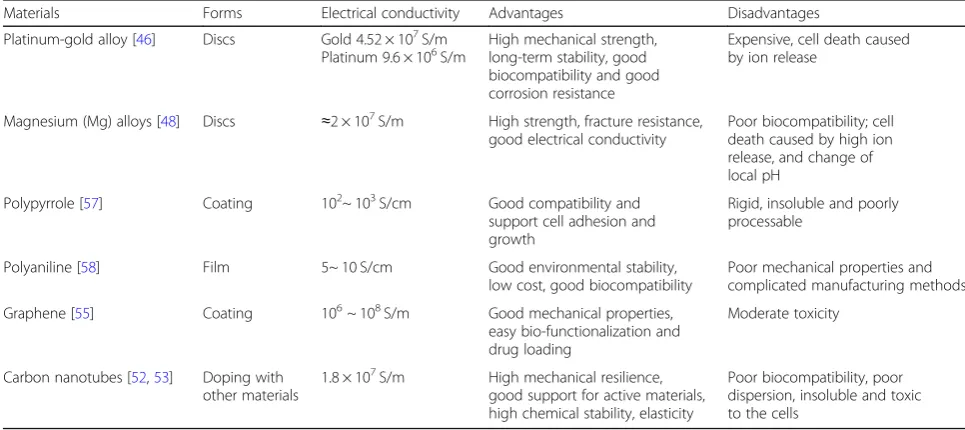
Direct coupling shows in Fig. 1a. The electrodes are inserted directly into the culture medium and attached to the scaffold to deliver ES. This method is most widely used because of its easy operation. However, drawbacks are apparent such as insufficient biocompatibility of the electrode, contact with the medium lead to temperature rise, pH changes, and the generation of harmful bypro-ducts [59]. Prabhakaran et al. [19] demonstrated that ES applied to the NSCs cultured on the electrospun Poly-L-lactide/polyaniline fibers scaffold exhibited extended neurite outgrowth. Briefly, a silver electrode and a plat-inum electrode were inserted into the opposite ends of the nanofiber scaffold placed in the medium and con-nected to constant unipolar trapezoidal pulses. The aver-age length of neurite extended from NSCs with stimulation were nearly 100% higher than the average
length of those without ES. In other circumstances, the scaffold is used as substrate-cathode. Stewart et al. [60] induced human NSCs differentiation with a two-electrode device, placing a platinum mesh two-electrode on top, and using a PPy-coated Au-mylar surface as a work-ing electrode. ES on PPy induced hNSC to differentiate into neurons expressing β-III Tubulin (Tuj1), and a small number of glial cells expressing glial fibrillary acidic proteins, accompanied with longer neurites and significant branches.
Capacitive coupling is more biologically safe compared with direct coupling. As shown in Fig.1b, two electrodes are placed at opposite ends to provide a uniform electric field to the cells seeded on the scaffold which locates be-tween the electrodes. This system is non-invasive and does not require a conductive scaffold to provide uni-form ES. Vaca-Gonzalez et al. [61] used a capacitive coupling system to provide chondrocytes with a 4 mV/ cm ES, which significantly increased the cell prolifera-tion. When applied an 8 mV/cm ES, the glycosaminogly-can secreted by chondrocytes remained stable, which is essential to maintain tissue moisture, lubrication, and protection of articular surfaces.
The third type is inductive coupling, as shown in Fig. 1c. Inductive coupling usually uses a controllable elec-tromagnetic field generated by a conductive coil placed around the cell culture system, called pulsed electromag-netic field stimulation (PEMF). The stimulus is transmit-ted by the pulse to mimic the natural potential transfer in the human body [40]. PEMF provide potential near the target cell, rather than directly apply ES to the cells. The main drawback of PEMF treatment is taking time and resource consumption. For example, some therapies
Table 1The forms, electrical conductivity, advantages and disadvantages of different materials
Materials Forms Electrical conductivity Advantages Disadvantages
Platinum-gold alloy [46] Discs Gold 4.52 × 10⁷S/m Platinum 9.6 × 10⁶S/m
High mechanical strength, long-term stability, good biocompatibility and good corrosion resistance
Expensive, cell death caused by ion release
Magnesium (Mg) alloys [48] Discs ≈2 × 10⁷S/m High strength, fracture resistance, good electrical conductivity
Poor biocompatibility; cell death caused by high ion release, and change of local pH
Polypyrrole [57] Coating 102~ 103S/cm Good compatibility and support cell adhesion and growth
Rigid, insoluble and poorly processable
Polyaniline [58] Film 5~ 10 S/cm Good environmental stability,
low cost, good biocompatibility
Poor mechanical properties and complicated manufacturing methods
Graphene [55] Coating 106~ 108S/m Good mechanical properties, easy bio-functionalization and drug loading
Moderate toxicity
Carbon nanotubes [52,53] Doping with other materials
1.8 × 10⁷S/m High mechanical resilience, good support for active materials, high chemical stability, elasticity
need to last 10 h per day [62] or quite high voltage. Hess et al. [63] created a device using ferromagnetic core cov-ered by the first current-carrying coil, and the culture chamber with connected silicone tube as the second coil. When applied an alternating voltage to the first coil, the second coil only influenced by the electrical potential without any interfering magnetic field or biochemical re-actions. The combination of inductive coupling and high sulfated hyaluronan derivative substrate can synergistic-ally stimulate BMSCs, the bone-related proteins (RUNX-2, ALP, OPN) in BMSCs were significantly improved then cells show an osteogenic differentiation. Table 2 lists the advantages and disadvantages of each methods mentioned above.
The different parameters of ES are quite considerable for regulating cell behavior. ES can provide in the form of monophasic and biphasic, where the waveform has pulse, sinusoidal, square, triangular, and sawtooth pat-tern. The use of intermittent or continuous stimulation is another parameter. According to the stimulation pa-rameters setup, monophasic stimulation is effective in polarizing the target tissue [65] but may produce react-ive oxygen species through the oxidation-reduction process due to the Faradaic reaction at the surface of a metal electrode [66]. Especially in the case of large current pulses delivered at long durations and/or high frequencies, cell damage may result from the Joule heat-ing effect [67]. However, the impact of localized ionic or electrochemical imbalance caused by the small Faradaic
impact on the experiment cannot be ignored [66]. On the contrary, biphasic stimulation may be more advanta-geous since it prevents the charge accumulation, gener-ates lower levels of electrolysis products at the electrodes, outside of the limitations of monophasic stimulation and can be applied for more extended pe-riods and at higher voltages [68–70]. For instance, bi-phasic stimulation is usually selected in clinical application to stimulate neural tissue, because of the few charge accumulation and toxic by-products and is less likely to cause neuronal loss [69,71]. Monophasic stimu-lation can be used for short-term experiments, but long-term applications require biphasic stimulation [72, 73]. Improper stimulation parameters can lead to results that are contrary to experimental expectations. The cell mi-gration rate is positively correlated with the intensity of ES, and is discussed in next section. For stimulus fre-quency, ES frequency below 1 kHz augment cell prolifer-ation through significantly affected the cell cycle, increasing the proportion of cells and synthesizing DNA [74]. Experiments show that ES frequency above 1 kHz can induce cell differentiation, but must maintain low intensity [75, 76]. High intensity above 100 V/cm can cause cell membrane electroporation, an immediate in-crease in intracellular Ca2+ and reactive oxygen species, then induce cell apoptosis [24, 77]. When high intensity is unavoidable, pulse electrical stimulation should be used to avoid continuous high intensity to reduce damage.
Fig. 1Three ways to deliver electrical stimulation: (a) direct coupling, (b) capacitive coupling, and (c) inductive Reprinted with permission from reference [40]
Table 2The advantages and disadvantages of three methods of providing ES
Methods Advantages Disadvantages
Direct coupling [59] Easy operation Insufficient biocompatibility of the electrode,
contact with the medium lead to temperature rise, pH changes, and the generation of harmful byproducts
Capacitive coupling [64] More biologically safe High voltage between the electrodes,
longer treatment time
Inductive coupling [62] Mimic the natural potential transfer in the human body, does not directly touch cells
The effects of electrical stimulation on cell alignment and migration
By participating in tissue formation, tissue regeneration, and wound healing, directed cell migration and align-ment can be very beneficial for regenerative medicine [78–81]. The ability to regulate cell migration and align-ment would be an invaluable asset for regenerative medicine. The mechanisms underneath the cell align-ment and migration are thought to be responsible for these effects, including voltage-gated ion channels, G-protein coupling receptors, integrins, cell polarization, and endogenous electric fields [82]. In literature, ES as the physical methods has attracted much attention be-cause it can activate specific signaling pathways in cells near the cathode or anode and induce cell migration and alignment [83].
The effects of electrical stimulation on cell alignment
Numerous methods are capable of inducing cell migra-tion and alignment by external factors, such as the addition of bioactive factors, providing individual surface patterns, and studies have shown that physical methods ES over all other techniques to guide cell migration and alignment [17,41,84].
ES has a significant effect on cell alignment and redir-ect random cells to be aligned, the dirredir-ection of cell align-ment changes gradually as the direction of the ES changes [84–86]. Some types of cell are aligned perpen-dicular to the direction of the electric field vectors to minimize the field gradient across the cell, such as car-diac adipose tissue-derived progenitor cells [18], endo-thelial progenitor cells [87], vascular ECs [77], BMSCs [88], adipose-derived stromal cells [89], etc. At the same time, some cells are aligned parallel to the field vectors due to the ES causes rearrangement of the cell cytoskel-eton, such as ventricular myocytes [20], cardiomyocytes [86], myoblasts [85], PC-12 cells [90], obsteoblasts [84], etc. The ES intensity usually < 10 V/cm, and the cells aligned better with the ES intensity increased, but the cell activity is relatively decreased [77,87,91].
In the presence of 100 mA monophasic ES, the osteo-blasts elongation and proliferation were mainly reliant on the ES, whereas the topographical features played a minor role [84]. In our present study [90], perpendicular electrical field vectors from the pattern may reorientate the PC-12 cell alignment, while parallel vectors could further increase neuritis extension compared with per-pendicular vectors. On the contrary, some types of cell are aligned perpendicular to the vectors under ES. The murine adipose-derived stromal cells exhibited a con-stant perpendicular alignment with the field vectors [89]. BMSCs consistent perpendicular alignment to the field vectors [88]. The long axis of cobblestone-like ECs transformed into highly ordered, perpendicular to the
field vectors with applied ES, then the cell morphology presents similarly to the inner surface topography of the blood vessel, which shows excellent potential in angio-genesis [77].
The effects of electrical stimulation on cell migration
As well as cell alignment, ES plays a significant role in cell migration. The directional migration of cells in re-sponse to ES is called electrotaxis [77]. The guiding ef-fect of ES on cell migration also differs depending on the cell type. Among different types of cell, NSCs [92], macrophages [93], mouse neural precursor cells (NPCs) [94], osteoblasts [95] and endothelial progenitor cells [87] toward the cathode [20, 89, 92, 96], BMSCs [97], human dermal fibroblasts [98] and SCs [99,100] toward the anode. Reversal of the ES polarity reversed the mi-gration direction of cells [87, 92]. The ES intensity can stimulate cell migration from a minimum of 0.1 V/cm to a maximum of 12 V/cm and did not cause any signifi-cant damage to cells, did not affect cell phenotype or the differentiation potential [101–103]. At the same time, cells showed gradually increased migration rate and dis-tance with higher ES strength [101,104,105].
As NPCs shows a cathodal migration, Liu et al. [103] demonstrated that reversing the ES direction resulted in a reversed direction of NPCs migration. This behavior is beneficial to long-distance migration of neural cells for nerve repair. ES also directs some types of cell migrate to the anode, such as BMSCs [97, 106], human dermal fibroblasts [37] and SCs [99, 100, 107]. Forciniti et al. [100] indicated an increase in average displacement of the SCs to anodal with 0.5 V to 1 V ES, which is of great value in optimizing conductive polymers for different biomedical applications such as nerve repair. Moreover, even different cell lines of the same specie have different responses to ES in the migration. Li et al. [108] demon-strated different cell lines of non-small cell lung cancer cells (H460, and H1299) showed great different in mi-gration direction, while H460 migrated toward cathode, H1299 exhibited anodal migration. This discovery has led to a better understanding of the mechanism of can-cer, which is beneficial for cancer therapy.
et al. [99] demonstrated the ES did not significantly affect the SCs migration speed, but as the ES intensity increases from 50 mV/mm to 200 mV/mm, the orienta-tion and displacement of the anode migraorienta-tion increase significantly.
Mechanism of ES on cell migration
The specific mechanism leading to electrotaxis is still unclear. Many factors may be included, such as en-dogenous microenvironment, ion channels, membrane receptors, transport proteins, and competing signal
path-ways such as Wnt/GSK3β and TGFβ1/ERK/NF-κB
[109–111]. According to the literature, the main mech-anism involved in ES induced cell migration is shown in Fig.2.
The importance of epidermal growth factor receptors (EGFR) in ES induced cell migration has attracted the attention of numerous scientists [77, 87, 112]. ES regu-lates downstream growth factors and cytokine
produc-tion through a feedback mechanism by EGFR.
Asymmetric expression of EGFR in front of and behind cells activates signaling pathways and leads to cell migra-tion [112, 113]. Pilipos et al. [114] demonstrated that blockade of EGFR via erlotinib significantly attenuate NPCs electrotaxis. EGFR activation stimulates several signaling pathways, including MAPK-ERK1/2 and PI3K/ Akt pathway. MAPK-ERK1/2 are generally involved in signal transduction from extracellular sources in
different signaling pathways. Downstream protein ERK1 and ERK2 are fully activated by phosphorylation of MEK, which is involved in cell migration. Hammerick et al. [89] proved that inhibiting the MAPK pathway leading to migration inhibited suggests the participation of this pathway in mASCs electrotaxis. It has been re-ported that static monophasic ES can regulate epithelial cell proliferation and migration by activating the MAPK signaling cascade ERK1/2 [115].
The other and the most critical pathway is the PI3K/ Akt signaling pathway, which has been mostly explored in the cellular response to ES. ES significantly increase the expression of downstream protein PIP3 and phos-phorylation of Akt, at the same time, induce the asym-metric distribution of PIP3 and cytoskeletal proteins migrate toward cathode [113,116]. Meng et al. [116] ex-hibited the cathode migration of NPCs under ES needed the activation of the PI3K signal pathway. Pharmaco-logical inhibition or genetic disruption of PI3K/Akt pathway will inhibit the electrotaxis, then applied ES in-creases Akt phosphorylation and PIP3 fluorescence, demonstrate the importance of the PI3K/Akt pathway in ES driven directed migration of NPCs. PTEN is a phos-phatase that inhibits PI3K signaling transduction includ-ing Akt. Zhao et al. [117] demonstrated genetic disruption of PTEN within keratinocyte enhanced ES in-duced ERK and Akt phosphorylation, cell performed a significantly higher directionality compared with
controls. This result supports the antagonistic relation-ship between PI3K and PTEN.
In addition to signal pathways, ion channels such as voltage-gated Ca2+ channels is a vital part of membrane polarization and cell response during ES [118]. All living cells have a transmembrane potential. The current in-duces a flow of ions (Na+, Cl−, K+, Ca2+, etc.) by ion channels and transporters [16]. In response to ES, intra-cellular molecular and transport channel polarization, then ion flow takes place and trigger cytoskeleton changes to direct cell migration, in consequence, the cal-cium influx contribute to persistent cell migration to-wards cathode [101]. In the review of Balint et al. [40], the ES effect will be impaired or completely blocked if block the calcium channels, intracellular store and the calmodulin by verapamil and nifedipine, TMB-8, W-7, respectively. Zhao et al. [102] reported that a 115 V/m monophasic ES could cause a calcium influx mediated NPCs mobility improved and cathodal migration.
The effects of electrical stimulation on cell proliferation and differentiation
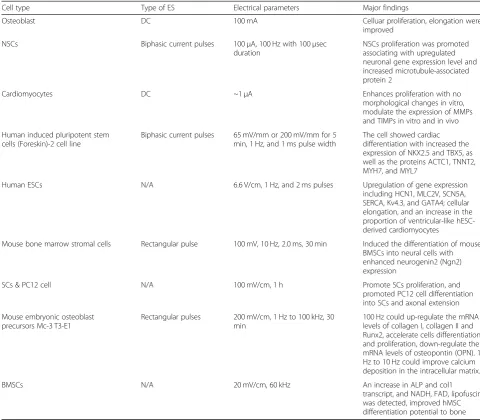
In addition to the impact on the migration, ES also plays a significant role in influencing proliferation and guiding differentiation [50, 119, 120]. A major challenge in re-generative medicine is to compensate cells that lost as a result of injury or disease [15]. For instance, after exces-sive cell loss, most tissues produce scars, such as fibrous collagen scars in the heart, causing an ischemic environ-ment and limiting oxygen delivery [121]. However, the inevitable problems are the difficulty in harvesting suffi-cient cells for implantation. In these circumstances, the capabilities of proliferation and multilineage differenti-ation of seed cells have attracted much attention [122]. Table 1 summarizes the specific conditions of ES to in-duce cell proliferation and differentiation.
The effects of electrical stimulation on cell proliferation
Proper ES can promote cell proliferation, usually under continuous stimulation of < 1 V/cm [37,95,120]. Within the ES intensity range the cell proliferation rate increases with increasing intensity [95]. Preosteoblasts [123], obsteoblasts [37], unrestricted somatic human stem cells [124], human umbilical vein ECs [125], NSCs [126], hu-man dermal fibroblasts [127] exhibited 0.2 to 1.5 times proliferation, with increasing cellular metabolic activity, and do not affect cell phenotype [123]. High-intensity ES of > 100 V/cm is also favorable for cell proliferation in a short period (< 1 ms) single stimulation, but excessively high intensity leads to cell death [128].
Shao et al. [17] demonstrated that in the presence of 100 mA direct current (DC), the viability of osteoblasts did not affect, and the degree of proliferation increased
significantly compared with no stimuli group and other current stimuli groups. This finding indicates that proper ES can be used for bone regeneration and frac-ture healing. Zhu et al. [126] revealed that compared with the control group, NSCs proliferation was increased 35% with ES, which condition is 100μA and pulse rates of 100 Hz with 100μsec duration for 24 h. A possible cause is that ES upregulates the proliferation of cell nu-clear antigen, which is a DNA polymerase-associated protein, and activate extracellular signal-regulated ki-nases 1 and 2 pathways involved in transduction of pro-liferative signals. Meanwhile, the differentiation potential of NSCs has not been affected by the promotion of pro-liferation. In the study of Sun et al. [129] SCs underwent a remarkable degree of proliferation under ES (100 mV/ cm, 1 h per day) than without ES, especially in day 5. It might because ES promoted SC myelin gene expression and neurotrophin secretion, then led to SCs prolifera-tion. This result indicated the promising potential of ES on peripheral nerve repair and regeneration. Kapeller et al. [119] pointed out that with 1μA DC stimuli, cardi-omyocytes showed better proliferation behavior with no morphological changes in vitro. At the same time, ES also affects matrix metalloproteinases (MMP) in cardio-myocytes, which involved to keep the balance between matrix synthesis and degradation. It shows that ES has a certain positive effect on heart repair.
The effects of electrical stimulation on cell differentiation
Cell differentiation based therapy provides a promising ap-proach for regeneration medicine. Short-term (several mi-nutes), low-intensity (0.06~6 V/cm) ES can promote cardiac differentiation of human induced pluripotent stem cells, muscle precursor cells, with the formation of embry-oid bodies [130,131]. Neural progenitor cells, neural pre-cursor cells, and NSCs can differentiate into neurons instead of glial cells under ES [102,106,132]. The stimula-tion intensity is basically < 2 V/cm and sustain more than 7 days. The differential medium can appropriately added with FBS, retinoic acid, and nerve growth factor. ES can induce bone marrow stromal cells, BMSCs, MC3T3-E1 cells osteogenic differentiation instead of cartilage, stimu-lation intensity should be < 2 V/cm and sustain 14~28 days, the medium need to add dexamethasone in most cases [6,63, 120, 133–135]. Therefore, the application of ES could provide a valid approach to induce cell differenti-ation in tissue engineering.
Hernández et al. [131] demonstrated human induced pluripotent stem cells (Foreskin)-2 cell line exhibit car-diac differentiation under ES (65 mV/mm or 200 mV/ mm, biphasic current pulses), by significantly increased the expression of cardiac transcription factors nkx2.5
proteins ACTC1, TNNT2, MYH7, and MYL7, compared with the unstimulated control group. In the study of Chan et al. [130], human ESCs cultured in the presence of ES (6.6 V/cm, 1 Hz, and 2 ms pulses) showed an in-crease in the proportion of ventricular-like cardiomyo-cytes, by significant upregulation of cardiac-specific gene expression including hcn1, mlc2v, scn5a, serca, kv4.3,
andgata4. Matsumoto et al. [135] induced the
differenti-ation of mouse bone marrow stromal cells into neural cells using ES (10 Hz, 100 mV, 2.0 ms, 30 min, rectangu-lar pulse). Neurogenin2 was detected as increased ex-pression through the β-catenin signaling pathway after ES, which is involved in neural differentiation and in-hibits astrocytic differentiation. Sun et al. [129] demon-strated ES (100 mV/cm, 1 h) could induce PC-12 cell differentiation into SCs and synaptic elongation even without nerve growth factor treatment, which is a kind
of nerve growth regulator that promotes both neuron nutrition and neurite outgrowth.
In the study of Wang et al. [120] ES (200 mV/cm, 1 Hz to 100 kHz, 30 min) promote MC3T3-E1 cells osteogenic differentiation via examined alkaline phosphatase activ-ity. During stimulation, 100 Hz could up-regulate the mRNA levels of collagen I, collagen II, and RUNX2, which are osteosis-related genes. On the other hand, 1 Hz to 10 Hz could improve calcium deposition in the intracellular matrix, which contribute to treat the bone fracture and bone nonunion. Hronik-Tupaj et al. [6] demonstrated ES (20 mV/cm, 60 kHz) improved hMSC osteogenic differentiation potential based on calcium de-position, because of the two-fold increase of alkaline phosphatase and collagen type 1.
Table 3 The specific conditions of ES to induce cell proliferation and differentiation.
Table 3The specific conditions of ES to induce cell proliferation and differentiation
Cell type Type of ES Electrical parameters Major findings
Osteoblast DC 100 mA Celluar proliferation, elongation were
improved
NSCs Biphasic current pulses 100μA, 100 Hz with 100μsec
duration
NSCs proliferation was promoted associating with upregulated neuronal gene expression level and increased microtubule-associated protein 2
Cardiomyocytes DC ~1μA Enhances proliferation with no
morphological changes in vitro, modulate the expression of MMPs and TIMPs in vitro and in vivo
Human induced pluripotent stem cells (Foreskin)-2 cell line
Biphasic current pulses 65 mV/mm or 200 mV/mm for 5 min, 1 Hz, and 1 ms pulse width
The cell showed cardiac differentiation with increased the expression of NKX2.5 and TBX5, as well as the proteins ACTC1, TNNT2, MYH7, and MYL7
Human ESCs N/A 6.6 V/cm, 1 Hz, and 2 ms pulses Upregulation of gene expression
including HCN1, MLC2V, SCN5A, SERCA, Kv4.3, and GATA4; cellular elongation, and an increase in the proportion of ventricular-like hESC-derived cardiomyocytes
Mouse bone marrow stromal cells Rectangular pulse 100 mV, 10 Hz, 2.0 ms, 30 min Induced the differentiation of mouse BMSCs into neural cells with enhanced neurogenin2 (Ngn2) expression
SCs & PC12 cell N/A 100 mV/cm, 1 h Promote SCs proliferation, and
promoted PC12 cell differentiation into SCs and axonal extension
Mouse embryonic osteoblast precursors Mc-3 T3-E1
Rectangular pulses 200 mV/cm, 1 Hz to 100 kHz, 30 min
100 Hz could up-regulate the mRNA levels of collagen I, collagen II and Runx2, accelerate cells differentiation and proliferation, down-regulate the mRNA levels of osteopontin (OPN). 1 Hz to 10 Hz could improve calcium deposition in the intracellular matrix.
BMSCs N/A 20 mV/cm, 60 kHz An increase in ALP and col1
Summary
In this review, we have highlighted the effects of ES as a physical stimulator on cellular behavior for the purposes of applying to regenerative medicine and tissue engin-eering. In most cases, ES facilitates cell proliferation and differentiation, enhance cell cathode migration and alignment to field vectors, and mainly through EGFR, PI3K and Ca2+ related mechanism. ES can be delivered through tissue engineering scaffolds made of metallic biomaterials, conducting polymers, or carbon materials, the main methods are direct coupling, capacitive coup-ling, and using an electromagnetic field.
In the future, the combination of specific material/ structure and ES will offer many advantages over other types of stimulations and allow for precise cellular regu-lation. Developing safe and effective partition-type scaf-fold combine with ES that can distinguish different areas to perform different stimulation still requires some chal-lenges to be overcome. Although still in its early stages, the field of ES is rapidly evolving, and new next-generation regenerative medicine and tissue engineering will make it possible to take advantage of ES. Studying the low risk ES method for wearable application is also a future direction. With increasing research, electrical stimuli have the potential to play a significant role in tis-sue engineering and regenerative medicine.
Acknowledgements
This research was supported by Natural Science Foundation of Zhejiang Province (LY20E010006, LQ16E020006), National Natural Science Foundation of China (51502265), Basic Science Research Program through the National Research Foundation of Korea (NRF) funded by the Ministry of Education, Republic of Korea (2015R1D1A1A09058875), Opening Project of Zhejiang Provincial Top Key Discipline of Pharmaceutical Sciences, and the Project of Administration of Traditional Chinese Medicine of Zhejiang Province of China (No. 2018ZB011).
Authors’contributions
CC is responsible for modifying the manuscript. XB was responsible for initial literature review and writing of the manuscript. YHD made some pertinent suggestions. ISL contributed to the completion of the manuscript. Both authors read and approved the final manuscript.
Funding
Not applicable.
Availability of data and materials
Not applicable.
Ethics approval and consent to participate
Not applicable.
Consent for publication
Not applicable.
Competing interests
The authors declare that they have no competing interests.
Author details
1
College of Life Sciences and Medicine, Zhejiang Sci-Tech University, Hangzhou 310018, People’s Republic of China.2Zhejiang Provincial Key Laboratory of Silkworm Bioreactor and Biomedicine, Hangzhou 310018, People’s Republic of China.3Department of Cardiology, Zhejiang Provincial
People’s Hospital, Hangzhou 310014, People’s Republic of China.4People’s Hospital of Hangzhou Medical College, Hangzhou 310014, People’s Republic of China.5Institute of Natural Sciences, Yonsei University, 134
Shinchon-dong, Seodaemoon-gu, Seoul 03722, Republic of Korea.
Received: 5 August 2019 Accepted: 27 November 2019
References
1. Tatullo M, Marrelli M, Paduano F. The regenerative medicine in oral and maxillofacial surgery: the most important innovations in the clinical application of mesenchymal stem cells. Int J Med Sci. 2015;2(1):72–7. 2. Mason C, Dunnill P. A brief definition of regenerative medicine. Regen Med.
2008;3(1):1–5.
3. Bhardwaj N, Devi D, Mandal BB. Tissue-engineered cartilage: the crossroads of biomaterials, cells and stimulating factors. Macromol Biosci. 2015;15(2): 153–82.
4. Gupta P, Adhikary M, Kumar M, Bhardwaj N, Mandal BB. Biomimetic, osteoconductive non-mulberry silk fiber reinforced tricomposite scaffolds for bone tissue engineering. ACS Appl Mat Interfaces. 2016;8(45):30797–810. 5. Mondschein RJ, Kanitkar A, Williams CB, Verbridge SS, Long TE. Polymer
structure-property requirements for stereolithographic 3d printing of soft tissue engineering scaffolds. Biomaterials. 2017;140:170–88.
6. Hronik-Tupaj M, Rice WL, Cronin-Golomb M, Kaplan DL, Georgakoudi I. Osteoblastic differentiation and stress response of human mesenchymal stem cells exposed to alternating current electric fields. Biomed Eng Online. 2011;10(1):9.
7. Li C, Wei G, Gu Q, Wen G, Qi B, Xu L, et al. Donor age and cell passage affect osteogenic ability of rat bone marrow mesenchymal stem cells. Cell Biochem Biophys. 2015;72(2):543–9.
8. Guillot PV, Cui WN, Polak DJ. Stem cell differentiation and expansion for clinical applications of tissue engineering. J Cell Mol Med. 2010;11(5):935–44. 9. Breuls RG, Jiya TU, Smit TH. Scaffold stiffness influences cell behavior:
opportunities for skeletal tissue engineering. Open Orthop J. 2008;2(2):103–9. 10. Bianco P, Robey PG. Stem cells in tissue engineering. Nature. 2014;
414(6859):639–53.
11. Ma F, Xiao Z, Chen B, Hou X, Han J, Zhao Y, et al. Accelerating proliferation of neural stem/progenitor cells in collagen sponges immobilized with engineered basic fibroblast growth factor for nervous system tissue engineering. Biomacromolecules. 2014;15(3):1062–8.
12. Chen G, Qi Y, Niu L, Di T, Zhong J, Fang T, et al. Application of the cell sheet technique in tissue engineering. Biomed Rep. 2015;3(6):749–57. 13. Min Z. Electrical fields in wound healing-an overriding signal that directs
cell migration. Semin Cell Dev Biol. 2009;20(6):674–82.
14. Li W, Guan T, Zhang X, Wang Z, Wang M, Zhong W, et al. The effect of layer-by-layer assembly coating on the proliferation and differentiation of neural stem cells. ACS Appl Mater Interfaces. 2015;7(5):3018–29. 15. Kobolak J, Dinnyes A, Memic A, Khademhosseini A, Mobasheri A.
Mesenchymal stem cells: identification, phenotypic characterization, biological properties and potential for regenerative medicine through biomaterial micro-engineering of their niche. Methods. 2016;99:62–8. 16. Love MR, Palee S, Chattipakorn SC, Chattipakorn N. Effects of electrical
stimulation on cell proliferation and apoptosis. J Cell Physiol. 2018;233(3): 1860–76.
17. Ding S, Kingshott P, Thissen H, Pera M, Wang PY. Modulation of human mesenchymal and pluripotent stem cell behavior using biophysical and biochemical cues: a review. Biotechnol Bioeng. 2017;114(2):260–80. 18. Llucià-Valldeperas A, Sanchez B, Soler-Botija C, Gálvez-Montón C, Prat-Vidal
C, Roura S, et al. Electrical stimulation of cardiac adipose tissue-derived progenitor cells modulates cell phenotype and genetic machinery. J Tissue Eng Regen Med. 2015;9(11):E76–83.
19. Prabhakaran MP, Ghasemimobarakeh L, Jin G, Ramakrishna S. Electrospun conducting polymer nanofibers and electrical stimulation of nerve stem cells. J Biosci Bioeng. 2011;112(5):501–7.
20. Radisic M, Park H, Shing H, Consi T, Schoen FJ, Langer R, et al. Functional assembly of engineered myocardium by electrical stimulation of cardiac myocytes cultured on scaffolds. Proc Natl Acad Sci U S A. 2004;101(52): 18129–34.
activation, procoagulant markers, growth factor release and cell proliferation. Platelets. 2016;27(2):128–35.
22. Jeon O, Lee K, Alsberg E. Spatial micropatterning of growth factors in 3d hydrogels for location-specific regulation of cellular behaviors. Small. 2018; 14(25):1800579.
23. Wang Z, Qing Q, Chen X, Liu CJ, Luo JC, Hu JL, et al. Effects of scaffold surface morphology on cell adhesion and survival rate in vitreous cryopreservation of tenocyte-scaffold constructs. Appl Surf Sci. 2016;388:223–7.
24. Nuccitelli R, Lui K, Kreis M, Athos B, Nuccitelli P. Nanosecond pulsed electric field stimulation of reactive oxygen species in human pancreatic cancer cells is ca (2+)-dependent. Biochem Biophys Res Commun. 2013;435(4):580–5. 25. Ji WC, Zhang XW, Qiu YS. Selected suitable seed cell, scaffold and growth
factor could maximize the repair effect using tissue engineering method in spinal cord injury. World J of Exp Med. 2016;6(3):58–62.
26. Choi JS, Yoon HI, Lee KS, Choi YC, Yang SH, Kim I-S, Cho YW. Exosomes from differentiating human skeletal muscle cells trigger myogenesis of stem cells and provide biochemical cues for skeletal muscle regeneration. J Control Release. 2016;222:107–15.
27. Prabhakaran MP, Venugopal J, Chan CK, Ramakrishna S. Surface modified electrospun nanofibrous scaffolds for nerve tissue engineering. Nanotechnology. 2008;19(45):455102.
28. Shori D, Pandey S, Kubde R, Rathod Y, Atara R, Rathi S. To evaluate and compare the effect of different post surface treatments on the tensile bond strength between fiber posts and composite resin. J Int Oral Health. 2013; 5(5):27–32.
29. Teker D, Muhaffel F, Menekse M, Karaguler NG, Baydogan M, Cimenoglu H. Characteristics of multi-layer coating formed on commercially pure titanium for biomedical applications. Mater Sci Eng C Mater Biol Appl. 2015;48:579–85. 30. Morgan JT, Wood JA, Shah NM, Hughbanks ML, Russell P, Barakat AI, et al. Integration of basal topographic cues and apical shear stress in vascular endothelial cells. Biomaterials. 2012;33(16):4126–35.
31. Yang Y, Wang K, Gu X, Leong KW. Biophysical regulation of cell behavior—cross talk between substrate stiffness and nanotopography. Engineering (Beijing). 2017;3(1):36–54.
32. Zhang SX, Liu L, Zhao W. Targeting biophysical cues: a niche approach to study, diagnose, and treat cancer. Trends Cancer. 2018;4(4):268–71. 33. Gao J, Raghunathan VK, Reid B, Wei D, Diaz RC, Russell P, et al. Biomimetic
stochastic topography and electric fields synergistically enhance directional migration of corneal epithelial cells in a mmp-3-dependent manner. Acta Biomater. 2015;12:102–12.
34. Huang X, Das R, Patel A, Nguyen TD. Physical stimulations for bone and cartilage regeneration. Regen Eng Transl Med. 2018;4(4):216–37. 35. Hernandez-Bule ML, Trillo MA, Ubeda A. Molecular mechanisms underlying
antiproliferative and differentiating responses of hepatocarcinoma cells to subthermal electric stimulation. PLoS One. 2014;9(1):e84636.
36. Jaatinen L, Young E, Hyttinen J, Vörös J, Zambelli T, Demkó L. Quantifying the effect of electric current on cell adhesion studied by single-cell force spectroscopy. Biointerphases. 2016;11(1):011004.
37. Kumar A, Nune KC, Misra R. Understanding the response of pulsed electric field on osteoblast functions in three-dimensional mesh structures. J Biomater Appl. 2016;31(4):594–605.
38. Li N, Zhang Q, Gao S, Song Q, Huang R, Wang L, et al. Three-dimensional graphene foam as a biocompatible and conductive scaffold for neural stem cells. Sci Rep. 2013;3:1064.
39. Rando TA, Ambrosio F. Regenerative rehabilitation: applied biophysics meets stem cell therapeutics. Cell Stem Cell. 2018;22(3):306–9.
40. Balint R, Cassidy NJ, Cartmell SH. Electrical stimulation: a novel tool for tissue engineering. Tissue Eng Part B Rev. 2013;19(1):48–57.
41. Wang ET, Zhao M. Regulation of tissue repair and regeneration by electric fields. Chin J Traumatol. 2010;13(1):55–61.
42. Chen C, Kong XD, Lee IS. Modification of surface/neuron interfaces for neural cell-type specific responses: a review. Biomed Mater. 2015;11(1):014108. 43. Deepthi S, Jeevitha K, Sundaram MN, Chennazhi K, Jayakumar R. Chitosan–
hyaluronic acid hydrogel coated poly (caprolactone) multiscale bilayer scaffold for ligament regeneration. Chem Eng J. 2015;260:478–85. 44. Wang J, Tian L, Chen N, Ramakrishna S, Mo X. The cellular response of nerve
cells on poly-l-lysine coated plga-mwcnts aligned nanofibers under electrical stimulation. Mater Sci Eng C Mater Biol Appl. 2018;91:715–26. 45. Li J, Hu H, Li H, Yao C. Recent developments in electrochemical sensors
based on nanomaterials for determining glucose and its byproduct H2O2. J Mater Sci. 2017;52(17):10455–69.
46. Colic M, Stamenkovic D, Anzel I, Lojen G, Rudolf R. The influence of the microstructure of high noble gold-platinum dental alloys on their corrosion and biocompatibility in vitro. Gold Bull. 2009;42(1):34–47.
47. Nazeer MA, Yilgor E, Yilgor I. Intercalated chitosan/hydroxyapatite nanocomposites: promising materials for bone tissue engineering applications. Carbohydr Polym. 2017;175:38–46.
48. Hu GQ, Guan K, Lu LB, Zhang JR, Lu N, Guan YC. Engineered functional surfaces by laser microprocessing for biomedical applications. Engineering. 2018;4(6):822–30.
49. Ramasamy MS, Nikolakapoulou A, Raptis D, Dracopoulos V, Paterakis G, Lianos P. Reduced graphene oxide/polypyrrole/pedot composite films as efficient pt-free counter electrode for dye-sensitized solar cells. Electrochimi Acta. 2015;173:276–81.
50. Pires F, Ferreira Q, Rodrigues CAV, Morgado J, Ferreira FC. Neural stem cell differentiation by electrical stimulation using a cross-linked pedot substrate: expanding the use of biocompatible conjugated conductive polymers for neural tissue engineering. Biochim Biophys Acta. 2015;1850(6):1158–68. 51. DeVolder RJ, Seo Y, Kong H. Proangiogenic alginate-g-pyrrole hydrogel with
decoupled control of mechanical rigidity and electrically conductivity. Biomater Res. 2017;21(1):24.
52. Zhang LL, Zhao X. Carbon-based materials as supercapacitor electrodes. Chem Soc Rev. 2009;38(9):2520–31.
53. Lee JR, Ryu S, Kim S, Kim BS. Behaviors of stem cells on carbon nanotube. Biomater Res. 2015;19(1):3.
54. Kim J, Kim HD, Park J, Lee ES, Kim E, Lee SS, et al. Enhanced osteogenic commitment of murine mesenchymal stem cells on graphene oxide substrate. Biomater Res. 2018;22(1):1.
55. Akhavan O. Graphene scaffolds in progressive nanotechnology/stem cell-based tissue engineering of the nervous system. J Mater Chem B. 2016; 4(19):3169–90.
56. Gupta P, Lahiri D. Aligned carbon nanotube containing scaffolds for neural tissue regeneration. Neural Regen Res. 2016;11(7):1062–3.
57. Ghasemi-Mobarakeh L, Prabhakaran MP, Morshed M, Nasr-Esfahani MH, Baharvand H, Kiani S, et al. Application of conductive polymers, scaffolds and electrical stimulation for nerve tissue engineering. J Tissue Eng Regen Med. 2011;5(4):e17–35.
58. Liu S, Wang J, Zhang D, Zhang P, Ou J, Liu B, et al. Investigation on cell biocompatible behaviors of polyaniline film fabricated via electroless surface polymerization. Appl Surf Sci. 2010;256(11):3427–31.
59. Samadian H, Zakariaee SS, Adabi M, Mobasheri H, Azami M, Faridi-Majidi R. Effective parameters on conductivity of mineralized carbon nanofibers: an investigation using artificial neural networks. RSC Adv. 2016;6(113):11908–18.
60. Stewart E, Kobayashi NR, Higgins MJ, Quigley AF, Jamali S, Moulton SE, et al. Electrical stimulation using conductive polymer polypyrrole promotes differentiation of human neural stem cells: a biocompatible platform for translational neural tissue engineering. Tissue Eng Part C Methods. 2015; 21(4):385–93.
61. Vaca-Gonzalez JJ, Guevara JM, Vega JF, Garzon-Alvarado DA. An in vitro chondrocyte electrical stimulation framework: a methodology to calculate electric fields and modulate proliferation, cell death and glycosaminoglycan synthesis. Cell Mol Bioeng. 2016;9(1):116–26.
62. Fu YC, Lin CC, Chang JK, Chen CH, Tai IC, Wang GJ, et al. A novel single pulsed electromagnetic field stimulates osteogenesis of bone marrow mesenchymal stem cells and bone repair. PLoS One. 2014;9(3):e91581. 63. Hess R, Jaeschke A, Neubert H, Hintze V, Moeller S, Schnabelrauch M, et al.
Synergistic effect of defined artificial extracellular matrices and pulsed electric fields on osteogenic differentiation of human mscs. Biomaterials. 2012;33(35):8975–85.
64. Meng S, Rouabhia M, Zhang Z, De D, De F, Laval U. Electrical stimulation in tissue regeneration. Appl Biomed Eng. 2011;23:37–62.
65. Sommer M, Kamm T, Tergau F, Ulm G, Paulus W. Repetitive paired-pulse transcranial magnetic stimulation affects corticospinal excitability and finger tapping in parkinson's disease. Clin Neurophysiol. 2002;113(6):944–50. 66. Waataja JJ, Tweden KS, Honda CN. Effects of high-frequency alternating
current on axonal conduction through the vagus nerve. J Neural Eng. 2011; 8(5):056013.
68. Babona-Pilipos R, Pritchard-Oh A, Popovic MR, Morshead CM. Biphasic monopolar electrical stimulation induces rapid and directed galvanotaxis in adult subependymal neural precursors. Stem Cell Res Ther. 2015;6(1):67. 69. Siegel D, Baca SM, Thompson DC, Huntsman MM, Mower MM, Ross D. The
effect of anodal/cathodal biphasic electrical stimulation on insulin release. J Cell Physiol. 2019;234(9):16389–99.
70. Ercan B, Webster TJ. The effect of biphasic electrical stimulation on osteoblast function at anodized nanotubular titanium surfaces. Biomaterials. 2010;31(13):3684–93.
71. Redouté JM, Browne D, Fitrio D, Lowery A, Kleeman L. A reduced data bandwidth integrated electrode driver for visual intracortical neural stimulation in 0.35μm mathcontainer loading mathjax high voltage CMOS. Microelectron J. 2013;44(4):277–82.
72. van dan Honert C, Mortimer JT. A technique for collision block of peripheral nerve: frequency dependence. IEEE Trans Biomed Eng. 1981;28(5):379–82. 73. Celik ME, Karagoz I. Comparison of monophasic and biphasic electrical
stimulation by using temporal analysis for different inter-electrode spacings in the hexagonal arrays. Arab J Sci Eng. 2018;43(6):2889–98.
74. Yadollahpour A, Jalilifar M. Electromagnetic fields in the treatment of wound: a review of current techniques and future perspective. J Pure Appl Microbio. 2014;8(4):2863–77.
75. Esfandiari E, Roshankhah S, Mardani M, Hashemibeni B, Naghsh E, Kazemi M, et al. The effect of high frequency electric field on enhancement of chondrogenesis in human adipose-derived stem cells. Iran J Basic Med Sci. 2014;17(8):571–6.
76. Mardani M, Roshankhah S, Hashemibeni B, Salahshoor M, Naghsh E, Esfandiari E. Induction of chondrogenic differentiation of human adipose-derived stem cells by low frequency electric field. Adv Biomed Res. 2016;5(1):97. 77. Tzoneva R. Influence of electric field on cell behavior. Electrotreatment of
cells for biomedical applications. Asian J Phys. 2014;23:789–814. 78. Ross CL. The use of electric, magnetic, and electromagnetic field for
directed cell migration and adhesion in regenerative medicine. Biotechnol Prog. 2017;33(1):5–16.
79. Zohar B, Blinder Y, Mooney DJ, Levenberg S. Flow-induced vascular network formation and maturation in three-dimensional engineered tissue. ACS Biomater Sci Eng. 2017;4(4):1265–71.
80. Colosi C, Shin SR, Manoharan V, Massa S, Costantini M, Barbetta A, et al. Microfluidic bioprinting of heterogeneous 3d tissue constructs using low-viscosity bioink. Adv Mater. 2016;28(4):677–84.
81. Min SK, Mi HL, Kwon BJ, Seo HJ, Koo MA, You KE, et al. Effects of direct current electric-field using ITO plate on breast cancer cell migration. Biomater Res. 2014;18(1):1–6.
82. Li YH, Huang GY, Zhang XH, Wang L, Du YA, Lu TJ, et al. Engineering cell alignment in vitro [J]. Biotechnol Adv. 2014;32(2):347–65.
83. Tai G, Tai M, Zhao M. Electrically stimulated cell migration and its contribution to wound healing [J]. Burns Trauma. 2018;6(1):20.
84. Shao SJ, Zhou SB, Li L, Li JR, Luo C, Wang JX, et al. Osteoblast function on electrically conductive electrospun pla/mwcnts nanofibers. Biomaterials. 2011;32(11):2821–33.
85. Ko UH, Park S, Bang H, Kim M, Shin H, Shin JH. Promotion of myogenic maturation by timely application of electric field along the topographical alignment. Tissue Eng Part A. 2018;24(9–10):752–60.
86. Ganji Y, Li Q, Quabius ES, Böttner M, Selhuber-Unkel C, Kasra M. Cardiomyocyte behavior on biodegradable polyurethane/gold
nanocomposite scaffolds under electrical stimulation. Mater Sci Eng C Mater Biol Appl. 2016;59:10–8.
87. Zhao Z, Qin L, Reid B, Pu J, Hara T, Zhao M. Directing migration of endothelial progenitor cells with applied dc electric fields. Stem Cell Res. 2012;8(1):38–48.
88. Banks TA, Luckman PSB, Frith JE, Cooper-White JJ. Effects of electric fields on human mesenchymal stem cell behaviour and morphology using a novel multichannel device. Integr Biol (Camb). 2015;7(6):693–712. 89. Hammerick KE, Longaker MT, Prinz FB. In vitro effects of direct current
electric fields on adipose-derived stromal cells. Biochem Biophys Res Commun. 2010;397(1):12–7.
90. Chen C, Ruan S, Bai X, Lin C, Xie C, Lee I-S. Patterned iridium oxide film as neural electrode interface: biocompatibility and improved neurite outgrowth with electrical stimulation. Mater Sci Eng C. 2019;103:109865. 91. Long H, Yang G, Ma K, Xiao Z, Ren X. Effect of different electrical stimulation
waves on orientation and alignment of adipose derived mesenchymal stem cells. Zhongguo Xiu Fu Chong Jian Wai Ke Za Zhi. 2017;31(7):853–61.
92. Feng JF, Liu J, Zhang XZ, Zhang L, Jiang JY, Nolta J, et al. Guided migration of neural stem cells derived from human embryonic stem cells by an electric field. Stem Cells. 2012;30(2):349–55.
93. Hoare JI, Rajnicek AM, McCaig CD, Barker RN, Wilson HM. Electric fields are novel determinants of human macrophage functions. J Leukoc Biol. 2016; 99(6):1141–51.
94. Hayashi H, Edin F, Li H, Liu W, Rask-Andersen H. The effect of pulsed electric fields on the electrotactic migration of human neural progenitor cells through the involvement of intracellular calcium signaling. Brain Res. 2016; 1652:195–203.
95. Kumar A, Nune KC, Misra RD. Electric fieldmediated growth of osteoblasts -the significant impact of dynamic flow of medium. Biomater Sci. 2016;4(1): 136–44.
96. Canillas M, Moreno B, Chinarro E, Rajnicek AM. TiO2surfaces support neuron growth during electric field stimulation. Mater Sci Eng C. 2017;79:1–8. 97. Zhao Z, Watt C, Karystinou A, Roelofs AJ, McCaig CD, Gibson IR, et al.
Directed migration of human bone marrow mesenchymal stem cells in a physiological direct current electric field. Eur Cells Mater. 2011;22:344–58. 98. Guo A, Song B, Reid B, Gu Y, Forrester JV, Jahoda CA, et al. Effects of
physiological electric fields on migration of human dermal fibroblasts. J Invest Dermatol. 2010;130(9):2320–7.
99. Yao L, Li YC, Knapp J, Smith P. Exploration of molecular pathways mediating electric field-directed schwann cell migration by RNA-seq. J Cell Physiol. 2015;230(7):1515–24.
100. Forciniti L, Ybarra J, Zaman MH, Schmidt CE. Schwann cell response on polypyrrole substrates upon electrical stimulation. Acta Biomater. 2014;10(6): 2423–33.
101. Iwasa SN, Babona-Pilipos R, Morshead CM. Environmental factors that influence stem cell migration: an“electric field”. Stem Cells Int. 2017;2017: 4276927.
102. Zhao H, Steiger A, Nohner M, Ye H. Specific intensity direct current (DC) electric field improves neural stem cell migration and enhances differentiation towardsβiii-tubulin+ neurons. PLoS One. 2015;10(6): e0129625.
103. Liu J, Zhu B, Zhang G, Wang J, Tian W, Ju G, et al. Electric signals regulate directional migration of ventral midbrain derived dopaminergic neural progenitor cells via wnt/gsk3βsignaling. Exp Neurol. 2015;263:113–21. 104. Lo KY, Wu SY, Sun YS. A microfluidic device for studying the production of
reactive oxygen species and the migration in lung cancer cells under single or coexisting chemical/electrical stimulation. Microfluid Nanofluid. 2016;20(1):15. 105. Jezierska-Wozniak K, Lipinski S, Huflejt M, Grabarczyk L, Barczewska M,
Habich A, et al. Migration of human mesenchymal stem cells stimulated with pulsed electric field and the dynamics of the cell surface glycosylation. Adv Clin Exp Med. 2018;27(9):1181–93.
106. Dong ZY, Pei Z, Li Z, Wang YL, Khan A, Meng XT. Electric field stimulation induced neuronal differentiation of filum terminale derived neural progenitor cells. Neurosci Lett. 2017;651:109–15.
107. McKasson MJ, Huang L, Robinson KR. Chick embryonic schwann cells migrate anodally in small electrical fields. Exp Neurol. 2008;211(2):585–7. 108. Li YP, Xu T, Chen XM, Lin S, Cho M, Sun D, et al. Effects of direct current
electric fields on lung cancer cell electrotaxis in a PMMA-based microfluidic device. Anal Bioanal Chem. 2017;409(8):2163–78.
109. Liu Q, Song B. Electric field regulated signaling pathways. Int J Biochem Cell B. 2014;55:264–8.
110. Gao RC, Zhang XD, Sun YH, Kamimura Y, Mogilner A, Devreotes PN, et al. Different roles of membrane potentials in electrotaxis and chemotaxis of dictyostelium cells. Eukaryot Cell. 2011;10(9):1251–6.
111. Zhao M, Penninger J, Isseroff RR. Electrical activation of wound-healing pathways. Adv Skin Wound Care. 2010;1(1):567–73.
112. Bai H, Forrester JV, Zhao M. DC electric stimulation upregulates angiogenic factors in endothelial cells through activation of VEGF receptors. Cytokine. 2011;55(1):110–5.
113. Cortese B, Palama IE, D'Amone S, Gigli G. Influence of electrotaxis on cell behaviour. Integr Biol (Camb). 2014;6(9):817–30.
114. Babona-Pilipos R, Droujinine IA, Popovic MR, Morshead CM. Adult subependymal neural precursors, but not differentiated cells, undergo rapid cathodal migration in the presence of direct current electric fields. PLoS One. 2011;6(8):e23808.
116. Meng XT, Arocena M, Penninger J, Gage FH, Zhao M, Song B. PI3K mediated electrotaxis of embryonic and adult neural progenitor cells in the presence of growth factors. Exp Neurol. 2011;227(1):210–7.
117. Zhao M, Song B, Pu J, Wada T, Reid B, Tai G, et al. Electrical signals control wound healing through phosphatidylinositol-3-OH kinase-γand PTEN. Nature. 2006;442(7101):457–60.
118. Babona-Pilipos R, Liu N, Pritchard-Oh A, Mok A, Badawi D, Popovic M, et al. Calcium influx differentially regulates migration velocity and directedness in response to electric field application. Exp Cell Res. 2018;368(2):202–14. 119. Kapeller B, Mueller J, Losert U, Podesser BK, Macfelda K. Microcurrent
stimulation promotes reverse remodelling in cardiomyocytes. Esc Heart Failure. 2016;3(2):122–30.
120. Wang Y, Cui HT, Wu ZX, Wu NP, Wang ZL, Chen XS, et al. Modulation of osteogenesis in MC3T3-E1 cells by different frequency electrical stimulation. PLoS One. 2016;11(5):e0154924.
121. Naumova AV, Michel M, Anna M, Murry CE, Frank JA. Clinical imaging in regenerative medicine. Nat Biotechnol. 2014;32(8):804–18.
122. Zhao C, Tan A, Pastorin G, Han KH. Nanomaterial scaffolds for stem cell proliferation and differentiation in tissue engineering. Biotechnol Adv. 2013; 31(5):654–68.
123. Santos N, Cicuéndez M, Holz T, Silva V, Fernandes A, Vila M, et al. Diamond-graphite nanoplatelet surfaces as conductive substrates for the electrical stimulation of cell functions. ACS Appl Mat Interfaces. 2017;9(2):1331–42. 124. Dodel M, Nejad NH, Bahrami SH, Soleimani M, Amirabad LM, Hanaee-Ahvaz
H, et al. Electrical stimulation of somatic human stem cells mediated by composite containing conductive nanofibers for ligament regeneration. Biologicals. 2017;46:99–107.
125. Li Y, Li X, Zhao R, Wang C, Qiu F, Sun B, et al. Enhanced adhesion and proliferation of human umbilical vein endothelial cells on conductive pani-pcl fiber scaffold by electrical stimulation. Mater Sci Eng C Mater Biol Appl. 2017;72:106–12.
126. Zhu W, Ye T, Lee SJ, Cui H, Miao S, Zhou X, et al. Enhanced neural stem cell functions in conductive annealed carbon nanofibrous scaffolds with electrical stimulation. Nanomedicine. 2018;14(7):2485–94.
127. Snyder S, DeJulius C, Willits RK. Electrical stimulation increases random migration of human dermal fibroblasts. Ann Biomed Eng. 2017;45(9):2049– 60.
128. Mamman HB, Adon M, Abdul JM. Optimization of electric field parameters for ht29 cell line towards wound healing application. Indian J Sci Technol. 2016;9(46):1–7.
129. Sun B, Tong W, Wang J, Li D, Jing W, Qiang G, et al. Polypyrrole-coated poly(l-lactic acid-co-ε-caprolactone)/silk fibroin nanofibrous membranes promoting neural cells proliferation and differentiation with electrical stimulation. J Mater Chem B. 2016;4(41):6670–9.
130. Chan YC, Ting S, Lee YK, Ng KM, Zhang J, Chen Z, et al. Electrical stimulation promotes maturation of cardiomyocytes derived from human embryonic stem cells. J Cardiovasc Transl Res. 2013;6(6):989–99.
131. Hernández D, Millard R, Sivakumaran P, Wong RCB, Crombie DE, Hewitt AW, et al. Electrical stimulation promotes cardiac differentiation of human induced pluripotent stem cells. Stem Cells Int. 2016;2016:1718041. 132. Park SY, Park J, Sim SH, Sung MG, Kim KS, Hong BH, et al. Enhanced
differentiation of human neural stem cells into neurons on graphene. Adv Mater. 2011;23(36):H263–7.
133. Creecy CM, O'Neill CF, Arulanandam BP, Sylvia VL, Navara CS, Bizios R. Mesenchymal stem cell osteodifferentiation in response to alternating electric current. Tissue Eng Part A. 2013;19(3–4):467–74.
134. Zhang J, Neoh KG, Kang ET. Electrical stimulation of adipose-derived mesenchymal stem cells and endothelial cells co-cultured in a conductive scaffold for potential orthopaedic applications. J Tissue Eng Regen Med. 2018;12(4):878–89.
135. Matsumoto M, Imura T, Fukazawa T, Sun Y, Takeda M, Kajiume T, et al. Electrical stimulation enhances neurogenin2 expression throughβ-catenin signaling pathway of mouse bone marrow stromal cells and intensifies the effect of cell transplantation on brain injury. Neurosci Lett. 2013;533:71–6.
Publisher’s Note
![Fig. 1 Three ways to deliver electrical stimulation: (a) direct coupling, (b) capacitive coupling, and (c) inductive Reprinted with permission fromreference [40]](https://thumb-us.123doks.com/thumbv2/123dok_us/412920.1534306/4.595.56.543.621.732/electrical-stimulation-coupling-capacitive-inductive-reprinted-permission-fromreference.webp)