metals
ISSN 2075-4701 www.mdpi.com/journal/metals/ ReviewMechanical Properties and Deformation Behavior of Bulk
Metallic Glasses
Dmitri V. Louzguine-Luzgin1,*, Larissa V. Louzguina-Luzgina2 and Alexander Yu. Churyumov 3
1 WPI Advanced Institute for Materials Research, Tohoku University, Aoba-Ku,
Sendai 980-8577, Japan
2 WPI Advanced Institute for Materials Research, Tohoku University, Aoba-Ku, Sendai 980-8577,
Japan; E-Mail: [email protected]
3 National University of Science and Technology “MISiS”, Moscow 119049, Russia;
E-Mail: [email protected]
* Author to whom correspondence should be addressed; E-Mail: [email protected]; Tel.: +81-22-217-5957; Fax: +81-22-217-5956.
Received: 2 November 2012; in revised form: 5 December 2012 / Accepted: 10 December 2012 / Published: 20 December 2012
Abstract: Metallic glasses demonstrate unique properties, including large elastic limit and high strength, which make them attractive for practical applications. Unlike crystalline alloys, metallic glasses, in general, do not exhibit a strain hardening effect, while plastic deformation at room temperature is localized in narrow shear bands. Room-temperature mechanical properties and deformation behavior of bulk metallic glassy samples and the crystal-glassy composites are reviewed in the present paper.
Keywords: metallic glasses; deformation; strength; plasticity
1. Introduction
Owing to their promising physical and functional properties, bulk metallic glassy alloys, which are also called bulk metallic glasses (BMGs), attract significant attention from materials scientists [1–3]. Zr-based glassy alloys have a high glass forming ability (GFA) compared to other TM-based alloys (TM-transition metals), except for some NM-based (NM-noble metals) alloys, which GFA is significantly enhanced by fluxing. The Zr-LTM (LTM-late transition metal) and Zr-LTM-NM glassy
alloys may demonstrate a large critical diameter up to 30 mm and low critical cooling rates below 10 K/s [1–3], while Zr-LTM-Ti-Be alloys exhibit even lower critical cooling rates down to 1 K/s. The purpose of the present work is to review mechanical properties and deformation behavior of BMGs at room and cryogenic temperature.
2. Mechanical Properties and Deformation of Bulk Metallic Glasses and Composites at Room Temperature
Owing to the absence of crystalline lattice and dislocations, a unique deformation mechanism is realized in bulk metallic glassy alloys [4,5], which thus, exhibit high strength (~2 GPa for Cu-, Ti-, Zr-based, ~3 GPa for Ni-based, ~4 GPa for Fe-based, ~5 GPa [6] and even ~6 GPa for Co-based alloys [7]), high hardness, good wear resistance and large elastic deformation. (Fe, Co)-Cr-Mo-C-B-Tm glassy alloys prepared by Amiya and Inoue [8] in a cylindrical form with a diameter of 18 mm demonstrate an excellent GFA and high strength exceeding 4 GPa. Co43Fe20Ta5.5B31.5 glassy alloy exhibited ultrahigh fracture strength exceeding 5 GPa, high Young’s modulus of 270 GPa, high specific strength and high specific Young’s modulus [6]. The strength and specific strength values exceed those reported for any bulk glassy alloys. The highest strength among Cu-based alloys was found for a Cu-Zr-Ti-Co bulk metallic glass [9].
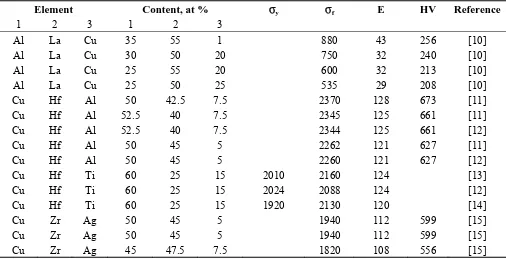
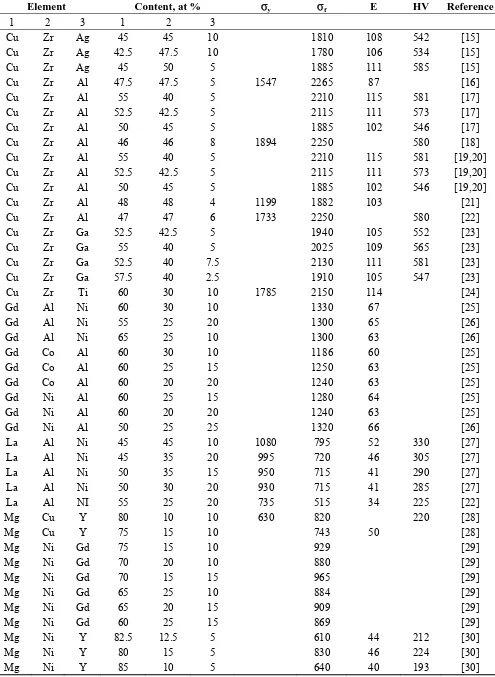
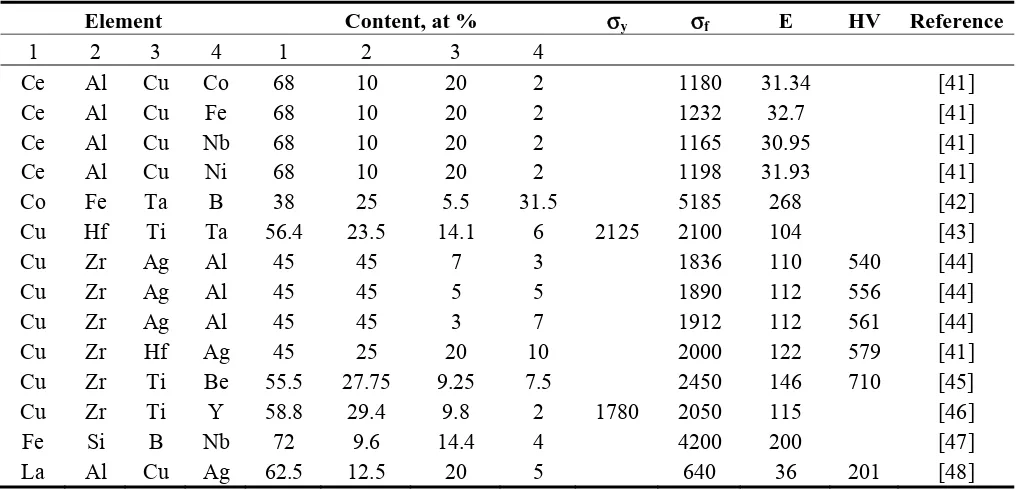
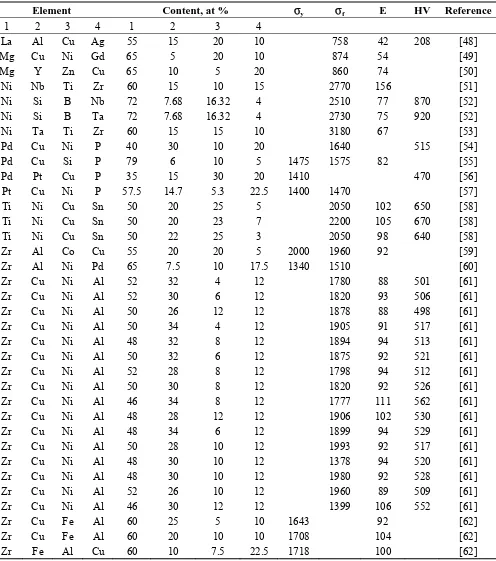
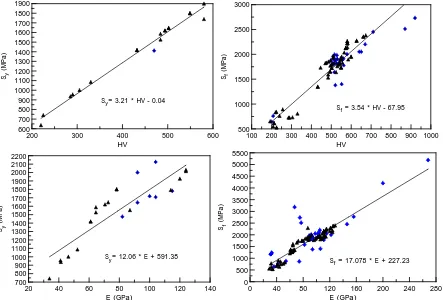
Mechanical properties of bulk metallic glasses (BMGs) in terms of Yield (σy) and Fracture Strength (σf), Vickers Hardness as well as the Young’s Modulus (E) are given in Tables 1 and 2 (together with the references) while possible correlations are shown in Figure 1. One can admit an excellent correlation between σy and HV (R2 = 0.98) as expected for isotropic solids like BMGs. Understandably, σf shows a less good correlation which is connected with different amount of plastic deformation in the case of each alloy. There is also a similar trend with Young’s Modulus but the results are more scattered.
Table 1. Composition and mechanical properties of ternary bulk glassy alloys.
Element Content, at % σy σf E HV Reference
1 2 3 1 2 3
Al La Cu 35 55 1 880 43 256 [10]
Al La Cu 30 50 20 750 32 240 [10]
Al La Cu 25 55 20 600 32 213 [10]
Al La Cu 25 50 25 535 29 208 [10]
Cu Hf Al 50 42.5 7.5 2370 128 673 [11]
Cu Hf Al 52.5 40 7.5 2345 125 661 [11]
Cu Hf Al 52.5 40 7.5 2344 125 661 [12]
Cu Hf Al 50 45 5 2262 121 627 [11]
Cu Hf Al 50 45 5 2260 121 627 [12]
Cu Hf Ti 60 25 15 2010 2160 124 [13]
Cu Hf Ti 60 25 15 2024 2088 124 [12]
Cu Hf Ti 60 25 15 1920 2130 120 [14]
Cu Zr Ag 50 45 5 1940 112 599 [15]
Cu Zr Ag 50 45 5 1940 112 599 [15]
Table 1.Cont.
Element Content, at % σy σf E HV Reference
1 2 3 1 2 3
Cu Zr Ag 45 45 10 1810 108 542 [15]
Cu Zr Ag 42.5 47.5 10 1780 106 534 [15]
Cu Zr Ag 45 50 5 1885 111 585 [15]
Cu Zr Al 47.5 47.5 5 1547 2265 87 [16]
Cu Zr Al 55 40 5 2210 115 581 [17]
Cu Zr Al 52.5 42.5 5 2115 111 573 [17]
Cu Zr Al 50 45 5 1885 102 546 [17]
Cu Zr Al 46 46 8 1894 2250 580 [18]
Cu Zr Al 55 40 5 2210 115 581 [19,20]
Cu Zr Al 52.5 42.5 5 2115 111 573 [19,20]
Cu Zr Al 50 45 5 1885 102 546 [19,20]
Cu Zr Al 48 48 4 1199 1882 103 [21]
Cu Zr Al 47 47 6 1733 2250 580 [22]
Cu Zr Ga 52.5 42.5 5 1940 105 552 [23]
Cu Zr Ga 55 40 5 2025 109 565 [23]
Cu Zr Ga 52.5 40 7.5 2130 111 581 [23]
Cu Zr Ga 57.5 40 2.5 1910 105 547 [23]
Cu Zr Ti 60 30 10 1785 2150 114 [24]
Gd Al Ni 60 30 10 1330 67 [25]
Gd Al Ni 55 25 20 1300 65 [26]
Gd Al Ni 65 25 10 1300 63 [26]
Gd Co Al 60 30 10 1186 60 [25]
Gd Co Al 60 25 15 1250 63 [25]
Gd Co Al 60 20 20 1240 63 [25]
Gd Ni Al 60 25 15 1280 64 [25]
Gd Ni Al 60 20 20 1240 63 [25]
Gd Ni Al 50 25 25 1320 66 [26]
La Al Ni 45 45 10 1080 795 52 330 [27]
La Al Ni 45 35 20 995 720 46 305 [27]
La Al Ni 50 35 15 950 715 41 290 [27]
La Al Ni 50 30 20 930 715 41 285 [27]
La Al NI 55 25 20 735 515 34 225 [22]
Mg Cu Y 80 10 10 630 820 220 [28]
Mg Cu Y 75 15 10 743 50 [28]
Mg Ni Gd 75 15 10 929 [29]
Mg Ni Gd 70 20 10 880 [29]
Mg Ni Gd 70 15 15 965 [29]
Mg Ni Gd 65 25 10 884 [29]
Mg Ni Gd 65 20 15 909 [29]
Mg Ni Gd 60 25 15 869 [29]
Mg Ni Y 82.5 12.5 5 610 44 212 [30]
Mg Ni Y 80 15 5 830 46 224 [30]
Table 1.Cont.
Element Content, at % σy σf E HV Reference
1 2 3 1 2 3
Zr Al Ni 70 10 20 1411 1335 61 432 [31] Zr Al Ni 65 10 25 1581 1520 64.5 484 [31] Zr Al Ni 65 15 20 1614 1640 70.5 494 [31] Zr Al Ni 60 15 25 1640 1715 72.6 502 [31] Zr Al Ni 60 20 20 1795 1720 78.2 549 [31]
Zr Co Al 55 30 15 1790 98 543 [32]
Zr Co Al 55 25 20 1750 96 530 [32]
Zr Co Al 55 25 20 1900 114 [33]
Zr Cu Al 50 40 10 1821 89 [34]
Zr Cu Al 50 40 10 1860 88 496 [35]
Zr Cu Al 52.5 37.5 10 1840 86 485 [32,36]
Zr Cu Al 50 37.5 12.5 1960 93 511 [32,36]
Zr Cu Al 50 42.5 7.5 1820 86 475 [32,36]
Zr Cu Al 55 35 10 1810 83 470 [36]
Zr Cu Al 60 30 10 1720 80 446 [36]
Zr Cu Al 47.5 42.5 10 1920 90 508 [36]
Zr Ni Al 60 25 15 1760 88 495 [31]
Zr Ni Al 55 25 20 1780 89 502 [31,37]
Zr Ni Al 55 30 15 1820 99 514 [31,37]
Zr Ni Al 60 20 20 1793 1720 78.2 549 [38] Zr Ni Al 70 20 10 1411 1335 61 432 [31,39] Zr Ni Al 65 25 10 1520 1581 64.5 484 [31,39]
Zr Ni Al 65 20 15 1614 1640 494 [31,39]
Zr Ni Al 60 25 15 1640 1715 502 [31,39]
Zr Ni Ti 40 37 23 1630 524 [40]
Table 2. Composition and mechanical properties of quaternary bulk glassy alloys.
Element Content, at % σy σf E HV Reference
1 2 3 4 1 2 3 4
Ce Al Cu Co 68 10 20 2 1180 31.34 [41]
Ce Al Cu Fe 68 10 20 2 1232 32.7 [41]
Ce Al Cu Nb 68 10 20 2 1165 30.95 [41]
Ce Al Cu Ni 68 10 20 2 1198 31.93 [41]
Co Fe Ta B 38 25 5.5 31.5 5185 268 [42]
Cu Hf Ti Ta 56.4 23.5 14.1 6 2125 2100 104 [43]
Cu Zr Ag Al 45 45 7 3 1836 110 540 [44]
Cu Zr Ag Al 45 45 5 5 1890 112 556 [44]
Cu Zr Ag Al 45 45 3 7 1912 112 561 [44]
Cu Zr Hf Ag 45 25 20 10 2000 122 579 [41]
Cu Zr Ti Be 55.5 27.75 9.25 7.5 2450 146 710 [45]
Cu Zr Ti Y 58.8 29.4 9.8 2 1780 2050 115 [46]
Fe Si B Nb 72 9.6 14.4 4 4200 200 [47]
Table 2.Cont.
Element Content, at % σy σf E HV Reference
1 2 3 4 1 2 3 4
La Al Cu Ag 55 15 20 10 758 42 208 [48]
Mg Cu Ni Gd 65 5 20 10 874 54 [49]
Mg Y Zn Cu 65 10 5 20 860 74 [50]
Ni Nb Ti Zr 60 15 10 15 2770 156 [51]
Ni Si B Nb 72 7.68 16.32 4 2510 77 870 [52]
Ni Si B Ta 72 7.68 16.32 4 2730 75 920 [52]
Ni Ta Ti Zr 60 15 15 10 3180 67 [53]
Pd Cu Ni P 40 30 10 20 1640 515 [54]
Pd Cu Si P 79 6 10 5 1475 1575 82 [55]
Pd Pt Cu P 35 15 30 20 1410 470 [56]
Pt Cu Ni P 57.5 14.7 5.3 22.5 1400 1470 [57]
Ti Ni Cu Sn 50 20 25 5 2050 102 650 [58]
Ti Ni Cu Sn 50 20 23 7 2200 105 670 [58]
Ti Ni Cu Sn 50 22 25 3 2050 98 640 [58]
Zr Al Co Cu 55 20 20 5 2000 1960 92 [59]
Zr Al Ni Pd 65 7.5 10 17.5 1340 1510 [60]
Zr Cu Ni Al 52 32 4 12 1780 88 501 [61]
Zr Cu Ni Al 52 30 6 12 1820 93 506 [61]
Zr Cu Ni Al 50 26 12 12 1878 88 498 [61]
Zr Cu Ni Al 50 34 4 12 1905 91 517 [61]
Zr Cu Ni Al 48 32 8 12 1894 94 513 [61]
Zr Cu Ni Al 50 32 6 12 1875 92 521 [61]
Zr Cu Ni Al 52 28 8 12 1798 94 512 [61]
Zr Cu Ni Al 50 30 8 12 1820 92 526 [61]
Zr Cu Ni Al 46 34 8 12 1777 111 562 [61]
Zr Cu Ni Al 48 28 12 12 1906 102 530 [61]
Zr Cu Ni Al 48 34 6 12 1899 94 529 [61]
Zr Cu Ni Al 50 28 10 12 1993 92 517 [61]
Zr Cu Ni Al 48 30 10 12 1378 94 520 [61]
Zr Cu Ni Al 48 30 10 12 1980 92 528 [61]
Zr Cu Ni Al 52 26 10 12 1960 89 509 [61]
Zr Cu Ni Al 46 30 12 12 1399 106 552 [61]
Zr Cu Fe Al 60 25 5 10 1643 92 [62]
Zr Cu Fe Al 60 20 10 10 1708 104 [62]
Figure 1. Correlation between mechanical properties of bulk metallic glasses. Here Sy and Sf denote Yield and Fracture Strength, respectively. Triangles denote ternary while diamonds quaternary alloys.
200 300 400 500 600
HV 600 700 800 900 1000 1100 1200 1300 1400 1500 1600 1700 1800 1900 Sy (MPa)
Sy= 3.21 * HV - 0.04
100 200 300 400 500 600 700 800 900 1000
HV 500 1000 1500 2000 2500 3000 Sf (MP a)
Sf = 3.54 * HV - 67.95
20 40 60 80 100 120 140
E (GPa) 700 800 900 1000 1100 1200 1300 1400 1500 1600 1700 1800 1900 2000 2100 2200 Sy (M Pa )
Sy= 12.06 * E + 591.38
0 40 80 120 160 200 240 280
E (GPa) 0 500 1000 1500 2000 2500 3000 3500 4000 4500 5000 5500 Sf (M Pa)
Sf = 17.078 * E + 227.23
Unless phase separated, bulk metallic glasses are isotropic solids, and thus, their mechanical properties are much less dependent of the processing history than those of crystalline alloys which microstructure can be modified in a wide range resulting in different mechanical properties. Structural relaxation on annealing modifies their plasticity/toughness but very slightly Yield Strength or hardness values.
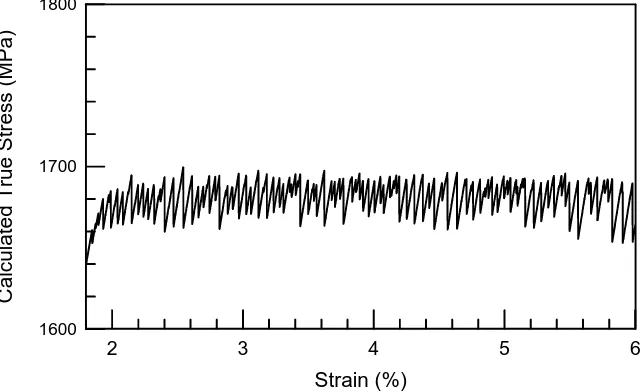
Although, a vast majority of bulk metallic glasses break shortly after yielding at ambient temperature, the deformation behavior of bulk metallic glassy alloys is under intense investigations at present owing to their high strength. At relatively low homologous temperatures the inhomogeneous plastic flow of glassy alloys occurs by propagation of shear bands [63] which are 10–20 nm thick and make steps on the surface up to several micrometers in height [64]. A strongly localized shear deformation at room temperature [65,66] limits practical application of such materials since a shear event may trigger a crack nucleation and rapid fracture. However, as illustrated in Figure 2, considerable apparent ductility was observed in several specific bulk metallic glassy alloys [67,68].
Pd40Ni40SixP20 −x [69,70], Zr-Cu-Fe-Al [71] and Zr65Al7.5Ni10Pd17.5 [72] alloys exhibit significant
Mg- and La-based alloys is caused by the inclusions of oxides (oxygen is insoluble in solid Mg and La, while it dissolves very well in Zr and Ti) acting as stress concentrators [75]. Zr-Cu-Fe-Al bulk glassy alloy exhibits phase separation on heating prior to crystallization [76], which also may be responsible for its higher room-temperature ductility compared to Zr-Cu-Al alloys.
A stress-strain curve in the plastic deformation range, which is typical for ductile bulk metallic glassy alloys, [77,78] is shown in Figure 2. One can see general absence of strain hardening. The average stress drop magnitude increases with strain, reaching a sort of a critical value at break. The amount of stress drop at each serration event increases with the degree of deformation.
Figure 2. A part of the true stress-strain diagram of Zr60Cu25Fe5Al10 glassy alloy tested at room temperature.
2 3 4 5 6
Strain (%)
1600 1700 1800
Ca
lc
ul
a
ted
T
rue
St
re
ss
(MP
a
)
It was shown that fracture of bulk metallic glasses is very sensitive to macroscopic defects (likely pores and surface imperfections) which explains large scattering in the values of the percentage deformation changing from sample to sample [79]. One should also remember that the engineering plasticity of bulk metallic glasses depends upon their geometry and aspect ratio [80,81]. Different specimen geometries influence the shear-band formation and deformation processes, resulting in variations of mechanical properties.
In situ monitoring of the deformation behavior of bulk metallic glasses was performed using an infrared camera. Although temporal resolution of the existing cameras is not high enough, some weak rise of temperature was observed as a result of shear band operation [82].
Fatigue properties of BMG alloys have been also studied and fatigue-endurance limits of some Zr-based alloys are comparable with those of high-strength crystalline alloys [83].
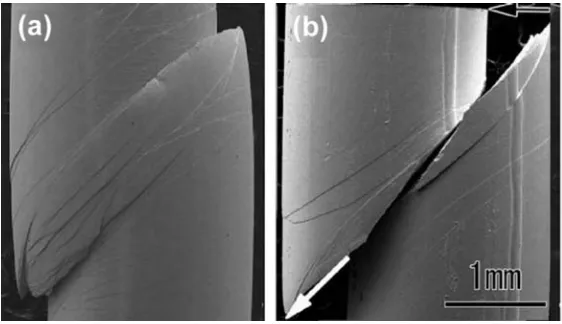
Figure 3. Two regimes of deformation observed in metallic glasses: (a) relatively homogeneous deformation with many shear bands in the Zr62.5Cu22.5Fe5Al10 BMG and (b) stick-slip behavior in a single major shear band in the Zr67.5Cu17.5Fe5Al10 BMG (SEM). Reprinted from [71] with permission of Elsevier.
In order to enhance the ductility of metallic glasses, the formation of heterogeneous microstructures in a composite-like manner has been found recently essential and employed in a variety of procedures combining a glassy matrix with second phase crystalline particles [85,86]; the deformation-induced nanocrystallization [87,88] is one of the possible ways illustrating this approach. One of the ways is to impede the propagation of shear bands through the sample by interaction with the phases (or microscopic pores) embedded into a glassy matrix. This enables multiplication, branching and termination of the shear bands similar to the composites where cracks are either blocked by reinforcements or blunted in ductile phases or matrix.
The blockage of the crack-tip area by nanoparticles stabilizing plastic deformation was observed in Cu50Zr50 as well as in the Zr65Al7.5Ni10Pd17.5 glassy alloys [89]. Moreover, the compressive room-temperature stress-strain curves of the Zr65Al7.5Ni10Cu17.5 and Zr65Al7.5Ni10Pd17.5 bulk metallic glassy alloys revealed significantly different plasticity of these alloys, though both of the alloys possess a glassy structure [90].
An alloy, which crystallizes by the nucleation and growth mechanism, is supposed to be less prone to nanocrystalsization during deformation while the alloy having pre-existing nuclei is predisposed to show such a behavior [91]. For example, the precipitation of the nanoscale α-Al particles at room temperature was observed in marginal Al-TM-RE glass-formers (like Al90Fe5Gd5 or Al90Fe5Ce5) within the shear bands on deformation [92,93], while a very limited fraction or complete absence of nanocrystals (depending on RE metal) was observed after significant plastic deformation in the Al85RE8Ni5Co2 amorphous and glassy samples [94] (~30% reduction in thickness) which undergo a clear nucleation and growth behavior.
The nanocrystallization within the shear bands was also observed in the Cu47.5Zr47.5Al5 glassy alloy, which was reported to be strain-hardenable [87,95]. The effect of strain rate on the flow stress [96] and ductility was studied [97,98] and the results showed that the higher strain rate used facilitates plasticity.
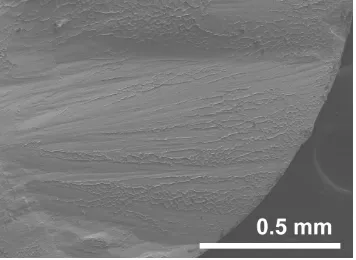
fracture surfaces (Figure 4). A fracture surface topography showing initial cleavage-like behavior starting from the lateral surface of the rod sample has long been known [100]. However, in the present case the several cleavage-like and vein patterns alternate in the body of the sample in the direction normal to shear deformation. Thus, cleavage-like areas may be considered as the areas of significant shear deformation. The vein fracture patterns, which are specific to metallic glasses, may signify local melting of the material at the surface upon fracture [101,102], and thus, existence of considerable temperature gradients in the deforming sample. Novel fracture behavior of Pd-based bulk metallic glasses with wavy features was also reported recently by Chen [103].
Figure 4. Fracture surface of the Zr60Cu16Ni14Al10 bulk glassy alloy tested at room temperature (SEM).
Unlike common observations of serrated plastic flow associated with the large scale shear bands in monolithic metallic glasses, propagation of the shear bands in the studied alloy does not lead to the stress drops, although the shear bands were readily seen on the lateral surface of the samples tested to fracture in addition to multiple slip bands linked to each cP2 crystalline grain. By analogy with deformation-induced martensitic transformations, one can suppose that the formation of the mP4 martensitic phase initiates within the cP2 crystalline phase [107,108]. The most of plastic deformation attained at stresses below 1400 MPa is transformation-aided. At the second stage of plastic deformation, there is an increasing strain hardening and intensive formation of shear bands and slip markings near the fracture surface.
3. Deformation of Bulk Metallic Glasses at Cryogenic Temperature
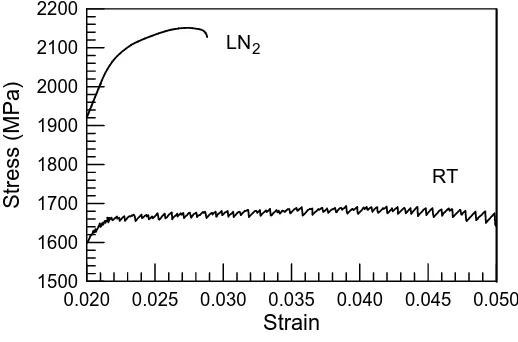
Low-temperature measurements have also been performed [109–111] and demonstrated the increase in the maximum compressive stress with decreasing testing temperature. The stress-strain diagrams for the typical glassy Zr64.13Ni10.12Cu15.75Al10 alloy tested at room temperature and close to boiling liquid nitrogen (LN2) temperature are shown in Figure 5. The sample tested in liquid nitrogen exhibits notably higher compression strength compared to the sample tested at room temperature.
Figure 5. Stress-strain diagrams of Zr64.13Ni10.12Cu15.75Al10 glassy alloy tested at room temperature and close to boiling LN2 temperature (the sample which showed the maximum strength). The data is taken from Reference 111.
0.020 0.025 0.030 0.035 0.040 0.045 0.050
Strain
1500 1600 1700 1800 1900 2000 2100 2200
Stress (MPa)
RT LN2
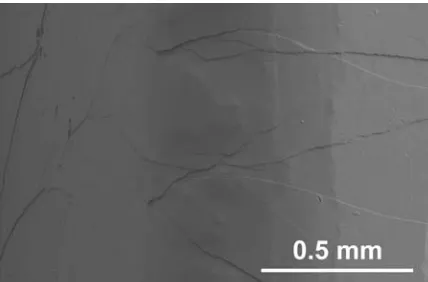
Figure 6. SEM image in secondary electrons of the lateral surface of the Zr64.13Ni10.12Cu15.75Al10 glassy alloy sample after mechanical test at boiling LN2 temperature.
The mechanical behavior and the kinetics of shear deformation in bulk metallic glassy alloys were also investigated at room and liquid nitrogen temperature using the acoustic emission technique. It was demonstrated that the intensive acoustic emission reflecting the activity of strongly localized shear bands at room temperature vanishes at the transition from serrated to non-serrated plastic flow at LN2 temperature [112]. The disappearance of acoustic emission signals clearly suggests that the shear band propagation velocity significantly decreases at low temperature likely owing to the increased viscosity of the deforming regions.
4. Strain-Rate Sensitivity
While the strain-rate sensitivity (SRS) of polycrystalline alloys is generally positive (except for special cases) [113], for bulk metallic glasses (BMGs) different results were reported. A negative SRS was reported for Zr57Ti5Cu20Ni8Al10 alloy at strain rates ranging from 10−4 to 3⋅× 103 s−1 [114]. In addition, a negative value was obtained [115] for a similar alloy composition, e.g., Zr52.5Ti5Cu17.9Ni14.6Al10 (Vit105) and for Vit105-based composite, at strain rates of 3.3⋅× 10−4 and 3.7⋅× 10−3 s−1. In Zr-based metallic-glass coatings with micrometer-scale thickness for the shallow indentation, in which the substrate effect can be neglected, the increase of the penetration rate also leads to the decrease of the hardness [116]. At the same time, nanoindentation studies indicate positive SRS parameter values [117].
In order to illustrate strain-rate sensitivity of BMG alloys, the Zr65Cu20Fe5Al10 rod (as one of relatively ductile BMG alloys) glassy samples were tested at room temperature and the strain rate was suddenly changed upon deformation.
Figure 7 shows the true stress-plastic strain curves calculated from engineering stress values. After an initial region of apparent strain hardening, the magnitude of the stress drops increases slightly. The value of strain rate sensitivity (SRS) parameter (m) has been calculated from the true stress-strain curves according to the relationship:
Τ •
∂ ∂ =
,
ln ln
ε
ε σ
where σ is the flow stress and
ε
• is the strain rate. It is important to note that the strain rate changes have been performed in the regions where the stress-strain curves are generally linear which may correspond to the formation of multiple shear bands and macroscopically homogeneous deformation of the sample.Figure 7. A part of the true stress-plastic strain curve (elastic strain is subtracted) obtained at the strain rates of 5 × 10⁻³ and 5 × 10⁻² s−1. The data is taken from Reference [118] with permission of Elsevier.
1.5 1.6 1.7 1.8 1.9 2.0 2.1 2.2 2.3 2.4 2.5 Plastic strain (%)
1650 1700 1750
Ca
lcula
ted True Stress
(MPa)
5*10-3 s-1
5*10-2 s-1
=1684.1 1.1 MPa =1675.2 2.0 MPa
The mean and maximum flow stresses and the confidence interval (probability p = 0.95) have been calculated in 0.25% plastic deformation interval using true stress values at both sides of each point of the strain rate change (Figure 7). An average maximum stress before each stress satisfied normality tests and produced similar results. Not only the flow stress but also the average maximum stress before each stress drop corresponding to a serration for each test is practically the same at each loading rate in the vicinity of the strain rate change point and the differences are practically within the confidence interval which indicates that the Zr65Cu20Fe5Al10 BMG is strain rate insensitive (m~0) in the range of strain rates from 5⋅× 10−6 to 5⋅× 10−4 s−1. Between 5 × 10⁻⁴ and 5 × 10⁻³ s−1 the average flow stress is similar, 1684.4 ± 0.5 MPa and 1685.2 ± 1.6 MPa, respectively, and the difference is within the confidence interval. It indicates that the alloy is not strain rate sensitive at these conditions. However, when the strain rate increases from 5 × 10⁻³ to 5 × 10⁻² s−1 the average flow stress meaningfully decreases from 1684.1 ± 1.1 to 1675 ± 2.0 MPa, and according to Equation 1 the SRS is negative (m = −0.0026).
From the statistical analysis of the mean and maximum flow stress at each loading rate it has been calculated that the alloy does not exhibit SRS within the confidence interval from 5 × 10⁻⁶ to 5 × 10⁻³ s−1. The SRS values derived by using the confidence interval are smaller (m~0) than the value of m reported for Zr52.5Ti5Cu17.9Ni14.6Al10 at room temperature (e.g., about −0.002) by [119] and Cu50Zr50 BMG by [120]. However, the SRS becomes meaningfully negative when the strain rate increases from 5 × 10⁻³ s−1 to 5 × 10⁻² s−1 because the strain rate is so fast that the relaxation time is not enough to build up the stress which explains the decrease in the flow stress.
mainly attributed to the stress state, which is closer to three-axial compression when tested by indentation. Moreover, there is a strong size effect on deformation behavior upon indentation in which the deformed volume is significantly smaller while local plastic deformation is larger than in compression.
5. In situ Room-Temperature Tensile Deformation in TEM
At the same time, metallic glasses are proven to deform homogeneously on nanoscale. Plastic deformation in metallic glasses has been performed using the in-situ TEM technique [123–125]. After initial observation, the beam current was reduced and the sample deformed in a straining holder in tension. This is an important precaution to prevent electron-beam heating of the sample upon deformation. This procedure (straining and subsequent observation) has been repeated several times until some cracks had become apparent. High-resolution in-situ TEM investigation showed that the Zr65Ni10Cu5Al7.5Pd12.5 ribbon sample retains its glassy structure after in-situ deformation and crack propagation (Figure 8). No nanocrystallization was observed even near the crack.
Figure 8. High-resolution TEM image obtained upon in-situ deformation in a microscope near the crack in the Zr65Ni10Cu5Al7.5Pd12.5 glassy alloy.
The homogeneous deformation of the thinned Zr65Ni10Cu5Al7.5Pd12.5 alloy is clearly seen in front of the crack tip upon loading. The deformation rate estimated by crack opening speed was quite low—about tens of nanometers per second or even less. A narrow featureless deformation zone forms ahead of the crack tip, with the brightness different from that in the rest of the sample. However, this zone is much wider than the typical (10–20 nm) width of a shear band. Similar results were obtained for submicron (about 200 nm) thick Zr52.5Cu17.9Al10Ni14.6Ti5 alloy [126].
6. Effect of Cyclic and Long-Term Creep Deformation in the Elastic Region
The beginning of nanocrystallization was observed in the Zr62.5Fe5Cu22.5Al10 bulk metallic glassy cubic samples (edge size equal to 4 mm) under low stress of 586 ± 242 MPa in the elastic region while no such an effect was seen in the rod shaped samples of 2 mm in diameter [130]. This alloy also showed phase separation on heating prior to crystallization [76,131]. Later the Zr62.5Fe5Cu22.5Al10 BMG samples of 3 mm in diameter and 3 mm in height were cyclically loaded at higher stresses of 800 ± 200 MPa and 1000 ± 200 MPa, which are still significantly lower than the Yield Strength. It was found that kinetically frozen anelastic deformation accumulates at room temperature and causes crystallization of metallic glassy phase. There was an increase in the crystallization enthalpy after cyclic loading for 1000 cycles at 1000 ± 200 MPa from 44 J/g to 48 J/g is likely connected with the formation of the nuclei of non-equilibrium phase which together with the residual glassy phase may represent a state with higher free energy. An anelastic contribution can arise from localized viscous flow of structural defects [132,133]. The volume changes were locally accommodated by cumulative anelastic deformation and led to subsequent partial nanocrystallization of the glass.
Uniaxial compression of a BMG close to Yield Strength induced creep of the samples, accompanied by an increase in the stored heat of relaxation [134]. The sample exhibited an increase in compressive plasticity on the subsequent test [135]. This creep is homogeneous and leads to decreases in density and in elastic moduli. The increase in heat of relaxation and in plasticity in BMGs resulting from static loading are reported to depend on the atomic packing density [136].
7. Conclusive Remarks
Acknowledgement
This work was supported by “World Premier International Research Center (WPI) Initiative for Atoms, Molecules and Materials” and by Russian Ministry of Education and Science of Russia, project 14.A18.21.1202.
References
1. Inoue, A. High strength bulk amorphous alloys with low critical cooling rates. Mater. Trans. JIM 1995, 36, 866–875.
2. Johnson, W.L. Bulk glass-forming metallic alloys: Science and technology. MRS Bull1999, 24, 42–56.
3. Inoue, A. Stabilization of metallic supercooled liquid and bulk amorphous alloys. Acta Mater. 2000, 48, 279–306.
4. Argon, A.S. Mechanisms of inelastic deformation in metallic lasses. Phys. Chem. Solids 1982, 43, 945.
5. Liu, F.X.; Liaw, P.K.; Wang, G.Y.; Chiang, C.L.; Smith, D.A.; Rack, P.D.; Chu, J.P.; Buchanan, R.A. Specimen-geometry effects on mechanical behavior of metallic glasses. Intermetallics2006, 14, 1014.
6. Inoue, A.; Shen, B.; Koshiba, H.; Kato, H.; Yavari, A.R. Cobalt-based bulk glassy alloy with ultrahigh strength and soft magnetic properties. Nat. Mater.2003, 2, 661.
7. Wang, J.; Li, R.; Hua, N.; Zhang, T. Co-based ternary bulk metallic glasses with ultrahigh strength and plasticity. J. Mater. Res.2011, 26, 16, 2072–2079
8. Amiya, K.; Inoue, A. Fe-(Cr, Mo)-(C, B)-Tm bulk metallic glasses with high, strength and high glass-forming ability. Rev. Adv. Mater. Sci. 2008, 18, 27.
9. Louzguine, D.V.; Inoue, A. Structural and thermal investigations of a high-strength Cu-Zr-Ti-Co bulk metallic glass. Philos. Mag. Lett.2003, 83, 191–196.
10. Inoue, A.; Yamaguchi, H.; Zhang, T.; Masumoto, T. Al-La-Cu amorphous alloys with a wide supercooled liquid region. Mater. Trans. JIM1990, 31, 104–109.
11. Zhang, W.; Inoue, A. Synthesis, thermal stability and mechanical properties of Cu-based bulk glassy alloys. World Bulk Met. Glass. Compos. 2007, 201–230.
12. Inoue, A.; Zhang, W.; Saida, J. Synthesis and fundamental properties of Cu-based bulk glassy alloys in binary and multi-component systems. Mater. Trans.2004, 45, 4, 1153–1162.
13. Inoue, A.; Zhang, W.; Zhang, T.; Kurosaka, K. Formation and mechanical properties of Cu-Hf-Ti bulk glassy alloys. J. Mater. Res. 2001, 16, 2836–2844.
14. Inoue, A.; Zhang, W.; Zhang, T.; Kurosaka, K. High-strength Cu-based bulk glassy alloys in Cu-Zr-Ti and Cu-Hf-Ti ternary systems. Acta Mater. 2001, 49, 2645–2652.
15. Zhang, W.; Inoue, A. High glass-forming ability and good mechanical properties of new bulk glassy alloys in Cu-Zr-Ag ternary system. J. Mater. Res.2006, 21, 234–241.
17. Inoue, A.; Zhang, W. Formation, thermal stability and mechanical properties of Cu-Zr-Al bulk glassy alloys. Mater. Trans.2002, 43, 2921–2925.
18. Zhang, Q.; Zhang, W.; Xie, G.; Inoue, A. Glass-forming ability and mechanical properties of the ternary Cu-Zr-Al and quaternary Cu-Zr-Al-Ag bulk metallic glasses. Mater. Trans. 2007, 48, 1626–1630.
19. Zhang, W.; Inoue, A. Formation and mechanical strength of new Cu-based bulk glassy alloys with large supercooled liquid region. Mater. Trans.2004, 45, 1210–1213.
20. Zhang, Q.; Zhang, W.; Inoue, A. Bulk metallic glass formation near a quaternary Cu-Zr-Ti-Al eutectic point. Mater. Trans. 2006, 47, 2804–2807.
21. Chen, J.; Zhang, Y.; He, J.P; Yao, K.F.; Wei, B.C.; Chen, G.L. Metallographic analysis of Cu-Zr-Al bulk amorphous alloys with yttrium addition. Scr. Mater.2006, 54, 1351–1355.
22. Bhatt, J.; Wu, J.; Xia, J.; Wand, Q.; Dong, C.; Murty, B.S. Optimization of bulk metallic glass forming compositions in Zr-Cu-Al system by thermodynamic modeling. Intermetallics2007, 15, 716–721.
23. Zhang, W.; Inoue, A. Cu-based bulk glass formation in the Cu-Zr-Ga alloy system and their mechanical properties. Mater. Trans.2004, 45, 532–535.
24. Men, H.; Fu, J.; Ma, C.; Pang, S.; Zhang, T. Bulk glass formation in ternary Cu-Zr-Ti system. J. Univ. Sci. Technol. Beijing2007, 14, 19.
25. Chen, D.; Takeuchi, A.; Inoue, A. Gd-Co-Al and Gd-Ni-Al bulk metallic glasses with high glass forming ability and good mechanical properties. Mater. Sci. Eng. 2007, 457, 226–230.
26. Chen, D.; Takeuchi, A.; Inoue, A. Gd-Ni-Al bulk glasses with great glass-forming ability and better mechanical properties. J. Mater. Sci.2007, 42, 8662–8666.
27. Inoue, A.; Zhang, T.; Masumoto, T. Al-La-Ni amorphous alloys with a wide supercooled liquid region. Mater. Trans. JIM1989, 30, 965–972.
28. Inoue, A.; Kato, A.; Zhang, T.; Kim, S.; Masumoto, T. Mg-Cu-Y amorphous alloys with high mechanical strengths produced by metallic mold casting method. JIM1991, 32, 609–616.
29. Park, E.S.; Chang, H.J.; Kim, D.H. Mg-rich Mg-Ni-Gd ternary bulk metallic glasses with high compressive specific strength and ductility. J. Mater. Res.2007, 22, 334–338.
30. Kim, S.G.; Inoue, A.; Masumoto, T. High mechanical strengths of Mg-Ni-Y and Mg-Cu-Y amorphous alloys with significant supercooled liquid region. Mater. Trans. JIM 1990, 31, 929–934.
31. Inoue, A.; Zhang, T.; Masumoto, T. Zr-Al-Ni amorphous alloys with high class transition temperature and significant supercooled liquid region. Mater. Trans. JIM1990, 31, 177–183. 32. Yokoyama, Y.; Yamasaki, T.; Liaw, P.K.; Inoue, A. Relations between the thermal and
mechanical properties of cast Zr-TM-Al (TM: Cu, Ni, or Co) bulk glassy alloys. Mater. Trans. 2007, 48, 1846–1849.
33. Wada, T.; Zhang, T.; Inoue, A. Formation, thermal stability and mechanical properties in Zr-Al-Co bulk glassy alloys. JIM2002, 43, 2843–2846.
35. Yokoyama, Y.; Liaw, P.K.; Nishijima, M.; Hiraga, K.; Buchanan, R.A.; Inoue, A. Fatigue-strength enhancement of cast Zr50Cu40Al10 glassy alloys. Mater. Trans. 2006, 47, 1286–1293.
36. Yokoyama, Y.; Yamasaki, T.; Liaw, P.K.; Inoue, A. Relations between the thermal and mechanical properties of cast Zr-TM-Al (TM: Cu, Ni, or Co) bulk glassy alloys. Evolution of mechanical properties of cast Zr50Cu40Al10 glassy alloys by structural relaxation. Mater. Trans. 2005, 46, 2755–2761.
37. Inoue, A.; Zhang, W. New bulk glassy Ni-based alloys with high strength of 3000 MPa. Mater. Trans. 2002, 43, 708–711.
38. Jing, Q.; Zhang, Y.; Wang, D.; Li, Y. A study of the glass forming ability in Zr-Ni-Al alloys. Mater. Sci. Eng.2006, 441, 106–111.
39. Inoue, A.; Zhang, T.; Masumoto, T. Amorphous Zr-Al-TM (TM = Co,Ni,Cu) alloys with significant supercooled liquid region of over 100 K. Mater. Trans. JIM1991, 32, 1005–1010. 40. Yi, S.; Park, T.G.; Kim, D.H. Ni-based bulk amorphous alloys in the Ni-Ti-Zr-(Si, Sn) system.
J. Mater. Res.2000, 15, 11.
41. Zhang, B.; Zhao, D.Q.; Pan, M.X.; Wang, R.J.; Wang, W.H. Amorphous metallic plastic. Acta Mater.2006, 54, 3025–3032.
42. Koshiba, H.; Inoue, A. Preparation and magnetic properties of Co-based bulk glassy alloys. Mater. Trans.2001, 42, 2572–2575.
43. Qin, C.; Zhang, W.; Kimura, H.; Inoue, A. Excellent mechanical properties of Cu-Hf-Ti-Ta bulk glassy alloys containing in situ dendrite Ta-based BCC phase. Mater. Trans. 2004, 45, 2936–2940.
44. Zhang, W.; Zhang, Q.; Qin, C.; Inoue, A. Synthesis and properties of Cu-Zr-Ag-Al glassy alloys with high glass-forming ability. Mater. Sci. Eng.2008, 148, 92–96.
45. Inoue, A.; Zhang, T.; Kurosaka, K.; Zhang, W. High strength Cu-based bulk glassy alloys in Cu-Zr-Ti-Be system. Mater. Trans.2001, 42, 1800–1804.
46. Zhang, T.; Kurosaka, K.; Inoue, A. Thermal and mechanical properties of Cu-based Cu-Zr- Ti-Y bulk glassy alloys. Mater. Trans. 2001, 42, 2042–2045.
47. Makino, A.; Kubota, T.; Chang, C.; Makabe, M.; Inoue, A. FeSiBP bulk metallic glasses with unusual combination of high magnetization and high glass-forming ability. Mater. Trans.2007, 48, 3024–3027.
48. Zhang, W.; Jia, F.; Inoue, A. Formation and properties of new La-based bulk glassy alloys with diameters up to centimeter order. Mater. Trans. 2007, 48, 68–73.
49. Yuan, G.; Amiya, K.; Inoue, A. Structural-relaxation, glass-forming ability and mechanical properties of Mg-Cu-Ni-Gd alloys. J. Non Cryst. Solids2005, 351, 729–735.
50. Yuan, G.; Zhang, T.; Inoue, A. Thermal stability, glass-forming ability and mechanical properties of Mg-Y-Zn-Cu glassy alloys. Mater. Trans 2003, 44, 2271–2275.
51. Inoue, A.; Zhang, W.; Zhang, T. Thermal stability and mechanical strength of bulk glassy Ni-Nb-Ti-Zr alloys. Mater. Trans.2002, 43, 1952–1956.
53. Arai, K.; Zhang, W.; Jia, F.; Inoue, A. Synthesis and thermal stability of new Ni-based bulk glassy alloy with excellent mechanical properties. Mater. Trans. 2006, 47, 2358–2362.
54. Kim, J.H.; Park, J.S.; Lim, H.K.; Kim, W.T.; Kim, D.H. Heating and cooling rate dependence of the parameters representing the glass forming ability in bulk metallic glasses. J. Non Cryst. Solids 2005, 351, 1433–1440.
55. Liu, L.; Inoue, A.; Zhang, T. Formation of bulk Pd-Cu-Si-P glass with good mechanical properties. Mater. Trans.2005, 46, 376–378.
56. Takenaka, K.; Wada, T.; Nishiyama, N.; Kimura, H.; Inoue, A. New Pd-based bulk glassy alloys with high glass-forming ability and large supercooled liquid region. Mater. Trans. 2005, 46, 1720–1724.
57. Inoue, A.; Nishiyama, N.; Kimura, H. Preparation and thermal stability of bulk amorphous Pd40Cu30Ni10P20 alloy cylinder of 72 mm in diameter. Mater. Trans. JIM1997, 38, 179–183. 58. Zhang, T.; Inoue, A. Thermal and mechanical properties of Ti-Ni-Cu-Sn amorphous alloys with a
wide supercooled liquid region before crystallization. Mater. Trans. JIM1998, 39, 1001–1006. 59. Wada, T.; Zhang, T.; Inoue, A. Formation and high mechanical strength of bulk glassy alloys in
Zr-Al-Co-Cu system. Mater. Trans.2003, 44, 1839–1844.
60. Saida, J.; Kato, H.; Deny, A.; Setyawan, H.; Yoshimi, K.; Inoue, A. Deformation-induced nanoscale dynamic transformation studies in Zr-Al-Ni-Pd and Zr-Al-Ni-Cu bulk metallic glasses. Mater. Trans. 2007, 48, 1327–1335.
61. Yokoyama, Y.; Inoue, A. Compositional dependence of thermal and mechanical properties of quaternary Zr-Cu-Ni-Al bulk glassy alloys. Mater. Trans.2007, 48, 1282–1287.
62. Zhang, Q.S.; Zhang, W.; Louzguine-Luzgin, D.V.; Inoue, A. High glass-forming ability and unusual deformation behavior of new Zr-Cu-Fe-Al bulk metallic glasses. Mater. Sci. Forum 2010, 654–656, 1042–1045.
63. Conner, R.D.; Li, Y.; Nix, W.D.; Johnson, W.L. Shear band spacing under bending of Zr-based metallic glass plates. Acta Mater.2004, 52, 2429–2434.
64. Donovan, P.E.; Stobbs, W.M. The structure of shear bands in metallic glasses. Acta Metall.1981, 29, 1419–1436.
65. Chen, H.S. Plastic flow in metallic glasses under compression. Scr. Metar.1973, 7, 931–935. 66. Mear, F.O.; Wada, T.; Louzguine-Luzgin, D.V.; Inoue, A. Highly inhomogeneous compressive
plasticity in nanocrystal-toughened Zr-Cu-Ni-Al bulk metallic glass. Philos. Mag. Lett.2009, 89, 276–281.
67. Yavari, A.R.; Lewandowski, J.J.; Eckert, J. Mechanical properties of bulk metallic glasses. MRS Bull. 2007, 32, 635–638.
68. Pan, J.; Chan, K.C.; Chena, Q.; Liu, L. Enhanced plasticity by introducing icosahedral medium-range order in ZrCuNiAl metallic glass. Intermetallics2012, 24, 79–83.
69. Chen, N.; Louzguine-Luzgin, D.V.; Xie, G.Q.; Wada, T.; Inoue, A. Influence of minor Si addition on glass forming ability and mechanical properties of Pd40Ni40P20 alloy. Acta Mater.2009, 57, 2775–2780.
71. Zhang, Q.S.; Zhang, W.; Xie, G.Q.; Louzguine-Luzgin, D.V.; Inoue, A. Stable flowing of localized shear bands in soft bulk metallic glasses. Acta Mater.2010, 58, 904–909.
72. Kato, H.; Saida, J.; Inoue, A. Influence of hydrostatic pressure during casting on as cast structure and mechanical properties in Zr65Al7.5Ni10Cu17.5 −xPdx (x = 0, 17.5) alloys. Scr. Mater. 2004, 51,
1063–1068.
73. Schroers, J.; Johnson, W.L. Ductile bulk metallic glass. Phys. Rev. Lett. 2004, 93, 255506–255510.
74. Lewandowski, J.J.; Wang, W.H.; Greer, A.L. Intrinsic plasticity or brittleness of metallic glasses. Philos. Mag. Lett.2005, 85, 77.
75. Madge, S.V.; Louzguine-Luzgin, D.V.; Lewandowski, J.J.; Greer, A.L. Toughness, extrinsic effects and Poisson’s ratio of bulk metallic glasses. Acta Mater.2012, 60, 4800–4809.
76. Louzguine-Luzgin, D.V.; Xie, G.; Zhang, Q.; Inoue, A. Effect of Fe on the glass-forming ability, structure and devitrification behavior of Zr-Cu-Al bulk glass-forming alloys. Philos. Mag. 2010, 90, 1955–1968.
77. Wright, W.J.; Schwarz, R.B.; Nix, W.D. Localized heating during serrated plastic flow in bulk metallic glasses. Mater. Sci. Eng.2001, 319–321, 229–232.
78. Dalla Torre, F.H.; Dubach, A.; Siegrist, M.E.; Löffler, J.F. Negative strain rate sensitivity in bulk metallic glass and its similarities with dynamic strain aging effect during deformation. Appl. Phys. Lett.2006, 89, 091918.
79. Yu, H.B.; Wang, W.H.; Zhang, J.L.; Shek, C.H.; Bai, H.Y. Statistic analysis of the mechanical behavior of bulk metallic glasses. Adv. Eng. Mater. 2009, 11, 370–375.
80. Liu, F.X.; Liaw, P.K.; Wang, G.Y.; Chiang, C.L.; Smith, D.A.; Rack, P.P.D; Chu, P.P.; Buchanan, R.A. Specimen-geometry effects on mechanical behavior of metallic glasses. Intermetallics2006, 14, 1014–1018.
81. Uchic, M.D.; Dimiduk, D.M.; Florando, N.; Nix, W.D. Sample dimensions influence strength and crystal plasticity. Science2004, 305, 986–989.
82. Wang, G.; Feng, Q.; Yang, B.; Jiang, W.; Liaw, P.K.; Liu, C.T.; Thermographic studies of temperature evolutions in bulk metallic glasses. Intermetallics2012, 30, 1–11.
83. Wang, D.; Li, Y.; Sun, B.B.; Sui, M.L.; Lu, K.; Ma, E. Bulk metallic glass formation in the binary Cu-Zr system. Appl. Phys. Lett.2004, 84, 4029.
84. Yokoyama, Y.; Fujita, K.; Yavari, A.R.; Inoue, A. Correlation between structural relaxation and shear transformation zone volume of a bulk metallic glass. Philos. Mag. Lett.2009, 89, 322. 85. Inoue, A.; Zhang, W.; Tsurui, T.; Yavari, A.R.; Greer, A.L. Unusual room-temperature
compressive plasticity in nanocrystal-toughened bulk copper-zirconium glass. Philos. Mag. Lett. 2005, 85, 221–229.
86. Louzguine, D.V.; Kato, H.; Inoue, A. High-strength Cu-based crystal-glassy composite with enhanced ductility. Appl. Phys. Lett. 2004, 84, 1088–1089.
87. Das, J.; Tang, M.B.; Kim, K.B.; Theissmann, R.; Baier, F.; Wang, W.H.; Eckert, J. Work-hardenable ductile bulk metallic glass. Phys. Rev. Lett. 2005, 94, 205501.
89. Hajlaoui, K.; Yavari, A.R.; LeMoulec, A.; Botta, W.J.; Vaughan, F.G.; Das, J.; Greer, A.L.; Kvick, A. Plasticity induced by nanoparticle dispersions in bulk metallic glasses. J. Non Cryst. Solids2007, 353, 327–331.
90. Saida, J.; Kato, H.; Setyawan, A.D.H.; Inoue, A. Characterization and properties of nanocrystal-forming Zr-based bulk metallic glasses. Rev.Adv. Mater. Sci.2005, 10, 34–38.
91. Louzguine-Luzgin, D.V.; Zeng, Y.; Setyawan, A.D.H.; Nishiyama, N.; Kato, H.; Saida, J.; Inoue, A. Corrosion resistance and XPS studies of Ni-rich Ni-Pd-P-B bulk glassy alloys. J. Mater. Res2007, 22, 1087–1090.
92. Gao, M.C.; Hackenberg, R.E.; Shiflet, G.J. Deformation-induced nanocrystal precipitation in Al-base metallic glasses. Mater. Trans. 2001, 42, 1741–1747.
93. Jiang, W.H.; Atzmon, M. Plastic flow of a nanocrystalline/amorphous Al90Fe5Gd5 composite formed by rolling. Intermetallics2006, 14, 962–965.
94. Louzguine-Luzgin, D.V.; Inoue, A. Comparative study of the effect of cold rolling on the structure of Al-RE-Ni-Co (RE = rare-earth metals) amorphous and glassy alloys. J. Non Cryst. Solids 2006, 352, 3903–3909.
95. Zhang, Z.F.; He, G.; Zhang, H.; Eckert, J. Rotation mechanism of shear fracture induced by high plasticity in Ti-based nano-structured composites containing ductile dendrites. Scri. Mater.2005, 52, 945–949.
96. Dalla Torre, F.H.; Dubach, A.; Schallibaum, J.; Loffler, J.F. Shear striations and deformation kinetics in highly deformed Zr-based bulk metallic glasses. Acta Mater.2008, 56, 4635–4646. 97. Sergueeva, A.V.; Mara, N.A.; Branagan, D.J.; Mukherjee, A.K. Strain rate effect on metallic
glass ductility. Scr. Mater.2004, 50, 1303–1307.
98. Hajlaoui, K.; Stoica, M.; LeMoulec, A.; Charlot, F.; Yavari, A.R. Fe-Nb-B bulk metallic glass with high boron content. Rev. Adv. Mater. Sci. 2008, 18, 23–26.
99. Louzguine-Luzgin, D.V.; Vinogradov, A.; Yavari, A.R.; Li, S.; Xie, G.; Inoue, A. On the deformation and fracture behaviour of a Zr-based glassy alloy. Philos. Mag. 2008, 88, 2979–2987.
100. Pampillo, C.A. Flow and fracture in amorphous alloys. J. Mater. Sci1975, 10, 1194–1227. 101. Lewandowski, J.J.; Greer, A.L. Temperature rise at shear bands in metallic glasses. Nat. Mater.
2006, 5, 15–18.
102. Yang, B.; Morrison, M.L.; Liaw, P.P.K.; Buchanan, R.A.; Wang, G.; Liu, C.T.; Denda, M. Dynamic evolution of nanoscale shear bands in a bulk-metallic glass. Appl. Phys. Lett 2005, 86, 141904–141907.
103. Chen, N.; Louzguine-Luzgin, D.V.; Xie, G.Q.; Inoue, A. Nanoscale wavy fracture surface of a Pd-based bulk metallic glass. Appl. Phys. Lett.2009, 94, 131906.
104. Hofmann, D.C.; Suh, J.Y.; Wiest, A.; Duan, G.; Lind, M.L.; Demetriou, M.D.; Johnson, W.L. Designing metallic glass matrix composites with high toughness and tensile ductility. Nature 2008, 451, 1085.
106. Louzguine-Luzgin, D.V.; Vinogradov, A.; Xie, G.; Li, S.; Lazarev, A.; Hashimoto, S.; Inoue, A. High-strength and ductile glassy-crystal Ni-Cu-Zr-Ti composite exhibiting stress-induced martensitic transformation. Philos. Mag. 2009, 89, 2887–2901.
107. Otsuka, K.; Wayman, C.M. Shape Memory Materials; Otsuka, K., Wayman, C.M., Eds.; Cambridge University Press: Cambridge, UK, 1998; p. 27–48.
108. Fukuda, T.; Saburi, T.; Chihara, T.; Tsuzuki, Y. Mechanism of B2-B19-B19’ transformation in shape memory Ti-Ni-Cu alloys. Mater. Trans. JIM1995, 36, 1244–1248.
109. Kawashima, A.; Zeng, Y.; Fukuhara, M.; Kurishita, H.; Nishiyama, N.; Miki, H.; Inoue, A. Mechanical properties of a Ni60Pd20P17B3 bulk glassy alloy at cryogenic temperatures. Mater. Sci. Eng. 2008, 498, 475–481.
110. Tabachnikova, E.D.; Podol’ski, A.V.; Bengus, V.Z.; Smirnov, S.N.; Luzgin, D.V.; Inoue, A. Low-temperature plasticity anomaly in the bulk metallic glass Zr64.13Cu15.75Ni10.12Al10. Low Temp. Phys.2008, 34, 675–677.
111. Louzguine-Luzgin, D.V.; Vinogradov, A.; Li, S.; Kawashima, A.; Xie, G.; Yavari, A.R.; Inoue, A. Deformation and fracture behavior of metallic glassy alloys and glassy-crystal composites. Metall. Mater. Trans. 2011, 42A, 1504–1510.
112. Vinogradov, A.; Lazarev, A.; Louzguine-Luzgin, D.V.; Yokoyama, Y.; Li, S.; Yavari, A.R.; Inoue, A. Propagation of shear bands in metallic glasses and transition from serrated to non-serrated plastic flow at low temperatures. Acta Mater. 2010, 58, 6736.
113. Woodford, D.A. Strain-rate sensitivity as a measure ductility. Trans. Am. Soc. Met. 1969, 62, 291–293.
114. Hufnagel, T.; Jiao, C.; Li, T.; Xing, Y.; Ramesh, L.Q. Deformation and failure of Zr57Ti5Cu20Ni8Al10 bulk metallic glass under quasi-static and dynamic compression. J. Mater. Res. 2002, 17, 1441.
115. Dalla Torre, F.H.; Dubach, A.; Siegrist, M.; Löffler, J.F. Shear striations and deformation kinetics in highly deformed Zr-based bulk metallic glasses. Appl. Phys. Lett. 2006,89, 091918. 116. Liu, F.X.; Gao, Y.F.; Liaw, P.K. Rate-dependent deformation behavior of Zr-based
metallic-glass coatings examined by nanoindentation. Metall. Mater. Trans. 2008, 39, 8, 1862–1867.
117. Pan, D.; Chen, M.W. Rate-change instrumented indentation for measuring strain rate sensitivity. J. Mater. Res.2009, 24, 4, 1466–1470.
118. González, S.; Xie, G.Q.; Louzguine-Luzgin, D.V.; Perepezko, J.H.; Inoue, A. Deformation and strain rate sensitivity of a Zr-Cu-Fe-Al metallic glass. Mater. Sci. Eng.2011, 528, 3506–3512. 119. Song, S.X.; Bei, H.; Wadsworth, J.; Nieh, T.G. Flow serration in a Zr-based bulk metallic glass
in compression at low strain rates. Intermetallics 2008, 16, 813.
120. Dalla Torre, F.H.; Dubach, A.; Nelson, A.; Löffler, J.F. Temperature, strain and strain rate dependence of serrated flow in bulk metallic glasses. Mater. Trans.2007, 48, 1774.
121. Dalla Torre, F.H.; Dubach, A.; Siegrist, M.; Löffler, J.F. Negative strain-rate sensitivity in bulk metallic glass and its similarities with the dynamic strain-aging effect during deformation. Appl. Phys. Lett.2006, 89, 091918.
123. Hajlaoui, K.; Yavari, A.R.; Doisneau, B.; LeMoulec, A.; Botta, W.J.F.; Vaughan, G.; Greer, A.L.; Inoue, A.; Zhang, W.; Kvick, A. Shear delocalization and crack blunting of a metallic glass containing nanoparticles: In situ deformation in TEM analysis. Scr. Mater. 2006, 54, 1829–1834.
124. Guo, H.; Yan, P.F.; Wang, Y.B.; Tan, J.; Zhang, Z.F.; Sui, M.L.; Ma, E. Tensile ductility and necking ofmetallic glass. Nat. Mater. 2007, 6, 735.
125. Louzguine-Luzgin, D.V.; Yavari, A.R.; Xie, G.Q.; Madge, S.; Li, S.; Saida, J.; Greer, A.; Inoue, A. Tensile deformation behaviour of Zr-based glassy alloys. Philos. Mag. Lett. 2010, 90, 139.
126. Guo, H.; Yan, P.P.F; Wang, Y.B.; Tan, J.; Zhang, Z.F.; Sui, M.L.; Ma, E. Tensile ductility and necking of metallic glass. Nat. Mater. 2007, 6, 735–739.
127. Georgarakis, K.; Aljerf, M.; Li, Y.; Lemoulec, A.; Charlot, F.; Yavari, A.R.; Chornokhvostenko, K.; Tabachnikova, E.; Evangelakis, G.A.; Miracle, D.B.; Greer, A.L.; Zhang, T. Shear band melting and serrated flow in metallic glasses. Appl. Phys. Lett.2008, 93, 031907.
128. Schuh, C.A.; Hufnagel, T.C.; Ramamurty, U. Mechanical behavior of amorphous alloys. Acta Mater.2007, 5, 4067–4109.
129. Lewandowski, J.J.; Shazly, M.; Nouri, A.S. Intrinsic and extrinsic toughening of metallic glasses. Scr. Mater. 2008, 54, 337–341.
130. Caron, A.; Kawashima, A.; Fecht, H.J.; Louzguine-Luzguin, D.V.; Inoue, A. On the anelasticity and strain induced structural changes in a Zr-based bulk metallic glass. Appl. Phys. Lett. 2011, 99, 171907.
131. Louzguine-Luzgin, D.V.; Xie, G.; Zhang, Q.; Inoue, A. Cooling rate, structure, thermal stability and crystallization behaviour of Cu-based bulk glass-forming alloys. J. Phys. 2009, 144, 012047. 132. Cavaille, J.Y.; David, L.; Perez, J. Relaxation phenomena in non crystalline solids: Case of
polymeric materials. Mater. Sci. Forum2001, 366–368, 499–545.
133. Pelletier, J.M.; Louzguine-Luzgin, D.V.; Li, S.; Inoue, A. Elastic and viscoelastic properties of glassy, quasicrystalline and crystalline phases in Zr65Cu5Ni10Al7.5Pd12.5 alloys. Acta Mater.2011, 59, 2797–2806.
134. Ke, H.B.; Wen, P.; Peng, H.L.; Wang, W.H.; Greer, A.L. Homogeneous deformation of metallic glass at room temperature reveals large dilatation. Scr. Mater. 2011, 64, 966–969.
135. Lee, S.C.; Lee, C.M.; Yang, J.W.; Lee, J.C. Microstructural evolution of an elastostatically compressed amorphous alloy and its influence on the mechanical properties. Scr. Mater. 2008, 58, 591.
136. Park, K.W.; Lee, C.M.; Wakeda, M.; Shibutani, Y.; Falk, M.L.; Lee, J.C. Elastostatically induced structural disordering in amorphous alloys. Acta Mater. 2008, 56, 5440.