Ch. Anil Kumar et al., J. Sci. Res. Phar. 2014, 3(1), 1 - 5
J
ournal of
S
cientific
R
esearch in
P
harmacy
Research Article
Available online through
ISSN: 2277-9469
www.jsrponl
ine.com
Formulation and In-Vitro Evaluation of Fast Dissolving Tablets of Amlodipine Besylate-using Different
Super Disintegrants
Ch. Anil kumar1*, Y. Ganesh Kumar2, K. Thirupathi1, Vijay Kumar. N3,Sreekanth J4
1University College of Pharmaceutical Sciences, Satavahana University, Karimnagar, A.P, INDIA. 2Research Scholar, Faculty of Pharmaceutical Sciences, JNTU Hyderabad, A.P, INDIA.
3St’peters Institute of pharmaceutical Sciences,Warangal Dist, A.P, INDIA., 4Senior General Manager MSN Pharmaceuticals,Hyderabad, A.P, INDIA.
Received on: 21-11-2013; Revised and Accepted on: 28-12-2013
ABSTRACT
A
mlodipine Besylate is used commonly for the treatment angina pectoris, commonly known as angina, is chest pain due to ischemia of the heart muscle, generally due to obstruction or spasm of the coronary arteries (the heart's blood vessels). Dosing for elderly patients is improved by mouth dissolving tablets it also provides convenience to whom that has trouble in swallowing tablets. The target of these new oral dissolving/disintegrating dosage forms has ODTs Direct Compression method was employed for blending of drug with polymers in the given ratio as a 9formulations. The prepared powder blends were then compressed into tablets using the necessary Superdisintegrants (CCS, CP, and SSG) and Excipients. The tablets were evaluated for Weight variation, thickness, hardness, friability, Drug Content and Disintegrating Time (Sec) were subjected to a 10 minutes in vitro drug release studies (USP dissolution rate test apparatus II, 50rpm, 370C ±0.50C) using phosphate buffer, pH 6.8as a dissolution medium (900ml). The amount of Amlodipine besylate released from the tablet formulations at different time intervals was estimated using a UV spectroscopy method. The formulations that showed a considerable retardation of the drug release are considered promising. Among the nine formulations, F9 formulation containing drug to Sodium Starch Glycollate (SSG) in the ratio 1:1 is optimized based on its ability to till 7 mins of in vitro dissolution time, and its % Cumulative Drug Release Of The 99% of dissolution study.
Key Words: Amlodipine besylate, Sodium Starch Glycollate, Angina pectoris.
INTRODUCTION
A
fast dissolving tablet system can be defined as a dosage form for oral administration, which, when placed in the mouth, rapidly dispersed or dissolved and can be swallowed in the form of liquid. Recently fast dissolving formulation has been popular as Novel Drug Delivery Systems because they are easy to administer and lead to better patient compliance. Pediatric and geriatric patient has difficulty in swallowing the conventional dosage forms these dosage forms dissolve or disintegrate in the oral cavity within a minute without the need of water or chewing. For these formulations, the small volume of saliva is usually sufficient to result in tablet disintegration in the oral cavity. The medication can then be absorbed partially or entirely into the systemic circulation from blood vessels in the sublingual mucosa, or it can be swallowed as a solution to be absorbed from the swallowed as a solution to be absorbed from the gastrointestinal tract [1, 20-21].Angina pectoris, commonly known as angina, is chest pain due to ischemia of the heart muscle, generally due to obstruction or spasm of the coronary arteries (the heart's blood vessels). Amlodipine is a dihydropyridine calcium antagonist (calcium ion antagonist or slow-channel blocker) that inhibits the transmembrane influx of calcium ions into vascular smooth muscle and cardiac muscle. Experimental data suggest that amlodipine binds to both dihydropyridine and non dihydropyridine binding sites. The contractile processes of cardiac muscle and vascular smooth muscle are dependent upon the movement of extracellular calcium ions into these cells through specific ion channels. Amlodipine inhibits calcium ion influx across cell membranes selectively, with a greater effect on vascular smooth muscle cells than on cardiac muscle cells [22].
*Corresponding author:
Ch. Anil Kumar
University College of Pharmaceutical Sciences, Satavahana University, Karimnagar, A.P, India. *E-Mail: [email protected]
MATERIALS AND METHODS
Materials:
Amlodipine besylate was a gift sample from MSN Laboratories Ltd, Hyderabad, Microcrystalline Cellulose, Magnesium Stearate were used and supplied by Bright Labs, Hyderabad, Mannitol, Sodium Starch Glycolate, Cros povidone was used and supplied by Signet chemicals, Hyderabad, Croscarmellose Sodium from Bright Scientific Traders, Hyd, Talc was supplied by SD chemicals, Hyderabad.
Methodology:
Preformulation Studies:
Standardization of Amlodipine besylate by UV-Visible Spectrophotometry:
Standard calibration of Amlodipine besylate in 6.8 Phosphate buffer:
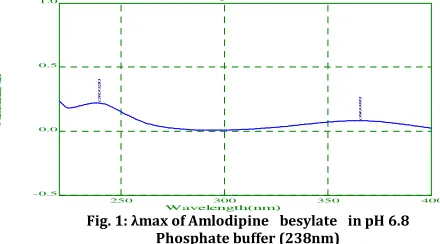
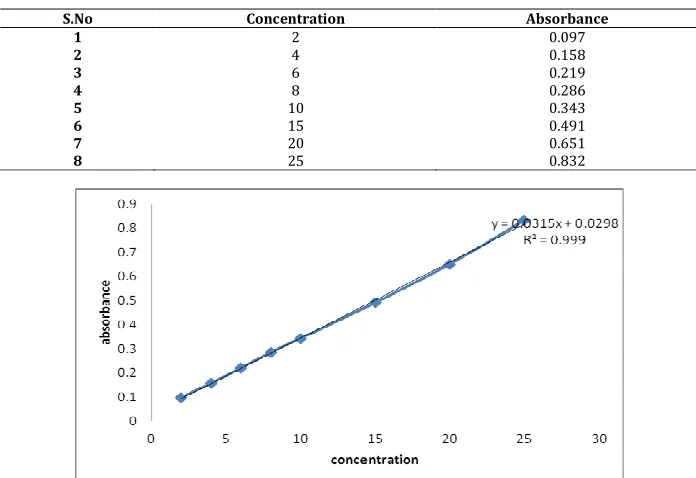
100mg of Amlodipine besylate was accurately weighed and dissolved in100ml of 6.8 phosphate buffer to obtain a concentration of 1000µg/ml. From the above 10ml was withdrawn and diluted to 100ml to obtain a concentration of 100µg/ml. From this stock solution aliquots of 0.5ml, 1ml, 1.5ml, 2ml and 2.5ml were diluted in 10ml volumetric flask with phosphate buffer to give concentrations in range of 5µg/ml to 25µg/ml respectively, absorbance was measured at 238nm as shown in fig 1and Table 1.
Sample-1
A
b
so
rb
an
ce
(A
b
s)
Wavelength(nm)
- 0.5 0.0 0.5 1.0
250 300 350 400
(
23
8.0
, 0
.2
210
)
(3
64
.0
, 0.0
81
7)
Ch. Anil Kumar et al., J. Sci. Res. Phar. 2014, 3(1), 1 - 5
Table No. 1: Standard graph of Amlodipine besylate in pH 6.8 Buffer
S.No Concentration Absorbance
1 2 0.097
2 4 0.158
3 6 0.219
4 8 0.286
5 10 0.343
6 15 0.491
7 20 0.651
8 25 0.832
Fig. 2: Standard graph of Amlodipine besylate in pH 6.8 Buffer
Drug- Excipient Compatibility by FTIR studies:
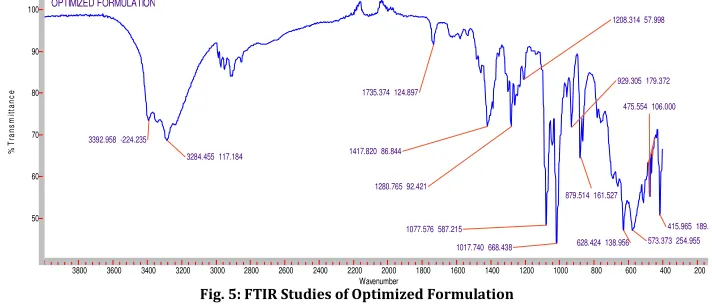
In the preparation of ODT tablet, drug and polymer may interact as they are in close contact with each other, which could lead to instability of the drug. Preformulation studies regarding drug-polymer interactions are therefore very critical in selecting appropriate polymers. FT-IR spectroscopy (AGILENT TECHNOLOGIES) was employed to ascertain the compatibility between Amlodipine besylate and selected polymers. The individual drug and drug with excipients were scanned separately.
Procedure:
Potassium bromide was mixed with drug and polymer in the ratio of 100:1 and pellet was prepared using KBr pellet press and spectrum was taken using FTIR (Agilent Technologies). FT-IR spectrum of Amlodipine besylate was compared with the spectrum of Amlodipine besylate and polymer. Disappearance of Amlodipine besylate peaks or shifting of peak in any of the spectra was studied [2,3,4].
FTIR Studies:
3004.421 30.764
2966.624 23.858 2838.489 25.864
2542.101 34.426
2459.550 27.100
2383.703 291.919
1741.779 537.082
1677.358 593.154 1607.286 184.862 1582.682 112.630
1509.500 351.702
1474.239 275.750
1412.225 130.162 1321.350 37.132
1215.631 651.557 839.158 175.736
781.495 218.455 665.779 158.435
568.633 129.966
531.929 125.402
479.928 260.237 435.801 77.043 415.876 15.337 PURE DRUG
3800 3600 3400 3200 3000 2800 2600 2400 2200 2000 1800 1600 1400 1200 1000 800 600 400 200 100
90
80
70
60
50
40
30
Wavenumber
%
T
ra
n
s
m
it
ta
n
c
e
Fig. 3: FTIR Graph of Pure Drug (Amlodipine besylate)
3348.185 356.340
2710.863 0.124
1731.637 416.639
1533.545 25.107
1405.523 109.385
1201.505 25.384
1019.265 35.534
848.185 47.780
799.182 48.772
707.445 46.555
546.995 74.394
523.571 46.926
DRUG +SSG
3800 3600 3400 3200 3000 2800 2600 2400 2200 2000 1800 1600 1400 1200 1000 800 600 400 200 100
95 90 85 80 75 70 65 60 55
Wavenumber
%
T
ra
n
s
m
it
ta
n
c
e
Ch. Anil Kumar et al., J. Sci. Res. Phar. 2014, 3(1), 1 - 5
3392.958 -224.235
3284.455 117.184
1735.374 124.897
1417.820 86.844
1280.765 92.421
1208.314 57.998
1077.576 587.215 1017.740 668.438
929.305 179.372
879.514 161.527
628.424 138.956 573.373 254.955 475.554 106.000
415.965 189.760
OPTIMIZED FORMULATION
3800 3600 3400 3200 3000 2800 2600 2400 2200 2000 1800 1600 1400 1200 1000 800 600 400 200 100
90
80
70
60
50
Wavenumber
%
T
ra
n
s
m
it
ta
n
c
e
Fig. 5: FTIR Studies of Optimized Formulation
Angle of repose:
The angle of repose of the blends was determined by the funnel method. The accurately weighed blend was taken in funnel. The height of the funnel was adjusted in such a way that the tip of the funnel just touched the apex of the heap of the blend. The blend was allowed to flow from the funnel on the surface. The diameter and height of the heap formed from the blend was measured. The angle of repose was calculated using following formula
Tan Ѳ= h/r ………… Eqn. (1)
Where, “h” is the height of the heap and “r” is the radius of the heap of granules.
Carr’s compressibility index:
The Carr’s compressibility Index was calculated from Bulk density and tapped density of the blend. A quantity of 2g of blend from each formulation, filled into a 10mL of measuring cylinder. Initial bulk volume was measured, and the cylinder was allowed to tap from the height of 2.5cm. The tapped frequency was 25±2 per min to measure the tapped volume of the blend. The bulk density and tapped density were calculated by using the bulk volume and tapped volume.
Carr’s compressibility index was calculated by using the following formula:
Carr’s compressibility index (%) = [(Tapped density-Bulk density) X100]/Tapped density.Eqn.(2)
Pre-compression parameters of Direct Compression method mean SD(n=3):
Table No. 2: Precompression Parameters
Formulation Bulk density Tapped density Angle of repose Carr’s index Hausner’s Ratio*
F1 0.49± 0.030 0.56± 0.04 28.43 ± 1.20 16 ± 1.41 1.20 ± 0.03
F2 0.52 ± 0.023 0.60 ± 0.02 30.1 ± 1.70 17 ± 1.20 1.21 ± 0.04
F3 0.54 ± 0.013 0.62 ± 0.01 30.72 ± 0.88 15 ± 2.51 1.19 ± 0.03
F4 0.52 ± 0.017 0.63 ± 0.01 29.25 ± 1.56 17 ± 1 1.20 ± 0.05
F5 0.53 ± 0.020 0.63 ± 0.01 30.02 ± 1.20 15 ± 1.51 1.19 ± 0.06
F6 0.53 ± 0.013 0.64 ± 0.02 30.1 ± 1.70 17 ± 1.20 1.20 ± 0.03
F7 0.55 ± 0.023 0.65 ± 0.01 30.20 ± 0.88 15 ± 2.51 1.18 ± 0.03
F8 0.50 ± 0.015 0.63 ± 0.01 28.43 ± 1.48 20 ± 1.58 1.26 ± 0.03
F9 0.52 ± 0.032 0.63 ± 0.02 30.72 ± 1.22 17 ± 1.55 1.21 ± 0.04
Preparation of tablets:
Different tablets formulations were prepared by direct compression technique. All powders were passed through 60 mesh. Required quantities of drug and polymers were mixed thoroughly Magnesium stearate was added as a lubricant. Talc was used as
glidant. Micro crystalline cellulose was used as diluent. Finally the powder mix was subjected to compression after mixing uniformly in a poly bag. Prior to compression, the blends were evaluated for several tests. In all formulations, the amount of the active ingredient is equivalent to 100mg of Amlodipine besylate [5-11] (Table 3).
Formulation Chart:
Table No. 3: Formulation Chart
S.No Ingredient F1 F2 F3 F4 F5 F6 F7 F8 F9
1 Amlodipine esylate 10 10 10 10 10 10 10 10 10
2 MCC 71 69 67 71 69 67 71 69 67
3 Mannitol 10 10 10 10 10 10 10 10 10
4 CCS 4 6 8 --- --- --- --- --- ---
5 CP --- --- --- 4 6 8 --- --- ---
6 SSG --- --- --- --- --- --- 4 6 8
7 Talc 2.5 2.5 2.5 2.5 2.5 2.5 2.5 2.5 2.5
8 Magnesium stearate 2.5 2.5 2.5 2.5 2.5 2.5 2.5 2.5 2.5
Total weight 100 100 100 100 100 100 100 100 100
Evaluation of Tablets:
A) Weight Variation Test:
From each batch twenty tablets were selected in a random and average weight was determined. Then individual tablets were weighed and the individual weight was compared with
an average weight, the variation in the weight was expressed in terms of % deviation.
B) Hardness and Friability Test:
Ch. Anil Kumar et al., J. Sci. Res. Phar. 2014, 3(1), 1 - 5
checked by using Roche Friabilator. This device subjects tablets tothe combined effect of abrasion and shock by utilizing a plastic chamber which revolves at 25 RPM dropping the tablets at a distance of 6 inches with an each revolution. Preweighed sample of tablets was placed in the friabilator, which was then operated for 100 revolutions. Tablets were dusted and reweighed and then % Friability was calculated.
C) Water Absorption Ratio and Wetting Time:
A piece of tissue paper folded twice was placed in a small Petri dish containing 6 ml of water. A tablet of known weight was put on the paper and the time required for complete wetting of the tablet was measured. The wetted tablet was then weighed; water absorption ratio R was determined using t
Wb - Wa R = --- x 100
Wb
Where; Wb is weight of the tablet before water absorption Wa is weight of the tablet after water absorption
D) Drug Content Uniformity Study:
Five tablets were weighed individually and powdered. The powder equivalent to 50 mg of Amlodipine besylate was weighed and extracted in 6.8 phosphate buffer (100 ml) and the concentration of drug was determined by measuring absorbance at 238 nm by spectrophotometer.
Postcompression Parameters: mean SD (n=3):
Table No. 4: Postcompression parameters
Formulation Hardness
(Kg/Cm2)
Friability % Thickness
(mm)
Weight varitation
Distegration Time(Sec)
F1 3.5 ± 0.21 0.71±0.12 2.21 ±0.16 109 ± 1.28 36±3
F2 3.8 ± 0.14 0.69±0.13 2.33 ±0.14 108 ± 1.32 28±1
F3 3.7 ± 0.15 0.39±0.17 2.32 ±0.17 104 ± 0.86 20±2
F4 3.6 ± 0.11 0.81±0.12 2.29 ±0.12 109 ± 1.78 48±1
F5 3.7 ± 0.12 0.64±0.16 2.30 ±0.15 102 ± 1.32 38±3
F6 3.9 ± 0.10 0.31±0.15 2.42 ±0.10 101 ± 0.56 29±1
F7 3.7 ± 0.12 0.62±0.18 2.31± 0.10 102 ± 1.97 35±3
F8 3.8 ± 0.18 0.47±0.17 2.32 ± 0.17 105 ± 0.85 28±1
F9 3.6 ± 0.10 0.65±0.15 2.36 ± 0.15 106 ± 1.73 21±2
In-Vitro Drug Release Study:
Dissolution rate was studied 6.8 phosphate buffer as dissolution medium. The temperature of the dissolution medium was maintained at 37±0.5ºC; aliquot of dissolution medium was withdrawn at every 2 minute interval and filtered. The absorbance of a filtered solution was checked by UV spectrophotometric method at 238nm and concentration of the drug was determined from the standard calibration curve. Dissolution rate was studied for all designed formulations [12-19].
In –vitro drug release studies details:
Apparatus used : USP XXIII dissolution test apparatus
Dissolution medium : 6.8 phosphate buffer at λ max 238 nm
Dissolution medium volume : 900ml
Temperature : 37±0.5ºC
Speed of basket paddle : 50rpm
Sampling intervals : 2min
Sample withdrawn : 5ml
Absorbance measured : 238nm.
In vitro dissolution studies:
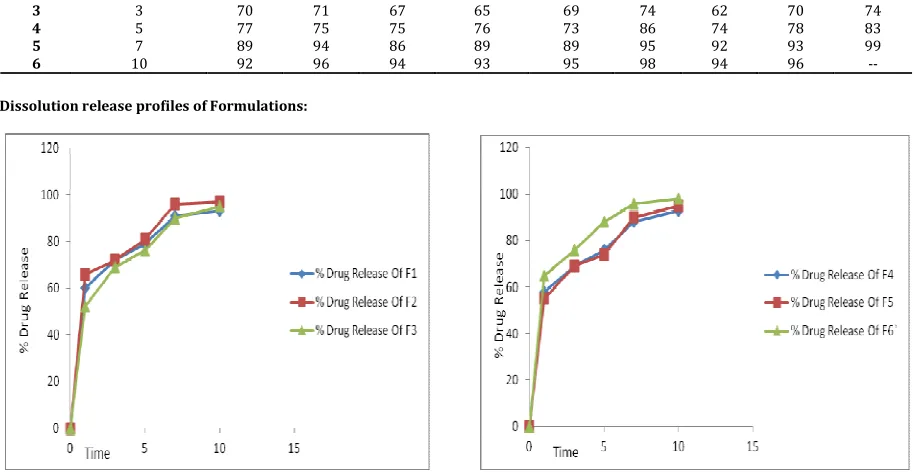
Table No. 5: % Cumulative Drug Release of the Formulations (f1-f9)
S.No Time(mins) F1 F2 F3 F4 F5 F6 F7 F8 F9
1 0 0 0 0 0 0 0 0 0 0
2 1 60 66 52 57 54 66 50 52 58
3 3 70 71 67 65 69 74 62 70 74
4 5 77 75 75 76 73 86 74 78 83
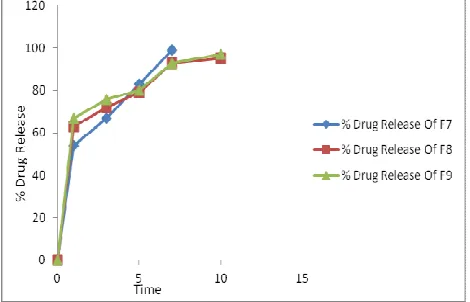
5 7 89 94 86 89 89 95 92 93 99
6 10 92 96 94 93 95 98 94 96 --
Dissolution release profiles of Formulations:
Fig. 6: Dissolution profiles of Formulations F1-F3 Fig. 7: Dissolution profiles of Formulations F4-F6
Ch. Anil Kumar et al., J. Sci. Res. Phar. 2014, 3(1), 1 - 5
Fig. 8: Dissolution profiles of Formulations F7-F9 (UsingSodium Starch Glycollate)
RESULTS AND DISCUSSION
A
mlodipine besylate has a UV absorbance of238 NM. Solutions ranging from 5 to 25 µg/ml were prepared using 6.8 Phosphate buffersseparately, absorbance was measured for each solution at λ max of 238nm using LABINDIA Double beam UV/ visible spectrophotometer, and graph was plotted for absorbance versus concentration of Amlodipine besylate. Standard graph of Amlodipine besylate in 6.8 pH Buffer at λ max 238nm. The drug compatibility studies were done by using FTIR and there is no interference to the drug and exipients. Precompression Parameters and post compression parameters were done and they were within the range.CONCLUSION
T
he fastest dissolving tablets of Amlodipine besylate were prepared successfully using Polymers in different ratios of by using Superdisintegrants. We can conclude Out of nine formulations formulated using various Superdisintegrants like CCS, CP, and SSG among these Formulation F9 containing 5 % Sodium Starch Glycollate (SSG) showed maximum drug release within 7 minutes of dissolution study. These formulations showed disintegrating times of 39 seconds respectively. Thus based on Disintegrating times and dissolution profiles, Formulations F9 is optimized to be the best among all the nine.ACKNOWLEDGEMENT
T
he authors are thankful for the management of MSN Pharmaceuticals, Hyderabad,A.P, India for the gift samples of drug and polymers used in the work.REFERENCES:
1. Renon J.P., Corveleyn S., rapidly disintegrating tablets, US Patent No. 6, 10, 719, 2000.
2. Indurwade N.H., Rajyaguru T.H. and Nakhat P.D. “Novel approach- Fast Dissolving Tablets”, Indian Drugs, 2002; 39(8): pp. 405-409.
3. Sohi H, Sultana Y, Khar RK. Taste masking technologies in oral pharmaceuticals: Recent developments and approaches.
Drug Dev. Ind.Pharm., 2004; 30: 429-448.
4. Seager H. Drug delivery products and zydis fast dissolving dosage form, J. Pharm. Phamacol., 1998; 50: 375-382. 5. Kuchekar B.S., Badhan A.C.and Mahajan H.S. “Mouth
Dissolving Tablets: A Novel Drug Delivery System”, Pharma Times, 2003; 35: pp-7-9.
6. Wilson C.G., Washington N., Peach J., Murray G.R. and Kennerley J. “The behavior of fast dissolving dosage form”
Int. J. Pharm., 1987; 40: PP 119-123.
7. Sastry S.V., Nyshadam J.R.and Fix J.A. “Recent technological advances in oral drug delivery- A Review”, Pharm. Sci.Tech.Today, 2000; pp 138-144.
8. Grother, L.P., et.al; “Taste masked fast dissolving tablets” Cardinal Health, PharmaceuticalTechnology and services.
9. Blank R.G., Mody D.S., Kenny R.J.and Aveson M.C. Fast dissolving dosage form US patent,4, 946, 684, 1990. 10. Sameer GL, Yu YY, Ajay BK. Effects of
disintegration-promoting agent, lubricants and moisture treatment on optimized fast disintegrating tablets. International Journal of Pharmaceutics, 2009.
11. Battu SK, Repka MA, Majumdar S, Rao YM. Formulation and evaluation of rapidly disintegrating fenoverine tablets: effect of superdisintegrants. Drug. Dev. International Journal of Pharmaceutics, 2007.
12. Srinivas. Making fast dissolving tablets by a direct compression method, by using cross caramellose sodium,
International Journal of Pharmaceutics, 2006.
13. Piera DM, Sante M,Pascal Wehrle. Evaluation of different fast melting disintegrants by means of a central composite design.Drug Development and Industrial Pharmacy., 2005; 1: 109-121.
14. Zhao N and Augsburger LL. The influence of swelling capacity of superdisintegrants in different ph media on the dissolution of hydrochlorothiazide from directly compressed tablets. AAPS Pharm. Sci. Tech., 2005; 6(1). 15. Sunada H, Yonezawa Y, and Danjo K. Evaluation of Rapidly
Disintegrating Tablets Prepared by a Direct Compression Method. Drug Dev. Ind. Pharma.,2001; 25(5): 571-581 16. Ishikawa T, Baku M, Shiraishi S, Utoguchi N, Fujii M,
Matsumoto M, Watanabe Y. Preparation of rapidly disintegrating tablet using new types of microcrystalline cellulose (ph-m series) and low substituted- hydroxypropylcellulose or spherical sugar granules by direct compression method). Chem. Pharm. Bull., 2001; 49(2): 230-232.
17. Ishikawa T, Watanabe Y, Utoguchi N, Matsumoto M. Preparation and evaluation of tablets rapidly disintegrating in saliva containing bitter-taste-masked granules by the compression method. Chem. Pharm. Bull.,1999.
18. Kaushik D. Prepared melt-in-mouth tablets by sublimation technique. Tablets were prepared by direct compression using directly compressible mannitol and ammonium bicarbonate as volatile salt. Drug Development and Industrial Pharmacy,2000.
19. Dandagi PM. Prepared taste masked ofloxacin mouth disintegrating tablets using Eudragit E100 as taste masking agent, International Journal of Pharmaceutics, 2006. 20. Berner, B., R. Birudaraj, S. Shen and X. Li. Buccal permeation
of buspirone: mechanistic studies on transport pathways. J. Pharm. Sci., 2005; 94: 70-78.
21. Ishikawa, T., N. Koizumi and B. Mukai. Pharmacokinetics of acetaminophen from rapidly disintegrating ompressed tablet prepared using microcrystalline cellulose (PH-M-06) and spherical sugar granules. Chem. Pharm. Bull. (Tokyo),
2001; 49: 230-232.
22. Price, T.M., K.L. Blauer, M. Hansen and F. Stanczyk. Single-dose pharmacokinetics of sublingual versus oral administration of micronized 17 beta-estradiol. Obstet Gynecol, 1997; 89: 340-345.
23. Available at http://www.drugs.com/pdr/amlodipinebesyla te.html.
Conflict of interest: The authors have declared that no conflict of interest exists.