Weighted Route Selection in Cluster-Based Protocol
for Wireless Sensor Networks
Rivo
S.
A.
Randriatsiferana
,
Herimpitia
T.
C.
Antilahy
,
Frederic
Alicalapa
and
Richard
Lorion
UniversityofLaReunion,LE2PLaboratory,SaintDenis,Reunion,France
Abstract
The efficiency of wireless sensor network is highly based on the algorithm complexity of the communication protocol which must minimize the energy dissipated by the sensor nodes. In order to pursue energy consumption minimization, this paper presents Weighted Route Selection (WeRoS) in Cluster-Based method, which uses multihop communication for data forwarding from cluster-head (CH) to the base station as a unique path. WeRoS takes also into account the remaining energy of a node and its coefficient of variation during CHs selection process. A novel-scheduling algorithm is also proposed, in which the CHs can self-organize themselves during the data transmission phase. This algorithm is executed in the cluster formation phase, in order to avoid another phase of route discovery and to conserve energy, while considering the node memory constraint. Complexity analysis and simulation results show that WeRoS can efficiently balance the energy consumption and extends the network lifetime.
Keywords: binarygreedyforwarding,cluster-based,energy-balance,networklifetime,self-organization,wirelesssensor 3FDFJWFEPO+VOFBDDFQUFEPO4FQUFNCFSQVCMJTIFEPO.BZ
$PQZSJHIUª3JWP4"3BOESJBUTJGFSBOBFUBMMJDFOTFEUP&"*5IJTJTBOPQFOBDDFTTBSUJDMFEJTUSJCVUFEVOEFSUIFUFSNTPGUIF $SFBUJWF$PNNPOT"UUSJCVUJPOMJDFODF IUUQDSFBUJWFDPNNPOTPSHMJDFOTFTCZXIJDIQFSNJUTVOMJNJUFEVTFEJTUSJCVUJPOBOE SFQSPEVDUJPOJOBOZNFEJVNTPMPOHBTUIFPSJHJOBMXPSLJTQSPQFSMZDJUFE
doi:FBJ
1. Introduction
Through technological advances in recent decades, soci-ety rapidly comes closer to an ubiquitous information systems era, composed of many digital distributed sys-tems in our physical environment. The main idea is based on embedded computing tools in objects of every-day life. In other words, this is an era of technological convergence in which a set of disparate equipments discreetly communicates through a network of hetero-geneous networks.
Distributed measurement systems contribute to this evolution through the development of wireless sensor networks (WSN). The miniaturization of microelec-tronics, micro-mechanical and communication systems has enabled the realization of wireless communicating sensors, allowing rapid deployments. The operational nature and expected features essentially depend upon constraints: energy and its correlated management [4]. A WSN is a set of nodes communicating over wireless links. It allows observing a given phenomenon in a geographical area. Actually, WSN has important appli-cations in various fields with latest technologies [3].
Controlling the energy consumption of WSN in order to maximize a network lifetime remains the most
∗Corresponding author. Email:[email protected]
crucial challenge. This challenge must be considered in the current context: nodes are small embedded components with limited resources, mainly memory capacity, data processing, communication range and non-rechargeable energy [3, 16]. Additionally, the communication part is the major energy consumer in these nodes [14]. Most of these applications area, such as battlefields, volcanoes and forests monitoring, industrial and clinical fields, requires that the WSN has a certain degree of autonomy: it has to run correctly without assistance, when human interventions and supervisions are difficult or impossible [11]. Therefore, sensor networks operation in a self-configured ad-hoc network and standalone mode became indispensable. This requires a well-organized network architecture in which the "next-hop" data transmission range toward the Base Station (BS) should be minimal as possible, with nodes autonomous decisions.
Architecture hierarchy has already been demon-strated as one of the best method to organize the network into a connected hierarchy, load balancing, increasing the network lifetime. It considerably allows light memory constraint due to the reduction of the routing table of each node when network scalability increases. Moreover, it avoids frequent broadcasts that can overload nodes [10, 11]. In fact, this architecture
on
)XWXUH,QWHUQHW
Research
Article
consists of partitioning the network as virtual clus-ters. In order to effectively ensure the load balance between nodes, some of them are sometimes elected as leader, which are usually called cluster-heads (CHs). In this case, the CH ensures that the data collection and aggregation from member nodes is operational. Afterwards, the aggregated data will be sent directly to the BS or through other CHs. Therefore, they gener-ally consume more energy than the member nodes in the fact they perform these additional tasks. The CH selection method becomes a main key in the clustering process [11]. It has to ensure load balancing and a good geographical CH distribution in the network. A common solution to balance this energy consumption between all nodes of the network is to periodically elect new CHs. Thus the role as CH should be distributed over time (rounds) to all nodes in the network.
Basically, the process of clustering is divided into two main phases: the cluster construction phase and the data communication phase. The cluster construction phase consists of CH node selection method, such as probabilistic or non-probabilistic, and members node assignment to a cluster. While the data communication phase focuses not only on reliable data transmission to the BS, but also on finding optimal routes to enhance energy efficiency. Two possibilities can be used for the data communication process: one-hop and multi-hop communications [2,9,11].
One-hop communication assumes that all nodes can communicate directly with the BS. Although, this assumption could be appropriate for a small network but it penalizes distant nodes. The furthest CHs (from the BS) will die more quickly according to the longest transmission distance [8]. This can result in areas that will not be covered during network operation [11]. Also, it is important to adopt a multi-hop communication between distant CHs and the BS, as much as possible, to improve the network coverage. However, multi-hop communications generally route data using fixed paths and overuse the nodes closest to the BS, making them also die quickly and resulting in the existence of energy holes [17,18]. Therefore, energy hole avoidance mechanism that ensures the data transmission, and adequate CH nodes selection that ensures energy balanced across the network, should be established.
In this paper, we propose a Weighted Route Selection in Cluster-Based Protocol for WSNs, denoted WeRoS, to mitigate the mentioned problems. WeRoS is an energy-efficient protocol that combines the CH selection rotation and a multi-hop data communication in order to extend the network lifetime. In fact, during the clustering process implementation, WeRoS adopts the probabilistic, adaptive and distributed approach. The CH selection depends on the remaining energy of the nodes and its coefficient of variation. These parameters are introduced to elect CHs by maximizing
the remaining energy as well as minimizing its variance. This is useful to predict node state and to ensure balanced energy consumption over all nodes in the network. However, given the probabilistic and distributed feature, the main challenge is to ensure the existence of an optimal number of CHs at each round. WeRoS will focus on that point. In the data transmission phase, a self-scheduling algorithm named "Binary Greedy Forwarding" is proposed. It consists of designing an adjacency table between CHs in order to establish communication between CHs and BS. So that CHs can be self-organized during the data transmission phase. The data routing is based on the construction of "elementary path" which passes only one time through a CH to address the energy hole problem. To implement these features, we introduce a weight at each node. It depends on the remaining energy and the distance between the elected CH and the BS.
The paper is organized as follows: in section2related works are presented. Section3describes the proposed WeRoS protocol and its algorithm. In Section 4, simulation context and results are given and discussed. And finally in Section5, conclusions are exposed.
2. Related works
communications between the nodes and the BS. This is a problem.
Several distributed protocols have also been pub-lished such as Advanced-LEACH [2] and Deterministic CH Selection (DCHS) [6]. They also address the energy problem by taking into account the remaining energy as the main metric in the CHs selection operation, but in a distributed process. Recently, e-LEACH [15] was proposed to improve the CHs selection by introducing an energy variation coefficient. The reduction of energy consumption phenomena has evolved, and the CHs layout is well distributed by setting as a main goal the following criteria: all nodes in the network should consume, approximately, the same amount of average energy at each round. However, the problem of unbal-anced energy consumption still exists due to a direct communication between CHs and the BS. Therefore, a cluster-based routing protocol with equalized energy consumption has to be found.
A well-known evolution of LEACH is Hybrid Energy-Efficient Distributed (HEED) [19]. The HEED clustering protocol uses a hybrid criterion for CH selection. It considers the residual energy of each node to elect tentative CHs, and the final CHs are elected according to the intra-cluster communication cost. Its main targets are to achieve "even-distributed" CHs over networks and to reduce long distance transmission. But it cannot guarantee an optimal elected set of CHs. And the weakness of using "Tentative Status" algorithm is the communication strategy of isolated nodes. Indeed, they are forced to be CHs and to directly transmit their data to the BS. The iterative nature of the CHs election is one more weakness due to many communications exchanges.
Other approaches were proposed to improve the performance of clustering. EEUC [5], addresses the hotspot problem: the CHs closest to the BS are burdened with heavy relay traffics and tend to die early. EEUC partitions the nodes into clusters of unequal size, and clusters closer to the BS have smaller size compared to those further from the BS. EECS [5], another extended version of LEACH, realizes a localized selection of CHs and a near uniform distribution of them. In cluster formation phase, a non-CH node chooses its corresponding CH by considering not only saving its own energy, but also balancing the load of CHs. EECS requires the global distance between all CHs and the BS and all nodes have to contribute to become CH. Those requirements substantially increase the overhead complexity of control messages.
3. Weighted Route Selection in Cluster-Based
Protocol
In this section, we present WeRoS protocol, which is proposed not only to enhance the network lifetime but
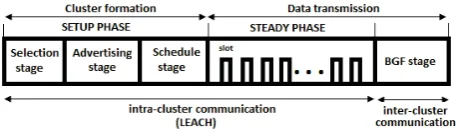
also to avoid energy hole problem by balancing the nodes energy consumption. The communication mech-anism of WeRoS protocol includes cluster formation phase and the data transmission phase. The organi-zation of cluster construction phase is based on the clustering method of LEACH protocol [7]. Nevertheless, WeRoS provides an optimized threshold function to elect the CH nodes by ensuring their existence at each round, in which, the data communication phase is made up of the "intra-cluster" and "inter-cluster" communica-tion (Fig.1).
Figure 1. Communicationmechanismof WeRoS protocol.
In the main, WeRoS protocol is based on the following mechanisms:
1. Intra-cluster communication consists of:
- The formation of clusters is periodic and under control of CHs.
- Data transmission between a CH and its node members is done in one-hop.
2. Inter-cluster communication consists of:
- Create an adjacency table between CHs by defining a scheduling function weight.
- Communication between CHs and the BS is done in multi-hop path if the base station cannot be reached directly.
Additionally, the following hypotheses are introduced:
1. all the nodes embed a voltage battery monitor electronic circuit. And the voltage value can be used for local calculus.
2. All the nodes also embed RSSI (receiver signal strength indication) circuit, to estimate the distance to any compatible emitter. Our approach considers static nodes.
3. Energy initial state is the same for all the nodes: for the simulation step, using TelosB nodes, two 3.3 mAh, 1.5 V batteries will be considered to provide the supply voltage for each node.
3.1. Energy
m
odel
transmission is based on radio-electronics and power amplifier characteristics. Moreover, the power amplifier model is based on the distance, by assumingd2for the free-space (f s) power loss andd4 for multipath (mp) fading channel. The energy consumed for transmission (ET X), of anL-bit message over distancedis:
ET X(L, d) =
Etx·L+f s·L·d2, if d≤do
Etx·L+mp·L·d4, if d > do (1)
With:d0=
f s
mp.Etx is the transmit energy consumed per bit. Whereas, the energy consumed to receive the
L-bit message, can be found by:
ERX(L) =ERx−elec(L) =Erx·L (2)
whereErxis the receiving energy consumed by the radio transceiver. The energy consumed in data aggregation at the CH from itself and m neighbor nodes is represented as:
EDA= (m+ 1)·L·Eda (3)
whereEda is the energy required to aggregate one-bit data. Through this model, the energy dissipated by the CH in a round is given by:
ECH = (nk −1)L·Erx+nkL·Eda+L·Etx+mp·L·dtoBS4 (4) wheredtoBS is the distance between CH and the BS. The energy dissipated in each non-CH node is expressed by:
EnonCH =Etx·L+f s·L·dtoCH2 (5)
3.2. Intra-cluster co
mm
unication
The organization of the intra-cluster communication can be organized as follows: when the CH was selected, the CSMA protocol is used to broadcast advertisement messages "AdvMsg" to nodes in the network (Fig.1
"Advertising Stage"). All nodes estimate their distances to CHs based on RSSI. Then, the nodes send a "Join-Request" message to the nearest CH again using the CSMA protocol. Once the CH has received all the information messages, it uses TDMA to schedule the data reception that is based on the number of member nodes in the cluster. Afterwards, it sends notification to its member nodes (Fig.1"scheduling stage").
Cluster-head selection. Given the role supported by the CHs, it obviously consumes more energy than the member nodes. It makes sense that selecting as CH the node having the most reserve energy and rotate the role of CH periodically between nodes significantly extend the network lifetime [6]. However, the problem of unbalanced energy consumption persists because of the random deployment of the nodes and non-uniform
node distribution. Therefore, WeRoS incorporates the residual energy value and its variation coefficient as main criterion to select CH. The coefficient of variation represents the ratio of the standard deviation to the arithmetic mean. This is a useful for statistical measurement of the dispersion, and also for comparing the degree of variation of the remaining energy of all nodes, even if the means are radically different from each other [12, 13]. And then, the efficiency of this dispersion measurement,EFFi (r), can be defined as the square of the variation coefficient, i.e:
EiFF(r) = (σ i(r)
μi(r))
2= Vi(r)
μi2(r) (6)
σi(r),μi(r) andVi(r) denote the standard deviation, the arithmetic mean and the variance of remaining energy of the nodei at roundr, respectively.
At first round, the variance of remaining energyνi(r) value equal to zero, then the efficiencyEFFi (r) goes to 0. However, so that we can see the impact of the variance and efficiency, we intend to be biased the remaining energy with it. Therefore, this efficiency should be initialized to 1 to ensure the convergence of our algorithm. Thus, a convex function γi(r) is proposed, by considering the target, which tries to maximize the average of remaining energy while minimize the variance of remaining energy of node. Let’s defineγi(r) as follow:
γi(r) = μ i2(r)
μi2(r) +ζVi(r) (7)
Where ζ is a tunable constant which is introduced to guarantee the same order of magnitude for the mean and the variance. Its value depends on the simulation parameters.
For choosing a node with highest value of remaining energy and lowest variance of energy consumption to become CHs, the remaining energy can be weighted by theγi(r) function. Thus, the threshold expressionpi(r) for CH selection proposed in [7] is modified as follow:
pi(r) = ⎧ ⎪⎪⎨
⎪⎪⎩ N−k∗(r modk N k)
γi(r)∗Ei(r)
Eo , Ci(r) = 1
0, Ci(r) = 0
(8)
Ei(r) denotes the remaining energy of nodei,C
i(r) is an indicator function, withCi(r) = 1 if node has not been a CH, andCi(r) = 0 otherwise.
Via this criteria selection, the node will be selected as CH in the current round, which ensures that the data should be collected to a node having a higher energy reserve value and lower variance.
mentioned in [6]. As the network runs continuously, the energy reserve of nodes progressively deviates from equality. Thus, theγi(r) expression considerably plays an important role.
To determine the mean and the variance values of remaining energy, all nodes must keep their previous remaining energy from first round to the current round (e.g.:R= 1 toR= 450 rounds). That puts a high burden on nodes to their limited processing and memory capacities and this iteration may create latency. Thus, it leads to a node’s dysfunction in this case, and it will also disturb the whole network operation. Therefore, it is preferable to use another method to calculateμi(r) andVi(r) in order to reduce the cost of the computation load. By using a moving average method deduction, we can recursively defineμi(r) as follows:
μi(r) = (r−1)·μ
i(r−1) +Ei(r)
r (9)
andVi(r) it can be written:
Vi(r) = (r−1)· Vi(r−1) +Ei2(r)
r −μ
i2(r) (10)
In this recursive average approach, the result obtained is exactly as an arithmetic mean that is a benefit. In addition, in a practical manner, a node just memorizes its previous average remaining energy.
Optimal number of Cluster-Head. After a long running time, nodes in the network have little energy left. Then,
the expression factor γi(r)∗Ei(r)
Eo , in equation (8), becomes smaller. This phenomenon will lead to the issue that the CHs number is too small in (r mod (N /k)) rounds, or, there is no CH in a round. The factor γi(r)E∗Ei(r)
o should be controlled by applying the threshold pi(r) in order to guarantee the existence ofkclusters number in each round.
Following the analysis in [7], author has proved that the probability function generated by Pi(r) =
k N−k∗(r modN
k)
can ensure that there iskoptimal number of CHs in each round, if this probability threshold is less than a number choose randomly in the range [0 1]. But in our approach, equation (8) will break this balance. However, the existence ofk cluster should be ensured. To do that, WeRoS proposes the lemma3.1:
Lemma 3.1.The expected optimal number of CHs k is guarantee in theI interval [0 γi∗EN CH(r)
Eo ].
Where EN CH(r) : Average of remaining energy of nodes that have not been CH in the previous round.
Proof. The expected number optimal k of CH can be defined as [7]:
E[#CH] = N
i=1
Pi(r)∗Ci(r) =k
Where Pi(r) is the node i probability computing by itself in order to react as CH or not, in the current round [7]. In our case, Pi(r) can be obtained by normalizing
pi(r) in theIinterval:
Pi(r) = p i(r)−0 γi∗E
N CH(r)
Eo −0
= k
N−k∗(r modNk)
γi(r)∗Ei(r)
Eo
Eo
γi ∗E N CH(r)
= k
N−k∗(r modNk)
Ei(r)
EN CH(r)
Thus,
E[#CH] = N
i=1
k
N−k∗(r modNk)
Ei(r)
EN CH(r)
∗Ci(r) (11)
• Considering N i=1
Ei(r)
EN CH(r)∗Ci(r), Ci(r) = 1, if the node is eligible to become CH and Ci(r) = 0 otherwise. Hence, this term is the total energy remaining of the nodes has not been already elected as CHs divide by its average. Then, it represents the total number of nodes that have not been selected, which are eligible to be a CH in the current round. Thus,
N
i=1
Ei(r)
EN CH(r)
∗Ci(r) =N−k∗(r modN
k) (12)
The equation (11) can be rewritten as:
E[#CH] = k
N−k∗(r modNk) N
i=1
Ei(r)
EN CH(r)
∗Ci(r)
By considering (12), thus
= k
N−k∗(r modNk)∗(N−k∗(r mod
N k))
=k
As a result, the average number of CHsk per round is guaranteed.
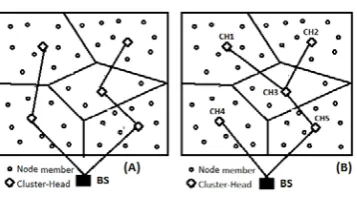
Figure 2. WeRoS Network Topology
3.3. Inter-cluster co
mm
unication
The inter-cluster communication step consists of the data delivery between the furthest CHs to the BS. In which, the main target is to find an optimal path to balance the energy consumption. In fact, to solve the multi-hop communication paradigm as overloading the CHs closest to the BS, WeRoS proposes an novel algorithm which construct a single path from a CH toward the BS (Fig.2a). Furthermore, WeRoS also proposed that the CHs, which have already participated in the data transmission, should go to sleep mode, to conserve energy. Accordingly, this can generate isolated CH. Therefore, if the BS is not reached directly, the data will be lost. Thereby WeRoS presents the Binary Greedy Forwarding algorithm (BGF), which tends to overcome this problem (Fig.2b). The BGF algorithm consists in the design of a scheduling algorithm between the CHs and the BS so that the CHs self-organize themselves during the data transmission phase, in the inter-cluster communication step. Indeed, the CHs just keep in their routing table the successor ID (SID) and the number of their predecessor (NP). The NP impacts the fact the CH should participate or not in the data transmission. Afterwards, if the CH has no predecessor, it may decide autonomously to communicate to his successor.
Overview Binary Greedy Forwarding algorithm. BGF algo-rithm runs in the data transmission phase (Fig.1 :Inter-cluster communication). Before developing this algo-rithm, let’s firstly consider the graph (Fig.2b), by refer-ring to its adjacency matrix (Table.3). It is called Boolean Matrix, which indicates the existence of a link between two CHs. BGF main goal is not only to build an elementary path for each CH, but also to order the CHs actions from furthest CH to BS (Fig.2a). However, there is a critical case, for example,CH4may be not accessible by CH1. In fact, CH1 must go through CH3 (Fig.2b). Furthermore, the nodeCH3must choose a path between ofCH4 orCH5. For easier analysis, the binary table is adopted which can be defined as follows: we assign the value 1 if the link (CHi, CHj) exists, and 0 otherwise.
In light of this table, the columns represent predecessor table of CHs, while the lines represent its table successor. First, reasoning on the predecessor table: columns only containing 0 (no link), it means
Figure 3. Booleanmatrix of link existence.
that the node has no predecessor (NP=0). Therefore, nodes can react as a source without waiting for any predecessor (CH1 and CH2). Let suppose that
CH5 is considered as CH3 successor, then CH4 can also react as a source and obviously, the BS is its successor. On the other side, for CH3 and CH5 their predecessor table is marked by 1, so they have to wait for their corresponding predecessors. Then, if we now examine the successor table (lines): rows only containing 0 (no link, BS excluded), it means that the node has no successor. Therefore, the nodes can react as sink (CH4 and CH5). They have to wait for their corresponding predecessors before sending their data to the BS. The following algorithm provides an overview of establishing a link between CHs.
Algorithm 1:BGFalgorithm
Input: NP[i]: NP ofCHietΩ: set of CHs
Result: Ordered construction of the link of CHs. fori ←1toCard(Ω)do
ifN P[i] = 0then
forj←i+ 1toCard(Ω)do ifmij = 1then
Establish the link between(CHi,CHj);
N P[j] =N P[j]−1; end
end end end
In practical, the nodes only need a table containing its successor ID (SID) and the number of its predecessors (N P). This method carries on benefits on memory constraint and the iterations number of computation. For example, CH3 only keep its SID and its N P, respectivelyN P= 2 andSID= 5. This node must wait for data fromCH1andCH2.
to react as a primary source without its intervention. For that purpose, all CH nodes evaluate the following weight valueψi:
ψi(r) = (1− RT h
Di(rssi))
Ei(r)
Eo
(13)
Where Ei(r), E0: remaining energy and initial energy value of the CH i, respectively. Di(rssi): distance to the BS estimation according to RSSI value, and RT h is its communication range threshold. In relation (13), the remaining energy of the node is biased by their distance from the base station. Therefore, the weight value depends strongly on the distance. The remaining energy is required when the node should select a route among its neighbors. Based on this relationship, two cases could be envisaged:
Case 1.IfDi(rssi)≤RT h, then the value ofψi(r) becomes negative or zero. Thus, the BS is in the coverage radius of the cluster. In fact, the CH can communicate directly with the BS unless there is no predecessor.
Case 2.If Di(rssi)> RT h, then the value of ψi(r) is certainly positive. Furthermore, if the node is further away from the base station, the weight value increases. Thus, the CH shall communicate to multi-hop.
Indeed, this expression allows the CH to pick one of his neighbors who has a high weight. This choice is to build an elementary path and also to avoid overloading the CH closer to the BS. Let assume, Ω is the set of CH neighbors of the cluster CHi and Ψ as the set of these weights. The binary matrixmij can be defined as follows:
mij = ⎧ ⎪⎪⎨
⎪⎪⎩ 1, ifψj = maxk∈Ψi (Ψk)
0, otherwise (14)
In other words,
route(CHi, CHj) = (CHj, ψj)∈Ωi ×Ψi, ij |ψj =max(Ψ) (15) If a CH receives data from another CH, it will forward the data directly to its next hop without aggregation, and go to sleep mode to save energy.
Principle of the protocol based on the algorithm BGF. Given that, once the CH selection phase is completed, the CH broadcast an announcement message "AdvMessage" to all nodes in the network whereby those nodes can join the closest CH to them. The CH is often in idle listening in order to access transmission medium (CSMA), which generates significant energy consumption. In fact, the advertisement message "AdvMsg" should be contained theID and the weightψi of the node. The goal is not only in order to avoid wasting this energy but also to prevent another route discovery after cluster formation, like we seen in [5, 10, 17]. Moreover, the others CHs can determine the number of its predecessor (N P) and
theIDof its immediate successor (SID). By considering the memory capacity and computation constraint, the CHs just only memorize its SID and its N P. Then, a predecessor counting principle is done locally at each time the node hears the "AdvMsg" message. The following algorithm carries a comprehensive view of determination of theSIDandN Pof each CH.
Algorithm 2:Determination of the SID and NP Input:ψi(r) ofCHi
Result: SID[i], NP[i] ofCHi max←0
N P[i]←0
Broadcast AdvMSG(ID,ψi) ifψi ≤0then
SID[i]←BS.Id else
while("Advertising stage"has not finished)do Receive AdvMSG(ID,ψi) message
if ψi >ψjthen ifmax≤ψjthen
max←ψj SID[i]←CHj.Id end
else
N P[i] =N P[i] + 1 end
end end
This algorithm runs during the "Advertising Stage" of the cluster formation in the intra-cluster communi-cation to reduce the overhead complexity of control message.
4. Analysis and Simulation
The performance evaluation of our algorithm has been simulated in Matlab, a series of simulation experiments were conducted. In order to investigate the feasibility and effectiveness of WeRoS, we compared it with LEACH, LEACH-C, e-LEACH and HEED. e-LEACH is one-hop version that considers only the optimized threshold (equation.8).
4.1. Co
m
plexity Analysis
Lemma 4.1.During clustering process, the control messages complexity in WeRoS protocol across the network isO(N).
Proof. The cluster formation process of WeRoS is the same of LEACH protocol [7]. Let assume, there areN
message "AdvMsg" and schedule message, while each cluster member node sends "Join Request" to the respective CH, where the total number isN−k. Thus, the total overhead control message in the entire network is: 2k+N−k=k+N Therefore, the control messages complexity isO(N)
HEED is a distributed protocol [19], the cluster construction phase is therefore localized. In addition, the CHs are selected with iterations. Thus, it provides an upper-bound control messages complexity ofNiter×
N. Where Niter is the iterations numbers. Therefore, WeRoS algorithm is much better than HEED in term of control messages.
Lemma 4.2.Node information stored complexity in each node during data transmission isO(1).
Proof. This analysis is proved according to the node’s role respectively.
Case 1, For the CH node: After data collection from member nodes, each furthest CH to BS start to transmit its data. In this case, it should only consider successor ID information. Thus, the complexity of node information stored in a CH isO(1).
Case 2, For member node: After receiving scheduling message, each node only keeps about its CH’s information. Thus, the complexity of node information stored in each member node isO(1).
Therefore, the node information complexity stored during data transmission phase in each node is
O(1).
By considering lemma(4.1) and lemma(4.2), WeRoS proved that it presents a lower complexity in the different phases of its algorithm. Therefore, WeRoS is an energy-efficiency protocol.
4.2. Si
m
ulation para
m
eters
Hundred sensor nodes have been deployed randomly in a 100x100 square meter area. For our simulation, we have taken standard values from the Chipcon RFIC datasheet [1]. Transmit energy consumed for a one packet transmission, Etx, was 0.121mJ and receiving energy consumed,Erx was 0.208mJ. The initial energy of each node was set to 100mJ. The data payload have the same length L= 320 bits. The other radio parameters are the same as in [7]: the consumed energy for data aggregation Eda= 5nJ, the transmit amplifier free-space parameter f s = 10pJ/bit/m2 and the transmit amplifier for multi-path fading parameter
mp= 0.0013pJ/bit/m4. First, we provide a study of the energy efficiency of the five algorithms by examining the network lifetime.
0 50 100 150 200 250 300 350 400 450 500 550
0 10 20 30 40 50 60 70 80 90 100
Time step[rounds]
Number of live nodes
LEACH LEACH−C e−LEACH HEED WeRoS
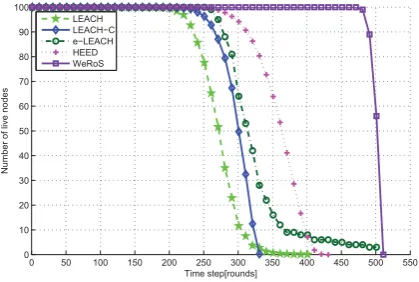
Figure 4. Comparison of network lifetime.
4.3. Network lifeti
m
e
Fig.4illustrates the comparison between WeRoS, HEED, LEACH, LEACH-C and e-LEACH protocol in term of the lifetime per rounds. This results show that WeRoS algorithm outperforms the others algorithms regarding the number of alive nodes. This is the fact that in LEACH, LEACH-C as well as e-LEACH protocol, each CH directly sends the aggregated data to the BS. Therefore, the CHs that are further from BS used a higher transmission power. This implies the rapid depletion of batteries of the CH nodes. Nevertheless, the performance of HEED and WeRoS comparing with LEACH, LEACH-C and e-LEACH can be explained by the fact that these HEED and WeRoS use multi-hop communication between CHs and BS in the data transmission phase. But, HEED is an iterative algorithm; it requires a lot of information exchanges to form clusters, which are energy consuming. On the other hand, the WeRoS protocol considers the remaining energy of the node in routing process between CH to the BS. And, it considers the energy dispersion in the CHs selection stage. Moreover, it presents a low complexity algorithm to form a cluster, which allows it to outperform the HEED algorithm.
Figure 5. Coefficient of synchronous death
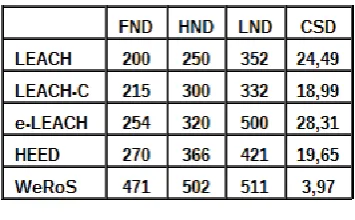
presented algorithms. Table(5) resumes those results, and also presents the coefficient of synchronous death (CSD).
4.4. Coefficient of synchronous death
The coefficient of synchronous death (CSD) of nodes can be defined as follows:
CSD=
HN D−FN D HN D +
LN D−HN D LN D
2 (16)
This expression is used to evaluate the death rate dispersion of nodes around HNA metric. If CSD is equal to zero that means nodes are died simultaneously. Therefore, energy balance scheme is achieved, and by the way the energy hole problem is completely solved.
Table(5) shows that the CSD value of WeRoS is smaller than other protocols. This means that WeRoS effectively presents stable energy consumption across all the nodes. Resulting in the fact that the nodes die almost simultaneously which proves the efficiency of load balancing.
4.5. Average residual energy
The energy-efficiency provided by WeRoS is clearly confirmed by the results in Figure(6). This figure illustrates the global evolution of the average remaining energy of the network over time step (rounds) compared to LEACH, LEACH-C, e-LEACH and HEED. We clearly see that WeRoS and HEED improve the energy expenditure than the others one-hop considered protocols. This comes from the fact that HEED and WeRoS address the communication problem between CH and the BS. In WeRoS, just after data collection of all CH from member nodes, CHs that are further from the BS dynamically chooses the CH successors. To which, they deliver the aggregated data, by the construction of an elementary path. Thus, the CHs progressively route the data to the BS by adjusting the transmission power depending on the distance to CH successor. It helps balancing the energy consumption of CH. Speaking about the HEED protocol; the CH selection process depends on residual energy and distance by
0 50 100 150 200 250 300 350 400 450 500 550
0 1 2 3 4 5 6 7 8 9 10
Time step[rounds]
Total remaining energy [J].
LEACH LEACH−C e−LEACH HEED WeRoS
Figure 6. Average remaining energy of the network.
using iteration algorithm, which requires significant time when the nodes are far from the BS. And, the "Tentative Status" mechanism used for CHs election in HEED, favors the existence of isolated nodes. The isolated nodes can be self-elected to become CH, and can also communicate directly to the BS. Therefore, this direct communication between distant CHs and the BS is an energy-intensive. This is one of the main causes why WeRoS outperforms the HEED.
In Fig.6, as the network runs to 200 rounds, the average remaining energy of all the nodes in the network for LEACH, LEACH-C, e-LEACH, HEED and WeRoS, are respectively 2.4J, 3.26J, 4.2J, 4.9J and 6.1J. That means WeRoS exhibits 95%, 87%, 45% and 24% reduction in energy consumption over LEACH, LEACH-C, e-LEACH and HEED.
4.6. A
m
ount of data collected at the BS
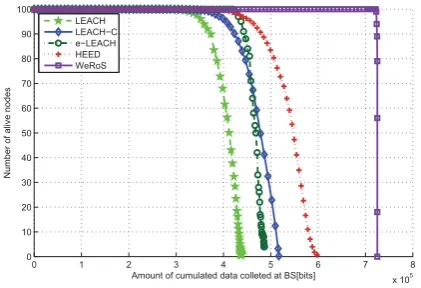
Figure 7 shows another comparison between LEACH, LEACH-C, e-LEACH, HEED and WeRoS protocol in term of amount of cumulative data collected at the BS according to the number of alive nodes in the network. The results presented in this figure demonstrate the effectiveness of WeRoS. It can deliver more amounts of data than others. According to HNA metric, WeRoS can deliver 7250kBit while LEACH, LEACH-C, e-LEACH, HEED cannot deliver more than 4121kBit, 4624kBit, 4782kBit and 5447kBit. Hence, WeRoS increases the amount of delivered data by 76%, 57%, 51% and 33% comparing to LEACH, LEACH-C, e-LEACH and HEED, respectively.
5. Conclusion
0 1 2 3 4 5 6 7 8 x 10⁵
0 10 20 30 40 50 60 70 80 90 100
Amount of cumulated data colleted at BS[bits]
Number of alive nodes
LEACH LEACH−C e−LEACH HEED WeRoS
Figure 7. Amount of cumulative data collected at the BS.
balance the energy consumption between nodes. Furthermore, multi-hop routing process during data transmission was considered to reduce the global energy consumption. Based on the considered network assumptions, simulation results show that this protocol exhibits satisfactory comparative performances on energy consumption reduction, nodes synchronous death, and increases the network lifetime.
Inter-cluster and intra-cluster communication are always considered as no retransmission operations. However, a retransmission is required when a transmit-ted packet contains at least one error. In this context, an improvement of convex function and the threshold expression should be tuned: the energy consumed per bit transmitted to obtain a minimum variation of energy per bit transmitted successfully will be introduced.
Measurements on energy characterization of the cluster formation phase and data transmission phase currently are under study.
Acknowledgement. We acknowledge the financial support of structural funds of the European Community, the French Government and the Regional Council of Reunion Island (Region Reunion) for providing research grants (PO FEDER Convergence 2007/2013, 2013-32 933 Carerc Project).
References
[1] (2006) Cc2420 data sheet. URL http://www.chipcon. com/files/CC2420_Data_Sheet_14.pdf.
[2] Ali, M.,Dey, T.andBiswas, R.(2008) Aleach: Advanced
leach routing protocol for wireless microsensor net-works. InICECE 2008. International Conf. on: 909–914. [3] Arampatzis, T.,Lygeros, J.,Member, S.andManesis, S.
(2005) A survey of applications of wireless sensors and wireless sensor networks. In Proc. 13 th Mediterranean Conference on Control and Automation, Limassol: 719–724. [4] Baronti, P.,Pillai, P.,Chook, V.W.,Chessa, S.,Gotta, A.
andHu, Y.F.(2007) Wireless sensor networks: A survey
on the state of the art and the 802.15.4 and zigbee standards.Computer Communication(30): 1655–1695. [5] Chen, G., Li, C., Ye, M. and Wu, J. (2009) An
unequal cluster-based routing protocol in wireless sensor networks.Wireless Netw.15(2): 193–207.
[6] Handy, M.J.,Haase, M.andTimmermann, D.(2002) Low
energy adaptive clustering hierarchy with deterministic cluster-head selection. In Fourth IEEE Conference on Mobile and Wireless Communications Networks, Stockholm. [7] Heinzelman, W.B.,Chandrakasan, A.P.and Balakrish-nan, H. (2002) An application-specific protocol
archi-tecture for wireless microsensor networks.IEEE Trans-actions on wireless communication1(4): 660 – 670. [8] Kansal, A., Hsu, J., Zahedi, S. and Srivastava, M.B.
(2007) Power management in energy harvesting sensor networks.ACM Trans. Embed. Comput. Syst.6(4). [9] Li, L., Shu-song, D. and Xiang-ming, W. (2006) An
energy efficient clustering routing algorithm for wireless sensor networks.The journal of china universities of posts and telecommunications13: 1005-8885(2006)03-0071-05. [10] Liu, M., Cao, J., Chen, G. and Wang, X. (2009)
An energy-aware routing protocol in wireless sensor networks.Sensors9(1): 445–462.
[11] Liu, X.(2012) A survey on clustering routing protocols in
wireless sensor networks.Sensors12(8): 11113–11153. [12] Mahmoudvand, R., Hassani, H.andWilson, R.(2007)
Is The Sample Coefficient Of Variation A Good Estimator For The Population Coefficient Of Variation?MPRA Paper 6106, University Library of Munich, Germany.
[13] Panichkitkosolkul, W.(2013) Confidence intervals for
the coefficient of variation in a normal distribution with a known population mean. Journal of Probability and Statistics2013: 11.
[14] Raghunathan, V., Schurgers, C., Park, S.and Srivas-tava, M.(2002) Energy-aware wireless microsensor
net-works.Signal Processing Magazine, IEEE19(2): 40–50. [15] Randriatsiferana, R., Lorion, R., Alicalapa, F. and
Harivelo, F.(2013) Energy-efficient clustering algorithm
based on energy variance for wireless sensor networks. InInter. Conf. on SaCoNet, 01: 1–5.
[16] Rashed, M.G., Kabir, M.H.andUllah, S.E.(2011) An
energy efficient protocol for cluster based heterogeneous wireless sensor network. International Journal of Dis-tributed and Parallel Systems2(2): 54–60.
[17] Wang, W., Wang, B., Liu, Z., Guo, L. and Xiong, W.
(2011) A cluster-based and tree-based power efficient data collection and aggregation protocol for wireless sensor networks. Information technology journal 10(3): 557–564.
[18] Wu, X.,Chen, G.andDas, S.K.(2008) Avoiding energy
holes in wireless sensor networks with nonuniform node distribution.IEEE Transactions on parallel and distributed systems19(5): 710–720.
[19] Younis, O.andFahmy, S.(2004) Heed: a hybrid,
energy-efficient, distributed clustering approach for ad hoc sensor networks.IEEE Transaction on Mobile Computing