
Localization and Damage Induced Softening using Finite Element and
Smooth Particle Hydrodynamic Methods
N. Djordjevic1,*, R. Vignjevic1, T. De Vuyst1, S. Gemkow2, J. Campbell1, K. Hughes1
1Dynamic Response Group, Structural Integrity Theme, Brunel University London, Kingston
Lane Uxbridge, UB8 3PH, United Kingdom
e-mail: [email protected]; [email protected]
2Cranfield University, Cranfield, Bedfordshire MK43 0AL, United Kingdom
*corresponding author
Abstract
The main aim of this work is investigation of localization problem in strain softening materials and regularization techniques, which will reduce and possibly remove mesh dependency of the numerical results and balance the effects of heterogeneous microstructure on local continua while keeping the boundary value problem of softening (damaged) continua well-posed. Finite Element Method (FEM) and Smooth Particle Hydrodynamic (SPH) combined with a local continuum damage model (CDM) were used for analysis of a dynamic stress wave propagation problem, which was analytically solved in (Bažant and Belytschko 1985). The analytical solution was compared to the numerical results, obtained by using a stable, Total-Lagrange form of SPH (Vignjevic et al. 2006, Vignjevic et al. 2009), and two material models implemented in the FEM based on: 1) classic CDM; and 2) equivalent damage force. The numerical results demonstrate that the size of the damaged zone is controlled by element size in classic FEM and the smoothing length in the SPH, which suggests that the SPH method is inherently non-local method and that the smoothing length should be linked to the material characteristic length scale in solid mechanics simulations.
Keywords: continuum damage, strain softening, localization, SPH, FEM
1. Introduction
non-Two discretization methods were considered in this work: FEM and Smoothed Particle Hydrodynamics (SPH) (Gingold and Monaghan 1977, Libersky and Petschek 1991, Libersky et al. 1993). The SPH is a meshless particle method, which does not require a structured grid. The motion of the continuum is approximated by motion of discrete material points (particles) with no fixed connectivity. Interaction of particles is defined by a weighting (smoothing) function, where the smoothing length (size of the smoothing function domain) defines the range of influence of an individual particle. It is this smoothing length scale that makes the SPH a non-local method.
The main aim of this paper was the analysis of strain softening effects observed in a dynamic stress wave propagation problem using FEM and SPH method, with two specific objectives: 1) to establish if SPH is by nature a nonlocal method capable of overcoming difficulties related to material softening without any additional regularization measures; and 2) to find a suitable solution for the localization problem observed in the classic FEM. The chosen one-dimensional stress wave propagation problem, analytically solved in (Bažant and Belytschko 1985), was modelled in LLNL Dyna3D and in house developed SPH code. The exact analytical solution was compared to the numerical results, obtained by using a stable, Total-Lagrange form of SPH described in (Vignjevic et al. 2006, Vignjevic et al. 2009), and two models implemented in the explicit FEM. The first material model was developed using classical continuum damage mechanics approach, whilst the second model was a proposed solution for strain softening problem, developed based on equivalent damage force.
This paper consists of four sections: following the introduction on the dynamic strain softening problem given above, analytical solution of the problem is given in Section 2, which is followed by the numerical experiments described in Section 3. Conclusion and future work are presented in Section 4.
2. Dynamic strain softening problem and its analytical solution
One dimensional stress wave propagation problem defined in (Bažant and Belytschko 1985) is shown in Fig. 1. The problem is 2L long bar, symmetrically loaded at both ends with a constant velocity v. In the original paper (Bažant and Belytschko 1985), material behavior of the bar was determined by stress strain relationship illustrated in Fig. 1b, where the softening zone between Point P and Point F, is characterized with a negative slope and elastic unloading/reloading law.
Fig. 1. (a) Geometry and loading of softening bar; (b) stress strain law (Bažant and Belytschko 1985)
The analytical solution for this stress wave propagation problem was defined with the following set of equations for displacement, strain and stress components in the loading direction:
u v x L x L
H t H t
x x c c c
(1)
, x L x Lu x t v t v t
c c
(2)
1
1 2 1
E x x
(3)
Where: u x t
, is displacement, x strain in loading x direction, x stress in loading xdirection, H is Heaviside function, t is time, c is elastic speed of sound and E and are Young’s modulus and Poisson’s ratio, respectively.
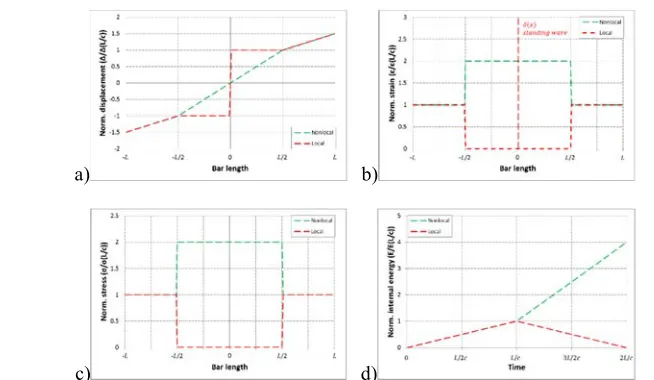
The analytical solutions for displacement, strain, stress and internal energy in the strain softening problem, at the response time t3 / 2L c, are shown in Fig. 2. The key difference between the elastic nonlocal solution and the strain softening (local) solution is discontinuity in the displacements and development of the standing strain wave in the midsection of the bar, which occurred as a result of superposition of the waves propagating from the bar ends. The obtained discontinuity could not propagate away from the localization zone, so that material unloads outside of the localization zone. In other words, the softening zone acts as a free boundary.
3. Simulation results for dynamic strain softening problem
a) b)
c) d)
Fig. 2. Elastic local and nonlocal solutions at the time instance t=3L/2c for: (a) Normalised displacement; (b) Normalised strain; (c) Normalised stress; (d) Normalised internal energy
SPH is a meshless particle method which does not require a structured grid. The motion of the continuum is approximated by the motion of discrete material points (particles) with no fixed connectivity. Interaction of particles is defined by a weighting (smoothing) function, where the smoothing length (size of the smoothing function domain) defines the range of influence of an individual particle. For instance, an estimate value of the function f
x at the location x is given as a continuous integral function in the following form:
,
Ωf x f x' W xx' h dx' (4)
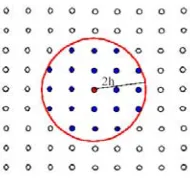
where the angled brackets denote kernel approximation, W is a weighting function, x is a new independent variable and h denotes smoothing length, i.e. size of the kernel support. The smoothing length is illustrated in Fig. 3 and calculated from inter-particle distance, p, as:
h p (5)
A discrete form of the kernel approximation, where the function is known at a finite number of points N, is given in terms of a sum:
mJ
,
f I f J W I h
J N
J J
x x x x (6)
investigation was to establish if SPH is by nature a nonlocal method capable of overcoming difficulties related to material softening without any additional regularization measures.
Fig. 3. Definition of neighborhood in SPH discretization method
Stress strain relationship of an isotropic bilinear material model with damage, implemented in the two numerical codes, is shown in Fig. 4. The damage was described with a single damage parameter , using a local continuum damage mechanics approach. The strain softening and the damage evolution developed when strain was in a range between i and ef.
Fig. 4. Bilinear law implemented in the FEM and SPH codes using a damage parameter and classic CDM approach
The effective stress, damage and tangent stiffness/slope of the stress stain curve at the material state determined by *, were respectively calculated as:
1
(8)
* 1
*
i f
i f
(9)
E i ET
i f
Fig. 5. Spatial discretization used in the FEM simulations of the dynamic strain-softening bar
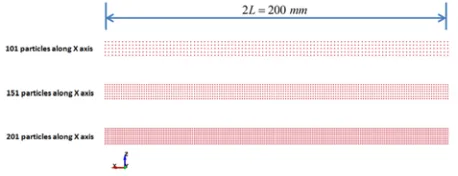
Fig. 6 Particle discretization in SPH of the dynamic strain-softening bar
3.1 Classic FEM analysis of strain softening problem
(a) (b)
(c) (d)
Fig. 7. Classic FEM solutions of dynamic strain softening problem at the time instance t=3L/2c for: (a) Longitudinal displacement; (b) Longitudinal strain; (c) Longitudinal stress; (d) Damage
distribution
Fig. 8. FEM results for damage distribution within dynamic strain softening problem using classical CDM approach; (fringe level: damage [-])
One possible way to address this problem is alternative approach to modelling damage described in the Subsection 3.3.
obtained with three models with the fixed smoothing length shown in Fig. 10 is independent of the interparticle distance h; instead the damage zone within the three models was constant and equal to 4h, which suggests that the smoothing length should be considered as a material property – characteristic length.
(a) (b)
(c) (d)
Fig. 9. SPH solutions of dynamic strain softening problem at the time instance t=3L/2c for: (a) Longitudinal displacement; (b) Longitudinal strain; (c) Longitudinal stress; (d) Damage
3.3 FEM analysis of strain softening problem with EDF
The first attempt to address the pronounced localization problem of the classic FEM was made by using an equivalent damage force as an alternative method for modelling damage, where the damage contribution to the conservation of momentum was defined by the means of divergence of damage and stress tensors. This approach did not affect the well posiness of the boundary problem, provided the nonlocal solutions for damage distribution in the considered wave propagation problem and allowed for implementation of the material characteristic length scale in the FEM solution. The first implementation of the equivalent damage force model was done in in-house developed FEM/SPH code and the numerical experiments were run for a one-dimensional wave propagation problem described above. The simulation results for damage distribution equivalent to the results shown in Fig. 8 and Fig. 10, now obtained with the EDF model are shown in Fig. 11. The EDF results for damage distribution in the problem considered, are not localized in one layer of elements, but distributed over a limited zone which is approximately 3l wide, where the l is input parameter. The EDF results for displacement, strain and stress are stable and consistent with the nonlocal analytical solutions presented in Fig. 2.
a)
analogous to the element size in the FEM. This demonstrates that the SPH method is inherently non-local and suggests that the SPH smoothing length should be linked to the material characteristic length scale in solid mechanics simulations. The first attempt to address the localization problem in the FEM model was made by alternative definition of damage effects using EDF. The numerical results obtained with this model show stable and nonlocal character, with a reduced mesh dependency, where the size of the damaged zone was controlled with characteristic length, as a material input parameter. Future work on this problem will be focused on extension of the equivalent damage force approach to orthotropic material formulation, suitable for composite materials.
Acknowledgements The project leading to this publication has received funding from the European Union’s Horizon 2020 research and innovation programme under grant agreement No 636549.
References
Aifantis EC (1984). On the Microstructural Origin of Certain Inelastic Models, Journal of Engng Mater. Tech., 106, 326-334.
Bammann DJ, Solanki K (2010). On Kinematic, Thermodynamic and Coupling of a Damage Theory for Polycrystalline Material, International Journal of Plasticity, 26 6, 775-793. Bazant ZP and Belytschko TB (1985). Wave Propagation In A Strain- Softening Bar: Exact
Solution, Journal of Engineering Mechanics, 111, 381-389.
Dillon OW and Kratochvill J, (1970). A Strain Gradient Theory of Plasticity, International Journal of Solids and Structures, 6, 1533-1566.
Enakoutsa K, Leblond JB and Perrin G (2007). Numerical Implementation and Assessment of a Phenomenological Nonlocal Model of Ductile Rupture, Comput. Meth. Appl. Mech. Engng., 196, 1946-1957.
Gingold RA and Monaghan JJ (1977). Smoothed particle hydrodynamics, Theory and application to non-spherical stars, Mon Not R Astron Soc, 181, 375-389.
Libersky LD and Petschek AG (1991), Smooth particle hydrodynamics with strength of materials, Advances in the Free-Lagrange Method Including Contributions on Adaptive Gridding and the Smooth Particle Hydrodynamics Method (Eds. Trease HE, Fritts MJ and Crowley WP), USA, Springer, 248-257.
Libersky LD, Petschek AG, Carney TC, Hipp JR and Allahdadi FA (1993). High strain lagrangian hydrodynamics a three-dimensional SPH code for dynamic material response, J. Comput Phys, 109, 67-75.
Pijaudier-Cabot G and Bazant ZP (1987). Nonlocal Damage Theory, ASCE J. Engrg. Mech., 113, 1512-1533.

![Fig. 8. FEM results for damage distribution within dynamic strain softening problem using classical CDM approach; (fringe level: damage [-])](https://thumb-us.123doks.com/thumbv2/123dok_us/8372147.1675540/7.499.68.399.59.276/results-distribution-dynamic-softening-problem-classical-approach-fringe.webp)
![Fig. 10. Localization of damage within a limited zone 4h in size (h=2.5mm) around the bar symmetry plane at response time t=3L/2c (fringe level: damage [-])](https://thumb-us.123doks.com/thumbv2/123dok_us/8372147.1675540/8.499.98.419.171.382/localization-damage-limited-symmetry-response-fringe-level-damage.webp)
![Fig. 11. Finite element results for damage distribution within dynamic strain softening problem obtained with EDF model at response time t=3L/2c (fringe level: damage [-]) with: (a) 101 element in impact direction; (b) 151 element in the impact direction; (c) 201 element in the impact direction](https://thumb-us.123doks.com/thumbv2/123dok_us/8372147.1675540/9.499.123.345.257.592/distribution-softening-obtained-response-direction-direction-element-direction.webp)
