I
R
I
S
A
IN ST ITU T D E R EC HE RC HE EN INF OR MA TIQ UE ET SYS TÈM ES ALÉ ATOI RESP U B L I C A T I O N
I N T E R N E
N
o1656
OPENMOSIX, OPENSSI AND KERRIGHED:
A COMPARATIVE STUDY
RENAUD LOTTIAUX, BENOIT BOISSINOT, PASCAL
GALLARD, GEOFFROY VALLÉE, CHRISTINE MORIN
OpenMosix, OpenSSI and Kerrighed:
A Comparative Study
Renaud Lottiaux * , Benoit Boissinot ** , Pascal Gallard *** , Georoy Vallee **** , Christine Morin ***** Systemes communicants Projets PARISPublication interne n1656 | November 2004 | 20 pages
Abstract:
This paper presents a comparative study of Kerrighed, openMosix andOpenSSI, three Single System Image (SSI) operating systems for clusters. This experimental study gives an overview of SSI features oered by these SSI and evaluates performance of such features.
Key-words:
Cluster, operating system, single system image, performance evaluation (Resume : tsvp) *IRISA/INRIA[email protected] **Ecole Normale Superieur de Lyon
[email protected] ***IRISA/INRIA [email protected] ****IRISA/INRIA/EDF [email protected] *****IRISA/INRIA [email protected]
Une etude comparative
Resume :
Ce rapport de recherche presente une etude comparative de Kerrighed, openMosix et OpenSSI, trois systemes d'exploitation a image unique pour grappe de PCs. Cette etude experimentale presente un panorama des fonctionnalites oertes par ces systemes et evalue les performance des fonctionnalites presentes.
Mots cles :
Grappe de machines, systeme d'exploitation, systeme a image unique, evaluation de performance1 Introduction
A Single System Image (SSI) is a physical or logical mechanism giving the illusion that a set of distributed resources (memory, disk or CPU) forms a unique and shared resource. At the present time, the term SSI is no more restricted to one given resource but is being more and more extended to all cluster resources: an SSI should oer the view of one unique machine on top of a cluster. SSI can be implemented at several levels : hardware, operating system, middleware or application.
SSI operating systems for clusters are attractive as they ease cluster programming and use. Dierent groups currently target the development of SSI operating systems, such as openMosix 1] resulting from Mosix 6], OpenSSI 2] derived from previous systems 16], Kerrighed 11], DragonyBSD 3], Genesis 9] or Plurix 8].
This paper focuses on Linux-based SSI and more precisely on Kerrighed, openMosix and OpenSSI. These systems start to be mature enough to be used outside of research centers. Some of them, such as openMosix are already in use in the industry. However, no real comparative study of these systems has been carried out up to now.
This experimental study aims at giving an overview of SSI features oered by openMosix, OpenSSI and Kerrighed and evaluate performance of such features.
The paper is organized as follows. In a rst part, we briey describe Kerrighed, open-Mosix and OpenSSI. In a second part, we present features oered by these three systems. In Section 4, we present a performance evaluation of several mechanisms such as process migration, Inter Process Communications (IPC), le accesses and global memory sharing. Finally, we conclude in Section 5.
2 Systems Description
In this section, we briey describe Kerrighed, openMosix and OpenSSI.
2.1 Overview of Kerrighed
Kerrighed 11] results from a research project started from scratch in 1999. Its aims at providing the view of a single SMP machine on top of a cluster. Kerrighed is made up of a set of kernel distributed services in charge of the global management of cluster resources.
Kerrighed oers a congurable global process scheduler. Using the Kerrighed scheduler builder tool 14], dedicated scheduling policies can be easily written and hot plugged in the cluster. Kerrighed comes with a default scheduling policy which allows to dynamically balance the cluster CPU load by using a receiver initiated preemptive process migration scheme. When a node is under-loaded, the system detects the unbalance and migrates a process from a high-loaded node to an under-loaded node.
The Kerrighed migration mechanism is based on several mechanims, such as process ghosting 13], containers 10], migrable streams 7] and distributed le system.
Process ghosting is used to extract process state information and store corresponding data on a given device. This device can be a disk (process checkpointing), a network (pro-cess migration or remote pro(pro-cess creation) or a memory (pro(pro-cess duplication or memory checkpointing).
The container mechanism is used to share data across nodes while ensuring data co-herency. This mechanism is used to implement memory sharing, a cooperative le cache and the Kerrighed distributed le system called KerFS.
The migrable stream mechanism is used to eciently handle communicating process migration. Processes using pipes or sockets can be migrated with no penalty on latency or bandwidth after migration.
2.2 Overview of openMosix
The openMosix system is based on Mosix 6] a research project started in 1981 at the Hebrew university of Jerusalem.
Mosix uses a sender initiated preemptive process migration scheme to balance the clus-ter CPU load. The Mosix's migration mechanism is based on a deputy mechanism: when a process is transfered from one node to another, a dependency is preserved on the original node through a deputy process. This deputy allows to solve system calls (network com-munications, le accesses) of the migrated process that Mosix cannot solve locally after a migration.
Some form of global memory management is provided in Mosix through the memory ushering algorithm 5]. This algorithm is activated when a node's free memory falls below a threshold value and attempts to migrate processes to other nodes which have sucient free memory. Thus, process migration is decided not only based on processor load criterion but also taking into account memory usage.
Mosix implements its own cluster le system, called Mosix FS (MFS) 4], to allows access to remote disks. To enhance le system performance after migration, a Direct File System Access (DFSA) algorithm is used. This algorithm reduces the need of I/O-bound processes to communicate with their home node.
Mosix was basically developed on a BSD based system. It has been ported on Linux in 1999 and the openMosix fork nally appeared in 2002.
2.3 Overview of OpenSSI
OpenSSI appeared in 2001 based on the previous NonStop Cluster for UnixWare project 16], itself based on Locus 15].
The OpenSSI design goal is to provide a platform in which other open source cluster technologies can be integrated. The current version of OpenSSI integrates several open source le systems and disk management systems (GFS, OpenGFS, Lustre, OCFS, DRBD), a distributed lock mechanism (OpenDLM) and a migration mechanism derived from Mosix. OpenSSI allows to dynamically balance the cluster CPU load by using a process migration scheme derived from Mosix and called load leveling. The OpenSSI migration mechanism
uses deputation to maintain IPC and some system calls after process migration and Cluster File System (OCFS) to maintain access to opened les.
3 Comparison of Covered SSI Features
In this section, we present the features oered by the dierent SSI on a qualitative point of view.
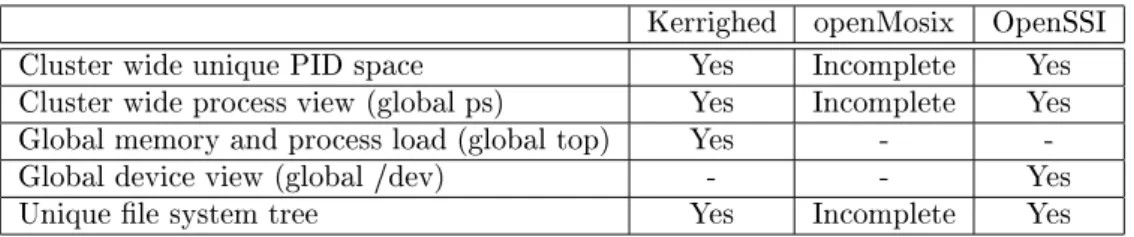
3.1 View of a Unique Machine
In the openMosix system, the non standard mps and mtop commands shows all processes launched from a given node, even if they have been migrated to remote nodes. However, processes launched from other nodes are not displayed with these commands. The mtop command does not display global memory statistics nor cluster wide CPU usage. A unique process identier (PID) space is oered for every process launched from a given home node. Thus, the PID space is not unique cluster wide.
In the OpenSSI system, the standard ps and top commands show all processes running in the cluster: processes running locally or remotely, whatever their initial execution node. The top command does not display global memory statistics nor cluster wide CPU usage. All cluster devices are listed in the /dev directory and can be reached from any node. For instance, it is possible to mount a partition from a disk located on a remote node. A unique and cluster wide process identier (PID) space is present.
In the Kerrighed system, the standard ps and top commands show all processes running in the cluster: processes running locally or remotely, whatever their initial execution node. The top command displays global memory statistics and cluster wide CPU usage just like on a SMP machine. A unique and cluster wide process identier (PID) space is present.
Table 1 summarizes covered features regarding the vision of a unique machine. Kerrighed openMosix OpenSSI
Cluster wide unique PID space Yes Incomplete Yes
Cluster wide process view (global ps) Yes Incomplete Yes
Global memory and process load (global top) Yes -
-Global device view (global /dev) - - Yes
Unique le system tree Yes Incomplete Yes
Table 1: Vision of a unique machine features
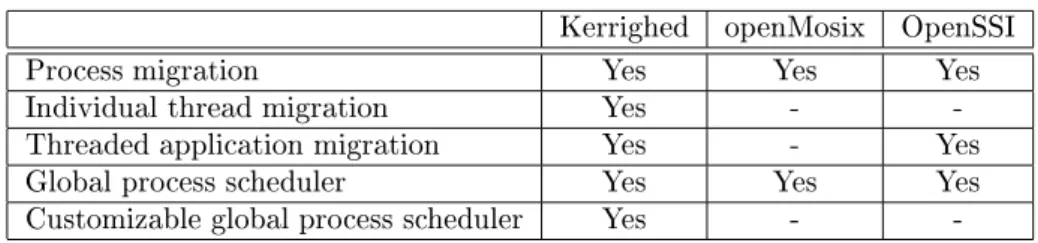
3.2 Global Process Management
OpenMosix allows to dynamically balance the cluster CPU load by using a sender initiated preemptive process migration scheme. Any process can be migrated except for processes
using system V segments or processes strongly connected to a node (direct access to video or network card memory for instance). Threads cannot be migrated. An extension to openMosix called migshm enables to migrate processes using system V memory segments. However, this extension does not appear to be really functional.
OpenSSI allows to dynamically balance the cluster CPU load by using a process migration scheme derived from Mosix. Any process can be migrated except for processes strongly connected to a node (direct access to video or network card memory for instance). Processes using system V memory segment and group of threads can be migrated. However, individual threads cannot be migrated.
Kerrighed allows to dynamically balance the cluster CPU load by using the default Kerrighed scheduling policy or with any other policy which can be written and hot-loaded. Any process can be migrated except processes strongly connected to a node. Processes using system V memory segment, individual and group of threads can be migrated.
Table 2 summarizes covered features regarding global process management. Kerrighed openMosix OpenSSI
Process migration Yes Yes Yes
Individual thread migration Yes -
-Threaded application migration Yes - Yes
Global process scheduler Yes Yes Yes
Customizable global process scheduler Yes -
-Table 2: Global process management features
3.3 Global IPC Management
OpenMosix supports migration of processes using sockets, pipes and system V semaphores. Processes using system V memory segments cannot be migrated.
OpenSSI supports migration of processes using sockets, pipes, system V semaphores and system V memory segments.
Kerrighed supports migration of processes using sockets, pipes and system V memory segments. Processes using system V semaphores cannot be migrated.
Table 3 summarizes covered features regarding global IPC management.
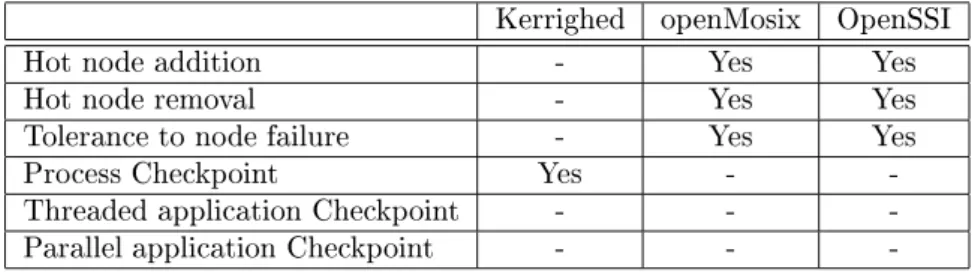
3.4 Fault Tolerance and Checkpointing
It is possible with OpenMosix to add or remove a node to a running cluster. If a node fails, the remaining nodes are not aected. Processes which were running on the faulty node are lost. Processes launched from the faulty node and migrated to remaining nodes before the failure are likely to crash. No checkpointing is provided.
Kerrighed openMosix OpenSSI
Migrate process using System V memory segment Yes - Yes
Migrate process using System V semaphores - Yes Yes
Migrate process using Pipes Yes Yes Yes
Migrate process using UNIX sockets Yes Yes Yes
Migrate process using INET sockets Yes Yes Yes
Table 3: Global IPC management features
It is possible with openSSI to add or remove a node to a running cluster. If a node fails, the remaining nodes are not aected except if the faulty node was hosting the global le system manager. Processes which were running on the faulty node are lost. Processes launched from the faulty node and migrated to remaining nodes before the failure are likely to crash. No checkpointing is provided.
Kerrighed does not yet oers the ability to add or remove a node to a running cluster. If a node fails, the remaining nodes are likely to be aected resulting in a whole cluster dead-lock or crash. Processes which were running on the faulty node are lost. Processes launched from the faulty node and migrated to remaining nodes before the failure are likely to crash. A checkpointing mechanism is oered and allows to restart a process after a node or a cluster crash.
Table 4 summarizes covered features regarding fault tolerance and checkpointing. Kerrighed openMosix OpenSSI
Hot node addition - Yes Yes
Hot node removal - Yes Yes
Tolerance to node failure - Yes Yes
Process Checkpoint Yes -
-Threaded application Checkpoint - -
-Parallel application Checkpoint - -
-Table 4: Fault tolerance and checkpointing features
3.5 Hardware Support
64 bits processors are supported by openMosix (Itanium) and OpenSSI (Alpha, Itanium). Both systems also support SMP mode on multiprocessor machines. Kerrighed does not support yet 64 bits architectures nor SMP mode. Table 5 summarizes supported hardware architecture for each system.
Kerrighed openMosix OpenSSI
64 bits - Yes Yes
SMP nodes - Yes Yes
Table 5: Supported hardware architectures
4 Performance Evaluation
In this section we present a performance evaluation of Kerrighed, openMosix and OpenSSI. We made several sets of experiments to evaluate the performance of dierent SSI features. The rst set of experiments aims at measuring the overhead of process migration. The second set of experiments aims at measuring the performance of IPC (sockets, pipes, etc) in the context of process migration. The third set of experiments aims at measuring le operations performance. Finally, the last set of experiments aims at measuring the performance of cluster wide shared memory.
4.1 Experimental Platform
The experimental platform consists of four nodes based on one-way Intel Pentium III 1GHz processor with 512 MB physical memory and interconnected with a Fast Ethernet network. We tested Kerrighed version 1.0-rc7 based on Linux 2.4.24, openMosix version 2.4.22-3 based on Linux 2.4.22 and OpenSSI version 1.0.0-rc5 based on Linux 2.4.20.
4.2 Process Migration Evaluation
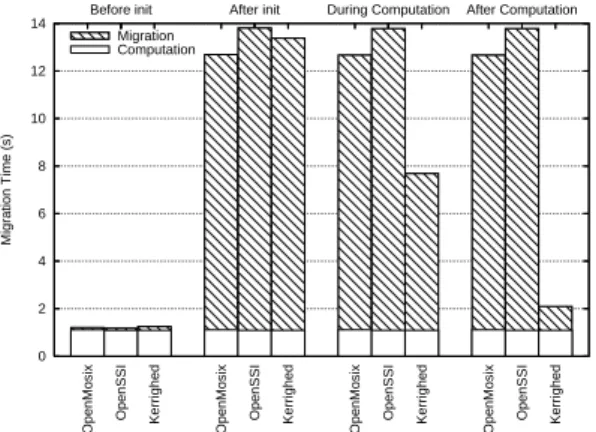
We measured the process migration overhead by measuring the execution time of a simple sequential application (vector addition) with and without migration. For the migration case, we started the application on an initial node A and migrated it to a destination node B.
The measurement has been done at four dierent times during the process execution: (1) before initialization of vectors, (2) after initialization of vectors, (3) in the middle of the computation and (4) at the end of the computation. The measurement has been done using the shell command /usr/bin/time. Figures 1 and 2 show experiment results with vector sizes 16 KB and 64 MB.
With a 16 KB vectors, the computation time is negligible compared to migration time. OpenMosix appears to be much slower than other systems. However, this test does not measure the only migration overhead but also the time needed to send the application termination signal to the time command on the initial node. The short migration time and imprecision of the time command makes this test dicult to analyze.
With a 64 MB vectors, when the migration occurs before vectors initialization, the overhead is very low and nearly equivalent for the three systems. In this case, the process
0 0.02 0.04 0.06 0.08 0.1 0.12 Kerrighed OpenSSI OpenMosix Kerrighed OpenSSI OpenMosix Kerrighed OpenSSI OpenMosix Kerrighed OpenSSI OpenMosix Migration Time (s) Migration Computation
Figure 1: Process migration overhead using a vectors addition with 16 KB data)
0 2 4 6 8 10 12 14 Kerrighed OpenSSI OpenMosix Kerrighed OpenSSI OpenMosix Kerrighed OpenSSI OpenMosix Kerrighed OpenSSI OpenMosix Migration Time (s) Migration Computation
Figure 2: Process migration overhead using a vectors addition with 64 MB data)
memory print mainly consists of code, global variables and stack, which represent less than 1 MB. Migrating this data is not a burden to the migration mechanism.
After vectors initialization, the overhead increases dramatically. Every vector data is needed for the computation on the destination node and has to be transfer through the network. The overheads measured are very close for the three systems. However, openMosix performs a little better than other systems.
During and after the computation, the migration overhead for openMosix and OpenSSI are the same than in the previous case. Both systems migrate every vector data on the destination node, even if they are not required for the computation.
With Kerrighed, the closer to the end the application is when we migrate it, the lower the overhead is. Only needed data is migrated to perform the computation. Computing an element for a vectors addition, does not require the previously computed data. Thus, the more the computation is achieved when we migrate the process, the less we need to transfer data and the lower the overhead is.
4.3 Stream Migration Evaluation
In this section, we present results from Inter Process Communication (IPC) performance evaluation in the context of process migration. Measurements have been carried out using NetPipe 12] for sockets (INET and Unix) and pipes.
4.3.1 Inet Socket
We measured the bandwidth and latency of inet sockets in three dierent cases:
No migration: two processes communicating through a inet socket are launched on
2 dierent nodes. Then, the measurement is performed.
One end migration
: two processes communicating through an inet socket are launched on 2 dierent nodes. Then, one process is migrated to a third node and the measurement is performed.
Both ends migration: two processes communicating through a inet socket are
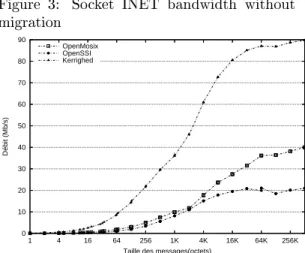
launched on 2 dierent nodes. One process is migrated to a third node, the other process on a fourth node. Then the measurement is performed.Figure 3 presents the bandwidth of inet sockets without migration. The bandwidth is nearly the same for the three systems and reaches 90 Mb/s.
Figure 4 presents the bandwidth of inet sockets after the migration of one process. For Kerrighed, there is no performance degradation. The bandwidth does not change and still reaches 90 Mb/s. With openMosix, the bandwidth decreases and does not exceed 52 Mb/s. Finally, with OpenSSI, the bandwidth collapses and reaches a maximum at 23 Mb/s. This performance loss with openMosix and OpenSSI can be easily explained by the use of deputation. Since every communication between 2 migrated processes has to go through the deputy located on the home node, an extra network overhead is added to all these communications.
Figure 5 presents the bandwidth of inet sockets after the migration of both processes on 2 dierent nodes. For Kerrighed, the bandwidth still not changes and reaches 90 Mb/s. With openMosix, the bandwidth decreases even more and does not exceed 40 Mb/s. Finally, with OpenSSI, the bandwidth still collapses and reaches a maximum at 21 Mb/s. Here the deputation adds a new extra overhead since 2 indirections (1 for each deputy to reach) are needed for any communication between the 2 migrated processes.
Figure 6 presents the latency of inet sockets for each previously described situations and for each SSI. Before migration, the latencies measured for each SSI are close and below 70 s. OpenMosix shows a latency of 64s, OpenSSI shows a latency of 52sand Kerrighed shows a latency of 45s. After the migration of 1 process the latency increases dramatically for openMosix and OpenSSI, while it remains very low for Kerrighed. This eect is even worth when both processes are migrated.
4.3.2 Unix Socket
We measured the bandwidth and latency of unix sockets in four dierent cases:
No migration
: two processes communicating through a unix socket are launched on 1 node. Then, the measurement is performed.
One end migration
: two processes communicating through a unix socket are launched on 1 node. Then, one process is migrated to a second node and the measurement is performed.
Both ends migration with di erent destinations: two processes communicating
through a unix socket are launched on 1 node. One process is migrated to a second node, the other process on a third node. Then the measurement is performed.0 10 20 30 40 50 60 70 80 256K 64K 16K 4K 1K 256 64 16 4 1 Débit (Mb/s)
Taille des messages(octets) OpenMosix
OpenSSI Kerrighed
Figure 3: Socket INET bandwidth without migration 0 10 20 30 40 50 60 70 80 256K 64K 16K 4K 1K 256 64 16 4 1 Débit (Mb/s)
Taille des messages(octets) OpenMosix
OpenSSI Kerrighed
Figure 4: Socket INET bandwidth after 1 end migration 0 10 20 30 40 50 60 70 80 90 256K 64K 16K 4K 1K 256 64 16 4 1 Débit (Mb/s)
Taille des messages(octets) OpenMosix
OpenSSI Kerrighed
Figure 5: Socket INET bandwidth after both ends migrated on 2 dierent nodes
0 50 100 150 200 250 300 350 400 450 Latence (µsec) OpenMosix OpenSSI Kerrighed
Both ends migration with same destination
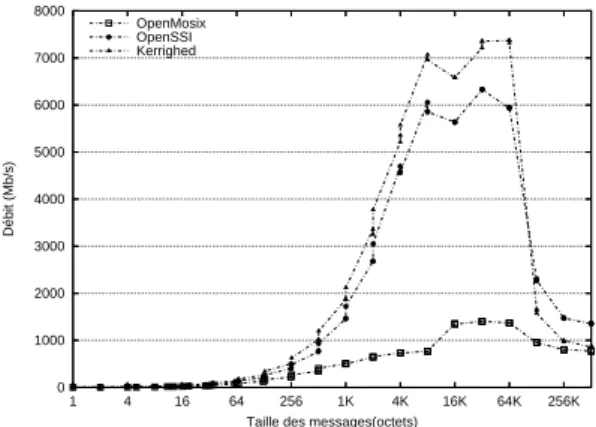
: two processes communicating through a unix socket are launched on 1 node. Both processes are migrated to same destination node. Then the measurement is performed.Figure 7 presents the bandwidth of unix sockets without migration. The bandwidth reaches 7000 Mb/s for Kerrighed, 6000 Mb/s for openSSI and 1500 Mb/s for openMosix.
Figure 8 presents the bandwidth of unix sockets after the migration of one process. For Kerrighed, the bandwidth falls to 90 Mb/s. By moving a process to a remote node, the memory bandwidth is replaced by a network bandwidth. With openMosix, the bandwidth falls to 72 Mb/s. Finally, with OpenSSI, the bandwidth falls to 59 Mb/s.
Figure 9 presents the bandwidth of unix sockets after the migration of both processes on 2 dierent nodes. For Kerrighed, the bandwidth does not change and still reaches 90 Mb/s. With openMosix, the bandwidth decreases and does not exceed 56 Mb/s. Finally, with OpenSSI, the bandwidth collapses and reaches a maximum at 33 Mb/s.
Figure 10 presents the bandwidth of unix sockets after the migration of both processes on the same destination node. With openMosix and OpenSSI, bandwidth does not change and remains mostly limited by the network bandwidth (56 Mb/s for openMosix and 33 Mb/s for OpenSSI). However, both processes have been migrated on the same destination node, making possible to recover a memory bandwidth. This is what Kerrighed does by oering a bandwidth of 7000 Mb/s.
Figure 11 presents the latency of unix sockets for each previously described situations and for each SSI. Before migration, the latencies measured for each SSI are close to 4s. After the migration of 1 process, the latency increases dramatically for every systems since we move from a memory latency to a network latency. However, we can observe a signicant dierence between systems. Kerrighed has a latency of 45 ms, openMosix a latency of 152 sand OpenSSI has a latency of 264s. After migration of both socket ends, the Kerrighed latency does not change, since the latency of other systems still increases. Finally, when both processes are sent to the same destination node, latency for openMosix and OpenSSI does not change and remains very high, since the Kerrighed latency falls back to a memory latency, i.e. 4s.
4.3.3 Pipe
We measured the bandwidth and latency of pipes in four dierent cases:
No migration
: two processes communicating through a pipe are launched on 1 node. Then, the measurement is performed.
One end migration
: two processes communicating through a pipe are launched on 1 node. Then, one process is migrated to a second node and the measurement is performed.
Both ends migration with di erent destinations: two processes communicating
through a pipe are launched on 1 node. One process is migrated to a second node, the other process on a third node. Then the measurement is performed.0 1000 2000 3000 4000 5000 6000 7000 256K 64K 16K 4K 1K 256 64 16 4 1 Débit (Mb/s)
Taille des messages(octets) OpenMosix
OpenSSI Kerrighed
Figure 7: Socket UNIX Bandwidth without migration 0 10 20 30 40 50 60 70 80 256K 64K 16K 4K 1K 256 64 16 4 1 Débit (Mb/s)
Taille des messages(octets) OpenMosix
OpenSSI Kerrighed
Figure 8: Socket UNIX Bandwidth after mi-gration of 1 end 0 10 20 30 40 50 60 70 80 90 256K 64K 16K 4K 1K 256 64 16 4 1 Débit (Mb/s)
Taille des messages(octets) OpenMosix
OpenSSI Kerrighed
Figure 9: Socket UNIX Bandwidth after both ends migrated on dierent nodes
0 1000 2000 3000 4000 5000 6000 7000 8000 256K 64K 16K 4K 1K 256 64 16 4 1 Débit (Mb/s)
Taille des messages(octets) OpenMosix
OpenSSI Kerrighed
Figure 10: Socket UNIX Bandwidth after both ends migrated on the same node
0 50 100 150 200 250 300 350 400 450 2 ends migration on the same node 2 ends migration on distincts nodes 1 end migration Before migration Latence (µsec) OpenMosix OpenSSI Kerrighed
Both ends migration with same destination
: two processes communicating through a pipe are launched on 1 node. Both processes are migrated to the same destination node. Then the measurement is performed.Figure 12 presents the bandwidth of pipes without migration. The bandwidth is nearly the same for the three systems and reaches 6500 Mb/s.
Figure 13 presents the bandwidth of pipes after the migration of one process. For Ker-righed, the bandwidth falls to 83 Mb/s. As for unix sockets, by moving a process using a pipe to a remote node, the memory bandwidth is replaced by a network bandwidth. With openMosix, the bandwidth falls to 79 Mb/s. Finally, with OpenSSI, the bandwidth falls to 50 Mb/s.
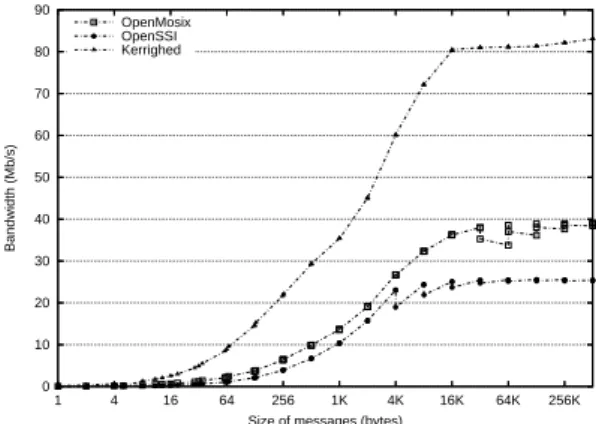
Figure 14 presents the bandwidth of pipes after the migration of both processes on 2 dierent nodes. For Kerrighed, the bandwidth does not change and still reaches 83 Mb/s. With openMosix, the bandwidth decreases and does not exceed 39 Mb/s. Finally, with OpenSSI, the bandwidth collapses and reaches a maximum at 25 Mb/s.
Figure 15 presents the bandwidth of pipes after the migration of both processes to the same destination node. We observe the same phenomenon as the one with Unix sockets: with openMosix and OpenSSI, the bandwidth does not change and remains mainly limited by the network bandwidth while Kerrighed falls back to a memory bandwidth of 7000 Mb/s. Figure 16 presents the latencies of pipes for each previously described situations and for each SSI. With pipes, the measured latencies are nearly identical to the ones measured with unix sockets.
4.4 File System Evaluation
We measured the impact of process migration on le access bandwidth. For each SSI, we used its dedicated le system, i.e. MFS with DFSA activated for openMosix, CFS for OpenSSI and KERFS for Kerrighed. The cluster has been rebooted between each test to highlight cache eect: rst time le accesses are performed with an empty cache and following le accesses are performed with a heat cache.
4.4.1 Read Access
For each system we did the following tests:
Read (cold cache)
: a process P1 started on a node A reads sequentially a 30 MB le after a fresh cluster reboot, to ensure that le caches are empty.
Read Again
: the same process P1 still on node A, reads again the same le from the beginning.
Read (after migration)
: the process P1 is migrated on a remote node B. Then the same le is again red from the beginning.0 1000 2000 3000 4000 5000 6000 7000 256K 64K 16K 4K 1K 256 64 16 4 1 Bandwidth (Mb/s)
Message size (bytes) OpenMosix
OpenSSI Kerrighed
Figure 12: Pipe Bandwidth without process migration 0 10 20 30 40 50 60 70 80 256K 64K 16K 4K 1K 256 64 16 4 1 Bandwidth (Mb/s)
Size of messages (bytes) OpenMosix
OpenSSI Kerrighed
Figure 13: Pipe Bandwidth after 1 end migra-tion 0 10 20 30 40 50 60 70 80 90 256K 64K 16K 4K 1K 256 64 16 4 1 Bandwidth (Mb/s)
Size of messages (bytes) OpenMosix
OpenSSI Kerrighed
Figure 14: Pipe Bandwidth after both ends migrated on dierent nodes
0 1000 2000 3000 4000 5000 6000 7000 8000 256K 64K 16K 4K 1K 256 64 16 4 1 Bandwidth (Mb/s)
Size of messages (bytes) OpenMosix
OpenSSI Kerrighed
Figure 15: Pipe Bandwidth after both ends migrated on the same node
0 50 100 150 200 250 2 ends migration on the same node 2 ends migration on distincts nodes 1 end migration Before migration Latence (µsec) OpenMosix OpenSSI Kerrighed
Read Again (after migration)
: the process P1 still on its destination node B, reads again the le from the beginning.Figure 17 presents the bandwidth measured for each system and for each previously described situation.
During the rst read with an empty cache, openMosix and OpenSSI reach a bandwidth of 25 MB/s, which corresponds to the disk bandwidth. Kerrighed does a counter performance, with a maximum bandwidth of 17 MB/s. We have no explanation at the moment for this poor result with Kerrighed.
During the second read, with a heat cache, all systems exhibit a bandwidth close to 450 MB/s, indicating that the le cache is correctly used.
After migration, for the rst read with an empty cache on the destination node, open-Mosix and OpenSSI reach a bandwidth of 5.5 MB/s, since Kerrighed reaches a bandwidth of 9.6 MB/s. This bandwidth is mainly limited by the network bandwidth. However, the bandwidth measured is far from the theoretical bandwidth of a fast Ethernet network (12 MB/s), especially for openMosix and OpenSSI.
Finally, during the second read on the destination node, with a heat cache, OpenSSI and Kerrighed exhibit a bandwidth close to 450 MB/s, since openMosix is still limited to 5.5 MB/s. This indicates that openMosix does not allow caching on client or destination nodes which is surprising if we consider the use of MFS and DFSA.
4.4.2 Write Access
For each system we did the following tests:
Write (cold cache)
: a process P1 started on a node A writes sequentially a 30 MB le after a fresh cluster reboot, to ensure that le caches are empty.
Read
: the same process P1 still on node A, reads the freshly written le from the beginning.
Write (after migration): the process P1 is migrated on a remote node B. Then the
process overwrites 30 MB on the same le.
Read (after migration)
: the process P1 still on its destination node B, reads the le from the beginning.Figure 18 presents the bandwidth measured for each system and for each previously described situation.
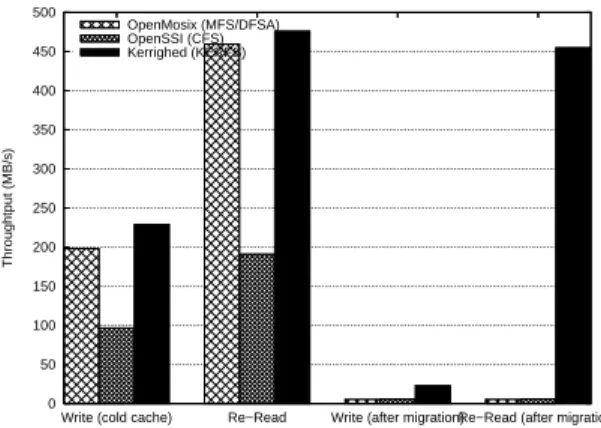
During the rst write with an empty cache, Kerrighed reaches a write bandwidth of 229 MB/s, since openMosix and OpenSSI reach respectively a bandwidth of 200 MB/s and 95 MB/s.
During the following read with a heat cache, openMosix and Kerrighed exhibit a read bandwidth close to 450 MB/s, indicating that the le cache is correctly used. For OpenSSI, the bandwidth is limited to 200 MB/s.
0 50 100 150 200 250 300 350 400 450
Re−Read (after migration) Read (after migration)
Re−Read Read (cold cache)
Throughput (MB/s)
OpenMosix (MFS/DFSA) OpenSSI (CFS) Kerrighed (KERFS)
Figure 17: Read throughput before and after process migration 0 50 100 150 200 250 300 350 400 450
Re−Read (after migration) Write (after migration)
Re−Read Write (cold cache)
Throughtput (MB/s)
OpenMosix (MFS/DFSA) OpenSSI (CFS) Kerrighed (KERFS)
Figure 18: Write throughput before and after process migration
After migration, during a le write with an empty cache on the destination node, open-Mosix and OpenSSI reach a write bandwidth of 5.7 MB/s. This bandwidth is mainly limited by the network bandwidth. With Kerrighed, the write bandwidth reaches 23 MB/s.
Finally, during the following read on the destination node, with a heat cache, openMosix and OpenSSI exhibit a read bandwidth still limited to 5.7 MB/s since Kerrighed exhibit a bandwidth close to 450 MB/s. This result is not surprising for openMosix since we got the same result for the read access test. This is more surprising for openSSI which has proved in the previous read test that caching was enabled after migration. It seems that writing after a migration kills the cache on an OpenSSI system.
4.5 Shared Memory Evaluation
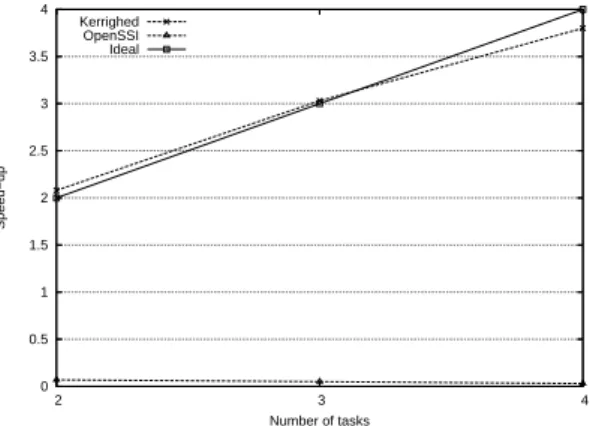
Performance evaluation of memory sharing for the three given SSI is dicult since only Kerrighed oers a usable cluster wide memory sharing mechanism. OpenMosix does not oer any mechanism to allow memory sharing between nodes. OpenSSI oers some support for cluster wide system V memory segments, however performance observed is dramatically low has shown on gures 19 and 20. These gures present speed-up obtained with simple shared memory parallel applications.
The rst application is a Modied Gram-Schmidt (MGS) algorithm used to orthonor-malize a vector basis, the second one is a matrix multiply. These applications use system V memory segments to share applications data. We have compared the sequential time to the parallel time using 2, 3 and 4 tasks, each task running on a dierent node.
With OpenSSI, we have measured very high slow down making this system completely unusable for shared memory programming. With Kerrighed, good speed-ups can be obtained as we can see of gures 19 and 20. However, the speed-up is highly dependent from the application access patterns as usual in software page based DSM systems.
0 0.5 1 1.5 2 2.5 3 3.5 4 2 3 4 Speed−up Number of tasks Kerrighed OpenSSI Ideal
Figure 19: Speed-up with MGS
0 0.5 1 1.5 2 2.5 3 3.5 4 2 3 4 Speed−up Number of tasks Kerrighed OpenSSI Ideal
Figure 20: Speed-up with matrix multiply
5 Conclusion
We have presented in this paper a comparison of three single system image cluster operating systems: Kerrighed, openMosix and OpenSSI, based on experimentations conducted on the same cluster.
OpenSSI is the most robust system and covers nearly all SSI features a user could expect. However performance exhibited by this system is often greatly below the one oered by other systems. The deputation mechanism used by openMosix and OpenSSI leads to dramatic extra overheads for IPC after a process migration.
OpenMosix, which is probably the most popular system, oers a good compromise be-tween performance and covered SSI features. However, the openMosix stability is not as good as the one oered by OpenSSI.
Up to now, Kerrighed is still a research prototype, less robust the 2 other systems. Kerrighed does not support hot node addition and removal. Moreover a node crash often leads to a complete cluster crash. However, Kerrighed oers the best performance, specially regarding IPC and le system. Kerrighed is also the only system oering highly customizable features, ecient cluster wide memory sharing, process checkpointing and able to migrate and schedule threads. Finally, Kerrighed still being in development, stability issues are likely to be xed in a near future.
A more complete set of experiments will be carried out during the next months using more recent machines and networks (gigabit Ethernet, Myrinet). Scalability has not been tested neither. This will be done in our future experiments.
References
2] http://openssi.org/index.shtml. 3] http://www.dragonybsd.org.
4] Loir Amar, Amnon Barak, and Amnon Shiloh. The mosix direct le system access method for supporting scalable cluster le systems. Cluster Computing, 7(2):141{150, April 2004.
5] A. Barak and A. Braverman. Memory ushering in a scalable computing cluster. In Proc. of IEEE third Int. Conf. on Algorithms and Architecture for Parallel Processing. IEEE, December 1997.
6] Amnon Barak, Shai Guday, and Richard G. Wheeler. The MOSIX Distributed Op-erating System, Load Balancing for UNIX, volume 672 of Lecture Notes in Computer Science. Springer-Verlag, 1993.
7] Pascal Gallard and Christine Morin. Dynamic streams for ecient communications between migrating processes in a cluster. Parallel Processing Letters, 13(4), December 2003.
8] Ralph Goeckelmann, Mickael Schoettner, Stefan Frenz, and Peter Schulthess. A kernel running in a dsm - design aspects of a distributed operating system. In Proceedings of the IEEE International Conference on Cluster Computing, 2003.
9] Andrzej Goscinski, Mickael Hobbs, and Jackie Silcock. GENESIS: an ecient, trans-parent and easy to use cluster operating system. Parallel Computing, 28(4):557{606, April 2002.
10] Renaud Lottiaux and Christine Morin. Containers: A sound basis for a true single system image. In Proceeding of IEEE International Symposium on Cluster Computing and the Grid (CCGrid '01), pages 66{73, May 2001.
11] Christine Morin, Renaud Lottiaux, Georoy Valle, Pascal Gallard, David Margery, Jean-Yves Berthou, and Isaac Scherson. Kerrighed and data parallelism: Cluster com-puting on single system image operating systems. In Proceedings of Cluster 2004. IEEE, September 2004.
12] Quinn O. Snell, Armin R. Mikler, and John L. Gustafson. Netpipe: A network protocol independent performance evaluator. In IASTED International Conference on Intelligent Information Management and Systems, June 1996.
13] Georoy Valle, Christine Morin, Jean-Yves Berthou, Ivan Dutka Malen, and Renaud Lottiaux. Process migration based on gobelins distributed shared memory. In Proceed-ings of the workshop on Distributed Shared Memory (DSM'02) in CCGRID 2002, pages 325{330. IEEE Computer Society, May 2002.
14] Georoy Valle, Christine Morin, Jean-Yves Berthou, and Louis Rilling. A new ap-proach to congurable dynamic scheduling in clusters based on single system image technologies. In Proceedings of 17th International Parallel and Distributed Processing Symposium (IPDPS 2003). IEEE, April 2003.
15] Bruce Walker, Gerald Popek, Robert English, Charles Kline, and Greg Thiel. The locus distributed operating system. In Proceedings of the ninth ACM symposium on Operating systems principles, pages 49{70. ACM Press, 1983.
16] Bruce Walker and Douglas Steel. Implementing a full single system image unixware cluster: Middleware vs underware. In Proceedings of International Conference on Par-allel and Distributed Processing Techniques and Applications, PDPTA'99, 1999.