The Effect of Project Environment on the
Relationship between Knowledge Sharing and
Team Creativity in the Software Development Context
Mei-Hsiang Wang
Department of Information Management,
Southern Taiwan University of Science & Technology, Taiwan
Chen-Fen Huang (Corresponding Author) Department of Information Management, National United University, Miaoli, Taiwan
Email:[email protected]
Tarng-Yao Yang
Department of Information Management,
Southern Taiwan University of Science & Technology, Taiwan ABSTRACT
Creativity is an important element of information systems development and is essential for successful software development. The creative work involved in software development is similar to knowledge sharing (KS), which is fundamental to the development of any complex information system. Although research has highlighted many factors that influence individual creativity, there has been little focus on how team-level creativity is determined. Software development teams may exhibit creativity in the interaction of its members. Since creative software development requires teams to share each other’s knowledge, KS becomes an important determinant in team creativity. Project environment is a moderating variable in the present study. Based on a sample of 52 software development teams, direct and moderated relationships between KS and team creativity were tested. The results indicate that KS has a direct effect on team creativity and that the relationship between KS and team creativity is moderated by project environment, where more task-centric KS will be required when the environment is dynamic. Theoretical and practical implications are discussed. Keywords: Team creativity, knowledge sharing, project environment, IS
1.
INTRODUCTIONSoftware development is a complex activity. This complexity is magnified by the continuous changes in user requirements brought about by changing organizational needs due to the ever-changing, competitive external environment. Software development is typically executed in a project-management approach. In today’s competitive, fast-paced environment, many projects increasingly rely on team members to generate creative solutions to software development problems. Creativity is, therefore, becoming essential in the non-routine work of project teams in software development settings. Modern software development projects are often complex and risky, and operate under time restrictions due not only to technological issues, but also organizational factors, that require consideration. These restraints necessitate increased attention to knowledge sharing (KS). That is, to ensure creativity, software development team members need to share knowledge among one another.
In this paper, software development refers to the analysis, design, and implementation of IS applications to support business activities in an organizational context. Software development teams were targeted for this study, since they continue to disappoint and fail at an alarming rate, in spite of great gains in technology, programming tools, methodology, and management techniques [Lyytinen and Robey, 1999].
Since the importance of knowledge in the software development process is widely recognized in prior research [Tiwana and Mclean, 2005], and knowledge can be created only through interaction between specialists with varying backgrounds of expertise, the cement of software development activities is KS. Previous research [Lyytinen and Robey, 1999] describes the project situation in which multiple stakeholders with widely diverse worldviews and objectives must work together to construct new perspectives for work activity, values, processes, and methods.
team to combine and integrate knowledge from different software development team members, KS is an important determinant in software development team creativity. The literature on software development and creativity offers various, quite different, directions. Interestingly, however, although creative work is considered to be closely related and reliant on KS, the literature on software development and creativity does not seem to draw much on knowledge management literature. The creative performance required of software development teams is driven by the KS of the teams.
Software development teams are information processing units. Like individuals, teams process information by encoding, storing, and retrieving it [Brauner and Scholl, 2000]. That is, in software development teams, team members interact directly to share their diverse knowledge and skills. Through effective KS, team members exchange information and create new knowledge and insight. The creative performance of software development teams is therefore largely shaped by KS among team members [Leenders, Kratzer, and van Engelen, 2003].
Given the role that intra-team interaction plays in the creation, dissemination, and combination of knowledge, KS largely governs the creativity of this process in a team [Allen, 197l, 1977; Hoegl and Gemuenden, 2001]. However, despite the fact that it has been long established that teams play a critical role in fostering creativity, the question of how to put such a team together remains an issue in any information systems development. Past research has mainly been done on the creativity of the individual [Tiwana and McLean, 2005]. Not much is known about the structures that foster the creativity of software development teams. Research on the social context necessary for fostering creativity in software development teams is rare [Leenders et al., 2003]. Focusing on analysis at the team level, aspects of KS and how it influences creativity in software development teams were investigated as part of the current study. Since little is known about the factors that determine the creativity of software development teams, this study investigated how modes of KS within software development teams affect creativity within the team.
This study, therefore, set out to explore the relationship between KS and team creativity. The moderating effect of project environment was also taken into consideration. In short, gaps in the existing literature prevent us from answering the basic question of how KS in a software development team affects team creativity. In the present study, two research questions were addressed:
(1) How does the KS of team members influence team creativity?
(2) How does the project environment moderate the relationship between KS and team creativity?
The remainder of this paper is organized into four sections. Section 2 presents our hypotheses regarding the effect of KS on team creativity. Section 3 discusses empirical tests of these hypotheses on a sample, including the method of data collection, the development of the measures, the analysis, and a brief discussion of the results. Section 4 includes a discussion of several implications of the empirical findings on how creative teams can be managed and designed. Section 5 focuses on further research directions.
2. LITERATURE REVIEW AND HYPOTHESES
This section presents information on team creativity, KS in information systems development project teams, the project environment, the relationship between KS and team creativity, and the moderating role of project environment.
2.1. Team Creativity
The importance of creativity in the ISD process has only recently been explicitly recognized. Development of information systems is a creative effort that involves the expertise, insights, and skills of many individuals. As organizations encounter the need to develop systems for novel business applications and new problem domains, the need for creativity in the information systems development process is increasingly recognized in practice. Creativity in software development project teams plays a bridging role for linking individual creativity and organizational creativity. Project teams are often relied on by organizations to generate creative ideas and to transfer newly created ideas into useful technology, products, or services [Thamhain, 2003].
the creation of a valuable, useful new product, service, idea, procedure, or process by individuals working together in a complex social system. King and Anderson [1990] propose that creativity at the team level explicitly incorporates interpersonal discussion among team members.
The task of a software development project team is complicated and multi-faceted, and a standard for evaluating the team’s creativity is a complex and largely unresolved issue. Also, software development takes time, rather than being performed at one particular point. Most software development studies stress the communication [Cramton, 2001; Kraut, 1995] involved in team members’ KS about the task and the team. In addition, team activity is inherently a social process that builds on and involves all team members’ creativity during a project. Therefore, in this study, based on prior research, team creativity has been defined as the degree to which a project team’s processes are novel in the context of the project’s objectives [Drazin et al., 1999].
2.2. KS in Information Systems Development Project Teams
An ISD project is a team-level activity. A typical ISD team consists of designers, system developers, engineers, and project managers, to name just a few. To successfully build a large and complex system, team members have to continuously learn from one another regarding different issues ranging from the capabilities of the new system, application-specific algorithms, architecture of the computers, to the intentions of the customers as reflected in the requirements statements. KS is a central issue in software development projects. Okhuysen and Eisenhardt [2002] note that effective teamwork emerges from new knowledge that results from interactions among specialists in a team, not simply from individual gains in knowledge by individual team members. Rus and Lindvall [2002] point out that developing a system that addresses the problem domain requires two types of knowledge: (1) technical knowledge, and (2) knowledge about the application problem domain, much of which is dispersed among different project stakeholders such as analysts, domain experts, programmers, and potential users [Hickey and Davis, 2004; Curtis, Krasner, and Iscoe, 1988]. Such technical and application domain knowledge must be shared at the project level in formulating project concepts and solutions.
one particular team member will have all the relevant expertise, knowledge, and information necessary to design the software. Therefore, team members need to network with each other in order to exchange knowledge and information. KS in software development teams is a complex social process since it involves a combination and integration of a variety of inputs and knowledge from multiple and interdependent team members. The process of networking encompasses social interaction and task systems that facilitate the actions of team members in order to develop information systems. In the current study, KS is defined as the transfer or dissemination of knowledge from one team member to another.
2.3. Project Environment
Software development refers to the analysis, design, and implementation of IS applications to support business activities in an organizational context. Different types of projects demonstrate different contingency characteristics that require different management approaches. Software development typically involves a number of organizational and technological elements, including the existing systems, infrastructure, new technology, user units, stakeholders, the project team, vendors, and external service providers. Based on a review of the project management literature, the project environment consists of many varied organizational and technological elements that are interrelated and change over time [Baccarini, 1996; Xia and Lee, 2005]. The organizational environment includes changes in user information needs, business processes, and organizational structures. The technological elements include technology platform, software environment, data processing requirements, and other integrated systems.
2.4. The Relationship Between KS and Team Creativity
and ultimately, to ensure that the project is on track. Bartol and Srivastava [2002] note that, through KS, team members are able to diffuse relevant information to others across the team. In the resource-based view, knowledge is considered to the most important resource. KS among its members should make members become more productive in terms of creativity. Creativity does not happen inside a person’s head, but in KS. Creativity and knowledge are closely linked [Edmonds and Candy, 2002].
Software development projects face peculiar challenges, such as requirement uncertainty and changes in technological and organizational environment. These problems demand effective KS mechanisms. In fact, the effectiveness of KS is a critical success factor for software development projects. An increased level of KS makes the ideas increasingly likely. Therefore, KS is expected to lead to more and better new ideas. Software development requires the generation of new knowledge and solutions. Novel combinations of existing knowledge and solution-processes are most effectively supported by combining and integrating existing but varying pools of knowledge and ideas. In other words, software development team creativity requires the team to combine and integrate knowledge from multiple team members. The effective KS of various team members may lead to increased novelty of creativity.
Individual knowledge is necessary in a software team; however, it is not sufficient in and of itself. Large-scale software projects require team members to share knowledge from multiple technical and functional domains [Espinosa et al., 2007]. In complex software development, there is an equivocality of information, goal, and role [Parolia et al., 2007]. To deal with this factor, KS is significant in the software development process. Hence, it is very important that team members exchange task-related information or knowledge (e.g., requirements documents, formal specifications, features, use cases, code, and documentation). KS of individually held expertise at the team level provides a mechanism for enhancing team creativity because it leads team members to access, explore, and use diverse information from related knowledge domains associated with the project.
agree on common work structure with a clear sub-goal for each team member. Team members must understand this and how they contribute to the objectives of the team. A lack of task-related KS within the team leads to duplicated efforts or missing responsibility for certain activities in the team process and thus impedes the team’s ability to complete its project within certain constraints [Hoegl et al., 2003].
Senge [1990] states that “building a shared vision” creates tension that leads to learning. In the software development context, team members need to understand a team’s objective for teamwork. Hutt et al. [1995] concur that a fundamental task for team members is to create a clear map with which team members can identify. Therefore, clarity of objectives will reduce the degree of role uncertainty and enhance development creativity.
Additionally, social interaction may also influence the ideas that team members generate in a team setting. Interpersonal communication provides a means for team members to interact and learn. As team members work together, they establish structures or traditions that constrain how they act by defining “normal” and “unacceptable” behavior. These traditions influence how team members work together.
Cooper [2000] notes that team creativity results from finding novel associations and linkages among the diverse ideas, perspectives, and domain expertise that individual team members hold. Individuals in a team often bring different ideas, perspectives, and expertise to the project. Access to a variety of alternatives, example solutions, and ideas can potentially lead to higher team creativity [Cooper, 2000]. Leenders et al. [2003] also point out that, for new product development teams, a moderate frequency of communication that allows team members to share their ideas and have a constructive dialogue is best for creativity.
H1: Task-centric KS is positively related to team creativity. H2: Human-centric KS is positively related to team creativity.
2.5.
The Moderating Role of P
roject Environment
Clearly, KS of team members provides important access of knowledge, but its impact on team creativity may depend on the project environment. That is, creativity requires that such ideas be relevant to the project activities with an appreciation of the project context. According to Stewart and Barrick [2000] and Hoegl et al. [2003], high levels of team collaboration (i.e., KS) are not necessarily associated with increased team creativity, as this relationship may be influenced by project environment such as varied organizational and technological elements that are interrelated and change over time. That is, project environment is also likely to influence the effect of KS on team creativity.
As the relationship seems common to all team projects, it can be argued that KS is more important in cases of high complexity, where the novelty and uncertainty of the software development make the KS more critical because of an unforeseen and rapidly changing project environment. Given the above-described statements from literature, high-level KS is not necessarily always better, but the assumed positive relationship between KS and team creativity depends on the environment of the project at hand.
The interaction between KS and project environment is critical for team creativity. For projects that pose moderate levels of complexity to the team – which can be the case when software development projects involve the design and development of an entirely new software solution – KS will have more influence on team creativity than it would for software development projects involving the upgrading or customizing of existing software. For example, in the instance of a complex project, KS will allow the team to adjust its approach to make trade-offs among competing alternatives or experiment with alternative ways to minimize complexity.
will itself be moderated by the project environment. That is, KS is expected to improve team creativity, especially under highly complex circumstances. According to the above discussion, we hypothesize:
H3: Task-centric KS is more positively related to team creativity when the project environment is dynamic than when static.
H4: Human-centric KS is more positively related to team creativity when the project environment is dynamic than when static.
3. RESEARCH METHODOLOGY
The objective of the current study is to understand the influence of project environment on team creativity regarding KS in software development teams. The basic model studied the relationship between KS and team creativity. The effects of project environment on this relationship were explored. What was studied was how KS is linked to team creativity in light of project environment.
3.1. Subjects
The data for this study was gathered from 109 team members at Taiwanese companies that develop software, using written questionnaires. In addition, team members were asked several questions regarding their background and team attributes. The average age of the team members was 30, and they were mostly male (76.0%). The main fields of specialization were programming (59.6%), system design (19.3%), requirement analysis (8.3%), and system testing (7.3%). Most had the required education (51.4%) or a master’s degree (45.0%). Approximately 56% of the participants had an engineering background, and the remaining participants were from a business management background.
3.2. Measurement Development
After developing the research model, we operationalized research constructs, based on related studies. For the questionnaire, a multiple-items method was used, and each item was based on a seven-point Likert scale from “strongly disagree” to “strongly agree.”
assesses the team’s experimentation with alternative ways of solving the problem at hand and the extent to which a team was imaginative in thinking about new and better ways, based on previous work [Dechant and Marsick, 1993; Denison et al., 1996; Chen, 2006].
KS, the independent variable in this research, refers to the activities of transferring or disseminating knowledge from one team member to another. During software development, team members have to share their task input (e.g., information, knowledge, resources) in order to complete the work successfully. A 14-item scale was used to measure the KS of team members, based on descriptions and measures of related constructs in the literature [Hoegl and Parboteeah, 2007]. The KS dimensions of task-centric and human-centric were adopted. The task-centric KS mode is relevant for solving problems and completing projects about work-related issues in a specific task domain. The human-centric KS mode is “interpersonal relationship oriented” and acquired by informal social networking, including the shared team objective and procedures.
Project environment, the moderating variable in this research, refers to the fact that software development consists of many varied organizational and technological elements that are interrelated and that change over time to understand the environment of project. Eight items were taken from Xia and Lee [2005] to measure project environment on seven-point Likert scales. Higher scores indicate a dynamic project environment and lower scores refer to a static environment.
4. DATA ANALYSIS AND RESULTS
This section presents information on measurement analysis in this study and hypothesis and model testing.
4.1. Measurement Analysis
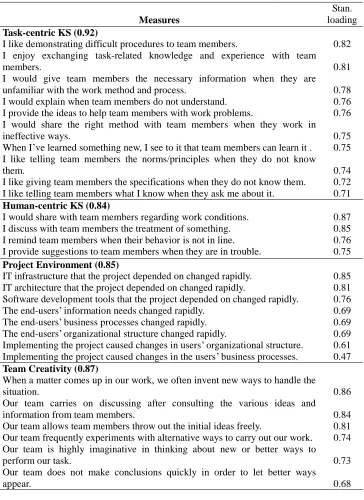
Table 1
Construct Measurements for the Current Study
Measures
Stan. loading Task-centric KS (0.92)
I like demonstrating difficult procedures to team members.
I enjoy exchanging task-related knowledge and experience with team members.
I would give team members the necessary information when they are unfamiliar with the work method and process.
I would explain when team members do not understand. I provide the ideas to help team members with work problems.
I would share the right method with team members when they work in ineffective ways.
When I’ve learned something new, I see to it that team members can learn it . I like telling team members the norms/principles when they do not know them.
I like giving team members the specifications when they do not know them. I like telling team members what I know when they ask me about it.
0.82 0.81 0.78 0.76 0.76 0.75 0.75 0.74 0.72 0.71 Human-centric KS (0.84)
I would share with team members regarding work conditions. I discuss with team members the treatment of something. I remind team members when their behavior is not in line. I provide suggestions to team members when they are in trouble.
0.87 0.85 0.76 0.75 Project Environment (0.85)
IT infrastructure that the project depended on changed rapidly. IT architecture that the project depended on changed rapidly.
Software development tools that the project depended on changed rapidly. The end-users’ information needs changed rapidly.
The end-users’ business processes changed rapidly. The end-users’ organizational structure changed rapidly.
Implementing the project caused changes in users’ organizational structure. Implementing the project caused changes in the users’ business processes.
0.85 0.81 0.76 0.69 0.69 0.69 0.61 0.47 Team Creativity (0.87)
When a matter comes up in our work, we often invent new ways to handle the situation.
Our team carries on discussing after consulting the various ideas and information from team members.
Our team allows team members throw out the initial ideas freely.
Our team frequently experiments with alternative ways to carry out our work. Our team is highly imaginative in thinking about new or better ways to perform our task.
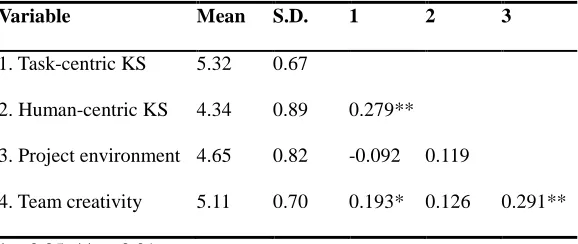
Table 2 shows the descriptive statistics of the sample data. The hypotheses were tested with the hierarchical regression analysis, the results of which are presented in Table 3. The correlations and collinearity statistics suggest that all required regressions could be run.
Table 2
Mean, Standard Deviations, and Correlations
Variable Mean S.D. 1 2 3
1. Task-centric KS 5.32 0.67
2. Human-centric KS 4.34 0.89 0.279**
3. Project environment 4.65 0.82 -0.092 0.119
4. Team creativity 5.11 0.70 0.193* 0.126 0.291**
*p<0.05, ** p<0.01
4.2. Hypothesis and Model Testing
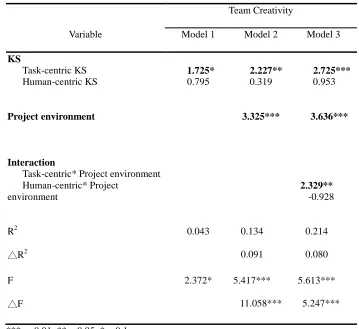
Hypotheses 1 and 2 propose positive relationships of task-centric and human-centric KS with team creativity. Table 3 shows the results of hierarchical regression analyses, estimating the effects of KS and project environment on team creativity. Hypotheses 1 and 2 predict direct effects of KS on team creativity. As shown in Table 3, the coefficient for task-centric KS is positive and has a significant influence (p<0.01) on team creativity, indicating that a team with more task-centric KS is likely to be more creative. Hence, Hypothesis 1 is confirmed. Hypothesis 2 states the relationship between human-centric KS and team creativity. As shown in Table 3, the coefficient for human-centric KS is not significant (p>0.05) on team creativity. Hence, Hypothesis 2 is not supported.
coefficient of the interaction was not significant, indicating that the effect of human-centric KS on team creativity is not dependent on project environment. Hence, Hypothesis 4 is not supported.
Table 3
Results of Hierarchical Regression Analysis, Effects of KS, and Program Environment
Team Creativity
Variable Model 1 Model 2 Model 3
KS
Task-centric KS Human-centric KS
1.725* 0.795
2.227** 0.319
2.725*** 0.953
Project environment 3.325*** 3.636***
Interaction
Task-centric* Project environment Human-centric* Project
environment
2.329**
-0.928
R2 0.043 0.134 0.214
△R2 0.091 0.080
F 2.372* 5.417*** 5.613***
△F 11.058*** 5.247***
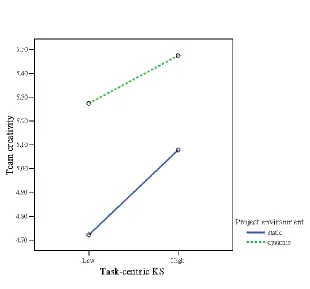
To better explain the form of interactions reported in the above hierarchical regression analysis, the interaction effects were plotted in the graphs shown in Figure 1. These data indicate the nature of the interaction effects in terms of the relationships between task-centric KS and team creativity for high levels (above the median) of project environment and low levels (at or below the median). The graph shows that, for teams with high or low project environment, the relationship between task-centric KS and team creativity was positive. Figure 1 also shows that, when task-centric KS was facilitated, team creativity was higher for a dynamic project environment and lower for a static project environment. In other words, the results suggest that a dynamic project environment generates higher team creativity with task-centric KS.
5.
CONCLUSIONS
The concluding remarks in this section focus on our research findings, managerial implications of the study, research limitations, recommendations, and ideas for future study.
5.1. Research Findings
solution. Sharing task-related knowledge and experience (e.g., work processes, work methods, and work specifications) might then stimulate team members’ creative thinking and lead to high team creativity. In other words, strong task-centric KS is likely to encourage the thinking of task-related knowledge as such team processes tend to create the novel solutions for task problems facing the team.
Our research also shows that the interaction between task-centric KS and project environment significantly affects team creativity. This finding is interesting, given that previous research has focused on the direct effect of KS in explaining team performance only, without addressing whether the effect might be dependent on the project environment. In this study, it was found that project environment played an important moderating role between KS and team creativity. As Figure 1 (shown previously) illustrates, the significant result for the moderating effect of project environment on the relationship between task-centric KS and team creativity implies that project environment is important to understand how team creativity is enhanced through task-centric KS by team members in software development projects.
This finding suggests that the project environment of software development is instrumental in using task-centric KS and directing the team process toward the critical performance of team creativity. Innovative tasks, such as the design and development of new software, as Daft and Lengel [1986] and Sicotte and Langley [2000] suppose, are characterized by high levels of ambiguity, uncertainty, and equivocality. It seems reasonable to suppose that a more dynamic project environment necessitates team members to take new perspectives on problems, thus increasing team creativity as well. Under dynamic software development project conditions, greater task-centric KS with team members may help achieve a common understanding of how teamwork can overcome any complexity they encounter in order to develop solutions to novel problems and to ensure that the project stays on track.
experience regarding what needs to get done, and how it needs to get done. Therefore, merely possessing human-centric knowledge, including the shared team objective and procedures, in a rapidly changing project environment may not be very helpful.
5.2. Managerial Implications
As for the practical implications of these findings, this study has shown the importance of KS in software development settings. It is clear that, to achieve high team creativity, task-centric knowledge must be shared. Moreover, the study findings also demonstrate the importance of project environment as a facilitator of the relationship between KS and team creativity. Because a project environment based on complexity, uncertainty, and change rapidly stimulates greater KS in teams, such an environment will also enhance team creativity. The findings of this research can also help team managers to understand the importance of such soft elements as KS and project environment. Thus, the finding implies that KS is more important in cases of highly complex software development, where the novelty and uncertainty of the task make interaction more critical because of unforeseen and rapidly changing technology or organizational environments.
5.3. Research Limitations
5.4. Recommendations
In knowledge management, a basic concept is that knowledge can be shared. Knowledge is crucial to contemporary professionals who have to continuously produce innovative products and services. The technological nature and complexity of information systems development require team work among specialists from various domains and communities. Team creativity is enhanced when team members communicate information, effective practices, thoughts, experiences, preferences, and insights on lessons learned. This study, which examined inter-team KS, found that task-centric knowledge significantly affects team creativity, and that team creativity can be enhanced via task-centric KS, including work processes, work methods, and work specifications related to project tasks. These findings provide useful recommendations for enhancing KS among team members through collaboration and sharing.
5.5. Future Study
This research demonstrates the importance of task-centric KS in team creativity. Further research should examine the factors affecting KS and verify the antecedent variables to develop a more complete research framework. In reviewing past research, we find that some studies have proposed that the success of KS in a team not only is due to technical issues, but also is relevant to social factors. As Clarke & Rollo [2002] note, KS is essentially a social process, one that must take into account social and cultural factors. Thus, there are many approaches for future studies to incorporate different variables into the research framework. However, in its current state, the empirically validated model posited in this study provides a good starting point for studying KS in the context of ISD projects. Future research could investigate the impact of the degree of congruency between source and recipient characteristics on the KS process.
REFERENCES
Allen, T. J. 1971. Communication networks in R&D Labs, R&D Management 1, 4-21. Allen, T.J. 1977. Managing the Flow of Technology, Boston: MIT Press.
Amabile, T.M. 1988. A model of creativity and innovation in organizations, Research in Organizational Behavior 10, 123-167.
Bartol, K.M., and A. Srivastava, A. 2002. Encouraging knowledge sharing: The role of organizational reward systems, Journal of Leadership & Organizational Studies 9(1), 64-76.
Brauner, E., and W. Scholl. 2000. The information processing approach as a perspective for group research, Group Processes and Intergroup Relations 3, 115-122.
Brown, J., and P. Duguid. 1998. Organizing knowledge, California Management Review 40(3), 90-111.
Chen, M.H. 2006. Understanding the benefits and detriments of conflict on team creativity process, Creativity and Innovation Management 15(1), 105-116.
Clarke, T., and C. Rollo. 2002. Corporate initiatives in knowledge management, Education and Training 43(4/5), 206-214.
Cooper, R. 2000. Information technology development creativity: A case study of attempted radical change, MIS Quarterly 24(2), 245-276.
Cramton, C.D. 2001. The mutual knowledge problem and its consequences in geographically dispersed teams, Organization Science 12(3), 346-371.
Curtis, B.; H. Krasner; and N. Iscoe. 1988. A field study of the software design process for large systems, Communications of the ACM 31(11), 1268-1287.
Daft, R.L., and R.H. Lengel. 1986. Organizational information requirements, media richness, and structural design, Management Science 32(5), 554-571.
Dechant, K., V.J. Marsick, and E. Kasl. 1993. Toward a model of team learning, Studies in Continuing Education 15(1), 1-14.
DeMeyer, A.C. L. 1985. The flow of technological innovation in an R&D department, Research Policy 14(6), 315-328.
Denison, D.; S. Hart; and J. Kahn. 1996. From chimneys to cross-functional teams: Developing and validating a diagnostic model, Academy of Management Journal 39(4), 1005-1023.
Drazin, R.; M.A. Glynn; and R. Kazanjian. 1999. Multilevel theorizing about creativity in organizations: A sense-making perspective, Academy of Management Review 24(2), 286-307.
Edmonds, E., and L. Candy. 2002. Creativity, art practice, and knowledge, Communications of the ACM 45(10), 91-95.
Espinosa, J.; S. Slaughter; R. Kraut; and J. Herbsleb. 2007. Team knowledge and coordination in geographically distributed software development, Journal of Management Information Systems 24(1), 135-169.
Hickey, A., and A. Davis. 2004. A unified model of requirements elicitation, Journal of Management Information Systems 20(4), 65-84.
Hoegl, M., and K.P. Parboteeah. 2007. Creativity in innovative projects: How teamwork matters, Journal of Engineering and Technology Management 24, 148-166. Hoegl, M.; K.P. Parboteeah; and H.G. Gemuenden. 2003. When teamwork really
matters: Task innovativeness as a moderator of the teamwork-performance relationship in software development projects, Journal of Engineering and Technology Management 20, 281-302.
Hutt, M.; B. Walker; and G. Frankwick. 1995. Hurdle the cross functional barriers to strategic change, Sloan Management Review 20-22.
Keller, R.T. 1994. Technology-information processing fit and the performance of R&D project groups: A test of contingency theory, Academy of Management Journal 37(1), 167-179.
King, N., and N. Anderson. 1990. Innovation in working groups, In West, M.A., and J.L. Farr (eds.), Innovation and Creativity at Work: Wiley, Chichester, 81-100. Kraut, R.E., and L.A. Streeter. 1995. Coordination in software development,
Communications of the ACM 38(3), 69-81.
Leenders, R.; A.J. Th.; J. Kratzer; and J.M.L. Van Engelen. 2003. Virtually, communication, and new product team creativity: A social network perspective, Journal of Engineering and Technology Management 20, 69-92.
Lyytinen, K., and D. Robey. 1999. Learning failure in information systems development, Information Systems Journal 9(2), 85-101.
McComb, S.A.; S.G. Green; and W.D. Compton. 2007. Team flexibility's relationship to staffing and performance in complex projects: An empirical analysis, Journal of Engineering and Technology Management 24(4), 293-313.
Moenaert, R.K.; F. Caeldries; A. Lievens; and E. Wauters,. 2000. Communication flows in international product innovation teams, Journal of Product Innovation Management 17, 360-377.
Nonaka, I.; and N. Konno. 1998. The concept of ‘ba’: Building a foundation for knowledge creation, California Management Review 40(3), 40-54.
Okhuysen, G., and K. Eisenhardt. 2002. Integrating knowledge in groups: How formal interventions enable flexibility, Organization Science 13(4), 370-386.
Parolia, N.; S. Goodman; Y. Li; and J.J. Jiang. 2007. Mediators between coordination and IS project performance, Information and Management 44, 635-645.
Robillard, P. 1999. The role of knowledge in software development, Communications of the ACM 42(1), 87-92.
Rus, I., and M. Lindvall. 2002. Knowledge management in software engineering, IEEE Software 19(3), 26-38.
Senge, P.M. 1990. The Fifth Discipline. Century Business, London: Doubleday.
Sicotte, H., and A. Langley. 2000. Integration mechanisms and R&D project performance, Journal of Engineering and Technology Management 17(1), 1-37. Stewart, G. L., and M.R. Barrick. 2000. Team structure and performance: Assessing the
mediating role of intrateam process and the moderating role of task type, Academy of Management Journal 43(2), 135-148.
Thamhain, H.J. 2003. Managing innovative R&D teams, R&D Management 33, 297-311. Tiwana, A., and E. Mclean. 2005. Expertise integration and creativity in information
systems development, Journal of Management Information Systems 22(1), 13-43. Woodman, R.W.; J.E. Sawyer; and R.W. Griffin. 1993. Toward a theory of
organizational creativity, Academy of Management Review 18, 293-321.
Xia, W., and G. Lee. 2005. Complexity of information systems development projects, conceptualization and measurement development, Journal of Management Information Systems 22(1), 45-83.
ABOUT THE AUTHORS
Mei-Hsiang Wang is an associate professor in the Information and Management Department, College of Management, Southern Taiwan University of Science and Technology. Her research interests include IS personnel management, managerial aspects of ISD project teams, and knowledge management in software development. Her work has been published in journals such as Journal of e-Business, Journal of Information Management, and NTU Management Review, among others.
Chen-Fen Huang is an associate professor in the Information and Management Department, College of Management, National United University. She received her Ph.D. in MIS from National Sun Yat-sen University. Her research interests include IS personnel management, career management, and knowledge management in software development projects. She has published articles in a variety of journals including the International Journal of Business and Systems Research, Journal of Information Management, and Sun Yat-sen Management Reviews, among others.