INFLUENCE OF BIO-PREPARATION ON WASTEWATER PURIFICATION
PROCESS IN CONSTRUCTED WETLANDS
Monika Puchlik1, Katarzyna Ignatowicz1, Wojciech Dąbrowski1
1 Białystok University of Technology, 45A Wiejska Str., 15-351 Białystok, Poland; e-mail: [email protected];
[email protected]; [email protected]
INTRODUCTION
In rural areas and areas with dispersed build-ings, the issue of wastewater management is still unresolved. Many years of negligence in the con-struction of sewers and sewage treatment plants cause that many residents of rural areas are forced to solve the problem of sewage treatment individ-ually. Only 63.6% of inhabitants used the waste-water treatment plant in the Podlaskie province in 2013 (CSO). The use of house sewage treatment plants in Podlaskie province is becoming an in-creasingly common method of wastewater man-agement, wherever it is not possible to connect the sewerage network. The constructed wetland method of wastewater treatment is a process tak-ing place with the participation of heterotrophic microorganisms as well as aquatic plants and hy-drophytes existing in purposely designed objects, i.e. groundwater beds or ponds.
Constructed wetlands have the ability to cumulate and retain organic substances. The ac-cumulation of these substances is the result of excess of the primary production in relation to the respiration of heterotrophic microorganisms active in the wetland system [www.ekologia24. biz25.05.2014, Ozimek et al. 1996]. Organic matter produced in the environment of wetland
Volume 16, Issue 1, Jan. 2015, pages 159–163
DOI: 10.12911/22998993/602 Research Article
ABSTRACT
Technological system of analyzed wastewater treatment plant is in part a biologi-cal bed of soil-reed in parallel arrangement. Unusual application is the application
of two independent purification lines where in the second line, a bio-preparation
is additionally dosed. The constructed wetland provides high removal of organic compounds expressed as BOD5 and COD, as well as reducing the concentration
of ammonia nitrogen and phosphates. This indicates a high performance of such a sewage treatment plant.
Keywords: constructed wetland, bio-preparation, wastewater. Received: 2014.09.01
Accepted: 2014.10.17 Published: 2015.01.02
ecosystem is seasonally accumulated on the sub-strate surface, and then converted during micro-biological processes into hard-degradable organic substances, such as humic compounds forming a new soil layer [Obarska-Pempkowiak et al. 2010, Obarska Pempkowiak 2002, Henze et al. 2000].
Bio-preparations are selected microorgan-isms, mainly bacteria, fungi, and enzymes, bound to the mineral medium, used for the biodegradation of organic pollutants. They are non-toxic to humans, animals and plants. Selec-tion of bacterial cultures in bio-preparaSelec-tions is made in such a way to eliminate disease-forming pathogens. The purpose of the bio-preparations application is faster decomposition of organic pollutants in wastewater (manure, paper, plant debris, grease), better biodegradation of deter-gents and cleaners, as well as the elimination of unpleasant odors.
MATERIAL AND METHODS
The study was conducted in a household sew-age treatment plant with constructed wetland bed in Dzierniakowo in Podlaskie province. The ob-ject is intended for use by 10 people. Thus, it is designed for the average wastewater flow of 1.2 m3/d. Exploitation of the household sewage
treat-ment plant with constructed wetland started in January 2012. To determine the effect of the bio-preparation on the efficiency of wastewater treat -ment, the plant operates in parallel system and is made up of two lines operating independently of each other [Markowski 2011]. Wastewater is pre-purified in septic tanks. Wastewater from the main septic tank (1) of a volume of 2.3 m3 is
sepa-rated by the well (2) evenly into two subsequent settlers of 1.5 m3 volume working in parallel,
from which they are delivered to two pumping stations (P4, L4) through two independent lines. Wastewater from the pumping section flows to the wetland beds. Two identical beds (working in parallel) with a square base 4×4 m and the bed height of 90 cm each. The ground-plant beds are piled in three layers: bottom layer (gravel 2–16 mm, thickness 20 cm), middle layer (sand 0.5–2 mm, 55 cm), upper layer of drainage (gravel 8–16 mm), on which common reed (Phragmites communis), was planted. A block diagram of a sewage treatment plant is shown in Figure 1.
The research has been conducted since Janu-ary 2012. In this paper, the average test results from 2013, when bed was exhausted and plants acclimatized, are presented. During the whole period of research, bio-preparation BIOSAN KZ 2000 was dosed into the septic tank of the II line every 14 days. The bio-preparation includes start-ing conditioner along with properly assembled set of non-pathogenic microorganisms of strictly di-rected action resulting in decomposition and deg-radation of harmful substances such as: ammonia, nitrites, hydrogen sulfide, indole, skatole, mer -captans, phosphorus compounds, and other single and multi-carbonaceous organic compounds. Mi-crobial composite has the ability to bind heavy metals, directing the desired fermentation pro-cesses, changing pH of the sewage and liquid manure, and very strong inhibition of pathogenic microorganisms growth, as well as enzymatic de-struction of eggs and spores of insects and endo-parasites [www.ekologia24.biz25.05.2014]. Bio-preparation BIOSAN KZ 2000 is designed to mi-crobial wastewater treatment of sewage in
treat-ment plants, lagoons, septic tanks, liquid manure and slurry reservoirs, microbiological treatment of sewage and impurities in other facilities and devices of similar nuisances and loads, as well as elimination of unpleasant odors and microbial contamination in the environment of such objects and to improve the physicochemical and hygienic parameters of contaminated reservoirs and water intakes [www.ekologia24.biz25.05.2014]. The bio-preparation is used in an amount of 20 g per 1 m3 of wastewater or projected liquid waste every
14 days [www.ekologia24.biz25.05.2014].
dance with the applicable methodology: COD, BOD5, phosphates (PO43-), total phosphorus (P
tot.),
ammonium nitrogen (NH4+), and Kjeldahl
nitro-gen (TKN).
RESULTS AND DISCUSSION
The COD to BOD5 ratio for raw sewage is less than 2, which indicates that those wastewa-ters are readily biodegradable. The average pu-rification effect on the bed for BOD5 was 79.2% in the left line, while 96.2% in the right line with the addition of bio-preparation; the total effect in the left line amounted to 84.3% and 97.4% in the right line (Figure 2).
The high percentage of the purification effect for BOD5 and COD provides the correct course of wastewater treatment from organic impurities, and achieved values at the outlet into the receiver comply with the requirements of 24 July 2006 (as amended in 2009), set by the Regulation of the Minister of Environment on the conditions to be met when discharging sewage into waters or soils, and on substances particularly harmful to the aquatic environment.
The tested sewage subjected to the treatment had pH = 6.5÷8, and therefore ammonia is pres-ent practically in 95 to 100% in an ionized form of NH4+. Municipal sewage contains biologically
non-decomposable organic nitrogen in the amount of about 2 mg N/m3. It remains in this form and
concentration in treated wastewater [Kalinowska et al. 2005]. A similar amount of organic nitro-gen was observed in the test samples, which was calculated on the basis of the difference between the concentration of TKN and N-NH4. Organic nitrogen compounds undergo a process of ammo-nification already during the inflow to the sewage
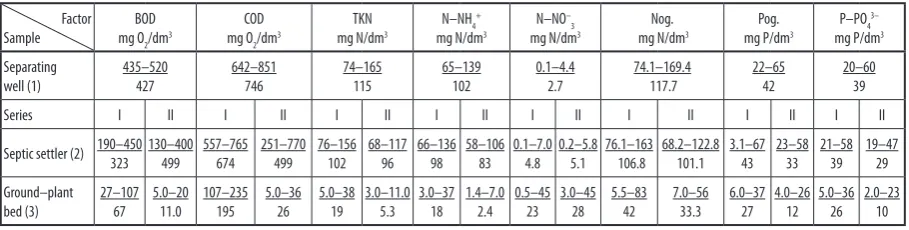
treatment plant. As a result, the average amount of ammonia nitrogen in samples from the septic tank was 102 mg N/dm3, and the Kjeldahl
nitro-gen 115 mg N/dm3. Favorable conditions for
ni-trification (good oxygenation of sewage, pH close to 7) during the flow of wastewater through the constructed wetland contributed to the removal of ammonia nitrogen in the left line in 81.6% and in the right line with use of the bio-preparation – in 97.1% 9 (Figure 3). Due to the microorgan-isms that can assimilate nitrogen only in the in-organic form, and for which ammonia is easily absorbed form, the concentration of NH4+ in the
effluent flowing out to the receiver was in the left line 18 mg N/dm3 and in the right line 2.4 mg N/
dm3 (Table 1).
Mean values of the Kjeldahl nitrogen concen-tration in the treated wastewater is for the left line 19 mg N/dm3, while for the right line with applied
bio-preparation, a decrease to 5.3 mg N/dm3 was
recorded. This indicates the presence of a small amount of nitrogen in organic form and ammonia nitrogen that was not subject to nitrification. The activity of Nitrosomonas and Nitrobacter bacteria is provided not only by reduction in the amount of ammonia nitrogen in the outflowing sewage, but also an increase in nitrate concentration at the measurement point (after beds). Comparing the achieved values and taking into account the fact that heterotrophic bacteria in the struggle for sub-strates displace nitrifying bacteria, it can be as-sumed that a significant portion of organic load was removed on the hydrophilic bed.
A small amount of wastewater flowing into the sewage treatment plant daily makes a consid-erable concentration of certain pollutants. This is evident in the case of phosphates in the studied wastewater. Phosphates in wastewater have their origin mainly from synthetic detergents,
wash-Figure 2. Efficiency of total COD and BOD [%]
ing agents, and their quantity affects the total phosphorus level. In the studied raw sewage, the average phosphate concentration was 39 mg P/ dm3. During the flow of wastewater through the
constructed wetland, the phosphate concentra-tion decreased to 26 mg P/dm3 in the left line,
whereas up to 10 mg P/dm3 in the line where
bio-preparation was applied. Complete effect of phosphate removing from wastewater during the study period reached 33.3% in the left, while 74.3% in the right line. Effect of the removal of total phosphorus in left line was 35.7%, and 71.4% when bio-preparation was used (Figure 4). In none of tested samples, there was any increase in the phosphate concentration. No secondary re-lease of phosphorus compounds by bacteria tes-tifies maintaining the aerobic conditions during the wastewater treatment on the bed. Some of the phosphorus compounds were assimilated by bac-teria and plants, expanding root system of which provides an environment rich in aerobic and an-aerobic bacteria.
According to Sadecka and Myszograj [Myszograj 2011, Sadecka 2008], in the case of sewage from rural areas, one should be prepared to determine pollutants concentrations, other than
the literature, particularly in relation to the con-tent of biogenic compounds. For the analysis of the wastewater composition, it should be remem-bered that they are constantly changing, what is caused by a high non-uniformity resulting from the operation cycles or habits of the people using a given treatment plant.
CONCLUSIONS
The analysis of performed measurements and calculation allows for drawing the following con-clusions:
1. The use of bio-preparation Biosan KZ 2000 contributes to the increase in the efficiency of treated wastewater in household sewage treat-ment plants with constructed wetland.
2. Improved total efficiency of organic com -pounds removal expressed as COD by 22.65% and BOD5 by 13.12% with the application of bio-preparation Biosan KZ 2000, was observed. 3. The bio-preparation slightly affects the en-hanced removal of total nitrogen (7.40%) and ammonia nitrogen (15.30%).
4. Efficiency of organic compounds removal in the constructed wetland for the line supported by the bio-preparation is higher by 23.72% for COD and by 16.99% for BOD5.
5. Removal of nitrogen forms for the bio-prep-aration supported line in the constructed wet-land is higher by 15.43% for ammonia nitro-gen and by 6.39% for total nitronitro-gen.
6. Twice as effective phosphorus removal was observed on the bed supported by bio-prepa-ration Biosan KZ 2000 during the whole study period.
7. Applied bio-preparation Biosan KZ 2000 clearly improves the quality of treated waste-water.
Figure 4. The effectiveness of the total phosphorus forms [%] in Dzierniakowo in 2013
Table 1. Parameters of wastewater during the treatment process in household sewage ground-plant bed Factor
Sample mg OBOD 2/dm3
COD mg O2/dm3
TKN mg N/dm3
N–NH4+
mg N/dm3
N–NO– 3
mg N/dm3
Nog. mg N/dm3
Pog. mg P/dm3
P–PO43–
mg P/dm3
Separating
well (1) 435–520 427 642–851 746 74–165 115 65–139 102 0.1–4.4 2.7 74.1–169.4 117.7 22–65 42 20–60 39
Series I II I II I II I II I II I II I II I II
Septic settler (2) 190–450 323 130–400 499 557–765 674 251–770 499 76–156 102 68–117 96 66–136 98 58–106 83 0.1–7.0 4.8 0.2–5.8 5.1 76.1–163 106.8 68.2–122.8 101.1 3.1–67 43 23–58 33 21–58 39 19–47 29
Ground–plant
bed (3) 27–107 67 5.0–20 11.0 107–235 195 5.0–36 26 5.0–38 19 3.0–11.0 5.3 3.0–37 18 1.4–7.0 2.4 0.5–45 23 3.0–45 28 5.5–83 42 7.0–56 33.3 6.0–37 27 4.0–26 12 5.0–36 26 2.0–23 10
Acknowledgments
Financial support for this research was pro-vided by Ministry of Science and Higher Educa-tion within the project N N304 274840 and W/ WBiIŚ/8/2013.
REFERENCES
1. Obarska-Pempkowiak H., Gajewska M.,
Wojcie-chowska E. 2010. Hydrofitowe oczyszczanie wód i ścieków. Wydawnictwo Naukowe PWN 2010.
2. Ozimek T., Renman G. 1996. Rola heliofitów w oc
-zyszczalniach hydrobotanicznych. [In:] II
Między-narodowa Konferencja Naukowo-Techniczna,
Akademia Rolnicza w Poznaniu, Poznań, 109–118.
3. http://www.ekologia24.biz/oczyszczalnie/biopre-parat-biosan-kz-2000-25.05.2014r.
4. Obarska-Pempkowiak H. 2002. Oczyszczalnie
hy-drofitowe. Wydawnictwo Politechniki Gdańskiej, Gdańsk.
5. Reddy K.R., D’Angelo E.M. 1996. Biochemical
indicator to evaluate pollutant removal efficiency
in constructed wetland. [In:] 5th International Con-ference on Wetland Systems for Water Pollution Control. Universität für Bodenkultur Wien and In-ternational Association on Water Quality. Vienna. 6. Markowski W. 2011. Wpływ biopreparatów na
efektywność usuwania związków węgla w przy
-domowej oczyszczalni ścieków ze złożem hy
-drofitowym. Praca magisterska. Politechnika Białostocka, 76–86.
7. Kalinowska E., Bonar G., Duma J. 2005. Zasady i
praktyka oczyszczania ścieków. Wyd. LEMTECH Konsulting, Kraków.
8. Henze M., Harremoes P., Jansen J., Arvin E. 2000.
Oczyszczanie ścieków. Procesy biologiczne i che-miczne. Wyd. Politechniki Śląskiej, Kielce.
9. Myszograj S. 2008. Zmiany ilościowe i jakościowe ścieków dopływających do małych oczyszczalni. [In:] Oczyszczanie ścieków i przeróbka osadów ściekowych, Tom 2, Zielona Góra.

![Figure 3. The effectiveness of the total forms of nitrogen [%] in Dzierniakowo in 2013](https://thumb-us.123doks.com/thumbv2/123dok_us/8362333.1671910/3.595.72.286.608.741/figure-effectiveness-total-forms-nitrogen-dzierniakowo.webp)