53 Solar engineers, agriculturists and architects need
so-lar radiation for many applications such as soso-lar heating, cooking, drying and interior illumination of buildings (Jiang, 2009). Solar radiation is also important for the growth period and development of plants (Citakoglu, 2015).
In the last decades, Model tree (MT) was used for
modelling rainfall-runoff by (Solomatine & Dulal, 2003), in forecasting flood by (Solomatine and Xue, 2004), for de -termining stage discharge relationship by (Bhattacharya & Solomatine, 2005) , for modelling sediment by (Bhattacha-rya & Solomatine, 2006), for estimating reference evapo-transpiration by (Pal & Deswal, 2009). MT based regression approach was used by (Pal & Deswal, 2009) for modelling daily reference evapotranspiration based on air tempera-ture, solar radiation, wind speed and relative humidity. The accuracy of support vector machine and MT was compared
in forecasting streamflow by (Sattari, Pal, Apaydin, Oz -turk,2013) and later one was found to be better than the
first method.
The purpose of the present study is to estimate solar ra-diation of Antalya City, Turkey using M5 model tree method.
M5 model tree
M5 model tree (M5tree), first presented by (Quinlan, 1992),
is based on a binary decision tree comprising linear
func-*Ph.D., Faculty of Computer Technologies and Engineering, International Black Sea University, Tbilisi, Georgia. E-Mail: [email protected]
**Assoc. Prof. Dr., Faculty of Computer Technologies and Engineering, International Black Sea University, Tbilisi, Georgia. E-Mail: [email protected]
***Assoc. Prof. Dr., Faculty of Computer Technologies and Engineering, International Black Sea University, Tbilisi, Georgia. E-Mail: [email protected]
Solar Radiation Modeling Using M5 Model Tree
Ozgur KISI* Okan ERAY** Cihan MERT***
Abstract
The study investigates the ability of M5 model tree in modeling monthly so-lar radiation. Monthly data of maximum and minimum air temperatures, wind speed, relative humidity and solar radiation from Antalya, Turkey were used in
the application. The effect of each climatic parameter on solar radiation is in
-vestigated. Periodic models are also developed to see the effect of periodicity
component on models’ accuracy. It was found that using periodicity as input to
the applied models significantly increases their accuracy in modeling monthly
solar radiation.
Keywords: Solar radiation, M5 model tree, modeling
tions at the leaf nodes and can also be utilized for
quantita-tive data (Rahimikhoob, 2014). M5tree needs two different
phases: i) A decision tree is created by dividing data into
subsets in the first phase, ii) Overgrown tree is pruned and
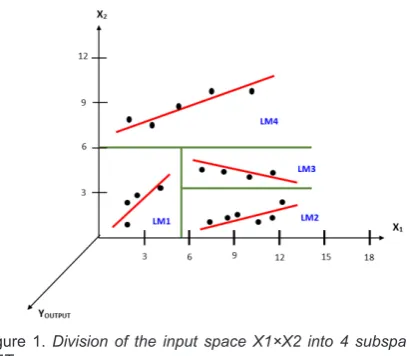
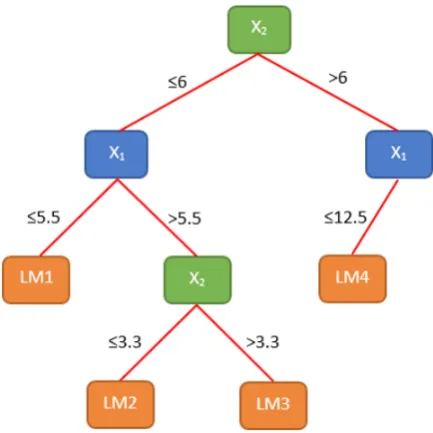
sub-trees are replaced with linear regression functions in second phase. Division of the input space X1×X2 (where X1 and X2 are the independent parameters) into 4 subspaces is shown in Figure 1. LM1, …, LM4 at the leaves denote the linear regression functions. Tree structure of M5tree is shown in Figure 2 (Rahimikhoob, 2014). More information about M5tree can be obtained from (Quinlan, 1992).
Figure 1. Division of the input space X1×X2 into 4 subspaces in M5Tree.
Figure 2. Tree structure of M5tree
Application and results
In the current study, the ability of M5tree was investigat-ed by using data from Adana station, Turkey. Data cover 391 monthly values with a period of 1981-2016. 293 values (75% of the whole data) were used for calibrating M5tree models and remaining 98 values (25%) were used for eval-uating the accuracy of the developed models. Following in-put scenarios were tried in the application:
i) Tmax,
ii) Tmax and Tmin iii) Tmax, Tmin and W, iv) Tmax, Tmin, W and RH.
where Tmax, Tmin, W and RH indicate the maximum air temperature, minimum air temperature, wind speed and relative humidity. The output of the models is monthly SR. The evaluation criteria, root mean square errors (RMSE), mean absolute relative errors (MARE), mean absolute
er-rors (MAE) and determination coefficient (R2) used in the present study are:
where N denotes the number of data.
The accuracy comparison of the M5tree models are
provided in Table 1 with respect to four different statistics.
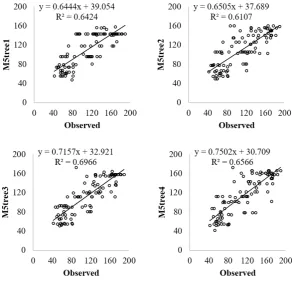
It is clear from the table that the model with three inputs (Tmax, Tmin and W) has the best accuracy (RMSE=25.46, MARE=20.30, MAE=19.06 and R2=0.697). The observed and estimated SR values using four different input scenar -ios are graphically compared in Figure 3 for the test stage.
As seen from the figure that the M5tree3 model using the in -puts, Tmax, Tmin and W has less scattered estimates than the other models.
55
The effect of periodicity component on models’ accura -cy was also investigated by adding month of the year as input to the applied models. The test results of the periodic models are reported in Table 2 in respect of RMSE, MARE, MAE and R2. In this table α denotes the periodicity and takes values from 1 to 12. From the table, It is apparent that
the Periodic-M5tree1 with two inputs (Tmax and α) has the
best accuracy from the MARE and R2 statistics. The Period-ic-M5tree2 model has slightly better RSME and MAE values
than the first model. First model should be preferred be -cause it has less number of input parameters. Comparison of Table 1 and 2 shows that adding periodicity into the model
inputs significantly improves M5tree accuracy in estimating
monthly SR. For example, Periodic-M5tree1 increase the RMSE, MARE and MAE accuracy of the M5tree1 model by 48%, 56% and 51%, respectively. The observed and esti-mated SR values by periodic M5tree models are graphically compared in Figure 4 for the test stage. Periodic-M5tree3 model seems to have less scattered estimates than the oth-er models especially for the peak SR values. Comparison
with the Figure 1 clearly indicates the significant positive effect of periodicity component on models’ accuracies in
modeling monthly SR. Figure 3. The scatterplots of observed and estimated SR by M5Tree models in test stage.
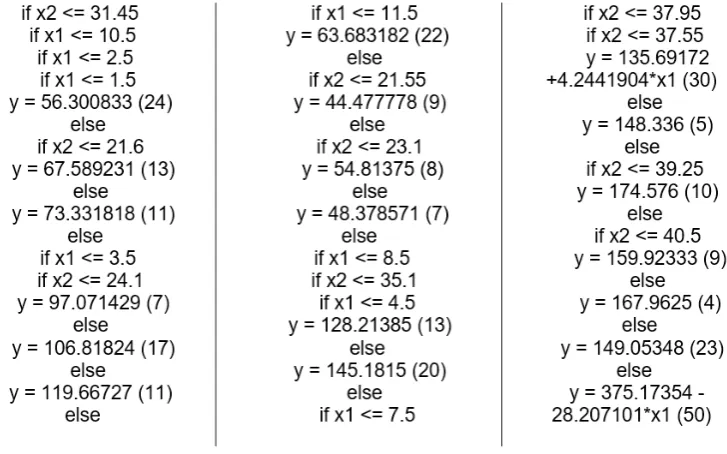
Model tree obtained from the Periodic-M5tree1 model comprising temperature and periodicity component as in-puts is given in Table 3. It is clear from the table that model tree involves if-then statements and can be simply used in practical applications.
Table 3. The model tree of the Periodic-M5tree1
57
Conclusions
In the current study, the accuracy of a popular soft comput-ing method, M5 model tree, in estimatcomput-ing monthly solar ra-diation was investigated. Monthly maximum and minimum air temperatures, wind speed and relative humidity data obtained from Antalya Station, Turkey were used as inputs
to the models. The study examined the effect of each cli -matic parameter on solar radiation and maximum
tempera-ture was found to be the most effective parameter on solar radiation for the studied station. The effect of periodicity
component on models’ accuracy was also investigated and it was found that adding this component to the M5 model tree inputs considerably increase its accuracy in monthly solar radiation modeling. It can be concluded that solar radiation of Antalya Station can be successfully modeled by using only maximum temperature data.
References
Bhattacharya B, Solomatine DP (2005) Neural networks and M5 model trees in modeling water level–discharge rela-tionship. Neurocomputing 63,381–396
Bhattacharya B, Solomatine DP (2006) Machine learning in sedimentation modelling. Neural Netw 19(2),208– 214
Citakoglu, H. (2015). Comparison of artificial intelligence
techniques via empirical equations for prediction of solar radiation, Computers and Electronics in Agriculture, 118, 28-37.
Jiang, Y. (2009). Computation of monthly mean daily global
solar radiation in China using artificial neural networks and
comparison with other empirical models, Energy, 34, 1276-1283.
Pal M, Deswal S (2009) M5 model tree based modelling of reference evapotranspiration. Hydrol. Process 23, 1437– 1443
Quinlan J.R. (1992). Learning with continuous classes. In Proceedings of the Fifth Australian Joint Conference on
Artificial Intelligence, Hobart, Australia, 16–18 November, World Scientific, Singapore: 343–348.
Rahimikhoob, A. (2014). Comparison between M5 Model Tree and Neural Networks for Estimating Reference Evapo-transpiration in an Arid Environment, Water Resource Man-age, 28: 657–669.
Sattari MT, Pal M, Apaydin H, Ozturk F (2013) M5
mod-el tree application in daily river flow forecasting in Sohu
stream, Turkey. Water Resources 40(3),233–242
Solomatine DP, Dulal KN (2003) Model trees as an
alterna-tive to neural networks in rainfall-runoff modelling. Hydrol
Sci J 48(3),399–411
Solomatine DP, Xue Y (2004) M5 model trees compared
to neural networks: application to flood forecasting in the