IMPROVING THE QUALITY OF LEARNING
THROUGH THE QUESTIONS OF TEXTS
Artur Sula, Irena Ndoci Lama, Mimoza Gjokutaj
University of Tirana, Tirana, Albania E-mail: [email protected], [email protected], [email protected]
Abstract
Didactic concept on the questioning is a process which is closely linked to student learning, provides interactivity during the process of teaching, enables deeper levels of learning, creates infinite space for the development of critical thinking and many other mental and psychological processes.
The dimensions of questioning lie on many levels: the level of the text, the level of student relations and student teachers relations during student group work and other educational activities.
The object of this study is the questioning process that relates to the inclusion of respondents used as pedagogical devices within the content of each lesson topic.
For the purpose of this study two groups of texts were taken inconsideration: texts of social sciences and natural sciences used in the Albanian school in order to see how questioning represents different levels of the taxonomy of learning and the types of questions designed according to different dimensions. In line with this observation the level of student learning was reviewed. This study gives some research findings based on the above analyses aiming at helping the authors of textbooks and teachers with writing and asking questions which enhance critical thinking and learning.
Key words: quality of learning, questioning, students’ questions, textbooks.
Introduction
in the interactive relationship between teachers and students and among students themselves an important role is played by questioning.
Questioning is an interactive relationship, which revives the conversation, giving continuity and understanding of teaching towards finding the final result.
Questioning should be considered as both a process and a technique, which gives high results when managed successfully and given attention by teachers, thus influencing student achievements greatly.
in the mentality of teachers the concept of questioning as an interactive teaching process is closely associated with learning. it is clearly expressed by the teaching paradigm that “student learning begins when the student begins to ask”.
in everyday school practice questioning has been considered as a competence owned and developed only by teachers. this belief has been so deeply rooted that the teaching process looks like an unending monologue where only teachers speak, ask and answer questions.
on the other side of the learning process there are students whose participation in questioning and answering seems to fall into a dangerous trajectory.
Problem of Research
of education in the 21st century Volume 36, 2011 107 of learning, which does not provide for active and creative learning.
in order to have a better insight of this issue in albanian schools a study was taken with the aim of identifying the questions and their types mostly used in school textbooks and in the teaching process.
this study describes the situation regarding the use of questions and their direct relation with the level of student knowledge.
in addition, a full view of the quantity and quality of textbooks questions is given. Questions included in textbooks directly influence the way the teacher will conduct the lesson and how students will learn.
based on the data analyses the study gives a new perspective on a more advanced concept of questioning by teachers and students.
Research Focus
this research focuses on the textbooks. textbooks filled with a variety of didactic elements need to be read in multiple ways to translate and understand the information they contain.
Questioning is a process which should be owned and further developed by the students. the shift of question ownership from teachers to students makes the pedagogical apparatus of textbooks important and which needs to be further enhanced. Questions asked by students on a particular topic include almost all questions that can be found in a text, sometimes they even surpass the questions that the teacher or textbook writer could have anticipated. this phenomenon promotes the development of critical and creative thinking of students.
to have a better view about the questions that textbooks provide and how they help to develop critical thinking skills an analysis of text questions was undertaken. the questions were identified and classified according to the taxonomic levels of learning. this gives us a detailed view of what kind of teaching and learning model they provide.
Methodology of Research
General Background of Research
to set questioning in an interactive relationship in the learning process, students and teacher trainees are led to ask questions about a picture.
students are given some learning material to study and then are required to ask two or three questions about what they have seen or read.
something very important happens in the interactive learning process. teachers could not imagine how many questions students would ask in such a short time (10 minutes within one hour of instruction). the bank of questions created may exceed the questions given in the certain text or those asked by the teacher. thus, for example in a classroom with 30 students when each one asks two to three questions on a particular topic (observing a picture) there are collected 60 questions,
even books with the best teaching apparatus can not have such a large bank of questions (about 60 to 90 questions in a classroom with thirty students).
in this process the students are involved in an interactive instructional situation and a very intensive learning process, during which they simultaneously read, write and then speak over a very short time. this new relationship makes teaching be directed to students, makes it student centered and integrates communicative competences while they participate in the lesson.
class take their time to learn while reading, writing and speaking.
the process of student questioning in the class brings many other positive outcomes in addition to the educational ones.
When the teacher appoints the students a task such as to ask questions about a figure, diagrams, tables, maps, text, etc.., he has given them new demands with regard to reading and getting information, because reading is not only a process of working with a written text, but also through the image, chart, melodic line, painting, etc.., learning processes which need to be revived in the daily process of teaching.
Sample of Research
the sample of research were the teachers and the students in secondary and high schools of various cities of albania and seven textbooks used in these schools of albania.
the observations are done in the textbooks of various subjects (albanian language and literature, Geography, history, chemistry, biology, etc.,) and it is seen how the questioning represented different levels of degrees taxonomy of learning and the types of questions according to different dimensions.
an observation form was designed to collect data on the number of questions in each textbooks and the level of learning they belong to. these data was analyzed according to the levels of learning.
this bank of questions recorded offered numerical data and helped in making analyses and comparisons among different subjects.
Instrument and Procedures
interviews, observations, and school text reviews were used in this study. the teacher training observation was semi-structured.
teacher trainees were appointed special tasks in group work in the framework of the study. being unaware of the observation they worked in real situation bringing forth their ability of asking questions. class observations conducted by the authors of the study and by teacher students in the classes observed yielded the same data as found out in the teacher training observations. the analysis of textbooks was another instrument which provided data on the number and levels of questions and their contribution towards students’ knowledge and skills quality.
the questions were classified as open-ended, close-ended and according to the levels of learning ranging from reproductive to critical and creative ones.
the tables have been divided according to bloom’s taxonomy (bloom, 1956).
at the first level (knowledge) there are questions such as: at what date...? When did it happen? Which was? Who are the characters?
in the second level (comprehension) there are questions like: What does it look like? What does this story describe? how do you feel when...? how do you imagine...? What scene appears before you? What’s the name?
in the third level (application) there are the questions: What is the idea...? do you think...? Why do you think so? What does it mean in your opinion?
in the fourth level (analysis) there are the questions: What are the characteristics? What are the factors that...? Which plan suits…? What are the steps to be taken?
of education in the 21st century Volume 36, 2011 109 in the sixth level (creation) there are questions like: how would you end..? do you have another definition? What is the likely outcome? how can you summarize?
Data Analysis
the practical exercise with the teachers of the country (from schools in tirana, durres, shkodra, dibra, Vlora, Korca, etc..,) is given during training sessions, while with the students of university of tirana it is given during the lessons.
the relationship between teachers and students questions is observed in various schools of the city of tirana in the years 2008-2010.
the completion of tables 3-8 were made after the observation of some of the textbooks used in two schools of tirana in the academic year 2010-2011. two of the best schools in the capital: the secondary school “edith durham” and high school “petro nini luarasi” have been selected.
teachers of all schools and districts in albania select the textbooks after the discussion in working groups with their school colleagues. different schools of the same city use different textbooks by different authors and publishing houses.
in the framework of the study 60 classes were observed, there were organised 15 training sessions and seven school texts were analysed.
Results of Research
in order to answer the questions “how do students ask?” different classes were observed. in these observations done in classes in various subjects such as languages, mathematics, physics, chemistry, geography, etc., it is clearly seen the indirect report of the above mentioned relationships. the data in table one gives information about this phenomenon.
Table 1. The relationship between teacher and student questions observed in schools of the city of Tirana in the years 2008-2010.
Subject observedClasses Questions asked Questions asked by teachers Questions asked by students
Albanian language and literature 10 90 82 8
Biology 10 80 72 8
Geography 10 78 70 8
History 10 80 68 12
Chemistry 10 66 60 6
Total 50 394 352 42
as seen from the table above questions are teachers’ property. the data show that teaching and learning in our school is directed by the teachers. the teaching process is teacher-centered. students must answer questions set by teachers and books. they are not seen as a subject of lessons able to produce questions. Very few teachers have tried to put the issue of student questioning in the spotlight: how much and how do they ask? little thought has been given to the quality and frequency of students’ questions.
if we put the above results in a cake shaped diagrams will see a large cake which is divided into two parts where its 92 % is consumed by teachers and only 8 % of it is consumed by students. it is not difficult to note “how much weight of knowledge is put on” by students by this model of teaching.
of questions that they themselves make about a photo.
Figure 1: Photo given to teachers and university students.
once given the above figure the trainees were asked to write three questions about the image. Questions they developed were grouped in this way:
1. What is she called? Where is she? how old is she?
2. What is she doing? Why is she laughing? What color are her eyes? 3. Why is she lying? is she in skype? is she listening to music?
Table 2. Questions developed by teachers around the given picture.
City Number of teachers Open-ended ques-tions % Closed-ended questions %
Tiranë 130 180 69 80 31
Durrës 70 90 64 50 36
Shkodër 70 82 58 58 42
Dibër 40 50 62 30 38
Korcë 55 70 63 40 36
Total 365 472 62 258 38
as seen from table 2, about 62 % of the questions are closed-ended questions, which shows what kind of teaching is given in our schools. so 62 % of teachers working in albanian schools have a traditional direction of teaching and use only questions of the reproductive type which stop at the first level of questions, at the level of cognitive learning and reproduction.
if only 38 % of questions are of creative character, evaluation, interpretation, this means that teaching and learning are more oriented towards reproductive learning and less reflective.
it must be said in advance that the authors of texts, the data of which are offered, are specialists and teachers from various subject fields who have provided banks of questions into the textbooks pedagogical apparatus without being aware of the taxonomy of questions because of lack of didactic training.
of education in the 21st century Volume 36, 2011 111 Table 3. Questions in the Albanian Language textbooks class 9 and 10.
Albanian
language Level 1 Level 2 Level 3 Level 4 Level 5 Level 6 Total
Class 9 25 74 59 7 2 24 191
Class 10 72 147 113 49 32 52 464
both textbooks, albanian language 9 and albanian language and literature 10, have more or less the same structure. analytical and synthetical questions have been replaced by exercises and requirements. in some cases questions are merged, which distracts students. sometimes there are used unclear sentences. if the requirements that begin with the imperative verb are modified into questions they would be questions of the fourth level (e.g if the verb “notice” is replaced with” What are…”). from a survey done in connection with students performing the tasks beginning with the verb” write” 80 % did not do it, because they did not do the work at all. sometimes there are too general question as is shown in table 3 where most of the questions are of the reproductive type (38.74 % for grade 9 and 31.61 % for grade 10) and interpretative (30.89 % for grade 9 and 24.3 % for grade 10).
Table 4. Questions in the History textbooks 9 and 10.
History Level 1 Level 2 Level 3 Level 4 Level 5 Level 6 Total
Class 99 4 8 9 8 7 2 38
Class 10 14 122 69 64 10 12 291
in the book history 9 there are few questions. requirements that begin with verbs of the type: justify, analyze, establish, conclude, describe, differ, highlight, remember, fill, lists, etc. are well designed. the information is sufficient and their relationships with pedagogical apparatus is 1 / 6. the authors have used an attractive way of designing the textbook, making use of cards to encourage independent work. it is evident that the demands placed on students help them to work independently (although some requirements are level i and ii). there are times that there is only one question at the end of the lesson. this chosen method avoids conversation generally since the student responds in writing and does not participate in oral discussions. the teacher creates questions based on the numerous requirements in the text. s/he has to change into questions all imperative sentences. in the textbook history 10 there are sometimes a few questions after each lesson, but the text is traditional. at the end of each chapter there are again many questions and a few requirements. there are cases when one question is made up of two questions, making it ambiguous and difficult to answer. as seen from table 4, most of the questions are of the reproductive type (21.05 % for grade 9 and 41.92 % for grade 10) and interpretative (23.68 % for grade 9 and 23.77 % for grade 10).
Table 5. Questions in Biology textbook 9.
Biology 9 Level 1 Level 2 Level 3 Level 4 Level 5 Level 6
248 questions 7 111 84 21 16 9
Chemistry 9 Level 1 Level 2 Level 3 Level 4 Level 5 Level 6
100 questions 4 42 14 36 4
-the textbook chemistry 9 has mostly questions of -the reproductive level, which take -the first place, followed by questions of the analysis level and the fewest are the questions of the interpretative level. as seen from table 6, most of the questions are of reproductive type (42 %) and analysis (36 %) while the interpretative questions make up only 14 %.
Table 7. Questions in Geography textbook 9.
Geography 9 Level 1 Level 2 Level 3 Level 4 Level 5 Level 6
112 questions 2 41 48 19 1 1
the book Geography 9 has an equal distribution of 4 to 5 questions after each lesson. there is a sporadic case when there is only a question in the text, though four issues may have been explained in the text. as seen from table 7, most questions are of the interpretative type (42.86 %) and reproductive (36.61 %).
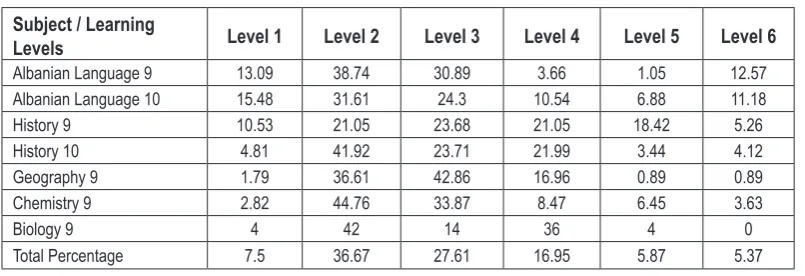
Table 8. Summary of data obtained from of 7 books analyzed.
Subject / Learning
Levels Level 1 Level 2 Level 3 Level 4 Level 5 Level 6
Albanian Language 9 13.09 38.74 30.89 3.66 1.05 12.57
Albanian Language 10 15.48 31.61 24.3 10.54 6.88 11.18
History 9 10.53 21.05 23.68 21.05 18.42 5.26
History 10 4.81 41.92 23.71 21.99 3.44 4.12
Geography 9 1.79 36.61 42.86 16.96 0.89 0.89
Chemistry 9 2.82 44.76 33.87 8.47 6.45 3.63
Biology 9 4 42 14 36 4 0
Total Percentage 7.5 36.67 27.61 16.95 5.87 5.37
as seen from table 8, most of the questions are of the comprehension type (36.67 %). the level of the application questions occupies the second place (27.61 %), the analysis the third place (16.95 %), the level of knowledge 7.5 %.only a few questions fall under synthesis (5.87 %) and evaluation (5.37 %) levels.
comparing the data for each subject it is seen that the questions in science subjects belong mostly to the second level of questions. fewer questions belong to the higher level of analyses and problem solutions. as for the albanian language, Geography and history the questions belong mainly to the second and third level of learning, but there is a distinct difference in the questions of the sixth level, so these questions in the albanian language textbooks make up 11, 87 % of the total number of questions, whereas they are only 3, 42 % of the total questions in history and Geography textbooks.
of education in the 21st century Volume 36, 2011 113 questions used in classes orientate students towards a reproductive and to some degree to applications and analyses.
Discussion
Various studies show that there is not a balanced ratio between teachers and students questions. Questions asked by students are very few and they are of the lowest level of learning. yet studies have pointed out the important and crucial role played by questions and questioning in education and in quality increasing process.
little research has been done in albania on these problem, so dealing with these issues highlights problems encountered and paves the way for further research with the aim of improving teaching and enhancing school performance.
the data analysed show that teachers need a lot of training to change their beliefs and approaches towards questions and questioning. asking questions of the lowest level of learning does not help critical thinking develompent.
it also hinders the development of comunicative skills in the class.
the problems found in the textbooks analysed show that their authors should be trained to design and write questions of the highest level of thinking. in this way the textbooks will contribute to the development of critical thinking skills.
in order to change the current profile of teaching and to direct it towards reflective one teachers must know how to direct questioning in such a way that both his/her questions and those of the students are in accordance with the levels of bloom’s taxonomy of learning.
Questions asked by students should be carefully collected by teachers and be treated in collaboration with students as both findings and teaching innovation.
if teachers pay attention to students’ questions they give a creative direction to the lesson by leading students to making questions, finding answers to them and involving them in a continuous research process to find solutions to different problems.
the process of student’s questioning and questions should be seen from a different light.
the teacher asks the students to develop their imagination, to assess their level of knowledge, to promote and encourage them to argue, to promote problem solving and alternative thinking and allow the expression of thoughts and feelings.
the students ask when they need additional information, when they want to clarify ideas of concepts, know when not to answer, when working in a group rather than individually, when they need instruction in the use of other devices, when you do not understand the information given.
students should be encouraged to ask questions. teachers have to show them that teachers always support and welcome students’ questions. this means that students should see that questions are not used to punish the students, but as a way of developing them and enhance their achievement through ensuring their active participation in the lesson.
teachers should give students enough time to answer questions asked by them themselves. students should be encouraged to tell their experiences in ways as varied as possible. teachers need to use various forms to encourage students to ask and should try to make the process friendlier to students in this process.
teacher should avoid prejudice to the types of questions and prejudices coming from them. the teacher should name the student who is going to ask the question.
the question asked by a student should be considered as a good one because it broadens and deepens students’ knowledge, encourages them to think critically and to focus attention. it requires analyses, comparisons, explanations and reasons, and helps to avoid misunderstandings in the classroom; enlivens discussions, involves students in learning, attracts attention and yields positive outcomes.
in some cases there is a bad experience of designing and asking questions in the class. under the pressure of time or wanting to give too much teachers ask some questions in a row and do not leave wait time to students before asking for their answer. Questions may not be well designed, they are more general questions requiring only a “yes” - “no” answer. When a student is asked the others are neglected and not actively involved in the lesson. Questions seem to be their own property or used as a trap for students.
Questions should be clear, precise, short, and understandable, in accordance with the terminology, have a logical connection between them and teachers should be able to cope with unexpected situations that may arise during in the classroom.
When designing and asking question teachers should take into consideration a variety of factors. they should know knowledge needs of their students, their level and quality of information, learning objectives and outcomes and the particular topic. they also should anticipate the possible answers. the questions asked must lead the students towards higher levels of learning and thinking.
special care must be shown to question management, their direction and distribution, wait time, appointment of students to answer and feedback giving.
finally, teaching the concept of questioning helps teachers in the implementation of an interactive teaching process and also offers students a more successful learning. recognition of this concept, the application of its criteria and practices, will introduce and maintain an interactive teaching environment that promotes critical and creative thinking.
Conclusions
from the above analysis based on the albanian school practices presented in this article it is seen that there must be a new approach to questions and questioning in education as a tool that enhances quality.
to improve teaching and learning in the contemporary context of learning in practice it is necessary to develop questioning and questions , which must be used in classes as an integral part of teaching.
an improved questioning process enhances the quality of learning and makes it student centered, cooperative, creative and friendly. students’ participation in asking and answering questions enhances their performance and is a sign of active and effective participation and commitment to learning.
this is possible when teachers, first of all, pay attention to the quality of their questions built according to the levels of learning and to questions types which must be intriguing and involving.
of education in the 21st century Volume 36, 2011 115 Acknowledgements
We would like to acknowledge teachers and students for the help provided to us. speciale would like to acknowledge teachers and students for the help provided to us. special thank goes to our colleague prof. as. dr. elida tabaku who encouraged and helped us to write the article.
References
anderson, l., Krathwohl, d. a. (2001). Taxonomy for Learning, Teaching and Assessing: A Revision of Bloom’s Taxonomy of Educational Objectives. new york: longman.
berisha, m., Guga, n. (2008). Kimia 9. tiranë. pegi.
bloom, b. s., engelhart, m. d., furst, e. J., hill, W. h., Krathwohl, d. r. (1956). Taxonomy of educational objectives: the classification of educational goals; Handbook I: Cognitive Domain. new york, longmans, Green.
dërguti, m., boçi, s., dushku, l. (2010). Historia 10. tiranë. albas.
Gjokutaj, m. (2009). Didaktika e gjuhës shqipe. tiranë. shtëpia botuese e librit universitar.
nathanaili, p. (2009). Historia 10: Historia e qytetërimeve në Antikitetit dhe Mesjetë. tiranë. filara.
orlich, d., harder, r., callahan,.r., Kravas, c., Kauchak, d., pendergrass, r., Keogh, a. (1985). Teaching Strategies: A guide to Better Instruction. d.c heath and company. massachusetts.
petro, r., Çerpja, a., metani, i. (2010). Gjuha shqipe 9. tiranë. albas.
Qiriazi, p., doka, dh., pushka, a. (2010). Gjeografia 9. tiranë. ideart.
steele, J. l., meredith, K. s., temple, c. (2000). Teknika të reja për zhvillimin e mendimit kritik. tiranë.tiranë. lilo.
tufa, a., prizreni, i. (2009). Gjuhë shqipe dhe letërsi 10. tiranë. mediaprint.
Zenelaj, f., bajrami, d. (2010). Biologjia dhe edukimi shëndetsor 9. tiranë. albas.
Advised by Andromaqi Haloçi, University of Tirana, Albania
received: September 16, 2011 accepted: October 30, 2011
Artur Sula Prof. As. Dr.�� Professor of Psycholinguistics and �ethodology�� �talian De-�� Professor of Psycholinguistics and �ethodology�� �talian De- Psycholinguistics and �ethodology�� �talian De-�� �talian De-partment�� Faculty of Foreign�� University of Tirana�� Tirana�� Albania. E-mail: [email protected]
Website: http//:www.unitir.edu.al
Irena Ndoci Lama Prof. As. Dr.�� Professor of Didactic Literature and �talian Literature��idactic Literature and �talian Literature�� �talian Department�� Faculty of Foreign�� University of Tirana�� Tirana�� Albania. E-mail: [email protected]
Website: http//:www.unitir.edu.al
Mimoza Gjokutaj Prof. Dr.�� Professor of Language Teaching�� Faculty of History - Philology�� Albanian Language Department�� University of Tirana�� Tirana�� Albania. E-mail: [email protected]