Sharon J Pitteri
1
, Samir M Hanash
1
, Aaron Aragaki
1
, Lynn M Amon
1
,
Lin Chen
1
, Tina Busald Buson
1
, Sophie Paczesny
1,2
, Hiroyuki Katayama
1,3
,
Hong Wang
1
, Melissa M Johnson
1
, Qing Zhang
1
, Martin McIntosh
1
,
Pei Wang
1
, Charles Kooperberg
1
, Jacques E Rossouw
4
, Rebecca D Jackson
5
,
JoAnn E Manson
6
, Judith Hsia
7
, Simin Liu
8
, Lisa Martin
9
,
and Ross L Prentice
1
Addresses: 1Public Health Sciences Division, Fred Hutchinson Cancer Research Center, 1100 Fairview Ave N, Seattle, WA 98109, USA; 2Department of Pediatrics, University of Michigan Comprehensive Cancer Center, 1500 East Medical Center Drive, Ann Arbor, MI 48109,
USA; 3Biomarkers and Personalized Medicine Unit, Eisai Inc., 4 Corporate Drive, Andover, MA 01810, USA; 4WHI Project Office, National
Heart, Lung, and Blood Institute, National Institutes of Health, 6701 Rockledge Drive, Bethesda, MD 20892, USA; 5Division of
Endocrinology, Ohio State University, 198 McCampbell, 1581 Dodd Drive, Columbus, OH 43210, USA; 6Division of Preventive Medicine,
Brigham and Women’s Hospital, Harvard Medical School, 75 Francis Street, Boston, MA 02115, USA; 7Research and Development,
AstraZeneca LP, 1971 Rockland Road, Wilmington, DE 19803, USA; 8Division of Public Health, Epidemiology & David Geffen School of
Medicine, Department of Medicine, Box 951772, Los Angeles, CA 90095, USA; 9Department of Medicine, George Washington University,
2121 Eye St, NW; Washington, DC 20052, USA
Corresponding author: Ross L Prentice, [email protected].
A
Ab
bssttrraacctt
B
Baacck
kggrro
ou
un
nd
d: Women’s Health Initiative randomized trials of postmenopausal hormone therapy
reported intervention effects on several clinical outcomes, with some important differences
between estrogen alone and estrogen plus progestin. The biologic mechanisms underlying these
effects, and these differences, have yet to be fully elucidated.
M
Me
etth
ho
od
dss: Baseline serum samples were compared with samples drawn 1 year later for 50 women
assigned to active hormone therapy in both the estrogen-plus-progestin and estrogen-alone
randomized trials, by applying an in-depth proteomic discovery platform to serum pools from 10
women per pool.
R
Re
essu
ullttss: In total, 378 proteins were quantified in two or more of the 10 pooled serum
comparisons, by using strict identification criteria. Of these, 169 (44.7%) showed evidence
(nominal P < 0.05) of change in concentration between baseline and 1 year for one or both of
estrogen-plus-progestin and estrogen-alone groups. Quantitative changes were highly correlated
between the two hormone-therapy preparations. A total of 98 proteins had false discovery rates
<0.05 for change with estrogen plus progestin, compared with 94 for estrogen alone. Of these,
84 had false discovery rates <0.05 for both preparations. The observed changes included multiple
proteins relevant to coagulation, inflammation, immune response, metabolism, cell adhesion,
Published: 24 December 2009Genome Medicine 2009, 11::121 (doi:10.1186/gm121)
The electronic version of this article is the complete one and can be found online at http://genomemedicine.com/content/1/12/121
Received: 9 September 2009 Revised: 7 November 2009 Accepted: 24 December 2009
© 2009 Pitteri et al.; licensee BioMed Central Ltd.
B
Baacck
kggrro
ou
un
nd
d
Postmenopausal hormone therapy was shown to have multiple effects of public-health importance in the Women’s Health Initiative (WHI) randomized, placebo-controlled hormone-therapy trials of 0.625 mg/day conjugated equine estrogen (E-alone) [1] or of this same estrogenic preparation plus 2.5 mg/day medroxyprogesterone acetate (E+P) [2], over respective average intervention periods of 7.1 and 5.6 years. The observed effects were similar for the two preparations for some outcomes, including stroke [3,4] and hip fracture [5,6]; whereas E+P effects were unfavorable
(P< 0.05) compared with those for E-alone for other
out-comes, including coronary heart disease (CHD) [7,8], breast cancer [9,10], and venous thromboembolism (VT) [11,12], and a global index [1,2] that was designed to summarize
major health benefits versusrisks [13].
Several of the articles just cited formally examined whether interactions occurred between the hormone-therapy hazard ratios and baseline study-subject characteristics. Although some moderate variations were detected (for example, for E-alone and breast cancer [10]), these tended to provide limited insight into the biologic mechanisms and pathways involved in the observed clinical effects. A cardiovascular disease nested case-control study also was conducted to relate baseline values of candidate biomarkers and post-randomization biomarker changes to observed hormone-therapy effects. This study confirmed baseline biomarker disease associations and identified some pertinent bio-marker changes after hormone-therapy initiation, but identified few interactive or explanatory biomarkers for either CHD [14] or stroke [15], although the E+P hazard ratio elevation for CHD appeared to be smaller among women having relatively low baseline low-density lipo-protein cholesterol [14].
It follows that much remains to be explained about the pattern of biologic changes induced by these hormone-therapy preparations in relation to the outcome effects mentioned earlier. Proteomic discovery work has the potential to identify biomarkers that may help to explain E+P or E-alone clinical effects or differences in effects between the two preparations. Hence, we applied a comprehensive quanti-tative proteomic approach designated Intact Protein Analysis System (IPAS) [16-19] to compare the serum
proteome at 1 year after randomization to baseline for 50 women assigned to E+P and for 50 women assigned to E-alone, in the WHI hormone-therapy trials. These women were selected to be free of major disease outcomes through the WHI clinical trial intervention phase and were selected to be adherent to their assigned hormone regimen over the first year of treatment, but were otherwise randomly selected from women assigned to active treatment in the trial cohorts. The IPAS approach involves extensive fractionation followed by tandem mass spectrometry and is capable of identifying proteins over seven orders of abundance. For reasons of throughput, serum pools were formed from 10 E+P women (five baseline and five 1-year pools), or from 10 E-alone women, before proteomic analysis.
We recently reported [20] proteomic changes from the E-alone component of this project. An impressive 10.5% of proteins had false discovery rates, for a change, of <0.05. The affected proteins had relevance to multiple pathways, including coagulation, metabolism, osteogenesis, and inflammation, among others. Ten of 14 protein changes tested were confirmed with enzyme-linked immunosorbent assays (ELISAs) in the original samples, and in serum samples from 50 nonoverlapping randomly chosen women, selected by using the same criteria, from the E-alone trial treatment group.
Here, we sought to uncover proteins and pathways that are differentially affected by E+P therapy relative to E-alone that would provide leads for the comparatively unfavorable effects with E+P observed in these trials.
M
Me
etth
ho
od
dss
S
Sttu
ud
dyy cco
oh
ho
orrttss
The use of human samples was approved by the Fred Hutchinson Cancer Research Center Institutional Review Board. Fifty study subjects were randomly selected from the 8,506 women assigned to active E+P in the WHI clinical trial, which also included 8,102 women assigned to placebo. All women were postmenopausal, with a uterus, and in the age range from 50 to 79 years, at recruitment during 1993 through 1998. The selected women were required to have been adherent to study medication (80% or more of pills taken) over the first year after randomization, and without a
growth factors, and osteogenesis. Evidence of differential changes also was noted between the
hormone preparations, with the strongest evidence in growth factor and inflammation pathways.
C
Co
on
nccllu
ussiio
on
nss: Serum proteomic analyses yielded a large number of proteins similarly affected by
major clinical event (CHD, stroke, VT, breast or colorectal cancer, or hip fracture) over the intervention and follow-up period (through March 2005). A second nonoverlapping subset of E+P women was selected, by using the same criteria, for replication studies with ELISA. As previously reported [20], the same selection criteria were used for the E-alone discovery and replication phases of the study. Women enrolled in the E-alone trial (10,739) satisfied the same eligibility criteria as E+P enrollees, but were post-hysterectomy at randomization. Women who used hormone therapy before trial enrollment had mostly stopped such treatment, months or years before enrollment, and were otherwise required to undergo a 3-month washout before randomization. Serum samples, collected at baseline and 1 year, were stored at -80° C until proteomic analyses.
S
Saam
mp
plle
e p
prre
ep
paarraattiio
on
n,, p
prro
otte
eiin
n ffrraaccttiio
on
naattiio
on
n,, aan
nd
d m
maassss
ssp
pe
eccttrro
om
me
ettrryy aan
naallyyssiiss
These methods were previously described [20] in detail and are only briefly summarized here. As in the E-alone project
component, pools formed from 30µl of serum for 10
randomly selected women from the 50 E+P group women were formed from baseline and 1-year specimens.
After immunodepletion of the six most abundant proteins (albumin, IgG, IgA, transferrin, haptoglobin, and anti-trypsin), pools were concentrated, and intact proteins having cysteine residues were isotopically labeled with acrylamide (baseline pools received the ‘light’ C12 acrylamide; 1-year pools the ‘heavy’ C13 acrylamide). The baseline and 1-year pools were than mixed together for further analysis.
The combined sample was diluted, and each sample was separated into 12 subsamples by using anion exchange chromatography, and each subsample was further separated into 60 fractions by using reversed-phase chromatography, giving a total of 720 fractions for each original mixed
sample. Aliquots of 200µl from each fraction,
corres-ponding to about 200µg of protein, were separated for mass
spectrometry ‘shotgun’ analysis.
Lyophilized aliquots from the 720 individual fractions were subjected to in-solution trypsin digestion, and individual digested fractions, four to 60 from each reversed-phase run, were combined into 11 pools, giving a total of 132 (12 × 11) fractions for analysis from each original mixed baseline and 1-year pool. Tryptic peptides were analyzed with an LTQ-FT mass spectrometer. Spectra were acquired in a data-depen-dent mode in a mass/charge range of 400 to 1,800, and the five most abundant +2 or +3 ions were selected from each spectrum for tandem mass spectrometry (MS/MS) analysis.
P
Prro
otte
eiin
n iid
de
en
nttiiffiiccaattiio
on
n aan
nd
d b
baasse
elliin
ne
e vve
errssu
uss 1
1--yye
eaarr cco
on
ncce
en
nttrraattiio
on
n
aasssse
essssm
me
en
ntt
The acquired LC-MS/MS data were automatically processed by the Computational Proteomics Analysis System [21].
Database searches were performed by using X!Tandem against the human International Protein Index (IPI) by using tryptic search. Database search results were analyzed by using PeptideProphet [22] and ProteinProphet [23].
The relative quantitation of 1-year to baseline concentration for cysteine-containing peptides identified by MS/MS was extracted by using a script designated Q3 ProteinRatioParser [16], which calculates the relative peak areas of heavy to light acrylamide-labeled peptides. Peaks with zero area were reset to a background value to avoid singularities. Peptides having
PeptideProphet ≥0.75, Tandem expect score <0.10, and
mass deviation <20 ppm were considered for quantification. Proteins were identified as those having ProteinProphet
scores ≥0.90, and their ratios were calculated by taking the
geometric mean of all the associated peptide ratios. Proteins from all 10 IPAS experiments were aligned by their protein group number, assigned by ProteinProphet, to identify master groups of indistinguishable proteins across experi-ments. Ratios for these protein groups were logarithmically transformed and median-centered at zero. The following protein groups were removed in this analysis: groups that had fewer than five peptide ratios across all 10 experiments; groups that contained proteins that were targeted for depletion; and groups in which all proteins had been annotated as ‘defunct’ by IPI.
S
Sttaattiissttiiccaall aan
naallyyssiiss o
off 1
1--yye
eaarr vve
errssu
uss b
baasse
elliin
ne
e p
prro
otte
eiin
n
cco
on
ncce
en
nttrraattiio
on
nss
Protein log-(concentration) ratios were analyzed by first normalizing further, so that the median of the log-ratios is zero for all the proteins identified from a mixed baseline and 1-year sample. Concentration changes after E+P use were identified by testing the hypothesis that the mean of the log-ratios across the (up to 5) mixed samples is zero, by using a
weighted moderated tstatistic [24] implemented in the R
package LIMMA [25]: the log-ratios were weighted by the number of quantified peptides for each protein, and a matrix of weights was included in the linear model. The variance was estimated by using the sum of the sample variances from the E+P and E-alone data, with the requirement of at least one degree of freedom for variance estimation. Benjamini and Hochberg’s method [26] was used to accommodate multiple testing for the large number of proteins quantified, through the calculation of estimated false discovery rates (FDRs).
The same method was used to identify proteins for which the 1-year to baseline change in concentration differed between
E+P and E-alone. Specifically, a moderated t statistic was
used to test for a difference in means between the log-ratios for E+P and those for E-alone, with common log-ratio variance for the two preparations.
B
Biio
ollo
oggiicc p
paatth
hw
waayy aan
naallyyssiiss
We developed a regularized Hotelling T2 procedure (Chen
2009) to identify sets of proteins, defined by biologic pathways, that change concentration with E+P, or that change differentially in the E+P and E-alone project compo-nents. This testing procedure takes advantage of the correlation structure among the log-ratios for proteins in a given set. Protein sets were defined by using the KEGG database [27,28].
To accommodate multiple hypotheses testing issues, the significance for individual proteins or for biologic pathways, is based on a 5% FDR criterion.
E
EL
LIIS
SA
A--b
baasse
ed
d vvaalliid
daattiio
on
n
ELISAs are commercially available for some of the proteins for which evidence emerged of change after E+P use, or of differential change between E+P and E-alone. ELISA tests were applied according to manufacturer’s protocols for individual baseline and 1-year serum samples from an additional randomly selected nonoverlapping 50 E+P and 50 E-alone women, for independent validation of leads from the
proteomic discovery work. P values were obtained by
applying t tests to log-transformed 1-year-to-baseline
concen-tration ratios. Log-ratios from ELISA and IPAS were compared to assess discovery platform signals.
R
Re
essu
ullttss
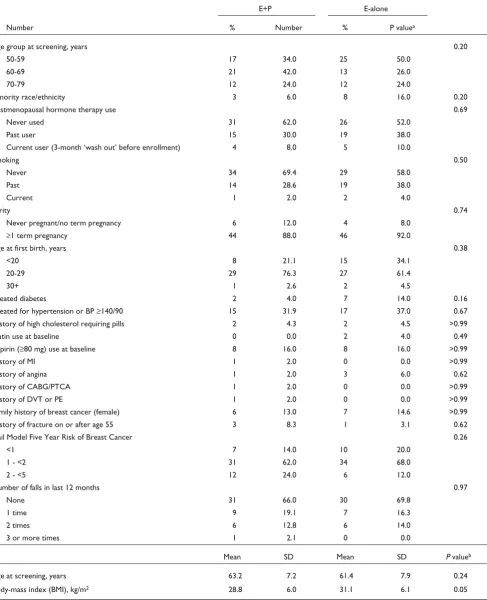
The average age at enrollment for the selected 50 E+P women is 63.2, similar to that for the trial cohort as a whole. Other study-subject characteristics were generally similar also to those for the entire trial cohort [2], as was also the case for the 50 selected E-alone women [20]. Subject characteristics for both studies are shown in Table 1. Some characteristics varied among the pools of size 10, as expected with the random assignment of women to pools. For example, the average baseline age (standard deviation) for the five E+P pools was 60.6 (8.4), 65.8 (5.3), 63.5 (8.5), 63.2 (7.1), and 62.8 (7.0), respectively. The project generated 2,576,869 spectra from the E+P pools, as compared with 2,458,506 from the E-alone pools. These led to the identifi-cation of 3,669 IPI-based proteins from the E+P pools compared with 4,679 from the E-alone analyses; and 942
IPI-based relative protein concentrations for E+P, versus
1,054 for E-alone, including 698 that were quantified in both E+P and E-alone analyses.
S
Se
erru
um
m p
prro
otte
eiin
n cco
on
ncce
en
nttrraattiio
on
n rraattiio
oss
Protein concentration ratios were further filtered and curated by using stringent standards (see Methods) for protein identification, including a requirement that a protein is quantified in at least two of the 10 IPAS experiments leading to a focus on 378 proteins (IPIs), all but 10 of which were quantified for both E+P and E-alone. A remarkable 169
(44.7%) of these showed evidence (nominal P< 0.05) of
change from baseline to 1-year with E+P or E-alone, or with both. For E+P, 371 proteins were quantified under these
quality standards, of which 132 (35.6%) had P< 0.05 as
compared with 18.6 expected by chance, and 98 (26.4%) had FDRs <0.05 compared with 94 for E-alone. Of these, 84 had FDR <0.05 for both preparations. Table S1 in Additional file 1 shows estimated 1-year-to-baseline concentration log ratios for all 378 proteins ranked according to the minimum
of P values for change with E+P or change with E-alone.
Significance levels (P values) are also given for a test of
equality of the E+P and E-alone ratios.
Table 2 lists proteins for which strong evidence (FDR < 0.01) exists of changed concentration with E+P or with E-alone, according to biologic pathways that were found to be
associated with E-alone use in [20]. Nominal Pvalues and
FDRs for change also are provided. Of note, five proteins involved in the insulin growth factor pathway are repre-sented in Table 2. Five of these proteins have 1.25-fold or greater changes in their concentrations with E-alone or E+P
treatment or both. Protein NOV homologue (NOV) and
insulin-like growth factor 1 (IGF1) were both decreased with
E-alone and E+P. Insulin-like growth factor-binding protein 1 (IGFBP1) level was increased with both E-alone and E+P. Strong evidence of the E+P effect exists on each of blood coagulation and inflammation, metabolism, osteogenesis, complement and immune response, and cell adhesion. More-over, the changes (base 2 logarithm of 1-year-to-baseline concentration ratio in Table 2) are mostly quantitatively very similar between E+P and E-alone, attesting to major effects of conjugated equine estrogens on the serum proteome.
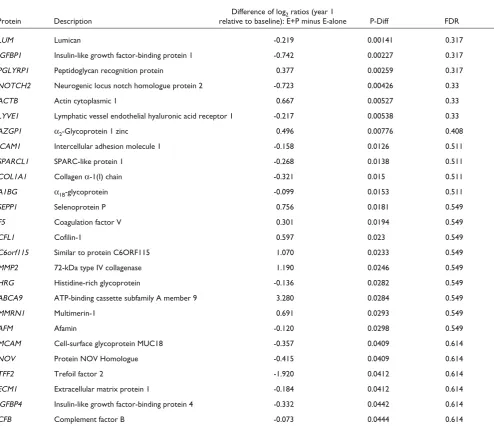
Table 3 presents the differences in quantitative ratios for E+P minus E-alone that were nominally significantly
differ-ent (P< 0.05) from each other. For this analysis, we tested
the 368 proteins meeting our identification and quantifi-cation criteria that were common to both E+P and E-alone.
Twenty-six proteins were identified with nominal P values
<0.05 for differential change between E+P and E-alone. The list includes proteins involved in insulin growth factor binding and inflammation. Insulin growth factor-binding proteins (IGFBPs) may be affected differently by E+P compared with E-alone. Specifically, three proteins show nominally statistically significant differences with E+P
compared with E-alone. IGFBP1 is increased (log2 ratio,
1.27) with E-alone, but the increase is mitigated with E+P
(log2ratio, 0.528). IGFBP4 is increased with E-alone (log2
ratio, 0.511), but not with E+P (log ratio, 0.179). NOV, also
known as IGFBP9, is decreased with E-alone (log2 ratio,
-0.344) and decreased to a greater extent with E+P (log2
ratio, -0.759).
P
Prro
otte
eiin
n--sse
ett aan
naallyysse
ess
T Taabbllee 11 B
Baasseelliinnee cchhaarraacctteerriissttiiccss aammoonngg wwoommeenn iinncclluuddeedd iinn hhoorrmmoonnee--tthheerraappyy pprrootteeoommiiccss pprroojjeecctt ((nn == 5500 ffoorr EE++PP aanndd ffoorr EE--aalloonnee ttrriiaallss))
E+P E-alone
Number % Number % P valuea
Age group at screening, years 0.20
50-59 17 34.0 25 50.0
60-69 21 42.0 13 26.0
70-79 12 24.0 12 24.0
Minority race/ethnicity 3 6.0 8 16.0 0.20
Postmenopausal hormone therapy use 0.69
Never used 31 62.0 26 52.0
Past user 15 30.0 19 38.0
Current user (3-month ‘wash out’ before enrollment) 4 8.0 5 10.0
Smoking 0.50
Never 34 69.4 29 58.0
Past 14 28.6 19 38.0
Current 1 2.0 2 4.0
Parity 0.74
Never pregnant/no term pregnancy 6 12.0 4 8.0
≥1 term pregnancy 44 88.0 46 92.0
Age at first birth, years 0.38
<20 8 21.1 15 34.1
20-29 29 76.3 27 61.4
30+ 1 2.6 2 4.5
Treated diabetes 2 4.0 7 14.0 0.16
Treated for hypertension or BP ≥140/90 15 31.9 17 37.0 0.67
History of high cholesterol requiring pills 2 4.3 2 4.5 >0.99
Statin use at baseline 0 0.0 2 4.0 0.49
Aspirin (≥80 mg) use at baseline 8 16.0 8 16.0 >0.99
History of MI 1 2.0 0 0.0 >0.99
History of angina 1 2.0 3 6.0 0.62
History of CABG/PTCA 1 2.0 0 0.0 >0.99
History of DVT or PE 1 2.0 0 0.0 >0.99
Family history of breast cancer (female) 6 13.0 7 14.6 >0.99
History of fracture on or after age 55 3 8.3 1 3.1 0.62
Gail Model Five Year Risk of Breast Cancer 0.26
<1 7 14.0 10 20.0
1 - <2 31 62.0 34 68.0
2 - <5 12 24.0 6 12.0
Number of falls in last 12 months 0.97
None 31 66.0 30 69.8
1 time 9 19.1 7 16.3
2 times 6 12.8 6 14.0
3 or more times 1 2.1 0 0.0
Mean SD Mean SD P valueb
Age at screening, years 63.2 7.2 61.4 7.9 0.24
Body-mass index (BMI), kg/m2 28.8 6.0 31.1 6.1 0.05
aaP value based on Fisher’s Exact test of association. bP value based on two-sample t test. MI = myocardial infarction; CABG/PCTA = coronary artery
T Taabbllee 22 G
Geennee oonnttoollooggyy ccllaassssiiffiiccaattiioonn ooff pprrootteeiinnss wwiitthh ssttaattiissttiiccaallllyy ssiiggnniiffiiccaanntt cchhaannggeess ((FFDDRR << 00..0011)) ffoorr EE++PP oorr EE--aalloonnee
E+P E-Alone
Log2ratio Log2ratio
year 1 year 1
relative to relative to
Protein Description baseline P value FDR baseline P value FDR
Blood coagulation and inflammation
VTN Vitronectin 0.352 2.16E-07 2.68E-05 0.368 7.09E-08 8.98E-06
CP Ceruloplasmin 0.679 5.19E-07 2.87E-05 0.752 3.01E-07 2.86E-05
SERPINC1 Antithrombin III variant -0.196 5.05E-06 0.000157 -0.143 5.50E-05 0.00106
PLG Plasminogen 0.224 1.56E-05 0.000404 0.230 1.24E-05 0.000393
HABP2 Uncharacterized protein 0.251 5.23E-05 0.00108 0.309 7.24E-05 0.00131
F12 Coagulation factor XII 0.261 0.000102 0.00158 0.252 0.000219 0.00268
APOH β2-Glycoprotein 1 0.149 0.000199 0.00242 0.193 8.89E-05 0.00135
ATRN Attractin -0.190 0.000213 0.00242 -0.126 0.00366 0.0214
F9 Coagulation factor IX 0.540 0.000214 0.00242 0.572 0.000511 0.00498
TFPI Tissue factor pathway inhibitor -0.396 0.000315 0.00317 -0.369 8.49E-05 0.00135
KNG1 Kininogen-1 0.152 0.00106 0.00786 0.228 5.60E-05 0.00106
Metabolism
GC Vitamin D-binding protein 0.231 3.10E-06 0.000115 0.237 2.75E-06 0.000131
HPX Hemopexin 0.123 6.65E-05 0.00118 0.117 0.000124 0.00162
RBP4 Plasma retinol-binding protein 0.167 0.000117 0.00161 0.177 0.000262 0.00311
APOA2 Apolipoprotein A-II 0.212 0.000532 0.00483 0.302 1.75E-05 0.000475
ENPP2 Ectonucleotide Pyrophosphatase/ 0.369 0.00692 0.0333 0.650 0.000749 0.00619
phosphodiesterase family member 2 Osteogenesis
FETUB Fetuin-B 0.783 1.09E-09 4.04E-07 0.741 1.02E-09 3.89E-07
COL1A1 Collagen α-1(I) chain -0.896 5.40E-07 2.87E-05 -0.575 8.80E-05 0.00135
AHSG α2-HS-glycoprotein 0.211 3.44E-06 0.000116 0.243 7.46E-07 5.02E-05
NOTCH2 Neurogenic locus notch -0.784 0.000315 0.00317 -0.062 0.648 0.815
homologue protein 2 Complement and immune response
PGLYRP2 N-acetylmuramoyl-L-alanine amidase -0.343 1.49E-06 6.17E-05 -0.335 3.72E-06 0.000141
ORM2 α1-acid glycoprotein 2 -0.181 1.63E-05 0.000404 -0.144 8.38E-05 0.00135
C4BPA C4B-binding protein αchain -0.200 3.34E-05 0.000731 -0.148 0.000377 0.00398
CFHR1 Complement factor H-related protein 1 0.162 8.95E-05 0.00145 0.185 2.96E-05 0.000661
CFB Complement factor B 0.137 0.000106 0.00158 0.210 5.58E-06 0.000193
C8A Complement component C8 αchain -0.206 0.000163 0.00216 -0.202 0.000121 0.00162
C4BPB C4B-binding protein βchain -0.260 0.00018 0.0023 -0.196 0.00156 0.0112
PGLYRP1 Peptidoglycan recognition protein 0.321 0.000232 0.00253 -0.056 0.458 0.68
CFHR5 Complement factor H-related 5 0.179 0.000264 0.00281 0.241 2.76E-05 0.000656
MASP2 Mannan-binding lectin serine protease 2 0.200 0.000435 0.00415 0.173 0.000643 0.00568
CFHR2 Complement factor H-related protein 2 0.181 0.000449 0.00417 0.205 0.00016 0.00203
C8B Complement component C8 βchain -0.221 0.00059 0.00522 -0.199 0.0015 0.0112
ITIH4 Inter-α-trypsin inhibitor heavy chain H4 0.458 0.000733 0.00634 0.374 0.00495 0.0273
VNN1 Pantetheinase 0.477 0.000888 0.00688 0.517 0.00124 0.00963
C6 complement component C6 -0.123 0.00151 0.011 -0.171 0.000123 0.00162
B2M β2-microglobulin 0.208 0.00205 0.0144 0.230 0.0011 0.00873
LRG1 Leucine-rich α2-glycoprotein 0.278 0.00553 0.0278 0.445 0.000582 0.0054
MBL2 Mannose-binding protein C -0.190 0.00677 0.0331 -0.341 9.37E-05 0.00137
two IPAS experiments in both E+P and E-alone. Table 4
indicates pathways that show a baseline versus 1-year
difference for E+P and E-Alone at FDR < 0.05 by using a
regularized Hotelling T2test. We also tested the equality of
log-concentration ratios between the two regimens for proteins in these pathways by using the same test statistic. Two pathways had FDR < 0.05 (Table 5). The gonadotropin-releasing hormone (GnRH) signaling pathway, known to be regulated by estrogen, was represented by two proteins
(matrix metalloproteinase 2 (MMP2) and phospholipase A2
(PLA2G1B)), and a pathway associated with bladder cancer
was represented by three proteins (MMP2, thrombospondin 1
(THBS1), and vascular endothelial growth factor C (VEGFC)).
Both pathways had nominal P values of 0.002, with
corres-ponding FDRs of 0.041. MMP2, a collagenase with the
ability to break down extracellular matrix proteins, was common to both pathways, and substantially explains the difference between the two regimens for these pathways. T
Taabbllee 22 ((CCoonnttiinnuueedd)) G
Geennee oonnttoollooggyy ccllaassssiiffiiccaattiioonn ooff pprrootteeiinnss wwiitthh ssttaattiissttiiccaallllyy ssiiggnniiffiiccaanntt cchhaannggeess ((FFDDRR << 00..0011)) ffoorr EE++PP oorr EE--aalloonnee
E+P E-Alone
Log2ratio Log2ratio
year 1 year 1
relative to relative to
Protein Description baseline P value FDR baseline P value FDR
Complement and immune response (Continued)
LILRA3 Leukocyte immunoglobulin-like -0.237 0.00874 0.0374 -0.281 0.000277 0.00319
receptor subfamily A member 3
FN1 Fibronectin -0.193 0.0663 0.176 -0.358 0.000574 0.0054
Cell adhesion
ICAM1 Intercellular adhesion molecule 1 -0.299 2.69E-05 0.000626 -0.142 0.00171 0.012
MEGF10 Multiple epidermal growth -1.330 0.0365 0.114 -1.100 0.000671 0.0058
factor-like domains 10 Growth factor activity
IGFBP7 Insulin-like growth factor-binding -0.295 0.000404 0.00395 -0.133 0.0342 0.109
protein 7
NOV Protein NOV homologue -0.759 0.00083 0.00672 -0.344 0.0123 0.0506
IGF1 Insulin-like growth factor IA -0.353 0.000981 0.00745 -0.371 0.000403 0.00414
IGFBP1 Insulin-like growth factor-binding 0.528 0.00242 0.0158 1.270 3.66E-06 0.000141
protein 1
IGFBP4 Insulin-like growth factor-binding 0.179 0.102 0.234 0.511 0.000697 0.00588
protein 4 Other
SHBG Sex hormone-binding globulin 1.460 1.14E-08 2.13E-06 1.450 2.57E-08 4.88E-06
AGT Angiotensinogen 1.150 3.09E-07 2.87E-05 1.200 2.05E-06 0.000111
LUM Lumican -0.382 4.81E-07 2.87E-05 -0.163 0.00175 0.0121
TFF3 Trefoil factor 3 2.590 8.84E-07 4.11E-05 2.160 2.06E-05 0.000522
OAF Out at first protein homologue 0.398 7.32E-06 0.000209 0.393 4.17E-05 0.000881
A1BG α1B-Glycoprotein 0.167 5.71E-05 0.00112 0.266 7.92E-07 5.02E-05
ABI3BP Target of NESH-SH3 -0.290 6.07E-05 0.00113 -0.184 0.00149 0.0112
CLEC3B Tetranectin -0.240 7.65E-05 0.00129 -0.158 0.00102 0.00827
FBN1 Fibrillin-1 -0.365 0.000114 0.00161 -0.269 1.45E-05 0.000423
DBH Dopamine β-hydroxylase -0.262 0.000207 0.00242 -0.186 0.00203 0.013
FGA Fibrinogen αchain 0.364 0.00076 0.00643 0.303 0.00741 0.0373
SPARCL1 SPARC-like protein 1 -0.311 0.0008 0.00661 -0.043 0.508 0.722
CPN2 Carboxypeptidase N subunit 2 0.161 0.000865 0.00685 0.190 0.000331 0.0036
AMBP AMBP protein 0.116 0.00283 0.0174 0.148 0.00061 0.00552
PEAR1 Platelet endothelial aggregation -0.650 0.00948 0.0379 -0.722 0.000424 0.00424
receptor 1
AFM Afamin 0.058 0.119 0.259 0.177 0.00033 0.0036
E
EL
LIIS
SA
A--b
baasse
ed
d p
prro
otte
eiin
n aassssaayyss iin
n aan
n iin
nd
de
ep
pe
en
nd
de
en
ntt sse
ett o
off ssu
ub
bjje
eccttss
The 26 proteins with nominal P< 0.05 for differential change
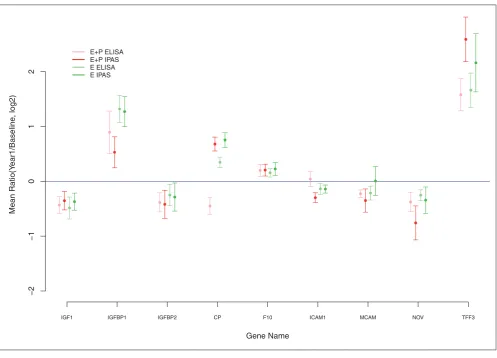
between E+P and E-alone based on IPAS mass spectrometry findings each had FDR > 0.3, so that many of these may be attributable to chance. We sought to determine whether concordant changes in these proteins can be demonstrated in an independent set of subjects and with independent methods. Figure 1 shows 1-year-to-baseline concentration log-ratios (95% confidence intervals (CIs)) from IPAS mass spectrometry data along with corresponding values from ELISA evaluation of 1-year-to-baseline ratios for an indepen-dent set of 50 women selected from the active-treatment group in the E+P trial. Corresponding IPAS and ELISA information also is provided for E-alone. We observed
concordance of IPAS and ELISA data between the two sets of subjects for six of eight proteins assayed. The lack of
replication for ceruloplasmin (CP) and ICAM1may be due to
multiple comparison effects in the discovery component or other factors, notably distinct epitope targets by ELISA assays compared with quantified peptides by mass spectrometry.
D
Diissccu
ussssiio
on
n
These analyses show that 1 year of use of E+P has a profound effect on the serum proteome, with more than a fourth (26.4%) of quantified proteins having FDR < 0.05 for change. Eight proteins with altered levels were further tested in an T
Taabbllee 33 D
Diiffffeerreennccee iinn YYeeaarr 11 ffrroomm bbaasseelliinnee ccoonncceennttrraattiioonn rraattiiooss ((EE++PP mmiinnuuss EE--AAlloonnee)) ffoorr aallll pprrootteeiinnss wwiitthh ddiiffffeerreennccee ooff PP << 00..0055 Difference of log2ratios (year 1
Protein Description relative to baseline): E+P minus E-alone P-Diff FDR
LUM Lumican -0.219 0.00141 0.317
IGFBP1 Insulin-like growth factor-binding protein 1 -0.742 0.00227 0.317
PGLYRP1 Peptidoglycan recognition protein 0.377 0.00259 0.317
NOTCH2 Neurogenic locus notch homologue protein 2 -0.723 0.00426 0.33
ACTB Actin cytoplasmic 1 0.667 0.00527 0.33
LYVE1 Lymphatic vessel endothelial hyaluronic acid receptor 1 -0.217 0.00538 0.33
AZGP1 α2-Glycoprotein 1 zinc 0.496 0.00776 0.408
ICAM1 Intercellular adhesion molecule 1 -0.158 0.0126 0.511
SPARCL1 SPARC-like protein 1 -0.268 0.0138 0.511
COL1A1 Collagen α-1(I) chain -0.321 0.015 0.511
A1BG α1B-glycoprotein -0.099 0.0153 0.511
SEPP1 Selenoprotein P 0.756 0.0181 0.549
F5 Coagulation factor V 0.301 0.0194 0.549
CFL1 Cofilin-1 0.597 0.023 0.549
C6orf115 Similar to protein C6ORF115 1.070 0.0233 0.549
MMP2 72-kDa type IV collagenase 1.190 0.0246 0.549
HRG Histidine-rich glycoprotein -0.136 0.0282 0.549
ABCA9 ATP-binding cassette subfamily A member 9 3.280 0.0284 0.549
MMRN1 Multimerin-1 0.691 0.0293 0.549
AFM Afamin -0.120 0.0298 0.549
MCAM Cell-surface glycoprotein MUC18 -0.357 0.0409 0.614
NOV Protein NOV Homologue -0.415 0.0409 0.614
TFF2 Trefoil factor 2 -1.920 0.0412 0.614
ECM1 Extracellular matrix protein 1 -0.184 0.0412 0.614
IGFBP4 Insulin-like growth factor-binding protein 4 -0.332 0.0442 0.614
CFB Complement factor B -0.073 0.0444 0.614
independent set of samples. ELISA assays of six of the eight proteins showed changes concordant with the mass spectro-metry data. The correlation of initial concentration ratios by mass spectrometry with ELISA ratios from an independent set of samples supports the reliability of the protein changes observed. Our previous report on E-alone [20] provided a detailed discussion of the proteins that changed after treatment with conjugated equine estrogens, in which 19% of proteins were changed after 1 year of treatment. Findings for
10 proteins were confirmed and validated by ELISA assays. Proteins altered with E-alone therapy had relevance to processes such as coagulation, inflammation, growth factors, osteogenesis, metabolism, and cell adhesion, among others. The most striking feature of the present E+P analysis is the similarity in these quantitative proteomic changes when medroxyprogesterone acetate is added to the daily conju-gated equine estrogen. For changes with E+P, 98 proteins had FDR < 0.05 compared with 94 proteins for E-alone. Of these, 84 proteins had FDR < 0.05 for both preparations, and corresponding intensity ratios tended to be quite similar between the two regimens for most of these proteins. Hence, our prior discussion [20] of proteins and pathways that were changed after E-alone is largely applicable to the E+P hormone preparation as well. The 1 year of aging between the baseline and 1-year blood-sample collection could have some influence on the serum proteome, but any such
influence should be absent for the comparison of E+P versus
E-alone changes, because age-related changes would apply equally for the two regimens.
When we specifically sought proteins for which the change with E+P differed from that for E-alone, a number of potential proteins (Table 3) emerged, but chance could not T
Taabbllee 44 K
KEEGGGG ppaatthhwwaayyss hhaavviinngg ttwwoo oorr mmoorree qquuaannttiittaatteedd pprrootteeiinnss ffoorr wwhhiicchh eevviiddeennccee ooff ddiiffffeerreennttiiaall cchhaannggee bbeettwweeeenn bbaasseelliinnee ttoo 11--yyeeaarr ccoonncceennttrraattiioonn wwiitthh EE++PP aanndd EE--aalloonnee wwaass ssiiggnniiffiiccaanntt,, wwiitthh FFDDRR << 00..0055
Number quantified protein P valuea FDR
E+P Pathway
Porphyrin and chlorophyll metabolism 2 <0.001 <0.001
Dorsoventral axis formation 4 <0.001 <0.001
Motor signaling pathway 2 0.002 0.009
Pancreatic cancer 2 0.002 0.009
Focal adhesion 14 0.003 0.011
Bladder cancer 3 0.005 0.015
Renal cell carcinoma 3 0.009 0.023
Notch signaling pathway 5 0.011 0.024
Ether lipid metabolism 2 0.012 0.024
Long term depression 2 0.022 0.039
Regulation of actin cytoskeleton 8 0.025 0.041
Cytokine-cytokine receptor interaction 21 0.032 0.048
E-alone pathway
Porphyrin and chlorophyll metabolism 2 <0.001 <0.001
GNRH signaling pathway 2 <0.001 <0.001
Ether lipid metabolism 2 0.001 0.011
Bladder cancer 3 0.002 0.016
aFrom a regularized Hotelling T2test.
T Taabbllee 55 K
KEEGGGG ppaatthhwwaayyss hhaavviinngg ttwwoo oorr mmoorree qquuaannttiittaatteedd pprrootteeiinnss ffoorr wwhhiicchh e
evviiddeennccee ooff ddiiffffeerreennttiiaall cchhaannggee bbeettwweeeenn EE++PP aanndd EE--aalloonnee wwaass ssiiggnniiffiiccaanntt,, w
wiitthh FFDDRR << 00..0055
E+P versus E-Alone GNRH signaling pathway Bladder cancer
Number of proteins 2 3
Proteins in the pathway MMP2, PLA2G1B MMP2, THBS VEGFC
P valuea 0.002 0.002
FDRa 0.041 0.041
be ruled out as an explanation for any particular protein. To check whether these suggested differences could be attributable to differences in the E+P and E-alone study cohorts (Table 1) we repeated the Table 3 analyses with the mean age and mean BMI at baseline in each pool as adjustment factors. The log intensity ratio differences were
not appreciably affected by this adjustment, although P
values tended to become less significant because of
reduction in ‘degrees of freedom’ for the moderated ttests.
Interestingly, after this adjustment, the FDR for NOTCH2
decreased to 0.02. None of the other FDRs in this sensitivity analysis were <0.05. Aberrant NOTCH signaling has been implicated in tumorigenesis and has been reported to play an oncogenic role in breast cancer [29,30]. A decrease of
NOTCH2serum levels with E+P, but not E-alone, could be related to alteration of signaling and increased risk of breast cancer with E+P but not with E-alone. A differential change
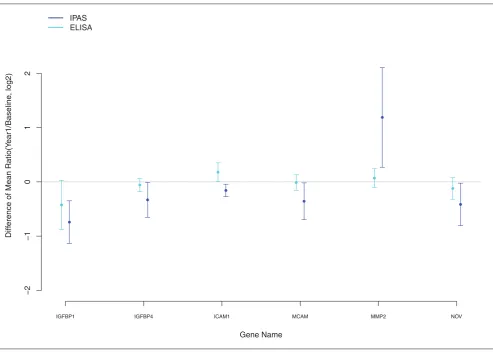
between E+P and E-alone in IGFBP1 was supported by
ELISA data in an independent set of 50 subjects for each regimen (Figure 2) and may provide an important lead to understanding clinical effects that differ between the two preparations, including breast cancer. As elaborated later,
Table 3 also contains proteins that are associated with atherogenesis.
First, consider proteins involved in the insulin growth factor-signaling pathway. The overall pattern (Table 3) is a greater increase in insulin growth factor-binding proteins (IGFBP1, IGFBP4) with E alone compared with E+P,
whereas the decrease in NOV was relatively greater with
E+P. ELISA testing produced trends in these same
direc-tions for all three proteins, but only that for IGFBP1
approached statistical significance in the independent set. Collectively, these analyses suggest that progestin may attenuate some of the estrogen-induced increases in IGF-binding proteins.
It has been previously suggested that medroxyprogesterone acetate has only a weak degree of opposition to the
estrogen-induced decrease of total IGF-1 (which is primarily of
hepatic origin), in agreement with our study findings for
IGF-1 levels [31]. However, given reduced levels of IGF-binding proteins, it would be expected that less IGF is bound, possibly increasing the availability of free IGF. The F
Fiigguurree 11
Mean log2-transformed ratios (95% confidence interval): Intact Protein Analysis System and enzyme-linked immunosorbent assay (ELISA). Gene Name
Mean Ratio(Y
ear1/Baseline
, log2)
IGF1 IGFBP1 IGFBP2 CP F10 ICAM1 MCAM NOV TFF3
−2
−1
0
1
2
IGF-signaling pathway plays a role in cell proliferation, tissue development, and tumorigenesis. The IGF pathway has been linked to colorectal malignancy [32,33], and serum
levels of IGF1 have been associated with colon cancer risk
[34]. Changes in the IGF pathway with E+P compared with E-alone could potentially explain some of the differences in
the clinical outcomes. In particular, IGF-1 is a strong
mitogen, and varying levels of free IGF-1between E+P and
E-alone treatment could help explain the increased risk of breast cancer with E+P.
In addition to proteins related to the IGF pathway, several other proteins of biologic interest in the context of E+P
versusE-alone effects on the serum proteome are presented
in Table 3. Expression of the α2-glycoprotein 1 zinc (AZGP1)
gene is regulated predominantly androgens and progestins
[35,36]. Our data suggest an increase in AZGP1 protein
levels with E+P and a decrease with E-alone. AZGP1 has
been identified as a potential prognostic marker for early-stage breast cancer and a useful immunohistochemical marker of apocrine cell differentiation in human breast
tissue [37]. Increased levels of circulating AZGP1 in E+P
compared with E-alone may be associated with increased risk of breast cancer in the former group. Circulating levels
of extracellular matrix proteins (collagen α-1 chain (COL1A1),
lumican (LUM), and extracellular matrix protein 1 (ECM1)
may also be differentially affected by E+P compared with
E-alone, whereas MMP2, a metalloproteinase that breaks
down COL1A1, may be increased with E+P compared with E.
The extracellular matrix plays a variety of physiological roles, many of which are related to cancer, including tumor invasion. Changes in the extracellular matrix with E+P compared with E-alone could also help explain the differences in cancer risks associated with these treatments.
Several proteins listed in Table 3 have been linked to atherogenesis, and thus may suggest avenues for exploring mechanisms underlying a more-substantial early increase in CHD risk with E+P than with E-alone in the randomized trials. For example, matrix metalloproteinases (for example,
MMP2) are thought to participate in atherogenic
inflammation [38]. The role of innate immunity in
athero-genesis is less well established; PGLYRP1 participates in
recognition of bacteria by neutrophils, but is independently F
Fiigguurree 22
Differences of mean log2-transformed ratios (95% CI): Intact Protein Analysis System and enzyme-linked immunosorbent assay (ELISA).
Gene Name
Diff
erence of Mean Ratio(Y
ear1/Baseline
, log2)
V O N 2
P M M M
A C M 1
M A C I 4
P B F G I 1
P B F G I
−2
−1
0
1
2
associated with coronary artery calcification and abdominal
aortic plaque [39]. The difference in PGLYRP1concentration
among women taking E+P versus E-alone suggests a
possible mechanistic link.
Other extracellular matrix proteins (Table 3) may also shed light on the relation between E+P and CHD events. One such
protein, lumican (LUM), contributes to variation in
proteo-glycan composition of arterial intima by location within the human vasculature. Enhanced deposition of lumican has been observed in the intima of the atherosclerosis-prone internal carotid artery compared with the internal thoracic artery, a relatively atherosclerosis-resistant vessel [40]. The relation between serum and tissue proteoglycan levels, the impact of proteoglycan composition on plaque stability, and the clinical significance of lumican all remain to be determined.
Our proteomic comparisons (Table 3) may also provide insight into the greater elevation in venous thromboembolic event risk when progestin was added to conjugated
estro-gens. For example, coagulation factor V (F5) binds to
multi-merin 1 (MMFN1), with high affinity for storage in human
platelet granules, and may modulate thrombosis [41].
Some important considerations exist in assessing the effects of estrogens and progestins broadly on the serum proteome. The preparations considered here are conjugated equine estrogen and medroxyprogesterone acetate. Further studies would be needed to determine whether the changes reported
here also arise for the other estrogen (for example, 17β
-estradiol) and progesterone (norethisterone acetate or levonorgestrel) treatments. Related to this, these substances are taken orally, and the first-pass hepatic metabolism of oral estrogens is known to stimulate a wide variety of proteins, synthesized in the liver. Of the 378 proteins reported here, 73 are included in the liver-specific gene set listed in Hsiao and colleagues [42] (Table S1 in Additional file 1). For example, of 66 significantly upregulated proteins (FDR < 0.05), 35 are in the liver-specific gene path, as were 28 of 71 for E-alone.
Of the proteins emphasized in the preceding discussion,
IGFBP1, AZGP1, and F5, but not others, are part of the liver-specific list. Given that transdermal estrogen, which is being increasingly used in clinical practice to treat menopausal symptoms, bypasses the liver, these proteins may not be affected when estrogen is administered transdermally.
C
Co
on
nccllu
ussiio
on
nss
In summary, E+P, like E-alone, has a profound effect on the serum proteome and affects multiple pathways that are relevant to observed clinical effects on cancer, cardio-vascular disease, and fractures, among others. The addition of 2.5 mg/d medroxyprogesterone acetate to 0.625 mg/d conjugated equine estrogen may have an impact on the IGF
pathway proteins and may affect circulating levels of
extracellular matrix proteins (for example, MMP2) of
poten-tial relevance to the less-favorable E+P effects, compared with those for E-alone, on breast cancer, and CHD. Similarly the addition of medroxyprogesterone acetate may also augment the effects of conjugated estrogens on coagulation factors (for example, factor V), of potential relevance to a relatively greater elevation in venous thromboembolism with E+P. These and other leads from our proteomic study will benefit from further testing in women who experienced major clinical outcomes and in matched controls from the WHI hormone therapy trials, to evaluate more directly the potential of these protein-concentration changes to contri-bute to a biologic explanation for observed trial-outcome patterns.
A
Ab
bb
brre
evviiaattiio
on
nss
AZGP1= α2-glycoprotein 1 zinc; CHD = coronary heart disease;
CIs = confidence intervals; COL1A1 = collagen α-1 chain; CP=
ceruloplasmin; E = conjugated equine estrogen; E+P = con-jugated equine estrogen plus medoxyprogesterone acetate;
ECM1 = extracellular matrix protein 1; ELISA =
enzyme-linked immunosorbent assay; F5 = coagulation factor V;
FDR = false discovery rate; GnRH = gonadotropin-releasing
hormone; ICAM1= intercellular adhesion molecule 1; IGF =
insulin-like growth factor; IGFBP = insulin-like growth factor-binding protein; IPAS = Intact Protein Analysis System; IPI = International Protein Index; LC-MS/MS =
liquid chromatography tandem mass spectrometry; LUM=
lumican; MMFN1= multimerin 1; MMP2= matrix
metallo-proteinase 2; NOV= protein NOV homologue; PGLYRP1=
peptidoglycan recognition protein; PLA2G1B= phospholipase
A2; THBS1= thrombospondin 1; THY1= THY-1 membrane
glycoprotein; VCAM1 = vascular cell adhesion protein 1;
VEGFC= vascular endothelial growth factor C; VT = venous thromboembolism; WHI = Women’s Health Initiative.
C
Co
om
mp
pe
ettiin
ngg iin
ntte
erre
essttss
The authors declare that they have no competing interests.
A
Au
utth
ho
orrss’’ cco
on
nttrriib
bu
uttiio
on
nss
SJP, SMH, CK, JR, RDJ, JEM, JH, SL, LM, and RLP participated in drafting the manuscript. Data acquisition was performed by HW and HK. Data were analyzed and interpreted by SJP, SMH, LA, LC, SP, HK, QZ, MM, PW, and RLP. Immunoassays were performed by TBB and MMJ. SMH and RLP were responsible for the study design. Statistical analysis was performed by AA, LC, MM, PW, and RLP.
A
Ad
dd
diittiio
on
naall ffiille
ess
1 to baseline log-transformed concentration ratios after estrogen plus progestin (E+P) or estrogen (E-Alone) exposure for all 378 quantified proteins.
A
Acck
kn
no
ow
wlle
ed
dgge
em
me
en
nttss
Funding/Support: This work was supported by the National Heart, Lung, and Blood Institute, National Institutes of Health, U. S. Department of Health and Human Services [contracts HHSN268200764314C, N01WH22110, 24152, 32100-2, 32105-6, 32108-9, 32111-13, 32115, 32118-19, 32122, 42107-26, 42129-32, and 44221]. Clinical Trials Regis-tration: ClinicalTrials.gov identifier: NCT00000611. The work of Dr. Prentice was partially supported by grant CA53996 from the National Cancer Institute.
Role of the sponsor: Decisions concerning study design, data collection and analysis, interpretation of the results, the preparation of the manu-script, or the decision to submit the manuscript for publication resided with committees comprising WHI investigators that included NHLBI rep-resentatives.
Program office: (National Heart, Lung, and Blood Institute, Bethesda, Maryland) Jacques Rossouw, Shari Ludlam, Joan McGowan, Leslie Ford, and Nancy Geller.
Clinical coordinating center: (Fred Hutchinson Cancer Research Center, Seattle, WA) Ross Prentice, Garnet Anderson, Andrea LaCroix, Charles L. Kooperberg; (Medical Research Labs, Highland Heights, KY) Evan Stein; (University of California at San Francisco, San Francisco, CA) Steven Cum-mings.
Clinical centers: (Albert Einstein College of Medicine, Bronx, NY) Sylvia Wassertheil-Smoller; (Baylor College of Medicine, Houston, TX) Haleh Sangi-Haghpeykar; (Brigham and Women’s Hospital, Harvard Medical School, Boston, MA) JoAnn E. Manson; (Brown University, Providence, RI) Charles B. Eaton; (Emory University, Atlanta, GA) Lawrence S. Phillips; (Fred Hutchinson Cancer Research Center, Seattle, WA) Shirley Beres-ford; (George Washington University Medical Center, Washington, DC) Lisa Martin; (Los Angeles Biomedical Research Institute at Harbor-UCLA Medical Center, Torrance, CA) Rowan Chlebowski; (Kaiser Permanente Center for Health Research, Portland, OR) Erin LeBlanc; (Kaiser Perma-nente Division of Research, Oakland, CA) Bette Caan; (Medical College of Wisconsin, Milwaukee, WI) Jane Morley Kotchen; (MedStar Research Institute/Howard University, Washington, DC) Barbara V. Howard; (Northwestern University, Chicago/Evanston, IL) Linda Van Horn; (Rush Medical Center, Chicago, IL) Henry Black; (Stanford Prevention Research Center, Stanford, CA) Marcia L. Stefanick; (State University of New York at Stony Brook, Stony Brook, NY) Dorothy Lane; (The Ohio State Uni-versity, Columbus, OH) Rebecca Jackson; (University of Alabama at Birm-ingham, BirmBirm-ingham, AL) Cora E. Lewis; (University of Arizona, Tucson/Phoenix, AZ) Cynthia A. Thomson; (University at Buffalo, Buffalo, NY) Jean Wactawski-Wende; (University of California at Davis, Sacra-mento, CA) John Robbins; (University of California at Irvine, Irvine, CA) F. Allan Hubbell; (University of California at Los Angeles, Los Angeles, CA) Lauren Nathan; (University of California at San Diego, La Jolla/Chula Vista, CA) Robert D. Langer; (University of Cincinnati, Cincinnati, OH) Margery Gass; (University of Florida, Gainesville/Jacksonville, FL) Marian Limacher; (University of Hawaii, Honolulu, HI) J. David Curb; (University of Iowa, Iowa City/Davenport, IA) Robert Wallace; (University of Massachusetts/Fallon Clinic, Worcester, MA) Judith Ockene; (University of Medicine and Dentistry of New Jersey, Newark, NJ) Norman Lasser; (University of Miami, Miami, FL) Mary Jo O’Sullivan; (University of Min-nesota, Minneapolis, MN) Karen Margolis; (University of Nevada, Reno, NV) Robert Brunner; (University of North Carolina, Chapel Hill, NC) Gerardo Heiss; (University of Pittsburgh, Pittsburgh, PA) Lewis Kuller; (University of Tennessee Health Science Center, Memphis, TN) Karen C. Johnson; (University of Texas Health Science Center, San Antonio, TX) Robert Brzyski; (University of Wisconsin, Madison, WI) Gloria E. Sarto; (Wake Forest University School of Medicine, Winston-Salem, NC) Mara Vitolins; (Wayne State University School of Medicine/Hutzel Hospital, Detroit, MI) Michael S. Simon. Women’s Health Initiative Memory Study: (Wake Forest University School of Medicine, Winston-Salem, NC) Sally Shumaker.
R
Re
effe
erre
en
ncce
ess
1. Women’s Health Initiative Steering Committee: EEffffeeccttss ooff ccoonnjjuuggaatteedd e
eqquuiinnee eessttrrooggeenn iinn ppoossttmmeennooppaauussaall wwoommeenn wwiitthh hhyysstteerreeccttoommyy:: tthhee W
Woommeenn’’ss HHeeaalltthh IInniittiiaattiivvee rraannddoommiizzeedd ccoonnttrroolllleedd ttrriiaall..JAMA 2004, 2
29911::1701-1712.
2. Writing Group for the Women’s Health Initiative Investigators: RRiisskkss aanndd bbeenneeffiittss ooff eessttrrooggeenn pplluuss pprrooggeessttiinn iinn hheeaalltthhyy ppoossttmmeennooppaauussaall w
woommeenn:: pprriinncciippaall rreessuullttss ffrroomm tthhee WWoommeenn’’ss HHeeaalltthh IInniittiiaattiivvee rraan n--d
doommiizzeedd ccoonnttrroolllleedd ttrriiaall..JAMA 2002, 228888::321-333.
3. Hendrix SL, Wassertheil-Smoller S, Johnson KC, Howard BV, Kooperberg C, Rossouw JE, Trevisan M, Aragaki A, Baird AE, Bray PF, Buring JE, Criqui MH, Herrington D, Lynch JK, Rapp SR, Torner J, WHI Investigators: EEffffeeccttss ooff ccoonnjjuuggaatteedd eeqquuiinnee eessttrrooggeenn oonn ssttrrookkee iinn tthhee WWoommeenn’’ss HHeeaalltthh IInniittiiaattiivvee..Circulation 2006, 111133::2425-2434. 4. Wassertheil-Smoller S, Hendrix SL, Limacher M, Heiss G,
Kooper-berg C, Baird A, Kotchen T, Curb JD, Black H, Rossouw JE, Aragaki A, Safford M, Stein E, Laowattana S, Mysiw WJ; WHI Investigators: E
Effffeecctt ooff eessttrrooggeenn pplluuss pprrooggeessttiinn oonn ssttrrookkee iinn ppoossttmmeennooppaauussaall w
woommeenn:: tthhee WWoommeenn’’ss HHeeaalltthh IInniittiiaattiivvee:: aa rraannddoommiizzeedd ttrriiaall.. Jama 2003, 228899::2673-2684.
5. Cauley JA, Robbins J, Chen Z, Cummings SR, Jackson RD, LaCroix AZ, LeBoff M, Lewis CE, McGowan J, Neuner J, Pettinger M, Stefan-ick ML, Wactawski-Wende J, Watts NB; Women’s Health Initiative Investigators: EEffffeeccttss ooff eessttrrooggeenn pplluuss pprrooggeessttiinn oonn rriisskk ooff ffrraaccttuurree aanndd bboonnee mmiinneerraall ddeennssiittyy:: tthhee WWoommeenn’’ss HHeeaalltthh IInniittiiaattiivvee rraannddoommiizzeedd ttrriiaall..JAMA 2003, 229900::1729-1738.
6. Jackson RD, Wactawski-Wende J, LaCroix AZ, Pettinger M, Yood RA, Watts NB, Robbins JA, Lewis CE, Beresford SA, Ko MG, Naughton MJ, Satterfield S, Bassford T; Women’s Health Initiative Investigators: EEffffeeccttss ooff ccoonnjjuuggaatteedd eeqquuiinnee eessttrrooggeenn oonn rriisskk ooff ffrraacc--ttuurreess aanndd BBMMDD iinn ppoossttmmeennooppaauussaall wwoommeenn wwiitthh hhyysstteerreeccttoommyy:: rreessuullttss ffrroomm tthhee WWoommeenn’’ss HHeeaalltthh IInniittiiaattiivvee rraannddoommiizzeedd ttrriiaall..J Bone Miner Res 2006, 2211::817-828.
7. Hsia J, Langer RD, Manson JE, Kuller L, Johnson KC, Hendrix SL, Pet-tinger M, Heckbert SR, Greep N, Crawford S, Eaton CB, Kostis JB, Caralis P, Prentice R; Women’s Health Initiative Investigators: CCoonnjju u--ggaatteedd eeqquuiinnee eessttrrooggeennss aanndd ccoorroonnaarryy hheeaarrtt ddiisseeaassee:: tthhee WWoommeenn’’ss H
Heeaalltthh IInniittiiaattiivvee..Arch Intern Med 2006, 116666::357-365.
8. Manson JE, Hsia J, Johnson KC, Rossouw JE, Assaf AR, Lasser NL, Trevisan M, Black HR, Heckbert SR, Detrano R, Strickland OL, Wong ND, Crouse JR, Stein E, Cushman M; Women’s Health Initia-tive Investigators: EEssttrrooggeenn pplluuss pprrooggeessttiinn aanndd tthhee rriisskk ooff ccoorroonnaarryy h
heeaarrtt ddiisseeaassee..N Engl J Med 2003, 334499::523-534.
9. Chlebowski RT, Hendrix SL, Langer RD, Stefanick ML, Gass M, Lane D, Rodabough RJ, Gilligan MA, Cyr MG, Thomson CA, Khandekar J, Petrovitch H, McTiernan A; WHI Investigators: IInnfflluueennccee ooff eessttrrooggeenn p
plluuss pprrooggeessttiinn oonn bbrreeaasstt ccaanncceerr aanndd mmaammmmooggrraapphhyy iinn hheeaalltthhyy ppo osstt--m
meennooppaauussaall wwoommeenn:: tthhee WWoommeenn’’ss HHeeaalltthh IInniittiiaattiivvee RRaannddoommiizzeedd T
Trriiaall..JAMA 2003, 228899::3243-3253.
10. Stefanick ML, Anderson GL, Margolis KL, Hendrix SL, Rodabough RJ, Paskett ED, Lane DS, Hubbell FA, Assaf AR, Sarto GE, Schenken RS, Yasmeen S, Lessin L, Chlebowski RT; WHI Investigators: EEffffeeccttss ooff ccoonnjjuuggaatteedd eeqquuiinnee eessttrrooggeennss oonn bbrreeaasstt ccaanncceerr aanndd mmaammmmooggrraapphhyy ssccrreeeenniinngg iinn ppoossttmmeennooppaauussaall wwoommeenn wwiitthh hhyysstteerreeccttoommyy.. JAMA 2006, 229955::1647-1657.
11. Curb JD, Prentice RL, Bray PF, Langer RD, Van Horn L, Barnabei VM, Bloch MJ, Cyr MG, Gass M, Lepine L, Rodabough RJ, Sidney S, Uwaifo GI, Rosendaal FR: VVeennoouuss tthhrroommbboossiiss aanndd ccoonnjjuuggaatteedd eeqquuiinnee e
essttrrooggeenn iinn wwoommeenn wwiitthhoouutt aa uutteerruuss.. Arch Intern Med 2006, 1
16666::772-780.
12. Cushman M, Kuller LH, Prentice R, Rodabough RJ, Psaty BM, Stafford RS, Sidney S, Rosendaal FR: EEssttrrooggeenn pplluuss pprrooggeessttiinn aanndd rriisskk ooff vveennoouuss tthhrroommbboossiiss..JAMA 2004, 229922::1573-1580.
13. Anderson GL, Kooperberg C, Geller N, Rossouw JE, Pettinger M, Prentice RL: MMoonniittoorriinngg aanndd rreeppoorrttiinngg ooff tthhee WWoommeenn’’ss HHeeaalltthh IIn niittiiaa--ttiivvee RRaannddoommiizzeedd HHoorrmmoonnee TThheerraappyy TTrriiaallss..Clin Trials 2007, 4 4::207-217.
14. Rossouw JE, Cushman M, Greenland P, Lloyd-Jones DM, Bray P, Kooperberg C, Pettinger M, Robinson J, Hendrix S, Hsia J: IInnffllaammm maa--ttoorryy,, lliippiidd,, tthhrroommbboottiicc,, aanndd ggeenneettiicc mmaarrkkeerrss ooff ccoorroonnaarryy hheeaarrtt d
diisseeaassee rriisskk iinn tthhee WWoommeenn’’ss HHeeaalltthh IInniittiiaattiivvee TTrriiaallss ooff HHoorrmmoonnee T
Thheerraappyy..Arch Intern Med 2008, 116688::2245-2253.
15. Kooperberg C, Cushman M, Hsia J, Robinson JG, Aragaki AK, Lynch JK, Baird AE, Johnson KC, Kuller LH, Beresford SA, Rodriguez B: C
Caann bbiioommaarrkkeerrss iiddeennttiiffyy wwoommeenn aatt iinnccrreeaasseedd ssttrrookkee rriisskk?? TThhee W
Woommeenn’’ss HHeeaalltthh IInniittiiaattiivvee HHoorrmmoonnee TTrriiaallss..PLoS Clin Trials 2007, 2
16. Faca V, Coram M, Phanstiel D, Glukhova V, Zhang Q, Fitzgibbon M, McIntosh M, Hanash S: QQuuaannttiittaattiivvee aannaallyyssiiss ooff aaccrryyllaammiiddee llaabbeelleedd sseerruumm pprrootteeiinnss bbyy LLCC--MMSS//MMSS..J Proteome Res 2006, 55::2009-2018. 17. Faca V, Pitteri SJ, Newcomb L, Glukhova V, Phanstiel D,
Krasnosel-sky A, Zhang Q, Struthers J, Wang H, Eng J, Fitzgibbon M, McIntosh M, Hanash S: CCoonnttrriibbuuttiioonn ooff pprrootteeiinn ffrraaccttiioonnaattiioonn ttoo ddeepptthh ooff aan naallyy--ssiiss ooff tthhee sseerruumm aanndd ppllaassmmaa pprrootteeoommeess.. J Proteome Res 2007, 6
6::3558-3565.
18. Faca VM, Song KS, Wang H, Zhang Q, Krasnoselsky AL, Newcomb LF, Plentz RR, Gurumurthy S, Redston MS, Pitteri SJ, Pereira-Faca SR, Ireton RC, Katayama H, Glukhova V, Phanstiel D, Brenner DE, Anderson MA, Misek D, Scholler N, Urban ND, Barnett MJ, Edel-stein C, Goodman GE, Thornquist MD, McIntosh MW, DePinho RA, Bardeesy N, Hanash SM: AA mmoouussee ttoo hhuummaann sseeaarrcchh ffoorr ppllaassmmaa pprro o--tteeoommee cchhaannggeess aassssoocciiaatteedd wwiitthh ppaannccrreeaattiicc ttuummoorr ddeevveellooppmmeenntt..PLoS Med 2008, 55::e123.
19. Hanash SM, Pitteri SJ, Faca VM: MMiinniinngg tthhee ppllaassmmaa pprrootteeoommee ffoorr ccaanncceerr bbiioommaarrkkeerrss..Nature 2008, 445522::571-579.
20. Katayama H, Paczesny S, Prentice R, Aragaki A, Faca VM, Pitteri SJ, Zhang Q, Wang H, Silva M, Kennedy J, Rossouw J, Jackson R, Hsia J, Chlebowski R, Manson J, Hanash S: AApppplliiccaattiioonn ooff sseerruumm pprrootteeoommiiccss ttoo tthhee WWoommeenn’’ss HHeeaalltthh IInniittiiaattiivvee ccoonnjjuuggaatteedd eeqquuiinnee eessttrrooggeennss ttrriiaall rreevveeaallss aa mmuullttiittuuddee ooff eeffffeeccttss rreelleevvaanntt ttoo cclliinniiccaall ffiinnddiinnggss.. Genome Med 2009, 11::47.
21. Rauch A, Bellew M, Eng J, Fitzgibbon M, Holzman T, Hussey P, Igra M, Maclean B, Lin CW, Detter A, : CCoommppuuttaattiioonnaall PPrrootteeoommiiccss AAn naallyy--ssiiss SSyysstteemm ((CCPPAASS)):: aann eexxtteennssiibbllee,, ooppeenn--ssoouurrccee aannaallyyttiicc ssyysstteemm ffoorr e
evvaalluuaattiinngg aanndd ppuubblliisshhiinngg pprrootteeoommiicc ddaattaa aanndd hhiigghh tthhrroouugghhppuutt bbiioollo ogg--iiccaall eexxppeerriimmeennttss..J Proteome Res 2006, 55::112-121.
22. Keller A, Nesvizhskii AI, Kolker E, Aebersold R: EEmmppiirriiccaall ssttaattiissttiiccaall m
mooddeell ttoo eessttiimmaattee tthhee aaccccuurraaccyy ooff ppeeppttiiddee iiddeennttiiffiiccaattiioonnss mmaaddee bbyy M
MSS//MMSS aanndd ddaattaabbaassee sseeaarrcchh..Anal Chem 2002, 7744::5383-5392. 23. Nesvizhskii AI, Keller A, Kolker E, Aebersold R: AA ssttaattiissttiiccaall mmooddeell
ffoorr iiddeennttiiffyyiinngg pprrootteeiinnss bbyy ttaannddeemm mmaassss ssppeeccttrroommeettrryy.. Anal Chem 2003, 7755::4646-4658.
24. Smyth GK: LLiinneeaarr mmooddeellss aanndd eemmppiirriiccaall bbaayyeess mmeetthhooddss ffoorr aasssseessssiinngg d
diiffffeerreennttiiaall eexxpprreessssiioonn iinn mmiiccrrooaarrrraayy eexxppeerriimmeennttss.. Stat Appl Genet Mol Biol 2004, 33::Article3.
25. Smyth GK: LLiimmmmaa:: lliinneeaarr mmooddeellss ffoorr mmiiccrrooaarrrraayy ddaattaa.. In Bioinformat-ics and computational biology solutions using R and bioconductor. Edited by R Gentleman, V Carey, S Dudoit, R Irizarry, W Huber. New York: Springer, 2005, pp. 397-420.
26. Benjamini Y, Hochberg Y: CCoonnttrroolllliinngg tthhee ffaallssee ddiissccoovveerryy rraattee:: aa p
prraaccttiiccaall aanndd ppoowweerrffuull aapppprrooaacchh ttoo mmuullttiippllee tteessttiinngg..J R Stat Soc Series B (Methodological) 1995, 5577::289-300.
27. Kanehisa M: TThhee KKEEGGGG ddaattaabbaassee..Novartis Found Symp 2002, 224477:: 91-101; discussion 101-103, 119-128, 144-152.
28. KEGG PATHWAY Database [http://www.genome.jp/kegg/pathway. html]
29. Shi W, Harris AL: NNoottcchh ssiiggnnaalliinngg iinn bbrreeaasstt ccaanncceerr aanndd ttuummoorr aannggiio o--ggeenneessiiss:: ccrroossss--ttaallkk aanndd tthheerraappeeuuttiicc ppootteennttiiaallss..J Mammary Gland Biol Neoplasia 2006, 1111::41-52.
30. Wu F, Stutzman A, Mo YY: NNoottcchh ssiiggnnaalliinngg aanndd iittss rroollee iinn bbrreeaasstt ccaanncceerr..Front Biosci 2007, 1122::4370-4383.
31. Campagnoli C, Abba C, Ambroggio S, Peris C: DDiiffffeerreennttiiaall eeffffeeccttss ooff p
prrooggeessttiinnss oonn tthhee cciirrccuullaattiinngg IIGGFF--II ssyysstteemm..Maturitas 2003, 4466((ssuuppppll 1
1))::S39-S44.
32. Davies M, Gupta S, Goldspink G, Winslet M: TThhee iinnssuulliinn--lliikkee ggrroowwtthh ffaaccttoorr ssyysstteemm aanndd ccoolloorreeccttaall ccaanncceerr:: cclliinniiccaall aanndd eexxppeerriimmeennttaall e evvii--d
deennccee..Int J Colorectal Dis 2006, 2211::201-208.
33. Durai R, Yang W, Gupta S, Seifalian AM, Winslet MC: TThhee rroollee ooff tthhee iinnssuulliinn--lliikkee ggrroowwtthh ffaaccttoorr ssyysstteemm iinn ccoolloorreeccttaall ccaanncceerr:: rreevviieeww ooff ccuurrrreenntt kknnoowwlleeddggee..Int J Colorectal Dis 2005, 2200::203-220.
34. Rinaldi S, Cleveland R, Norat T, Biessy C, Rohrmann S, Linseisen J, Boeing H, Pischon T, Panico S, Agnoli C, Palli D, Tumino R, Vineis P, Peeters PH, van Gils CH, Bueno-de-Mesquita BH, Vrieling A, Allen NE, Roddam A, Bingham S, Khaw KT, Manjer J, Borgquist S, Dumeaux V, Gram IT, Lund E, Trichopoulou A, Makrygiannis G, Benetou V, Molina E, et al: SSeerruumm lleevveellss ooff IIGGFF--II,, IIGGFFBBPP--33 aanndd cco oll--o
orreeccttaall ccaanncceerr rriisskk:: rreessuullttss ffrroomm tthhee EEPPIICC ccoohhoorrtt,, pplluuss aa mmeettaa--aan naallyy--ssiiss ooff pprroossppeeccttiivvee ssttuuddiieess..Int J Cancer 2009, [Epub ahead of print]. 35. Chalbos D, Haagensen D, Parish T, Rochefort H: IIddeennttiiffiiccaattiioonn aanndd
aannddrrooggeenn rreegguullaattiioonn ooff ttwwoo pprrootteeiinnss rreelleeaasseedd bbyy TT4477DD hhuummaann bbrreeaasstt ccaanncceerr cceellllss..Cancer Res 1987, 4477::2787-2792.
36. Lopez-Boado YS, Diez-Itza I, Tolivia J, Lopez-Otin C: GGlluuccoocco orrttii--ccooiiddss aanndd aannddrrooggeennss uupp--rreegguullaattee tthhee ZZnn--aallpphhaa 22--ggllyyccoopprrootteeiinn mme ess--sseennggeerr RRNNAA iinn hhuummaann bbrreeaasstt ccaanncceerr cceellllss..Breast Cancer Res Treat 1994, 2299::247-258.
37. Hassan MI, Waheed A, Yadav S, Singh TP, Ahmad F: ZZiinncc aallpphhaa 2 2--ggllyy--ccoopprrootteeiinn:: aa mmuullttiiddiisscciipplliinnaarryy pprrootteeiinn..Mol Cancer Res 2008, 6 6::892-906.
38. Deguchi JO, Aikawa M, Tung CH, Aikawa E, Kim DE, Ntziachristos V, Weissleder R, Libby P: IInnffllaammmmaattiioonn iinn aatthheerroosscclleerroossiiss:: vviissuuaalliizziinngg m
maattrriixx mmeettaalllloopprrootteeiinnaassee aaccttiioonn iinn mmaaccrroopphhaaggeess iinn vviivvoo..Circulation 2006, 111144::55-62.
39. Rohatgi A, Ayers CR, Khera A, McGuire DK, Das SR, Matulevicius S, Timaran CH, Rosero EB, de Lemos JA: TThhee aassssoocciiaattiioonn bbeettwweeeenn p
peeppttiiddooggllyyccaann rreeccooggnniittiioonn pprrootteeiinn--11 aanndd ccoorroonnaarryy aanndd ppeerriipphheerraall aatthheerroosscclleerroossiiss:: oobbsseerrvvaattiioonnss ffrroomm tthhee DDaallllaass HHeeaarrtt SSttuuddyy.. Athero-sclerosis 2009, 220033::569-575.
40. Talusan P, Bedri S, Yang S, Kattapuram T, Silva N, Roughley PJ, Stone JR: AAnnaallyyssiiss ooff iinnttiimmaall pprrootteeooggllyyccaannss iinn aatthheerroosscclleerroossiiss--pprroonnee aanndd aatthheerroosscclleerroossiiss--rreessiissttaanntt hhuummaann aarrtteerriieess bbyy mmaassss ssppeeccttrroommeettrryy..Mol Cell Proteomics 2005, 44::1350-1357.
41. Jeimy SB, Fuller N, Tasneem S, Segers K, Stafford AR, Weitz JI, Camire RM, Nicolaes GA, Hayward CP: MMuullttiimmeerriinn 11 bbiinnddss ffaaccttoorr VV aanndd aaccttiivvaatteedd ffaaccttoorr VV wwiitthh hhiigghh aaffffiinniittyy aanndd iinnhhiibbiittss tthhrroommbbiinn ggeenne erraa--ttiioonn..Thromb Haemost 2008, 110000::1058-1067.