Abstract: Quality of concrete is influenced by the proportion of ingredients and method of preparation in concrete production. A unique word which is used on concrete is inevitable in human life due to its properties and applications. From the ancient days lime and jiggery are used as binding materials. This review paper expressed the significance of jaggery on strength behavior of a new concrete composition. Experimentation carried out for determining strength properties of a new concrete for M20 grade nominal concrete using jaggery as admixture. Based on previous study, jaggery is an unrefined sugar product and it is easily available market; the main function of jaggery is to increase the initial setting time of concrete and it also influencing the properties of concrete. Preferably this type of admixture is used in different construction sites like deep foundations, piers and long piles. Four different percentages of admixture was chosen into the experimentation at 0, 0.25, 0.50 and 0.75% by weight of cement, finally it is accomplished that the workability of concrete is being superior with jiggery as admixture but flexural strength and shear strength of this new concrete decreased as compared with convectional M20 concrete.
Index Terms: workability, shear strength, flexural strength, jaggery.
I. INTRODUCTION
Concrete is one of the important construction material used in all engineering works including the infrastructure development at all stages. It has been used in construction sector for a long time and proved that, its ingredients are widely available in natural world. Due to wide spread usage and fast infrastructure development in all over the world, there is shortage of natural and quality aggregates. Due to this reason quality of concrete is being reduced, in order to satisfy certain conditions, retarders( Admixtures) are used in concrete composition to improve the setting time with different type of natural, mineral and chemical admixtures. From the ancient period also natural admixtures like jaggery were preferred to use in masonry works and structural elements for enhancement of concrete properties.
II. LITERATUREREVIEW
The diversity of compressive strength between conventional concrete and concrete with 0.1% sugar as admixture in concrete was 12.0%, for jaggery, its variation was 15.11% after 28 days, among these two admixtures, raw jaggery was given better results than sugar, hence jiggery is suitable admixture into concrete composition [1]. It was accomplished that replacement ratio of jaggery increases; workability and setting time was increased. Compressive strength of this new concrete was increased by 8.93% at 15% optimum replacement of sugar cane ash as admixture.
Revised Manuscript Received on August 05, 2019.
V. Giridhar, Professor, K.S.R.M College of Engineering, Kadapa, A.P. India.
P.Rajendra Kumar, Asst professor, K.S.R.M college of Engineering, Kadapa, A.P. India.
P.Kishore Kumar Reddy, Asst professor, K.S.R.M college of Engineering, Kadapa, A.P. India.
There was no much more increase of compressive strength with sugar cane ash replacement after 28 days [2]. Based on experimental results for M30 and M60 grade of concretes and they prepared with molasses treated with waste water, revealed as slight increase in compressive, flexural, splitting tensile strengths at all ages [3].Strength of Concrete with Jaggery as admixture was Shown high strength values than the sugar. Segregation and bleeding was very less due to this admixture and it acts as a thin layer over a cement and slows down the hydration process, formation of calcium ions increases the solubility and discouraging the formation of Calcium Hydroxide. Setting time of the concrete increased as the percentage of dosage was increased [4]. It was proficient that the strength achieved more than 100% at 30% replacement and 90% of compressive strength was achieved at 40% and 50% replacement. Bonding property of the concrete is increased with the use of jaggery in concrete [5]. It was concluded that the workability increments with the expansion in the rates of Jiggery, compressive strength increased at 0.1% and 0.2% of jiggery as admixture and reduced at dosage of 0.3% and 0.4% jiggery as admixture. Similar trends were observed in flexural strength and tensile strength [6]. It was concluded that molasses used as admixture into the concrete, increased the workability condition. Molasses enhance the compressive strength, initial and final setting time. Bleeding and Segregation in concrete was reduced by using molasses as an admixture [7].Concrete made by using jaggery as an admixture gives better workability than concrete made by using Sugar as an admixture and conventional concrete. Percentage of admixture improved, compressive strength and workability was increased. Setting time of samples was increased and difficult to demould after 24 hrs, due to this difficulty of demoulding, so, specimens were demoulded after 48 hrs [8]. Setting time, workability and compressive strength of the concrete composition was increased with increase of sugar percentage as admixture. The setting time of concrete increased 30 to 85 min by increase of sugar percentage from 0 to 0.08 and similarly compressive strength was improved from 24.44 MPa to 29.46 MPa [9].Workability of concrete increases when the dosage of admixture was increased. All explored Jaggery blends had high slump values and worthy workability. Segregation and bleeding was a smaller amount due to the usage of these admixtures. Compressive Strength at the age of 7, 14, 28 and 50 days were higher than with the use as admixture at 0.1 and 0.2% of Composition and lower than 0.3 and 0.4% of jaggery contrast with other organization cube examples for M20 grade of concrete [10].
Behaviour of a New Concrete Composition
with Jaggery as Admixture
III. EXPERIMENTALPLAN
Experimentation was done to examine the following: The important objectives are to study the workability and strength properties like flexural strength and shear strength of concrete with jaggery as admixture in concrete composition. The purpose of this study is to investigate the influence and behaviour of jaggery on concrete composition.
To study the behavior of concrete with different admixture proportions at 0, 0.25, 0.5, 0.75%
Workability of concrete with jaggery as admixture in fresh condition
The performance of concrete under flexure with jaggery as admixture into the concrete composition.
Shear behavior with jaggery as admixture
IV. MATERIALS USED IN CONCRETE COMPOSITION
Cement: 53 grade Ordinary Portland Cement conforming to IS: 12269 was used, its Specific gravity was 3.12 and initial and final setting times were 90 and 300 minutes respectively. Fine Aggregate: Locally available sand procured from Penna river basin passing through 4.75 mm. Its specific gravity was 2.62 and conforming to Zone II as per IS: 393-1970.
Coarse Aggregate: Locally available machine crushed granite coarse aggregate has been used. Graded aggregates were used in concrete composition for good compaction and strength. The size of coarse aggregate was chosen for experimentation work is 20 and 12.5 mm. its specific gravity was 2.65.
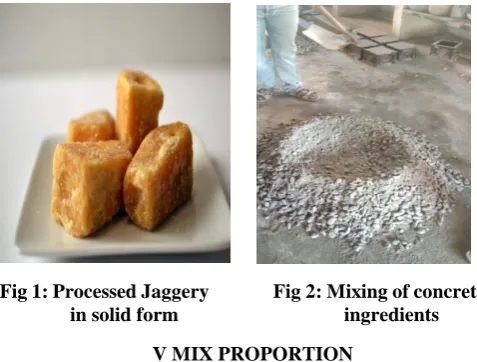
[image:2.595.312.545.346.478.2] Admixture: The useful purpose of this study is to influence of jaggery available in market was used as admixture in concrete composition and it was used at different percentages at 0, 0.25, 0.50 and 0.75%. After crushing and make the powder form which passes through one mm sieve was used as admixture in concrete preparation.
Fig 1: Processed Jaggery Fig 2: Mixing of concrete in solid form ingredients
V MIX PROPORTION
Nominal mix of M20 grade concrete of 0.5:1.0:1.5:3 (W: C: C.A:F.A) by weight was chosen for the concrete mix of M20 grade as per IS: 10262-1982. Graded aggregates were usedin preparation of samples at 60% of 20mm and 40% of 12.5mm. Zone 2 Fine aggregate was used in composition.
V. OVERVIEWONNEWCONCRETE
To find out the performance of flexural strength, used standard size 700×150×150mm mould and for shear strength
double L shape moulds. For each proportion cast six beam specimens, six double L shear specimens and tested for evaluating the strength properties of concrete.
6.1 Overview on Workability: Workability of fresh concrete has been performed according to IS: 1199-1959, it can also depend on type of structures, thickness of structural element and place of casting. Workability of concrete is combined work, which consists of mixing, transportation, placing and enough compaction. In order to meet the above said uniqueness, it is necessary to add admixture into the concrete. In present study jiggery added at 0 to 0.75% to the composition and studied the workability behavior.
6.2 Overview of Flexural strength: With reference from IS 516-1959, the standard size of the specimen 150x150x700 mm over a centre to centre support of 600 mm was used to study the perform the modulus of rupture for the new concrete composition with admixture. Typical test performance has been shown in the Fig 5 and 6. Six beam specimens of each percentage (0, 0.25, 0.50 and 0.75%) were cast according to nominal mix proportion. Demoulding of specimen was difficult after 24 hours admixture of 0.25, 0.50 and 0.75% because of increase of setting time. 0.25% admixture specimens were demoulded after 48 hours and for 0.5 and 0.75% specimens after 72 hours and 96 hours.
Fig. 5: Beam specimens Fig.6; Typical line diagram after casting. for testing of Beam
6.3 Overview of Shear Strength:
Shear strength is the resistance of one layer with respect to other during slip at common surface of contact. There exists no standard reliable and simplified method for determining shear strength of concrete specimens using with compressive testing machine.[image:2.595.47.286.489.670.2]
Shear failure will be occurred due to brittle nature in concrete structures. Six double L shear moulds of each percentage (0, 0.25, 0.50, and 0.75%) were cast with size of 290×210×80mm and between the layers 10 mm steel reinforcement bars were provided, finishing the top surface smoothly and demoulded after setting. Fig 7 and 8 shows the casting procedure of doble L push off specimens for shear strength of the concrete.
VI. TESTPROCEDUREOFNEWCONCRETE
7.1 Test procedure of Workability: Workability of concrete has been determined by conducting slump cone and compaction tests. Mix the all concrete ingredients on water tight platform (on finished concrete floor) and measure the slump and compaction factor values. During the experimentation work, it was clearly observed that true slump for 0% and collapse slump when admixture added at dosages of 0.75%.
[image:3.595.43.290.220.429.2]
Fig. 9: True slump for 0% Fig.10: Collapse slump for
Admixture 0.75% Admixture 7.2 Test procedure of flexural strength: This testhas been
performed under symmetrical third point loading system. It is determined from the moment at failure. Flexural strength of the beam specimen is determined according to IS516-1959 with
fb = 3 P a / bd2 ---(1)
Where “a” is less than 20 cm but more than 17 cm for 150x150x700 cm specimen.
[image:3.595.309.540.237.674.2]Fig.11: Testing of beam Fig 12: Testing of Double L
Shear 7.3 Test procedure of Shear Strength: For determining the shear strength, testing of specimen has been carried out in compressive testing machine as shown in fig.12. Check the surface of the specimen contact to the upper arm of CTM, if not use rubber mats to contact the surface properly. Apply the
load uniformly and record the ultimate load. The failure load for each specimen was recorded and all most all specimens have failed in shear along the shear plane of failure.
VII. RESULTSANDDISCUSSIONS
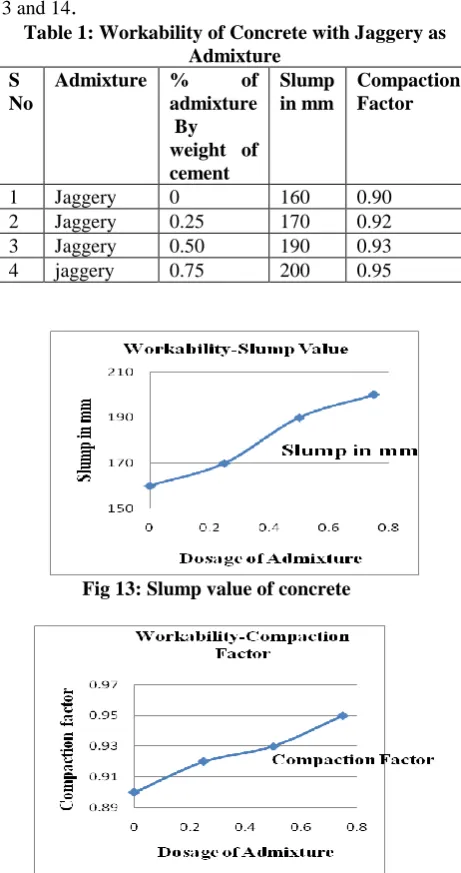
8.1 Workability of Concrete with Jaggery as Admixture The test results of each dosage were compared with convectional M20 grade concrete and results tabulated in Table No1. Based on experimental results, workability of new composition was increased with percentage of admixture increased. Addition of jaggery into the concrete composition is greatly influences the setting time of concrete and it is increased from 160 mm to 200 mm and compaction factor from 0.90 to 0.95 as addition of admixture from 0 to 0.75%. Behavior of slump and Compaction factor being shown in Fig 13 and 14
.
Table 1: Workability of Concrete with Jaggery as Admixture
S No
Admixture % of admixture By weight of cement
Slump in mm
Compaction Factor
1 Jaggery 0 160 0.90
2 Jaggery 0.25 170 0.92
3 Jaggery 0.50 190 0.93
4 jaggery 0.75 200 0.95
Fig 13: Slump value of concrete
Fig 14 Compaction Factor of concrete
The basic reason with addition of jaggery as admixture into concrete is acts as thin layer over the cement particles and slows down the hydration process. Formation of calcium ion will increase solubility and discouraging the formation of Calcium-Hydroxide. Due to
[image:3.595.45.298.553.712.2]8.2 Flexural Strength of Concrete with Jaggery as Admixture
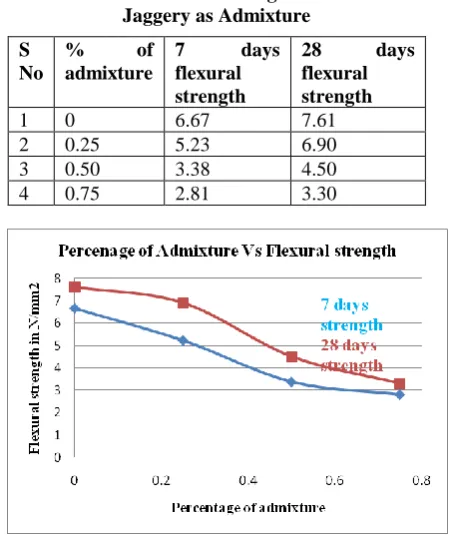
[image:4.595.60.289.183.451.2]With reference from the above experimental results, as the percentage of admixture increases, flexural strength decreased. From table 2 it is clear that, as replacement ratio increases flexural strength decreased. This is due to increase in the fluidity of concrete structure. Excess replacement of admixture jiggery may reduce the flexural strength of concrete due to the more fluidity and flaws.
Table 2: Flexural Strength of Concrete with Jaggery as Admixture
S No
% of
admixture
7 days
flexural strength
28 days
flexural strength
1 0 6.67 7.61
2 0.25 5.23 6.90
3 0.50 3.38 4.50
4 0.75 2.81 3.30
Fig 15: Flexural strength of concrete with jaggery as admixture.
[image:4.595.57.284.512.775.2]8.3 Shear Strength of new Concrete with Jaggery as Admixture
Table 3: Shear Strength of Concrete with Jaggrery as Admixture
S No
% of
admixture
7 days shear strength
28 days shear strength
1 0 2.58 3.98
2 0.25 1.78 3.52
3 0.50 0.89 2.16
4 0.75 0.69 1.69
.
Fig 16: Shear strength of Concrete with Jaggery as Admixture
Based on experimental results of a new concrete, the percentage of admixture (Jaggery) increases, shear strength of the new concrete was decreased. From the Table 3, few specimens were failed during curing in curing pond between 7 days to 28 days, this was happen due to the excess fluidity within the specimen and most of the specimens failed at joining portion of double L specimen
VIII. CONCLUSIONS
Based on the test results, following conclusions are drawn; The slump and compaction factor values being increased with increase in percentage of jaggery.
Addition of jaggery into the concrete composition is acts as a thin layer over a cement and slows down the hydration process, formation of calcium ions increases the solubility and discouraging the formation of Calcium Hydroxide. Hence the setting time of concrete increased. Adding of jaggery in concrete composition slows down the hydration process; hence jaggery is a better retarder and it can be used in deep foundations.
True slump observed at 0.25% of admixture and Collapse of slump was observed at 0.75% of jaggery added to the concrete composition.
The flexural strength of concrete decreased 50% with respect from conventional concrete. Jaggery with water forms a thin layer and increases fluidity of concrete, hence bonding between the concrete ingredients was reduced. So that the strength was decreased.
Similar trend was observed in shear strength, shear strength was decreased to 50 to 70% because of same reason as mentioned in flexure test and also week joint at double L push off joining portion.
REFERENCES
1. Giridhar. V. et al., “Effect of sugar and jaggery on strength properties of concrete”.||volume ||2|| Issue|| 10|| Pages||01-06||2013||
2. A.V. Pavan Kumar et al., “Effect of sugar, jaggery and sugar cane ash, on properties of concrete”.||ISSN 2319-8885||volume-04||Issue-51||pages||11000-11006||
December||2015||
3. 3Somawanshi. S.P. et al., “Effect of molasses in concrete as a water reducing and time retarding admixture”||PP.13417-13421||volume||07||September||2016||
4. 4Lavhare Rajendra et al., “Effect of sugar and jaggery (molasses) on strength properties of concrete”. ||ISSN2277-5528||jan-mar 2017||. 5. 5Manjunatha. M “ An experimental study on partial replacement of
cement by cementitious materials, sand by copper slag and the use of jaggery, egg albumen and human hairs in concrete”||ISSN 2455-7137||PP 47-56||volume 02||Issue 08||August||2017||
6. 6Fouziya Qureshi et al., “Study on strength of concrete by adding jaggery”||e-ISSN 2278-1684||p-ISSN 2320-334X||volume||14||Issue 5 ver. V(sep-oct2017)||PP 26-30||.
7. 7 Dinesh Kumar “Sugar cane molasses in concrete as a water reducing – Retarding Admixture”: A Review ||ISSN 2348-8352|| pages||123-125||April 2015||.
8. 8Suraj.V.Sha et al,” Effect of sugar and Jaggery on workability and compressive strength of concrete” 13 International conference on Recent Innovations in Science, Engineering and Management, 23 Feb 2018, Pages546-551.
Author-2 Photo Author-3
Photo
Technology and Engineering Research,Vol-5, Issue-4, July 2015. 10. Harish Moolchandani, “Influence of Addition of Jiggery Concentration
on Different Grades of Concerte” International Journal for Scientific Research & Development| Vol. 6, Issue 03, 201, pp 1117-1118
AUTHORSPROFILE
First Author: Obtain PG from JNTUA-Ananthapuramu in structural stream and awarded Ph.D from JNTUA-Ananthapuramu. Author has published 19 International journal papers, presented 3 International conference papers and published a book with international publisher on “Waste management and properties of ceramic waste aggregate concrete”. His area of interests is structures and replacement of concrete aggregates by waste materials. Author has two memberships from Institute of Engineers India MIE and CE.
Second Author: Obtained PG From IIT-Delhi. He published 3 journals in national and international, Presented 2 international conference papers.His area of intersest is Geotechnical engineering and Rock Mechanics. He is life member in IGS.