Enabling learning for all through adaptable personal
learning environments
Elaine Pearson, Steve Green, Voula Gkatzidou Accessibility Research Centre
University of Teesside, UK
In the current landscape of technological and social change, the shape of learning technology is being influenced by forces which present significant challenges for the learning designer. The increasing demand for personalised approaches and pedagogies, together with an emphasis on the need to cater for the needs and preferences of the individual learner, are shifting the focus to the integration of adaptive and ubiquitous learning, to respond to the challenge of providing truly- learner-centred, accessible, personalised and flexible learning. This paper proposes a model for the development of a framework for an open source Adaptable Personal Learning Environment (APLE). It goes beyond current definitions of a Personal Learning Environment (PLE) that encompasses personal systems and tools. In our definition an APLE is also adaptable to the needs and preferences of the individual learner, and to the environment in which they are working. Taking an existing Virtual Learning Environment (VLE), known as the Portland VLE, as the starting point the framework is focused around the creation of individual interfaces for personal learning. Central to the development of this framework is engagement with and development of a community of practice (COP) comprising tutors, developers, researchers, students and administrators. Through the COP we aim to develop a set of anonymous personal profiles from which sample interfaces and learning objects will be produced. These sample interfaces and learning object templates will enable the definition of requirements that should meet the needs and preferences of all learners regardless of disability, environment or personal preference.
Keywords:Adaptable, personal, learning, environments, accessibility, inclusion
Introduction
Outside of formal learning, students are becoming accustomed to personalisation in their choice of tools for communication, entertainment, socialisation and informal learning through the growing ubiquity of social software tools. Learning Management Systems (LMS) or Virtual Learning Environments (VLE), as they are known in the UK, are now widely used in education. They provide opportunities for
asynchronous delivery of learning to distributed students, as well as incorporating tools for group work, synchronous communication and collaboration. However, many higher education institutions are now exploring new pedagogical approaches that are required to meet the needs of this new generation of learners (McLoughlin and Lee, 2007). One such approach is the Personal Learning Environment (PLE). The Joint Information Systems Committee (JISC) (JISC, 2005) describe a Personal Learning
Environment as one that replaces some or all of the tools of a standard (VLE) with tools that are personal to the learner and integrated with the student’s own personal systems and tools. The interface and tools are not designated by the institutional VLE; instead they are the personal choice of the learner. However, we contend that the individual selection of systems and tools is not enough to meet the needs of all learners particularly those with disabilities. An Adaptable Personal Learning Environment (APLE) extends that description by adding the concept of adaptability as defined by the IMS AccessForAll [6] group. An Adaptable Personal Learning Environment would facilitate participation by all students including those with disabilities for whom access may currently be difficult or impossible. The
framework is focused around the creation of novel interfaces for personal learning, and the starting point for this work is an existing specialist Virtual Learning Environment (VLE) known as the Portland VLE. This was developed as part of a recently completed research project on a symbols-based accessible VLE for the Portland partnership, a large cross institutional European funded initiative. The APLE project draws on this and other related research activities within our group incorporating symbols based interfaces, social software and inclusion, adaptable assessment and mobile learning and draws on related
work with the IMS AccessForAll (IMS, 2004) anonymous Profiles of Needs and Preferences (PNPs). Central to the proposed APLE is the need to establish and test the concept of personal profiles. Three major areas of research for the Accessibility Research Centre at University of Teesside are the development of an adaptive, symbols based VLE for students with severe disabilities, self adapting interfaces for mobile devices, and a Transformation, Adaptation and Substitution Service (TASS) for the definition of adaptable learning objects. Central to all of these is the concept of anonymous personal profiling for the definition of requirements. This enables adaptation of the mobile interface, the delivery of learning objects and personalisation of the learning environment to meet the needs and preferences of the individual. In addition an exploration of appropriate standards will establish a framework that enables interoperability between learning environment, devices and learning objects (Pearson and Jones, 2006).
The Portland personal learning environment
The aim of the Portland Partnership project was to develop ICT- curriculum content within a Virtual Learning Environment to meet the needs of young adult learners with a range of physical disabilities and associated learning difficulties. The Partnership was funded as part of the European Social Fund’s ‘Equal’ initiative which sought to develop innovative ways of ensuring participation in lifelong learning. Portland College is a national specialist college for learners with physical disabilities and learning difficulties, and the project involved partners from Further and Higher Education, as well as the private sector. The Accessibility Research Centre was responsible for conducting an analysis of user requirements and designing and developing the adaptive and accessible learning environment itself.
The rationale for the project was that there were no appropriate resources designed specifically for this user group and no means for the learners to access any resources independently. The first stage of the research was to identify the needs of a diverse group of learners with disabilities in order that we could design specifically for their needs.
The Portland user group was young adult learners aged 16 years upwards at pre-Entry level (DFES, 2000). The differing needs and requirements of these learners make it difficult to portray a typical learner, however DfES describe these students as being “capable of learning, but they will have profound
intellectual impairments and will require very specialised teaching” (DfES, 2001). The varying abilities and disabilities of this learner group suggest that each learner has unique access needs for learning. The characteristics of a learner with profound and multiple disabilities vary greatly from one learner to another, but may include:
• limited or no sight e.g. lack of depth perception or reduced visual fields • limited or no verbal communication e.g. dysarthria
• learning difficulties e.g. low levels of literacy and numeracy • physical disabilities e.g. poor or no fine motor skills or quadriplegia
The Portland VLE (Harrison et. al. 2008) took a specific and pragmatic approach to the development of an adaptable learning environment and its particular characteristics means that it could be regarded as a Personalised Virtual Learning Environment (PVLE). The tutor or administrator is able to make the required adjustments to the VLE by selecting elements of interaction according to the learner profile that is derived from baseline observations and formal assessment of student needs. It was important to make the environment as accessible and autonomous as possible for the learner to facilitate independent online learning.
This VLE is designed so that it can be tailored to meet the individual needs and preferences of the target user group. The interface is personalised to allow learners to have the screen display and layout of their choice, and choice of symbol set (PCS, Rebus or Makaton). This means the environment meets the needs of those learners with low literacy levels through symbol-supported text and speech output. Interaction is tailored to meet students’ requirements through compatibility between the VLE and their preferred input device (e.g. mouse, switch, scanning).The Portland VLE includes the standard features found in most mainstream VLEs, (e.g. a secure login system, communication tools, timetable and access to tailored learning resources).
Portland’s unique functionality and features has resulted in an accessible and adaptable learning environment that meets the needs of learners with severe learning difficulties and physical disabilities. The design encourages a greater level of independence for the learner by ensuring that the VLE and the learning objects are accessible with the appropriate input device, language tools and layout required by each individual user (Figure 1).
Figure 1: The Portland VLE symbolised log-in screen
The JISC concept of a Personal Learning Environment (PLE) goes one step further in that every aspect, including the functions of the environment such as e-mail, discussion and calendar are actively selected by the individual. A PLE can be developed from a PVLE if a common set of standards can be identified for component interoperability and the individual is allowed to build up their personal set of functions from available components (Pearson et. al. 2005, Green et. al. 2006).
The beta application developed demonstrated that a PVLE could be created that is adaptable to the needs of a particular group of learners with complex physical and cognitive disabilities and is in use by the students and their colleagues who were involved in its development. Transforming the PVLE to an open source tool, adopting the JISC concept of a PLE and incorporating aspects of adaptability would result in the creation of an APLE that could be used by many other learner groups with particular needs and preferences.
A transformation, augmentation and substitution service for adaptable learning objects and learning patterns
In order to achieve an accessible relationship between the resource and the user, descriptions of user needs and preferences are checked against descriptions of resource components until they match. This process involves a description of a user’s control, display and content needs and preferences being matched with a description of the components of the learning object (Nevile et. al. 2005). The delivery of the appropriate component will form an accessible relationship between the user and the learning object. According to the AccessForAll metadata overview, accessible systems should be able to adjust the user interface of the learning environment, locate needed resources and alter resource properties to match the needs and preferences of the user. This may involve the substitution, augmentation or transformation of components of the resource such as changes in sensory modality. For our purposes we have developed a transformation, augmentation and substitution service (TASS) which is geared to a limited subset of e-learning applications and contexts. It represents a special instance of an AccessForAll service.
Our work to date has focused on applying the TASS to learning objects. To make rich online content match individual needs and preferences, this approach requires a basic resource to be created from existing or newly authored components, and the appropriate adaptations (transformations, augmentations and substitutions) need to be identified. Examples of these adaptations are as follows.
Transformation
Transformation may occur where text is rendered visually, as characters, or a sign language, or aurally, perhaps by a screen reader, or transformed into a tactile form as Braille or simply changed in colour, size and other display features.
Augmentation
Augmentation involves the optional addition of a feature to a primary resource, for instance a textual caption could be added to a video when required by a user with a hearing impairment or in a noisy environment.
Substitution
Substitution might occur when a user requires a vision-free access to the resource, for instance if the user was accessing the learning object on a PDA on a field trip and be accessible it is necessary to replace the visual element of the learning objects with components that match the user’s preferences of vision-free access. Alternatively, an interactive exercise requiring a mouse for operation could be substituted by one that can be controlled using a keyboard or keyboard emulator for a user with a mobility impairment. As an example a replacement occurs when a user accessing a learning object requires vision-free access to a resource, and therefore needs alternatives to the visual content contained in the primary resource of the learning object. The profile of this user may actually be the same as the profile of a sighted user accessing the learning object on a PDA while driving: the user needs to access the learning object using non-visual techniques. For this relationship to be accessible it is necessary to replace the visual element of the learning objects with components that match the user’s preferences of vision-free access. It is also often the case that the original content of the resource has to be supplemented, as for example with their availability of a dictionary or captions, for an aural component.
Application profiles
In this context we accept the extension of the definition of accessibility beyond disability, and define the relationship between a user and a resource as accessible when the characteristics of the resource as delivered match the user’s needs and preferences (Nevile, 2005) The definition of accessibility implied here is that the relationship between the user and the resource is one that enables the user to make sensory and cognitive contact with the content of the resource (IMS, 2004 op.cit.). According to the AccessForAll statement the term disability has been re-defined as a mismatch between the needs of the learner and the education offered and it is therefore not a personal trait but an artefact of the relationship between the learner and the learning environment or education delivery (Cooper et. al. 2005). Accessibility, therefore, is the ability of the learning environment to adjust to the needs of all learners and is determined by the flexibility of the environment (with respect to presentation, control methods and access modality) and the availability of adequate alternative-but-equivalent content (Heath et. al. 2005). The needs and preferences of a user may arise from the context or environment the user is in, the tools available (e.g., mobile devices, assistive technologies etc.), their background, or a disability. According to the AccessForAll vocabulary, descriptions of needs and preferences are separated into display, control and content
characteristics. Declared needs and preferences may change according to context. (Nevile, 2005; Pearson and Koppi, 2002).
As well as knowing what learning resources they are dealing with and their properties, in an APLE the learners’ characteristics will be available so that available resources can be matched to them. This is referred to as learner profiling. Learner profile information can be used for accessibility purposes but in many instances context or preference may be equally important. For example, a non-auditory profile might mean that audio material needs a transcription and video - captions or subtitles. In broad terms there is a need to be able to define a user’s contextual profile as a set of requirements for services and resources.
Typically the profile will define the user’s human-computer interaction (HCI) requirements in terms of visual, auditory and tactile components. The three main elements of the profile will be:
1. Display or output (typically visual but could be an auditory screen reader or tactile Braille display) 2. Control or input (typically keyboard and mouse but could be switches, touch-screen, joystick tactile
devices or an auditory voice recognition system)
3. Content (primarily visual, auditory media or textual components which can be read or transformed into auditory components by a screen reader)
In the IMS AccessForAll proposal an “Adaptability” element is employed to identify a set of user needs and preferences. This is considered an important enough extension by the DCMI to consider
incorporation into the Dublin Core standards itself.
Profile for adaptable learning
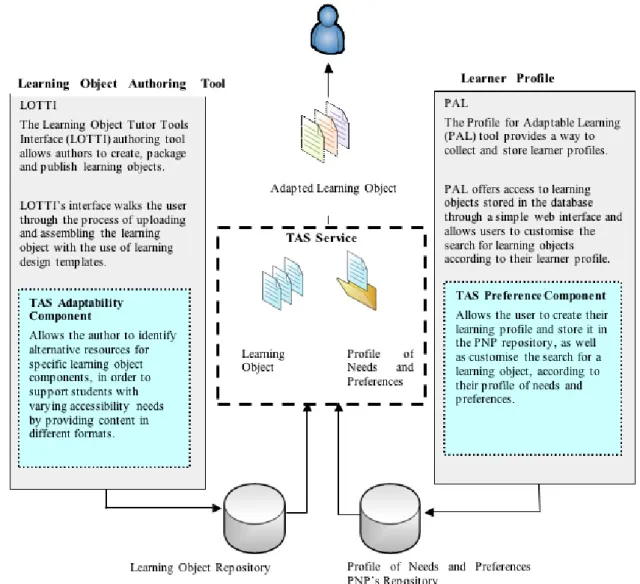
The Profile for Adaptable Learning (PAL) tool currently under development aims to provide a way to create, store and edit a learner profile, based on the IMS Accessibility for Learner Information Package (ACCLIP) specifications.
PAL demonstrates the potential benefits of adaptable and personalised resources and tools for the learner and this part of our work aims to investigate the practical boundaries of transformable content and the tools needed to support the creation of adaptable learning objects.
ACCLIP describes the user in terms of accessibility needs by using a XML-based syntax. It enables the description of user preferences (visual, aural or device), which can be usefully exploited for tailoring learning contents (e.g., preferred/required input/output devices or preferred content alternatives). In other words, such a personal user profile provides a means to describe how learners interact with an e-learning environment, by focusing on accessibility requirements.
The profile is anonymous in that there is no need to know who the user is or why they require the specified support. Furthermore, choices and options are considered just as important as absolute needs; for example a user might express a preference for Braille output, but with an indicator that auditory substitution is also acceptable, but visual elements unacceptable.
The development of the PAL tool means that the TASS will comprise of two separate components, the adaptability and the preference component (Figure 2). The TASS adaptability component allows the author to identify alternative resources for specific learning object components. The learning object, its underlying pattern and its components will all be stored in the Learning Object Repository. The TASS preference component allows the user to create a Profile of Needs and Preferences (PNP), which would be stored in the PNP repository.
From adaptable resources to an APLE
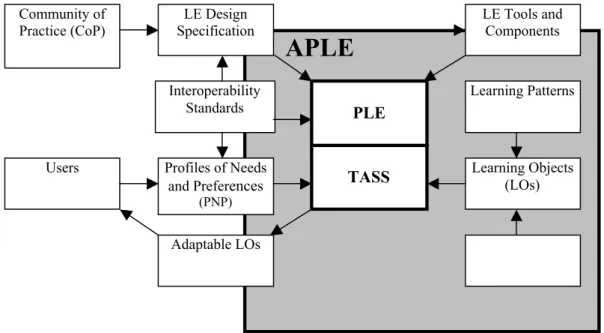
One way of achieving an APLE is to extend the concept of a transformation, augmentation and
substitution service to deal with the features of the learning environment as well as the content, and then to embed the TASS into the PVLE (Figure 3). This suggestion is based on the principle that learning content can be generated from adaptable aggregations of learning objects and media components using proven learning patterns. Using a variant of IMS AccessForAll (IMS, 2004 op. cit.), the TASS works on available metadata and user profiles to generate alternative, equivalent learning experiences relating to a user’s declared needs, preferences and learning styles (Pearson and Jones, 2006, op. cit.). This might provide a more pragmatic, adaptable and ultimately accessible learning environment than the current JISC PLE concept can achieve by itself. Although the JISC PLE proposals consider the concepts of personal choice, no specific account has been taken of the work on adaptability by the IMS AccessForAll group. The JISC PLE proposals are based on a well recognised and understood need to make learning
environments more usable for individuals or better suited to their learning and research needs. It is a small step to extend this to be more accessible by adapting both content and functions to the needs and
preferences of our users.
Further work
Further research is needed on user interface and component aspects of adaptability before a fully adaptable open source PLE becomes a reality. For example one principle of a full IMS AccessForAll service is that the alternative content or services can be provided from a number of potential sources. If a function or learning object can be identified that is better suited to the individual, in theory it can be accommodated. In practice this accommodation is fraught with problems associated with incompatibility and lack of interoperability. We have identified three specific areas of research that will turn the potential for APLE into a real prospect. Through close involvement with an already partially established
community of practice, we propose to explore the potential for adaptability of learning objects, interfaces and environments.
Figure 2: The TASS model
1. The current Portland VLE is being evaluated and re-engineered, through engagement with an existing CoP comprised of stakeholders in further and higher education. This will establish the requirements for typical groups of users to develop a framework for an Open Source Adaptable Personal Learning Environment. This ongoing work includes:
• Evaluation of the existing adaptable VLE in terms of alternative user requirements; • Gathering sample profiles of typical users from a range of user groups e.g. learning
disabled; hearing impaired, vision impaired, learners with English as a foreign language; • Concept designs based on user requirements;
• A technical requirements specification for an open source APLE; • A prototype of an open source APLE component model.
2. A personal profiling model also drawn from our CoP user groups will be mapped against the TASS to produce a set of sample learning objects adaptable to users’ accessibility requirements, personal preferences, device or environmental needs. This is being achieved by:
• Analysing existing sample profiles;
• Mapping the profiles against Dublin Core and IMS PNPs; • The development of structured templates;
• Mapping of structured profiles against TASS for adaptability requirements; • Creation of sample LOs based on template information and TASS.
Figure 3: An adaptable personal learning environment
3. The third area of research is to establish the existing standards pertaining to each component of a PLE for interoperability, and to identify gaps and inconsistencies. We propose a case study that will include:
• Identification of specific standards for PLE, mobile devices and LOs; • A critical evaluation of the standards in practice;
• Identification of requirements and standards for interoperability; • Analysis of problems, gaps and inconsistencies in interoperability; • Recommendation on standards for APLEs.
Conclusion
This project aims to develop a community approach to the definition and delivery of an Adaptable Personal Learning Environment. The component elements of content, context, user needs and preferences are all considered equally important with respect to the learning environment. However central to all of this work is the learner and the resulting enhancement of the learner experience. We may not be able to guarantee an improved experience in all cases but we believe that with the support of our community of practice we can develop a truly personal learning environment that is adaptable to the needs and
preferences of most learners. Finally the project will produce a personal profiling model and a framework for an open source Adaptable Personal Learning Environment - that is an adaptable model able to grow and change according to the needs of the user. Through our collaborative approach with users involved throughout, we are confident of outcomes that offer maximum potential for wider adoption not only by disabled learner groups but within the mainstream community.
References
Cooper, M., Treviranus, J., & Heath, A. (2005). Meeting the diversity of needs and preferences - A look at the IMS AccessForAll specifications' role in meeting the accessibility agenda efficiently. Accessible Design in the Digital World Conference.
http://ewic.bcs.org/conference/2005/accessible/workshops/workshop3.pdf
DfES (2000). Freedom to Learn: Basic Skills for Learners with Learning Difficulties and/or Disabilities. London DfES
DfES (2001) Adult Literacy Core Curriculum including Spoken Communication, London DfES Pearson, E., & Gkatzidou, S. (2006). Accessibility and adaptability of learning objects: responding to
metadata, learning patterns and profiles of needs and preferences. ALT-J Research in Learning Technology, 14(1), 117-129.
APLE
Community of Practice (CoP) LE Design Specification LE Tools and Components Interoperability StandardsPLE
TASS
Users Profiles of Needs
and Preferences (PNP)
Learning Patterns
Learning Objects (LOs)
Green, S., Pearson, E., & Stockton, C. (2006). Personal Learning Environments: Accessibility and Adaptability in the Design of an Inclusive Learning Management System, AACE World Conference on Educational Multimedia (EDMEDIA), Orlando, Florida, USA
Harrison, M Stockton C, Pearson, E. (2008). Inclusive, Adaptive Design for Students with Severe Learning Disabilities. The 8th IEEE International Conference on Advanced Learning Technologies, Santander, Cantabria, Spain
Heath, A., Treviranus, J., & Nevile, L. (2005). Individualised Adaptability and Accessibility in E-learning, Education and Training Part 1: Framework. http://jtc1sc36.org/doc/36N1024.pdf IMS. (2004). IMS Global learning/Dublin Core AccessForAll project. Available online:
http://www.imsglobal.org/accessibility
JISC (2005). Personal Learning Environments. http://www.jisc.ac.uk/index.cfm?name=cetis_ple McLoughlin, C. & Lee, M. J. W. (2007). Social software and participatory learning: Pedagogical
choices with technology affordances in the Web 2.0 era. In ICT: Providing choices for learners and learning. Proceedings ascilite Singapore 2007.
http://www.ascilite.org.au/conferences/singapore07/procs/mcloughlin.pdf
Nevile, L. (2005). Anonymous Dublin Core Profiles for Accessible User Relationships with Resources and Services. The International Conference on Dublin Core and Metadata Applications, Madrid, Spain.
Nevile, L., Cooper, M., & Heath, A. (2005). Learner-centred Accessibility for Interoperable Web-based Educational Systems. 14th International World Wide Web Conference, Chiba, Japan.
http://l3s.de/~olmedilla/events/interopPapers/paper08.pdf
Pearson, E., & Koppi, T. (2002). Inclusion and online learning opportunities: designing for accessibility, Association for Learning Technology Journal, 10(2).
Pearson, E., Stockton C., & Green S. (2005). Overcoming barriers to e-learning for students with severe disabilities, Association for Learning Technology Conference (ALT-C), Manchester.
Pearson, E. & Jones, R. (2006). Designing Adaptable Learning Resources, AACE World Conference on Educational Multimedia (EDMEDIA), Orlando, Florida, USA
Contact author: Dr Elaine Pearson, Accessibility Research Centre, University of Teesside, UK. Email: [email protected] Web: http://rime.tees.ac.uk/ARC
Please cite as: Pearson, E., Green, S. & Gkatzidou, V. (2008). Enabling learning for all through adaptable personal learning environments. In Hello! Where are you in the landscape of educational technology? Proceedings ascilite Melbourne 2008.
http://www.ascilite.org.au/conferences/melbourne08/procs/pearson.pdf Copyright 2008 Elaine Pearson, Steve Green and Voula Gkatzidou
The authors assign to ascilite and educational non-profit institutions a non-exclusive licence to use this document for personal use and in courses of instruction provided that the article is used in full and this copyright statement is reproduced. The authors also grant a non-exclusive licence to ascilite to publish this document on the ascilite web site and in other formats for Proceedings ascilite Melbourne 2008. Any other use is prohibited without the express permission of the authors.