Learning Climate and Workplace Learning: Does Work Restructuring Make a Difference?
ARTICLE ACCEPTED FOR PUBLICATION AT
JOURNAL OF PERSONNE PSYCHOLOGY
Irina Nikolova
Open Unversity, The Netherlands Joris Van Ruysseveldt Open Unversity, The Netherlands
Karen Van Dam
Open Unversity, The Netherlands Hans De Witte
KU Leuven, Belgium North-West University, South Africa
Author Note
Correspondence concerning this article should be addressed to Irina Nikolova, Faculty of Psychology, Open University, the Netherlands, P.O. Box 2960, 6401 DL Heerlen, the Netherlands. Office phone 003145 576 2354, E-mail address: [email protected]
Abstract
In the current study, we propose that organizational learning climate in terms of facilitation learning climate, appreciation learning climate, and error-avoidance climate has the capacity to enhance employees’ level of newly acquired competences. Additionally, we investigated whether this relationship holds when employees face work-restructuring. Structural Equation Modeling was used to test the hypotheses on a large sample of the Dutch working population (N = 1013). The results showed that work restructuring moderated the hypothesized
relationships. Under conditions of high restructuring, facilitation learning climate was an important predictor of learning outcomes; yet, under conditions of low work restructuring, appreciation learning climate was more effective. The current paper contributes to research on organizational change and workplace learning by providing evidence that organizational change can impact the way organizational learning climate supports employee learning.
Keywords: Work restructuring, organizational change, workplace learning, KSAOs, learning climate
Learning Climate and Workplace Learning: Does Work Restructuring Make a Difference?
Nowadays, organizations and employees are continuously confronted with changes, which compel intensification of both labor and workplace learning practices (Marsick & Watkins, 2003). Moreover, employee learning and organizational learning have been increasingly recognized as crucial for the ability of employees and organizations to adapt successfully to changing conditions (Armstrong & Foley, 2003; Mikkelsen & Gronhaug, 1999). The basic premise of this paper is that a learning-supportive organizational climate can be particularly salient for sustaining employees’ competence levels in times of organizational change. During change, employees often face work restructuring, that is changes in work practices (methods, procedures, standards), which might affect the way learning climate impacts the development of new competencies. Even though changing work settings have often been acknowledged as a primary drive for employee learning (Bauer & Gruber, 2007; Marsick & Watkins, 2003), to the best of our knowledge no study so far has systematically investigated how work restructuring impacts the way learning climate relates to learning.
The purpose of the present study was to establish whether work restructuring
moderates the relationship between learning climate and learning outcomes. We test a model that depicts the relationships between three dimensions of learning climate and employees’ recently acquired knowledge, skills, abilities and other characteristics (KSAOs). This model illustrates the importance of a learning supportive environment for employees’ actual learning. Our hypotheses are developed along insights from Conservation of Resources (COR) theory (Hobfoll, 2011). In line with COR theory, we portray change in terms of work restructuring, as a stressor or a demanding condition that modifies the relationships between the constructs in our model.
Learning Climate and Newly Acquired KSAOs: Prior Research Learning climate (i.e. employees’ perception of organizational policies and practices aimed at supporting employees’ learning behaviors) can play a key role in the facilitation of employees’ KSAOs (Ellinger & Cseh, 2007; Taverniers, 2011). In the literature, both qualitative and quantitative research has supported this assumption. For instance, based on semi-structured-in-depth interviews, Ellinger and Cseh (2007) identified “an internal culture committed to learning” (p. 445) and “the training department” (p. 445) as positive
organizational contextual factors that are of particular importance for employee learning. Similarly, using face-to-face interviews with HRM practitioners, Crouse, Doyle, and Young (2011) found that organizational and managerial support were mentioned as some of the strongest facilitators of workplace learning. In a mixed method study among low-qualified employees, Govaerts, Claes, De La Marche, and Dochy (2013) found that perceived
organizational support for learning was a positive predictor of employees’ learning intention. Learning intentions, in turn, have been established to serve as a precursor of actual
participation in learning activities (Maurer, Weiss, & Barbeite, 2003).
Trying to advance the understanding of the processes underlying the relationship between work support for learning and development, and actual participation in learning and development, Maurer et al. (2003) depicted the complex interdependencies among several learning related constructs. Work support for learning (i.e. encouragement, persuasion about the value of development, offering time, information, resources, and rewards for participation in learning) was found to positively impact actual participation in learning and development through attitudes towards learning. Altogether, organizational support for learning or learning supportive climate (involving provision of material resources for learning, as well as material and non-material incentives for learning) seems to enhance employees’ positive competences such as self-efficacy for learning, beliefs for learning capabilities, positive attitudes towards
learning, intentions as well as actual participation in learning and developmental activities (Maurer et al., 2003). These learning concepts and relationships delineate an important implicit motivational process: organizational support for employee learning motivates employees to engage in actual learning activities because it increases their positive learning beliefs and attitudes, and offers opportunities for facilitating individuals’ inherent tendencies for growth and development (Maurer et al., 2003).
One of the most prevalent mechanisms through which organizations provide support for employee learning refers to the organizational policies, practices, norms and procedures that constitute learning climate (Schneider, Brief, & Guzzo, 1996; Schneider, Ehrhart, & Macey, 2013). Three aspects of learning climate were distinguished in the current study: facilitation learning climate, appreciation learning climate, and error-avoidance climate (authors, 2014b). Facilitation learning climate concerns employees’ perception of the organizational policies and practices aimed at providing access to educational resources, while appreciation learning climate maps the perception that pertains to the material and immaterial incentives for employees’ learning behaviors. Error-avoidance climate can be described as a climate that sustains a working atmosphere dominated by fear or anxiety of making errors during work. This type of climate is embedded in the organizational practices with regard to the tolerance for errors. Error-avoidance climate indicates a lack of
psychological safety when errors in the work process are made (Van Dyck, Frese, Baer, & Sonnentag, 2005).
Learning Climate and Newly Acquired KSAOs: The Perspective of COR Theory According to COR theory (Hobfoll, 2011), the organizational environment is a
powerful source of influence on employees and their personal resources. Through shaping specific working conditions (e.g. fostering learning conditions), the organization has the capacity to enrich or tax employees’ personal resources (e.g. their professional learning)
(Hobfoll, 2011). COR theory states that people commonly apprize the objective elements of their (organizational) environment as resourceful or threatening (Hobfoll, 2011). People thus will perceive an organizational environment or climate that provides facilitation and
appreciation for certain personal resources as a resourceful context. Resources as posited by COR are valuable assets (e.g. health, family, positive self-image) that possess protective properties and can help individuals generate new resources. One of the main tenets of COR theory is that people who possess more resources tend to be less vulnerable to resource loss and are better capable of realizing resource gain when challenging situations occur (Hobfoll, 2011). COR theory also posits that individuals or organizations with more resources are able to acquire new resources with increased efficiency. Subsequently, an organizational resource such as a supportive or resourceful organizational climate (e.g. climate oriented towards facilitating learning behaviors) will be the key to efficient generation of new resources, such as personal learning resources.
To illustrate the tendency of resources to travel together and enhance each other, Hobfoll (2011) further introduced the concept of resource caravans. He defined caravan passageways (in organizational context) as “the environmental conditions that support, foster, enrich, and protect the resources of individuals, sections or segments of workers, and
organizations in total, or that detract, undermine, obstruct, or impoverish people’s or group’s resource reservoirs” (Hobfoll, 2011, p.119). In line with the notion of caravan passageways, we propose that a learning supportive climate will offer the environmental conditions necessary for fostering the resources of individuals (personal resources) in terms of newly acquired KSAOs. A working environment that affords educational opportunities and signals appreciation for employees’ learning behaviors can be viewed as supportive of the
individuals’ resources for learning. Regarding KSAOs as a personal resource, it is important to note that personal resources pertain to different positive personal characteristics (e.g.
personal competences and self-efficacy) that can provide the individual with a sense of general resiliency and empowerment for dealing with challenges (Hobfoll, 2011;
Xanthopoulou, Bakker, Demerouti, & Schaufeli, 2007). KSAOs can be viewed as a valuable personal resource in our contemporary knowledge-driven society. Employees’ KSAOs are essential for individuals’ professional success in the circumstances of continuously increasing demands for knowledge (Kyndt et al., 2013). Following the argumentation of COR theory that environmental resources tend to enhance personal resources (Hobfoll, 2011), an
organizational learning climate, which can serve as a powerful organizational resource, would be expected to enhance employee learning (personal resource).
In a similar vein, one can argue that error-avoidance climate, which per definition is a resource restrictive condition (the autonomy to make errors and learn from them is obstructed) will have a depleting impact on individuals’ resources and more specifically on their ability to obtain new KSAOs. In contrast, psychological safety climate can serve as an organizational level resource supporting employee learning at work, a notion that has been supported in numerous studies(Edmondson, 1999; Hirak, Peng, Carmeli, & Schaubroeck, 2012; Kessel, Kratzer, & Schultz, 2012). A work environment that instigates a sense of fear of making errors (instead of psychological safety) is likely to make employees reluctant to learn through experimentation (Edmondson, 1999). A lack of tolerance for errors implies that organizational members might experience anxieties about the safety of their job and about their professional image when an error in the work process occurs (Lee, Edmondson, Thomke, & Worline, 2004). Owing to possible interpersonal risks associated with making errors (e.g. being seen as incompetent or prone to failures), employees are likely to conceal unsuccessful work
experiences, and avoid experimentation (Edmondson, 1999). Thus, employees’ experimentation at work as a form of proactive learning behavior can be significantly
In summary, as outlined in COR theory, the model in the current study illustrates the relationship between organizational resources (e.g. learning climate) and personal resources (e.g. newly acquired KSAOs). We hypothesized that a generally supportive (facilitation as well as appreciation) learning climate can enhance the acquisition of KSAOs. Alternatively, an environment that does not foster resource-supporting conditions can adversely impact employees’ personal resources. In line with the propositions of COR theory, we hypothesize:
Hypothesis 1: Facilitation (a) and appreciation (b) learning climate relate positively to newly acquired KSAOs; error-avoidance climate relates negatively to newly acquired KSAOs (c).
Learning Climate and Newly Acquired KSAOs: The Impact of Work Restructuring Practices
In the organizational change literature, work restructuring has often been viewed as a powerful trigger of disruptions of the existing work practices and routines (Hetzner, Heid, & Gruber, 2012). The new work practices that emerge as a result of work restructuring typically require from employees new KSAOs or even an entirely novel approach to work (Hetzner et al., 2012). Consequently, a certain demand or requirement to learn is deeply inherent to changing work settings and to change processes in general. However, in order to meet the emerging demand for learning, employees need to be provided an access to adequate opportunities to engage in learning. This implies that organizations need to ensure learning supportive conditions or a climate that fosters employees’ actual learning, especially in times of work restructuring. In their study on change in relation to workplace learning, Hetzner et al. (2012) viewed “learning through change” as a construct that strongly depends on the conditions for learning that a specific workplace affords to the employees.
In line with previous research, we propose that work restructuring will be perceived as a threat (Chen, Westman, & Eden, 2009; authors, 2014a). At the onset of the restructuring
process, one is likely to experience the changes in his/her job as entailing a certain degree of ambiguity. In all, change might be seen as a disruption of the status quo and a source of uncertainty with regard to the outcomes. Even though restructuring might possess potential for resource gain in the long term, at the beginning of the process it can be perceived as a threat and thus can negatively impact employee well-being (Chen et al., 2009; authors, 2014a). In keeping with the assumptions of COR theory, when the individual identifies some environmental condition as a threat, the available resources that he/she possesses become particularly salient for overcoming the challenge and for obtaining new resources. Following this line of reasoning, it is likely that in times of work restructuring, learning climate will be perceived as a resource and utilized to its fullest. Therefore, we developed the following hypotheses:
Hypothesis 2: Work restructuring moderates the relationships between learning climate and newly acquired KSAOs. Specifically, the associations of the three dimensions of learning climate, facilitation (a), appreciation (b) and error-avoidance (c), with newly acquired KSAOs are stronger in case of high work restructuring compared to a low restructuring context.
Method Participants and Procedure
Data from 1013 respondents working in different companies in the Netherlands were collected. Initially, a total of 1362 employees were approached through e-mail with an invitation to take part in the survey. A specialized online marketing research company operating in the Netherlands conducted the data collection for this study. Each year, the company receives information from the Central Office for Statistics of the Netherlands about gender, age, and education of the general Dutch population. This information is used to stratify the pool of potential participants, which enables for a representative heterogeneous
sample of the Dutch population to be selected and surveyed. It should be noted that self-employed, freelancers and temporary workers were not included in our sample. Mean age was 45.16 years (SD = 10.86) and 62.1% were male. The educational level of the participants was: high school (44.1%), lower educational training (15.9%), and higher educational training (40.0%); the professional level of de respondents was: blue-collar workers (24.1%), white-collar workers (42.8%), and supervisors (33.1%). Mean tenure was 11.77 years (SD = 10.15). Measures
Learning climate was measured with a validated scale assessing three dimensions (facilitation learning climate, appreciation learning climate, and error-avoidance climate) developed by the authors (2014b). Responses were given on a five-point Likert scale ranging from 1 (= not applicable at all) to 5 (= fully applicable). Each climate dimension was
measured with three items.A sample item for facilitation learning climate was “My
organization provides appealing learning opportunities”. Cronbach’s alpha was .89. A sample item for appreciation learning climatewas “In my organization, employees who make an effort to learn new things, receive appreciation and respect”. Cronbach’s alpha was .84.A sample item for error-avoidance climate was “In my organization, one is afraid to admit mistakes”. Cronbach’s alpha was .75.
Work restructuring was measured with four items based on existing scales on work changes and innovation (see Jiménez-Jiménez & Sanz-Valle, 2011; Petrou, Demerouti, Peeters, Schaufeli, & Hetland, 2012). By using the phrase “In my department during the past six months changes occurred regarding…” as an introduction to the items in this scale, we ensured that participants referred to a similar period of recent changes. A sample item was “… the work methods for producing goods or delivering services”. A five-point response scale was used ranging from 1 (= to a very small degree) to 5 (= to a very large degree). Cronbach’s alpha was .81.
Newly acquired KSAOs were measured with four items developed by Taverniers (2011). This scale has already been used in prior studies (authors, 2014a; Van Ruysseveldt &
Taverniers, 2010) and has shown good reliability ( = .95 and = .93, respectively). The scale probes into newly (in the past half a year) obtained work competences. The scale’s items are: “I have developed new skills, which enable me to do my work more efficiently”, “I have obtained new knowledge about how to conduct my work tasks better”, “I have obtained new competences, which help me to achieve my work goals more accurately”, “I have obtained new competences, which help me to function better at my work”. A five-point response scale was used ranging from 1 (= strongly disagree) to 5 (= strongly agree). Cronbach’s alpha was .95.
Control variables gender (1 = male, 2 = female), age and educational level were included when conducting the study’s analyses.
Analyses
The data were analyzed with Structural Equation Modeling (SEM) using the Mplus statistical package (version 7.11; Muthen & Mutchen, 1998 - 2009) and applying Monte Carlo integration 5000; parameters were estimated with robust standard errors MLR estimator. Before testing the structural paths between the latent variables, we investigated the measurement model by conducting confirmatory factor analyses (CFA). This can help us determine whether the latent variables used in the analysis represent separate constructs, which might be a concern when self-reports and cross-sectional data are used. Taking into consideration that a prior study (authors, 2014b) has already provided evidence for the three-factor structure of the learning climate scales, we did not examine the structure of these scales separately. Using CFA, we tested and compared four measurement models. In Model 1, we allowed all items to load on one common factor. In Model 2, the items initially designed to measure learning climate, and the ones intended to measure KSAOs were allowed to load on
one ‘learning’ factor, while the four items for work restructuring were set to represent a second factor. In Model 3, all learning climate and restructuring items constituted one factor, while the KSAOs items constituted a separate factor. Finally, Model 4 represented the five-factor model as hypothesized in the current study.
The four nested CFA-models were compared to one another using several indicators: the chi-square difference test, Akaike’s Information Index (AIC), Bayesian Information Criterion (BIC), and AIC difference. In general, the model that delivers the smallest AIC and BIC values is considered the best model (Muthen, & Muthen, 1998–2009). In order to
establish if the difference in AIC between models is significant AIC is computed. Typically, a value for the AIC difference (between models) higher than 4 is considered to be significant. After examination of the factorial structure of the model, the structural latent model was analyzed. This model included four dependent variables (the three climate dimensions and work restructuring), three control variables (gender, age and education), and three interaction variables. SPSS was used to determine the significance of the interactions by means of simple slope analyses (Aiken & West, 1991).
The goodness of fit of the CFA and SEM models was assessed with a number of fit indices commonly used in SEM for evaluating model fit: chi-square (2), the Comparative Fit Index (CFI), the Tucker-Lewis Index (TLI), and the Standardized Root Mean Square Residual (SRMR). Values for SRMR lower than or equal to .08, and values for CFI and TLI exceeding .90 indicate a good fit (Byrne, 2010).
Results Descriptive statistics
Table 1 shows the study variables’ correlations, means, standard deviations, and reliabilities.
Insert Table 1 about here
Investigating the measurement model
As Table 2 shows, the initially hypothesized 5-factor model (Model 4) yielded the best fit (2 (df = 109) = 398.93, SRMS = .04, CFI = .98, TLI = .97, AIC = 38488.56, BIC = 38594.98). Moreover, the chi-square difference test and the AIC unambiguously indicated that Model 4 was better than the other models (see Table 2), providing evidence that the five variables used in our model represent separate constructs.
Insert Table 2 about here Hypotheses testing
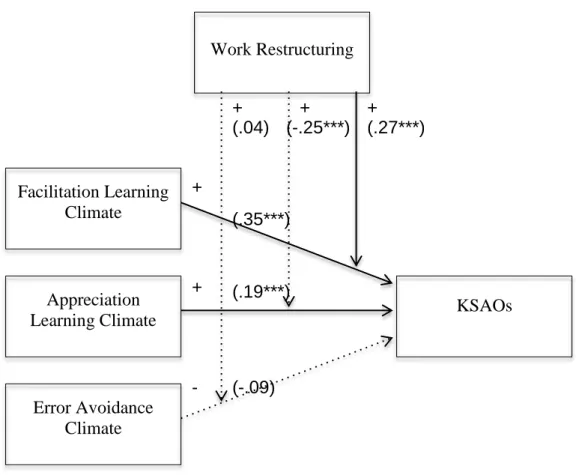
Main effects. The regression weights obtained from the path analyses (see Figure 1) showed that facilitation learning climate (B= .35, p <.001) as well as appreciation learning climate (B= .19, p =.003) related positively and significantly to KSAOs, providing support for Hypotheses 1a and 1b. However, the association between error-avoidance climate and KSAOs was not significant (B= -.09, p =.153). Thus, Hypothesis 1c was rejected. Two out of the three control variables included in the statistical model - age and education - were significantly associated with KSAOs, indicating that younger and more educated employees reported higher levels of newly acquired KSAOs.
Interactions. Regarding the moderation hypotheses, the regression weights showed that the interaction term of work restructuring and facilitation climate related significantly to newly acquired KSAOs (B= .27, p <.001). Similarly, the interaction term of work
restructuring and appreciation learning climate was significantly related to newly acquired KSAOs (B= - .25, p = .004). The association between the interaction term of work
restructuring and error-avoidance climate with newly acquired KSAOs was not significant (B = .04, p = .631).
Complementary to the SEM analyses, simple slope analyses were conducted to assess the significance and direction of the interaction slopes. The outcomes revealed that, as hypothesized, the positive relationship between facilitation climate and KSAOs was stronger for employees experiencing higher levels of restructuring (= .45, t = 9.61, p <.001)
compared to employees reporting low levels of restructuring (= .20, t = 4.55, p <.001). Therefore, Hypothesis 2a was supported. Contrary to our expectations, the positive relationship between appreciation learning climate and newly acquired KSAOs was only found among employees reporting low restructuring (= .31, t = 6.70, p < .001) but not among those dealing with high restructuring (= .09, t = 1.93, p = .054). Thus, Hypotheses 2b was rejected. As the interaction term of error-avoidance climate and restructuring was not significant, Hypothesis 2c was rejected., and no simple slope analysis was conducted.
Insert Figure 1 about here
Discussion
The findings of the current study indicate that a learning climate in terms of a facilitation learning climate and an appreciation learning climate can serve as an important promotor of employee learning and result in the acquisition of new KSAOs. This supports Schneider’s et al. (1996) notion that an organizational climate that fosters important and valued employee behaviors through organizational practices, procedures and policies will result in an increase or greater prominence of these behaviors (e.g. learning behaviors) and the associated outcomes (e.g. KSAOs). It is also in line with COR-theory’s claims that an
organizational environment can provide the necessary conditions (i.e. ‘caravan passageways’) for fostering employee personal resources (Hobfoll, 2011). Moreover, our findings support
prior studies showing that a learning supportive environment can stimulate employee learning (Crouse et al., 2011; Ellinger & Cseh, 2007; Maurer et al., 2003). No support was found for the role of error-avoidance climate. Although the correlation between error avoidance climate and KSAOs was significant (albeit modest), the two constructs were unrelated when tested in a structural model together with the other two learning climate dimensions. Apparently, the positive aspects of learning climate served as stronger triggers of employee learning than error avoidance climate.
Work restructuring was expected to strengthen the relationships between the learning climate dimensions and newly acquired KSAOs. Although the findings did show a
moderation effect of work restructuring, they also revealed a more complex picture. The findings suggested that the impact of the facilitation and appreciation dimensions of learning climate on KSAOs differed with the level of work restructuring.
As expected, the relationship between facilitation learning climate and newly acquired KSAOs was moderated by work restructuring. Whereas facilitation learning climate was postively related to learning outcomes in times of low and high work restructuring, it
appeared especially important under conditions of high restructuring. This finding underlines the notion that restructuring processes have the capacity to enhance the demand for learning (Bauer & Gruber, 2007; Hetzner, Gartmeier, Heid, & Gruber, 2009), and that a climate that provides the necessary (educational) opportunities and facilities for learning will be effective in aiding employee learning in times of changes (Kyndt et al., 2013; Maurer et al., 2003). Prior studies suggested that employees need to possess adequate up-to-date work-specific KSAOs in order to carry out their daily tasks efficiently (Hetzner et al., 2009), and that learning at work can help employees reduce the gap between acquired and newly required KSAOs (Loon & Casimir, 2007). Since the work restructuring process is usually associated with changes in the daily tasks that require new working approaches and thus a new set of
skills (Hetzner et al., 2009), employees may perceive their KSAOs as out-dated and inadequate in times of changes. The restructuring process therefore could be viewed as a condition that increases the competency gap and poses a strongdemand for fast, effective and efficient learning (Hetzner et al., 2009). A strong facilitation learning climate directly aids the acquisition of desired learning outcomes by supplying the needed (learning) resources. This accords with the notion of Hetzner and colleagues (2012) that the level of individual learning induced by organizational change processes largely depends on the conditions for learning provided by the organization.
Whereas the findings thus indicated that a facilitation climate can enhance learning, especially in work settings with high restructuring, they also indicated that appreciation climate only stimulates learning in work settings with little restructuring. In these stable work settings, little changes happen and consequently the necessity to adapt and develop will be low (Hetzner et al., 2009; Kyndt et al., 2013; Maurer et al., 2003). In such low-change conditions, learning will take place when the learning climate emphasizes the importance of employee development by appreciating and rewarding employees’ engagement in learning activities, and – as mentioned earlier – by facilitating learning. Our findings suggest that appreciating and rewarding employee learning is no longer necessary under conditions of high structuring, when the pace of changes forces employees to increase and develop their
competencies. The differential way facilitation and appreciation learning climate impact employee learning under conditions of high and low restructuring indicates that these two dimensions of learning climate impact learning through specific mechanisms. Specifically, it seems that work restructuring operates as a job demand that requires from employees a
significant and strong effort to learn (Hetzner et al, 2009). Hence, the strong learning-inducive properties of work restructuring inherently motivate employees to learn, and, as a
becomes paramount in safeguarding this learning process. As such, the presence of a strong facilitation climate is critical in advancing workplace learning in times of work restructuring. At the same time, owing to this motivational aspect of high restructuring conditions, the role of appreciation learning climate as a motivational source for competence development may become redundant. In contrast, in case of low work restructuring, there is no or little threat for a skill gap to occur, and hence, there is no or little necessity and thus motivation to develop new KSAOs. Under this condition, appreciation learning climate can serve as a motivational force by providing the incentives that trigger employees to learn and develop their
competencies. As such it appears that a strong facilitation learning climate directly aids the acquisition of desired learning outcomes by supplying the needed (learning) resources, whereas a strong appreciation learning climate indirectly fuels learning processes by establishing incentives which stimulate employees to strive towards competence
development. This is in line with the idea that an organization’s incentives (e.g. rewards and remuneration) can act as an impetus for employee learning and innovative behaviours (Lee et al., 2004; Shipton, Fay, West, Patterson, & Birdi, 2005).
Finally, work restructuring did not moderate the relationship between error avoidance climate and newly acquired KSAOs. That is, there was no significant relationship between error avoidance climate and newly acquired KSAOs in either conditions of high and low restructuring. By definition restructuring implies that employees need to become proficient in using new methods and learn to comply with new procedures. Especially in a period of
adjustment to the new ways of working, individuals would optimize their learning experience, if they could safely “try out” the new working methods and freely talk about their errors (Hetzner et al., 2009). It is possible that some of the respondents worked in occupations (e.g. health care providers, workers in chemical industries) where “trying out” new working
order to determine the real impact of error-avoidance climate on employee learning in times of restructuring, future research should take these occupational groups into account.
Limitations and Directions for Future Research
Some shortcomings should be acknowledged when discussing the study’s results. First, the use of self-reports can inflate the magnitude of the effects (Podsakoff et al., 2012). As common method variance cannot account for effects in moderation models (Evans, 1985), the chance that the effects in our study are inflated is limited, however. Still, the inclusion of other methods of data collection such as observations, interviews, and evaluations from third parties can enrich our evidence, as these methods have incremental value over the use of self-reports. Second, one could raise a concern that while our study involved change aspects, the analyses were conducted on cross-sectional data, which hinders establishing cause-effect linkages.
Despite these limitations, our study provides several directions for future research. Most importantly we would like to note that some of our hypotheses were not supported; the outcomes pointed at a more complex model than we initially had developed. Although our findings could be well explained, it is of utmost importance that our findings are replicated. Therefore, we would like to invite researchers to test the new model in a new sample of respondents using alternative research designs. For instance, an experimental pretest-posttest control-group design in a large organization may offer a more precise view on the way the three different facets of learning climate operate under the condition of restructuring. Such design may pertain to planned interventions in which each of the three learning climate facets is being promoted in one specific department of the organization where employees undergo work restructuring. A pretest and two posttest measurement could be applied to assess how the interventions have affected employees actual learning across time, and should include a control condition where no intervention takes place. Such a design will allow to establish both
across time differences and a thorough between-group comparison of the interventions and of the work restructuring effects.
Alternatively, a longitudinal research design using multiple data sources and applying a multi-level approach could provide deeper insight in the complex interrelationships between change, learning climate and workplace learning. Ideally, a (large) number of organizations each consisting of numerous work units or teams would constitute the research population. This enables aggregation of individual data to the unit/team level and the application of multi-level analyses. Variables such as learning climate can be measured at organizational and work unit level, by aggregating individual survey data, but also through qualitative data collection (document analysis, observation, semi-structured interviews with key persons within the organization), e.g. qualitative data about the level, direction and content of organizational change processes, HRD policies and interventions (organizational facilitation and
appreciation of learning), and workplace learning policies and practices. Exploring employee learning as shaped by various multi-level (e.g. team, supervisor and organization level) variables will allow research to construct a holistic view of the learning processes in a dynamic organizational context. For instance, whereas at team level scholars may wish to assesses how ideas’ generation and knowledge sharing practices can impact team learning in times of restructuring, at the level of the supervisor, it could be valuable to research the impact of the leadership style (e.g. LMX, servant leadership or transformational leadership) on employee learning outcomes. In addition, a more thorough assessment of the influence of organizational level covariates such as size and type of the organization or occupational group on the way organizational facilitation of learning affects employee learning may be valuable. Prior studies have suggested that organization’s size is a relevant predictor of learning and innovation related outcomes (Shipton et al., 2005; Sung & Choi, 2014). It is for instance possible that smaller organizations may be more sensitive to the needs of training and
education of their employees in times of restructuring and thus may be faster and more flexible in providing learning opportunities when undergoing work restructuring. With regard to the occupational groups as control variable, as suggested earlier for some professions and sectors learning through errors may not be possible, owing to the high costs associated with errors and failures. For these specific groups, assessing error-avoidance climate as a predictor of employee learning would not be meaningful implying that occupation and sector could be confounding variables in these type of studies.
Conclusion
This study suggests that companies that need to enhance their employees’ KSAOs should invest in shaping a learning supportive organizational climate. Our findings indicate that sustaining employees’ professional competences requires a directed effort of the
organization’s management to develop a learning climate that takes the level of work restructuring into account. In situations of low restructuring, management should install procedures and practices that aim at rewarding and facilitating employee learning; whereas in times of high structuring, it is of crucial importance to offer conditions for learning that facilitate the development of KSAOs necessary for dealing with these changes. A climate that emphasizes learning in times of restructuring serves a double purpose. On the one hand, a facilitation learning climate contributes to employees’ knowledge by helping individuals meet the increased need for new and relevant knowledge and adapt their competences to the
changes in the work context. On the other hand, investing in employees’ professional
development in times of changes might be perceived as a signal from the organization that it values its workforce and thus intends to retain employees. This might have far-reaching consequences, because it may thwart employees’ feelings of insecurity that are often associated with restructuring processes.
References
Aiken, L. S., & West, S. G. (1991). Multiple regression: Testing and interpreting interactions. Thousand Oaks, CA, US: Sage Publications, Inc.
Bauer, J., & Gruber, H. (2007). Workplace changes and workplace learning: Advantages of an educational micro perspective. International Journal of Lifelong Education, 26(6), 675-688.
Byrne, B. M. (2010). Structural equation modeling with AMOS: Basic concepts, applications, and programming (2nd ed.). New York, NY: Routledge/Taylor & Francis Group. Chen, S., Westman, M., & Eden, D. (2009). Impact of enhanced resources on anticipatory
stress and adjustment to new information technology: A field-experimental test of conservation of resources theory. Journal of Occupational Health Psychology, 14, 219-230.
Crouse, P., Doyle, W., & Young, J. D. (2011). Workplace learning strategies, barriers, facilitators and outcomes: A qualitative study among human resource management practitioners. Human Resource Development International, 14, 39-55.
Edmondson, A. (1999). Psychological safety and learning behavior in work teams. Administrative Science Quarterly, 44, 350-383.
Ellinger, A. D., & Cseh, M. (2007). Contextual factors influencing the facilitation of others' learning through everyday work experiences. Journal of Workplace Learning, 19, 435-452.
Evans, M. G. (1985). A Monte Carlo study of the effects of correlated method variance in moderated multiple regression analysis. Organisational Behavior and Human Decision Processes, 36, 305-323.
Hetzner, S., Gartmeier, M., Heid, H., & Gruber, H. (2009). The interplay between change and learning at the workplace: A qualitative study from retail banking. Journal of
Workplace Learning, 21, 398-415
Hetzner, S., Heid, H., & Gruber, H. (2012). Change at work and professional learning: How readiness to change, self-determination and personal initiative affect individual learning through reflection. European Journal of Psychology of Education, 27, 539-555.
Hobfoll, S. E. (2011). Conservation of resource caravans and engaged settings. Journal of Occupational and Organisational Psychology, 84, 116-122.
Jiménez-Jiménez, D., & Sanz-Valle, R. (2011). Innovation, organizational learning, and performance. Journal of Business Research, 64, 408-417.
Kyndt, E., Govaerts, N., Claes, T., De La Marche, J., & Dochy, F. (2013). What motivates low-qualified employees to participate in training and development? A mixed-method study on their learning intentions. Studies in Continuing Education, 35, 315-336. Lee, F., Edmondson, A. C., Thomke, S., & Worline, M. (2004). The mixed effects of
inconsistency on experimentation in organizations. Organization Science, 15, 310-326.
Loon, M., & Casimir, G. (2008). Job-demand for learning and job-related learning: The moderating effect of need for achievement. Journal of Managerial Psychology, 23, 89-102. doi:10.1108/02683940810849684
Marsick, V. J., & Watkins, K. E. (2003). Demonstrating the value of an organisation's
learning culture: The dimensions of the learning organisation questionnaire. Advances in Developing Human Resources, 5, 132-151.
Maurer, T. J., Weiss, E. M., & Barbeite, F. G. (2003). A model of involvement in work-related learning and development activity: The effects of individual, situational, motivational, and age variables. Journal of Applied Psychology, 88, 707-724. Muthen, L. K., & Muthen, B. O. (1998–2009). Mplus user’s guide (5th ed.). Los Angeles,
CA: Muthen & Muthen.
Petrou, P., Demerouti, E., Peeters, M. C., Schaufeli, W. B., & Hetland, J. (2012). Crafting a job on a daily basis: Contextual correlates and the link to work engagement. Journal of Organizational Behavior, 33, 1120-1141.
Podsakoff, P. M., MacKenzie, S. B., & Podsakoff, N. P. (2012). Sources of method bias in social science research and recommendations on how to control it. Annual Review of Psychology, 63, 539-569.
Schneider, B., Brief, A. P., & Guzzo, R. A. (1996). Creating a climate and culture for sustainable organizational change. Organizational Dynamics, 24, 7–19.
Schneider, B., Ehrhart, M. G., & Macey, W. H. (2013). Organizational climate and culture. Annual Review of Psychology, 64, 361-388.
Shipton, H., Fay, D., West, M., Patterson, M., & Birdi, K. (2005). Managing People to Promote Innovation. Creativity and Innovation Management, 14, 118-128. doi:10.1111/j.1467-8691.2005.00332.x
Taverniers, J. (2011). Learning reduces stress? Stress inhibits learning? It depends: occupational research combining survey studies, field experiments, and cortisol
assessments. Unpublished doctoral dissertation, Heerlen: Open University.
Van Dyck, C., Frese, M., Baer, M., & Sonnentag, S. (2005). Organizational error management culture and its impact on performance: A two-study replication. Journal of Applied Psychology, 90, 1228-1240.
Karasek revisited [Learning while working: Karasek’s active learning hypothesis revisited]. Gedrag & Organisatie, 23, 1–18.
Xanthopoulou, D., Bakker, A. B., Demerouti, E., & Schaufeli, W. B. (2007). The role of personal resources in the job demands-resources model. International Journal of Stress Management, 14, 121-141.
Figure 1. Study model.
Note. The direction of the study hypotheses are indicated with “+” and “-“ sign. Unstandardized parameters are given in parenthesis; solid arrows indicate supported hypothesis, dashed arrows - rejected hypothesis. The parameters reported underneath the moderator are based on interaction terms. Control variables are not presented for simplicity.
Facilitation Learning Climate Appreciation Learning Climate Error Avoidance Climate KSAOs Work Restructuring - + + + + + (.35***) (.19***) (-.09) (.27***) (-.25***) (.04)
Table 1
Means, Standard Deviations, Reliability Estimates, and Correlations of the Study Variables (N = 1013)
Variable M SD 1 2 3 4 5 6 7 8
1. Gender 1.38 0.49 -
2. Age 45.16 10.86 -.16**
3. Education 4.94 1.60 -.26** -.28**
4. Facilitation Learning Climate 3.06 0.88 -.14** -.01 .14** (.89)
5. Appreciation Learning Climate 2.67 0.84 -.16** -.07* .17** .59** (.84)
6. Error Avoidance Climate 2.57 0.78 -.11** .03 -.01 -.19** -.06* (.75)
7. Work Restructuring 1.92 0.84 -.06* -.03 .09** .06* .11** .17** (.81)
8. Newly Acquired KSAOs 2.84 0.91 -.10** -.24** .25** .47** .43** -.08* .28** (.95) Note: *p < .05, **p < .01