Issues in Data Stream Management
∗
Lukasz Golab and M. Tamer ¨
Ozsu
University of Waterloo, Canada
{lgolab, tozsu}@uwaterloo.ca
Abstract
Traditional databases store sets of relatively static records with no pre-defined notion of time, unless timestamp attributes are explicitly added. While this model adequately represents commercial catalogues or repositories of personal information, many current and emerging applications require support for on-line analysis of rapidly changing data streams. Lim-itations of traditional DBMSs in supporting stream-ing applications have been recognized, promptstream-ing re-search to augment existing technologies and build new systems to manage streaming data. The purpose of this paper is to review recent work in data stream management systems, with an emphasis on appli-cation requirements, data models, continuous query languages, and query evaluation.
1
Introduction
Traditional databases have been used in applications that require persistent data storage and complex querying. Usually, a database consists of a set of objects, with insertions, updates, and deletions oc-curring less frequently than queries. Queries are exe-cuted when posed and the answer reflects the current state of the database. However, the past few years have witnessed an emergence of applications that do not fit this data model and querying paradigm. In-stead, information naturally occurs in the form of a sequence (stream) of data values; examples include sensor data [10], Internet traffic [36, 61], financial tickers [17, 72], on-line auctions [3], and transaction logs such as Web usage logs and telephone call records [21].
A data stream is a real-time, continuous, ordered (implicitly by arrival time or explicitly by timestamp) sequence of items. It is impossible to control the or-der in which items arrive, nor is it feasible to locally store a stream in its entirety. Likewise, queries over ∗This research is partially supported by the Natural
Sci-ences and Engineering Research Council (NSERC) of Canada.
streams run continuously over a period of time and incrementally return new results as new data arrive. These are known aslong-running,continuous, stand-ing, andpersistentqueries [17, 48]. The unique char-acteristics of data streams and continuous queries dic-tate the following requirements of data stream man-agement systems:
• The data model and query semantics must al-low order-based and time-based operations (e.g. queries over a five-minute moving window).
• The inability to store a complete stream suggests the use of approximate summary structures, re-ferred to in the literature as synopses [6] or di-gests [72]. As a result, queries over the sum-maries may not return exact answers.
• Streaming query plans may not use blocking op-erators that must consume the entire input be-fore any results are produced.
• Due to performance and storage constraints, backtracking over a data stream is not feasible. On-line stream algorithms are restricted to mak-ing only one pass over the data.
• Applications that monitor streams in real-time must react quickly to unusual data values.
• Long-running queries may encounter changes in system conditions throughout their execution lifetimes (e.g. variable stream rates).
• Shared execution of many continuous queries is needed to ensure scalability.
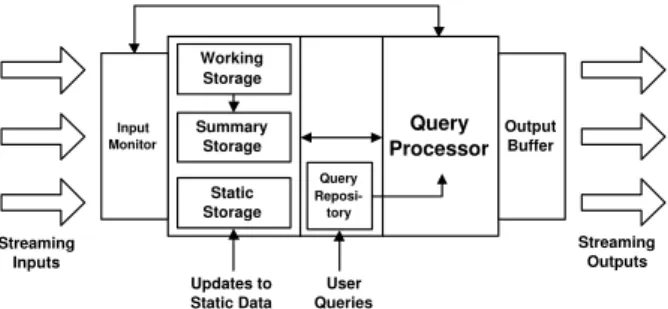
Proposed data stream systems resemble the ab-stract architecture shown in Figure 1. An input mon-itor may regulate the input rates, perhaps by drop-ping packets. Data are typically stored in three par-titions: temporary working storage (e.g. for window queries), summary storage for stream synopses, and static storage for meta-data (e.g. physical location of each source). Long-running queries are registered
Input
Monitor OutputBuffer
Streaming
Inputs StreamingOutputs
Query Processor Query Reposi-tory Working Storage Summary Storage Static Storage User Queries Updates to Static Data
Figure 1: Abstract reference architecture for a data stream management system.
in the query repository and placed into groups for shared processing, though one-time queries over the current state of the stream may also be posed. The query processor communicates with the input moni-tor and may re-optimize the query plans in response to changing input rates. Results are streamed to the users or temporarily buffered.
In this paper, we review recent work in data stream processing, including data models, query languages, continuous query processing, and query optimization. Related surveys include Babcock et al. [6], which dis-cusses stream processing issues in the context of the STREAM project, and a tutorial by Garofalakis et al. [31], which reviews algorithms for data streams. An extended version of this survey [39] includes more details.
The remainder of this paper surveys requirements of streaming applications (Section 2), models and query languages for data streams (Section 3), stream-ing operators (Section 4), and query processstream-ing and optimization (Section 5). We conclude in Section 6 with a list of academic projects related to data stream management.
2
Streaming Applications
We begin by reviewing a collection of data stream ap-plications in order to define a set of query types that a data stream management system should support; more examples may be found in [60, 65].
2.1
Sensor Networks
Sensor networks may be used in various monitoring applications that involve complex filtering and acti-vation of an alarm in response to unusual conditions. Aggregation and joins over multiple streams are re-quired to analyze data from many sources, while ag-gregation over a single stream may be needed to com-pensate for individual sensor failures. Representative
queries include the following:
• Drawing temperature contours on a weather map: Perform a join of temperature streams (on the temperature attribute) produced by weather monitoring stations. Join the results with a static table containing the latitude and longitude of each station, and connect all points that have reported the same temperature with lines.
• Analyze a stream of recent power usage statistics reported to a power station (group by location, e.g. city block), and adjust the power generation rate if necessary [18].
2.2
Network Traffic Analysis
Ad-hoc systems for analyzing Internet traffic in near-real time are already in use to compute traffic statis-tics and detect critical conditions (e.g. congestion and denial of service) [22, 36, 61]. Monitoring popular source and destination addresses is particularly im-portant as Internet traffic patterns are believed to obey the Power Law distribution, meaning that most of the bandwidth is consumed by a small set of heavy users. Example queries include:
• Traffic matrices: Determine the total amount of bandwidth used by each source-destination pair, and group by protocol type or subnet mask.
• Compare the number of distinct source-destination pairs in the (logical) streams con-taining the second and third steps, respectively, of the three-way TCP handshake. If the counts differ by a large margin, then a denial-of-service attack may be taking place.
2.3
Financial Tickers
On-line analysis of stock prices involves discovering correlations, identifying trends and arbitrage oppor-tunities, and forecasting future values [72]. The fol-lowing are typical queries [63]:
• High Volatility with Recent Volume Surge: Find all stocks priced between $20 and $200, where the spread between the high tick and the low tick over the past 30 minutes is greater than 3% of the last price, and where in the last 5 minutes the average volume has surged by more than 300%.
• NASDAQ Large Cap Gainers: Find all NAS-DAQ stocks trading above their 200-day moving average with a market cap greater than $5 Bil-lion that have gained in price today by at least 2%, and are within 2% of today’s high.
2.4
Transaction Log Analysis
On-line mining of Web usage logs, telephone call records, and Automated Bank Machine transactions also conform to the data stream model. The goal is to find interesting customer behaviour patterns, iden-tify suspicious spending behaviour that could indicate fraud, and forecast future data values. The following are some examples:
• Examine Web server logs in real-time and re-route users to backup servers if the primary servers are overloaded.
• Roaming diameter [21]: Mine cellular phone records and for each customer, determine the greatest number of distinct base stations used during one telephone call.
2.5
Analysis of Requirements
The preceding examples show significant similarities in data models and basic operations across applica-tions (and some differences related to workload char-acteristics, such as stream arrival rates or the amount of historical data needed). We list below a set of fun-damental continuous query operations over stream-ing data, keepstream-ing in mind that new streamstream-ing appli-cations, possibly with additional requirements, will likely be proposed in the future.
• Selection: All streaming applications require support for complex filtering.
• Nested aggregation: Complex aggregates, includ-ing nested aggregates (e.g. comparinclud-ing a mini-mum with a running average) are needed to com-pute trends in the data.
• Multiplexing and demultiplexing: These are sim-ilar to group-by and union, respectively, and are used to decompose and merge logical streams.
• Frequent item queries: These are also known as top-k orthreshold queries, depending on the cut-off condition.
• Stream mining: Operations such as pattern matching, similarity searching, and forecasting are needed for on-line mining of streaming data.
• Joins: Support should be included for multi-stream joins and joins of multi-streams with static meta-data.
• Windowed queries: All of the above query types may be constrained to return results inside a window (e.g. the last 24 hours or the last one hundred packets).
3
Data Models and Query
Lan-guages for Streams
The above requirements demand specific features to be included in the data models and query languages for data streams. In this section, we survey the pro-posed models and languages.
3.1
Data Models
A real-time data stream is a sequence of data items that arrive in some order and may be seen only once. Since items may arrive in bursts, a data stream may instead be modeled as a sequence of lists of ele-ments [64]. Individual stream items may take the form of relational tuples or instantiations of objects. In relation-based models (e.g. STREAM [56]), items are transient tuples stored in virtual relations, possi-bly horizontally partitioned across remote nodes. In object-based models (e.g. COUGAR [10] and Tribeca [61]), sources and item types are modeled as hierar-chical data types with associated methods.
In many cases, only an excerpt of a stream is of in-terest at any given time, giving rise to window mod-els, which may be classified according the the follow-ing three criteria [14, 33]:
1. Direction of movement of the endpoints: Two fixed endpoints define a fixed window, two slid-ing endpoints (either forward or backward, re-placing old items as new items arrive) define a sliding window, while one fixed endpoint and one moving endpoint (forward or backward) define a landmark window.
2. Physical vs. logical: Physical, ortime-based win-dows are defined in terms of a time interval, while logical, (also known ascount-based) windows are defined in terms of the number of tuples. 3. Update interval: Eager re-evaluation updates the
window upon arrival of each new tuple, while batch processing (lazy re-evaluation) induces a “jumping window”. If the update interval is larger than the window size, the result is a series of non-overlapping tumbling windows [11].
3.2
Continuous Query Semantics
Assume for simplicity that time is represented as a sequence of integers. LetA(Q, t) be the answer set of a continuous queryQat timet,τbe the current time, and 0 be the starting time. If a continuous query is monotonic, it suffices to re-evaluate the query over newly arrived items and append qualifying tuples to
the result. Thus, the answer set of a monotonic con-tinuous queryQat timeτ is [3]:
A(Q, τ) =
τ
[
t=1
(A(Q, t)−A(Q, t−1))∪A(Q,0) (1) In contrast, non-monotonic queries may need to be re-computed from scratch during every re-evaluation, giving rise to the following semantics [3]:
A(Q, τ) =
τ
[
t=0
A(Q, t) (2)
3.3
Stream Query Languages
Three querying paradigms for streaming data have been proposed: relation-based, object-based, and procedural. We briefly describe each group below. 3.3.1 Relation-based Languages
Three proposed relation-based languages are CQL [3, 56], StreaQuel [12, 14], and AQuery [47], each of which has SQL-like syntax and enhanced support for windows and ordering. CQL (Continuous Query Language) is used in the STREAM system, and con-siders streams and windows to be relations ordered by timestamp. Relation-to-stream operators are pro-vided to convert query results to streams. With these operators, the user may explicitly specify the query semantics, as defined in Equations (1) and (2). Addi-tionally, the sampling rate may be explicitly defined, e.g. ten percent, by following a reference to a stream with the statement10 % SAMPLE.
StreaQuel, the query language used in Tele-graphCQ, also provides advanced windowing capa-bilities, and does not require any relation-to-stream operators as it considers all query inputs and outputs to be streams. Each StreaQuel query is followed by a for-loop construct with a variable t that iterates over time. The loop contains a WindowIsstatement that specifies the type and size of the window. LetS
be a stream and NOW be the current time. To spec-ify a sliding window overSwith size five that should run for fifty time units, the following for-loop may be appended to the query (note that changing the for-loop increment condition to t=t+5 causes the query to re-execute every five time units):
for(t=NOW; t<NOW+50; t++) WindowIs(S, t-4, t)
AQuery consists of a query algebra and an SQL-based language for ordered data. Table columns are treated as arrays, on which order-dependent opera-tors such as next, previous (abbreviated prev), first,
and last may be applied. For example, a continu-ous query over a stream of stock quotes that reports consecutive price differences of IBM stock may be specified as follows:
SELECT price - prev(price) FROM Trades WHERE company = ’IBM’
3.3.2 Object-based Languages
One approach to object-oriented stream modeling is to classify stream elements according to a type hier-archy. This method is used in the Tribeca network monitoring system, which implements Internet pro-tocol layers as hierarchical data types [61]. Another possibility is to model the sources as ADTs, as in the COUGAR sensor database [10]. Each type of sensor is modeled by an ADT, whose interface con-sists of the sensor’s signal processing methods. The proposed query language has SQL-like syntax and also includes a $every() clause that indicates the query re-execution frequency; however, few details on the language are available in the published literature (which is why we do not include it in Table 1). 3.3.3 Procedural Languages
An alternative to declarative query languages is to let the user specify the data flow. In the procedural language of the Aurora system [11], users construct query plans via a graphical interface by arranging boxes (corresponding to query operators) and joining them with directed arcs to specify data flow, though the system may later re-arrange, add, or remove oper-ators in the optimization phase. Aurora includes sev-eral operators that are not explicitly defined in other languages: map applies a function to each item (this operator is also defined in AQuery, where it is called “each”),resampleinterpolates values of missing items within a window, whiledrop randomly drops items if the input rate is too high.
3.3.4 Comments on Query Languages
Table 1 summarizes the proposed streaming query languages. Note that periodic execution refers to al-lowing the users to specify how often to refresh re-sults. All languages (especially StreaQuel) include extensive support for windowing. In comparison with the list of fundamental query operators in Sec-tion 3.3, all required operators except top-kand pat-tern matching are explicitly defined in all the lan-guages. Nevertheless, user-defined aggregates should make it possible to define pattern-matching func-tions and extend the language to accommodate fu-ture streaming applications. Overall, relation-based
Language/ Motivating Allowed Basic Supported windows Custom system applications inputs operators type base execution operators? AQuery stock quotes, sorted relational, “each”, fixed, time not via “each” network traffic relations order-dependent landmark, and discussed operator
analysis (first, next, etc.) sliding, count in [47]
Aurora sensor data streams σ,π,∪,./, group-by, fixed, time streaming via map
only resample, drop, landmark, and operator map, window sort sliding count
CQL/ all-purpose streams relational, currently time streaming allowed STREAM and relation-to-stream, only and
relations sample sliding count
StreaQuel/ sensor data streams relational all time streaming allowed
TelegraphCQ and types and or
relations count periodic
Tribeca network single σ,π, fixed, time streaming allows
traffic input group-by, union landmark, and custom analysis stream aggregates sliding count aggregates
Table 1: Summary of existing and proposed data stream languages. languages with additional support for windowing and
sequencing appear to be the most popular paradigm at this time.
4
Implementing Streaming
Op-erators
In this section, we discuss issues in implement-ing streamimplement-ing operators, includimplement-ing non-blockimplement-ing be-haviour, approximations, and sliding windows. Note that simple operators such as projection and selection (that do not keep state information) may be used in streaming queries without any modifications.
4.1
Non-blocking Operators
Recall that some relational operators are blocking. For instance, prior to returning the next tuple, the Nested Loops Join (NLJ) may potentially scan the entire inner relation and compare each tuple therein with the current outer tuple. Three gen-eral techniques exist for unblocking stream opera-tors: windowing, incremental evaluation, and exploit-ing stream constraints.
Any operator can be unblocked by restricting its range to a finite window, so long as the window fits in memory. To avoid re-scanning the entire window (or stream), streaming operators must be incremen-tally computable. For example, aggregates such as
AVERAGE[68] may be incrementally updated by main-taining the cumulative sum and item count. Simi-larly, a pipelined hash join [66, 69] is a non-blocking join operator, which builds hash tables on-the-fly for
each of the participating relations. When a tuple from one of the relations arrives, it is inserted into its table and the other tables are probed for matches. However, an infinite stream may not be buffered in its entirety, so both windowing and incremental eval-uation must be applied (see [2] for a discussion of memory requirements of continuous queries).
Another way to unblock query operators is to ex-ploit stream constraints. Schema-level constraints in-clude synchronization among timestamps in multiple streams, clustering (duplicates arrive contiguously), and ordering [9, 37, 56]. Constraints at the data level may take the form of control packets inserted into a stream (referred to as punctuations in [64]), which specify any conditions that will hold for all future items, e.g. no other tuples with timestamp smaller than τ will be produced by a given source. There are several open problems concerning punctuations— given an arbitrary query, is there a punctuation that unblocks this query? If so, is there an efficient algo-rithm for finding this punctuation?
4.2
Approximate Algorithms
If none of the above unblocking conditions are satis-fied, compact stream summaries may be stored and approximate queries may be posed over the sum-maries. This implies a trade-off between accuracy and the amount of memory used to store stream summaries, with an additional restriction that the processing time per item (amortized) should be kept small. We classify approximate algorithms in the in-finite stream model according to the method of gen-erating synopses:
• Counting methods, used to compute quantiles and frequent item sets, store frequency counts of selected item types (perhaps chosen by sam-pling) along with error bounds on their true fre-quencies, e.g. [25, 40, 54].
• Hashing methods are generally used with count-ing or samplcount-ing, e.g. for findcount-ing frequent items in a stream [27, 30].
• Sampling methodscompute various aggregates to within a known error bound, but may not be applicable in some cases (e.g. finding a maximum element in a stream). Examples include [25, 27, 34, 54, 55].
• Sketches are used in various aggregate queries. Sketching involves taking an inner product of a function of interest (e.g. item frequencies) with a vector of random values chosen from some dis-tribution with a known expectation. Some ex-amples include [1, 15, 20, 26, 29, 33, 37].
• Wavelet transforms that reduce the underlying signal to a small set of coefficients have been proposed to approximate aggregates over infinite streams, e.g. [32, 37, 41].
4.3
Data Stream Mining
On-line stream mining operators must be incremen-tally updatable without making multiple passes over the data. Recent results in (approximate) algo-rithms for on-line stream mining include computing stream signatures and representative trends [21], de-cision trees [44], forecasting [71],k-medians clustering [16, 42], nearest neighbour queries [46], and regression analysis [18]. A comprehensive discussion of similar-ity detection, pattern matching, and forecasting in sensor data mining may be found in [28].
4.4
Sliding Window Algorithms
Many infinite stream algorithms do not have obvi-ous counterparts in the sliding window model. For instance, while computing the maximum value in an infinite stream is trivial, doing so in a sliding window of size N requires Ω(N) space—consider a sequence of non-increasing values, in which the maximum item is always expired when the window moves forward. Thus, the fundamental problem is that as new items arrive, old items must be simultaneously evicted.
In addition to windowed sampling [7], a possible solution to computing sliding window queries in sub-linear space is to divide the window into small por-tions (called basic windows in [72]) and only store a
synopsis and a timestamp for each portion. When the timestamp of the oldest basic window expires, its synopsis is removed, a fresh window is added to the front, and the aggregate is incrementally re-computed. This method may be used to compute correlations between streams [72], find frequently ap-pearing items [24], and compute various aggregates [8, 23, 35]. However, some window statistics may not be incrementally computable from a set of synopses. The symmetric hash join [69] and an analogous symmetric NLJ may be extended to operate over two [45] or more [38] sliding windows by periodically scan-ning the hash tables (or whole windows) and remov-ing stale items. Interestremov-ing trade-offs appear in that large hash tables are expensive to maintain if tuple expiration is performed too frequently [38].
5
Continuous Query
Process-ing and Optimization
We now discuss problems related to processing and optimizing continuous queries. In what follows, we outline emerging research in cost metrics, query plans, quality-of-service guarantees, and distributed optimization of streaming queries.
5.1
Cost Metrics and Statistics
Traditional cost metrics do not apply to (possibly ap-proximate) continuous queries over infinite streams, where processing cost per-unit-time is more appro-priate [45]. Below, we list possible cost metrics for streaming queries along with necessary statistics that must be maintained.
• Accuracy and reporting delay vs. memory usage: Sampling and load shedding [62] may be used to decrease memory usage by increasing the er-ror. It is necessary to know the accuracy of each operator as a function of the available memory, and how to combine such functions to obtain the overall accuracy of a plan. Furthermore, batch processing [6] may be done instead of re-evaluating a query whenever a new item arrives.
• Output rate: If the stream arrival rates and out-put rates of query operators are known, it is pos-sible to optimize for the highest output rate or to find a plan that takes the least time to output a given number of tuples [67].
• Power usage: In a wireless network of battery-operated sensors, energy consumption may be minimized if each sensor’s power consumption
characteristics (when transmitting and receiv-ing) are known [51, 70].
5.2
Continuous Query Plans
In relational DBMSs, all operators are pull-based: an operator requests data from one of its children in the plan tree only when needed. In contrast, stream op-erators consume data pushed to the system by the sources. One approach to reconcile these differences, as considered in Fjords [49] and STREAM [6], is to connect operators with queues, allowing sources to push data into a queue and operators to retrieve data as needed. Since queues may overflow, operators should be scheduled so as to minimize queue sizes and queuing delays [5]. Another challenge in continuous query plans deals with supporting historical queries. Designing disk-based data structures and indices to exploit access patterns of stream archives is an open problem [12].
5.3
Processing Multiple Queries
Two approaches have been proposed to execute sim-ilar continuous queries together: sharing query plans [17] and indexing query predicates [13, 52]. In the former, queries belonging to the same group share a plan, which produces the union of the results needed by each query in the group. A final selection is then applied to the shared result set. Problems include dynamic re-grouping as new queries are added to the system, and shared evaluation of windowed joins with various window sizes [43].
In the indexing approach, query predicates are stored in a table. When a new tuple arrives for pro-cessing, its attribute values are extracted and looked up in the query table to see which queries are satis-fied by this tuple. Data and queries are treated as duals, reducing query processing to a multi-way join of the predicate table with the data tables. The in-dexing approach works well for queries with simple boolean predicates, but is currently not applicable to, e.g. windowed aggregates [13].
5.4
Query Optimization
5.4.1 Query Rewriting
A useful rewriting technique in relational databases deals with re-ordering a sequence of binary joins in order to minimize a particular cost metric. There has been some preliminary work in join ordering for data streams in the context of the rate-based model [67] and in main-memory window joins [38]. In gen-eral, each of the query languages outlined in Section 3
introduces some new rewritings, e.g. commutativity of selections and projections over sliding windows [3, 14].
5.4.2 Adaptivity
The cost of a query plan may change for three rea-sons: change in processing time of an operator, change in selectivity of a predicate, and change in the arrival rate of a stream [4]. Consequently, instead of maintaining a rigid tree-structured query plan, the Eddies approach (introduced in [4], extended to multi-way joins in [58], and applied to continuous queries in [13, 52]) performs scheduling of each tu-ple separately by routing it through the operators that make up the query plan. In effect, the query plan is dynamically re-ordered to match current sys-tem conditions. This is accomplished by tuple rout-ing policies that attempt to discover which operators are fast and selective, and those operators are sched-uled first. There is, however, an important trade-off between the resulting adaptivity and the overhead required to route each tuple separately.
5.5
Distributed Query Processing
In sensor networks, Internet traffic analysis, and Web usage logs, multiple data streams arrive from remote sources. Distributed optimization strategies aim at decreasing communication costs by re-ordering query operators across sites [19, 59] and performing simple query functions (e.g. filtering or aggregation) locally at a sensor or a network router [22, 50, 53, 70]. For example, if each node pre-aggregates its results by sending to the central node the sum and count of its values, the co-ordinator may then take the cumulative sum and cumulative count, and compute the overall average. A similar technique involves sending up-dates to the central node only if new data values differ significantly from previously reported values [57].
Some optimization techniques have been designed specifically for ad-hoc wireless sensor networks in or-der to decrease communication costs, extend battery life, and deal with poor wireless connectivity [50, 53]. These techniques make use of the fact that query dis-semination and result collection in a wireless sensor network proceed along a routing tree (or a DAG) via a shared wireless channel. For example, if a sensor reports its maximum local value x in response to a
MAXquery, a neighbouring sensor that overhears this transmission need not respond if its local maximum is smaller than x. Moreover, a sensor could broad-cast redundant copies of its maximum value to all of its neighbours in order to minimize the chances of
packet loss (at a cost of increased bandwidth and bat-tery usage). However, this does not work for other aggregates such asSUMandCOUNT, as duplicate values would contaminate the result. In these cases, a sen-sor may “split” its local sum and send partial sums to each of its neighbours. Even if one packet is lost, the remainder of the sum should still reach the root.
6
Conclusions
Designing an effective data stream management sys-tem requires extensive modifications of nearly every part of a traditional database, creating many inter-esting database problems such as adding time, or-der, and windowing to data models and query lan-guages, implementing approximate operators, com-bining push-based and pull-based operators in query plans, adaptive query re-optimization, and dis-tributed query processing. Recent interest in these problems has generated a number of academic projects. There exist at least the following systems:
• Aurora [11, 19] is a workflow-oriented system that allows users to build query plans by arranging boxes (operators) and arrows (data flow among operators).
http://www.cs.brown.edu/research/aurora.
• COUGAR [10, 70] is a sensor
database that models sensors as ADTs and their output as time series.
http://www.cs.cornell.edu/database/cougar.
• Gigascope [22] is a distributed network moni-toring architecture that proposes pushing some query operators to the sources (e.g. routers).
• NiagaraCQ [17] is a continuous query sys-tem that allows continuous XML-QL queries to be posed over dynamic Web content.
http://www.cs.wisc.edu/niagara.
• OpenCQ [48] is another continuous query sys-tem for monitoring streaming Web content. Its focus is on scalable event-driven query process-ing. http://disl.cc.gatech.edu/CQ
• StatStream [72] is a stream monitor-ing system designed to compute on-line statistics across many streams.
http://cs.nyu.edu/cs/faculty/shasha/ papers/statstream.html.
• STREAM [56] is an all-purpose relation-based system with an emphasis on memory man-agement and approximate query answering.
http://www-db.stanford.edu/stream.
• TelegraphCQ [12] is a continuous query pro-cessing system that focuses on shared query evaluation and adaptive query processing
http://telegraph.cs.berkeley.edu.
• Tribeca [61] is an early on-line Internet traffic monitoring tool.
References
[1] N. Alon, Y. Matias, M. Szegedy. The Space Com-plexity of Approximating the Frequency Moments. InProc. ACM Symp. on Theory of Computing, 1996, pp. 20–29.
[2] A. Arasu, B. Babcock, S. Babu, J. McAlister, J. Widom. Characterizing Memory Requirements for Queries over Continuous Data Streams. In Proc. ACM Symp. on Principles of Database Systems, 2002, pp. 221–232.
[3] A. Arasu, S. Babu, J. Widom. An Abstract Seman-tics and Concrete Language for Continuous Queries over Streams and Relations. Technical Report, Nov. 2002. dbpubs.stanford.edu:8090/pub/2002-57. [4] R. Avnur, J. Hellerstein. Eddies: Continuously
Adaptive Query Processing. InProc. ACM Int. Conf. on Management of Data, 2000, pp. 261–272. [5] B. Babcock, S. Babu, M. Datar, R. Motwani. Chain:
Operator Scheduling for Memory Minimization in Data Stream Systems. To appear inProc. ACM Int. Conf. on Management of Data, June 2003.
[6] B. Babcock, S. Babu, M. Datar, R. Motwani, J. Widom. Models and Issues in Data Streams. In
Proc. ACM Symp. on Principles of Database Sys-tems, 2002, pp. 1–16.
[7] B. Babcock, M. Datar, R. Motwani. Sampling from a Moving Window over Streaming Data. In Proc. SIAM-ACM Symp. on Discrete Algorithms, 2002, pp. 633–634.
[8] B. Babcock, M. Datar, R. Motwani, L. O’Callaghan. Maintaining Variance and k-Medians over Data
Stream Windows. To appear in Proc. ACM Symp. on Principles of Database Systems, June 2003. [9] S. Babu, J. Widom. Exploiting k-Constraints to
Reduce Memory Overhead in Continuous Queries over Data Streams. Technical Report, Nov. 2002.
dbpubs.stanford.edu:8090/pub/2002-52.
[10] P. Bonnet, J. Gehrke, P. Seshadri. Towards Sensor Database Systems. In Proc. Int. Conf. on Mobile Data Management, 2001, pages 3–14.
[11] D. Carney, U. Cetinternel, M. Cherniack, C. Con-vey, S. Lee, G. Seidman, M. Stonebraker, N. Tat-bul, S. Zdonik. Monitoring streams—A New Class of Data Management Applications. InProc. Int. Conf. on Very Large Data Bases, 2002, pp. 215–226. [12] S. Chandrasekaran, O. Cooper, A. Deshpande, M.
J. Franklin, J. M. Hellerstein, W. Hong, S. Krishna-murthy, S. Madden, V. Raman, F. Reiss, M. Shah. TelegraphCQ: Continuous Dataflow Processing for
an Uncertain World. In Proc. Conf. on Innovative Data Syst. Res, 2003, pp. 269–280.
[13] S. Chandrasekaran, M. J. Franklin. Streaming Queries over Streaming Data. InProc. Int. Conf. on Very Large Data Bases, 2002, pp. 203–214.
[14] S. Chandrasekaran, S. Krishnamurthy, S. Madden, A. Deshpande, M. J. Franklin, J. M. Hellerstein, M. Shah. Windows Explained, Windows Expressed. 2003. www.cs.berkeley.edu/~sirish/research/ streaquel.pdf.
[15] M. Charikar, K. Chen, M. Farach-Colton. Finding frequent items in data streams. InProc. Int. Collo-quium on Automata, Languages and Programming, 2002, pp. 693–703.
[16] M. Charikar, L. O’Callaghan, R. Panigrahy. Better Streaming Algorithms for Clustering Problems. To appear inProc. ACM Symp. on Theory of Comput-ing, June 2003.
[17] J. Chen, D. DeWitt, F. Tian, Y. Wang. NiagaraCQ: A Scalable Continuous Query System for Internet Databases. InProc. ACM Int. Conf. on Management of Data, 2000, pp. 379–390.
[18] Y. Chen, G. Dong, J. Han, B. W. Wah, J. Wang. Multi-Dimensional Regression Analysis of Time-Series Data Streams. In Proc. Int. Conf. on Very Large Data Bases, 2002, pp. 323–334.
[19] M. Cherniack, H. Balakrishnan, M. Balazinska, D. Carney, U. Cetintemel, Y. Xing, S. Zdonik. Scalable Distributed Stream Processing. InProc. Conf. on In-novative Data Syst. Res, 2003.
[20] G. Cormode, M. Datar, P. Indyk, S. Muthukrishnan. Comparing Data Streams Using Hamming Norms (How to Zero In). InProc. Int. Conf. on Very Large Data Bases, 2002, pp. 335–345.
[21] C. Cortes, K. Fisher, D. Pregibon, A. Rogers, F. Smith. Hancock: A Language for Extracting Signa-tures from Data Streams. InProc. ACM Int. Conf. on Knowledge Discovery and Data Mining, 2000, pp. 9–17.
[22] C. Cranor, Y. Gao, T. Johnson, V. Shkapenyuk, O. Spatscheck. GigaScope: High Performance Network Monitoring with an SQL Interface. In Proc. ACM Int. Conf. on Management of Data, 2002, p. 623. [23] M. Datar, A. Gionis, P. Indyk, R. Motwani.
Main-taining Stream Statistics over Sliding Windows. In
Proc. SIAM-ACM Symp. on Discrete Algorithms, 2002, pp. 635–644
[24] D. DeHaan, E. D. Demaine, L. Golab, A. Lopez-Ortiz, J. I. Munro. Towards Identifying Frequent Items in Sliding Windows. Technical Report, March 2003.db.uwaterloo.ca/~lgolab/frequent.pdf. [25] E. Demaine, A. Lopez-Ortiz, J. I. Munro. Frequency
Estimation of Internet Packet Streams with Lim-ited Space. InProc. European Symp. on Algorithms, 2002, pp. 348–360.
[26] A. Dobra, M. Garofalakis, J. Gehrke, R. Rastogi. Processing Complex Aggregate Queries over Data Streams. In Proc. ACM Int. Conf. on Management of Data, 2002, pp. 61–72.
[27] C. Estan, G. Varghese. New Directions in Traffic Measurement and Accounting. In Proc. ACM SIG-COMM Internet Measurement Workshop, 2001, pp. 75–80.
[28] C. Faloutsos. Sensor Data Mining: Similarity Search and Pattern Analysis. Tutorial inProc. Int. Conf. on Very Large Data Bases, 2002.
[29] J. Feigenbaum, S. Kannan, M. Strauss, M. Viswanathan. An Approximate L1-Difference Algo-rithm for Massive Data Streams. InProc. Symp. on Foundations of Computer Science, 1999. pp. 501– 511.
[30] P. Flajolet, G. N. Martin. Probabilistic Counting. In
Proc. Symp. on Foundations of Computer Science, 1983, pp. 76–82, 1983.
[31] M. Garofalakis, J. Gehrke, R. Rastogi. Querying and Mining Data Streams: You Only Get One Look. Tu-torial inACM Int. Conf. on Management of Data, 2002.
[32] M. Garofalakis, P. Gibbons. Wavelet Synopses with Error Guarantees. InProc. ACM Int. Conf. on Man-agement of Data, 2002, pp. 476–487.
[33] J. Gehrke, F. Korn, D. Srivastava. On Comput-ing Correlated Aggregates Over Continual Data Streams. InProc. ACM Int. Conf. on Management of Data, 2001, pp. 13–24.
[34] P. Gibbons, S. Tirthapura. Estimating Simple Func-tions on the Union of Data Streams. InProc. ACM Symp. on Parallel Algorithms an Architectures, 2001, pp. 281–291.
[35] P. Gibbons, S. Tirthapura. Distributed Streams Al-gorithms for Sliding Windows. InProc. ACM Symp. on Parallel Algorithms and Architectures, 2002, pp. 63–72.
[36] A. C. Gilbert, Y. Kotidis, S. Muthukrishnan, M. J. Strauss. QuickSAND: Quick Summary and Analy-sis of Network Data. Technical Report, Dec. 2001.
citeseer.nj.nec.com/gilbert01quicksand.html
[37] A. C. Gilbert, Y. Kotidis, S. Muthukrishnan, M. J. Strauss. Surfing Wavelets on Streams: One-Pass Summaries for Approximate Aggregate Queries. In
Proc. Int. Conf. on Very Large Data Bases, 2001, pp. 79–88.
[38] L. Golab, M. T. ¨Ozsu. Processing Sliding Win-dow Multi-Joins in Continuous Queries over Data Streams. Technical Report, Feb. 2003.
db.uwaterloo.ca/~ddbms/publications/stream/ multijoins.pdf.
[39] L. Golab, M. T. ¨Ozsu. Data Stream Management Issues – A Survey. Technical Report, Apr. 2003.
db.uwaterloo.ca/~ddbms/publications/stream/ streamsurvey.pdf.
[40] J. Greenwald, F. Khanna. Space Efficient On-Line Computation of Quantile Summaries. InProc. ACM Int. Conf. on Management of Data, 2001, pp. 58–66. [41] S. Guha, P. Indyk, S. Muthukrishnan, M. Strauss. Histogramming Data Streams with Fast Per-Item Processing. In Proc. Int. Colloquium on Automata, Languages and Programming, 2002, pp. 681–692.
[42] S. Guha, N. Mishra, R. Motwani, L. O’Callaghan. Clustering Data Streams. In Proc. IEEE Symp. on Foundations of Computer Science, pp. 359–366. [43] M. A. Hammad, M. J. Franklin, W. G. Aref, A.
K. Elmagarmid. Scheduling for shared window joins over data streams. Submitted for publication, Feb. 2003.
[44] G. Hulten, L. Spencer, P. Domingos. Mining Time-Changing Data Streams. In Proc. ACM Int. Conf. on Knowledge Discovery and Data Mining, 2001, pp. 97–106.
[45] J. Kang, J. Naughton, S. Viglas. Evaluating Window Joins over Unbounded Streams. To appear inProc. Int. Conf. on Data Engineering, 2003.
[46] F. Korn, S. Muthukrishnan, D. Srivastava. Reverse Nearest Neighbor Aggregates over Data Streams. In
Proc. Int. Conf. on Very Large Data Bases, 2002, pp. 814–825.
[47] A. Lerner, D. Shasha. AQuery: Query Language for Ordered Data, Optimization Techniques, and Experiments. Technical Report, March 2003. csdocs.cs.nyu.edu/Dienst/Repository/ 2.0/Body/ncstrl.nyu_cs%2fTR2003-836/pdf. [48] L. Liu, C. Pu, W. Tang. Continual Queries for
Internet-Scale Event-Driven Information Delivery. In
IEEE Trans. Knowledge and Data Eng., 11(4): 610– 628, 1999.
[49] S. Madden, M. J. Franklin. Fjording the Stream: An Architecture for Queries Over Streaming Sensor Data. InProc. Int. Conf. on Data Engineering, 2002, pp. 555–566.
[50] S. Madden, M. J. Franklin, J. M. Hellerstein, W. Hong. TAG: a Tiny AGgregation Service for Ad-Hoc Sensor Networks. InProc. Symp. on Operating Sys-tems Design and Implementation, 2002.
[51] S. Madden, M. J. Franklin, J. M. Hellerstein, W. Hong. The Design of an Acquisitional Query Proces-sor For SenProces-sor Networks. To appear in Proc. ACM Int. Conf. on Management of Data, June 2003. [52] S. Madden, M. Shah, J. Hellerstein, V. Raman.
Continuously Adaptive Continuous Queries Over Streams. In Proc. ACM Int. Conf. on Management of Data, 2002, pp. 49–60.
[53] S. Madden, R. Szewczyk, M. J. Franklin, D. Culler. Supporting Aggregate Queries Over Ad-Hoc Wire-less Sensor Networks. InProc. IEEE Workshop on Mobile Computing Systems and Applications, 2002, pp. 49–58.
[54] G. S. Manku, R. Motwani. Approximate Frequency Counts over Data Streams. In Proc. Int. Conf. on Very Large Data Bases, 2002, pp. 346–357.
[55] G.S. Manku, S. Rajagopalan, B.G. Lindsay. Ran-dom Sampling Techniques for Space Efficient Online Computation of Order Statistics of Large Datasets. InProc. ACM Int. Conf. on Management of Data, 1999, pp. 251–262.
[56] R. Motwani, J. Widom, A. Arasu, B. Babcock, S. Babu, M. Datar, G. Manku, C. Olston, J. Rosen-stein, R. Varma. Query Processing, Approximation,
and Resource Management in a Data Stream Man-agement System. InProc. Conf. on Innovative Data Syst. Res, 2003, pp. 245–256.
[57] C. Olston, J. Jiang, J. Widom. Adaptive Filters for Continuous Queries over Distributed Data Streams. To appear inProc. ACM Int. Conf. on Management of Data, June 2003.
[58] V. Raman, A. Deshpande, J. Hellerstein. Using State Modules for Adaptive Query Processing. To appear inProc. Int. Conf. on Data Engineering, 2003. [59] M. A. Shah, J. M. Hellerstein, S. Chandrasekaran,
M. J. Franklin. Flux: An Adaptive Partitioning Op-erator for Continuous Query Systems. To appear in
Proc. Int. Conf. on Data Engineering, 2003. [60] Stream Query Repository,
www-db.stanford.edu/stream/sqr.
[61] M. Sullivan, A. Heybey. Tribeca: A System for Man-aging Large Databases of Network Traffic. In Proc. USENIX Annual Technical Conf., 1998.
[62] N. Tatbul, U. Cetintemel, S. Zdonik, M. Cher-niack, M. Stonebraker. Load Shedding in a Data Stream Manager. Technical Report, Feb. 2003. www.cs.brown.edu/~tatbul/papers tatbul_tr.pdf.
[63] Traderbot,www.traderbot.com.
[64] P. Tucker, D. Maier, T. Sheard, L. Fegaras. Enhancing relational operators for querying over punctuated data streams. 2002. www.cse.ogi.edu/ dot/niagara/pstream/punctuating.pdf.
[65] P. Tucker, T. Tufte, V. Papadimos, D. Maier. NEXMark—a Benchmark for Query-ing Data Streams. 2002. www.cse.ogi.edu/ dot/niagara/pstream/nexmark.pdf.
[66] T. Urhan, M. J. Franklin. XJoin: A Reactively-Scheduled Pipelined Join Operator. In IEEE Data Engineering Bulletin, 23(2):27–33, June 2000. [67] S. Viglas and J. Naughton. Rate-Based Query
Opti-mization for Streaming Information Sources. InProc. ACM Int. Conf. on Management of Data, 2002, pp. 37–48.
[68] H. Wang, C. Zaniolo. ATLaS: A Native Extension of SQL for Data Mining and Stream Computations.
citeseer.nj.nec.com/551711.html.
[69] A. Wilschut, P. Apers. Dataflow query execution in a parallel main-memory environment. In Proc. Int. Conf. Parallel and Distributed Information Systems, 1991, pp. 68–77.
[70] Y. Yao and J. Gehrke. Query Processing for Sensor Networks. In Proc. Conf. on Innovative Data Syst. Res, 2003, pp. 233–244.
[71] B.-K. Yi, N. Sidiropoulos, T. Johnson, H. V. Ja-gadish, C. Faloutsos, A. Biliris. On-Line Data Mining for Co-Evolving Time Sequences. InProc. Int. Conf. on Data Engineering, 2000, pp. 13–22.
[72] Y. Zhu, D. Shasha. StatStream: Statistical Monitor-ing of Thousands of Data Streams in Real Time. In
Proc. Int. Conf. on Very Large Data Bases, 2002, pp. 358–369.