http://researchcommons.waikato.ac.nz/
Research Commons at the University of Waikato
Copyright Statement:
The digital copy of this thesis is protected by the Copyright Act 1994 (New Zealand).
The thesis may be consulted by you, provided you comply with the provisions of the Act and the following conditions of use:
Any use you make of these documents or images must be for research or private study purposes only, and you may not make them available to any other person. Authors control the copyright of their thesis. You will recognise the author’s right
to be identified as the author of the thesis, and due acknowledgement will be made to the author where appropriate.
You will obtain the author’s permission before publishing any material from the thesis.
Delivery Issues in E-Commerce:
The Case of Saudi Arabia
A thesis
submitted in partial fulfillment
of the requirement for the degree
of
Master of Electronic Commerce
at
The University of Waikato
By
Eid Aleid
The University of Waikato 2012
ii The rapid proliferation of internet has turned the growth of E-commerce into a global phenomenon including both, in the developed and developing countries. Several studies have been conducted in the perspective of consumer level E-commerce adoption for different developed countries. There felt a need to look into the adoption of E-commerce on other countries, especially the developing countries. This study aims at investigate the delivery issues on E-commerce, and how does it concerns consumers. The delivery factors (cost of delivery, duration of delivery, and the ability to deliver products to any destinations) are involved in the study in order to find their importance in consumers’ decisions in online shopping. Saudi Arabia, like many other developing countries, has – to a certain extent – acceptable delivery systems. However, the delivery situation is not as strong as it is in the developed world, thus, examining the delivery systems in developing countries could provide different results. This Study verified the importance of the delivery factors in consumers’ decisions with regard the preference and willingness of purchasing from online stores. Additionally, the study identified the importance of the delivery factors in purchasing different types of products. In general, delivery factors are highly important in purchasing expensive and sensitive products. These results assist all players in E-commerce (governments, business, and individuals). Further, the study provides extensive details about online shoppers in Saudi Arabia which would help in improving E-commerce in Saudi Arabia. Generally, the situation of the delivery system in E-commerce in Saudi Arabia is not as bad as it is in other developing countries.
Key words:
iii After sincerely thanking Allah for all blessings, I would like to express my gratitude to people who stood with me during this research.
First of all, I would like to thank Dr. Jim Corner of the University of Waikato for providing me with guidance and fruitful thoughts during the entire thesis. Without his guidance, and the guidance of the associate supervisor Karyn Rastrick, it would have been very difficult to keep this research on the right track.
I would like also to express my warmest love and appreciation to my parents and my brother and sisters for their support. Special thanks to my wife for her patience and support in writing the thesis.
iv
Acknowledgement ... iii
Tables of contents ... iv
List of figures... ix
List of tables ... ix
CHAPTER ONE: INTRODUCTION ... 1
1.1. Introduction... 1
1.2. Research concept... 1
1.3. Research context ... 2
1.4. Aims and objectives ... 3
1.5. Thesis structure ... 4
CHAPTER TWO: LITERATURE REVIEW ... 6
2.1. E-commerce definition ... 6
2.2. Types of E-commerce... 8
2.3. Type of product sold online ... 10
2.4. Benefits of E-commerce ... 14
2.5. Information and Communication Technologies (ICT) and E-Commerce ... 16
2.5.1. Internet penetration and EC... 16
2.6. E-commerce requirements ... 17
2.6.1. Government E-Readiness ... 17
2.6.2. Market Forces E-Readiness ... 17
2.6.3. Supporting Industries E-Readiness ... 18
2.7. Digital divide ... 18
2.8. E-Commerce in developing countries ... 19
2.8.1. Advantages of electronic commerce in developing countries... 19
2.8.2. Limitations of EC in developing countries ... 19
2.8.2.1. Technical challenges ... 20
2.8.2.2. Societal challenges ... 21
2.8.2.3. Legal and standards challenges... 21
2.8.2.4. Financial challenges ... 22
2.9. Model of diffusion of e-commerce ... 22
v
2.10.3. Cost factor “efficiency” ... 26
2.11. Delivery systems in developing countries ... 27
2.11.1. Delivery options in developing countries ... 28
2.11.1.1 Russian Case ... 29
2.11.1.2 Indian Case... 29
2.11.1.3. Latin American case... 30
2.12. ICT and E-Commerce in Saudi Arabia ... 32
2.12.1. Overview of Saudi Arabia ... 32
2.12.2. ICT and Internet penetration in Saudi Arabia ... 33
2.12.3. E-Commerce in Saudi Arabia ... 37
2.12.4. Profiling of E-commerce adopters in Saudi Arabia ... 39
2.12.5. Online retailers in Saudi Arabia ... 41
2.12.6. Delivery system in Saudi Arabia... 41
2.12.6.1. Saudi Post service ... 42
2.12.6.2. Alternative delivery in Saudi Arabia ... 43
CHAPTER THREE: RESEARCH GAP AND QUESTIONS... 45
3.1. The issue of delivery in e-commerce... 45
3.2. Choosing Saudi Arabia as the focus of this study ... 47
3.3. Gap in literature ... 48
3.4. Research questions ... 50
CHAPTER FOUR: METHODOLOGY ... 52
4.1. Introduction... 52
4.2. Research Philosophy ... 52
4.2.1. Chosen Research Philosophy ... 53
4.3. Theoretical framework ... 53
4.4. Research Approach ... 55
4.4.1. Inductive versus Deductive Research ... 55
4.4.2. Qualitative versus Quantitative ... 56
4.5. Survey and data collection techniques ... 57
4.5.1. Secondary data ... 57
4.5.2. Primary data ... 57
vi
4.9. Ethical issues in research ... 60
4.10. Summary ... 61
CHAPTER FIVE: FINDINGS ... 62
5.1. Introduction... 62
5.2. Participant profile ... 62
5.3. Computer skills and Internet experience ... 64
5.4. Online shopping experience ... 66
5.4.1. Online shopping experience with different type of products ... 69
5.4.1.1. Products Group A ... 70 5.4.1.2. Products Group B ... 71 5.4.1.3. Products Group C ... 74 5.4.1.4. Products Group D ... 76 5.4.1.5. Products Group E ... 78 5.5. Hypotheses testing ... 80
5.6. Procedure for testing hypotheses ... 82
5.7. Products group A (includes mobiles, computers and laptops, computer hardware, TVs and LCDs, Cameras, & DVD players) ... 82
5.7.1. Group A summary ... 87
5.8. Products Group B (includes gold and jewelry, watches and glasses, beauty and health products, perfumes, and clothes and shoes) ... 88
5.8.1. Group B summary ... 92
5.9. Products Group C (includes packaged software, music CDs, games CDs, and movies) 93 5.9.1. Group C summary ... 97
5.10. Product Group D (includes books, journals, and magazines) ... 98
5.10.1. Group D summary... 102
5.11. Product Group E (includes fruits, vegetables, fresh meat, beverages, chocolates and candy, and flowers) ... 103
5.11.1. Group E summary ... 107
CHAPTER SIX: DISCUSSION ... 109
6.1. Introduction... 109
vii
6.2.3. Ability to reach any destination ... 113
6.3. Profiling of online shoppers ... 115
6.4. Delivery system ... 116
6.5. Preferred products offered online ... 116
6.6. Summery ... 117
CHAPTER SEVEN: LIMITATIONS AND IMPLICATIONS... 118
7.1. Limitations ... 118
7.2. Implications ... 119
CHAPTER EIGHT: CONCLUSION... 122
REFERENCES ... 125
KAMEL, S., & HUSSEIN, M. (2002). THE EMERGENCE OF E-COMMERCE IN A DEVELOPING NATION. BENCHMARKING, 9(2), 146-153. ... 130
ROBB, D. (2000). OFFSHORE OUTSOURSING NEAR CRITICAL MASS. INFORMATION WEEK, 790(12), 89-94. ... 134
APPENDICES ... 137
Appendix A: hypotheses (from H1.A.2. to H5.C.4.) ... 137
Products group A ... 137
The importance of time of delivery ... 140
The importance of the ability to deliver to any destination ... 144
Products Group B ... 148
The importance of cost of delivery ... 148
The importance of time of delivery ... 152
The importance of the ability to deliver to any destination ... 156
Products Group C... 160
The importance of cost of delivery ... 160
The importance of time of delivery ... 164
The importance of the ability to deliver products to any destination ... 168
Product Group D ... 172
The importance of cost of delivery ... 172
viii
The importance of cost of delivery ... 184
The importance of time of delivery ... 188
The importance of the ability to deliver to any destination ... 192
Appendix B: Survey Questions... 196
E-Commerce Survey ... 196
Conditions and agreement ... 196
Section One: Types of products sold online:... 197
Group A ... 197
Group B ... 201
Group C ... 205
Group D ... 209
Group E ... 213
Section Two: Internet and E-Commerce experience: ... 218
ix
Figure 2-2, E-commerce diffusion model. Source: Travica, 2005... 24
Figure 5-3, Number of purchases from products group A ... 71
Figure 5-4, Number of purchases from products group B ... 73
Figure 5-5, Number of purchases from products group C ... 75
Figure 5-6, Number of purchases from products group D ... 77
Figure 5-7, Number of purchases from products group E ... 79
List of tables
Table 2-1, Classification of e-commerce ... 9Table 2-2, Products and services in E-commerce Source: Peffers (2001) ... 14
Table 2-3, Summary of the delivery methods (Hawk, 2004) ... 31
Table 2-4, Overview of Saudi Arabia ... 33
Table 3-5, Previous studies on e-commerce in developing countries. ... 46
Table 4-6, Qualitative vs. quantitative adopted from Malhotra (2004) ... 56
Table 5- 7, Age groups of participants ... 63
Table 5-8, Level of education of participants ... 63
Table 5-9, Occupation of participants... 64
Table 5-10, Participants’ income per month ... 64
Table 5-11, Computer and Internet experience ... 65
Table 5-12, Purposes of uses of the Internet ... 66
Table 5-13, Online shopping experience ... 67
Table 5-14, Preferred products offered online ... 68
Table 5-15, Number of delivery options offered online, and the preferred method. 69 Table 5-16, Preference and willingness to purchase from products group A ... 71
Table 5-17, Preference and willingness to purchase from products group B ... 73
Table 5-18, Preference and willingness to purchase from products group C ... 75
x
Table 5-22, Group B summary ... 93
Table 5-23, Group C summary ... 98
Table 5-24, Group D summary ... 103
Table 5-25, Group E summary ... 108
Chapter One: Introduction
1.1. Introduction
This chapter introduces research overview by detailing the research concept and context. Firstly, research concept answers what is the study about besides mentioning the main theme of the research. Secondly, the research context discusses the reason behind conducting the study. Finally, the aims and objectives are identified followed by an overview of the structure of this research.
1.2. Research concept
A strong influence of Internet is obvious on life, from work to leisure, information to entertainment, study to play, socializing to business; everywhere internet is playing an important role specifically in economy (Baig, Raza, & Farooq, 2011). With its growing popularity, the Internet (or e-commerce) is now a popular shopping channel that is accessible to most consumers. E-commerce can be defined as the use of the Internet and other networking technologies in order to buy, sell, transfer, or exchange products or services (Khoshnampour, Nosrati, & Nosrati, 2011; Turban, Lee, King, McKay, & Marshall, 2008; Ahmed, Zairi, & Alwabel, 2006). According to Turban, et al., (2008) e-commerce from a business perspective, is doing business electronically via electronic networks. Based on the nature of the transactions or the relationship among participants, the most popular types of e-commerce are business (B2B), consumer (B2C), and business-to-government (B2G).
The adoption of e-commerce has opened new sources of products as well as giving customers greater choices regarding comparison of efficiencies achieved by business (Simon, 2004). The adoption of e-commerce would dramatically change shopping
tradition from physical markets to virtual markets. In other words, e-commerce would change businesses from marketplace to marketspace. The global market “Internet” can provide great benefits for both businesses and individuals by accessing the market remotely. Businesses can find new method of offering their products and services locally and globally because the Internet facilitates the cross-border transactions and information flows (Quelch & Klein, 1996).
Internet penetration is one of the key factors in the adoption of e-commerce. Internet is the dominant method of remote shopping and provides services virtually. As a result of the high Internet penetration among their populations, developed countries are able to diffuse e-commerce to their advantages (Vaithianathan, 2010). Completing a transaction through e-commerce requires two crucial components: payment system and delivery system. The importance of obtaining solid and reliable payment and delivery systems is widely discussed (Anigan, 1999; Bingi, Mir, & Khamalah, 2000; Cheung, 2001; Palumbo & Herbig, 1998; and Hawk, 2004).
1.3. Research context
Saudi Arabia (The Kingdom of Saudi Arabia) is one the developing countries that have adopted e-commerce recently. Like many other developing countries, Saudi Arabia is a relatively new follower in the utilization of information and communication technologies (ICT) and e-commerce. Even though Saudi Arabia has the largest and fastest growth of ICT in the Middle East, e-commerce growth is not developing at the same speed (Saudi Ministry of Commerce, 2001; Alfuraih, 2008; cited in AlGamdi, Drew, & Al-Ghaith, 2011). Several studies have attempted to find the reasons behind the slow e-commerce growth in Saudi Arabia. It has been found that poor IT infrastructure, trust and privacy issues, cultural issues, and lack of clear regulations, legislation, rules and procedures, are the reasons for the weakness of e-commerce development (Albadr, 2003; Aladwani, 2003; Alfuraih, 2008; Alrawi and Sabry, 2009; Alghaith, et al., 2010).
In the world of e-commerce, the marketplace has been expanded and therefore necessitates more frequent delivery systems that can reach consumers regardless of their disparities and geographical patterns. Since e-commerce can open up the global marketplace to consumers and attract even the most remote consumers to this marketplace, the need for reliable and efficient delivery system is essential, that is, capable to support significant fluctuations in geographical delivery patterns (2). The requirements for any successful delivery system are: 1) dependable post service; 2) alternative delivery; 3) absolute addressing; 4) broader reach; and 5) increased volumes (2). Usually, the issue of delivering an online order comes at the bottom of the list of the crucial issues in e-commerce adoption. Nonetheless, the necessity of possessing at least one method of delivering materials to customers is seen as one of the requirements of the success of the e-commerce sites (Hawk, 2004).
However, hardly any study has focused on the importance of the delivery service in a developing country like Saudi Arabia. Also, the literature lacks of studies that discuss the role of the delivery service in affecting consumers’ decisions towards online shopping. Therefore, this study discusses the importance of the delivery service in affecting consumers’ attitudes in terms of the preference and willingness to purchase from online stores.
1.4. Aims and objectives
In this study, it is intended to achieve the following aims and objectives:
Examine the importance of the delivery factors (cost of delivery, duration of delivery, and the ability to deliver products to any destination) in consumers’ decisions in preferring or rejecting online shopping.
Examine the role of type of products in affecting the importance of the delivery factors.
Detail consumers’ experiences in purchasing different types of products.
1.5. Thesis structure
Introduction: This chapter introduces the basic concept of study and discusses the research concept, context, aims and objectives and brief overview of the entire thesis.
Literature Review: This chapter identifies the theoretical background of e-commerce, discuses the different types of e-commerce and the benefits of adopting e-commerce. It outlines the requirements of successful e-commerce as well as the challenges in the deployment of e-commerce. Further, it discusses the delivery system in the developing countries and in Saudi Arabia in particular.
Research Gap and Questions: this chapter discusses the need for conducting this research, identifies the gap that is presented in the literature, and states the overall research questions.
Methodology: This chapter provides the basic methodologies involved in research and details the approaches, techniques and systematic steps taken to conduct this research.
Findings: This chapter presents the statistical analysis of empirical research conducted, and data tables for testing hypotheses are presented.
Discussion: This chapter concludes the empirical findings and the literature about the importance of the delivery factors in consumers’ decisions. It further details online shoppers’ experiences and preferences towards online shopping.
Conclusion: This chapter summarizes the objectives of the study and answers the research questions.
Limitations and implications: finally this chapter outlines the limitations that were experienced during conducting this research. It further draws recommendations for
future research. The implications of the study are discussed next which can offer helpful points that may assist all parties (businesses, governments, and academics).
Chapter Two: Literature Review
2.1. E-commerce definition
With the development of the Internet and its commercialization since 1994, a new environment of commerce has been created which is E-commerce (EC). E-commerce can be defined as the use of the Internet and other networking technologies in order to buy, sell, transfer, or exchange products or services (Turban, King, Lee, & Viehland, 2004 cited in Vaithianathan, 2010; Khoshnampour, et al., 2011; Turban et al., 2008; Ahmed, et al., 2006). Another broad definition of e-commerce was introduced by the Organization for Economic Cooperation and Development (OECD) as: “an electronic transaction is the sale or purchase of goods or services, whether between businesses, households, individuals, governments, and other public or private organizations, conducted over computer mediated networks. The goods and services are ordered over those networks, but the payment and the ultimate delivery of good or service may be conducted on or offline” (p. 89). Thus, e-commerce is a mixture of technologies, infrastructures, processes, and products that brings together whole industries and narrow applications, products and users, information exchange and economic activities into a global marketplace which is the Internet (9).
Moreover, Turban et al., (2008) define e-commerce from five different perspectives. From a business perspective, EC is doing business electronically via electronic networks. From a service perspective, EC is a tool that addresses the desire of governments, companies, consumers, and management in order to reduce service cost, improve the quality of customer service, and increase the speed of service delivery. From a learning perspective, EC is an enabler of online training and education in schools, universities, and other organizations including businesses. From a collaborative perspective, EC is the framework for inter- and intraorganizational collaboration. From a community perspective, EC provides a
gathering place for community members to learn, transact, and collaborate such as Facebook and MySpace. Furthermore, Sharma (2000) has argued that e-commerce is adopted to accomplish six core business goals: “empowerment of customers, enhancement of trade, increased business agility, extension of enterprises in virtual manner, evolution and invention of products and services, and the development of new markets and audiences” (p. 28).
Defining E-commerce, however, faces some difficulties and misunderstanding. Due to the relationship between the Internet (as a marketplace) and e-commerce, there is no universal definition of e-commerce (Al-Fadhli, 2011). That is, the Internet and its participants are frequent and their relationships are evolving rapidly, thus, the participants of e-commerce are evolving frequently (Ahmed, et al., 2006). In addition, defining e-commerce varies among academics and researchers. The widely used definition of e-commerce is the act of selling, buying, exchanging, or transferring of products or services among various players (individuals, firms, governments, and other public or private organizations) conducted over mediated networks such as the Internet. As a result, this definition not only includes the monetary transaction of goods or products between participants, but also includes the exchange of services (e.g. e-government, and consultation etc.) or transfer of information (e.g. e-learning). However, this result is seen as confusion between the definition of commerce and business. According to Turban et al., (2008), e-business refers to a broader definition of e-commerce which includes not just the buying and selling of goods and services but also includes servicing consumers, collaborating with business partners, conducting e-learning, and conducting electronic transaction within an organization. In other words, e-business is the use of Internet and other information technologies to support commerce and improve business performance. Interestingly, the terms e-business and e-commerce are used interchangeably as can be seen in the previous definitions. However, E-commerce in this study is the act of selling and buying of goods and services over computer networks (e.g. Internet) which includes a monetary transaction.
2.2. Types of E-commerce
Type of E-commerce refers to the classification of e-commerce by the nature of the transactions or the relationship among participants. The most popular types of e-commerce are business-to-business (B2B), business-to-consumer (B2C), and business-to-government (B2G). (B2B) e-commerce is concerned with businesses selling either products or services to each other (e.g. between manufacturer and wholesaler, or between a wholesaler and a retailer), with one organization selling and another is buying (Ahmed, et al., 2006; Vaithianathan, 2010; Quader, 2007; Nemat, 2011; Turban et al., 2008). (B2B) e-commerce is defined as market-link transaction in which businesses depend on computer-to-computer communications as a fast, economical, and dependable way to conduct business transaction (Vaithianathan, 2010). Compared with other types of e-commerce, the volume of (B2B) transactions is much higher than the volume of e-commerce types with over 85 percent of e-commerce volume (Nemat, 2011; Turban, et al., 2008). The reason behind this high volume is that in a typical supply chain there will be many (B2B) transactions involving sub components or raw materials, whereas in (B2C) transaction there will be only one transaction, specifically sale of the finished product to the end customer (Nemat, 2011).
Another form of e-commerce is (B2C) EC that describes activities of businesses servicing end consumer with product and/or services. Basically, (B2C) e-commerce is defined as a transaction of products or services from businesses to individual shopper (Turban, et al., 2008; Ahmed, et al., 2006; Vaithianathan, 2010; Nemat, 2011). B2C e-commerce has changed how organizations and consumers interact. That is, (B2C) EC is marketplace transaction where consumers find out about products differently through electronic publishing, buy products differently using electronic cash and secure payment systems, and have products delivered differently. When most people think of B2C e-commerce, they think of Amazon, the
online bookseller that launched its site in 1995 and took place as one of the most popular retailers. B2C e-commerce entities are the key players in the Internet exchange process. Based on Shaw’s (1999) structure, the Internet exchange process is viewed as an interaction of four different entities: the buyer, the seller, the third party, and technology. Buyers, sellers, and third parties can interact via an electronic market structure supported by information technology. In B2C e-commerce, buyers are individual consumers and sellers could be online retailers, intermediaries or suppliers. Third parties are impartial organizations including individual mechanisms, delivering business confidence, through an electronic transaction, using commercial and technical security features (Lekkas, Katsikas, Spinellis, Gladychev, & Patel, 1999; Turban, et al., 2008).
B2G is another type or e-commerce which is a derivative of (B2B) e-commerce and often referred as “public sector marketing” which involves marketing products and services to various government levels (Nemat, 2011; Turban et al., 2008). B2G networks offer a platform for businesses to provide products and services for government agencies. Those three types of e-commerce (B2B, B2C, and B2G) are the common types of e-commerce. However, there are other types of e-commerce which are summarized with some examples in table 2-1 (Turban et al., 2008; Nemat, 2011; Vaithianathan, 2010).
Table 2-1, Classification of e-commerce
E-commerce Type Definition Example
Business-to-business (B2B)
E-commerce model in which all of the participants are businesses or other organizations General Motor (GM) electronic market “covisint.com” Business-to-consumer (B2C)
E-commerce model in which businesses sell to individual shoppers.
Amazon.com
Business-to-government (B2G)
E-commerce model in which businesses offer their products and
services to governments agencies. Consumer-to-business
(C2B)
E-commerce model in which individuals sell products and services to organizations via the Internet
Priceline.com
Business-to-employee (B2E)
E-commerce model in which businesses deliver services,
information, and products to their individual employees.
Maybelline.com
Consumer-to-consumer (C2C)
E-commerce model in which individuals sell directly to individuals.
Auction sites
Government-to-employee (G2E)
It is one form of e-government model in which government units communicate with their
employees.
2.3. Type of product sold online
The products offered online can take different forms depending on the nature of the product, the process, and the delivery method. According to Turban et al., (2008) “e-commerce can take several forms depending on the degree of digitization (the transformation from physical to digital) of (1) the product (service) sold, (2) the
process(e.g. ordering, payment, fulfillment), and (3) the delivery method” (p. 4). This is, a product might be physical or digital, the process might be physical or digital, and the delivery might be physical or digital. As a result, a framework was created by Whinston, Stahl, and Choi (1997 cited in Turban, et al., 2008) which explains the possible configurations of these three dimensions (Figure 2-1).
Eight cubes were created in which each has three dimensions. In traditional commerce (lower-left cube) the three dimensions (product, process, and method of delivery) of the cube are physical, whereas, in the pure e-commerce (upper-right cube) all three dimensions are digital (Turban, et al., 2008; Whinston, et al., 1997). All other cubes combine a mixture of digital and physical dimensions. The product axis refers to the commodities that are exchanged. For instance, a printed newspaper is a physical product, whereas its online version is a digital product. The process axis refers to the interaction between market agents (seller, buyers, intermediaries, or other third parties) regarding products or other activities. The process includes product selection, production, market research, searches, ordering, payment, delivery, and consumption (Whinston, et al., 1997). For example, visiting a store is a physical process, whereas searching on the web is a digital process. The third axis, the delivery method, refers to whether the market players are physical or digital. Example of digital agents is a web store and an online shopper, while example of physical agent is a department store and a shopper in a mall.
The classification of organizations, therefore, is affected by this framework whether they are pure e-commerce, partial e-commerce, or traditional commerce organizations. Pure e-commerce businesses those conduct their business solely online and all three components (process, product, and delivery method) are digital (Turban, et al., 2008; Whinston, et al., 1997). In pure e-commerce, all activities occur online including production, payment, delivery, and consumption. In contrast, traditional commerce organizations (or as referred as brick-and-mortar companies) that conduct their business activities off-line, and all three components are physical (Turban, et al., 2008; Whinston, et al., 1997). The third category is a partial e-commerce (click-and-mortar or click-and-brick) which is allocated for companies that conduct some e-commerce activities, usually as an additional marketing channel (Turban, et al., 2008). For example, product might be physical, but marketing and payment might be conducted online. In spite of not being pure commerce, organizations in the partial commerce areas are considered as e-commerce businesses as well (Turban, et al., 2008). Moreover, most of the current e-commerce applications and issues fall within partial e-commerce areas (Whinston, et al., 1997). In addition to organizations that are categorized based on their e-commerce activities, products are classified based on their viability of being sold in e-commerce channel.
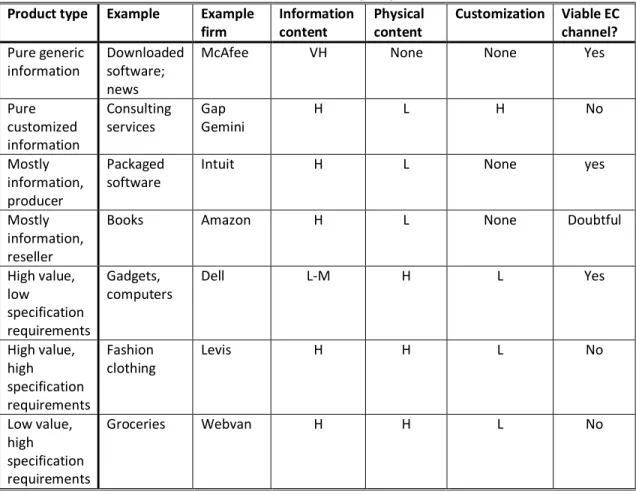
Commodities vary in terms of the possibility and viability of being traded in e-commerce world. Peffers (2001) examines the likelihood for seven types of products for being successfully sold online. The author categorizes the products and services into seven types based on several criteria. The first category is pure generic information (e.g. downloaded software, news, and music etc). The characteristics of this type of product make it suitable to be successfully distributed online which are no physical content, require only automated customization, and precisely specified. The second category is pure customized information (e.g. consulting services, university teaching, and investigation etc). This type of product requires extensive
customization by human, and requires offline delivery. The third category is mostly information product, producer sales (e.g. packaged software) which is mostly information with some physical components. The fourth type is mostly information product, reseller sales (e.g. Amazon.com). From consumer’s perspective, books and similar products are mostly information products, but from online retailer’s perspective, they are physical products with some information components. The next category is high value products with low specification requirements (e.g. electronic gadgets, computers, and industrial parts etc). For this type of product, customization is not necessary, and it can be easily specified. The characteristics of this type make it suitable to be sold on e-commerce channel. The next category is
high value products with high specification requirements (e.g. fashion clothing, and real estate). This category requires high information, especially requirements for information that is difficult to specify. The last category is low value products with high information requirements (e.g. Groceries, and fresh meat etc). This type is characterized by high levels of information and physical content, as well as the difficulty of specifying the product. Table 2 summarizes these categories with Peffers (2001) findings about the viability of being sold successfully in e-commerce channel.
However, recent studies and figures contradict Peffers’s findings regarding the classification of products that can be sold online. According to State of Retailing Online (2006) report, the largest categories of products sold online in 2006 are computer hardware and software ($16.8 billion), autos and auto parts ($15.9 billion), and apparel, accessories, and footwear (13.8 billion), and cosmetics and fragrances. Another study by Maravilla (2011) indicates that the most popular online purchases are computer and related products (40%), books (20%), travel (16%), clothing (10%), recorded music (6%), subscriptions (6%), gifts (5%), and investments (4%). However, these figures are relative different to what Nielson (2010 cited in AlGamdi, et al., 2011) reported about the top ten product and services that are sold online which includes books; clothing, accessories, and shoes; airline ticket and reservations; electronic equipment; tour and hotel reservations; cosmetics and
nutrition suppliers; event tickets; computer hardware; videos, DVD, and games; and groceries.
Table 2-2, Products and services in E-commerce Source: Peffers (2001)
Product type Example Example firm Information content Physical content Customization Viable EC channel? Pure generic information Downloaded software; news
McAfee VH None None Yes
Pure customized information Consulting services Gap Gemini H L H No Mostly information, producer Packaged software
Intuit H L None yes
Mostly information, reseller
Books Amazon H L None Doubtful
High value, low specification requirements Gadgets, computers Dell L-M H L Yes High value, high specification requirements Fashion clothing Levis H H L No Low value, high specification requirements Groceries Webvan H H L No
2.4. Benefits of E-commerce
The adoption of EC has opened new sources of products as well as giving customers greater choices regarding comparing efficiencies achieved by business (Simon, 2004). The adoption of EC would dramatically change shopping tradition from physical markets to virtual markets. In other words, EC would change businesses from marketplace to marketspace. The global market “Internet” can provide great benefits for both businesses and individuals by accessing the market remotely. Businesses can find new method of offering their products and services locally and globally because the Internet facilitates the cross-border transactions and
information flows (Quelch & Klein, 1996). In addition, the Internet offers customers new interactive capabilities, and customized information which might lead to attracting new customers (Awoyelu, Tangba, & Awoyelu, 2010). Utilizing of e-commerce, for instance, could be useful in providing an access to a wide range of markets nationally and internationally; updating information remotely; and lowering the transaction costs (Baron, Shaw, & Bailey, 2000; Brunn, Jensen, & Skovgaard, 2002; Essig, & Arnold, 2001; Fariselli, et al., 1999; Senn, 2004; Tumolo, 2001; cited in
Vaithianathan, 2010). In addition to the remote shopping, customers may be able to
access a variety of markets nationally and internationally which will facilitate customers’ purchase decisions with regard to the quality and cost of the products (or efficiency and effectiveness of the products).
Business sector, however, utilizes most of the benefits of EC more than the other players. Businesses can find new methods of selling and offering their services and products abroad using EC. Some of the benefits of EC for businesses include improvement on revenue generation by integrating EC into their value chain activities (Brynjolfsson, &Kahin, 2000), creating potential for partnership with suppliers and vendors (Koch, 2002; Tumolo, 2001), improvement in customer services (Bakos, 1998; Burton, & Mooney, 1998; Tumolo, 2001), and the ability to access the market at any time (Deeter, et al., 2001; Lin, & Hsieh, 2000). Further, EC can help in improving flexibility in administration and partnership (Brunn, et al., 2002), lowering transaction costs (Bakos, 1998; Clemons, et al., 1993; Malone, et al., 1987; Tumolo, 2001), product and service differentiation (Brunn, et al., 2002; Burton, & Mooney, 1998; IOAI, 2005), the ability to enter supply chain for larger organizations (Erbschloe, 1999; Korchak, & Rodman, 2001). In addition, businesses can use EC in order to provide relevant or customized products/services for customers which mean that businesses can attract new customers (Vaithianathan, 2010). Chan (2001) and Schneider (2002) summarized the benefits of e-commerce for small and medium size enterprises (SMEs) as:
E-commerce offers unmatched saving in terms of transaction costs. The reduction of cost in advertising and promoting.
Speed communication between buyer and seller.
Companies can shorten their traditional supply chain, minimize transport obstacles, and reduce delivery cost.
Physical limitations of time and space are removed.
2.5. Information and Communication Technologies (ICT)
and E-Commerce
2.5.1. Internet penetration and EC
Internet penetration, as mentioned earlier, is one of the key players in the adoption of e-commerce. Internet is the dominant method of remote shopping and provides services virtually. In spite of the noticeable importance of Internet penetration in the deployment of e-commerce, diffusion of the Internet is not uniform between developed and developing countries. As a result of the high Internet penetration among their populations, developed countries are able to diffuse e-commerce to their advantages, whereas developing countries are lag behind (Vaithianathan, 2010). Petrazzini and Kibati (1999) noted that “a closer look reveals great disparities between high- and low-income regions in terms of both Internet hosts and uses. More than 97% of all Internet hosts are in developed countries that are home to only 16% of the world’s population” (p. 31).
2.6. E-commerce requirements
2.6.1. Government E-Readiness
The first and most important player in e-commerce adoption is the government of a country. It plays a major role in affecting the implementation of e-commerce, especially in developing countries (Ang, Tahar, & Murat, 2003; King, Gurbaxani, Kraemer, McFarlan, Raman, & Yap, 1994; Montealegre, 1999, cited in Molla, & Licker, 2005). A government can encourage the private sector to adopt e-commerce by facilitating supportive infrastructure, legal and regulatory framework, and commerce use directive. The importance of government participating in e-commerce has been discussed by several authors. Molla and Licker, (2005) have tested the effect of government pressure on e-commerce adoption, and they have found a high percentage of adoption among firms that have perceived high government pressure. The role of governments, thus, is critically important in facilitating and enhancing the implementation of e-commerce by firms as well as other players such as citizens and organizations.
2.6.2. Market Forces E-Readiness
Market forces e-readiness refers to the adoption and use of e-commerce by a firm’s competitors, customers, suppliers, and other partners (Molla, & Licker, 2005). That is, firms adopt e-commerce in response to the pressure that is found in the social system of the organization. For example, the role of a business’s market forces (suppliers, clients, and other partners) is seen as one of the crucial drivers for the adoption and utilization of commerce. However, the role of the market forces e-readiness varies from one country to another, especially between developed and developing countries (Molla, & Licker, 2005).
2.6.3. Supporting Industries E-Readiness
Besides government and market forces readiness, the implementation of e-commerce depends of a number of supporting industries. The development of these industries also may facilitate the adoption of e-commerce in terms of offering available efficient, rapid, and sometimes special access to e-commerce inputs (Molla, & Licker, 2005). Supporting industries in e-commerce adoption may refer to most aspects of an economy. However, there are three such industries that are critical in e-commerce implementation, especially in developing countries. These include the availability and affordability of services from the IT industry, the institutionalization and development of the financial sector, and the penetration and reliability of carrier and transportation services.These three industries are relatively weak in developing world in comparison to their counterpart in developed world. Molla and Licker, (2005) found that in most developing nations, the IT industry is not adequately developed in order to play the push roles, the financial sector is not mature enough to complete the electronic transaction, and transportation and carrier facilities are insufficiently developed.
2.7. Digital divide
In contrast to the developed world, the Internet adoption and gains in efficiency and productivity from the Internet have not been achieved yet in the developing countries. This gap between the developed and developing countries has led to the introduction of the term “Digital Divide” which refers to the disparity in Internet access and technology between developed and developing countries or the gap between Internet/technology “haves” and “have-nots” (Simon, 2004). The “digital divide” is widely used in order to describe the Internet/technology inequalities between developed and developing countries. According to OECD (2001) “The term “digital divide” refers to the gap between individuals, households, businesses and geographic areas at different socio-economic levels with regard both to their opportunities to access information and communication technologies (ICT) and to
their use of the Internet for a wide variety of activities” (p. 5). Digital Divide is a serious matter for those who are currently behind in Internet access. Also, they are not able to enjoy many benefits of using the Internet in terms of participating in society’s economic, political, and social life.
2.8. E-Commerce in developing countries
2.8.1. Advantages of electronic commerce in developing countries
The adoption of e-commerce has brought great potential for the developing (or less developed) countries. Similar to the early adopters of e-commerce in the developed world, all players in developing regions (governments, business, and individuals) may gain benefits from the diffusion of EC. For instance, individuals can access a wide range of markets nationally and internationally; update information remotely; and lower the transaction costs (Baron, Shaw, & Bailey, 2000; Brunn, Jensen, &Skovgaard, 2002; Essig, & Arnold, 2001; Fariselli, et al., 1999; Senn, 2004; Tumolo, 2001). Additionally, the adoption of EC has opened new sources of products as well as giving customers greater choices regarding comparing efficiencies achieved by business (Simon, 2004). Business sector, however, utilizes most of the benefits of EC more than the other players. Businesses can find new methods of selling and offering their services and products abroad using EC, and the Internet, as a main way of facilitating cross-border transactions and information flows (Quelch & Klein, 1996).2.8.2. Limitations of EC in developing countries
Adopting e-commerce in any region of the world can suffer from certain shortcomings and difficulties. Despite the fact that the developing world was not the first adopters of e-commerce, they still struggle to implement complete e-commerce from the developed countries. Most of the developed countries have faced a great
number of challenges in the adoption of e-commerce and have overcome a large number of these difficulties. Developing countries, however, still face significant barriers that impede the adoption of e-commerce. These barriers include technical challenges, societal challenges, legal and standards challenges, and financial challenges.
Due to the fact that most of the previous studies were concentrating on the adoption of e-commerce in developed countries, there are few studies that examine e-commerce in the developing world. These studies about the developing countries either focus on several developing countries (Petrazzini, & Kibati, 1999; Plant, 1999; Travica, & Olson, 1998; Shareef, Kumar, & Kumar, 2008; Papazafeiropoulou, 2004; Simon, 2004), concentrate on one developing country and evaluate its e-commerce (Peha, 1999; Clark, 1999; Lee, 1999; Kamel, & Hussein, 2002; Park, 2008; Ahmed, Zairi, &Alwabel, 2006), or compare e-commerce adoption between two or more countries from the developing and developed countries (Slyke, Belanger, & Sridhar, 2005; Hawk, 2004). In the following paragraphs, the limitations and barriers of e-commerce adoption are discussed that are found in the related literature.
2.8.2.1. Technical challenges
Companies that attempt to use the Internet to market in the developing countries may face crucial challenges more than their counterparts in the developed world. Due to the link between e-commerce and other technological innovations, the deployment of e-commerce relies on the implementation of these innovations beforehand. These players include Internet, Information and Communication Technologies (ICT), and telephone lines.
The importance of Internet, as one of the main channels for conducting e-commerce, is discussed in most of the previous studies. Lack of Internet accessibility is one of the main threats that face the deployment of e-commerce (Petrazzini, &Kibati, 1999; Travica, 2002; Davis, 1999; Hawk, 2004). Petrazzini and Kibati (1999)
examined the Internet in developing countries and found that there is limited internet accessibility especially in rural areas. The penetration of the Internet is at its early stage in most of the developing countries. This limitation can be attributed to the lack of telecommunication infrastructure (Hawk, 2004; Kamel, & Hussein, 2002).
In addition to the Internet deployment in developing countries, there are further technical challenges include a lack of competition in international telephone tariff, Internet and bandwidth costs, the lack of technical support, longer server response time in websites, lack of timely and reliable systems for the delivery of physical goods (Travica, 2002; Kamel, & Hussein, 2002; Hawk, 2004; Ahmed, Zairi, &Alwabel, 2006).
2.8.2.2. Societal challenges
The societal challenges relate to all factors that affect consumers’ attitudes, willingness, and decisions. The societal challenges are linked to many players such as the national culture, level of education, and political pressure. Some of the societal challenges include a lack of trust in merchants/products, a lack of awareness, a lack of training, resistance to change, language barriers, a lack of tradition of remote shopping/selling, and the reliance on face-to-face contact principle (Travica, 2002; Kamel, & Hussein, 2002; Ahmed, Zairi, &Alwabel, 2006; Shareef, et al., 2008).
2.8.2.3. Legal and standards challenges
E-commerce requires legal norms and standards such as covering contact enforcement, consumer protection, privacy protection, and intellectual property rights. In order to implement secure and trusted e-commerce environment, governments and businesses need to establish protection laws. Most of the previous studies indicate that a large number of the developing countries suffer from the lack of customers’ protection laws (Shareef, et al., 2008; Travica, 2002; Simon, 2004; Kamel, & Hussein, 2002). Also, there is a lack of certificate authority that can offer legal advice, provide safety certification against the negative implications and
dangers of e-commerce, help raising public awareness in terms of the uses and benefits of e-commerce, and support building a trust in this new technology (Kamel, & Hussein, 2002).
2.8.2.4. Financial challenges
Financially, developing countries suffer from the lack of e-payment systems, non-existence of credit card community, low income, and issues of customs and taxation (Kamel, & Hussein, 2002; Travica, 2002; Ahmed, Zairi, & Alwabel, 2006; Hawk, 2004). In order to complete any transaction in e-commerce, the payment has to be carried out in one of the electronic methods (e.g. online banking, credit card, debit card, or electronic voucher from third party). These payment methods have not been fully implemented in most of the developing world. A vast number of the previous studies mentioned that the use of credit card is not common in the developing countries. Another crucial financial issue, that faces the adoption of e-commerce, is the low income of the citizens. This limitation affects citizens’ ability to afford the Internet access cost, and more seriously this limitation may affect their ability to have computer to access the Internet.
2.9. Model of diffusion of e-commerce
The adoption of e-commerce, as mentioned above, faces significant numbers of challenges starting from technical challenges, to societal challenges, to legal and standards challenges, and to financial challenges. Technically, the lack of Internet penetration and Internet use is one of the main challenges (Petrazzini, &Kibati, 1999; Travica, 2002; Davis, 1999; Hawk, 2004; Kamel, & Hussein, 2002). Societal or cultural challenges include a lack of trust in merchants/products, a lack of awareness, a lack of training, resistance to change, language barriers, a lack of tradition of remote shopping/selling, and the reliance on face-to-face contact principle (Travica, 2002; Kamel, & Hussein, 2002; Ahmed, Zairi, &Alwabel, 2006; Shareef, et al., 2008). Legal and standards challenges flow around the need to
implement secure and trusted e-commerce environment as well as establishing protection laws. Most of the previous studies indicate that a large number of the developing countries suffer from the lack of customers’ protection laws (Shareef, et al., 2008; Travica, 2002; Simon, 2004; Kamel, & Hussein, 2002). Financially, developing countries suffer from the lack of e-payment systems, non-existence of credit card community, low income, and issues of customs and taxation (Kamel, & Hussein, 2002; Travica, 2002; Ahmed, Zairi, &Alwabel, 2006; Hawk, 2004). Hence, in order to fully adopt e-commerce, developing countries need to overcome all these impediments. Moreover, the immediate need is to start addressing and solving the basic of these challenges which is the structural conditions and the infrastructure of e-commerce.
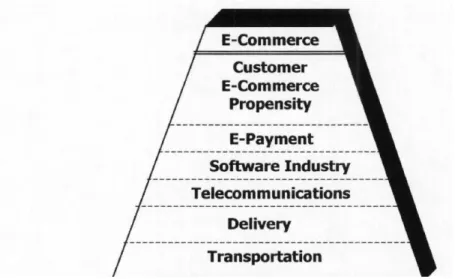
As a result of not being early adopters of e-commerce, developing countries have the advantages of avoiding others’ mistakes in the process of adopting e-commerce. In order to draw a roadmap for implementing e-commerce, the e-commerce diffusion model was generated by Travica (2005) who built this model based on the generic trade cycle (Whiteley, 1999). The model of e-commerce diffusion (presented below) reflects conditions for developing e-commerce based on early e-commerce adopters such as the United States and west European countries (Travica, 2005). This model consists of six layers that are developed in accordance with economic, technological, and cultural conditions or aspects. These layers include, in sequence from the bottom to the top, transportation which refers to road, air, and railroads that need to be frequent transportation with less regular and temporal patterns. The second layer is the delivery infrastructure which builds on the first layers and needs to be reliable, efficient, and supportive of e-commerce changes such as expanding to global marketplace, reaching remote customers, and supporting significant fluctuation on geographical delivery patterns. The next layer is the
telecommunication layer which discusses the need for pervasive, modern, secure, and affordable telecommunication channels that are the key to e-commerce. The next layer, software industry, refers to the capability of supporting standard
e-commerce application (e.g. e-payment) in terms of facilitating the implantation and maintenance of these applications. The next layer, e-payment, reflects the need of work and willingness from the three players (buyer, seller, and financial institution). Buyer needs to be willing to adopt remote payment; on the other hand, creditor organizations need to support the consumers’ trust in the safety of the remote transaction. The last layer, cultural layer, relates to consumers’ acceptance and attitude toward e-commerce which is affected by the tradition of remote shopping and the culture of trust in products and merchants. The reason for choosing the model of diffusion of e-commerce is discussed next as well as the specific layer to be investigated in this study.
Figure 2-2, E-commerce diffusion model. Source: Travica, 2005
As mentioned earlier, the model of e-commerce diffusion reflects the conditions for developing e-commerce in countries that were early entrants. Thus, this model provides the key elements for adopting e-commerce, especially for developing countries. Moreover, this model gives practitioners and academics the capability to evaluate and investigate the process of adopting e-commerce from different aspects or layers of the model.
2.10. Requirements for a successful delivery system
In the world of e-commerce, order fulfillment refers to all activities needed to provide customers with their ordered goods and services, including all related customer services (Turban, et al., 2008). Order fulfillment includes not only the delivery of customers’ orders, but also offering of all related services (for example, assembly and operation instructions, an arrangement of exchange or return of products etc). It is clear that the order fulfillment includes delivery of goods and services. According to Turban et al. (2008) “the key aspects of order fulfillment are delivery of materials or services at the right time, to the right place, and at the right cost” (p. 591). From this statement it is understood that there are three factors affecting any delivery process which are the right time (punctuality), the right place (accuracy), and the right cost (efficiency). Furthermore, Numberger and Rennhak (2005) mentioned different distribution service aspects, such as delivery speed, time, flexibility and reliability as important for broader long-term adoption of email orders for physical goods.
2.10.1. Time factor
For both players in online shopping (customer and retailer) delivering orders at the right time is seen as an essential factor in order to complete an online purchase. From consumers’ perspective, the advantage of purchasing online is receiving an ordered product faster and more easily more than shopping in traditional stores. Consumers choose to purchase online because they want to save time and receive their order within an allocated time. The importance of on-time delivery has been mentioned by Yankelovich (2000; cited in Esper, et al., 2003 in 40), shows that 89 percent of online shoppers prioritize to on-time delivery and that consumers see accurate order and delivery information as an essential part of customer service (Baig, et al., 2011). Failing to do so, consumers may not see any advantages of purchasing online. Retailers are also concerned about delivering the ordered goods to their customers at the right time. In order to compete with other retailers, an
online retailer needs to have a punctual delivery system that provides the ordered goods faster or at least at the same time as other competitors do. In most cases, online retailers choose to deal with a delivery provider or a third party that will deliver the products to customers. The third party might be from the private or governmental sectors. In such cases, retailers and consumers need to consider the time factor involved in dealing with any delivery provider.
2.10.2. Place factor “accuracy”
Delivering ordered goods to the right place (place factor) has two dimensions: 1) products need to be delivered to the right person, and 2) the delivery service needs to cover a range location nationally and internationally. The place factor affects the choice of the delivery options as well as the choice of the delivery provider. When a consumer purchases a product online, he or she needs their goods to be delivered to their place or at least to be delivered to the nearest branch so as to pick them up. Consumers require a delivery system that reaches them regardless of their geographical disparity. In addition, retailers want to be able to deliver consumers’ orders at any place locally and globally. Completing a purchase through an e-commerce website requires at least one delivery option that can reach customers at any place. Because of this, most of e-commerce websites offer one or more delivery options to give their customers the chance to choose the most suitable delivery option.
2.10.3. Cost factor “efficiency”
The cost of delivery refers to the amount of money added to the overall cost of a product in order to deliver a product to a consumer. This cost is added because consumers will not collect the product from its retailer, instead their orders will be delivered to them by one of the available delivery options. Generally, home delivery seems simple but difficulties arise when challenges of controlling costs (Baig, et al., 2011). For both players (consumers and retailers), the cost of delivery may affect the
process of online purchasing. In order to achieve consumer satisfaction, consumers need their orders to be delivered to them with the lowest delivery fee added to the cost of product (Baig, et al., 2011). Otherwise, consumers may choose not to complete the purchase if they feel the cost of delivery is too high to them. On the other hand, e-commerce websites strive to offer the cheapest delivery option for their customers in order to fulfill their desires and keep them shopping in the future.
The purpose of presenting the possible factors that might affect the delivery process is to assist this study in terms of finding which factors influence consumers’ decisions in choosing a delivery method. Considering that delivery systems in developing countries are not as mature as its counterparts in the developed world, these factors might not be solid enough to reach consumers’ expectations. Therefore, it is important to examine consumers’ perspective on choosing a delivery option and how this affects their decisions.
2.11. Delivery systems in developing countries
The need for sufficient and reliable delivery systems is another challenge that faces the adoption of e-commerce. Assuming that the previous challenges of commerce deployment have been solved or overcome: if the Internet service is penetrated in most houses; if all players in e-commerce (consumers, businesses, and governments) are educated and trained to accept online shopping; if the privacy and security concerns are overcome and an environment of trust is built among the community of e-commerce; if the financial issue is solved and the credit card and other payment options are widely used; how can an e-commerce website deliver a single order to a customer? Usually, the issue of delivering an online order comes at the bottom of the list of the crucial issues in e-commerce adoption. Nonetheless, the necessity of possessing at least one method of delivering materials to customers is seen as one of the requirements of the success of the e-commerce sites. The poor delivery systems combined with the lack of credit card penetration are the most
cited problems of the deployment of B2C e-commerce in developing countries (Hawk, 2004).
In order for an e-commerce site to exist, the issue of delivery needs to be solved. An e-commerce site must provide at least one way to get the order to the customer. The western model of B2C exemplified by Amazon.com that has a few delivery options such as Priority Mail, Next Day or Second Day courier (Hawk, 2004). Failing to provide a reliable method of delivering the product leads to failing in the competition of being a successful e-commerce website. Therefore, the possibility of understating the situation of delivery systems in developing countries is achieved by reviewing the delivery method(s) in e-commerce sites in these regions. In the following paragraphs three cases of B2C E-commerce sites are presented with consideration to the delivery procedures and methods that are provided in these sites.
2.11.1. Delivery options in developing countries
As mentioned earlier, the most significant issues that are facing the deployment of e-commerce in developing countries are the poor delivery system and the lack of credit card penetration. In order to assess how sites in developing countries have responded to these challenges, Hawk (2004) investigates B2C e-commerce sites in three developing regions: 1) India, 2) Russia, and 3) Latin America (Brazil, Argentina, and Mexico). He examines the delivery and payment systems in 10 e-commerce sites from each region. Additionally, the author reviews some factors that might affect the diffusion of e-commerce in these regions such as the percentage of computer ownership, the number of Internet users, the number of credit card holders, and the income per capita. In the following paragraphs, a brief summary of each region is presented with the similarities and differences between these regions. Due to the focus of this study, which is on the delivery challenges, the discussion about credit card and payment difficulties has been excluded from summaries below.
2.11.1.1 Russian Case
In comparison with other developing countries (in central or Eastern Europe) Russia has some advances when it comes to e-commerce. Russia has higher Internet density than other countries in the region (Dembeck, 2000). Its population is highly educated with more emphasis on science more than technology and software professionals (Robb, 2000; Schweitzer, 2000). Similar to other developing countries, however, Internet usage in Russia is relatively low (Hawk, 2004). According to Krel (2000) 9.2 million Russians have used the Internet at least once in their life. Moreover, 1.8 million Russian were classified as regular internet users (at least one hour of access per week). With regard to e-commerce, Russian e-commerce revenue is fairly small; nevertheless, it is estimated to grow to 5.15 billion (Helque, 2000).
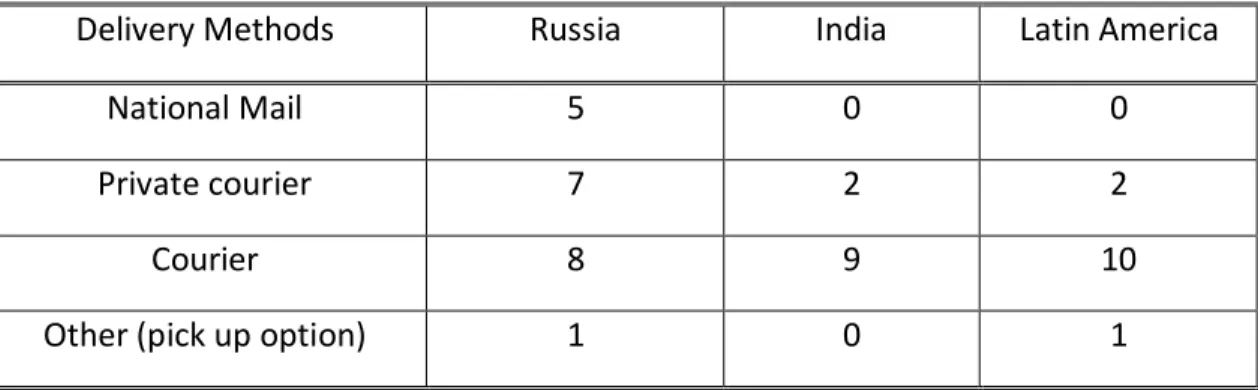
Hawk (2004) finds that only Russian e-commerce sites use the country’s mail system compared with other countries in the study. Half of the websites in Russian use the Russian’s Federal Postal System. Also, Russia has a higher use of private delivery than other countries where 7 out of the 10 sites operate their own delivery service. The majority of the private delivery option is offered only within Moscow region. Most of the Russian sites use courier services that provide deliveries between two and ten days. An Express courier, that offers a fast delivery to most of the cities within two to three days, is provided by a few Russian sites as a second option. In addition, Russian sites offer a pick-up option for consumers from the nearest office as an option to reduce the delivery cost. Overall, in comparison with other developing countries in the study, Russian sites offer a reasonable number of delivery options ranging from one to four options.
2.11.1.2 Indian Case
Among the three countries in Hawk’s study, India seems in the least favorable position for the growth of e-commerce. According to Hawk (2004) India was home to only 5 million Internet users, which is about 0.5 percent of the population. With
regard to computer ownership, India has the lowest per capita computer ownership at less than 0.5 computers per 100 people (Cheung, 2001). However, one area that makes India a favorable environment of e-commerce is its strong software development industry. Last decade, India saw a rise in the offshore software development industry. India has the largest offshore development industry of any country with annual revenue of approximately $10 billion (Carmel, 1999).
In contrast to Russia, the most common method of delivery in Indian sites is the courier service. Nine out of ten sites use a courier service to deliver their orders. The delivery via the postal system is uncommon among the Indian sites. In fact, none of the ten sites use the mail service to deliver their products. The private delivery is seen in two of these sites which can reach most of Indian regions. In comparison with the other two regions, the delivery system is relatively weak, with only one or two delivery options available in most Indian e-commerce sites.
2.11.1.3. Latin American case
In his study, Hawk (2004) chose the most developed countries from the Latin American region: Brazil, Mexico, and Argentina. The reason for this choice was due to their high incomes per capita among other countries in Latin America. Moreover, these countries represent the largest populations of active Internet users where they account for more than sixty five percent of the region’s active Internet users (Cohen, 2001). In addition, these three countries generated ninety three percent of the region’s estimated $9.63 billion annual e-commerce revenue (Hawk, 2004). Instead of considering each of these countries separately, the author chose to review these countries as a unit because they have much in common. The economic and business environments of the three countries are relatively similar with regard to the factors that affect e-commerce. In comparison with Russia and India, the three Latin American countries seem more developed of the developing countries with higher per capita income and better telecommunications infrastructure (McConnell, 2000).