UNIVERSITY OF TARTU
Institute of Computer Science
Software Engineering Curriculum
Sven Mitt
Blockchain Application - Case Study on
Hy-perledger Fabric
Master’s Thesis (30 ECTS)
Supervisor(s): Luciano García-Bañuelos
Fredrik Milani
2
Blockchain Application - Case Study on Hyperledger Fabric
Abstract:
To enable software platform to be used without a third trusted party, one of the possibilities is to use blockchain and smart contracts. One of the latest platform is open-source Hy-perledger Fabric, a modular system that uses conventional programming languages for smart contracts. This opens up vast possibilities for using it product centric enterprise systems. In this paper we compare the platform to a conventional solution and study the challenges provided by the smart contract called chaincode. We implement a parking spot application for multisided market using smart contract and Go programming language. In the end we have a working prototype with solutions to technical problems, covering predetermined use cases.
Keywords:
Distributed Ledger Technology, Smart contract, Blockchain Technology, Hyperledger Fab-ric, chaincode, timestamps in distributed system, blockchain GIS support
CERCS: P170
Plokiahela rakendus – Hyperledger Fabric uuring
Lühikokkuvõte:
Usalduse keskkonna saamiseks kasutatakse kolmandaid osapooli ja nende tarkvara plat-vorme. Plokiahela tehnoloogia ja nutikaid lepingud on üks võimalus kuidas välistada kol-mas osapool. Üks viikol-mased turule tulnud vabatarkvara platvorme on Hyperledger Fabric, modulaarne süsteem, mis kasutab üldkasutavaid programmeerimskeeli nuitikate lepingute keelena. See avardab platvormi kasutamist ettevõtte tarkvara loomisel. Võrdleme platvormi tavapäraste lahendustega ning uurime väljakutseid, mida pakub uus plokiahela põhine süs-teem ja selle jaoks loodud nutika leping nimega chaincode. Selle töö käigus realiseeriti par-kimiseks mõeldud rakendus, mille nutikas leping on kirjutatud Go programmeerimiskeeles. Töö käigus realiseerisime prototüübi, leidsime lahendused tehnilistele probleemidele, reali-seerisime kasutusjuhud.
Võtmesõnad:
Distributed Ledger Technology, Smart contract, Blockchain Technology, Hyperledger Fab-ric, chaincode, timestamps in distributed system, blockchain GIS support
3
Table of Contents
1 Introduction ... 6 1.1 Motivation ... 6 1.2 Scope ... 6 1.3 Research problem ... 6 1.4 Summary of contribution ... 7 2 Background ... 8 2.1 Blockchain ... 8 2.2 Smart contract ... 9 2.3 Hyperledger fabric ... 9 2.3.1 Nodes ... 10 2.3.2 Chaincode ... 11 2.3.3 Processing of transactions ... 112.4 Blockchain for business ... 13
2.4.1 Technology for two- vs multi-sided markets ... 13
2.4.2 Criteria for a platform to be blockchain enabled ... 13
3 Use case ... 14
3.1 Currently available parking spot applications ... 14
3.1.1 Current business models in use ... 14
3.2 Business process model for parking spot application ... 15
3.2.1 Adding and removing parking spot from listing ... 15
3.2.2 Reserving a parking spot ... 16
3.2.3 Using parking spot: paying in advance ... 17
3.2.4 Using parking spot: paying after parking ended ... 18
3.3 Hyperledger Fabric prototype ... 19
3.3.1 Software architecture and implementation ... 19
3.3.2 Smart contract for parking spot ... 20
3.4 Executing nondeterministic functions ... 22
3.4.1 Trusting client time stamp within tolerance ... 22
3.4.2 Cryptographically signed timestamp ... 23
3.4.3 Keeping current timestamp in a another blockchain ... 23
3.5 Time persistence and querying ... 24
3.5.1.1 Timestamps ... 24
3.5.2 Queries ... 25
4
4 Evaluation ... 28
4.1 Evaluation framework ... 28
4.1.1 Atomicity, consistency, isolation and durability ... 28
4.1.1.1 Transaction validation ... 28
4.1.2 Scalability ... 28
4.1.3 Consistency, availability and partition tolerance ... 29
4.1.4 Security ... 29
4.1.5 Migration ... 29
4.1.5.1 Continuous integration and delivery ... 29
4.1.6 Development support ... 29
4.2 Comparison of conventional and Hyperledger Fabric ... 30
4.2.1 Atomicity, consistency, isolation and durability ... 30
4.2.1.1 Transaction validation ... 31
4.2.2 Scalability ... 32
4.2.3 Consistency, availability and partition tolerance ... 33
4.2.4 Security ... 34
4.2.5 Migration ... 35
4.2.5.1 Continuous integration and delivery ... 37
4.2.6 Development support ... 37
5 Evaluation of results ... 39
5.1 Executing nondeterministic functions ... 39
5.2 Atomicity, consistency, isolation and durability ... 39
5.2.1 Transaction validation ... 39
5.3 Scalability ... 40
5.3.1 Consistency, availability and partition tolerance ... 40
5.4 Security ... 40
5.5 Migration ... 41
5.5.1 Continuous integration and deployment ... 43
5.5.2 Development support ... 43 6 Conclusions ... 44 7 References ... 45 Appendix ... 46 I. Glossary ... 46 II. License ... 47
6
1
Introduction
1.1 Motivation
When creating an application that involves two or more parties exchanging monetary values, a third trusted party is used. The third trusted party will make sure that all transaction are rejected or accepted and finalized, leaving the system in consistent state. To enable platform to be used without a third trusted party, one of the possibilities is to use blockchain and smart contracts.
There are many blockchain enabled platforms that allow using smart contracts, Bitcoin, Ethereum, Hyperledger Fabric etc., but they are not equal.
Bitcoin smart contract use stack based language, which is not Turing complete, and supports only transactions for monetary value Bitcoin.
Ethereum has its own Turing complete language called Solidity. It is a new language de-signed especially for using in Ethereum and it is Turing complete [1]. It has support for loading code from another address and this enables creation of libraries, pieces of reusable software code.
These technologies have limited uses in Enterprise software, the first one is too limited and the other one has not had time to be mature and requires porting libraries from other systems to be used with Solidity.
This is where Hyperledger Fabric and its smart contract called chaincode shines. It is built from known and already proven Enterprise software pieces. Chaincode supports usage of Java, Go or Node.js as programming language for developing smart contracts. That also allows to use a vast amount already existing libraries created during the lifetime of the pro-gramming language. It also support complex queries that we are used to having in SQL and NoSQL databases. This is first blockchain based system that supports using conventional programming languages for building smart contracts [2] and only one enable complex data queries. This mechanism gives the edge to Hyperledger Fabric and opens up possibilities of using the smart contracts in systems like enterprise systems.
To compare the platform with a traditional soultion, we create a parking spot application prototype presenting an enterprise software and find solutions to problems that the new ar-chitecture calls for, evaluate if it is suitability for this software, and compare Hyperledger Fabric to conventional solution.
1.2 Scope
Scope of this thesis is to research blockchain suitability for parking spot type application and implement it using predetermined use cases. A network of nodes running Hyperledger Fabric is created and parking spot application is deployed into the network as a smart con-tract. This setup is used to study the new technology and compare it to conventional solu-tions.
1.3 Research problem
7
1. What are the key similarities and differences between Hyperledger Fabric service paradigm and traditional database paradigm?
2. What are the benefits and disadvantages of Hyperledger Fabric compared to tradi-tional database systems?
1.4 Summary of contribution
By the end of this thesis, we have implemented selected use cases for parking application and shown that it is possible to provide a viable system using Hyperledger Fabric as a block-chain platform. We have provided alternative solutions for nondeterministic functions in smart contract, time range queries and implemented GIS support. Built upon the experience of using the platform for creating parking application, we do a comparison between conven-tional systems and Hyperledger Fabric.
The thesis is structured as follows. Section 2 presents background about blockchain, smart contract and Hyperledger Fabric Section 3 describes the domain problem statement and im-plementation of the parking spot software. Section 4 contains the description comparison framework, details about conventional and Hyperledger Fabric platforms using the compar-ison framework Section 5 presents the evaluation of results Section 6 summarizes the paper and outlines future work to be done
8
2
Background
Distributed ledger (also called distributed ledger technology – DLT) is an digital ledger that is shared across multiple locations and all participating parties can verify the authenticity of the data. There is no central data store or 3rd trusted party. Ledgers use mathematical con-sensus algorithms to make sure that all or most participants have the same data. One of the technologies that enables this is called blockchain. In the context of this thesis, blockchain and distributed ledger, is used interchangeably.
2.1 Blockchain
The first business endeavor that used a blockchain-based ledger was presented in the white-paper published in 2008 by Satoshi Nakamoto describing a system for electronic cash [3]. This was the start of Bitcoin.
Blockchain is a decentralized ledger that is shared by all network participants. Because of its nature, modifying an existing ledger is not possible, because it is mathematically impos-sible. This is achieved by using cryptographic algorithms.
Blockchain data structure is list of data blocks that are timestamped, immutable and in
strict order. Immutability is implemented by using a hash, a digital fingerprint of data. Every block has reference to previous blocks hash and this gives a strict order to blockchain. Following hashes from current block ends with block 0 – called genesis block. It is the first created block on specific blockchain. Blocks contain list of transactions. This type of data structure enables provenance, there is single place of origin for any transaction.
Blockchain are divided as public and private ledgers [4]. Public ledger are accessible and by anybody and everybody can add blocks to them. Private ledgers only include a selected group of people. To make a blockchain viable, a single chain is needed and this is achieved by consensus – all or most participants agree what is the next block in the chain and thus what is state of the whole blockchain. Public ledger consensus algorithms are Proof-of-Work and Proof-of-Stake.
Proof-of-Work make a use of computer CPU raw power. Whoever solves the mathemati-cally difficult calculation for creating new block, will add the new block to chain and publish it to all other members. Algorithm is built so it is easy to verify that calculations are correct and others accept the new block. This consensus algorithm means that the longest chain will contain the highest amount of work. of-Stake tries to mitigate the high price of Proof-of-Work algorithm. The algorithm decides who will be the next one who creates a new block and must contain some randomness.
Private ledgers are permissioned and have much simpler consensus algorithms since the participants number is very limited and participants authenticated and authorized.
The General Data Protection Regulation (GDPR) will become enforceable in Europe by 25 May 2018. This has paradoxical effect on blockchain. It enables the right to be forgotten, but blockchain is immutable by its nature and data cannot be deleted.
Definitions used in blockchain context:
Asset – any type of capital or durable goods, anything with monetary value.
Transaction – move value from inputs to output. Input can be previous transaction
9
Blocks –multiple transactions are batched into blocks and those make up the
block-chain. New block is written when a consensus program is executed successfully.
Consensus – agreement of majority of participants in network.
2.2 Smart contract
A smart contract [5] adds functionality to blockchain as it is a computer program that can execute transactions, access blockchain blocks and the history. This functionality was added to second generation of blockchain.
It is a computer program that is stored in distributed database. Smart contract allows the addition of constraints, validation and business logic to transactions. They could be consid-ered similar to database triggers. Quite a powerful tool for interacting with the blockchain, particularly if the smart contract implementation is Turing complete.
This program is executed on all nodes that are participating in the transactions. That means the contract itself has to be committed to the blockchain and all parties must accept it. This is also true if there is a need to change the currently existing contract. If the majority will not find consensus, then the contract cannot be updated.
Smart contract is not just a computer program, it is an agreement between parties. It contains parts for entering the contract, executing operations and exiting. Example using parking spot renting contract. Entering into a contract could mean that the parking spot provider signs the contract, stating the parking spot is available at given time and price. Interested renter signs the contract and enters to the agreement with the renter, accepting the time and price. During the execution of an agreement, the renter could exit the contract by payment of final amount or by canceling it. Cancelation could mean that renter has to pay a predetermined fee. These operations are executed on the smart contract and the transactions are written to the blockchain. Auditing the contract is simple by nature of blockchain.
There are pitfalls. Since smart contracts move digital values that also have real monetized value in the real world, a bug in a contract will be costly. Writing even a simple smart con-tract needs economic thinking and can lead to unexpected results [6].
Operations in a smart contract must be deterministic. It is being executed individually on each blockchain node and the result must be same. If the majority of executions fail, the transaction will fail.
Conventional contracts require that certified lawyer or lawyers by both parties come to an agreement of the contents. Reading a smart contract requires the knowledge of the program-ming language, that contract is written in. This provides more complexity.
2.3 Hyperledger fabric
Founded by Linux Foundation in 2015, Hyperledger project builds upon collaborative ap-proach to develop blockchain technologies. Hyperledger Fabric is one of the projects, it is main purpose is to have modular, extensive architecture. This enables consensus and mem-bership services to be plug-and-play. It is open source software licensed under Apache Li-cense, Version 2.0 [7].
Hyperledger Fabric is a platform for building you own blockchain applications. It differs from other known blockchain systems as it is private and permissioned. All participants must enrolled through a trusted Membership Service Provider (MSP), before they can be
10
part of the network. No transaction is allowed without verifying the participant. Since all participants are known, there is no need for proof-of-work or other protocols that are used in Bitcoin or Ethereum. A participant in permissioned network can be allowed invoke smart contract, but not allowed to deploy a new one. To enable private, confidential transactions, a separate channel can be created. Data is only visible to the participants of the channel. Distributed ledger is shared between all nodes. It is composed of two data structures: trans-action log and world state. The transtrans-action log is not replaceable and is built in. After ac-cepting new block with transactions, new world state is agreed and written. World state describes the end state of sequential transactions.
2.3.1 Nodes
The system contains three types of nodes: peers, client and orderers. The client is the node that represents the end-user. It connects to peers and orderers for updating the data. SDK is provided in Java, JavaScript (Node.js) and Go.
Peer manages digital ledger data, transactions and runs smart contract called chaincode. The ledger consists of two components:
transaction log
world state
The transactions change the world state by using chaincode. Also deploying a new chaincode is considered a transaction. The chaincode will be signed and system creates an immutable package of the chaincode. A separate Docker image is created with version tag and it is running as a separate machine. This will ensure that if something happens within the chaincode, the peer will not crash with it. Peers will run the chaincode on a channel, a separate ledger, and one peer can run multiple channels.
Hyperledger Fabric depends on certificates, the same ones used by HTTPS protocol. Every move is signed by certificates, so there are no users in perspective of system. These certifi-cates can be generated in advance, but that would be too static for enterprise applications, so a separate service called Fabric CA is provided to dynamically generate certificates for users. Persistence is provided by MySQL, PostgreSQL or LDAP server.
Orderer is a consensus service that purpose is to quarantine that all transactions in the same order for all participants and it sends them as a block to all peers, which will persist the block to the ledger. There are multiple implementations supported, SOLO a single instance for developing and Apache Kafka, a well-known distributed streaming platform. Apache ZooKeeper, well-known coordination service, is used by Kafka for providing group ser-vices, distributed synchronizing and maintaining configuration information. The work of adding Simplified Byzantine Fault Tolerance is on the way. This is one of the strengths of the system, it is built modular and is possible can change the consensus service as needed. Each peer has a world state database kept in a key-value store LevelDB or document-ori-ented database called Apache CouchDB. Latter enables chaincode to execute complex que-ries on blockchain data.
11
2.3.2 Chaincode
A smart contract in Hyperledger Fabric is called chaincode. It is a program, written in Go, Node.js or Java language. This enables the usage of vast libraries that have been developed during the lifetime of programming language.,
Chaincode runs in an isolated Docker container. This gives the ability to use existing API and make the migration easier. Chaincode purpose is to be the business layer in software development.
Deployment of new chaincode is two-step process. In the first step the code is deployed to all peers file system. Second step is called instantiate for new code and upgrade for upgrad-ing existupgrad-ing chaincode. The second step is for actually deployupgrad-ing the code into production. Deployment of chaincode goes through the same process as transactions and requires that all peers sign the new chaincode. When deploying new chaincode, it is possible to assign policy, of which peers must sign transactions running this chaincode. Chaincode can be deployed via CLI or by using SDK.
To implement permissioned ledgers, platform offers channels. Chaincode is running on the channel – a separate ledger. Same Chaincode can run on different channels, similar how same server software can run on different client environments. It is possible to invoke other chaincode and even chaincode in another channel. Channels can be used to keep private data leaking to other members. When channel is set up between subset of members, the block-chain data is physically available only to the participants nodes. Hyperledger Fabric latest adds a possibility to encrypt part of data using built in functions. Use this built in function-ality enables even querying the encrypted data. The safekeeping of encryption key is trusted to the client.
2.3.3 Processing of transactions
Transaction management is split between peers and orderers. This allows higher parallelism and concurrency for the network. Every transaction is executed in the peer using world state. If the transaction succeeds, it is signed with Peers certificate. Executing transactions prior ordering allows each node to process multiple transaction at the same time. The orderer will not re execute the transaction, just order them and do not maintain ledger. This also enables the peers to trust all orderers and vice versa, so they can run independently. Peers are divided into endorsing peers (peers that contain specific chaincode and are part of the policy) and peers without the chaincode. Peers without the chaincode can still validate and commit the transaction to their ledger after receiving it from the endorsing peer.
12
Figure 1: Hyperledger Fabric Network example [8]
In Figure 1: Hyperledger Fabric Network example Figure 1Error! Reference source not found. is a Hyperledger Fabric setup for two organizations, both using 3 peer groups and one orderer group.
1. Transaction proposal - client creates a transaction proposal using SDK, it sends it to all peers that need to sign it including the ones in another organization. This is set by endorsement policy when deploying smart contract called chaincode. Examples of policies:
a. AND ('Organization1.member', 'Organization2.member') – both organiza-tions are required to accept transaction
b. OR ('Organization1.member', 'Organization2.member') – one is required to accept transaction
c. OR('Organization1.member',
AND('Organization2.member', 'Organization3.member') ) – logical operators can be combined
2. Endorsement response - If all needed peers return successful result called endorse-ment, a result of simulating the transaction (contains read-write set). Endorsement is cryptographically signed by all needed peers using their own copy of world state. 3. Invocation request - Client sends the transaction endorsement to orderer which
ver-ifies that all needed peers have signed the proposal and verver-ifies policies. If all is correct, it creates a block consisting of transactions in order. This is logical order, not to be confused with strict timestamp based order.
4. Verify policy – The order of transactions are synchronized between orderers of both organizations
5. Invocation: Orderer sends transaction block back to Peers which apply the transac-tions from block and write to the ledger and update the state of world.
13
2.4 Blockchain for business
2.4.1 Technology for two- vs multi-sided markets
To understand how blockchain enables to provide better business value, we have to under-stand how it is produced currently [9].
Most business models today depend on two-sided platforms, where a trusted third party is involved for mediating the interaction between end-users. End users do not trust each other, so they need a third party that can be trusted by all. Transactions and resolving data left on the shoulders of the mediator and its platform. The platform must keep records and use architectural patterns to resolve transaction problems. All that involves cost since the third party must develop and maintain a platform for mediating and will charge end users for using it.
Multisided platforms enable end users trust each other since data is decentralized and all parties have a full copy of database. The problem is how to resolve simultaneous changes and how to synchronized data to all parties.
That is the reason why blockchain is multisided platform enabler [4]. It allows to create specific data store that contains immutable blocks and gives order to transactions. Mediator in this case will only monitor the trading and revenue is split according to contract and business rules.
2.4.2 Criteria for a platform to be blockchain enabled
With every technology, there are benefits and limitations. Blockchain based systems are no exception. Before committing to this technology, the current business model and require-ments need to be analyzed for suitability to use blockchain [9].
If any of the next requirements do not apply, then it could mean that there are better alter-natives than blockchain:
1. Durable or capital good – there is no business value for keeping an eternal ledger of non-durable goods
1. Need for trust for untrusted parties and permissions on items 2. Need for completely shared database
3. Need for multiple concurrent modifications 4. Need for single version database
5. Must depend on previous modifications – if it does not, then there is no consensus needed
6. Need to remove intermediation (someone who maintains joint database and enables trust and multiversion concurrency)
7. Technology can stand the transaction needs for system - blockchain can have limits to transaction performance as low as 3-20 transactions per second [4].
8. Data stored in block chain is limited. All data persisted to blockchain will remain there as long as the blockchain exists. Deleting it will not reduce the size of data. There can be other technologies for implementing the solution for parking platform, but this paper concentrates on enabling platform on blockchain, specifically Hyperledger Fabric in-frastructure and using chaincode for smart contracts.
14
3
Use case
The following chapter describes the parking application business models, architecture and implementation. Parking application contains all the major aspects of full solution and rep-resents the traditional application, yet it is simple.
3.1 Currently available parking spot applications
Currently existing parking applications in Estonia are divided into two categories. In first type vehicle owner finds a parking spot and buys a ticket for predetermined time. This is done using separate machine, which accepts cash or card payment and prints out the parking ticket. It is possible to by using app on a smartphone. The cost of using parking app in Estonia is 32 euro cents. That is mediator fee collected by the parking app platform owner. In the second type, you get a ticket before you enter through a barrier gate. Paying for park-ing time is done before leavpark-ing the parkpark-ing lot. The fee for platform owner is included in the parking price. The standard fee is between 10-20%.
Both of those technical solutions is driven by a third party that has built a platform for man-aging the app and hardware and takes a hefty cut when you use their service.
We are interested in searching a cheaper solution. One that has smaller mediator fee and does not include vendor lock-in. That means the platform is shared between the companies that are interested providing parking spots.
What if you are in a hurry and need a parking spot and you do not have time to lose. There is no reservation possibility in current business models nor assigning specific parking spot per vehicle (premium spots could mean more revenue).
To get the cost down, we would like to remove the third party and make the community as the owner of data and software. Blockchain is technology that enables this.
3.1.1 Current business models in use
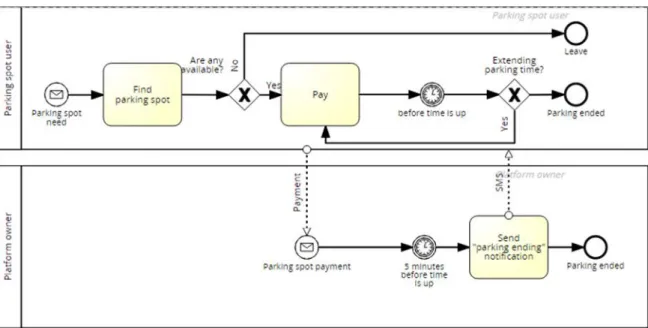
We provide a description of business model of parking model using Business Process Model and Notation (BPMN).
In conventional application, the platform owner takes the responsibility to mediate the trans-action between the parking spot owner and renter.
15
Figure 2: BPMN of conventional parking business model
3.2 Business process model for parking spot application
We provide a description of business model to be implemented using Business Process Model and Notation (BPMN).
We have three actors to business transactions: parking spot provider, parking spot renter and the software system that makes this possible. Parking spot provider can be any person or business who has business interest of creating revenue by renting out one or more parking spots. Parking spot renter is any person or business who has a need for parking spot and is willing to pay for it. Software system is blockchain enabled application that is implemented for this thesis.
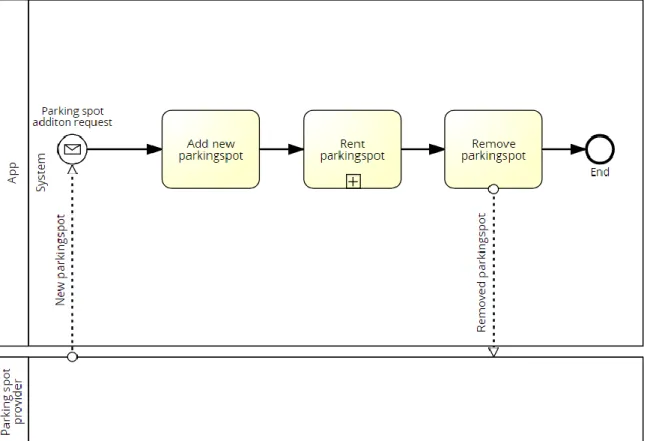
3.2.1 Adding and removing parking spot from listing
Parking spot provider must be able to add the parking spot to list of available parking spots and remove it later. During business process “Rent parking spot”, the provider can assign daily periods when the parking spot is available.
16
Figure 3: BPMN of adding and removing parking from listing
3.2.2 Reserving a parking spot
This is a use case that is not available in conventional parking spot business models. It gives the client the ability to reserve parking spot, for example a period of meeting, so he or she can be sure that upon arrival, the spot is free. The client provides a location and timespan. Multisignature smart contract I used with signatures from parking spot provider indicating it is available and another one from renter.
17
Figure 4: BPMN of parking spot reservation
3.2.3 Using parking spot: paying in advance
In this scenario, a person looking for a parking spot pays the full amount beforehand. The renter will specify the timeslot for using the parking spot. When the time is ending, the renter will receive a message from the system to create a new timeslot (and keep the same parking spot). If no notification is received from the renter, the parking spot will be available for usage after time slice has ended. Multisignature smart contract I used with signatures from parking spot provider indicating it is available and another one from renter.
18
Figure 5: BPMN of paying for parking spot in advance
3.2.4 Using parking spot: paying after parking ended
Not always the renter knows how long he or she will be needing a parking spot. In that case it is more client friendly to pay after user has ended the contract and calculate the cost. This business model needs a predetermined maximum time limit, in case the customer forgets, clock keeps running and the final fee can be very expensive. Multisignature smart contract I used with signatures from parking spot provider indicating it is available and another one from renter.
19
3.3 Hyperledger Fabric prototype
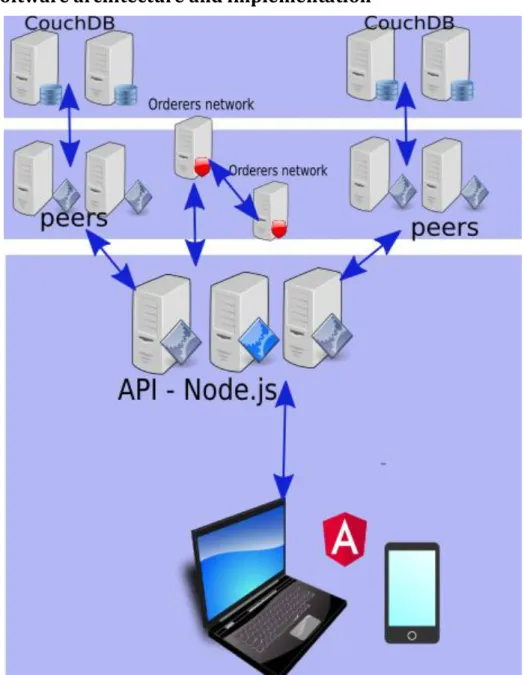
3.3.1 Software architecture and implementation
Figure 7 Hyperledger Fabric parking spot application architecture
Parking spot provider uses computer or smartphone to manage the information about the parking spot. Parking spot renter uses a computer or smartphone to search and pay for the parking spot. Smart contract running in the Hyperledger Fabric provides a contract between the two parties. Blockchain enables to implement these requirements without an third party. Smart contract client side user interface is implemented using AngularJS and the API in Node.js. Package for the smartphone can be built from the same software using mobile app framework called Ionic. This enables the same codebase to be used for desktop and smartphone reducing cost. This is one possibility to implement the parking solution. System is built so that there can be multiple implementations and providers of software for client
20
side, enabling free market competition and lower prices. Since authentication and authori-zation is provided by smart contract, adding new client does not affect business processes are implemented in system.
The central implementation will be a smart contract framework Hyperledger Fabric. It will guarantee that transactions are accepted by all parties, are immutable after transaction has ended and allows access for interested parties, so the business transactions are transparent. Implementation started by defining user stories and use cases. Use cases will be transformed into implementation code. In the end, this thesis the project code and underlying system available using version control system and Docker platform.
The source code is available in a public version control system: https://github.com/sven-zik/hyperledger-fabric-case-study-proto
3.3.2 Smart contract for parking spot
Smart contract is piece of software that runs the transactions, makes sure that the transac-tions is valid and calculates end results. This will make it the most valuable piece of the entire software where bugs may have expensive effect. This application uses multisignature contract with signature from owner of the parking spot and the renter of parking spot. Smart contract must allow:
Parking spot owner, to define
1. a fee per hour, for the parking spot 2. time for parking spot availability 3. a fee for canceling the reservation
Parking spot renter
1. to search a parking spot in given location and time
2. to make sure that parking spot is not double used (somebody has already using it)
3. ability to cancel reservation and make sure only cancelation fee is taken
Example of one smart contract method for ending parking space rental and creating a pay-ment:
func (s *SmartContract) EndParking(APIstub shim.ChaincodeStubInterface, args []string) sc.Response {
if len(args) != 1 {
return shim.Error("Incorrect number of arguments. Expecting 1, id of parkingTime")
}
parkingTimeId := args[0]
fmt.Printf("Ending parking for id: %s\n", parkingTimeId) //1
// parkingTime, err := s.ParkingTimeService.Get(APIstub, parkingTimeId)
//2
// objectKeys := []string{parkingTimeId}
// parkingTimeObject, err := s.ParkingCommonService.GetObject(APIstub, object-Keys, ParkingTime{})
// fmt.Printf("Got parking: %s\n", parkingTimeObject) // parkingTime, _ := parkingTimeObject.(ParkingTime)
//3
objectKeys := []string{parkingTimeId}
compositeKey, _ := s.ParkingCommonService.CreateKey(APIstub, ParkingTime{}, ob-jectKeys)
21
oResultAsBytes, err := APIstub.GetState(compositeKey) parkingTime := ParkingTime{}
err = json.Unmarshal(oResultAsBytes, &parkingTime)
fmt.Printf("Got parking type: %s\n", parkingTime) if err != nil {
return shim.Error(fmt.Sprintf("Failed to find parkingTime(%s): %s", parkingTimeId, err))
}
//TIME CALCULATIONS
calculatedEndTime := CurrentTimestamp{TimeWindow: time.Minute * 5, Errors: []string{}}
ts, _ := APIstub.GetTxTimestamp()
//using current timestamp of server - will not work in multipeer envir // calculatedEndTime = time.Now()
//Using transaction timestamp set by client, unsafe
calculatedEndTime.TransactionTime = time.Unix(ts.Seconds, int64(ts.Nanos)).UTC()
//Using transaction timestamp set by client with chekcing window (lets say 5min) endorsedEndTime := time.Unix(ts.Seconds, int64(ts.Nanos)).UTC()
if math.Abs(time.Now().Sub(endorsedEndTime).Minutes()) < calculatedEndTime.Time-Window.Minutes() {
calculatedEndTime.TimeWindowCurrentTime = time.Unix(ts.Seconds, int64(ts.Nanos)).UTC()
}
// USING Timestamp Protocol
// Time-Stamp request with nonce, to create with OpenSSL:
// $ openssl ts -query -data data.txt -cert -sha256 -out reqnonoce.tsq tspResponse :=
timeServerSignedResponse, err := timestamp.ParseResponse(calculatedEndTime. tspResponse) if err != nil { calculatedEndTime.Errors = append(calculatedEndTime.Errors, fmt.Sprintf("TSP: %s", err)) } else { calculatedEndTime.TimeServerCurrentTime = timeServerSignedResponse.Time }
//from time chaincode
timeChaincodeResponse := APIstub.InvokeChaincode("time-app", To-ChaincodeArgs("GetCurrentTime"), "mychannel")
if timeChaincodeResponse.Status != shim.OK {
errStr := fmt.Sprintf("Failed to query chaincode. Got error: %s", time-ChaincodeResponse.Payload) calculatedEndTime.Errors = append(calculatedEndTime.Errors, fmt.Sprintf("CHAINCODE: %s", errStr)) // return shim.Error(errStr) } else { chaincodeCurrentTime := HyperledgerFabricTimestamp{}
err = json.Unmarshal(timeChaincodeResponse.Payload, &chaincodeCur-rentTime) if err == nil { calculatedEndTime.ChaincodeCurrentTime = chaincodeCur-rentTime.CurrentTime } } parkingTime.CurrentTimestamps = calculatedEndTime //END parkingTime.ParkingEnd = calculatedEndTime.TransactionTime delta := parkingTime.ParkingEnd.Sub(parkingTime.ParkingStart) totalCost := int(delta.Minutes()) * parkingTime.CostPerMinute parkingTime.Cost = totalCost
s.ParkingTimeService.Save(APIstub, parkingTime) fmt.Printf("Saved parking type: %s\n", parkingTime)
owner, err := s.UserService.Get(APIstub, parkingTime.Parkingspot.Owner.Id) if err != nil {
22
return shim.Error(fmt.Sprintf("Failed to change parkingspot owner bal-ance: %s", err))
}
renter, err := s.UserService.Get(APIstub, parkingTime.Renter.Id) if err != nil {
return shim.Error(fmt.Sprintf("Failed to change renter balance: %s", err))
}
owner.Balance.AddCents(totalCost) renter.Balance.SubtractCents(totalCost)
owner, err = s.UserService.Save(APIstub, owner) if err != nil {
return shim.Error(fmt.Sprintf("Failed to add parkingspot owner balance: %s", err))
}
renter, err = s.UserService.Save(APIstub, renter) if err != nil {
return shim.Error(fmt.Sprintf("Failed to reduce renter balance: %s", err))
}
resultAsBytes, _ := json.Marshal(parkingTime) return shim.Success(resultAsBytes)
}
3.4 Executing nondeterministic functions
Smart contracts can only execute deterministic functions since the contract is execute in multiple nodes, the result for the same input state must be always the same output state. Otherwise, the transaction will be rejected. In the example application, current timestamp was needed to record the ending of parking time. Possible solutions were considered:
1. Providing timestamp from the client to all required peers 2. Getting timestamp from smart contract running in peer
First solution would make the system simple and smart contract executing nodes would get the same timestamp. Hyperledger Fabric protocol even provides the client timestamp as default to the smart contract. Unfortunately, the time from client is unreliable and cannot be used without some added trust.
Conventional solutions use the local time of the API, since transaction is performed at API level. With smart contracts, the business logic is inside blockchain network and cannot trust the API.
Here are two possible solutions for trusting the client timestamp.
3.4.1 Trusting client time stamp within tolerance
This is not a new idea, both Bitcoin and Ethereum use the notion of that the time is what most of the of the participants agree. Timestamp compared to previous block timestamps giving it a minimal value and not more than n hours into the future. This gives the timestamp very big tolerance, but these are public blockchain and with myriad of connecter time pro-vided can have consensus algorithms to decide the time.
In the case of parting applications, hours is not acceptable accuracy. This needs accuracy in minutes. A more accurate solution must be found.
23
Proposed solution is using the peers internal time and comparing it with the clients timestamp. If the clients timestamp is within the tolerance of smart contract, the time of the client is accepted. Peers timestamp is kept accurate with the same methods as in conven-tional solutions – Network Time Protocol.
This solution can provide accuracy in minutes.
The time window must selected to cover latency from client to all peers. If a connection to one of the peers is down or lagging, then the client must try to deliver a new timestamp. Otherwise it will not be any more in the window of tolerance and will be rejected.
This will create a new problem, if the there is connection issues and the client connects later on, the lost time will cost the client money.
3.4.2 Cryptographically signed timestamp
If minutes is not precise, enough for a time widow requirement or we cannot accept network outages, we need a more accurate solution. The solution is to use trusted timestamping, using cryptography to sign piece of data and getting a time of the signature. This signature can be verified later on in the smart contract,, without connecting to network or using other nondeterministic functions. In this case the client timestamp as the data and what we got back was the timestamp on the service.
Since the protocol is well defined, the service can run on the same network as Hyperledger Fabric or by a trusted third party. Trusted timestamp request can be made by application running in the client hardware or by API. API is also considered to be untrusted client in the Hyperledger Fabric platform.
Validating correctness of the timestamp in a smart contract that is running in Hyperledger Fabric is not hard. Since smart contract are written programing languages that have been in use for a long time and all the necessary functionality is already packaged in reusable librar-ies, verifying the timestamp is not much work. Signed timestamp can be verified using de-terministic functions. Timestamp is signed with timeserver certificate and all we need to do is to verify that we trust the signature using PKI. This is similar how software clients trust remote HTTPS servers.
If connection to all peers is not working right now, then signed timestamp can allow for eventual consistency – initial timestamp is serialized into immutable data structure at the time of creation and when the message is delivered later, the initial time can be trusted. Verifying this data structure in Bitcoin is not possible at all and Ethereum does not support cryptographic algorithms in Solidity.
3.4.3 Keeping current timestamp in a another blockchain
Since each peer executes the smart contract and has its own state, it is can be a good idea to keep the current timestamp that is near the smart contract. The smart contract has read access to other chains that are running on the same peer and if correct access rights have given to it. So it is an easy deterministic read operation from, since all peers have the same state. It must be used with time window to give time for the gossip protocol to guarantee that the new block will be delivered to all endorsing peers. The latency of this operation depends on the configuration, but is safe to consider it is less than 10 seconds.
24
This solution depends on another client that is committing the new current timestamps to this special channel after every predetermined period. Server, where the client is running, needs to be synchronized with timeservers to provide valid time, for example Network Time Protocol. This is with upmost importance, since if the client fails or its clock is not correct, it can jeopardize the rest of the system and make the transaction validations fail.
To raise the trust on committing client, the smart contract can also use the same solution of time tolerance, that is compared to peers clocks. If the transaction validation starts failing of peer with a bad clock, then the system could get into broken state with a stopped clock for parking application.
This is why in the prototype, a mix if these technique is used. If one of the services is down, then other replaces it. Order of executing is determined by the precision that it provides.
1. TSP protocol based time
2. Hyperledger Fabric blockchain based time 3. Client timestamp with time window
3.5 Time persistence and querying
Hyperledger Fabric allows data persistence of any byte stream, so anything that serializes into byte stream can be persisted. This is the part that requires the stream to be in a JSON format. It enables querying syntax called selectors. They are JSON object describing the document properties we are searching for.
To make time queries work we need to fulfill some of the requirements for time persistence. The JSON date is not a date type by a string. Comparing dates come down to comparing strings.
During persistence, convert all dates to ISO 8601 date format. This allows to compare dates as strings. Convert all dates to use Zulu time. Querying will not work if the time is in dif-ferent time zones, date is actually text, not a date type like in SQL databases. The date type should be persisted using strict format, usage of precious should be same during writes. We encountered issues when Go persisted time library so that it lost the milliseconds off the ISO date when they were 0. Example: time 05-09T04:37:57.000Z was persisted as 2018-05-09T04:37:57Z and that made the queries fail. So we recommend making a decision to persist timestamps with fixed precision and making sure that it is persisted into world state with same strict length.
3.5.1.1Timestamps
Timestamps are a way to prove what order did the events and transactions happen.
Conventional systems timestamp can be generated by repository (database for instance) or middleware (micro services or server API) from current server time, that is kept synchro-nized with precise timeservers. Since there is one trusted process that generates the current time, then the result is trustworthy and can be propagated through the system.
Hyperledger Fabric uses multiple peer servers that all get the transaction from the client. The client is considered untrustworthy and thus the peers must be responsible for providing trusted timestamp. When the transaction is propagated to different peers, it is impossible for all the server have synchronized timestamps within the accuracy of millisecond. There has been suggestions on other blockchain enabled platforms that the timestamp should be the
25
one most participants, that validate the transaction, agree on. These time differences can be off by 10 of minutes. In case of parking spot application, that precision is not enough. Park-ing fees can be high and acceptable accuracy should be at least minute accurate. There are multiple possible solutions:
1. Trusting the client when the time is newer than the timestamp of last block in the chain. Unfortunately, Hyperledger Fabric does not persist timestamp into a block when Orderer sends it to peers. This might change in the future. The timestamps in transactions that are included in the block, contain only the timestamps from the client.
2. Trusting the client when the timestamp is within allowed tolerance. That gives us more accuracy. For example, the client sends a timestamp of 1.1.2018 00:00:53, if the server receives the transaction within the time of time window and time does not differ from client more than 1 minute, then the transaction is accepted and the time of client is used as current timestamp.
3. Using a validation oracle, mechanism for accessing external state
a. Internal validation oracle – internal to the blockchain network. Since the smart contract can be written in programming languages that have existed for long time, there are multiple reusable pieces of code that can be used for accessing validation oracle – that means basically there are libraries that can be used to connect to such server within the smart contract execution envi-ronment – within Peer. The authenticity can be verified by TLS/SSL certifi-cates or other similar cryptographic methods. Since this is internal to the net-work, then this is
i. Fast, since it is internal connections and that can be controlled by the owner of the network
ii. correctness of time in the oracle can be managed by the owner of the network
iii. Peers are not responsible for ordering and generating the blocks. So if one connection blocks the transaction, then the execution of other smart contracts are not blocked and only this transaction will be part of the next block.
b. External validation oracle – the timestamp must be generated by untrusted client and signed by external validation oracle that the internal Hyperledger Fabric network trusts (this trust is verified by Peers) using TLS/SSL or other similar cryptographic methods. It will be the responsibility of the client to make sure that the validated data is included into the transaction.
3.5.2 Queries
Capabilities for complex queries is enabled by the world state database called CouchDB. This enables searching data that no other smart contract platform enables. Example of time search is given in figure below.
26 { "selector": { "$and": [ "parkingTime": {"$gt": “2018-03-15T05:25:59.000Z”}, "parkingTime": {"$lt": “2018-03-15T06:25:59.000Z”}, ] },
"fields": [“id", “parkingspotName", “location“, “price"], "sort": [{“price": "asc"}],
"limit": 10, "skip": 0 }
Figure 8 Complex Query using timestamps
3.6 GIS support
Parking spot application is dependent on users finding parking spots using location based searches. This requires the data store to support spatial persistence and queries for finding locations in a given map window. These are called range and radius queries.
Hyperledger Fabric does not support spatial queries or does not a dedicated data structure. In the context of this applications, parking spot can be modelled as a point on map.
To find a parking spot a we propose a solution that uses GeoHash [10]. It is enables simple bounding box search using string based approach. This solution works with longitude and latitude coordinates, more exactly using projection called WGS 84 (also known as WGS 1984, EPSG:4326). For every coordinate, it is possible to provide precision to what accuracy it is mapped. Using GeoHash length of 9 results in accuracy < 5 meters and length 11 in accuracy of 15cm. This is accurate enough for parking spot application and we can use GeoHash as spatial index.
When adding parking spot to the blockchain, we provide latitude and longitude. Smart con-tract uses will use built in parameter to decide the length of GeoHash. We chose 11 because it will provide accuracy enough to describe the location of smallest parking spots, for in-stance motorcycle. Calculating the hash is deterministic and can be in the smart contract. Data is persisted in a triple: latitude, longitude, hash.
Searching using GeoHash indexes is a matter of comparing strings. For example, searching area of 600m x 600m means you search spatial index that matched the 6 first characters. Example area of 600m x 600m in the city of Tartu, Estonia: https://www.movable-type.co.uk/scripts/geohash.html?geohash=ud6upe This means all points starting with ud6upe are guaranteed to be inside that area.
Search algorithm was included inside of the smart contract, client software can query it with triple: latitude, longitude and zoom. This was intentional design decision, since the window
27
of interest can cover multiple GeoHash areas. They have to be calculated and separately queried.
The secondary filter is applied by map component in client user interface, basically all the locations that are outside of window of interest are just not shown.
28
4
Evaluation
In this chapter, we describe framework and implement a comparison of conventional system and Hyperledger Fabric. This platform enables the usage of generic purpose programming languages and vast possibilities for using it in enterprise markets. There are no good existing frameworks for comparing blockchain solution to a conventional solution. This thesis will create a framework, combining case study of using it as shared platform with for product centric information management [9] and approach developed by a case study describing blockchain as Software Connector [4]. We propose to add several properties that are con-sidered essential in conventional systems.
Hyperledger Fabric is initially compared as a data store and we study the properties of as a connector, how concurrent writes are enabled and how the consensus of the data store is compares to conventional. Then we discuss the coordination service properties with a con-ventional system. We compare system properties, like performance, reliability, security, mi-gration and development support. We add the properties of continuous intemi-gration and de-livery.
4.1 Evaluation framework
4.1.1 Atomicity, consistency, isolation and durability
There is a need for multiple concurrent modifications in a shared system. In any software system, the ACID properties of a transaction are desirable. Atomicity is requires that trans-action is accepted entirely or if any part of transtrans-action fails, the whole transtrans-actions fails. Allows the client to build on assumption, that if the server did not return error during the transaction then it is guaranteed to persisted into the system. Consistency guarantees that the transaction takes system from one valid state to another. Isolation is property that all concurrent transactions is the same as applying them sequentially. Durability means that in the case of disaster, the data is persisted even if the system crashes.
4.1.1.1Transaction validation
Transaction is an operation that takes the data from initial valid state to a new valid state. It is desirable that transactions support data consistency and data integrity. The possibilities that a platform provides are crucial.
4.1.2 Scalability
A software system has to grow with the growth of the users. This requires more computa-tional power. Ideally, adding resources would be linear to computacomputa-tional power. Modern software must handle short spikes and short periods of high demand. If the software system does not respond in sensible time, the client will take their business elsewhere. Able to scale with usage is a desirable property of software systems.
29
4.1.3 Consistency, availability and partition tolerance
These three properties are all desirable in a modern software systems. CAP theorem [11] says if you lose one of the properties for the system, then you must choose between the rest of two properties. The balance between them is considered when designing a new software system architecture. Consistency, also called linearizability, is a property to allow an oper-ation to see all the previous operoper-ations that have successfully completed before it starts. This means that the operation is getting the latest version of data. If this property is not available, the data could be stale. Availability is the property to guarantee that if a node is reached, then it will return a non-erroneous response. Client software can be certain that if transaction is delivered then it will not get lost. Partition tolerance is a property to tolerate individual server failures or network outages in a distributed system.
4.1.4 Security
High availability systems span multiple global networks. There are firewalls and physical security measures, but it is essential that those networks are secured and do not allow an attacker to gain access to server. Compromised server cannot be used to compromise other parts of systems. Thus, some schema is needed to create trust between the nodes in the network.
Most software systems deal with sensitive data like personal and business information. This data must be protected from unauthorized user access and is an essential part of software systems. Authentication is an answer to question: who are you and are you present? Without having a certainty of the users identity, there cannot be a secure system. Authorization tells the system what are the permissions for a user. What operations can be executed and what data can be accessed.
From a business point of view, confidentiality is a key property of software systems. Busi-nesses and private people need to certain that their data does not leak. This can be regulated by law to enforce privacy or cause financial losses to businesses.
4.1.5 Migration
Modern software is in a continuous change and migrating the changes of data and upgrading infrastructure is important part of the system. The possibility of upgrading the platform soft-ware is vital because of bug fixes and security updates.
4.1.5.1Continuous integration and delivery
Modern system evolve rapidly and it is desirable for push out new features and bug fixes quickly. Bugs in global software could mean substantial loss of financial resources. Leaving behind with a new feature could mean loss of revenue.
4.1.6 Development support
Deciding to develop on a new platform includes risks. These risks can be mitigated by good development support. These include documentation for the developers and architects. Fo-rums for discussing parts that are not very well documented.
30
4.2 Comparison of conventional and Hyperledger Fabric 4.2.1 Atomicity, consistency, isolation and durability
Relational databases that support transactions have built in ACID compliancy. They do however differ how isolation is implemented. Most of the databases do agree on read com-mitted isolation implementation. NoSQL databases support ACID properties, but only on single record transactions. There are no multi-record transaction support available. Most modern relational and NoSQL databases support Multiversion Currency Control (MVCC). No locking is needed to achieve ACID properties. MVCC enables increase of the database throughput, since no locking is used and operations do not have to wait for locks. Instead, when data is read the current a snapshot of the data is used. Writing new data will cause the database to create a new version of this snapshot. After the data is committed the new snap-shot will be used in next read or write executions.
Execution of Hyperledger Fabric smart contract methods are guaranteed to atomic. The smart contract transaction can fail in two different steps. If there is an error during execution of contract, the error will make the endorsing peer fail and error is returned. Even if there is a bug in client and the transaction reaches the Orderer, it will not accept it and error is returned. If the transaction is endorsed, but fails later after Orderer has sent it to peers to be added to blockchain, the transaction will be rejected and logged as failure. The client SDK make this last rejection step available to client code and success of transaction can be checked.
There are no consistency rules in Hyperledger Fabric data store and that means the con-sistency is left for the smart contract to enforce. If the concon-sistency checks fail inside the contract, then the transaction is not added to ledger and thus making the ledger fully con-sistent in the sense of ACID.
Fabric data access methods differ significantly from SQL and NoSQL. There are multiple ways of reading data from chain. Serializable isolation is guaranteed for most of the data access methods. There are two exceptions when phantom reads are not detected: GetQueryResult and GetHistoryForKey. The first one executes a rich query from using the world state. This read is not re-executed in the final block writing phase and should not be used during smart contract methods that use a write method PutState, method that adds new value for a key. The second one is used for reading the history from the blockchain for the key. Data is similarly kept in separate database and should not be read during a write. There are some side effects using PutState. It will add changes to write set, but reading the state for same key using GetState will return the initial value. That means that the changes written to write set are not read during GetState.
The client has to go through many steps to commit data to ledger and the last one is an event that will indicate if the final blockchain block write included the transaction. This is indica-tion that the transacindica-tions are fully durable and in the event of crash, the transacindica-tion will be written to multiple peers and are not lost.
There is no locking in Hyperledger Fabric. All operations use Multiversion Currency Con-trol with postimage info.
31
4.2.1.1Transaction validation
In a conventional system, transactions are validated by data store and software business rules. Relational data model dissects data into separate tables and databases use constraints, triggers and foreign keys to accept to enforce data integrity. Constraints check the data nul-lability, attribute type, allowed range for numbers and that strings match patterns. Foreign keys are used to check that data is composed correctly, as the relational data model describes it. NoSQL databases allow dynamically changing data structures and depends that the busi-ness layer manages validation before data is persisted. There are no internal mechanisms to ensure any consistency rules.
Business layer can use domain model specific constraints similar to database constraints, for example Java Validation API. These double the constraints in relational databases and are checked before the data is persisted by implementing framework. If the data is not valid, the persistence layer will raise an error and data never reaches data store. If there is a need for more complex validation, it can be implemented in the business layer and involves cus-tom written domain specific logic.
Transactions management can be divided into two: one changes data in a specific data store and distributed transactions, that are executed on multiple heterogenic resources. These re-sources can be databases from different networks and types.
X/Open XA architecture [12] provides ACID like properties to distributed transactions. The architecture uses separate transaction processing monitor, which coordinates the transaction. It uses two-phase commit protocol to guarantee that all or none of the transaction succeed. In first phase, data is sent to all resources where the commit is simulated and if any of them return error, the transaction fails. In a happy case all of them return success and the second phase commits the transaction.
There are also software integration patterns that can be implemented in business layer, for example Try-Cancel/Confirm [13], to enable transactions in system does not support any distributed transaction architecture.
Hyperledger Fabric supports creating multiple blockchains, called channels, in the same network infrastructure. Channel is the storage for a smart contract that is called chaincode. Channel can have multiple chaincodes making transactions on it and specific chaincode can be installed on multiple channels. In the latter case, the chaincode installation changes the data only on the channel it is installed on. This is similar to conventional software that can use different instances of database.
Client software sends a transaction proposal to all endorsing peers. All peers are specified in a policy specified when the smart contract is deployed. The peers validate that the client software is authorized and simulate the transaction. If it succeeds, then a signature is re-turned with read-write set. Read set consist of the original data that was in ledger and was read during the execution of smart contract. Write set contains the new state of data that was written by the contract. When the client has gotten signatures from all required peers, the signed endorsements are sent to orderer. Orderer collects all transactions that are happening in the system into a block giving them total order and delivers them back to the endorsing peers to be added to the blockchain. Peers run the transactions in the received order, check-ing that none of the previous transactions have not changed the data that current transaction reads. If the data was changed, then the transaction will be rejected, logged and the rejection of this transaction is notified to client. Client will have to resolve the conflict automatically in code or with a help of end user..
32
There are no built in constraints or Hyperledger Fabric that would be applied when persist-ing data to the ledger. Validation must happen in smart contract. There is also no built in validation framework that can be used with chaincode domain classes. Since the smart con-tract can be written in Go, Java or Node.js, it is possible to choose from myriad of existing frameworks. Similarly, to conventional software system, custom domain specific validation is written into smart contract.
Smart contract can execute another smart contract in the same channel or on an another channel. If it invokes a chaincode on the same channel, the all writes are included in the transaction. The read-write set from the operations in another smart contract will be added to current read-write set and making them part of the transaction. If the chaincode runs on another channel, then only read operations are executed. The other blockchain will not change as a result of this type of execution.
There are no documented built in distributed transaction support for Hyperledger Fabric. The cross channel transaction is planned for the future, indicated by tag post-v1 feature. This would allow distributed transactions inside Hyperledger Fabric blockchain. Fabric does not have support for distributed transactions using for X/Open XA architecture in hetero-genic systems.
4.2.2 Scalability
Relational databases provide multi-record transactions support and are ACID compliant. These properties mean that they scale vertically very well, meaning the server can have more processors, memory etc. This means that single server must execute complex queries and execute transactions. Adding new clients or vast amount of data will make the vertical scal-ing reach it limit and get very expensive very quickly.
Unfortunately, they do not scale well horizontally - adding more servers to service requests. There are techniques that relational databases use to scale horizontally, they include:
1. Shared disk architecture – multiple servers are using a shared disk SAN with spe-cially designed file system to able to read and write data with multiple nodes. 2. Data sharding - data is logically partitioned and any parts are written manually to
different database node. This can be implemented in software code or by database implementations on a value in a table. This will get complex very quickly and may lose transactional data integrity.
3. Replication - One writer, multiple readers. One database is considered as the master and receives writes. Writes are then replicated to slaves using transaction logs. Read operations use slave and do not burden master. If the master fails, hot standby server takes over.
NoSQL databases are designed to fix the issues with relational database horizontal scaling difficulties. They do this by sacrificing multi-record transactions and consistency of rela-tional data model. Data is aggregated using JSON or similar format and persisted and read by key. There are no complex queries. Horizontal scaling is achieved by
1. Data auto-sharding - data is logically partitioned by database and full aggregates are written automatically to different database node.
2. Replication – similar to the pattern with relational databases, but the data is repli-cated to the slaves in an already aggregate format and no transaction log is used. It can include master-slave, master-master or quorum-based replication.
![Figure 1: Hyperledger Fabric Network example [8]](https://thumb-us.123doks.com/thumbv2/123dok_us/1269453.2670715/12.892.134.785.109.463/figure-hyperledger-fabric-network-example.webp)