On the Distribution and Revocation of Cryptographic Keys
in Sensor Networks
∗
Haowen Chan
Carnegie Mellon University
[email protected]
Virgil Gligor
†University of Maryland
[email protected]
Adrian Perrig
‡Carnegie Mellon University
[email protected]
Gautam Muralidharan
University of Maryland
[email protected]
Abstract
Key management has two important aspects: key distribution, which describes how to disseminate secret information to the principals so that secure communications can be initiated, and key revocation, which describes how to remove secrets that may have been compromised. Key management in sensor networks face constraints of large scale, lack of a priori information about deployment topology, and limitations of sensor node hardware. While key distribution has been studied extensively in recent work [1, 2, 3, 4, 5], the problem of key and node revocation in sensor networks has received relatively little attention. Yet revocation protocols that function correctly in the presence of active adversaries pretending to be legitimate protocol participants via compromised sensor nodes are essential. In their absence, an adversary could take control of the sensor network’s operation by using compromised nodes which retain their network connectivity for extended periods of time. In this paper, we present an overview of key-distribution methods in sensor networks and their salient features to provide context for understanding key and node revocation. Then we define basic properties that distributed sensor-node revocation protocols must satisfy, and present a protocol for distributed sensor-node revocation that satisfies these properties under general assumptions and a standard attacker model.
∗The views and conclusions contained in this paper are those of the authors and should not be interpreted as representing
the official policies, either expressed or implied, of Bosch, Carnegie Mellon University, NSF, the US Army Research Office, The US Army Research Laboratory, The University of Maryland, the U.S. Government or any of its agencies.
†This research was supported in part by the U.S. Army Research Office under Award No. DAAD19-01-1-0494, and by
the U.S. Army Research Laboratory under Cooperative Agreement DAAD19-01-2- 0011 for the Collaborative Technology Alliance for Communications and Networks.
‡This research was supported in part by CyLab at Carnegie Mellon under grant DAAD19-02-1-0389 from the Army
1
Introduction
As with all networks comprising geographically distributed nodes, communication security in sensor net-works requires effective management of cryptographic keys. In contrast to traditional netnet-works, key man-agement in sensor networks is particularly complex due to the large numbers of sensor nodes, the lack of a priori information about the deployment topology of the network, the limited hardware capabilities of the nodes, and the constant exposure of nodes to capture by an active adversary who could obtain key material. Two important aspects of key management are key distribution and key revocation. Key dis-tribution refers to the task of distributing secret keys between sensor nodes to provide communication secrecy and authenticity. Key revocation refers to the task of securely removing keys that are known to be compromised. If the cryptographic primitives themselves do not expose the secret keys – a reasonable and common assumption – then secret keys can only be exposed by compromising sensor nodes. The problem of sensor node revocation can thus be reduced to that of key revocation; i.e., by revoking all of the keys belonging to a known compromised sensor node, we can effectively remove the node’s presence in the network.
In contrast to key distribution, which has been studied extensively in recent work [1, 2, 3, 4, 5], key revocation received relatively little attention; i.e., with the exception of the centralized revocation scheme proposed by Eschenauer and Gligor [3] and the distributed revocation scheme proposed by Chan et al. [1], no other schemes have been reported to date. Yet, key revocation is as important as key distribution in sensor network key management. A sensor network is generally designed for deployment in open, unmonitored environments exposing nodes to physical attacks. This requires that, in the event of node capture by an adversary, the sensor network have the ability to revoke the cryptographic keys of captured nodes. Otherwise, the entire network’s operation may be compromised by an adversary that surreptitiously controls both the operation and communication of these nodes.
In this paper, we first review in brief several known methods for key distribution in sensor networks. This forms the background for our main discussion of the problem of distributed key revocation. Dis-tributed node revocation is useful due to its ability to eliminate compromised nodes without requiring a central authority that might become an attractive attack target. Thus, distributed revocation improves
re-action time after node capture and overall system resilience. However, distributed revocation protocols are more complex than centralized ones due to the fact that any of the nodes executing the protocol may be malicious and attempt to block or subvert the protocol. Thus, even if a distributed revocation protocol is correctly designed, specified, and formally verified in the absence of an active adversary, assurance of correct behavior would still be lacking. For example, captured nodes could circumvent or block protocol operation, or collude among themselves to execute the revocation protocol correctly against legitimate nodes to disconnect them from the network. So far, research in sensor net key management has been miss-ing the followmiss-ing tools: (1) a rigorous specification of distributed-revocation properties that must hold in a sensor network even in the presence of an active adversary, (2) a precise definition of the adversary model, and (3) a distributed key revocation protocol that satisfies those properties in a general sensor-network setting.
The main contributions of this paper are a rigorous definition of distributed revocation properties for sensor networks, a general active-adversary model, and a protocol for distributed key revocation that satisfies the specified properties under the defined adversary model. However, distributed key revocation cannot be defined independently of the specific key distribution scheme used in a particular sensor network. This is the case because some key distribution methods are more suitable for specific key revocation methods (e.g., centralized or distributed), while others may prevent key revocation altogether. A secondary contribution of this paper is a succinct overview of key pre-distribution methods and their salient features that affect key revocation and overall sensor-network operation and resiliency.
2
Overview of Key Distribution Schemes for Sensor Networks
1 The problem of key distribution in sensor networks is as follows. We wish to preload sensor nodes with cryptographic information such that, after deployment, the nodes are able to perform secure com-munications with each other and initiate a secure network. The scheme must be able to work without prior knowledge of the network deployment topology and also allow new nodes to be added to the net-work after deployment. A further constraint is that the protocol must be implementable on the nodes’
limited hardware and thus it must have low computational and storage requirements; thus, in this article we only consider schemes that do not use asymmetric cryptography. We review several classes of known symmetric key distribution protocols suitable for sensor networks in this section.
2.1
Fully Pairwise-shared Keys
In this approach, every node in the sensor network shares a unique symmetric key with every other node in the network. Hence, in a network ofn nodes, there are a total of n2 unique keys. Every node stores n−1keys, one for each of the other nodes in the network.
This class of protocols achieves similar security properties to the class of asymmetric key-establishment schemes: nodes captured do not reveal information in the rest of the network, and central revocation is simple (just broadcast the revoked node’s set of keys). However, these protocols require a large amount of memory storage space for all the keys, most of which are not actually used since nodes only communicate with their immediate neighbors and do not need to establish keys with every other node in the network.
2.2
Use of a Trusted Base Station as a KDC
This method of key distribution uses a secure base station as a trusted third party (or Key Distribution Center, KDC) to provide link keys to sensor nodes, e.g., similar to Kerberos [7, 8]. The sensor nodes authenticate themselves to the base station, after which the base station generates a link key and sends it securely to both parties.
An example of a base-station-mediated protocol is SPINS, which includes a protocol where two nodes A andB can establish a session keySKAB by communicating with the base station [9]. The properties of this method of key establishment are that each node only requires preloaded storage of one single key, nodes captured do not reveal information in the rest of the network, and centralized revocation is simple via authenticated unicasts from the trusted base station. The main drawback of this scheme is that the trusted base station represents a single point of compromise for security information, and may also induce a focused communication load centered on the base station which may lead to early battery exhaustion
for the nodes closest to the base station. Another concern is that certain networks do not have a suitable highly functional, tamper-proof device that can be used as a secure KDC.
2.3
λ
-secure
n
×
n
Key Establishment Schemes
Blom [10] and Blundo et al. [11] addressed the problem of key distribution and key establishment between all pairs of n principals. While these schemes were originally intended for group keying in traditional networks, and not for sensor networks, we include them here because of their relevance to the development of subsequent key distribution schemes for sensor networks. Both the Blom and the Blundo et al. schemes have an important resiliency property, called the theλ-secure property; i.e., the coalition of no more than λcompromised sensor nodes reveals nothing about the pairwise key between any two non-compromised nodes.
The main advantage of this class of schemes are that they allow a parameterizable trade-off between security and memory overhead. Whereas the full pairwise scheme involves the storage ofO(n)keys at each node and isn-secure, this class of schemes allows the storage ofO(λ)keys in return for aλ-secure property: it is perfectly resilient to node compromise until exactlyλ+ 1nodes have been compromised, at which point the entire network’s communications are compromised.
2.4
The Basic Random Key Predistribution Scheme
Eschenauer and Gligor proposed the basic random key predistribution scheme [3]. In this scheme, letm denote the number of distinct cryptographic keys that can be stored on the key ring of a sensor node. The basic scheme works as follows. Before sensor nodes are deployed, an initialization phase is performed. In the initialization phase, the basic scheme picks a random pool (set) of keysQout of the total possible key space. For each node,m keys are randomly selected from the key poolQand stored into the node’s memory. This set of m keys is called the node’s key ring. The number of keys in the key pool, |Q|, is chosen such that two random subsets of sizeminQwill share at least one key with some probabilityp. After deployment, neighboring sensor nodes then perform a challenge-response key discovery to find out if they happen to share keys with each other; if they do, then they establish a secure link. If the probabilityp
were chosen correctly for the network’s neighbor density (see the paper for details of how this calculation is made), then the resultant graph of secure links will be connected with some high probability. The remaining links in the graph are then filled in by routing key-establishment messages along this connected network of initial secure links.
In the basic random key scheme, all nodes use the same key poolQ. This implies that the security of the network is gradually eroded as keys fromQare compromised by an adversary that captures more and more nodes. In this scheme, the number of exposed keys is roughly linear to the number of nodes com-promised. This characteristic of the basic scheme motivated development of key predistribution schemes that have better resiliency to node capture. The basic scheme was extended by the q-composite scheme Chan et al. [1], and generalized by the more advanced probabilistic schemes discussed in Section 2.6.
In the q-composite keys scheme, instead of designing for a given probability p of sharing a single key, the parameters are altered such that any two nodes have a given probability p of sharing at least q different keys from the key pool. All q keys are used in the generation of the key which encrypts communications between sensor nodes, hence, in order to eavesdrop on the secured link, the adversary now has to compromise all q keys instead of just one. As q increases, the likelihood of the adversary having compromised all the keys necessary decreases geometrically. However, increasing the probability of overlap in this fashion naturally involves reducing the size of the key poolQ. The smaller key pool size thus makes the scheme more vulnerable to an adversary which is capable of compromising larger numbers of sensor nodes. This trade-off improves the initial resilience of the scheme toward low levels of node compromise, for a subsequent weakness in security once a larger number of sensor nodes have been compromised.
In general, random key predistribution presents a desirable trade-off between the insecurity of using a single network-wide key and the impractical high memory overhead of using unique pairwise keys. Its main advantage is that it provides much lower memory overhead than the full pairwise keys scheme while being more resilient to node compromise than the single-network-wide-key scheme. Furthermore, it is fully distributed and does not require a trusted base station.
difficult to provide the guarantee of the initial graph of secure links being connected under non-uniform conditions or sparse deployments. Furthermore, since keys can be shared between a large number of nodes, this class of schemes does not provide very high resilience against node compromise and subsequent exposure of node keys.
2.5
Random Pairwise Keys Scheme
The Random Pairwise Keys scheme is a scheme proposed by Chan et al. which is a hybrid of the random key predistribution scheme and the full pairwise keys scheme [1]. Recall that in the analysis for random key predistribution, it was deduced that as long as any two nodes can form a secure link with at least probabilityp, then the entire network will be connected with secure links with high probability. Based on this observation, Chan et al. note that it is not necessary to perform full pairwise key distribution in order to achieve a network where any two nodes can find a secure pathway to each other. Instead of preloading n−1 unique pairwise keys in each node, the Random Pairwise Keys Scheme preloadsm << nunique pairwise keys from each node. Themkeys of a key ring are a small, random subset of then−1possible unique keys that this node could share with the other n nodes in the network. By the same reasoning as the random key predistribution scheme, as long as thesem keys provide some sufficient probabilityp of enabling any two neighboring nodes to be able to establish a secure link, the resultant graph of initial secure links will have a high probability of being connected. The remaining links are then established using this initial graph exactly as in the random key predistribution scheme.
In their paper, Chan et al. present a preliminary initial distributed node revocation scheme that makes use of the fact that possessing unique pairwise keys allows nodes to perform node to node identity authen-tication. In their scheme, each of themnodes which share a unique pairwise key with the target node (i.e. the node’s participants) carries a preloaded vote which it can use to denote a message that the target is compromised. Thesemvotes form a Merkle hash tree [12] withmleaves. To vote against the target node, a node performs a network-wide broadcast of its vote (i.e., its leaf in the Merkle hash tree) along with the logminternal hash values that will allow the other participants of the target to verify that this leaf value is part of the Merkle hash tree. Once at leasttparticipants of a given target have voted, and the votes have
been verified by the othermparticipants using the Merkle hash tree, allmnodes will erase any pairwise keys shared with the target, thus revoking it from the network.
The Random Pairwise Keys scheme inherits both strengths and weaknesses from the full pairwise keys scheme (see Section 2.1) and the random key distribution scheme (see Section 2.4). Under the random pairwise keys scheme, nodes captured do not reveal information in the rest of the network, and central revocation can be accomplished by just unicasting to each of the nodes that share keys with the revoked node. It also involves a much lower memory overhead than the full pairwise keys scheme. Unfortunately, like the random key predistribution schemes, it is probabilistic and cannot be guaranteed to work in non-uniform or sparse deployments.
2.6
Multi-Space Key Schemes
This class of schemes is a hybrid between random key predistribution and theλ-securen×n key estab-lishment schemes. These schemes were first proposed by Du et al. [2] and by Liu and Ning [4].
Recall that in random key predistribution, a key pool is first selected from the universe of possible keys. Each sensor node is then given a set of keys from the key pool such that any two nodes possess some chosen probability p of sharing enough keys to form a secure link. Multi-space key schemes use the same basic notion of random key predistribution, but use key spaces where individual keys are used in random key predistribution. Hence, the key pool is replaced by a pool of key spaces, and each node randomly selects a subset of key spaces from the pool of key spaces such that any two nodes will have some common key space with probabilityp. Each key space represents a unique instance of a different λ-secure n ×n key establishment scheme (for example, Blom’s scheme [10], see Section 2.3). If two nodes possess the same key space, they can then perform the relevantλ-securen×n key establishment scheme to generate a secure session key.
The main advantage of of multi-space schemes are that node compromise under these schemes re-veals much less information to the adversary than for the random key predistribution schemes. However, they retain the disadvantage of being probabilistic in nature (no guarantee of success in non-uniform or sparse deployments) and furthermore they experience the threshold-based sudden security failure mode
that is a characteristic of theλ-secure schemes (see Section 2.3). Other schemes have combinedλ-secure schemes with other constructions than random key-space selection; Liu and Ning [4] in particular de-scribe a deterministic grid-based construction where key-spaces are used to preform intermediary-based key establishment between nodes.
2.7
Deterministic Key Predistribution Schemes
One drawback of the random key distribution approach is that it does not guarantee success; Lee and Stinson [13], as well as Camtepe and Yener [14], both propose using combinatorial design techniques to allocate keys to nodes in such a way as to always ensure key sharing between any two nodes. The amount of memory required per node is typically some fractional power of the overall supported network size (e.g.O(√n)). The main drawback of these schemes is that the same keys are shared between many nodes leading to weaker resilience to node compromise. Chan and Perrig have proposed a deterministic scheme using peer nodes as intermediaries in key-establishment with similar memory overheads [15]; compared with the combinatorial design approach, this scheme trades off increased communication cost for greater resilience against node compromise.
3
The Node Revocation Problem
Key revocation for captured sensor nodes poses new design challenges that do not arise in key pre-distribution. Key revocation protocols are carried out in the presence of active adversaries. These adver-saries can both monitor and modify network messages, and more importantly, can pretend to be legitimate participants in the protocols themselves. Captured (and hence compromised) nodes may act as an adver-sary’s surrogates within a revocation protocol, and may collude to subvert its execution (e.g., they could block the operation of the protocol by exhausting resources of legitimate nodes, or refuse to carry out key protocol steps). Thus, a specific challenge in the design of revocation protocols is to achieve revocation of sensor nodes that are compromised by an adversary despite the active participation of that adversary in the protocol. An additional challenge, which is shared with key pre-distribution protocols, is that of using
only limited computation and communication resources in the protocol design; i.e., revocation protocols must rely on very simple cryptographic primitives and achieve their goal with a limited number of mes-sages. For example, effective primitives include hash functions such as SHA-1 [16] and hash trees [12], authenticated encryption of protocol messages in one pass over the message data using only the block cipher [17, 18, 19], and evaluations of low-degree polynomials. In contrast, energy or memory inten-sive primitives such as public-key based primitives or consensus protocols that reach agreements in the presence of malicious adversaries and require multiple network-wide broadcasts are much less desirable.
Recent research on key revocation in sensor networks illustrates two different approaches with orthog-onal properties; i.e., a centralized approach (e.g. for the basic random keys scheme [3]) and distributed approach (e.g. for the random pairwise scheme [1]). In the centralized approach, upon detection of a compromised node, a base station broadcasts a revocation message to all sensor nodes that need to remove the copies of keys to be revoked from the compromised node.
In distributed revocation for random pairwise pre-distributed keys [1] (see Section 2.5), revocation decisions are made by the neighbors of a compromised node. These neighbors vote to decide whether to revoke a given node and, if the vote tally exceeds a specified threshold, revocation takes effect. In con-trast with centralized revocation, distributed revocation should be faster, as it requires predominantly local broadcast messages that are inexpensive, and avoids a single point of failure. These features are important since compromised nodes must be sealed off and effectively disconnected from the rest of the network ex-peditiously. However, the current known distributed revocation protocol proposed for the random pairwise scheme solely uses network-wide broadcasts of long messages, which is slow, consumes communication energy, and makes the network prone to denial-of-service attacks. Furthermore, its operation requires each node to keep a record of which votes have been heard since the beginning of the network’s lifetime. Not only is this memory-intensive, but it also can lead to stale state and incorrect results. For example, suppose that on average, once a month each legitimate sensor node may mistakenly detect a neighbor as having malicious characteristics, causing a revocation vote to be released against it. Further suppose that the threshold number of votes for revocation is 3. Since each vote, once cast, can never be retracted, this means that on average any given legitimate node will be revoked from the network in much less than 3
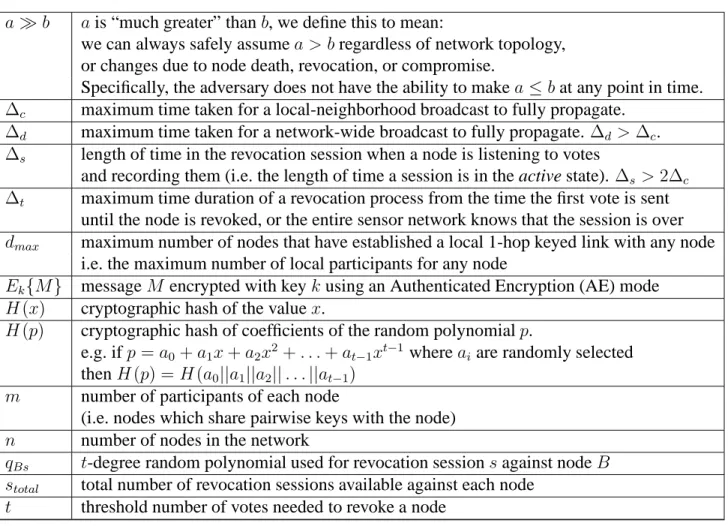
a≫b ais “much greater” thanb, we define this to mean:
we can always safely assumea > bregardless of network topology, or changes due to node death, revocation, or compromise.
Specifically, the adversary does not have the ability to makea≤bat any point in time. ∆c maximum time taken for a local-neighborhood broadcast to fully propagate.
∆d maximum time taken for a network-wide broadcast to fully propagate.∆d >∆c. ∆s length of time in the revocation session when a node is listening to votes
and recording them (i.e. the length of time a session is in the active state). ∆s >2∆c ∆t maximum time duration of a revocation process from the time the first vote is sent
until the node is revoked, or the entire sensor network knows that the session is over dmax maximum number of nodes that have established a local 1-hop keyed link with any node
i.e. the maximum number of local participants for any node
Ek{M} messageM encrypted with keykusing an Authenticated Encryption (AE) mode H(x) cryptographic hash of the valuex.
H(p) cryptographic hash of coefficients of the random polynomialp. e.g. ifp=a0+a1x+a2x2+. . .+at−1x
t−1 whereai are randomly selected
thenH(p) =H(a0||a1||a2||. . .||at−1) m number of participants of each node
(i.e. nodes which share pairwise keys with the node) n number of nodes in the network
qBs t-degree random polynomial used for revocation sessionsagainst nodeB stotal total number of revocation sessions available against each node
t threshold number of votes needed to revoke a node
Figure 1: Notation used in this paper months. These serious flaws make the current scheme impractical.
In general, distributed revocation is inherently more complex than centralized revocation. Such proto-cols are inherently prone to design error, and the verification of their correctness becomes essential. Cor-rectness verification requires precise definition of both revocation properties and adversary attack model. Both have been lacking to date. In this article, we present the first precise definition of desired properties for the design of distributed revocation protocols. Furthermore, we present the first distributed revocation protocol that can be shown to fulfil the list of desired properties. It is hoped that this new protocol can demonstrate the usefulness and viability of the provided framework, thus facilitating further research into distributed node revocation schemes.
4
Adversary and Communications Model
In this section, we list the assumptions that are general to the node revocation problem. This defines the standard adversary and communications model described by in the literature for key distribution in sensor networks [1, 2, 3, 4]. These assumptions are independent of the details of our proposed protocol (for protocol-specific assumptions, please see Section 6.2).
1. Adversary has universal communication presence. We assume that the adversary can simultane-ously send and receive an arbitrary number of messages in any part of the network at any time. 2. Adversary can perform chosen node compromise. The adversary can selectively compromise a
small fraction of the nodes in the sensor network. All data on a compromised node becomes known to the adversary. Furthermore, compromised nodes are controlled by the adversary and can perform active network functions as part of the network until they are revoked. In particular, compromised nodes can launch revocation attacks (see Definition 1 below, in Section 5.2).
3. Compromised nodes collaborate. We assume a single adversary performs all the node compromise in the network; hence all leaked information in the compromised nodes is collectively known to the adversary and compromised nodes can coordinate to perform collaborative attacks on the sensor network.
4. Adversary cannot block or significantly delay communications. We assume that compromised nodes can selectively drop packets which they have received, but the adversary is unable to jam or delay local (single hop) communications in the network whose source and destinations are both uncompromised nodes. The adversary cannot block or delay multi-hop broadcast messages, either neighborhood-wide or network-wide (i.e. compromised nodes can refuse to forward broadcasts but we assume that there are sufficient legitimate nodes performing the forwarding to ensure complete coverage). The adversary is also unable to partition the network via node compromise. Note that implicit in this assumption is that since an adversary is unable to perform these disruptions, random failures also do not affect the assumed connectivity and communication properties of the network.
Under these assumptions, we can assume a bound on the time for broadcasts to propagate over the network. Neighborhood-wide broadcasts take at most time∆c to fully propagate over a neighbor-hood. Network-wide broadcasts or node-to-base-station communications take at most time∆d to propagate to every node, where∆d > ∆c. It may seem that this is a strong assumption, since pro-viding efficient reliable broadcast in the presence of active adversaries is a challenging technical problem in itself. However, we note that without this assumption, no revocation protocol (dis-tributed or centralized) could be feasible, since the adversary would always be able to interrupt the revocation messages to some part of the network and remain active there. Hence, this is a required assumption if we are to discuss the revocation problem at all. Note that even in the absence of an efficient solution, simple flooding still provides an inefficient but adequate solution to the reliable broadcast problem. Given that revocation events are rare, it may be possible that the costs associated with simple flooding are acceptable compared with the security benefits of node revocation.
5
Basic Properties of Distributed Revocation
To date, there has not been a succinct definition of distributed revocation properties. It is clear that a distributed revocation protocol should enable a set of nodes to make a decision to exclude another node from the network. However, the problem contains many complicating factors, such as the need to be resistant to attempts by an adversary to block or subvert the protocol. In this section, we describe a set of desired properties, thus providing a precise definition of the problem. Figure 1 is available as a reference which summarizes the notation used in this part of the paper.
5.1
Correct Operation
The following properties ensure the correct operation of the distributed sensor node revocation protocol.
Property 1 (Completeness). If a compromised node is detected bytor more uncompromised neighboring nodes, then it is revoked from the entire network permanently (i.e. its subsequent re-insertion into another part of the network is not possible).
Property 1 ensures that if compromise is detected by sufficient nodes, then the protocol always op-erates correctly in permanently removing the compromised node, and the adversary is unable to prevent such a revocation from taking place, or circumvent it by reinserting the compromised node elsewhere.
Property 2 (Soundness). If a node is revoked from the network using this scheme, then at leastt nodes must have agreed on its revocation.
Property 2 ensures that the protocol always requires the agreement of at leasttnodes to perform the distributed revocation of any single node. The threshold t provides a mechanism for verifying that the compromise was detected by at leasttnodes before a revocation commitment can be made. Note that the property does not state that the revoked node must be actually compromised, nor that all the collaborating revoking nodes must be legitimate. In particular, this property allows an uncompromised node to be revoked by a set oftmalicious compromised nodes. This is allowed because it is not realistic to assume that node compromise is always detected with 100% effectiveness; hence if t undetected compromised nodes in the network collude to revoke an uncompromised node, this action is necessarily indistinguishable from havingtuncompromised nodes agree to revoke a compromised node.
Property 3 (Bounded Time Revocation Completion). Revocation decision and execution occur within a bounded time period (let this bound be∆t) from the time of sending of the first revocation vote.
Property 3 ensures that the revocation decision is completed in a timely fashion. This means that an adversary cannot prolong the lifetime of a detected compromised node by delaying the outcome of the revocation decision and thus slowing down the revocation process; in order to circumvent the revocation, the adversary has to force the revocation decision to return a negative result (i.e. a decision not to revoke). This property also means that sensor nodes do not have to carry revocation state information for long periods of time, which is attractive since sensor nodes generally have limited memory. This condition also implies that, within the time period∆t, if there is an insufficient quorum of sensor nodes that agree that a node is to be revoked, then the revocation decision correctly returns a negative result, instead of waiting indefinitely for the threshold number of votes to be reached. This property resolves the problem of stale state in the original random pairwise revocation scheme, where erroneous votes can accumulate over the network’s lifetime and result in the revocation of a legitimate node.
Property 4 (Unitary Revocation). Revocations of nodes are unitary (all-or-nothing) in the network. Specif-ically, if a node is revoked in one part of the network, then it will be revoked in the whole network within time∆d, where ∆d is the time taken for any message to propagate across the entire network. If it is not revoked in one part of the network, then it was not revoked in any part of the network in the time prior to the last∆dtime period.
Property 4 ensures that revocation is universal within the given limits of communication delay. In particular, the adversary cannot block or delay part of the revocation such that when a compromised node is revoked in one part of the network, it can still operate in a different part of the network for a substantial length of time.
5.2
Resistance to Revocation Attack
The properties in Section 5.1 ensure that the protocol operates correctly. However, correctness is insuf-ficient. Since compromised sensor nodes can actively participate in the distributed revocation of other nodes, an adversary could abuse the distributed revocation protocol to further its own agenda without actually interfering in the correct operation of the protocol. In particular, the adversary could use the compromised nodes under its control to launch a revocation attack:
Definition 1 (Revocation Attack). An attack where an adversary uses the distributed node revocation protocol to selectively revoke uncompromised nodes from the network.
Hence, we require an additional property:
Property 5 (Revocation Attack Resistance). If c nodes are compromised, then they can only revoke at mostαcother nodes whereαis a constant andα ≪ m
t.
A distributed revocation scheme that satisfies Property 5 restricts the adversary’s ability to perform a revocation attack. Based on the property, when an adversary has compromised some number of nodes, it is only able to successfully revoke a number of nodes that is much less than the total number of nodes it would have been able to revoke if every compromised node had casted a vote against each of the nodes which share a key with it.
6
Our Protocol for Distributed Sensor Node Revocation
In this section we describe our protocol for distributed node revocation. Although for simplicity we present our protocol in the context of the Random Pairwise Key Distribution scheme, our protocol can be extended for implemention with other key distribution protocols, for example with the generalized random key predistribution mechanisms proposed by Du et al. [2] and Liu and Ning [4].
Our distributed revocation protocol is a significant improvement of the distributed revocation scheme presented by Chan et al. [1]. First, we add the idea of revocation sessions, which is a mechanism by which a revocation decision can be completed in bounded time, thus resolving the issue of stale votes causing eventual erroneous revocation of legitimate nodes. Second, we improve the efficiency of the scheme by performing the voting and revocation decision process only using hop-limited local broadcast messages that cover only the target’s local neighborhood, thus eliminating the extremely high communication over-head of the original scheme. After the voting process is complete, a single short cryptographic message is then broadcast into the entire network to finalize the revocation outcome. This is in contrast to the original scheme where all voting and communications are full network-wide broadcasts involving large amounts of cryptographic information, which can be very expensive in a large sensor network. Finally, the protocol that we describe is the first distributed node revocation protocol that provides rigorous proofs of high-level desired properties.
The addition of sessions is necesary to facilitate the bounded-time completion of the revocation pro-cess. Without sessions, each note could only cast a revocation vote at most once against any other node, and, once cast, it would be unable to withdraw the vote. Given that intrusion detection may yield some level of inaccuracy, this implies that each node can only estimate that one of its neighbors is malicious with some level of certainty. If we set the nodes to trigger their votes at a low certainty level, then inaccurate false-positive votes could accumulate and cause the revocation of legitimate nodes. If we set the nodes to trigger only at a high level of certainty, then we lose the advantage the distributed revocation is fast react-ing. The use of sessions avoids this dilemma by allowing nodes to react immediately with high sensitivity to intrusion events, and yet not have to worry about accumulated votes from false positives being a factor. Note that votes, once cast, become public and cannot be withdrawn. Hence session information cannot be
re-used for a subsequent voting process — once voting is complete for each session, the session must be closed regardless of the outcome of the vote.
In the description of the protocol we will assume that the Random Pairwise Key Distribution is the underlying key establishment protocol, and we perform node revocation actions only among themnodes which share pairwise keys with the target (i.e. themparticipants of the target). The set ofmparticipants does not include the target itself. We note that our scheme is general in the sense that it can be directly adapted for other key distribution mechanisms and not just the Random Pairwise protocol. For example, if SPINS [9] was used for key establishment, the set of a participants could be defined as the set of neighbors of a node, and the required revocation data downloaded from the base station during the key-establishment process. In the general case, we could setm =nand allow the set of participants of a node to be the entire sensor network. Hence, any other key distribution scheme such as the generalized random key predistribution schemes proposed by Du et al. [2] or Liu and Ning [4] could also be used with our protocol. We further assume that each sensor node has a unique symmetric key that it shares with only the base station. This key is used for authenticated, confidential communications between sensor nodes and the base-station.
6.1
Definitions of Terms Used
In this section we will define the terms we will use in the description of the distributed revocation protocol. As mentioned, Figure 1 summarizes the notation we will be using in this paper.
Definition 2 (Neighborhood). The neighborhood of a node is the set of nodes that are within communi-cation range of it.
Definition 3 (Target, Participants). A node to be revoked is called a target node and any of themnodes that has a shared pairwise key with a target node is called a participant. A participant is a local participant if it has established a direct (1-hop) communication link with the target (hence it is must be located within the neighborhood of a target); otherwise, it is a non-local participant. All other nodes are called the
non-participant nodes. The target node is a non-participant of itself, since it cannot participate in
Definition 4 (Local Neighborhood Broadcast). A local-neighborhood broadcast is a multihop broadcast that originates within a given neighborhood and reaches all the nodes inside that neighborhood. Gen-erally this refers to broadcasts limited to the neighborhood of a revocation target. Local-neighborhood broadcasts take at most ∆c time to propagate over the entire neighborhood (based on Attacker Model Property 4).
6.2
Assumptions of Our Protocol
Before we describe our protocol, we list the assumptions under which our protocol operates. Each of these assumptions was necessary to facilitate a proof that our protocol fulfils the set of properties we described in our problem framework in Section 5. Hence, the strength of these assumptions is closely tied to the strictness of the requirements in our problem framework: a weaker set of properties would require fewer assumptions. Instead of opting for proving weaker properties with few assumptions in our initial protocol, we chose instead to show that with some number of reasonable assumptions, we are able to describe the first protocol that fulfils all the stringent properties we described in our problem statement. It is hoped that future research will be able to pick up on this direction, and provide new protocols that require fewer assumptions while fulfilling the same set of stringent requirements.
1. Deployment Atomicity. Deployment of new nodes is atomic (i.e. it appears to happen instanta-neously from the point of view of the network). Deployments do not occur while there are active revocation sessions in the network. All communications in the network are received at their final destinations before deployment begins. In practice, this can be achieved by shutting down the net-work in an orderly fashion prior to physical deployment of new nodes; after the new nodes have been physically deployed, then the network is turned on again.
2. Locality Restriction Of Compromised Nodes. The problem of controlling replication of a single node identity or the generation of multiple Sybil node identities across the network is an important technical challenge that is independent of distributed node revocation — examples of techniques to provide such functionality has been described by Newsome et al. [20] and Parno et al. [21].
Since this problem is not the focus of our protocol, we assume the functionality for addressing this problem is already present. More specifically, we assume that node replication, Sybil node identities or node movement can be detected and the offending node centrally revoked, hence each malicious node is confined to a single neighborhood. However, all malicious nodes can share information arbitrarily. We assume that all sensor nodes are immobile. Immobile sensor networks constitute a majority of known sensor network applications to date. We design our protocol only for this subset of applications, since mobility creates complications that this initial protocol is not meant to address. 3. Node Degrees. Each nodeihasdi ≫ tlocal participants with which it has successfully performed key-establishment, wherem ≫di (hence,m≫dmaxwheredmax is the maximum number of local participants for any node). We assume that this is enforced by some degree-counting mechanism, where nodes with low degrees are centrally revoked (i.e. it is enforced that di > dmin for some dmin). An example is described by Chan et al [1]. An adversary could attempt to exploit the degree-counting mechanism by reducing the degrees of legitimate nodes (e.g. by causing malicious nodes to refuse to complete key exchange with legitimate nodes). This is a very inefficient attack, since in order to disable a single node in this manner, an adversary has to capture or disable a large number of the nodes in its neighborhood. For example, typical values fordmin should not exclude legitimate nodes that simply happen to be deployed in a sparse area. Since t is typically also not large compared with deployment density, the typical degree of any node is usually much greater thandmin+t. Hence, if an adversary wishes to cause the removal of a node, for the vast majority of the nodes it would be more efficient to simply capturetlocal participants and perform a coordinated revocation attack than to attempt to drive the target node’s degree below dmin in order to cause automatic central revocation.
4. Events that can cause a node to start a revocation against another node are visible to the
node’s entire neighborhood. If we allow nodes to trigger revocation sessions based on events that
are only observable to themselves, then it is difficult to ascertain if this is a legitimate response to misbehavior, or if a malicious node is performing spurious revocations, or if a malicious node is
de-liberately inducing a legitimate node to perform legitimate revocation actions that are guaranteed to fail. Hence, we only trigger revocation based on events that are visible to all the target node’s neigh-bors. By the previous assumption 3, this also means that such events are always observed by some di ≫ tlegitimate nodes. Hence, nodes only react to events which they know can also be observed by many other nodes, and thus there is assurance of reaching the thresholdtwhenever a voting ses-sion is started legitimately. In practice, the legitimate nodes observing the event may encounter false positives or false negatives, which may cause the initiation of failed revocation sessions. We assume that the rate of false positives and false negatives is small. In fact, the development of distributed intrusion detection mechanisms is a challenging research problem. As a current working example, we can suppose that our detection mechanism only reacts to highly visible, egregious misbehav-iors such as repeatedly performing spurious transmissions, or complete absence of communication over a long period of time. As intrusion detection mechanisms become more advanced and more accurate, the range of detectable behaviors supported by this scheme will also increase.
5. Revocation Sessions Are Always Available. We assume that revocation attempts by legitimate nodes are infrequent enough that onlys sessions need to be stored on the sensor nodes such that no node ever runs out of revocation sessions during its lifetime. We assume that s > t but it is small (e.g. less than 10). If all the available sessions against a given target nodeB are exhausted, all ofB’s participants will be able to detect this since each of them is aware of how many sessions are remaining forB. Hence, each participant simply suspends communications withB until new sessions arrive, thus temporarily excludingB from the network as long as it cannot be revoked. An adversary may attempt to exhaust all available revocation sessions against a given node such that this behavior occurs, but it such an attack is easily detectable and counteracted. For example, if a node Arepeatedly initiates revocation sessions against nodeB that subsequently fail, then this behavior is reported by its fellow participants to a central base station. By assumption 4 above, we know that such behavior is not typical of a legitimate node, because a legitimate node should only react to events visible to the entire node neighborhood. If this happens repeatedly the base station may then detect if this is an attempt to perform a session exhaustion attack, and the offending node A will
be centrally revoked. An adversary may attempt to circumvent this mechanism by usingsnodes in turn to attempt the session exhaustion attack. However, since we required thats > t, in this case the adversary could simply revoke the target node permanently instead of performing such an attack. Hence, we can assume that revocation sessions are always available for the revocation of any target node. Node sessions may be slowly expended as false positives and random events accrue over time. However, new sessions can be refreshed via encrypted transmissions from the base station to each relevant participant. While such a refresh is very costly in terms of communication overhead, we note that since revocation attempts are infrequent, a node would probably only experience a very small number of such refresh events in its lifetime.
We further note the the following non-assumptions of our protocol:
1. We do not assume time synchronization between sensor nodes. We do not make use of any internal clock information in sensor nodes. We also do not expect sensor nodes or the network to react instantaneously to any event.
2. We do not assume any asymmetric-key cryptography capabilities on the sensor nodes. We present our protocol using only symmetric-key primitives, thus trading off an increased memory requirement for lower energy and computational requirements. We note that it is simple to convert our symmetric-key scheme to one based on asymmetric cryptography. In particular, note that such a conversion would assure that revocation sessions are always available since each node would be able to generate more revocation sessions for any number of neighbors indefinitely.
6.3
Protocol Overview
A high-level overview of our revocation protocol is as follows. Local participant nodes perform voting in sessions to agree to revoke a neighbor. In each voting session, we use a secret-sharing scheme to tally revocation votes from each participant. Each vote is a secret share, and voting is performed by broadcasting the secret share to all the participant nodes in the target node’s neighborhood. Once a certain time has elapsed since the first vote of the session was broadcast, each local participant tallies the votes
that it heard; if sufficient votes were heard then it can prove this fact by broadcasting the secret of the secret-sharing scheme. Such a broadcast indicates that the target was successfully revoked and causes all nodes in the network to erase the keys associated with the target, thus eliminating it from the network. In the subsequent sections, we decribe the protocol in detail.
6.4
Cryptographic Primitives
In the revocation protocol we make use of random polynomials. Polynomialq(x) = a0 +a1x+a2x2+
. . .+at−1xt−1
is random if all its coefficientsa0, a1. . . at−1 are random uniformly distributed values in a certain range[0, l−1](e.g.,l = 264). We define the cryptographic hash of a random polynomialq(x)to
beH(q(x)) =H(a0||a1||a2||. . .||at−1), whereHis a hash function anda0, a1. . . at−1 are the coefficients
ofq(x). We also use Merkle Hash Trees.
The protocol also uses Authenticated-encryption (AE) modes. AE modes detect (1) ciphertext forg-eries (e.g., ciphertext messages produced by manipulation of encrypted-message blocks or simply by ar-bitrary message strings that are not obtained by encryption) and (2) false (or inauthentic) decryption keys (i.e., decryption keys not used by the corresponding encryption operation), during ciphertext decryption. AE modes specially designed to save power and energy are particularly well-suited for sensor networks (e.g., AE modes that use a single pass over the data using a single cryptographic primitive, namely the block cipher [17, 18, 19]).
6.5
Off-line Node Initialization
For node initialization, we first compute stotal random polynomials of degreet for each of the n nodes in the network, wherestotal is the number of revocation sessions (attempts) against any target node in the network. For example, if the size of the sensor network is n = 10,000 and the number of revocation sessions isstotal = 6, this would require60,000polynomials of degreet. This is not a very large number considering that they are generated off-line, efficiently. Furthermore, typically t is small hence these polynomials are of low degree. For the purposes of discussion, we number each session against a given
target from1. . . stotal, with session 1 starting first and proceeding sequentially until the last sessionstotal. The voting sessions are necessary to fulfil Property 3 (bounded-time revocation decision completion).
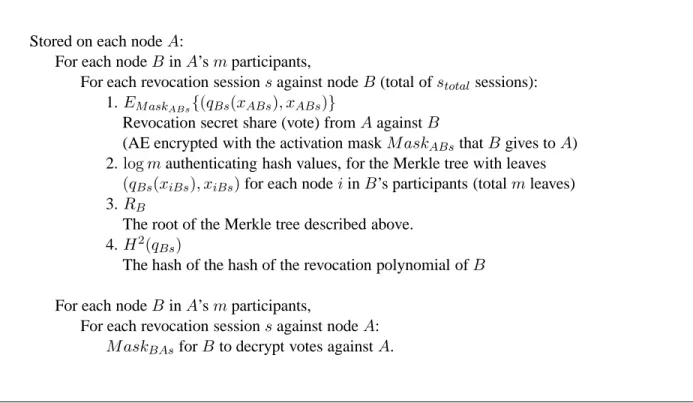
Second, on each node A, for each nodeB of A’s m participants, and for each revocation sessions against targetB, based on our random polynomialqBs, we load the the revocation vote fromAagainstB. This revocation vote consists of the secret share(qBs(xABs), xABs), AE encrypted with the activation mask M askABs that B gives to A. The points at which the secret-sharing polynomial are evaluated (e.g. xABs) are generated such that no two participants have the same revocation secret share. The preloaded data is represented as (EM askABs{(qBs(xABs), xABs)}). The purpose of the masks is to ensure that each node is
only able to revoke nodes within its immediate neighborhood. Since we assume nodes are unable to move or replicate (see Assumption 2), each malicious node can only collect masks from one neighborhood, thus limiting their revocation power. For each vote we also load thelogm authenticating hash values for the Merkle tree with leaves (qBs(xiBs), xiBs) for each node i inB’s participants (a total of m leaves). The root RB of this Merkle tree is also stored. When the revocation vote is cast, these logm authenticating values are also attached to the message. This allows fellow participants ofB to verify the authenticity of the vote by computing the hashes up the tree and comparing it to the known root valueRB. Finally, we loadH2(qBs), which is the hash of the hash of the revocation polynomial of B. This will allow non-local
participants to verify the authenticity of a revocation decision againstB. Note that these Merkle trees are typically low depth since typical values ofmare not high (m ≤40).
Third, on each target nodeA, for each node B in A’sm participants, for each revocation sessions against target node A, we load the valueM askBAsthatAwill give toBto allowBto decrypt votes against A.
The information that is preloaded on each sensor node is summarized in Figure 2. The total storage overhead per node isO(stotalmlogm). Note that the overhead of the random pairwise keys scheme itself is alreadyO(m), hence this revocation scheme is only a small factor larger than the basic overhead necessary for key-establishment.
Stored on each nodeA:
For each nodeB inA’smparticipants,
For each revocation sessionsagainst nodeB(total ofstotalsessions): 1.EM askABs{(qBs(xABs), xABs)}
Revocation secret share (vote) fromAagainstB
(AE encrypted with the activation maskM askABs thatBgives toA) 2.logmauthenticating hash values, for the Merkle tree with leaves
(qBs(xiBs), xiBs)for each nodeiinB’s participants (totalmleaves) 3.RB
The root of the Merkle tree described above. 4.H2(qBs)
The hash of the hash of the revocation polynomial ofB For each nodeB inA’smparticipants,
For each revocation sessionsagainst nodeA: M askBAsforB to decrypt votes againstA.
Figure 2: Information Preloaded On Each Sensor Node
6.6
Connection Establishment
The masks for the current revocation sessions are exchanged at connection time. Masks are verified if votes can be decrypted — due to the authenticated encryption property, an incorrect mask would cause decryption of the vote to fail. If the mask exchange protocol is not completed (e.g. by a malicious node refusing to reveal its mask, or revealing an incorrect mask), and still does not succeed after some number of retries, then the link is dropped. Malicious nodes which repeatedly refuse to perform mask exchange will have a low degree and this will be detected and centrally revoked by the degree-counting scheme assumed in Assumption 3. Note that by Definition 3, if the unmasking protocol fails and the link is dropped between two neighboring nodes, we consider them to be non-local participants even though they are in physical communication range of each other.
A malicious nodeM1 may attempt to circumvent the unmasking process by having another malicious
nodeM2 act as its proxy in a distant location to obtain extra masks. However, since all communications
are authenticated (node-to-node identity authentication is a prerequisite for any distributed revocation protocol), this is exactly equivalent toM1producing a Sybil replication atM2’s location. By Assumption 2,
functionality to address this kind of replication is already present, hence such an attack is not feasible. Once the masks are exchanged, they are used to decrypt the relevant votes.
6.7
Stages of a Revocation Session
We now describe the process of an entire revocation session sfor some given participant A. Each node keeps a state variable for each session. Before any voting occurs in a current session, node A’s state for sessions is the pending state. In this state, A is awaiting the first vote in the sessions. When the first vote of the session is cast or received byA,Astarts its timer for the new revocation session, and changes its state for the current revocation session to active. Only whenAis in the active state does it record and verify other votes cast in this session by fellow participants. WhenAenters the active state, ifAbelieves thatBis compromised, it will cast its vote if it has not already done so. The active state lasts for exactly∆s time for each node, after which the node transitions to the completed state for this session, and starts the
pending state for the next session. ∆sis a precomputed time duration based on the time that a revocation decision is expected to take. In order to ensure full dissemination of all messages within a session, we require that∆s >2∆c where∆c is the maximum time that a message needs to completely propagate in a local neighborhood broadcast.
Definition 5 (Current Session). The current session of a node for the revocation of a target is the session with the smallest session number that has not yet completed (i.e. it is either active or pending).
Any session that comes after the current session is considered to be in the not-current state. Any votes received for a session that is not-current is buffered and only acted upon after the current session is completed.
6.8
Voting in a Revocation Session
When a node A detects compromise of a node B, it reacts differently depending on whether node A is aware of a revocation session currently active against nodeB. If the current session is pending for A, it activates the current session by sending out its vote in that session only. If the current session is already in
the active state forA, it votes both in the current session and on the next session. Voting in the next session occurs immediately upon completion of the current session. This voting process is to ensure thatA’s vote is actually counted, because a vote in an already-active session cannot be guaranteed to disseminate in time for all nodes to receive it. For example, suppose both node Aand C are currently near the end of an active revocation sessionsagainstB (i.e. both of them have been in the active state for sessions for nearly∆stime). Suppose that both of them have recordedt−2votes againstB. Simultaneously, bothA andC detect thatB is compromised. If they vote only in the current session, since the session is almost over, it is possible that neither of their votes reach each other within the remaining time for the session, so bothAandCtallyt−1votes and fail to reach the threshold needed to revokeB, even thought votes were cast in sessions. Hence it is necessary that the nodes also vote in the next sessions+ 1. Voting only in the next session (and not the current session) is insufficient since in the interest of speed, we would like the current revocation session to succeed if at all possible.
When A votes against B, it performs an unencrypted hop-limited broadcast of A’s against node B in the current revocation sessions, (qBs(xABs), xABs)along with thelogmMerkle authentication values that verify that this vote is a valid vote. This is a local neighborhood broadcast, i.e. the broadcast only needs to go far enough to ensure complete dissemination in the neighborhood ofB (4-6 hops can cover the area with high probability [3]). Only nodes that can verify the authenticity of the vote using the Merkle authentication values (i.e., the participants of B) will disseminate the broadcast. This ensures complete coverage with high probability [1].
6.9
Completing the Revocation Process
WhenA’s state for the session has transitioned to complete, it counts the number of votes it has received while it was in the active state.
IfA has at least trevocation votes (including its own if it detected the compromise, otherwise not), then it computes the revocation polynomial ofB for this session,qBs. From this,Acomputes the hash of the polynomial,H(qBs). This value is then broadcast through the entire network. Note that we broadcast only the hash of the polynomialqBsinstead of the polynomial itself, thus we only need to transmit a single
cryptographic value instead of a lengthy set of large polynomial coefficients. All participants ofB verify this pre-image against the value stored in their memory,H2(qBs). If the verification is successful, then all shared keys withB are deleted and B is marked as revoked. The broadcast is then disseminated to the other participants ofB until the entire network is covered.
If A does not have at least t verified revocation votes, then the revocation session has failed. Each local participant privately notifies the base station of the failed revocation session, thus ensuring that future deployed nodes will be deployed with the most current revocation session in the correct state (i.e., in the pending state, since deployments should not occur if there are any active revocation sessions in the network). Local participants ofB then proceed to request the masks for the new session s+ 1, i.e. M askAB(s+1) (ifB does not respond correctly then its degree is reduced and it may be centrally revoked
due to insufficient degree (Assumption 3). To save memory, any state regarding the old revocation session sis cleared.
6.10
Proofs of Properties
In this section we shall prove that Distributed Sensor Node Revocation satisfies the properties outlined in Section 5.
Lemma 6.1. Every node is deployed with the correct current revocation session for its participants. Proof. Immediate from Deployment Atomicity (Assumption 1). We assume that the base station keeps
track of the current revocation session of each node and updates newly deployed nodes with the correct session information; since deployment is atomic, the base station always has a correct notion of the current session of every node in the network.
Definition 6 (Session Agreement). Two nodes are in session agreement with respect to a target node at some instant in time if, for some sessions, either (1) sessionsis pending for both nodes, or (2) sessions
is active for both nodes, or (3) sessionsis active for one nodeB and sessions is completed for another nodeA, but sessions is completing within time∆c for nodeB, or (4) sessionsis active for one nodeA
Lemma 6.2. At any given point in time, any two uncompromised local participants are in session agree-ment for any target node.
Proof. Let the initial session of node that was deployed later ber. By Correct Deployment (Lemma 6.1), when the later node was deployed, the earlier node also had sessionrpending since (1) deployment only occurs when there is no active revocation session and (2) the deployed nodes are always deployed with the correct current session. Hence the two nodes are session agreement on sessionrwhen the later node was deployed.
We now show the inductive step that if the two nodes are in session agreement in all time instants T′ ≤ T (after both nodes have been deployed), then they are still in agreement in time T + ǫ where
ǫ < ∆s. If the states of the nodes are unchanged between the two times, or if both nodes changed states into the same states at timeT +ǫ, then we are done. Otherwise, we have 5 non-degenerate cases. Recall that∆swas chosen at design time such that∆s >2∆c.
Case 1: Session sis pending for both nodes at timeT, and at timeT +ǫ, nodeA activated session s. SinceAis uncompromised, it will perform a local broadcast of the first vote of sessions. By Attacker Model Property 4 local communications cross the local neighborhood in time ∆c. Since node B is in pending mode for sessions, it will receive the first vote of sessionsin time ∆c and activate the session. Hence the nodes are in agreement by option (4) of the definition of agreement.
Case 2: Sessionsis active for both nodes at timeT. At timeT +ǫ, nodeAcompleted sessions, but nodeB still has the session active. By the induction hypothesis, the nodes are in agreement when the first one of them started sessions, hence they must have both started sessionswithin∆c of each other. Since each session takes a fixed amount of time to complete (∆s), and A completed session s at time T +ǫ, we know thatB will complete sessionsbyT +ǫ+ ∆c, hence they are in agreement by option (3) of the definition of agreement.
Case 3: Sessionsis active for nodeB and sessionsis complete for nodeAat timeT. At timeT +ǫ, sessions has completed for node B. Hence sessions+ 1 must be either active or pending for nodeB. If sessions+ 1is active or pending for both nodes, then by options (1) or (2) of the definition, we have agreement. Otherwise, one node has session s+ 1 active and the other has session s+ 1pending. By
Attacker Model Property 4 local communications cross the local neighborhood in time ∆c. Hence the node with sessions+ 1pending will receive the first vote for session s+ 1within time∆c and start the session. Hence we have agreement by option (4) of the definition.
Case 4: At timet, sessionsis active forAand pending forB. Two subcases:
Subcase 4a: At timeT +ǫ, session s is completed forA and session s is still pending forB. This subcase is impossible. By the induction hypothesis, the nodes are in agreement whenAstarted sessions, henceB must be starting sessionswithin∆c of that time. In order forB to be still pending sessionsat timeT +ǫ, it must be thatAstarted sessionsafter timeT +ǫ−∆c. However we know thatAneeds at least∆stime to complete sessions, so the earliest time it can complete the session is atT +ǫ−∆c+ ∆s, but since∆s >∆c, this time is afterT +ǫ(contradiction). Hence this subcase is impossible.
Subcase 4b: At time T +ǫ, session s has completed for A and session s is active for B. By the induction hypothesis, the nodes are in agreement when A started session s, hence they must have both started the session within∆c of each other. Since each session takes a fixed amount of time to complete (∆s), andAcompleted sessions at timeT +ǫ, we know thatB will complete sessionsbyT +ǫ+ ∆c, hence we have agreement by option (3) of the definition.
Hence, we have shown by induction thatAandBare in session agreement for all timesT.
Property 1 (Completeness). If a compromised node is detected bytor more uncompromised neighboring nodes, then it is revoked from the entire network permanently (i.e. its subsequent re-insertion into another part of the network is not possible).
Proof. Suppose a compromised nodeB is detected by a setS oft or more uncompromised neighboring nodes. By Lemma 6.2, alltnodes are in mutual session agreement on some session for the targetB. We proceed by 2 possible cases. Let nodeC be the node with the lowest current session in the setS. Recall that∆swas chosen such that∆s>2∆c.
Case 1: The current session s is pending for node C. Consider an arbitrary node A in S. By the definition of session agreement (Definition 6), A either (1a) has session s pending, or (1b) has session s active. A cannot have session s′ > s pending or active since in that case it could not be in session
active. Since sessionsis starting at this instant forA, it has at least time∆s >∆c to receive alltvotes in sessions. For Case (1b), nodeA will vote in sessions. We know by that sessions could not have been active for nodeAfor more than∆c time, otherwise within that time the first vote would have reached node C and activated sessions. This is due to Attacker Model Property 4 which states that local broadcasts take at most∆c time. Hence, since sessionshas not been active for more than∆c time, so there is at least ∆s−∆c >∆c time remaining for it to receive all thetvotes in sessions. In both cases (1a,1b), we have that all nodes inS will vote in sessionsand every node has at least∆c time to receive all the votes from the other nodes. Since the votes are local broadcasts and so need at most∆c time to propagate and always reach their destinations (Attacker Model Property 4), we know that all|S| ≥ t votes in sessionswill be received by all members ofS.
Case 2: The current sessions −1 is active in node C. Consider an arbitrary nodeA in S. By the definition of session agreement (Definition 6),Aeither (2a) has sessions−1pending (2b) has sessions−1 active, (2c) has sessionspending, or (2d) has sessionsactive. It cannot be that sessionsis completed for Asince that would mean that sessionswould also complete forC within time∆c, which cannot be true sinceCwill take at least∆s > 2∆c time to complete sessionswhich has started at this point. Case (2a) is covered by Case 1 above. Hence we only have three cases (2b,2c,2d). For Case (2b), both nodesAand C have detected compromise while a session is active, so they will vote in both sessions−1and session s. We know by Lemma 6.2 thatAandCwere in agreement when the first one of the started sessions−1, hence they must have started sessions −1 within∆c of each other. Since they will both start session s immediately after they complete session s−1, they will also start session s within ∆c of each other. Hence, each node has at least∆s−∆c >∆c time to receive the votes in sessions. For Case (2c),Awill vote in sessions (as will C). Since session s has not started for node A, it will have ∆s > ∆c time to receive all|S|votes in sessions. For Case (2d), nodeAwill vote in both sessionsand sessions+ 1. Since nodeC still has sessions−1active, it could not be that nodeAcompleted sessions−1and then started sessionsmore than∆ctime ago. This is because by Definition 6, nodeCmust be completing sessions−1 within time∆c of the time when nodeAcompleted sessions−1. Since this has not happened yet, node Amust have completed sessions−1(and started sessions) within the last∆c. Hence, nodeAstill has at