AIRCRAFT DETECTION USING PASSIVE
MULTISTATIC RADAR
Navyashree
1, Anita.P
21,2
TCE, CMRIT College, Bangalore, (India)
ABSTRACT
Passive multistatic radar (PMR uses transmission from opportunistic radars to detect targets. In this paper, a
multistatic radar is used which contain multiple transmitters transmitting at S-band (3 GHz), serving as
opportunistic radars and a PMR receiver to detect a low-radar cross-section (RCS) target. The simulation is
carried out using the tool MATLAB. The simulation results show that the multistatic geometry of four
transmitters at the same range from the passive receiver with 90-degree separation offers the best coverage.
Passive detection of a target of up to a radial range of 30 km with detection coverage of 85% or better is
possible. This range coverage is similar to that of the monostatic radar but lacks in the area of detection
coverage.
Keywords:
LPI, PBR, PMR, RAMI. INTRODUCTION
The ability to detect targets passively has been greatly used nowadays because of the development of modern
radar. The term ‘passive’ refers to ability to detect targets without active transmission by the sensor on the target
of interest. Nowadays receivers are using new technologies and techniques like low probability-of-intercept
(LPI) radars, low-radar cross-section (RCS) design, radar absorbent material (RAM) coating and ultra-sensitive
electronic warfare (EW) receivers have changed the nature of the aircraft. On the one hand, the risk of being
detected by ultra-sensitive EW receivers has forced military aircraft to go on a strict radar transmission policy
and other means of sensing. On the other hand, aircraft equipped with LPI radars receive weak signals from
low-RCS designed aircraft. Researches are doing some improvements to good detection coverage using
Multistatic radar systems [3-4].The paper proposes system geometry for S-band Multistatic radar for detecting
and tracking the low RCS designed aircraft.Aircrafts designed with LPI radars receive weak signals from
low-RCS designed aircraft. A solution to resolve this problem is to use multiple pairs of passive bistatic radar (PBR)
to detect targets using common radar transmission by transmitters. This approach offers many advantages.
Firstly, there is no radar transmission by a source eliminating the risk of being intercepted by the target’s
receiver. Secondly, the unique geometry formed by separating transmitter and receiver reduces the effectiveness
II. BASIC’S OF PMR
Passive multistatic radar (PMR) makes use of multiple transmitters to detect targets. In the case of detecting
low-RCS (radar cross section) targets, passive multistatic radar (PMR) outperforms monostatic radars.The unique
geometry formed between the opportunistic transmitter, passive receiver and unsuspecting target provides
exceptional military applications not offered by the current military technologies. It offers true passive detection
while at the same time supports detection coverage comparable to monostatic radar. Passive detection means
there is no minimum range detection limitation that is unavoidable in monostatic radar. Alongwith there is no
need for blanking of electronic support measures (ESM) receiver every time the onboard radar transmits.
Passive detection allows for permanent monitoring of the electromagnetic spectrum for intelligence and threat.
On the other hand this removes the risk posed by anti-radiation missiles and, at the same time, enhances mission
survivability, allowing the receiver to continue tracking targets without working radar or with damaged radar.
The simplicity of PMR lies in the fact that there are no expensive systems to build. Instead, all the information
that the PMR system needs is already available on most receivers. This information can be extracted and used to
carry out tracking.
III.METHDOLOGY
In the methodology topic the reason behind using passive multistatic radar is explained. A Multistatic radar
system contains multiple spatially diverse Monostatic radar or bistatic radar components with a shared area of
coverage. An advantage of separating the receiver and the transmitter is that the receiver is passive and difficult to
locate and which doesn’t make it a target.
On the transmitter side, it is the relative position of the transmitter in the PBR geometry that determines the
detection coverage or detection gaps. On the receiver end the deciding parameters are the sensitivity and
bandwidth of the receiver. These two parameters affect the signal-to-noise ratio and, thereby, change the
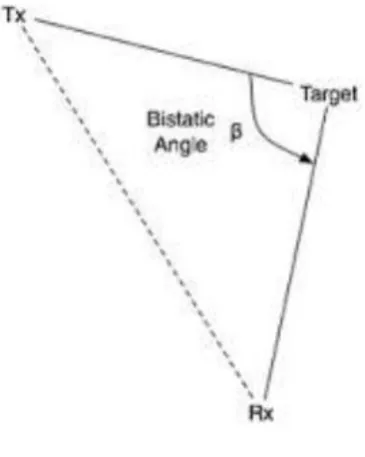
maximum detection range. The factor that is used here to quantify the geometry is the bistatic angle β formed
between the transmitter and receiver (Fig1). The angle formed between transmitter and receiver is known as the
Fig 1. Bistatic Angle - β.
The minimum number of transmitters is four, placed 90 degrees apart, with one in each quadrant. To achieve
maximum coverage with this particular combination of system parameters and transmitter constellation, the
baseline distance of 18,000 m is recommended. By rotating the quadrant placement of transmitters, one could
direct the detection gaps away from a specific bearing of choice to improve detection.The range equation for
bistatic radar is given by,
(1)
By grouping some of the terms, eq.(1) can be presented in more compact and generalized form for any SNR
value. Defining
(2)
In general the equation for SNR is given by,
(3)
IV.SIMULATION RESULTS
The proposed multistatic radar system configuration is a single receiver and multiple transmitter’s
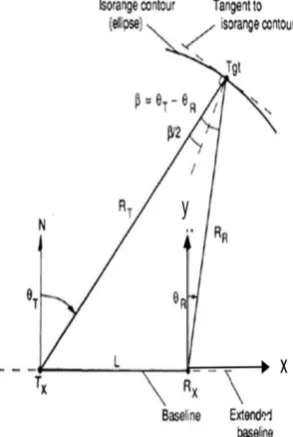
Fig 2. Bistatic Geometry Showing the Tx, Tgt and Rx.
Table 1: Radar Transmitter Parameters
In Fig 2, a typical bistatic radar geometry is presented with the transmitter (Tx) and receiver (Rx) separated by
the baseline distance, also known as the direct path or line-of-sight (LOS) of transmission, denoted by L.
Passive multistatic radar is the combination of different bistatic radars. Table 1 indicates the radar transmitter
parameters which are used for doing the simulation.The first step is to determine the maximum possible
detection range based on the radar horizon and the maximum detection range using the bistatic radar equation.
The latter takes into consideration system and physical parameters like antenna gains, transmission losses,
frequency, bistatic RCS, antenna beam width, bistatic geometry of transmitter-target-receiver,
receiver sensitivity for detection, etc. Next, evaluation of the combined detection range for different bistatic
geometries, based on the SNR at the receiver, is presented. Based on the coverage characteristics of
individualbistatic geometry, combinations of multiple bistatic pairs at different angles and ranges are simulated
to determine the optimal detection coverage. Finally, the range accuracy is determined for each of the previously
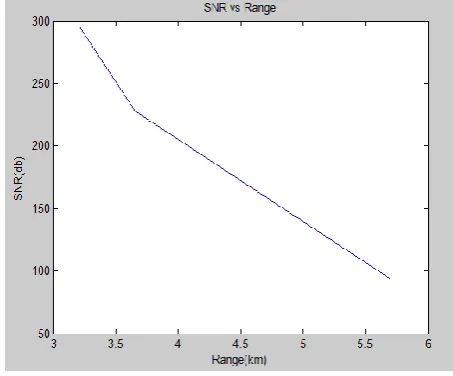
Fig 3. Simulation Result
V. CONCLUSION
From the simulation plot it is shown that when more transmitters are spaced further apart, they provide better
overall coverage with small detection gaps.From the simulation result graph it can be seen that for passive
multistatic radars the range covered is more with less SNR that is the signal strength is more with less noisy
levels.
REFERENCES
[1] Chong Sze Sing,”Passive Multistatic Detection of Maritime targets using Radars”, PHD Thesis,Naval
Postgrade School,Monte- rery,California March 2014.
[2] Steven Kay," Waveform Design for Multistatic Radar Detection," Dept.of Electrical, Computer, and
Biomedical Engineering,University of Rhode Island Kingston, RI 02881, 2007.
[3] Merril I. Skolnik," Radar Handbook, Second Edition," McGraw-Hill,1990.