Washington State
Retail Food Code
Chapter 246-215
Washington Administrative Code (WAC)
Effective May 1, 2013
DOH 332-033 May 2013
For people with disabilities, this document is available on request in other formats. To submit a request, please call 1-800-525-0127 (TDD/TTY call 711).
CONTENTS
PART 1: INTENT, SCOPE, AND DEFINITIONS ___________________________________________ 1
PART 2: MANAGEMENT AND PERSONNEL ___________________________________________ 17
PART 3: FOOD ___________________________________________________________________ 25
PART 4: EQUIPMENT, UTENSILS AND LINENS ________________________________________ 53
PART 5: WATER, PLUMBING AND WASTE ____________________________________________ 75
PART 6: PHYSICAL FACILITIES _____________________________________________________ 85
PART 7: POISONOUS OR TOXIC MATERIALS _________________________________________ 93
PART 8: COMPLIANCE AND ENFORCEMENT _________________________________________ 97
PART 9: ALTERNATIVE FOOD FACILITIES ___________________________________________ 111
PART 10: SEVERABILITY __________________________________________________________ 121
PART 1: INTENT, SCOPE, AND DEFINITIONS
01100 Intent – Food safety, illness prevention, and honest presentation (2009 FDA Food Code 1-102.10)
The purpose of this chapter is to safeguard public health and provide to CONSUMERSFOOD that
is safe, not ADULTERATED, and honestly presented.
01105 Scope – Statement (2009 FDA Food Code 1-103.10)
This chapter establishes definitions; sets standards for management and personnel, FOOD
operations, and EQUIPMENT and facilities; and provides for FOOD ESTABLISHMENT plan review, PERMIT issuance, inspection, EMPLOYEERESTRICTION, and PERMIT suspension.
01110 Applicability
(1) The requirements of this chapter apply to an operation that meets the definition of a
FOODESTABLISHMENT as defined in 01115(48).
(2) When a LOCAL BOARD OF HEALTH adopts rules with more stringent provisions than those contained in this chapter, the more stringent rules apply.
01115 Definitions, abbreviations, and acronyms (2009 FDA Food Code 1-201.10(B))
The definitions in this section apply throughout this chapter unless the context clearly indicates otherwise.
(1) "ACCREDITED PROGRAM."
(a) ACCREDITED PROGRAM means a food protection manager certification program that
has been evaluated and listed by an accrediting agency as conforming to national standards for organizations that certify individuals.
(b) ACCREDITED PROGRAM refers to the certification process and is a designation based
upon an independent evaluation of factors such as the sponsor's mission; organizational structure; staff resources; revenue sources; policies; public information regarding program scope, eligibility requirements, recertification, discipline, and grievance procedures; and test development and administration. (c) ACCREDITED PROGRAM does not refer to training functions or educational programs.
(2) "ADDITIVE."
(a) "FOOD ADDITIVE" has the meaning stated in the Federal Food, Drug, and Cosmetic Act, Section 201(s) and 21 C.F.R. 170.3(e)(1).
(b) "COLOR ADDITIVE" has the meaning stated in the Federal Food, Drug, and Cosmetic
Act, Section 201(t) and 21 C.F.R. 70.3(f).
(3) "ADULTERATED" has the meaning stated in the Federal Food, Drug, and Cosmetic Act,
Section 402.
(4) "APPROVED" means acceptable to the REGULATORY AUTHORITY based on a determination of conformity with principles, practices, and generally recognized standards that protect public health.
(5) "ASYMPTOMATIC."
(a) ASYMPTOMATIC means without obvious symptoms; not showing or producing indications of a disease or other medical condition, such as an individual infected with a pathogen but not exhibiting or producing any signs or symptoms of vomiting, diarrhea, or jaundice.
(b) ASYMPTOMATIC includes not showing symptoms because symptoms have resolved
or subsided, or because symptoms never manifested.
(6) "AW" means water activity which is a measure of the free moisture in a FOOD, is the quotient of the water vapor pressure of the substance divided by the vapor pressure of pure water at the same temperature, and is indicated by the symbol AW.
(7) "BALUT" means an embryo inside a fertile EGG that has been incubated for a period
sufficient for the embryo to reach a specific stage of development after which it is removed from incubation before hatching.
(8) "BED AND BREAKFAST OPERATION" means a private home or inn offering one or more
lodging units on a temporary basis to travelers.
(9) "BEVERAGE" means a liquid for drinking, including water.
(10) "BOTTLED DRINKING WATER" means water that is SEALED in bottles, packages, or other
containers and offered for sale for human consumption, including bottled mineral water. (11) "CATERING OPERATION."
(a) CATERING OPERATION means a PERSON who contracts with a client to prepare a
specific menu and amount of FOOD in an APPROVED FOOD ESTABLISHMENT for
service to the client's guests or customers at a different location.
(b) Consistent with its application under 08325, a CATERING OPERATIONAPPROVED for a PERMIT may cook or perform final preparation on certain FOOD at the service
location.
(12) "CERTIFICATION NUMBER" means a unique combination of letters and numbers assigned
by a SHELLFISH CONTROL AUTHORITY to a MOLLUSCAN SHELLFISHDEALER according to the
provisions of the National Shellfish Sanitation Program.
(13) "C.F.R." means Code of Federal Regulations. Citations in this chapter to the C.F.R. refer sequentially to the Title, Part, and Section numbers, such as 40 C.F.R. 180.194 refers to Title 40, Part 180, Section 194.
(14) "CIP."
(a) CIP means cleaned in place by the circulation or flowing by mechanical means through a piping system of a detergent solution, water rinse, and SANITIZING
solution onto or over EQUIPMENT surfaces that require cleaning, such as the
method used, in part, to clean and SANITIZE a frozen dessert machine.
(b) CIP does not include the cleaning of EQUIPMENT such as band saws, slicers, or
mixers that are subject to in-place manual cleaning without the use of a CIP system.
(15) "COMMINGLE" means:
(a) To combine SHELLSTOCK harvested on different days or from different growing
areas as identified on the tag or label; or
(b) To combine SHUCKED SHELLFISH from containers with different container codes or
different shucking dates. (16) "COMMINUTED."
(a) COMMINUTED means reduced in size by methods that include chopping, flaking,
grinding, or mincing.
(b) COMMINUTED includes FISH or MEAT products that are reduced in size and
restructured or reformulated such as gefilte FISH, gyros, ground beef, and sausage;
and a mixture of two or more types of MEAT that have been reduced in size and
combined, such as sausage made from two or more MEATS.
(17) "COMMISSARY" means an APPROVED FOOD ESTABLISHMENT where FOOD is stored,
prepared, portioned, or PACKAGED for service elsewhere.
(18) "CONDITIONAL EMPLOYEE" means a potential FOOD EMPLOYEE to whom a job offer is
made, conditional on responses to subsequent medical questions or examinations designed to identify potential EMPLOYEES who might be suffering from a disease that can
be transmitted through FOOD and done in compliance with Title 1 of the Americans with
Disabilities Act of 1990.
(19) "CONFIRMED DISEASE OUTBREAK" means a FOODBORNE DISEASE OUTBREAK in which
laboratory analysis of appropriate specimens identifies a causative agent and epidemiological analysis implicates the FOOD as the source of the illness.
(20) "CONSUMER" means a PERSON who is a member of the public, takes possession of FOOD,
is not functioning in the capacity of an operator of a FOOD ESTABLISHMENT or FOOD PROCESSING PLANT, and does not offer the FOOD for resale.
(21) "CORROSION-RESISTANT" means a material that maintains acceptable surface
cleanability characteristics under prolonged influence of the FOOD to be contacted, the
normal use of cleaning compounds and SANITIZING solutions, and other conditions of the
use environment.
(22) "COUNTER-MOUNTED EQUIPMENT" means EQUIPMENT that is not portable and is designed
to be mounted off the floor on a table, counter, or shelf (previously table-mounted
EQUIPMENT).
(23) "CRITICAL CONTROL POINT" means a point or procedure in a specific FOOD system where
loss of control might result in an unacceptable health RISK.
(24) "CRITICAL LIMIT" means the maximum or minimum value to which a physical, biological,
or chemical parameter must be controlled at a CRITICAL CONTROL POINT to minimize the RISK that the identified FOOD safety HAZARD might occur.
(25) "CUT LEAFY GREENS" means fresh leafy greens whose leaves have been cut, shredded,
sliced, chopped, or torn. The term "leafy greens" includes iceberg lettuce, romaine lettuce, leaf lettuce, butter lettuce, baby leaf lettuce (i.e., immature lettuce or leafy greens), escarole, endive, spring mix, spinach, cabbage, kale, arugula, and chard. The term "leafy greens" does not include herbs such as cilantro or parsley. The term "cut" does not include removing and discarding the exterior leaves.
(26) "DEALER" means a PERSON who is authorized by a SHELLFISH CONTROL AUTHORITY for the
activities of SHELLSTOCK shipper, shucker-packer, repacker, reshipper, or depuration
processor of MOLLUSCAN SHELLFISH according to the provisions of the National Shellfish Sanitation Program.
(27) "DISCLOSURE" means a written statement that clearly identifies the animal-derived FOODS which are, or can be ordered, raw, undercooked, or without otherwise being
processed to eliminate pathogens, or items that contain an ingredient that is raw, undercooked, or without otherwise being processed to eliminate pathogens.
(28) "DONATED FOOD DISTRIBUTING ORGANIZATION" means a charitable nonprofit organization
under Section 501(c) of the federal Internal Revenue Code that distributes FOOD free of
charge to the needy.
(29) "DONOR" means a PERSON, corporation, association, or other organization that donates FOOD to a DONATED FOOD DISTRIBUTING ORGANIZATION under the provisions of chapter
69.80 RCW, known as the Good Samaritan Food Donation Act.
(30) "DONOR KITCHEN" means a kitchen that is used by a DONOR to handle, store, or prepare
FOOD for donation to needy PERSONS through a DONATED FOOD DISTRIBUTING ORGANIZATION and which is not a residential kitchen in a private home.
(31) "DRINKING WATER."
(a) DRINKING WATER means water that meets 40 C.F.R. 141, National Primary Drinking
Water Regulations.
(b) DRINKING WATER is traditionally known as "potable water."
(c) DRINKING WATER includes the term "water" except where the term used connotes
that the water is not potable, such as "boiler water," "mop water," "rainwater," "wastewater," and "nondrinking" water.
(d) DRINKING WATER means potable water that is supplied in compliance with chapters
246-290 and 246-291 WAC.
(32) "DRY STORAGE" means a room or area designated for the storage of PACKAGED or
containerized bulk FOOD that is not POTENTIALLY HAZARDOUS FOOD and dry goods such
as SINGLE-SERVICE ARTICLES.
(33) "EASILY CLEANABLE."
(i) Allows effective removal of soil by normal cleaning methods;
(ii) Is dependent on the material, design, construction, and installation of the surface; and
(iii) Varies with the likelihood of the surface's role in introducing pathogenic or toxigenic agents or other contaminants into FOOD based on the surface's APPROVED placement, purpose and use.
(b) EASILY CLEANABLE includes a tiered application of the requirements that qualify the
surface as EASILY CLEANABLE as specified in (a) of this subsection to different
situations in which varying degrees of cleanability are required such as:
(i) The appropriateness of stainless steel for a FOOD preparation surface as
opposed to the lack of need for stainless steel to be used for floors or for tables used for consumer dining; or
(ii) The need for a different degree of cleanability for a utilitarian attachment or accessory in the kitchen as opposed to a decorative attachment or accessory in the CONSUMER dining area.
(34) "EASILY MOVABLE" means:
(a) Portable; mounted on casters, gliders, or rollers; or provided with a mechanical means to safely tilt a unit of EQUIPMENT for cleaning; and
(b) Having no utility connection, a utility connection that disconnects quickly, or a flexible utility connection line of sufficient length to allow the EQUIPMENT to be
moved for cleaning of the EQUIPMENT and adjacent area.
(35) "EGG."
(a) EGG means the shell EGG of avian species such as chicken, duck, goose, guinea,
quail, RATITES, turkey, or any other species of fowl.
(b) EGG does not include:
(i) A BALUT;
(ii) The EGG of a reptile species such as alligator; or
(iii) An EGGPRODUCT.
(36) "EGG PRODUCT."
(a) EGG PRODUCT means all, or a portion of, the contents found inside EGGS separated
from the shell and pasteurized in a FOOD PROCESSING PLANT, with or without added
ingredients, intended for human consumption such as dried, frozen, or liquid EGGS.
(b) EGG PRODUCT does not include FOOD which contains EGGS only in a relatively small
portion such as cake mixes.
(37) "EMPLOYEE" means the PERMIT HOLDER, PERSON IN CHARGE, FOOD EMPLOYEE, PERSON
having supervisory or management duties, PERSON on the payroll, family member,
volunteer, PERSON performing work under contractual agreement, or other PERSON
working in a FOOD ESTABLISHMENT.
(38) "ENTEROHEMORRHAGIC ESCHERICHIA COLI (EHEC)" means E. coli which cause
hemorrhagic colitis, meaning bleeding enterically or bleeding from the intestine. The term is typically used in association with E. coli that have the capacity to produce Shiga toxins and to cause attaching and effacing lesions in the intestines. EHEC is a subset of STEC, whose members produce additional virulence factors. Infections with EHEC might be ASYMPTOMATIC but are classically associated with bloody diarrhea (hemorrhagic colitis) and hemolytic uremic syndrome (HUS) or thrombotic thrombocytopenic purpura (TTP). Examples of serotypes of EHEC include: E. coli
O157:H7; E. coli O157:NM; E. coli O26:H11; E . coli O145:NM; E. coli O103:H2; or E. coli O111:NM. Also see Shiga Toxin-producing E. coli.
(39) "EPA" means the United States Environmental Protection Agency. (40) "EQUIPMENT."
(a) EQUIPMENT means an article that is used in the operation of a FOOD ESTABLISHMENT
refrigerator, scale, sink slicer, stove, table, TEMPERATURE MEASURING DEVICE for
ambient air, VENDING MACHINE, or WAREWASHING machine.
(b) EQUIPMENT does not include items used for handling or storing large quantities of PACKAGEDFOODS that are received from a supplier in a cased or overwrapped lot,
such as hand trucks, forklifts, dollies, pallets, racks, and skids.
(41) "EXCLUDE" means to prevent a PERSON from working as an EMPLOYEE in a FOOD ESTABLISHMENT or entering a FOOD ESTABLISHMENT as an EMPLOYEE.
(42) "FDA" means the United States Food and Drug Administration. (43) "FISH."
(a) FISH means fresh or saltwater finfish, crustaceans, and other forms of aquatic life
(including alligator, frog, aquatic turtle, jellyfish, sea cucumber, and sea urchin and the roe of such animals) other than birds or mammals, and all mollusks, if such animal life is intended for human consumption.
(b) FISH includes an edible human FOOD product derived in whole or in part from FISH,
including FISH that have been processed in any manner.
(44) "FOOD" means a raw, cooked, or processed edible substance, ice, BEVERAGE, or
ingredient used or intended for use or for sale in whole or in part for human consumption, or chewing gum.
(45) "FOODBORNE DISEASE OUTBREAK" means the occurrence of two or more cases of a
similar illness resulting from the ingestion of a common FOOD.
(46) "FOOD-CONTACT SURFACE" means:
(a) A surface of EQUIPMENT or a UTENSIL with which FOOD normally comes into contact;
or
(b) A surface of EQUIPMENT or a UTENSIL from which FOOD might drain, drip or splash:
(i) Into a FOOD; or
(ii) Onto a surface normally in contact with FOOD.
(47) "FOOD EMPLOYEE" means an individual working with FOOD that is not PACKAGED, FOOD EQUIPMENT or UTENSILS, or food-contact surfaces.
(48) "FOOD ESTABLISHMENT."
(a) FOOD ESTABLISHMENT means an operation that:
(i) Stores, prepares, PACKAGES, serves, and vends FOOD directly to the CONSUMER, or otherwise provides FOOD for human consumption such as a
restaurant; satellite or catered feeding location; CATERING OPERATION if the
operation provides FOOD directly to a CONSUMER; or to a conveyance used to transport people; institution; or FOOD bank; and
(ii) Relinquishes possession of FOOD to a CONSUMER directly, or indirectly
through a delivery service such as home delivery or grocery orders or restaurant takeout orders, or delivery service that is provided by common carriers.
(b) FOOD ESTABLISHMENT includes:
(i) An element of the operation such as a transportation vehicle or a central preparation facility that supplies a vending location or satellite feeding location unless the vending or feeding location is PERMITTED by the REGULATORY AUTHORITY; and
(ii) An operation that is conducted in a mobile, stationary, temporary, or permanent facility or location; where consumption is on or off the PREMISES;
and regardless of whether there is a charge for the FOOD.
(c) FOOD ESTABLISHMENT does not include:
(i) An establishment that offers only FOOD that is not POTENTIALLY HAZARDOUS FOOD prePACKAGED in a licensed FOOD ESTABLISHMENT or FOOD PROCESSING PLANT;
vegetables, and fresh herbs that are not POTENTIALLY HAZARDOUS FOOD or READY-TO-EAT FOOD;
(iii) A FOOD PROCESSING PLANT, cottage FOOD operation, or other establishment
for activities regulated by the Washington state department of agriculture or the United States Department of Agriculture;
(iv) An establishment that offers only READY-TO-EAT FOOD that is not POTENTIALLY HAZARDOUS FOOD produced in a licensed FOOD ESTABLISHMENT or FOOD PROCESSING PLANT (such as premixed soda pop, powdered creamer, pretzels, cookies, doughnuts, cake, or MEAT jerky) that are served without
direct hand contact, with limited portioning, directly onto or into sanitary
SINGLE-USE ARTICLES or SINGLE-SERVICE ARTICLES from the original package;
(v) An establishment that offers only hot BEVERAGES (such as coffee, hot tea, or hot apple cider) that are not POTENTIALLY HAZARDOUS FOOD served directly
into sanitary SINGLE-SERVICE ARTICLES;
(vi) An establishment that offers only dry FOODS that are not READY-TO-EAT FOODS (such as dry beans, dry grains, in-shell nuts, coffee beans, tea leaves, or herbs for tea) and that are not POTENTIALLY HAZARDOUS FOODS;
(vii) An establishment that offers only prePACKAGED frozen confections produced
in a licensed FOOD ESTABLISHMENT or FOOD PROCESSING PLANT;
(viii) A residential kitchen in a private home or other location, if only baked goods that are not POTENTIALLY HAZARDOUS FOOD are prepared and wrapped in a
sanitary manner for sale or service by a nonprofit organization operating for religious, charitable, or educational purposes and if the CONSUMER is
informed by a clearly visible placard at the sales or service location that the
FOODS are prepared in a kitchen that is not inspected by a REGULATORY AUTHORITY;
(ix) A location where FOODS that are prepared as specified in (b)(viii) of this
subsection are sold or offered for human consumption;
(x) A hotel/motel or other similar business that maintains an ice dispensing machine for self-service use by guests and the ice is not used by a FOOD ESTABLISHMENT;
(xi) A kitchen in a private home operated as a family day care provider as defined in RCW 43.215.010 (1)(c) or an adult family home as defined in RCW 70.128.010, used only to prepare FOOD for residents and other people
for whom the operation is licensed to provide care;
(xii) A private home that receives catered or home-delivered FOOD;
(xiii) A private home or other location used for a PRIVATE EVENT;
(xiv) A DONOR KITCHEN; and
(xv) A location used for a POTLUCK.
(49) "FOOD PROCESSING PLANT."
(a) FOOD PROCESSING PLANT means a commercial operation that manufactures,
packages, labels, or stores FOOD for human consumption, and provides FOOD for
sale or distribution to other business entities such as FOOD PROCESSING PLANTS or FOOD ESTABLISHMENTS.
(b) FOOD PROCESSING PLANT does not include a FOOD ESTABLISHMENT.
(50) "FOOD WORKER CARD" means a FOOD and BEVERAGE service worker's PERMIT as required under chapter 69.06 RCW.
(51) "GAME ANIMAL."
(a) GAME ANIMAL means an animal, the products of which are FOOD, that is not
classified as livestock, sheep, swine, goat, horse, mule, or other equine in 9 C.F.R. 301 Definitions, or as POULTRY, or FISH.
(b) GAME ANIMAL includes mammals such as reindeer, elk, deer, antelope, water buffalo, bison, rabbit, squirrel, opossum, raccoon, nutria, or muskrat, and nonaquatic reptiles such as land snakes.
(52) "GRADE A STANDARDS" means the requirements of the United States Public Health
Service/FDA "Grade A Pasteurized Milk Ordinance" with which certain fluid and dry milk and milk products comply.
(53) "GRILL MARKED" means FOOD that has been seared using a NONCONTINUOUS COOKING
process in which the FOOD is placed on a heated cooking surface for no more than one
minute on each side.
(54) "HACCP PLAN" means a written document that delineates the formal procedures for
following the Hazard Analysis and Critical Control Point principles developed by The National Advisory Committee on Microbiological Criteria for Foods.
(55) "HANDWASHING SINK."
(a) HANDWASHING SINK means a lavatory, a basin or vessel for washing, a wash basin,
or a PLUMBING FIXTURE especially placed for use in personal hygiene and designed for the washing of hands.
(b) HANDWASHING SINK includes an automatic handwashing facility.
(56) "HAZARD" means a biological, chemical, or physical property that might cause an
unacceptable CONSUMER health RISK.
(57) "HEALTH PRACTITIONER" means a physician licensed to practice medicine, or if allowed
by LAW, a nurse practitioner, physician assistant or similar medical professional. (58) "HERMETICALLY SEALED CONTAINER" means a container that is designed and intended to
be secure against the entry of microorganisms and, in the case of low acid canned
FOODS, to maintain the commercial sterility of its contents after processing.
(59) "HIGHLY SUSCEPTIBLE POPULATION" means PERSONS who are more likely than other
people in the general population to experience foodborne disease because they are: (a) Immunocompromised, PRESCHOOL age children, or older adults; and
(b) Obtaining FOOD at a facility that provides custodial care, health care, assisted
living, nutritional services, or socialization services, including, but not limited to child or adult day care center, kidney dialysis center, hospital, nursing home, or senior center.
(60) "IMMEDIATE SERVICE" means service to the public within thirty minutes of preparation.
(61) "IMMINENT HEALTH HAZARD" means a significant threat or danger to health that is
considered to exist when there is evidence sufficient to show that a product, practice, circumstance, or event creates a situation that requires immediate correction or cessation of operation to prevent injury based on a fire, flood, extended interruption of electrical or water service, SEWAGE backup, misuse of POISONOUS OR TOXIC MATERIALS,
onset of an apparent FOODBORNE DISEASE OUTBREAK, gross insanitary occurrence or
condition, or other circumstance that might endanger public health.
(62) "INJECTED" means manipulating a MEAT to which a solution has been introduced into its
interior by processes that are referred to as "injecting," "pump marinating," or "stitch pumping."
(63) "JUICE."
(a) JUICE means the aqueous liquid expressed or extracted from one or more fruits or
vegetables, purees of the edible portions of one or more fruits or vegetables, or any concentrates of such liquid or puree.
(b) JUICE does not include, for purposes of HACCP, liquids, purees, or concentrates
that are not used as BEVERAGES or ingredients of BEVERAGES.
(64) "KITCHENWARE" means FOOD preparation and storage UTENSILS.
(65) "LAW" means applicable local, state, and federal statutes, regulations, and ordinances.
(66) "LINENS" means fabric items such as cloth hampers, cloth napkins, table cloths, wiping
cloths, and work garments including cloth gloves.
(68) "LOCAL HEALTH OFFICER" means the legally qualified physician who has been appointed
as the health officer for the county or district public health department. (69) "MAJOR FOOD ALLERGEN."
(a) MAJOR FOOD ALLERGEN means:
(i) Milk, EGG, FISH (such as bass, flounder, cod, and including crustacean
shellfish such as crab, lobster, or shrimp), tree nuts (such as almonds, pecans, or walnuts), wheat, peanuts, and soybeans; or
(ii) A FOOD ingredient that contains protein derived from a FOOD as specified in
(a)(i) of this subsection.
(b) MAJOR FOOD ALLERGEN does not include:
(i) Any highly refined oil derived from a FOOD specified in (a)(i) of this
subsection and any ingredient derived from such highly refined oil; or (ii) An ingredient that is exempt under the petition or notification process
specified in the Food Allergen Labeling and Consumer Protection Act of 2004. (Public Law 108-282.)
(70) "MEAT" means the flesh of animals used as FOOD including the dressed flesh of cattle,
swine, sheep, or goats and other edible animals, except FISH and POULTRY.
(71) "MECHANICALLY TENDERIZED."
(a) MECHANICALLY TENDERIZED means manipulating MEAT with deep penetration by
processes which might be referred to as "blade tenderizing," "jaccarding," "pinning," "needling," or using blades, pins, needles, or any mechanical device. (b) MECHANICALLY TENDERIZED does not include processes by which solutions are
INJECTED into MEAT.
(72) "MG/L" means milligrams per liter, which is the metric equivalent of parts per million.
(73) "MOBILE FOOD UNIT" means a readily movable FOOD ESTABLISHMENT.
(74) "MOLLUSCAN SHELLFISH" means any edible species of fresh or frozen oysters, clams,
mussels, and scallops or edible portions thereof, except when the scallop product consists only of the shucked adductor muscle.
(75) "NONCONTINUOUS COOKING."
(a) NONCONTINUOUS COOKING means the cooking of FOOD in a FOOD ESTABLISHMENT
using a process in which the initial heating of the FOOD is intentionally halted so
that it may be cooled and held for complete cooking at a later time prior to sale or service.
(b) NONCONTINUOUS COOKING does not include cooking procedures that only involve
temporarily interrupting or slowing an otherwise continuous cooking process. (76) "PACKAGED."
(a) PACKAGED means bottled, canned, cartoned, securely bagged, or securely
wrapped, whether PACKAGED in a FOOD ESTABLISHMENT or a FOOD PROCESSING PLANT.
(b) PACKAGED does not include a wrapper, carry-out box, or other nondurable
container used to containerize FOOD with the purpose of facilitating FOOD
protection:
(i) During service and receipt of the FOOD by the CONSUMER; or
(ii) During the display at a staffed, self-service buffet line, such as at a school. (77) "PERMIT" means the document issued by the REGULATORY AUTHORITY that authorizes a
PERSON to operate a FOOD ESTABLISHMENT.
(78) "PERMIT HOLDER" means the entity that:
(a) Is legally responsible for the operation of the FOOD ESTABLISHMENT such as the
owner, the owner's agent, or other PERSON; and
(79) "PERSON" means any individual, corporation, company, association, society, firm,
partnership, joint stock company, or any governmental agency, or the authorized agents of these entities.
(80) "PERSON IN CHARGE" means the individual present at a FOOD ESTABLISHMENT who is
responsible for the operation at the time. (81) "PERSONAL CARE ITEMS."
(a) PERSONAL CARE ITEMS means items or substances that might be poisonous, toxic,
or a source of contamination and are used to maintain or enhance a PERSON'S
health, hygiene, or appearance.
(b) PERSONAL CARE ITEMS include items such as medicines; first-aid supplies; and
other items such as cosmetics, and toiletries such as toothpaste and mouthwash. (82) "pH" means the symbol for the negative logarithm of the hydrogen ion concentration, which is a measure of the degree of acidity or alkalinity of a solution. Values between zero and seven indicate acidity and values between seven and fourteen indicate alkalinity. The value for pure distilled water is seven, which is considered neutral. (83) "PHYSICAL FACILITIES" means the structure and interior surfaces of a FOOD
ESTABLISHMENT including accessories such as soap and towel dispensers and
attachments such as light fixtures and heating or air conditioning system vents. (84) "PLUMBING FIXTURE" means a receptacle or device that:
(a) Is permanently or temporarily connected to the water distribution system of the
PREMISES and demands a supply of water from the system; or
(b) Discharges used water, waste materials, or SEWAGE directly or indirectly to the
drainage system of the PREMISES.
(85) "PLUMBING SYSTEM" means the water supply and distribution pipes; PLUMBING FIXTURES
and traps; soil, waste, and vent pipes; sanitary and storm sewers and building drains, including their respective connections, devices, and appurtenances within the
PREMISES; and water treating EQUIPMENT.
(86) "POISONOUS OR TOXIC MATERIALS" means substances that are not intended for ingestion
and are included in four categories:
(a) Cleaners and SANITIZERS, which include cleaning and SANITIZING agents and
agents such as caustics, acids, drying agents, polishes, and other chemicals; (b) Pesticides, except SANITIZERS, which include substances such as insecticides and
rodenticides;
(c) Substances necessary for the operation and maintenance of the establishment such as nonFOOD grade lubricants and PERSONAL CARE ITEMS that might be
deleterious to health; and
(d) Substances that are not necessary for the operation and maintenance of the establishment and are on the PREMISES for retail sale, such as petroleum products
and paints.
(87) "POOLED" is the combination of four or more raw EGGS, EGG yolks, or EGG whites.
(88) "POTENTIALLY HAZARDOUS FOOD (PHF)."
(a) POTENTIALLY HAZARDOUS FOOD means a FOOD that requires time/temperature control for safety to limit pathogenic microorganism growth or toxin formation. (b) POTENTIALLY HAZARDOUS FOOD includes:
(i) An animal FOOD that is raw or heat-treated, a plant FOOD that is heat-treated
or consists of raw seed sprouts, cut melons, CUT LEAFY GREENS, cut
tomatoes or mixtures of cut tomatoes that are not modified in a way so that they are unable to support pathogenic microorganism growth or toxin formation, fresh herb-in-oil mixtures, or garlic-in-oil mixtures unless modified in a way so that they are unable to support pathogenic microorganism growth or toxin formation; and
(ii) Except as specified in (c)(iv) of this subsection, a FOOD that because of the
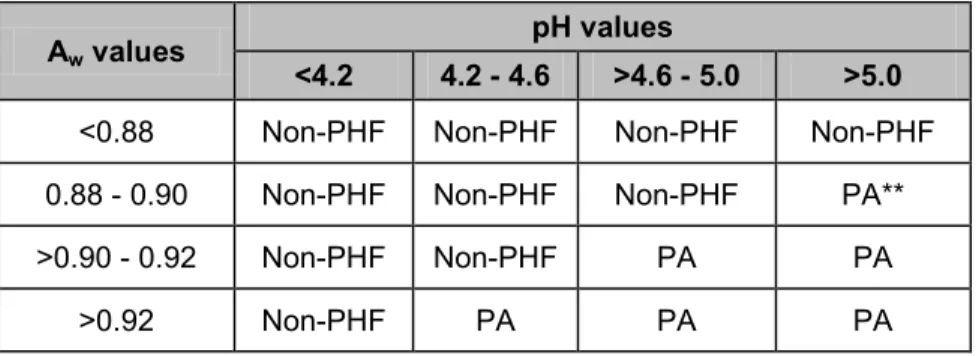
interaction of itsAW and PHvalues is designated as product assessment required (PA) in Table A or B of this subsection:
Table A. Interaction of pH and Aw for Control of Spores in Food Heat-treated to Destroy Vegetative Cells and Subsequently Packaged
Aw values pH values
4.6 or less >4.6 - 5.6 >5.6
≤0.92 non-PHF non-PHF non-PHF
>0.92 - .95 non-PHF non-PHF PA**
>0.95 non-PHF PA PA
** PA means Product Assessment required.
Table B. Interaction of pH and Aw for Control of Vegetative Cells and Spores in Food Not Heat-treated or Heat-treated but not Packaged*
Aw values pH values
<4.2 4.2 - 4.6 >4.6 - 5.0 >5.0
<0.88 Non-PHF Non-PHF Non-PHF Non-PHF
0.88 - 0.90 Non-PHF Non-PHF Non-PHF PA**
>0.90 - 0.92 Non-PHF Non-PHF PA PA
>0.92 Non-PHF PA PA PA
** PA means Product Assessment required.
(c) POTENTIALLY HAZARDOUS FOOD does not include:
(i) An air-cooled hard-boiled EGG with shell intact, or an EGG with the shell intact
that is not hard-boiled, but has been pasteurized to destroy all viable salmonellae;
(ii) A FOOD in an unopened HERMETICALLY SEALED CONTAINER that is
commercially processed to achieve and maintain commercial sterility under conditions of nonrefrigerated storage and distribution;
(iii) A FOOD that because of its PHorAWvalue, or interaction ofAWand PHvalues, is designated as a non-PHF FOOD in Table A or B of this subsection;
(iv) A FOOD that is designated as product assessment required (PA) in Table A
or B of this subsection and has undergone a product assessment showing that the growth or toxin formation of pathogenic microorganisms that are reasonably likely to occur in that FOOD is precluded due to:
(A) Intrinsic factors including added or natural characteristics of the FOOD
such as preservatives, antimicrobials, humectants, acidulants or nutrients;
(B) Extrinsic factors including environmental or operational factors that affect the FOOD such as packaging, modified atmosphere such as REDUCED OXYGEN PACKAGING, shelf life and use, or temperature range of storage and use; or
(C) A combination of intrinsic and extrinsic factors; or
(v) A FOOD that does not support the growth or toxic formation of pathogenic
microorganisms in accordance with (c)(i) or (iv) of this subsection even though the FOOD might contain a pathogenic microorganism or chemical or
(89) "POTLUCK" means an event where:
(a) People are gathered to share FOOD;
(b) People attending the event are expected to bring FOOD to share;
(c) There is no compensation provided for people bringing FOOD to the event;
(d) There is no charge for any FOOD or BEVERAGE provided at the event; and
(e) The event is not conducted for commercial purposes. (90) "POULTRY" means:
(a) Any domesticated bird (chickens, turkeys, ducks, geese, guineas, RATITES, or
squabs), whether live or dead, as defined in 9 C.F.R. 381.1 Poultry Products Inspection Regulations Definitions, Poultry; and
(b) Any migratory waterfowl or game bird, pheasant, partridge, quail, grouse, or pigeon, whether live or dead, as defined in 9 C.F.R. 362.1 Voluntary Poultry Inspection Regulations, Definitions.
(91) "PREMISES" means:
(a) The physical facility, its contents, and the contiguous land or property under the control of the PERMIT HOLDER; or
(b) The physical facility, its contents, and the land or property not described under (a) of this subsection if its facilities and contents are under control of the PERMIT HOLDER and might impact FOOD ESTABLISHMENT personnel, facilities, or operations,
and a FOOD ESTABLISHMENT is only one component of a larger operation such as a
health care facility, hotel, motel, school, recreational camp, or prison. (92) "PRESCHOOL."
(a) PRESCHOOL means a program that provides organized care and education for
children below the age required for kindergarten entry. A PRESCHOOL operates for two or more days per week with no child enrolled on a regular basis for more than four hours per day.
(b) A PRESCHOOL does not include:
(i) Programs where the parent or guardian is present at each session; (ii) Parent-child classes where the focus is on parent education; (iii) Short-term parks and recreation programs;
(iv) Informal parent and child groups; (v) Irregular babysitting;
(vi) Licensed child care; or
(vii) FOOD preparation and service operations otherwise under PERMIT or license
by the REGULATORY AUTHORITY.
(93) "PRIMAL CUT" means a basic major cut into which carcasses and sides of MEAT are
separated, such as beef round, pork loin, lamb flank, or veal breast.
(94) "PRIVATE EVENT" means a private gathering limited to members and guests of members
of a family, organization, or club, where the event is not open to the general public, and where FOOD is provided without compensation.
(95) "PUBLIC WATER SYSTEM" means a DRINKING WATER system that is operated in compliance
with chapters 246-290 and 246-291 WAC.
(96) "RATITE" means a flightless bird such as an emu, ostrich, or rhea.
(97) "READY-TO-EAT FOOD."
(a) READY-TO-EAT FOOD means FOOD that:
(i) Is in a form that is edible without additional preparation to achieve FOOD
safety, as specified under 03400 (1) through (3) or 03405 or 03425; or (ii) Is raw or partially cooked animal FOOD and the CONSUMER is advised as
(iii) Is prepared in accordance with a VARIANCE that is granted as specified under
03400 (4)(d); and
(iv) Might receive additional preparation for palatability or aesthetic, epicurean, gastronomic, or culinary purposes.
(b) READY-TO-EAT FOOD includes:
(i) Raw animal FOOD that is cooked as specified under 03400 or 03405, or
frozen as specified under 03425;
(ii) Raw fruits and vegetables that are washed as specified under 03318; (iii) Fruits and vegetables that are cooked for hot holding, as specified under
03410;
(iv) All POTENTIALLY HAZARDOUS FOOD that is cooked to the temperature and time
required for the specific FOOD under 03400 through 03445 and cooled as
specified under 03515;
(v) Plant FOOD for which further washing, cooking, or other processing is not
required for FOOD safety, and from which rinds, peels, husks, or shells, if
naturally present, are removed;
(vi) Substances derived from plants such as spices, seasonings, and sugar; (vii) A bakery item such as bread, cakes, pies, fillings, or icing for which further
cooking is not required for FOOD safety;
(viii) The following products that are produced in accordance with USDA guidelines and that have received a lethality treatment for pathogens: Dry, fermented sausages, such as dry salami or pepperoni; salt cured MEAT and POULTRY products, such as prosciutto ham, country cured ham, and Parma
ham; and dried MEAT and POULTRY products, such as jerky or beef sticks;
and
(ix) FOODS manufactured according to 21 C.F.R. Part 113, Thermally Processed
Low-Acid Foods Packaged in Hermetically Sealed Containers.
(98) "RED HIGH RISK FACTORS" are improper practices or procedures identified as the most
prevalent contributing factors to foodborne illness or injury, as listed on the Food Establishment Inspection Report form.
(99) "REDUCED OXYGEN PACKAGING."
(a) REDUCED OXYGEN PACKAGING means:
(i) The reduction of the amount of oxygen in a package by removing oxygen; displacing oxygen and replacing it with another gas or combination of gases; or otherwise controlling the oxygen content to a level below that normally found in the surrounding atmosphere (approximately twenty-one percent at sea level); and
(ii) A process as specified in (a)(i) of this subsection that involves a FOOD for
which the HAZARDSClostridium botulinum or Listeria monocytogenes require control in the final PACKAGED form.
(b) REDUCED OXYGEN PACKAGING includes:
(i) Vacuum packaging, in which air is removed from a package of FOOD and the
package is hermetically SEALED so that a vacuum remains inside the
package;
(ii) Modified atmosphere packaging, in which the atmosphere of a package of
FOOD is modified so that its composition is different from air but the
atmosphere might change over time due to the permeability of the packaging material or the respiration of the FOOD. Modified atmosphere
packaging includes reduction of the proportion of oxygen, total replacement of oxygen, or an increase in the proportion of other gases such as carbon dioxide or nitrogen;
(iii) Controlled atmosphere packaging, in which the atmosphere of a package of
FOOD is modified so that until the package is opened, its composition is
different from air, and continuous control of that atmosphere is maintained, such as by using oxygen scavengers or a combination of total replacement of oxygen, nonrespiring FOOD, and impermeable packaging material;
(iv) Cook chill packaging, in which cooked FOOD is hot filled into impermeable
bags which have the air expelled and are then SEALED or crimped closed.
The bagged FOOD is rapidly chilled and refrigerated at temperatures that
inhibit the growth of psychrotrophic pathogens; or
(v) Sous vide packaging, in which raw or partially cooked FOOD is placed in
hermetically SEALED, impermeable bag, cooked in the bag, rapidly chilled,
and refrigerated at temperatures that inhibit the growth of psychrotrophic pathogens.
(100) "REFUSE" means solid waste not carried by water through a SEWAGE system.
(101) "REGULATORY AUTHORITY" means the local, state, or federal enforcement body or
authorized representative having jurisdiction over the FOOD ESTABLISHMENT. The LOCAL BOARD OF HEALTH, acting through the LOCAL HEALTH OFFICER, is the REGULATORY AUTHORITY for the activity of a FOOD ESTABLISHMENT, except as otherwise provided by LAW.
(102) "REMINDER" means a written statement concerning the health RISK of consuming animal FOODS raw, undercooked, or without otherwise being processed to eliminate pathogens. (103) "RESERVICE" means the transfer of FOOD that is unused and returned by a CONSUMER
after being served or sold and in the possession of the CONSUMER, to another PERSON.
(104) "RESTRICT" means to limit the activities of a FOOD EMPLOYEE so that there is no RISK of
transmitting a disease that is transmissible through FOOD and the FOOD EMPLOYEE does
not work with exposed FOOD, clean EQUIPMENT, UTENSILS, LINENS; and unwrapped SINGLE-SERVICE or SINGLE-USE ARTICLES.
(105) "RESTRICTED EGG" means any check, dirty EGG, incubator reject, inedible, leaker, or loss
as defined in 9 C.F.R. 590.
(106) "RESTRICTED USE PESTICIDE" means a pesticide product that contains the active
ingredients specified in 40 C.F.R. 152.175 Pesticides classified for restricted use, and that is limited to use by or under the direct supervision of a certified operator.
(107) "RISK" means the likelihood that an adverse health effect will occur within a population as a result of a HAZARD in a FOOD.
(108) "SAFE MATERIAL" means:
(a) An article manufactured from or composed of materials that might not reasonably be expected to result, directly or indirectly, in their becoming a component or otherwise affecting the characteristics of any FOOD;
(b) An ADDITIVE that is used as specified in Section 409 of the federal Food, Drug, and Cosmetic Act; or
(c) Other materials that are not ADDITIVES and that are used in conformity with
applicable regulations of the FDA.
(109) "SANITIZATION" means the application of cumulative heat or chemicals on cleaned FOOD-CONTACT SURFACES that, when evaluated for efficacy, is sufficient to yield a
reduction of five logs, which is equal to a 99.999% reduction, of representative disease microorganisms of public health importance.
(110) "SEALED" means free of cracks or other openings that allow the entry or passage of
moisture.
(111) "SERVICE ANIMAL" means any dog that is individually trained to do work or perform tasks
for the benefit of an individual with a disability, including a physical, sensory, psychiatric, intellectual, or other mental disability, as specified in RCW 49.60.218.
(112) "SERVICING AREA" means an operating base location to which a MOBILE FOOD UNIT or
transportation vehicle returns regularly for such things as vehicle and EQUIPMENT
cleaning, discharging liquid or solid wastes, refilling water tanks and ice bins, and boarding FOOD.
(113) "SEWAGE" means liquid waste containing animal or vegetable matter in suspension or
(114) "SHELLFISH CONTROL AUTHORITY" means a state, federal, foreign, tribal, or other
government entity legally responsible for administering a program that includes certification of MOLLUSCAN SHELLFISH harvesters and DEALERS for interstate commerce.
(115) "SHELLSTOCK" means raw, in-shell MOLLUSCAN SHELLFISH.
(116) "SHIGA TOXIN-PRODUCING ESCHERICHIA COLI" (STEC) means any E. coli capable of
producing Shiga toxins (also called verocytotoxins or "Shiga-like" toxins). Examples of serotypes of STEC include both O157 and non-O157 E. coli. Also see
Enterohemorrhagic Escherichia coli.
(117) "SHUCKED SHELLFISH" means MOLLUSCAN SHELLFISH that have one or both shells
removed.
(118) "SINGLE-SERVICE ARTICLES" means TABLEWARE, carry-out UTENSILS, and other items such
as bags, containers, placemats, stirrers, straws, toothpicks, and wrappers that are designed and constructed for one-time, one-PERSON use after which they are intended
for discard.
(119) "SINGLE-USE ARTICLES."
(a) SINGLE-USE ARTICLES means UTENSILS and bulk FOOD containers designed and
constructed to be used once and discarded.
(b) SINGLE-USE ARTICLES includes items such as wax paper, butcher paper, plastic wrap, formed aluminum FOOD containers, jars, plastic tubs or buckets, bread
wrappers, pickle barrels, ketchup bottles, and number 10 cans which do not meet the materials, durability, strength, and cleanability specifications under 04100, 04200, and 04204 for multiuse UTENSILS.
(120) "SLACKING" means the process of moderating the temperature of a FOOD such as
allowing a FOOD to gradually increase from a temperature of -10°F (-23°C) to 25°F
(-4°C) in preparation for deep-fat frying or to facilitate even heat penetration during the cooking of previously block-frozen FOOD such as shrimp.
(121) "SMOOTH" means:
(a) A FOOD-CONTACT SURFACE having a surface free of pits and inclusions with a
cleanability equal to or exceeding that of (100 grit) number three stainless steel; (b) A non-FOOD-CONTACT SURFACE of EQUIPMENT having a surface equal to that of
commercial grade hot-rolled steel free of visible scale; and
(c) A floor, wall, or ceiling having an even or level surface with no roughness or projections that render it difficult to clean.
(122) "TABLEWARE" means eating, drinking, and serving UTENSILS for table use such as
flatware including forks, knives, and spoons; hollowware including bowls, cups, serving dishes, and tumblers; and plates.
(123) "TEMPERATURE MEASURING DEVICE" means a thermometer, thermocouple, thermistor, or
other device that indicates the temperature of FOOD, air, or water.
(124) "TEMPORARY FOOD ESTABLISHMENT" means a FOOD ESTABLISHMENT:
(a) Operating at a fixed location, with a fixed menu, for not more than twenty-one consecutive days in conjunction with a single event or celebration, such as a fair or festival; or
(b) Operating not more than three days a week at a fixed location, with a fixed menu, in conjunction with an APPROVED, recurring, organized event, such as a farmers
market.
(125) "USDA" means the United States Department of Agriculture.
(126) "UTENSIL" means a FOOD-contact implement or container used in the storage,
preparation, transportation, dispensing, sale, or service of FOOD, such as KITCHENWARE
or TABLEWARE that is multiuse, SINGLE-SERVICE, or SINGLE-USE; gloves used in contact
with FOOD; temperature sensing probes of FOODTEMPERATURE MEASURING DEVICES; and
(127) "VARIANCE" means a written document issued by the REGULATORY AUTHORITY that
authorizes a modification or waiver of one or more requirements of this chapter if, in the opinion of the REGULATORY AUTHORITY, a health HAZARD or nuisance will not result from
the modification or waiver.
(128) "VENDING MACHINE" means a self-service device that, upon insertion of a coin, paper
currency, token, card, or key, or by optional manual operation, dispenses unit servings of FOOD in bulk or in packages without the necessity of replenishing the device between
each vending operation.
(129) "VENDING MACHINE LOCATION" means the room, enclosure, space, or area where one or
more VENDING MACHINES are installed and operated and includes the storage areas and
areas on the PREMISES that are used to service and maintain the VENDING MACHINES.
(130) "WAREWASHING" means the cleaning and sanitizing of utensils and FOOD-CONTACT SURFACES of EQUIPMENT.
(131) "WHOLE-MUSCLE, INTACT BEEF" means whole muscle beef that is not INJECTED, MECHANICALLY TENDERIZED, reconstructed, or scored and marinated, from which beef
PART 2: MANAGEMENT AND PERSONNEL
Subpart A - Supervision
02100 Responsibility--Assignment (2009 FDA Food Code 2-101.11).
(1) Except as specified in subsection (2) of this section, the PERMIT HOLDER shall be the PERSON IN CHARGE or shall designate a PERSON IN CHARGE and shall ensure that a PERSON IN CHARGE is present at the FOOD ESTABLISHMENT during all hours of operation.
(2) In a FOOD ESTABLISHMENT with two or more separately PERMITTED departments that are
the legal responsibility of the same PERMIT HOLDER and that are located on the same PREMISES, the PERMIT HOLDER may, during specific time periods when FOOD is not being
prepared, PACKAGED, or served, designate a single PERSON IN CHARGE who is present on
the PREMISES during all hours of operation, and who is responsible for each separately PERMITTEDFOOD ESTABLISHMENT on the PREMISES.
02105 Demonstration of knowledge (2009 FDA Food Code 2-102.11).
Based on the RISKS of foodborne illness inherent to the FOOD operation, during inspections and
upon request, the PERSON IN CHARGE shall demonstrate to the REGULATORY AUTHORITY
knowledge of foodborne disease prevention, application of the HAZARD analysis and CRITICAL CONTROL POINT principles, and the requirements of this chapter. The PERSON IN CHARGE shall
demonstrate this knowledge by:
(1) Complying with this chapter by having no violations of RED HIGH RISK FACTORS during the
current inspection;
(2) Being a certified FOOD protection manager who has shown proficiency of required
information through passing a test that is part of an ACCREDITED PROGRAM; or
(3) Responding correctly to the inspector's questions as they relate to the specific FOOD
operation. The areas of knowledge include:
(a) Describing the relationship between the prevention of foodborne disease and the personal hygiene of a FOOD EMPLOYEE;
(b) Explaining the responsibility of the PERSON IN CHARGE for preventing the
transmission of foodborne disease by a FOOD EMPLOYEE who has a disease or
medical condition that might cause foodborne disease;
(c) Describing the symptoms associated with the diseases that are transmissible through FOOD;
(d) Explaining the significance of the relationship between maintaining the time and temperature of POTENTIALLY HAZARDOUS FOOD and the prevention of foodborne
illness;
(e) Explaining the HAZARDS involved in the consumption of raw or undercooked MEAT, POULTRY, EGGS, and FISH;
(f) Stating the required FOOD temperatures and times for safe cooking of POTENTIALLY HAZARDOUS FOOD including MEAT, POULTRY, EGGS, and FISH;
(g) Stating the required temperatures and times for the safe refrigerated storage, hot holding, cooling, and reheating of POTENTIALLY HAZARDOUS FOOD;
(h) Describing the relationship between the prevention of foodborne illness and the management and control of the following:
(i) Cross contamination;
(ii) Hand contact with READY-TO-EAT FOODS; (iii) Handwashing; and
(iv) Maintaining the FOOD ESTABLISHMENT in a clean condition and in good repair;
(i) Describing FOODS identified as MAJOR FOOD ALLERGENS and the symptoms that a MAJOR FOOD ALLERGEN could cause in a sensitive individual who has an allergic
(j) Explaining the relationship between FOOD safety and providing EQUIPMENT that is:
(i) Sufficient in number and capacity; and
(ii) Properly designed, constructed, located, installed, operated, maintained, and cleaned;
(k) Explaining correct procedures for cleaning and SANITIZING UTENSILS and FOOD-CONTACT SURFACES of EQUIPMENT;
(l) Identifying the source of water used and measures taken to ensure that it remains protected from contamination such as providing protection from backflow and precluding the creation of cross connections;
(m) Identifying POISONOUS OR TOXIC MATERIALS in the FOOD ESTABLISHMENT and the
procedures necessary to ensure that they are safely stored, dispensed, used, and disposed of according to LAW;
(n) Identifying CRITICAL CONTROL POINTS in the operation from purchasing through sale
or service that when not controlled can contribute to the transmission of foodborne illness and explaining steps taken to ensure that the points are controlled in accordance with the requirements of this chapter;
(o) Explaining the details of how the PERSON IN CHARGE and FOOD EMPLOYEES comply
with the HACCP PLAN if a plan is required by the LAW, this chapter, or an agreement
between the REGULATORY AUTHORITY and the FOOD ESTABLISHMENT;
(p) Explaining the responsibilities, rights, and authorities assigned by this chapter to the:
(i) FOOD EMPLOYEE;
(ii) CONDITIONAL EMPLOYEE;
(iii) PERSON IN CHARGE; and (iv) REGULATORY AUTHORITY;
(q) Explaining how the PERSON IN CHARGE, FOOD EMPLOYEES and CONDITIONAL EMPLOYEES comply with reporting responsibilities and exclusion or RESTRICTION of FOOD EMPLOYEES.
02110 Duties – Food protection manager certification (2009 FDA Food Code 2-102.20).
A PERSON IN CHARGE who is certified by a FOOD protection manager certification program is
deemed to comply with 02105(2).
The certification program must be evaluated and listed by a Conference for Food Protection-recognized accrediting agency as conforming to the Conference for Food Protection Standards for Accreditation of Food Protection Manager Certification Programs.
02115 Duties – Person in charge (2009 FDA Food Code 2-103.11). The PERSON IN CHARGE shall ensure that:
(1) FOOD ESTABLISHMENT operations are not conducted in a private home or in a room used
as living or sleeping quarters as specified under 06290;
(2) PERSONS unnecessary to the FOOD ESTABLISHMENT operation are not allowed in the FOOD preparation, FOOD storage, or WAREWASHING areas, except that brief visits and
tours may be authorized by the PERSON IN CHARGE if steps are taken to ensure that
exposed FOOD; clean EQUIPMENT, UTENSILS, and LINENS; and unwrapped SINGLE-SERVICE
and SINGLE-USE ARTICLES are protected from contamination;
(3) EMPLOYEES and other PERSONS such as delivery and maintenance PERSONS and
pesticide applicators entering the FOOD preparation, FOOD storage, and WAREWASHING
areas comply with this chapter;
(4) EMPLOYEES are effectively cleaning their hands by routinely monitoring the EMPLOYEES'
handwashing;
(5) EMPLOYEES are visibly observing FOODS as they are received to determine that they are
from APPROVED sources, delivered at the required temperatures, protected from
contamination, not ADULTERATED, and accurately presented, by routinely monitoring the EMPLOYEES' observations and periodically evaluating FOODS upon their receipt;
(6) EMPLOYEES are properly cooking POTENTIALLY HAZARDOUS FOOD, being particularly
careful in cooking those FOODS known to cause severe foodborne illness and death,
such as EGGS and COMMINUTEDMEATS, through daily oversight of the EMPLOYEES' routine
monitoring of the cooking temperatures using appropriate TEMPERATURE MEASURING DEVICES properly scaled and calibrated as specified under 04220 and 04580(2);
(7) EMPLOYEES are using proper methods to rapidly cool POTENTIALLY HAZARDOUS FOODS
that are not held hot or are not for consumption within four hours, through daily oversight of the EMPLOYEES' routine monitoring of FOOD temperatures during cooling;
(8) CONSUMERS who order raw or partially cooked READY-TO-EAT FOODS of animal origin are
informed as specified under 03620 that the FOOD is not cooked sufficiently to ensure its
safety;
(9) EMPLOYEES are properly SANITIZING cleaned multiuse EQUIPMENT and UTENSILS before they are reused, through routine monitoring of solution temperature and exposure time for hot water SANITIZING, and chemical concentration, pH, temperature, and exposure
time for chemical SANITIZING;
(10) CONSUMERS are notified that clean TABLEWARE is to be used when they return to
self-service areas such as salad bars and buffets as specified under 03345;
(11) Except when approval is obtained from the REGULATORY AUTHORITY as specified under
03300(4), EMPLOYEES are preventing cross-contamination of READY-TO-EAT FOOD with
bare hands by properly using suitable UTENSILS such as deli tissue, spatulas, tongs, SINGLE-USE gloves, or dispensing EQUIPMENT;
(12) EMPLOYEES are properly trained in FOOD safety, including FOOD allergy awareness, as it
relates to their assigned duties; and
(13) FOOD EMPLOYEES and CONDITIONAL EMPLOYEES are informed of their responsibility to report in accordance with LAW, to the PERSON IN CHARGE, information about their health
and activities as they relate to diseases that are transmissible through FOOD, as
specified under 02205.
02120 Food worker cards.
(1) The PERMIT HOLDER and PERSON IN CHARGE of the FOOD ESTABLISHMENT shall ensure that
all FOOD EMPLOYEES are in compliance with the provisions of chapter 69.06 RCW and
chapter 246-217 WAC for obtaining and renewing valid FOOD WORKER CARDS.
(2) The PERMIT HOLDER and PERSON IN CHARGE of the FOOD ESTABLISHMENT shall display or
file the original or a copy of the FOOD WORKER CARD of each FOOD EMPLOYEE at the EMPLOYEE'S place of employment, to be available for inspection by the REGULATORY AUTHORITY upon request.
(3) This section does not add to, or remove from, the provisions of chapter 69.06 RCW and chapter 246-217 WAC regarding FOOD WORKER CARDS.
Subpart B - Employee Health
02200 Employee health--Reporting policy.
The PERMIT HOLDER shall require FOOD EMPLOYEES and CONDITIONAL EMPLOYEES to report to the
PERSON IN CHARGE information about their health and activities as they relate to diseases that
are transmissible through FOOD. A FOOD EMPLOYEE or CONDITIONAL EMPLOYEE shall report the
information in a manner that allows the PERSON IN CHARGE to reduce the RISK of foodborne
disease transmission, including providing necessary additional information, such as the date of onset of illness symptoms.
02205 Employee health--Reportable history of illness.
(1) FOOD EMPLOYEES and CONDITIONAL EMPLOYEES shall report to the PERSON IN CHARGE if
they:
(a) Have diarrhea, vomiting, sore throat with fever, or jaundice (yellow skin or eyes), except as specified under 02235;
(b) Have a lesion containing pus such as a boil or infected wound that is open or draining and is:
(i) On the hands or wrist;
(ii) On exposed portions of the arms; or
(iii) On other parts of the body, unless the lesion is covered by a dry, durable, tight-fitting bandage; or
(c) Have an illness diagnosed by a HEALTH PRACTITIONER as due to an infection with:
(i) Hepatitis A virus;
(ii) Salmonella Typhi (Typhoid Fever); (iii) Shigella; or
(iv) Enterohemorrhagic or SHIGA TOXIN-PRODUCING ESCHERICHIA COLI.
(2) In addition to the reporting in subsection (1) of this section, FOOD EMPLOYEES and CONDITIONAL EMPLOYEES in a FOOD ESTABLISHMENT serving a HIGHLY SUSCEPTIBLE POPULATION shall report to the PERSON IN CHARGE if they:
(a) Have an illness diagnosed by a HEALTH PRACTITIONER as due to an infection with
Norovirus or Salmonella other than Salmonella Typhi;
(b) Have consumed or prepared FOOD implicated in a CONFIRMED DISEASE OUTBREAK;
(c) Have attended or worked in a setting where there is a CONFIRMED DISEASE OUTBREAK;
(d) Live in the same household as someone who works at or attended a setting where there is a CONFIRMED DISEASE OUTBREAK; or
(e) Live in the same household as or have consumed FOOD prepared by a PERSON who
is infected or ill with:
(i) Enterohemorrhagic or SHIGA TOXIN-PRODUCING ESCHERICHIA COLI;
(ii) Shigella;
(iii) Salmonella Typhi; or
(iv) Hepatitis A virus or jaundice.
02210 Employee health--Prohibit a conditional employee from becoming a food employee. The PERSON IN CHARGE shall ensure that a CONDITIONAL EMPLOYEE who reports symptoms or a
diagnosed disease as described in 02205 (1) or (2)(a) does not become a FOOD EMPLOYEE until
they meet the requirements for the removal of RESTRICTION or EXCLUSION in 02245 and 02250.
A CONDITIONAL EMPLOYEE that reports a history of exposure to disease in 02205 (2)(b) through
(e) may not become a FOOD EMPLOYEE in a FOOD ESTABLISHMENT serving a HIGHLY SUSCEPTIBLE POPULATION until the requirements in 02250 are met.
02215 Employee health--Notify health officer.
The PERSON IN CHARGE shall notify the LOCAL HEALTH OFFICER and the REGULATORY AUTHORITY, if
not the same agency, when a FOOD EMPLOYEE is:
(1) Jaundiced; or
(2) Diagnosed with an illness due to a pathogen as specified under 02205 (1)(c) and (2)(a). 02220 Employee health--Conditions of exclusion.
Except as provided in 02235, the PERSON IN CHARGE of a FOOD ESTABLISHMENT shall EXCLUDE
any FOOD EMPLOYEE who is known to have:
(1) Diarrhea or vomiting; (2) Jaundice;
(3) A diagnosed infection (symptomatic or ASYMPTOMATIC) with Salmonella Typhi, Shigella,
Enterohemorrhagic or SHIGA TOXIN-PRODUCING ESCHERICHIA COLI, or hepatitis A virus;
(4) A sore throat with fever or a diagnosed infection with Norovirus or Salmonella other than
Salmonella Typhi, and works in a FOOD ESTABLISHMENT serving a HIGHLY SUSCEPTIBLE POPULATION; or
(5) A previous infection with Salmonella Typhi within the past three months without having antibiotic therapy.
02225 Employee health--Conditions of restriction.
The PERSON IN CHARGE of a FOOD ESTABLISHMENT shall RESTRICT any FOOD EMPLOYEE who is known to have:
(1) A lesion that appears inflamed or contains pus and that is not covered;
(2) Exposure to foodborne pathogens as described in 02205 (2)(b) through (e) and works in a FOOD ESTABLISHMENT serving a HIGHLY SUSCEPTIBLE POPULATION; or
(3) A sore throat with fever.
02230 Employee health--Aiding illness investigations.
The PERSON IN CHARGE of a FOOD ESTABLISHMENT and all EMPLOYEES shall cooperate with the REGULATORY AUTHORITY and the LOCAL HEALTH OFFICER investigating:
(1) A foodborne disease outbreak or a suspected foodborne disease outbreak; or
(2) A FOOD EMPLOYEE suspected to be infected with a disease agent that can be transmitted
from a FOOD EMPLOYEE through food.
02235 Employee health--Other conditions.
A FOOD EMPLOYEE with a symptom of gastrointestinal illness, such as vomiting, diarrhea, or
jaundice, may work in a FOOD ESTABLISHMENT without special RESTRICTION, provided that the FOOD EMPLOYEE furnishes written medical documentation to the REGULATORY AUTHORITY from a HEALTH PRACTITIONER that the symptom is due to a medical condition not transmissible through FOOD, such as Crohn's disease, irritable bowel syndrome, ulcerative colitis, or hepatitis C.
02240 Employee health--Complying with LOCAL HEALTH OFFICER.
The PERSON IN CHARGE of a FOOD ESTABLISHMENT and FOOD EMPLOYEES shall comply with orders
issued by the LOCAL HEALTH OFFICER for EXCLUDINGEMPLOYEES from a FOOD ESTABLISHMENT or RESTRICTINGEMPLOYEE activities due to a diagnosed or suspected infection by a disease agent
that can be transmitted from a FOOD EMPLOYEE through FOOD until the LOCAL HEALTH OFFICER
rescinds the order.
02245 Employee health--Removal of exclusion or restriction based on diagnosis.
Except as specified under 02250, the PERSON IN CHARGE shall obtain approval from the LOCAL HEALTH OFFICER before reinstating a FOOD EMPLOYEE who was RESTRICTED or EXCLUDED based
on:
(1) The 19th edition of the Control of Communicable Disease Manual, published by the American Public Health Association; or
(2) Other measures the LOCAL HEALTH OFFICER deems necessary based on his or her
professional judgment, current standards of practice and the best available medical and scientific information.
02250 Employee health--Removal of exclusion or restriction based on symptoms.
The PERSON IN CHARGE shall adhere to the following conditions when reinstating a FOOD EMPLOYEE who was RESTRICTED or EXCLUDED due to:
(1) Diarrhea or vomiting: Remove EXCLUSION when ASYMPTOMATIC for more than
twenty-four hours;
(2) Jaundice: Remove EXCLUSION with approval of the LOCAL HEALTH OFFICER;
(3) Sore throat with fever: Remove EXCLUSION when ASYMPTOMATIC; or
(4) Uncovered infected wound or pustular boil: Remove RESTRICTION when skin, wound, or
pustular boil is properly protected by an impermeable cover and, if on the hand or wrist, with a SINGLE-USE glove.
02255 Employee health--Removal of exclusion or restriction based on exposure.
The PERSON IN CHARGE shall adhere to the following conditions when reinstating a FOOD EMPLOYEE who was RESTRICTED due to:
(1) Exposure to Norovirus, Shigella spp., or Enterohemorrhagic or SHIGA TOXIN-PRODUCING
ESCHERICHIA COLI: Remove RESTRICTION when more than three days since potential
exposure or more than three days since household contact became ASYMPTOMATIC;
(2) Exposure to Salmonella Typhi: Remove RESTRICTION when more than fourteen days
since the last potential exposure or more than fourteen days since household contact became ASYMPTOMATIC;
(3) Exposure to hepatitis A: Remove RESTRICTION when:
(a) The FOOD EMPLOYEE is immune to hepatitis A virus infection because of prior illness
from hepatitis A, vaccination, or IgG administration; or
(b) More than thirty days have passed since the last day the FOOD EMPLOYEE was
potentially exposed or since the FOOD EMPLOYEE'S household contact became
jaundiced.
Subpart C - Personal Cleanliness
02300 Hands and arms--Clean condition (2009 FDA Food Code 2-301.11).
FOOD EMPLOYEES shall keep their hands and exposed portions of their arms clean.
02305 Hands and arms--Cleaning procedure (2009 FDA Food Code 2-301.12).
(1) Except as specified in subsection (4) of this section, FOOD EMPLOYEES shall clean their
hands and exposed portions of their arms, including surrogate prosthetic devices for hands or arms for at least 20 seconds, using a cleaning compound in a HANDWASHING SINK that is equipped as specified under 05210 and Part 6, Subpart C.
(2) FOOD EMPLOYEES shall use the following cleaning procedure in the order stated to clean
their hands and exposed portions of their arms, including surrogate prosthetic devices for hands and arms:
(a) Rinse under clean, running warm water;
(b) Apply an amount of cleaning compound recommended by the cleaning compound manufacturer;
(c) Rub together vigorously for at least ten to fifteen seconds while:
(i) Paying particular attention to removing soil from underneath the fingernails during the cleaning procedure; and
(ii) Creating friction on the surfaces of the hands and arms or surrogate prosthetic devices for hands and arms, finger tips, and areas between the fingers;
(d) Thoroughly rinse under clean, running warm water; and
(e) Immediately follow the cleaning procedure with thorough drying using a method as specified under 06310.
(3) To avoid recontaminating their hands or surrogate prosthetic devices, FOOD EMPLOYEES
may use disposable paper towels or similar clean barriers when touching surfaces such as manually operated faucet handles on a HANDWASHING SINK or the handle of a
restroom door.
(4) If APPROVED and capable of removing the types of soils encountered in the FOOD
operations involved, an automatic handwashing facility may be used by FOOD EMPLOYEES to clean their hands or surrogate prosthetic devices.