Abstract— Offshore wind and tidal current are of the most common energy resources for generating electricity in the near future because of the oil problems (crises and pollution). The dynamic model of the offshore wind and tidal current is very important topic for dealing with these renewable energies. This paper describes the overall dynamic models of offshore wind and tidal current turbine using three different types of generators (doubly fed induction generator (DFIG), squirrel cage induction generator (SCIG) and direct drive permanent magnet synchronous generator (DDPMSG)). The state space for all types of the generators are concluded. All models are validated using a common property of the generator for the validation.
Index Terms— Offshore wind, Tidal current, Direct drive permanent magnet synchronous generator (DDPMSG), Doubly fed induction generator (DFIG).
NOMENCLATURE
Vtide Tidal current speeds.
Vnt Neap tide speed.
Vst Spring tide speed.
Pts Tidal in-stream power.
Density of the water (1025 kg/m3)
A Cross-sectional area perpendicular to the flow direction.
Tm Mechanical torque applied to the turbine.
A Cross-sectional area perpendicular to the flow direction.
Cp Marine turbine blade design constant in the range of 0.35-0.5.
ωs ,ωr ,
ωt
Stator, rotor electrical angular velocities, and turbine speed at hub height upstream the rotor.
Te Electrical torque of the generator.
Ds Shaft stiffness damping.
Ht ,Hg Turbine and generator inertia constants.
Ks Shaft stiffness coefficient.
Ɵt ,Ɵr Turbine and generator rotor angles.
β Tidal turbine pitch angle.
S Rotor slip.
d, q Indices for the direct and quadrature axis components.
s, r Indices of the stator and the rotor.
Manuscript received June 21, 2013; revised July 13, 2013. This work was supported in part by the Egyptian Governoment and Dalhousie University.
Hamed H. H. Aly was with Zagazig University, Zagazig, Egypt. He is now with the Department of Electrical & Computer Engineering at Dalhousie University, NS, B3H 4R2, Canada. (e-mail: [email protected]). M. E. El-Hawary is a professor at the Department of Electrical and Computer Engineering, Dalhousie University, Halifax, NS, B3H 4R2, Canada (e-mail: [email protected]).
v, R, i, ψ
Voltage, resistance, current, and flux linkage of the generator.
, Coefficients for the proportional-integral controller of the pitch controller.
Pg, PDC Active power of the AC terminal at the grid side converter and DC link power respectively.
vDg , vQg D and Q axis voltages of the grid side converter.
iDg ,iQg D and Q axis currents of the grid side converter.
C Capacitance of the capacitor.
vDC , iDC Voltage and current of the capacitor.
Kp1, Kp2,
Kp3
Proportional controller constants for the generator side converter controller
Ki1, Ki2 ,Ki3
Integral controller constants for the generator side converter controller.
iDg, iQg D and Q axis grid currents.
vDg, vQg D and Q axis grid voltages.
Kp4, Kp5,
Kp6
Proportional controller constants for the grid side converter.
Ki4, Ki5,
Ki6
Integral controller constants for the grid side converter.
Xc Grid side smoothing reactance.
State variable
I. INTRODUCTION
ind is hardly predictable source of energy. Tidal current turbines extract electric energy from the water. Tidal currents are fluctuating, intermittent but a predictable source of energy compared to wind. Its use is very effective as it relies on the same technologies used in wind turbines. The electrical-side layout and modeling approaches used in tidal in-stream systems are similar to those used for wind and offshore wind systems. The speed of water currents is lower than wind speed, while the water density is higher than the air density and as a result wind turbines operate at higher rotational speeds and lower torque than tidal in-stream turbines which operate at lower rotational speed and high torque [1-5].
The easier predictability of the tidal in-stream energy resource makes it easier to integrate in an electric power grid. Recognizing that future ocean energy resources are available far from load centers and in areas with limited grid capacity will result in challenges and technical limitations. With the growing penetration of tidal current energy into the electric power grid system, it is very important to study the impact of tidal current turbines on the stability of the power system grid and to do that we should model the overall
Modeling of Offshore Wind and Tidal Current
Turbines for Stability Analysis
Hamed H. H. Aly and M. E. El-Hawary
system. The model of the ocean energy system consists of three stages. The first stage contains the fluid mechanical process. The second stage consists of the mechanical conversion and depends on the relative motion between bodies. This motion may be mechanical transmission and then using mechanical gears or may be depending on the hydraulic pumps and hydraulic motors. The third stage consists of the electromechanical conversion to the electrical grid [4-9].
II. OFFSHORE WIND AND TIDAL CURRENT MODEL USING IG
A. The Speed Signal Resource Model for the Tidal Current and Offshore Wind
The tidal current speed may be expressed as a function of the spring tide speed, neap tide speed and tides coefficient. Paper (10) proposed different algorithm models for the tidal current speed.
The Wind Speed Signals Model (vw)consists of four components related to the mean wind speed (vmw), the wind speed ramp (vrw) (which is considered as the steady increase in the mean wind speed), the wind speed gust (vgw), and the turbulence (vtw). vw = vmw + vgw + vrw + vtw
The mean wind speed is a constant; a simple ramp function will be used for ramp component (characterized by the amplitude of the wind speed ramp (Ar (m/s)), the starting time (Tsr), and the ending time (Ter)). The wind speed gust component is characterized by the amplitude of the wind speed gust (Ag (m/s)), the starting time (Tsg), and the ending time (Teg). The wind speed gust may be expressed as a sinusoidal function. The most used models are given by:
vgw= Ag(1-cos(2(t/Dg-Tsg/Dg))) Tsg ≤ t≤ Teg
vgw =0 t< Tsg or t >Teg Dg= Teg - Tsg
A triangular wave is used to represent the turbulence function which has adjustable frequency and amplitude [11].
B. The Rotor Model
For the offshore wind the rotor model represents the conversion of kinetic energy to mechanical energy. The wind turbine is characterized by Cp (wind power coefficient), λ (tip speed ratio), and β (pitch angle). λ =
ωtR/vw , where R is the blade length in m, vw is the wind speed in m/s, and ωt is the wind turbine rotational speed in rad/sec. CP-λ-β curves are manufacturer-dependent but there is an approximate relation expressed as
,
Cf is the wind turbine blade design constant. The rotor model may be represented by using the equation of the power extracted from the wind (Pw = ) [11]. For the tidal current turbines the rotor model may be represented by using the equation of the power extracted from the wind (Pw = ),
The power (Pts) may be found using: Pts = ½ A(Vtide) 3
. The turbine harnesses a fraction of this power, hence the power output may be expressed as: Pt = ½ CpA(Vtide)3. The power output is proportional to the cube of the velocity. The velocity at the bottom of the channel is lower than at the water column above seabed. The mechanical torque applied to the turbine (Tm) can be expressed as [4-9]:
The shaft system for tidal current and offshore turbines may be represented by a two mass system one for the turbine and the other for the generator as shown:
2Ht
= Tt – Ks(Ɵr-Ɵt) – Ds (ωr- ωt) (2)
2Hg
= Te - Ks(Ɵr-Ɵt) – Ds (ωr- ωt) (3) Ɵtr = Ɵr-Ɵt (4) Ɵ
= ωr- ωt (5) There is a ratio for the torsion angles, damping and stiffness that need to be considered when one adds a gear box as all above calculations must be referred to the generator side and calculated as : a= ,
,
, a2 ,
=a2 . The same model used for the offshore wind is used for tidal in-stream turbines; however, there is a number of differences in the design and operation of marine turbines due to the changes in force loadings, immersion depth, and different stall characteristics.
C. Dynamic Model of DFIG
The DFIG model is developed using a synchronously rotating d-q reference frame with the direct-axis oriented along the stator flux position. The reference frame rotates at the same speed as the stator voltage. The stator and rotor active and reactive power are given by [4-10]:
Ps=3/2( vds ids + vqs iqs ) , Pr= 3/2(vdr idr + vqr iqr ) (6)
Pg= Ps + Pr (7)
Qs=3/2(vqs ids - vds iqs ) , Qr=3/2 (vqr idr - vdr iqr ) (8)
The model of the DFIG can be described as:
vds = -Rs ids - ωs ψqs + (9)
vqs = -Rs iqs + ωs ψds + (10)
vdr = -Rr idr - s ωs ψqr + (11)
vqr = -Rr iqr + s ωs ψdr + (12) Ψds = -Lss ids - Lm idr , Ψqs = -Lss iqs - Lm iqr (13) Ψdr = -Lrr idr - Lm ids , Ψqr = - Lrr iqr - Lm iqs (14)
s =( ωs –ωr )/ωs (15)
= -ωs
(16)
Where, Lss= Ls+ Lm, Lrr= Lr+ Lm, Ls, Lrand Lmare the stator leakage, rotor leakage and mutual inductances, respectively. The previous model may be reduced by neglecting stator transients and is described as follows:
vds = -Rs ids + Xˈ iqs + ed (17) vqs = -Rs iqs - Xˈ ids + eq (18)
(19)
(20)
The components of the voltage behind the transient are
and . The stator reactance
X = ωs Lss = Xs +Xm, and the stator transient reactance Xˈ =
ωs (Lss – Lm 2
/Lrr) = Xs + (Xr Xm)/ (Xr + Xm). The transient open circuit time constant is To = Lrr/Rr = (Lr +Lm)/Rr, and the electrical torque is Te= (idsiqr-iqsidr)Xm/ . Figure (1) shows d and q – axis equivalent circuit of DFIG.
d – axis equivalent circuit of DFIG
q – axis equivalent circuit of DFIG Figure (1) d and q – axis equivalent circuit of DFIG.
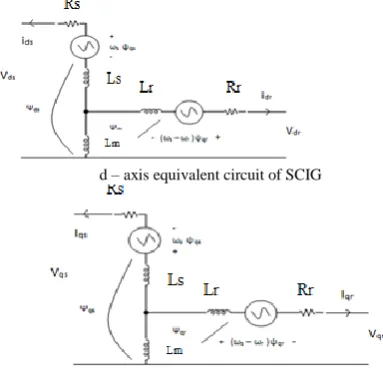
d – axis equivalent circuit of SCIG
q – axis equivalent circuit of SCIG Figure (2) d and q – axis equivalent circuit of FSIG
D. Dynamic Model of SCIG
In the SCIG the rotor is short circuited and so, the stator voltages are the same as the DFIG. In the SCIG there are capacitors to provide the induction generator magnetizing current and for compensation. Figure (2) d and q – axis equivalent circuit of FSIG.
E. The Pitch Controller Model
The pitch controller is used to adjust the tidal current turbine to achieve a high speed magnitude. This may be represented by a PI controller with a transfer function + .
Figure (3) Pitch angle control block
β=( + )ωt (21)
=
+ ωt (22)
F. The Converter Model
A converter feeds or takes power from the rotor circuit and gives a variable speed (a partial scale power converter used). The rotor side of the DFIG is connected to the grid via a
back to back converter. The converter at the side connected to the grid is called supply side converter (SSC) or grid side converter (GSC) while the converter connected to the rotor is the rotor side converter (RSC). The RSC operates in the stator flux reference frame. The direct axis component of the rotor current acts in the same way as the field current as in the synchronous generator and thus controls the reactive power change. The quadrature component of the rotor current is used to control the speed by controlling the torque and the active power change. Thus the RSC governs both the stator-side active and reactive powers independently. The GSC operates in the stator voltage reference frame. The
d-axis current of the GSC controls the DC link voltage to a constant level, and the q-axis current is used for reactive power control. The GSC is used to supply or draw power from the grid according to the speed of the machine. If the speed is higher than synchronous speed it supplies power, otherwise it draws power from the grid but its main objective is to keep dc-link voltage constant regardless of the magnitude and direction of rotor power The back to back converter using a DC link is shown in Figure (4). The balanced power equation is given by [13, 14]:
Pr=Pg+PDC (23)
PDC=vDCiDC=-CvDC
, Pg=vDgiDg+vQgiQg (24)
CvDC
= vDgiDg+vQgiQg - vdr idr - vqr iqr (25)
Figure (4) Back to back converter
G. Rotor Side Converter Controller Model
Figure (5) Generator side converter controller
The rotor side converter controller used here is represented by four states ( , , and ), is related to the difference between the generated power of the stator and the reference power that is required at a certain time, is related to the difference between the quadrature axis generator rotor current and the reference current that is required at a certain time, is related to the difference between the stator terminal voltage and the reference
Lm
+
[image:3.595.70.234.50.248.2] [image:3.595.69.261.283.477.2] [image:3.595.312.535.478.663.2]voltage that is required at a certain time, and is related to the difference between the direct axis generator rotor current and the reference current that is required at a certain time [13, 14]. Figure (5) shows the rotor side converter controller. This is described by equations (26-34).
= Pref -Ps (26)
= - Ki1/ Kp1x1 +1/ Kp1 iqr_ref (27)
= iqr_ref -iqr (28)
= Kp1 + Ki1 x1 - iqr (29)
=- / x2 +1/ vqr - ωsLm/ ids -ωsLrr/ idr +
(Lm/ ) idsωr +(Lrr/ )idrωr
(30)
= vs_ref- vs (31)
= - Ki3/ Kp3x3 +1/ Kp3 idr_ref (32)
= idr_ref- idr (33)
=- / x4 +1/ vdr - ωsLm/ iqs -ωsLrr/ iqr +
(Lm/ ) iqsωr +(Lrr/ )iqrωr
(34)
H. Grid Side Converter Controller Model
The grid side converter controller used here is represented by four states ( , , and ), x5 is related to the difference between the DC voltage and the reference DC voltage required at a certain time, x6 related to the difference between the grid terminal voltage and the reference terminal voltage required at a certain time, x6 is a combination of x5 and direct axis grid current and x8 is a combination of x6 and quadrature axis grid current as shown in equations (35-40). Figure (6) shows the grid side converter controller.
Figure (6) Grid side converter controller
= vDC_ref -vDC (35)
= Kp4 +Ki4x5-iDg (36)
= vt_ref –vt (37)
= Kp6 +Ki6x7-iQg (38)
vDg=Kp5 +Ki5x6+XciQg (39)
vQg=Kp5 +Ki5x8- XciDg (40)
III. TIDAL CURRENT TURBINE MODEL USING DDPMSG
A. The Dynamic Modeling of The DDPMSG
The DDPMSG can be modeled as the following [3, 13]: vds =-Rs × ids - ωs × ψqs + (41) vqs =-Rs × iqs + ωs × ψds + (42) The flux linkages and the torque can be expressed as:
Ψds = - Ld × ids + ψf (43)
Ψqs = -Lq × iqs
Te= (3/2)p iqs ((Ld-Lq) ids + ψf )
(44) (45)
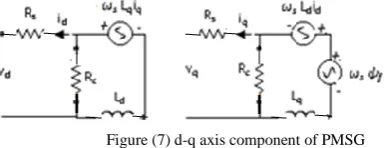
Ld, and Lq are the direct and quadrature inductances of the stator. Ψf is the excitation field linkage, and p is the number of pair poles. Figure (7) shows the d-q axis component of the DDPMSG. In this paper for simplicity we will assume that Ld=Lq=Ls , and so the generator model can be rewritten in a state space representation as:
Ls - vds -Rs × ids + Ls× ωs × (46)
Ls -vqs -Rs × iqs - Ls× ωs × +ω × ψf (47) The converters models used for the DFIG are the same converters that used for the DDPMSG keeping in mind that a full scale power converter is used.
Figure (7) d-q axis component of PMSG
B. The Generator Side Converter Controller Model for DDPMSG
The generator side converter controller used here is represented by two states only (x1, and x2), x1 related to the difference between the generated power and the reference power that required at a certain time and x2 related to the difference between the direct axis generator current and the reference current that required at a certain time [13-15]. Figure (8) shows the generator side converter controller described by:
=Ps-Pref
=ids-ids_ref
(48) (49)
vqs=Kp1 +Ki1x1-Lswids
vds=Kp2 +Ki2x2+Lswiqs
(50) (51) Where: Kp1, Kp2, represent the proportional controller constants and Ki1, Ki2 represent the integral controller constants for the generator side converter controller.
Figure (8) Generator side converter controller for DDPMSG
C. The Grid Side Converter Controller Model for DDPMSG
The grid side converter controller used here is represented by four states (x3, x4, x5, x6), x3 related to the difference between the DC voltage and the reference DC voltage that required at a certain time, x5 related to the difference between the terminal voltage and the reference terminal voltage that required at a certain time, x4 is a combination of
and quadrature axis grid current. Figure (9) shows the grid side converter controller.
Figure (9) Grid side converter controller for DDPMSG
=vsDC_ref-vDC
=Kp3 +Ki3x3-iDg (52)
(53)
=vt_ref–vt
=Kp4 +Ki4x5-iQg
vDg=Kp5 +Ki5x4+XciQg
vQg=Kp5 +Ki5x6-XciDg
(54) (55) (56) (57) Where: VDC is the DC link voltage, iDg, iQg are the D and Q axis grid currents, vDg, vQg are the D and Q axis grid voltages, Kp3, Kp4, Kp5 represent the proportional controller constants, Xc is the grid side smoothing reactance, and Ki3,
Ki4, Ki5 represent the integral controller constants for the grid side converter.
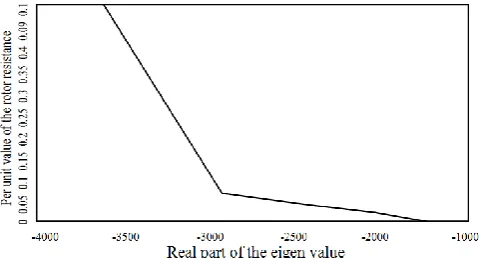
Figure (10) The relation between different values of the rotor resistance and the eigenvalues of the changed mode in case of DFIG.
IV. VALIDATION OF THE MODELS
As the value of the resistance or inductance changes the stability degree will change. Figure (10) shows the relation between different values of the rotor resistance and the eigenvalues of the changed mode in case of DFIG. Figure (11) shows the relation between different values of the stator resistance and the eigenvalues of the changed mode in case of DDPMSG. Figure (12) shows the relation between different values of the rotor inductance and the eigenvalues of the changed mode in case of DFIG. Figure (13) shows the relation between different values of the stator inductance and the eigenvalues of the changed mode in case of DDPMSG. As the resistance value of the rotor increase, the stability degree will increase and as the inductance value increase as the stability will decrease because of increasing the delay time.
Figure (11) The relation between different values of the stator resistance and the eigenvalues of the changed mode in case of DDPMSG.
Figure (12) The relation between different values of the rotor inductance and the eigenvalues of the changed mode in case of DFIG.
Figure (13) The relation between different values of the stator self inductance and the eigenvalues of the changed mode in case of DDPMSG.
V. CONCLUSION
[image:5.595.305.546.56.180.2] [image:5.595.51.251.84.210.2] [image:5.595.309.550.213.341.2] [image:5.595.308.546.375.509.2] [image:5.595.52.292.393.522.2]ACKNOWLEDGMENT
The first author would like to thank the Egyptian Government for supporting this work.
REFERENCES
[1] ”Tidal Stream” Available online (January 2011),
http://www.tidalstream.co.uk/html/background.html
[2] ”Tidal Currents” Available online (April 2011),
http://science.howstuffworks.com/environmental/earth/oceanography/ ocean-current4.htm
[3] Hamed H. H. Aly, and M. E. El-Hawary “State of the Art for Tidal Currents Electrical Energy Resources”, 24th Annual Canadian IEEE
Conference on Electrical and Computer Engineering, Niagara Falls, Ontario, Canada, 2011.
[4] Hamed H. Aly, and M. E. El-Hawary “An Overview of Offshore Wind Electrical Energy Systems” 23rd Annual Canadian IEEE
Conference on Electrical and Computer Engineering, Calgary, Alberta, Canada, May 2-5, 2010.
[5] Marcus V. A. Nunes, J. A. Peças Lopes, Hans Helmut, Ubiratan H. Bezerra, and Rogério G. “Influence of the Variable-Speed Wind Generators in Transient Stability Margin of the Conventional Generators Integrated in Electrical Grids” IEEE Transactions on Energy Conversion, 2004.
[6] J.G. Slootweg, H. Polinder and W.L. Kling“Dynamic Modeling of a Wind Turbine with Doubly Fed Induction Generator” IEEE Power Engineering Society Summer Meeting, 2001.
[7] Janaka B. Ekanayake, Lee Holdsworth, XueGuang Wu, and Nicholas Jenkins” Dynamic Modeling of Doubly Fed Induction Generator Wind Turbines” IEEE Transactions on Power Systems, Vol. 18, No. 2, May 2003.
[8] M.J.Khan, G. Bhuyan, A. Moshref, K. Morison, “An Assessment of Variable Characteristics of the Pacific Northwest Regions Wave and Tidal Current Power Resources, and their Interaction with Electricity Demand & Implications for Large Scale Development Scenarios for the Region,” Tech. Rep. 17485-21-00 (Rep 3), Jan. 2008.
[9] Lucian Mihet-Popa, Frede Blaabjerg, and Ion Boldea,” Wind Turbine Generator Modeling and Simulation Where Rotational Speed is the Controlled Variable” IEEE Transactions On Industry Applications, Vol. 58, No. 1, January/February 2004.
[10] Hamed H. H. Aly, M. E. El-Hawary “A Proposed Algorithms for Tidal in-Stream Speed Model” American Journal of Energy Engineering. Vol. 1, No. 1, 2013, pp. 1-10.
[11] Hamed H. H. Aly, M. E. El-Hawary. The Current Status of Wind and Tidal in-Stream Electric Energy Resources, American Journal of Electrical Power and Energy Systems. Vol. 2, No. 2, 2013, pp. 23-40. [12] Yazhou Lei, Alan Mullane, Gordon Lightbody, and Robert Yacamini
“Modeling of the Wind Turbine with a Doubly Fed Induction Generator for Grid Integration Studies” IEEE Transaction on Energy Conversion, Vol. 28, No. 1, March 2006.
[13] F. Wu, X.-P. Zhang, and P. Ju “Small signal stability analysis and control of the wind turbine with the direct-drive permanent magnet generator integrated to the grid” Journal of Electric Power and Engineering Research, 2009.
[14] F. Wu, X.-P. Zhang, and P. Ju “Small signal stability analysis and optimal control of a wind turbine with doubly fed induction generator” IET Journal of Generation, Transmission and Distribution, 2007.