Search Advertising
Alexandre de Corni`
ere
∗October 1, 2013
Abstract
Search engines enable advertisers to target consumers based on the query they have entered. In a framework in which consumers search sequentially after having entered a query, I show that targeting reduces search costs, improves matches and intensifies price competition. However, a profit-maximizing monopolistic search engine imposes a distortion by charging too high an advertising fee, which may negate the benefits of targeting. The search engine also has incentives to provide a suboptimal quality of sponsored links. Competition among search engines can increase or decrease welfare, depending on the extent of multi-homing by advertisers.
Keywords: search engine, targeted advertising, consumer search.
JEL Classification: D43, D83, L13, M37.
1
Introduction
Search engines are arguably the most important actors of the digital economy. More than four billion search queries are processed every day by search engines such as Google, Yahoo or Bing, to help users find all sorts of information. It is not a surprise that the development of these actors has generated interest from advertisers, to the point that search advertising is nowadays a multi-billion dollar industry.1
Search advertising designates the display of “sponsored links” on a search engine results page, alongside “organic links”. Whereas organic links are free, sponsored links are the main source of
∗Department of Economics and Nuffield College, University of Oxford. Email: [email protected]. I thank
the editor and three anonymous referees for helping me improve the paper. I am also grateful to Simon Anderson, Mark Armstrong, Heski Bar-Isaac, Luc Bridet, Bernard Caillaud, Olivier Compte, Jacques Cr´emer, Gianni De Fraja, Gabrielle Demange, Renaud Foucart, Gilles Grandjean, Bruno Jullien, Frederic Koessler, Dina Mayzlin, Romain de Nijs, Marco Ottaviani, R´egis Renault, Joana Resende, Andy Skrzypacz, Greg Taylor and Xavier Wauthy for very useful suggestions. Previous versions of this paper have circulated under the title “Targeting with consumer search: an economic analysis of keyword advertising”.
1 See Evans (2008) for an interesting presentation of the online advertising industry, with a special emphasis on
revenue for search engines. The standard pricing scheme in the industry is per-click pricing: search engines collect fees from advertisers every time a consumer clicks on their link.
Besides the size of search engines’ user base, several factors explain the success of this advertising format. Unlike, say, TV advertising, search advertising reaches consumers at a point at which they are actively looking for information, and is therefore less of a nuisance. This is all the more so that, as advertisers can select precise keywords to target, sponsored links are generally relevant to the queries and thus valuable to consumers.
The questions that I address in the paper are the following: how does the mechanism composed of keyword targeting and per-click pricing affect the market outcomes (profits, welfare)? What are the strategic incentives of a search engine? Is competition between search engines desirable?
To answer these questions, I present (sections 2 and 3) a model of targeted advertising through a search engine, with differentiated products, which includes the main features mentioned above. Firms are horizontally differentiated `a la Salop (1979), and consumers do not have prior knowledge of firms’ prices or products’ characteristics. The search engine is an intermediary between firms and consumers: firms choose which keywords they want to target, and consumers enter keywords and then search sequentially at random through the links that appear. Firms incur a fixed cost to be registered on the search engine, and they pay the latter on a per-click basis. In this model, I do not consider organic links.
The main findings are the following: in equilibrium, search expenses are minimized, since firms only target consumers who find it optimal not to search further. With respect to a benchmark in which firms cannot target consumers, I also find that the quality of the matching between firms and consumers is higher (i.e the average distance in the product space is smaller). Perhaps more surprisingly, another consequence of firms’ ability to target consumers is an increase in the intensity of price competition. This result stems from the fact that targeting endogenously reduces the perceived cost of an additional search, because consumers know that with targeting they draw firms from a better pool (thecompositioneffect2). The intensification of price competition thus lowers firms’ mark-up, which is the third way through which targeting may improve efficiency on the market. However, allowing firms to target their advertising leads them to regard the per-click fee as a marginal cost, and to pass it through in the price of their product. The optimal fee charged by the search engine is thus too high with respect to the social optimum, because it excludes some consumers from the market. On the other hand, without targeting, the per-click fee is analogous to a fixed cost, which has no bearing on the equilibrium price chosen by firms.
In practice, if search engines possess superior information about the quality of the match between a firm and a keyword, they will most likely try to use it so as to optimally design the matching mechanism. For instance, Google sorts firms using a weighted average of the firms’ bids and of a
“quality score” index. Consumers are also sometimes provided with additional information on the results page, such as a map showing the locations of different vendors. On the other hand, the “broad match” technology enables search engines to expand the set of keywords corresponding to a given advertisement. In section 4, I study a situation in which the search engine can more finely design the matching mechanism. The analysis reveals that, even if the search engine could implement the perfect matching at no cost, it would not be optimal to do so. Indeed, implementing an accurate matching mechanism would lead to a hold-up situation (the Diamond paradox), in which firms charge such a high price that consumers prefer not to participate. It can even be optimal for the search engine to implement a matching that is less accurate than the laissez-faire outcome (in which accuracy is the result of equilibrium behavior by firms and consumers). The reason is that offering a noisy matching mechanism makes consumers more willing to accept high-prices on the product market, because it is now more costly to refuse an offer and to search again, as the next firm is less likely to be a good match (another instance of composition effect). Since the search engine cannot charge consumers, it may then be optimal to use such a strategy. It is not always optimal, because it results in a decrease in the number of active consumers, and so the search engine trades off per-consumer profit and number of consumers.
In section 5, I build upon my baseline model to incorporate the issue of competition between search engines. I show that there may exist equilibria in which competition is socially harmful, but also equilibria in which competition is desirable. A key factor for competition to be desirable is the extent to which advertisers multi-home, which in turns depends on the magnitude of economies of scale in advertising. Full multi-homing makes advertising fees irrelevant as a competitive tool, and competing search engine thus behave like monopolists facing a low elasticity of demand, which lowers welfare compared to the monopoly case. When advertisers single-home, competition leads to lower advertising prices, and therefore improves welfare.
Related literature
This paper develops a new framework to provide an economic analysis of search engine advertising. The key features of the model (targeted advertising, consumer search, two-sided market) each have been extensively studied in the economic literature, but the combination of the three generates new insights.
Targeted advertising has received increased attention in recent years, in particular in relation to its impact on product market pricing. Most of the models in this literature discuss mechanisms through which targeting tends to increase prices. In Roy (2000), Galeotti and Moraga-Gonzalez (2008) or Iyer, Soberman, and Villas-Boas (2005), targeting enables firms to segment the market, thereby relaxing price competition. In Esteban, Gil, and Hernandez (2001), competition between advertisers is shut down, and targeting, by making it optimal to advertise only on specialized outlets that cater to high
willingness-to-pay consumers, leads to a price increase. In a framework with several advertisers who compete in an auction for an advertising slot on a platform, de Corniere and de Nijs (2011) show that targeted advertising (i.e allowing firms to condition their bids on consumers’ characteristics) changes the expected composition of demand for each firm, with more weight on consumers with less elastic demands. Firms then have an incentive to charge higher prices.
In contrast, as discussed above, the present paper shows that targeted advertising, when coupled with consumer search, intensifies price competition. Grossman and Shapiro (1984) also find that targeting can lower prices, although through a reduction in advertising costs.
Other recent works on targeted advertising include Van Zandt (2004) who shows that targeted advertising can lead to information overload, Johnson (2013), who examines ad avoidance behavior, or Bergemann and Bonatti (2011) and Athey and Gans (2010), who study competition between medias with different targeting technologies. These papers ignore the issue of product market pricing.
The seminal paper on consumer search is Diamond (1971). In a model with several firms producing an homogenous good, and in which consumers incur a positive cost to obtain price information, firms necessarily charge the monopoly price in equilibrium. The reason for that is that demand is inelastic with respect to price, because a rise in the price inferior to the search cost does not drive consumers away from a firm. With heterogenous consumers, demand becomes price elastic and the “Diamond paradox” disappears. Such heterogeneity can lie in the level of information of consumers (e.g. Varian (1980), Stahl (1989)) or in their tastes. In the present paper I use the latter source of heterogeneity, building on Wolinsky (1983) who models preferences using Salop (1979)’s circular city model. Wolinsky (1986) and Anderson and Renault (1999) also deal with heterogenous preferences, modeling match values as i.i.d shocks.3
Some models of consumer search are more directly relevant to the search engine industry. Athey and Ellison (2011) focus on the design of the auction to allocate advertisement slots, given that consumers search strategically through the slots. However their analysis does not include compe-tition between firms on the product market. Armstrong, Vickers, and Zhou (2009) deal with price competition between firms, in a model in which one firm is made prominent, meaning that although consumers search strategically, they always visit the prominent firm first. Chen and He (2011) and Haan and Moraga-Gonzalez (2011) endogenize prominence by including an advertising stage prior to firms’ pricing decision and consumer search. In Chen and He (2011) this advertising stage is an auction in which the more relevant firms submit higher bids, making it rational for consumers to sample them first. Haan and Moraga-Gonzalez (2011) assume that consumers are boundedly ra-tional, in the sense that the probability that a consumer remembers a firm is proportional to that firm’s advertising expenses. Yang (Forthcoming) looks at the impact of improvements in the search technology on product design decisions. None of these papers study the strategic choice of keywords
by advertisers, nor the role of the search engine.
Finally, my paper is related to the growing literature on two-sided markets, with the seminal papers of Armstrong (2006), Caillaud and Jullien (2003), or Rochet and Tirole (2006). My approach is different from these papers, in the sense that I do not use a reduced-form way of modeling interactions between agents on the platform, in order to account for some important details. Other papers have a similar approach: Baye and Morgan (2001) model an intermediary who acts as an information gatekeeper on a homogenous product market, and look at the optimal two-sided pricing, taking into account subsequent price setting by firms and consumer search. Hagiu and Jullien (2011) focus on the design of a platform in terms of search diversion, and highlight several reasons why an intermediary does not want to provide the highest quality matching, even when the technology is costless. Eliaz and Spiegler (2011), in a related paper, also show that a search engine wants to implement a matching with a suboptimal quality. White (Forthcoming) and Taylor (2013) examine the trade-off faced by a search engine between providing quality organic results (which tend to attract users) and generating clicks on sponsored links (through which the search engine makes money).4 Gomes (2011) characterizes the optimal mechanism to sell an advertising slot when consumers and advertisers are heterogenous.
2
The model
2.1
Description of the market and of preferences
The framework is based on Wolinsky (1983). Consider a market in which there is a continuum of products uniformly distributed along a circle whose perimeter is normalized to one. Each product can be described by a keyword. For each product, there is a continuum of firms that are potential entrants.5 When a firm enters the market, its type, i.e the keyword that perfectly describes its product, is denotedθ ∈[0; 1]. θ is private information.6
Consumers differ along two dimensions: (i) each consumer has a favorite product (or keyword),
ω ∈ [0; 1], uniformly distributed around the circle, and (ii) consumers differ in their willingness to pay for their favorite product. More specifically, for each productω, there is a continuum of mass 1 of consumers whose willingness to payv is distributed on [0, v] according to a continuous and increasing cumulative distribution function F , with a log concave density f.7
4I discuss how these papers relate to my model at the end of sections 3.3 and 4.
5The assumptions of a continuum of firms and of a circular product space are made for analytical convenience.
The main insights hold under an alternative specification with a finite number of firms, finite number of products and i.i.d. valuations for the products.
6In section 4 I assume thatθ is also observed by the search engine.
7Having consumers differ with respect tovallows to generate an elastic demand for the search engine. Log-concavity
will ensure that the search engine’s profit is quasi-concave in the advertising fee (see Caplin and Nalebuff (1991)). This property is satisfied by many usual distributions (see Bagnoli and Bergstrom (2005)).
Both ω and v are consumers’ private information.
Consumers have use for at most one unit, and the utility that a consumer located in ω gets from consuming product θ, with the distance between them d(θ, ω) = d, is
u(v, d, p) =v−φ(d)−p (1)
wherepis the price of the good andφ is a mismatch cost. I assume thatφis increasing, and convex, which implies that consumers are risk-averse with respect to the quality of the match .8 φ(d) is often referred to as a transportation cost in traditional models of spatial competition. Here, I use the terminology “mismatch cost”.
2.2
Advertising technology on the search engine
Consumers have imperfect information about firms’ characteristics: they do not know firms’ position on the circle (θ) nor their price, and thus have to search before buying.
A firm that launches an online advertising campaign using the search engine incurs a fixed cost
C. This cost corresponds to the marketing or monitoring expenses that accompany the advertising campaign, and is not a payment to the search engine.
The search engine plays the role of a matchmaker: on the one hand, firms select the set of keywords that they want to target. This set is assumed to be symmetric around θ and convex:
K(θ) = [θ−Dθ;θ +Dθ]. On the other hand, consumers enter the keyword they are interested in
L(ω) = {ω}. If a certain keyword ω is entered by a consumer, the search engine randomly selects a firm θ such that ω ∈ K(θ).9 The consumer incurs a search cost s > 0 and learns the price and position of this firm. scorresponds to the amount of time and effort that are necessary to examine a firm’s offer. The firmθ pays a fee a >0 to the search engine. At that point, the consumer has three options: (i) he can accept the offer and leave the market, (ii) he can refuse the offer and leave the market, (iii) he can hold the offer and continue searching. In that case, the search engine randomly selects another firm θ0 such thatω ∈ K(θ0), and the process starts over.
At any point, consumers can come back at no cost towards a firm they have previously visited (recall is costless). It is the case if for instance consumers open a new window every time they click on a link.
Discussion The assumption that consumers do not observe anything before clicking on a link seems appropriate in many contexts. Indeed, firms can provide very little information with the text
8Convexity ofφis not always necessary, as Proposition 1 would hold with a weaker requirement (φ0(x)+xφ00(x)≥0).
However I need convexity for Proposition 2.
9The random matching corresponds to the assumption that the search engine is non-strategic with respect to the
under their link on a search engine’s page. Consumers have to click on the link to get more precise information. In this respect, advertising is not informative in the usual sense: it does not provide information in itself, but in equilibrium consumers correctly infer that a firm which targets them is not farther than a certain distance. The assumption is less relevant when consumers have a previous knowledge of the firms and/or products (if they bought in the past, of if they know the brand). I assume away these kinds of situations, which certainly deserve a proper analysis.
In the model, I also ignore the auction mechanism that is run in practice, and assume that all firms pay the same price and are visited with the same probability. There are three conceptual differences between an auction and the mechanism that I use in the paper: (i) in an auction, firms revealhow much they are willing to pay to receive a click, whereas here they only revealwhether they are willing to pay a given price per click, (ii) in an auction, the price of advertising is determined through a capacity constraint (or a reserve price), as opposed to directly being set by the search engine, and (iii) the auction mechanism results in ordered links, which are not clicked on with a uniform probability. In appendix B, I consider extensions that incorporate some of these features, and show that the main results of the paper (the pricing distortion and the composition effect) still hold.
Finally, the model captures the complementarity between search and advertising that is inherent to this technology. Firms have to target a keyword for them to be visited by the consumers who enter that keyword, and consumers can infer something about the product offered by the firm and its price from knowing that the keyword they entered is targeted by the firm. Receiving an ad does not dispense consumers from searching, and neither does it provide “hard” information regarding the products’ characteristics or their price. Rather, advertising acts more like a signal of relevance. This approach is very different from Robert and Stahl (1993), in which advertising and consumer search are substitutes, in the sense that if a consumer has received an advertisement he does not need to search. The subtle interaction between search and advertising is reminiscent of, although different from, Anderson and Renault (2006). In that paper, a monopolist can give as much information as it wants in its advertising, but consumers still need to incur a search cost, which must then be interpreted as a cost to physically visit the store. Interestingly, they show that for some parameter range, it is optimal for the firm to reveal to consumers that the match value is above a given threshold, which is very close to what is achieved in the present paper.10
2.3
Strategies and equilibrium concept
Timing and strategies The timing of the game is the following:
1. Search engine pricing: The search engine chooses a per-click fee a, which is publicly
10For other papers exploring the links between search and informative advertising, see for instance Mayzlin and Shin
observed by firms and consumers.
2. Firms pricing and targeting: Firms decide whether to register on the search engine. The mass of active firms is µ. Entrants incur the fixed cost C. A firm θ that decides to use the search engine chooses a price pθ and an advertising strategy Dθ.
3. Consumer search: Consumers decide whether they want to use the search engine or not. If a consumer uses the search engine, he enters the keyword corresponding to his favorite product (ω), and starts a sequential search among firms such that d(θ, ω) ≤ Dθ. Firms are uniformly
drawn from{θ s.t. d(θ, ω)≤Dθ}.
A consumer faces two decisions: whether to participate, and, if so, how to search. Both decisions involve cutoff rules. First, let EU(v) be the expected utility of a consumer of type v if he uses the search engine. If he does not search, his utility is normalized to zero. Let v∗(a) (sometimes noted
v∗) be such that EU(v∗(a)) = 0. Consumers withv ≥v∗(a) use the search engine, while consumers with v < v∗(a) do not.11
Second, once a consumer has decided to use the search engine, he faces a sequential search problem. We know, from Kohn and Shavell (1974), that the optimal strategy is a stationary decision rule as long as there is at least one firm that has not been sampled. If, at any point, the best available offer comes from a firm located at a distance ˆd from ω, with a price of ˆp, the consumer continues to search if and only if v −φ( ˆd)− p < Uˆ R. The strategy of a consumer thus consists
in the choice of the reservation utility UR, or, alternatively, in the choice of a reservation distance
R(ˆp)≡ φ−1(v −pˆ−U
R). Notice thatR depends on the expected future prices and locations if the
consumer keeps on searching. Figure 1 illustrates how the market works.
The equilibrium concept used is perfect Bayesian equilibrium with free entry. The search engine optimally chooses its fee a. Given a per-click fee a, advertisers set their participation decision, their price and their advertising policies so as to maximize their profit given the other firms’ strategies and the stopping rule used by consumers. The number of entrants is such that there is no profit for advertisers in equilibrium.
The stopping ruleR∗is a best-response to firms’ strategies. I focus on symmetric equilibria in pure strategies (a∗, R∗, v∗, p∗, D∗, µ∗). To highlight the fact that R∗(.) depends on the expectation about future prices and locations, I use the notation R∗(p, p∗, D∗) where (p∗, D∗) refer to what consumers expect other firms to play.
The following assumption ensures existence of a symmetric equilibrium.
Assumption 1 For any p, R(p, p,1/2)<1/2.
11 In practice, consumers most likely do not observe the per-click fee paid by advertisers. My interpretation of
this assumption is, in a broad sense, that a higher per-click fee will eventually drive consumers away from the search engine, because they experience that prices online are too high compared to their search costs. Ifawas not observed but consumers could form rational expectations, the market would unravel.
A firm located in $\theta_0$ targets all the keywords in $[\theta_0-D, \theta_0+D]$ (clockwise), and a consumer located in $\omega_0$ stops searching as soon as he samples a firm in $[\omega_0-R, \omega_0+R]$. Here, the $\omega_0$-consumer may buy from the $\theta_0$-firm, but would not accept the offer by the $\theta_1$-firm. The $\omega_1$-consumer cannot see an ad by the $\theta_0$-firm, because he is not in its targeted set of keywords.
𝜃1 𝜔1 𝜔0+𝑅 𝜔0− 𝑅 𝜔0 𝜃0− 𝐷 𝜃0+𝐷 𝜃0
Figure 1: Targeting strategy and stopping rule. A firm located in θ0 targets all the keywords in [θ0−D, θ0+D] (clockwise), and a consumer located in ω0 stops searching as soon as he samples a firm in [ω0 −R, ω0 +R]. Here, the ω0-consumer may buy from the θ0-firm, but would not accept the offer by the θ1-firm. The ω1-consumer cannot see an ad by the θ0-firm, because he is not in its targeted set of keywords.
Under Assumption 1, if firms do not target specific keywords (i.e they target the whole circle) in a symmetric equilibrium, some consumers search more than once before buying. In particular, this assumption requires search costs not to be too large. It seems a rather weak assumption, for if it was not satisfied there would be little point in studying the implications of a targeting mechanism (since firms would target every keyword).
3
Equilibrium analysis
Solving the game can be done in three steps. First, given equilibrium behavior by firms, and given the per click fee a, one can determine consumers’ optimal stopping rule. Next, given this rule, we can find firms’ equilibrium strategy in terms of pricing, advertising and entry. Finally, given the equilibrium of the subgame, we can find the search engine’s optimal per click feea.
3.1
Consumer search
In equilibrium, when a consumer of type (v, ω) clicks on a link, the expected utility he gets from this click if he buys is Z ω+D∗ ω−D∗ u(v, d(ω, θ), p∗) 2D∗ dθ = Z D∗ 0 u(v, x, p∗) D∗ dx
Consumers regard each click as a random draw of a location θ from a uniform distribution, whose support is [ω −D∗;ω+D∗]. Indeed a firm located at a distance greater than D∗ from ω would not appear on the results’ page in equilibrium (the consumer would not be targeted). Suppose for now that all firms set the equilibrium price p∗. Then, after the first visit, the only way a consumer can improve his utility is by finding a firm that is a better match, i.e that is closer to him. For
R∗ ≡ R(p∗, p∗, D∗) to be a reservation distance it must be such that a consumer is indifferent between continuing to search and buying the product
Z R∗
0
u(v, x, p∗)−u(v, R∗, p∗)
D∗ dx=s (2)
The left-hand side of this equality is the expected improvement if a consumer decides to keep on searching after being offered a product at a pricep∗and at a distanceR∗. This expected improvement equals the search cost, so that the consumer is indifferent between buying or searching again. By totally differentiating (2), one gets
dR∗ ds =− D∗ R∗u 2(v, R∗, p∗) >0, dR ∗ dD∗ =− s∗ R∗u 2(v, R∗, p∗) >0 (3)
where u2 is the partial derivative of u with respect to the second argument. R∗ is an increasing function of the equilibrium reach of advertisingD∗: if consumers expect firms to try to reach a wide audience (by targeting many keywords), they adjust their stopping rule by being less demanding, because the expected improvement after a given offer is lower than with more precise targeting. R∗ is also an increasing function of search costs: consumers are less demanding if it costs more to continue searching. Note also thatR∗ does not depend on the equilibrium pricep∗, because in equilibrium the expected price improvement due to an extra sample is always zero with quasi-linear utility functions. Indeed we have the following result:
Lemma 1 For every D, p and p0, we have R(p, p, D) =R(p0, p0, D) when the utility is given by (1).
Proof: From (2), R(p, p, D) is the solution toR0Rφ(R)D−φ(x)dx=s, and hence does not depend onp.
Now, when a consumer samples a firm which has set an out-of-equilibrium pricep6=p∗, his belief about other firms’ strategy and position does not change, and therefore his optimal stopping rule (and thus the firm’s demand) R(p, p∗, D∗) is such that accepting a pricep at a distance R(p, p∗, D∗) gives the same utility as accepting a pricep∗ at a distance R∗, i.ev−φ(R(p, p∗, D∗))−p=v−φ(R∗)−p∗. Thus we have the following result:
Lemma 2 Given other firms’ expected strategy (p∗, D∗), a consumer accepts to buy a good at price p if and only if the selling firm is located at a distance less than R(p, p∗, D∗), withR(p, p∗, D∗) such that
v−φ(R(p, p∗, D∗))−p=v−φ(R∗)−p∗
Moreover, by the implicit function theorem, R is continuously differentiable and dR(p, p∗, D∗) dp =− dR(p, p∗, D∗) dp∗ =− 1 φ0(R(p, p∗, D∗)) <0 (4)
Thus we have the natural property that a firm’s demand decreases with its own price and increases with the expected price of other firms.
3.2
Advertisers’ strategy
Advertising Now that we know consumers’ search behavior, it is possible to characterize firms’ optimal targeting strategy. It turns out that this optimal strategy is surprisingly simple: a firm should target a consumer if and only if the distance between the two is smaller than the reservation distance. Indeed, suppose that firm θ sets a price p. Since it only has to pay for consumers who actually visit its link, firmθ’s optimal targeting strategy is to appear to every consumer ω such that the expected profit made byθ through a sale to ω conditionally on ω clicking on θ’s link is positive, i.e
p.P r(ω buysθ’s product|ω clicks on θ’s link)−a≥0 (5)
whereais the per-click fee paid to the search engine. With a continuum of firms, consumers’ stopping rule is stationary, and a consumer never comes back to a firm he previously visited. Thus the conditional probability is either 0 (when d(ω, θ) > R(p, p∗, D∗)) or 1 (when d(ω, θ) ≤ R(p, p∗, D∗)). Thus we have the following result, the proof of which is in the appendix:
Lemma 3 Any symmetric equilibrium must involve D∗ = R∗(p∗, p∗, D∗). Therefore, if an equilib-rium exists, it must be the case that consumers do not search more than once.
This result, which relies on the assumption that all consumers have the same search rule and that targeting can be arbitrarily accurate, is counterfactual in the sense that in practice some consumers search more than once. This apparent paradox is still useful in that it clearly illustrates that targeting through keywords is a powerful instrument to reduce some inefficiencies due to the presence of search costs. However, notice that the equilibrium outcome is not the perfect matching, which would mean that firms target only the consumers for whom the product they offer is the ideal one. There is still some noise in the matching, due to the existence of search costs, but the level of noise is endogenously determined so as to cancel consumers’ incentives to visit more than one firm.12
12The first part of the lemma also relies on there being a continuum of firms. This assumption is however not crucial
to obtain the result that consumers only search once. A model with a finite number of firms would deliver the same result.
Pricing Thanks to Lemma 3, it is straightforward to find the per-(search engine)-user profit func-tion of a firm if the other firms and consumers play their respective equilibrium strategies.13 Indeed, if that firm wants to set a pricepdifferent from the candidate equilibrium pricep∗, it must also change the set of consumers that it targets. By the same argument as in Lemma 3, the optimal advertising strategy is to target consumers if and only if they are located at a distance smaller than the new reservation distance R(p, p∗, D∗). Since every consumer within this reservation distance is targeted by a mass 2R(p∗, p∗, D∗)µ∗ of firms,14 the per-user demand for the firm’s product is R(Rp(∗p,p,p∗∗,D,D∗∗))µ∗.
Conditional on visiting the firm, all consumers buy without searching further, and this implies that
a is formally equivalent to the firm’s marginal cost of production. Therefore, if all the other players (firms and consumers) follow the equilibrium strategy profile, a firm’s per-user profit function is
π(p, p∗, a) = (p−a) R(p, p
∗, D∗)
R(p∗, p∗, D∗)µ∗ (6)
The previous reasoning does not rely onp∗ being an equilibrium price, and so the profit function is defined for any pricep∗ that is played by all the other firms. The only restriction is that the profit function is defined only for D∗ = R(p∗, p∗, D∗). But it should be clear that if firms expect all the firms to play a price p∗, it is indeed optimal to choose D∗ =R(p∗, p∗, D∗).
Given firms’ profit function when their rivals play the equilibrium targeting strategy D∗ and charge the same pricep∗, standard arguments will ensure the existence of a price equilibrium. Notice first that there always exists a “trivial”’ equilibrium, in which firms do not participate and in which consumers do not search at all. I shall assume that when there is another equilibrium in which trade takes place, agents coordinate on the latter.
Entry Recall thatv∗(a) is the lowest value ofv such that a consumer participates. Given the profit function (6), the free-entry condition writes
(p∗(a)−a)1−F(v
∗(a))
µ∗(a) =C (7)
Proposition 1 Under Assumption 1, there exists a unique non trivial equilibrium of the subgame in which the search engine has chosen a, given by:
s= Z R∗ 0 φ(R∗)−φ(x) D∗ dx (8) R∗ =D∗ (9) p∗(a)−a=φ0(R∗)R∗ (10)
13Since consumers cannot observe prices prior to using the search engine, firms cannot affect the number of search
engine users and we can focus on the per-user profit.
v∗(a) = a+φ0(R∗)R∗+φ(R∗) (11)
µ∗(a) = φ0(R∗)R∗(1−F(v ∗(a)))
C (12)
Proof: The proof of the existence and uniqueness is provided in the appendix. Equation (8) is simply a rewriting of equation (2), while (9) comes directly from Lemma 3. Equation (10) obtains by taking the first-order condition at a symmetric equilibrium in the expression of profit (equation (6)). This FOC writes (p−a)R1 +R = 0 which, after using (4), gives the solution. To obtain (11), note that the expected surplus of a consumer is v−p∗(a)−s−E[φ(d)|d≤R∗]. Now, using (8) and (9), one can show thats+E[φ(d)|d≤R∗] =φ(R∗). Given (10), the indifferent consumer is thus such that v−φ0(R∗)R∗−a−φ(R∗) = 0. Finally, (12) is simply a rewriting of the free-entry condition. Equation (10) gives the mark-up in equilibrium. By convexity of φ and by (3), one can see that the mark-up is an increasing function of the search costs. Assincreases, the option to search further becomes less valuable for consumers, and firms can therefore charge a higher price. As s goes to zero, the mark-up vanishes.
One should note that the results would also hold if payments were made on a per-impression basis, i.e every time a consumer enters a keyword, instead of a per-click basis. Indeed, in that case the per-user profit function of a firm would beπ(p, p∗, a) = 1µpRR((pp,p∗,p∗∗,D,D∗∗)) −aR(p, p
∗, D∗), and one
would just need to replace a byaR(p∗, p∗, D∗) in the expression of the equilibrium price (10).15
3.3
Search engine pricing
I now turn to the pricing decision of the search engine. The search engine is constrained in its choice, since it only has one instrument, namely the per-click fee paid by firms.16 Given that a higher fee
a leads to a higher product price (see 10)), it also leads to fewer consumers using the platform, as shown by (11).
Since in equilibrium every consumer who uses the search engine clicks only once, the search engine’s profit is
ΠSE(a) =a(1−F(v∗(a))) (13)
It is well-known, see Caplin and Nalebuff (1991), that the log concavity of the distribution of willingness to pay implies the quasi-concavity of the profit function, here ΠSE(a).
An interior solution to the search engine’s program is given in the next proposition:
15If firms paida to the search engine on a per-sale basis, (8), (9) and (10) would still constitute an equilibrium,
but there would also be an equilibrium without targeting (such thatD∗= 1/2). See Taylor (2011) for a comparison of these payment schemes. Other mechanisms (two-part tariffs, first- or second-degree price-discrimination) would be more profitable for the search engine than the flat per-click fee used in this model. However, such schemes would, in my opinion, add complexity without doing as much in the way of realism.
16In Appendix B.2 I show that it would be equivalent for the search engine to choose a quantity of available slots.
Proposition 2 The optimal fee for the search engine is
a∗ = 1−F(v
∗(a∗))
f(v∗(a∗)) (14)
Proof: The first-order condition to (13) isa∗ = 1−F(v∗(a∗))
v∗0(a∗)f(v∗(a∗)). But according to (11),v
∗0
(a∗) = 1. One can see that the optimal fee for the search engine is greater than the socially optimal fee, which is zero. Indeed, looking at (8), (9) and (10), one sees that a has no impact on the quality of the matching in equilibrium, while a high a implies a higher price paid by consumers.17 However, the search engine would not make any profit if this was the case. In order to increase its profit, the search engine imposes a distortion, because the higher fee results in a higher equilibrium price.
The previous discussion relies on a particular feature of my model, namely that the search engine is not able to fine-tune the targeting strategies through its per-click fee a. This is in contrast to Eliaz and Spiegler (2011) for instance, who, using a different targeting technology,18 find that marginally increasing the advertising fee leads to more accurate targeting. Another difference due to the distinct modelling approaches is that their model predicts that an increase in the per-click fee leads to a decrease in the product price, while my model gives the opposite prediction. Hence, whereas they focus on the quality distortion induced by monopolistic behavior, I show that there might exist a pricing distortion. I study quality distortion in section 4.
3.4
The effects of targeting
One of the main motivations for this paper is to understand the implications of the targeting technol-ogy on the product market equilibrium. In order to properly evaluate these implications, one needs a benchmark in which targeting is not possible. This benchmark, provided by Wolinsky (1983) (see also Bakos (1997) ), consists in simply assuming that firms cannot specify a set of keywords, so that advertising is non-targeted. I use the subscriptN T to index the equilibrium values corresponding to this case, andT for the case of targeting corresponding to the previous analysis.
The main results are the following:
Proposition 3 Compared to a situation with random advertising, targeting:
1. reduces the expected number of clicks;
2. reduces the mismatch frictions;
3. has an ambiguous effect on the price of the final good.
17Whena = 0 there is also an equilibrium without targeting, but setting a arbitrarily close to zero is enough to
discipline firms into targetingD∗.
18In Eliaz and Spiegler (2011) advertisers can only observe the probability that the consumer is interested, not the
Proof: In the case of no-targeting, the equilibrium reservation distance for consumers, RN T, is
given by (8) with DN T = 1/2. The first point of the proposition is a direct corollary of Lemma 3
and of Assumption 1.
The second point is a consequence of the fact that, as Dincreases without targeting, so does the reservation distance (by (3)), and therefore the expected mismatch cost E[φ(d)|d≥R∗] decreases.
The third point of the proposition is subtler. To understand it, notice that, without targeting, the (per search engine user) profit of a firm that charges p is
1 2µN TRN T
(p×2R(p, pN T, DN T)−aN T)
Using equation (4), which gives the firm’s demand derivative, and the first order condition at a symmetric equilibrium, one gets
pN T =φ0(RN T)RN T (15)
Comparing this latter expression with (10), one gets
pT −pN T = aT |{z} pass-through effect,>0 + RTφ0(RT)−RN Tφ0(RN T) | {z } composition effect,<0 .
The pass-through effect follows from the remark that, unlike in (6), advertising expenses without targeting do not vary with the firm’s own price. Indeed, the number of clicks is independent of this price because the firm cannot adjust its advertising strategy along with its price.19 This leads firms to regard these expenses as fixed costs, with no impact on the optimal product price.
Since φ is convex, the function x 7→ φ0(x)x is non-decreasing, which explains why the second effect is negative. The intuition for this effect is that targeting, by affecting the composition of the pool of firms from which consumers sample, increases the continuation value of search for consumers and thus the (semi-) elasticity of demand. This in turn puts more pressure on firms to reduce their mark-up.
Example. Suppose thatφ(d) =td, and thatF(v) = 1−e−ηv. Then we getp
T = 2s+a∗,pN T =
√ st
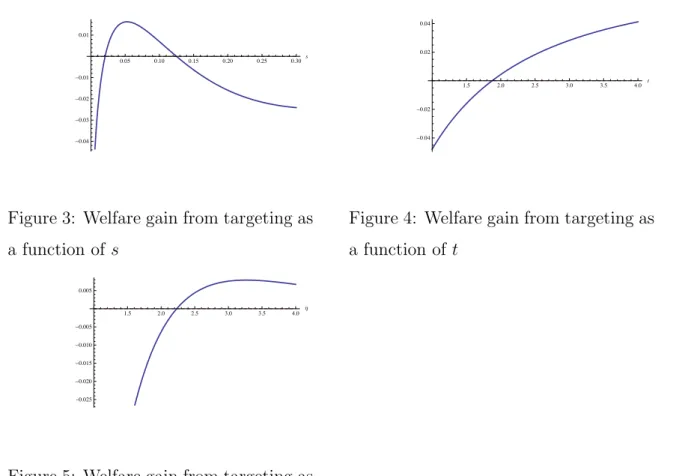
anda∗ = 1η. Targeting leads to a price reduction if and only if η1 + (2s−√st)<0. Numerical results show that it is possible for welfare to be higher or lower with targeting. Welfare is more likely to be higher with targeting whent is high,s is intermediate and η is high. (See Appendix C for details.)
4
Platform design
The assumption that the search engine does not behave strategically with respect to information revelation leaves aside interesting theoretical as well as practical issues. There is evidence that search engines pay a lot of attention to the way advertisements are displayed. The ranking of advertisements through a “quality score” illustrates this concern, as well as the use of a “broad match” technology aimed at matching consumers to firms when the keywords do not correspond exactly but are “close” enough. Basically, with broad match, which is the default option on Google, the search engine might display an advertisement even if the keyword has not been selected by the firm, provided it is regarded as relevant by the search engine. For instance, a company that selects the keyword “hat” may appear following a query for “caps”. Google argues that one of the benefits brought by such a practice is that it saves time for firms: they no longer have to spend time and resources figuring out what are the right keywords to use. The search engine will do that for them, using the available information on past queries and results in order to find relevant keywords.
Such practices may be regarded as an attempt to choose the accuracy of the matching system. For instance, putting large weights on the most relevant websites to a query improves the quality of the matching process, whereas applying a very loose “broad match” policy introduces some additional noise. Another example is the display of maps, indicating the physical location of firms. In this section I assume that the search engine can influence the relevance of ads by choosing the value of
D, on top of chosing a per-click feea. We saw in the previous section that the accuracy of targeting affects firms’ market power (via their mark-up, equal toR∗φ0(R∗)). The search engine faces a trade-off between giving firms enough market power and ensuring sufficient consumer participation. The main result of this section is that the optimal value is always at least as large as the equilibrium value obtained in section 3. The following lemma will be useful in proving that result.
Lemma 4 If the search engine has the possibility to choose the accuracy of the matching, then (i) the equilibrium price no longer depends on a, and (ii) the search engine can entirely extract firms’ profit.
Proof: Let v∗(D) be the consumer who is indifferent between using the search engine and his outside option of zero. LetR(p, p∗, D) be the reservation distance of a consumer who faces a pricep
if other firms set a pricep∗, and if the search engine chooses a level of accuracy D. Then the firm’s profit is (1−F(v∗(D)) pR(p, p ∗, D) R(p∗, p∗, D) −amax{ D R(p∗, p∗, D),1} −C
Indeed, if D ≤ R(p∗, p∗, D) consumers search only once, whereas otherwise they search on average
D
R(p∗,p∗,D) times. It is straightforward to see that the level of a does not affect which price a firm
should charge. In equilibrium, by setting a = (p∗ − C
1−F(v∗))/max{
D
extracts all the profit.
As is the case when firms cannot target specific keywords, the search engine extracts the whole profit. It is now straightforward to see that the search engine will chooseD so as to maximize firms’ gross profit, because it cannot make consumers pay.
The following proposition gives the optimal matching accuracy for the search engine. Recall that
D∗ is the equilibrium distance in the game in which firms choose their targeting strategy.
Proposition 4 The optimal matching accuracy, from the search engine’s point of view, is DSE ≥
D∗. That is, the search engine will not improve the quality of the matching with respect to the “laissez-faire” situation.
The complete proof of this proposition is in the appendix, but its logic is the following. When the search engine chooses a low value ofD(D < D∗), the reservation distanceR(p, p, D) is strictly larger thanD, so that sufficiently small price increases by firms do not result in a lower demand. But then firms increase their price at least up to the willingness to pay of the marginal user. Since the search cost is sunk, it does not enter into the willingness to pay, and the marginal user is thus left with a negative utility. This leads the market to collapse. This is a variant of the well-known Diamond paradox (Diamond (1971)). Said differently, too much accuracy in the results protects firms from competition, but this extra market power dissuades consumers from participating. A corollary of this observation is that D∗ is the targeting accuracy that would be chosen by a benevolent planner unable to affect firms pricing.
On the other hand, when D > D∗, we haveR(p, p, D)< D, so that some users find it optimal to visit several firms. This disciplines firms into charging “competitive” prices (as opposed to monopoly prices), and thus ensures user participation. Over the range [D∗; 1/2], firms’ per-user profit is in-creasing inD ( by the same logic as the composition effect discussed in section 3.4) but the number of users is decreasing. The search engine chooses the optimalDSE so as to balance these two effects.
Discussion. The idea that a platform should pay attention to the competition that takes place between merchants is present in Armstrong (2006). In particular, that paper shows, in a very stylized way, that when the platform cannot charge one side of the market, it is better-off restricting the intensity of competition, by granting exclusivity to one merchant.20 In the present model, I focus on instruments that differ from exclusivity contracts (although these could be incorporated without difficulties). Several recent contributions make related points. Hagiu and Jullien (2011) show that an intermediary has two important motives to divert consumer search: (i) it can generate visits that would not have occurred if consumers had been directed towards their favorite shop, (ii) diversion may increase the elasticity of demand that each shop faces, leading them to charge a lower price,
which can result in more participation to the platform by consumers. The latter effect is present in my model, in a very stark way, and explains why the search engine never wants to implement
D < D∗. Eliaz and Spiegler (2011), in a setup closer to this one, underline the fact that a lower quality of the matching mechanism increases the effective search cost faced by consumers, so that firms can charge a higher price to consumers. Here, it is because of this effect that the search engine may want to implement a matching of even lower quality than D∗.
Another paper that looks at the design of a platform in a related spirit is White (Forthcoming). In that paper, the search engine can choose the value of search costs, by choosing the quality of the organic results. The trade-off is then that some of the clicks on sponsored links will be diverted to organic links, which bring no profits to the search engine. Taylor (2013) shows that even with competition among search engines, there exist equilibria in which both search engines provide sub-optimal quality for their organic links, in order to generate more revenues from the sponsored links.
5
Competing search engines
In this section I come back to a setup of decentralized targeting, that is in which firms are free to choose their targeting strategy. Recall from Proposition 2 that a monopolistic search engine imposes a distortion on the economy through a per-click fee that is higher than the socially optimal fee (here, zero). The purpose of this section is to determine under which conditions, if any, can competition between search engines improve welfare.
To do so, I study a stylized game of competition in which a second search engine operates on the market. Consumers can use at most one search engine, whereas advertisers can be present on both platforms. The cost structure of firms is the following: it costs CH to register on one search
engine, andCH+CL∈[CH,2CH] to register on both search engines (to multi-home). ThatCH ≥CL
means that there may exist economies of scale. For instance, whereas registering on a search engine for the first time implies developing a website and devising an advertising strategy, many of these expenses need not be incurred when registering on another search engine. However, if monitoring the performance on a search engine is the main expense, it may be that economies of scale are not very important.
The timing is the following:
1. Both search engines choose their per-click fees a1 and a2.
2. Advertisers observe a1 and a2, make their participation decision, and choose their targeting (D) and pricing (p) strategies. Advertisers can have different targeting strategies across search engines, but are constrained to charge a uniform price.21
21The latter assumption is consistent with casual empiricism. If firms could price-discriminate between search
3. Consumers observe observe a1 and a2, choose a search engine (or none) and start a sequential search. If consumers are indifferent between the two search engines, search engine 1 receives a market sharen1 ≥n2.
Because of the importance of coordination, multiple equilibria arise in this setup. Rather than characterising the whole set of equilibria, I focus on two kinds of equilibria: equilibria with full multi-homing and equilibria with full single-homing.22 The reason for this shortcut is that, with partial multi-homing, all the firms on a given search engine may no longer be symmetric (some only use search engine i, while others multi-home), and the analysis of the model is much more delicate. Focusing on full multi-homing and full single-homing restores symmetry. Hopefully this will be enough to convey the point that the extent of multi-homing is a key driver of the desirability of competition between search engines.
Indeed, when advertisers multi-home, the Bertrand logic of price competition between search engines cannot apply: a decrease in the fee a1 results in a decrease in the final price of the good on both search engines, and thus such a strategy does not increase the market share of search engine 1. On the other hand, when advertisers single home on search engine 1, reducing a1 allows to attract consumers. Advertising fees are then driven down to zero.
The following intermediary result will prove useful in the subsequent analysis of equilibrium under competition. Consider a situation in which a shareαi ∈ {0, ni,1}of search engine users utilize search
engine i, and in which there is no partial multi-homing.23 By the same logic as that of Lemma 3 , we have:
Lemma 5 If firms decide to advertise on search engine i, the equilibrium targeting strategy must satisfy Di =R(pi, pi, Di), where pi is the price charged by advertisers who use search engine i.
Indeed, if we had Di > R(pi, pi, Di), a firm could deviate by choosing a smaller Di, whereas for
Di < R(pi, pi, Di) a profitable deviation would consist in targeting a larger set of keywords.
Multihoming equilibrium Intuitively, multi-homing is more likely to occur in equilibrium if there are large enough economies of scale. To see this, let’s assume that CL = 0 so that registering on a
second search engine is costless.
Proposition 5 If CL = 0, there exists an equilibrium in which all active firms multi-home. In this
equilibrium, the expected per-click fee n1aM1 +n2aM2 is higher than the monopoly per-click fee a
∗.
Therefore welfare is lower than under monopoly.
outcome.
22The former exists if C
L = 0, the latter if CL =CH and there are enough potential firms. Propositions 5 and 6
focus on these polar cases.
Proof: First, note that given that CL = 0, single-homing is dominated by multi-homing. Now
consider a situation in which all active firms advertise on both search engines. Lemma 5 implies that
D1 =D2 = D∗ = R∗ = R1∗ =R
∗
2, as given by (8) and (9). Given that firms charge the same price irrespective of the search engine used by consumers, consumers are then indifferent between the two search engines and market shares are rthusn1 and n2. It should be clear that the situation is exactly the same as if there was a unique search engine charging a per-click fee of n1a1+n2a2. Thus, as in Proposition 1, there is a unique equilibrium in the subgame. We have
p(a1, a2) =R∗φ0(R∗) +n1a1+n2a2 (16)
The consumer type who is indifferent between using a search engine and his outside option is
v(a1, a2) = R∗φ0(R∗) +n1a1+n2a2+φ(R∗) (17)
The mass of active firms, µ(a1, a2), is then given by
(p(a1, a2)−n1a1−n2a2)(1−F(v∗(n1a1+n2a2))) =CHµ(a1, a2) (18)
Given the above analysis, search engine i’s profit maximization program is
max
ai
aini(1−F(v∗(n1a1+n2a2)))
The first-order condition is
niai =
1−F(v∗(n1a1+n2a2))
f(v∗(n
1a1+n2a2))
(19)
Let us now show that the system of first-order conditions has a unique solution, such thatn1aM1 +
n2aM2 > a
∗. First, from assumption 3,f is log-concave. Theorem 2 in Bagnoli and Bergstrom (2005)
thus ensures that 1−F is also log-concave, which implies that 1−fF is decreasing. To prove uniqueness, notice that (19) leads to a2 = nn12a1. Thus we can rewritev∗ = 2n1a1+R∗φ0(R∗) +φ(R∗). It is clear that the solution to (19) fori= 1 exists and is unique, since it is the intersection between a decreasing curve (1−F(v∗(n1a1+n2a2))
f(v∗(n
1a1+n2a2)) as a function ofa1) and an increasing line (n1a1) that covers the whole range of positive reals.
Note that since n1aM1 = n2aM2 , we also have aM1 ≤ aM2 . Finally, in order to show that n1aM1 +
n2aM2 ≥a∗, rewrite (19) as n1aM1 +n2aM2 2 = 1−F(v∗(n1aM1 +n2aM2 ))) f(v∗(n 1aM1 +n2aM2 ))
and compare with equation (14):
a∗ = 1−F(v
∗(a∗)) f(v∗(a∗))
It is easy to see that the solution to the first equation (n1aM1 +n2aM2 ) must be larger than the solution to the second (a∗).
With multi-homing, and under the assumption that firms cannot price-discriminate, each search engine behaves like a monopolist. However, the relevant demand for search engine i is ni(1−
F(v∗(n1a1 +n2aM2 ))), and its elasticity is lower than that of the monopoly demand 1−F(v
∗(a)),
because an increase in ai is passed through to consumers at a rate ni <1.24
Single-homing equilibrium The previous result relies on the fact that with multi-homing, search engines do not benefit relative to their competitors from having firms lower their prices. When firms single-home, this logic no longer applies, as I show now. Suppose that there are no economies of scale, i.e that CL = CH,25 and that the mass of potential firms is very large. Then we have the
following result:
Proposition 6 When CL =CH and there are many potential entrants, there exists an equilibrium
in which all entrants single-home. In this equilibrium, the advertising fees are aS1 =aS2 = 0, so that welfare is higher than with a monopolistic search engine.
Proof: Consider the following strategy profile:
1. Search engines charge zero advertising fees: aS
1 =aS2 = 0;
2. Targeting strategies and reservation distances are given by (8) and (9) on both search engines;
3. Firms on both search engines charge the same price p1 =p2 =R∗φ0(R∗); 4. The number of consumers on search engine i is ni(1−F(v∗(0)));
5. All entrants single-home, and the mass of firms who advertise on search engine i is given by
2µiCH =niR∗φ0(R∗)(1−F(v∗(0)))
Given aS1 = aS2 = 0, points 2 to 5 clearly form an equilibrium. It remains to check that no search engine has an incentive to deviate. Although one could construct paths following a deviation that would make the deviation profitable,26 a more reasonable outcome is that no consumer will switch
24This intuition is also present in Wright (2002), although in a different setup. 25ForC
L ∈(0, CH) pure single-homing cannot be part of the equilibrium, since a firm who single-homes on search
engineiwould make a positive profit by also registering onj. As mentionned above, partial multi-homing is difficult to study, but pure single-homing delivers some insights that should, to a certain extent, carry over to the partial multi-homing case.
26For instance, by assuming that following a deviation by a search engine everybody coordinates on this search
to a search engine that increases its advertising fee, given that it would lead to a higher price of the good.
Discussion. This model of competition between search engines has several drawbacks. Given the potential multiplicity of equilibria, it is delicate to derive unambiguous results while comparing monopoly and duopoly. Moreover, the use of infinitely elastic market shares leads to very stark results that seem at odds with what one observes in practice. However, this simplistic model delivers an original insight, namely that the desirability of competition on the search engine market depends on the extent of multi-homing. Even though equilibria with partial multi-homing are difficult to study, it seems reasonnable to conjecture that, as economies of scale in advertising increase, more advertisers will multi-home, which relaxes competition between search engines.
An intriguing consequence of such a result is that efforts to foster advertisers multi-homing, such as the ones made by the European Commission27 in its recent investigation on Google, might have adverse consequences by increasing the advertising fees. It may well be that these effects are of second order compared to the risks of exclusion of rival search engines through exclusivity clauses, but, given that the theory is still far from being established, these elements probably deserve further investigation.
On a different note, the results here differ from the standard results on multi-homing (Armstrong (2006)) due to the limited instruments that can be used. Indeed, if search engines can only use the fee (or the quantity of sponsored links), they are not able to extract profit from advertisers (the multi-homing side) while at the same time providing high surplus to consumers (the single-homing side), as would be the case with a richer set of instruments.
6
Concluding remarks
This paper presents a model of search engine advertising that incorporates targeted advertising and consumer search in a two-sided market framework. The main results show that the targeting technology potentially improves efficiency, by minimizing search costs, reducing mismatch costs, and increasing the competitive pressure among firms, with respect to a benchmark without targeting. However, the search engine’s profit-maximizing behavior leads it to charge too high an advertising fee, which results in a rise in the equilibrium price of the good that can offset the efficiency gains. When the search engine determines the accuracy of targeting, the previous distortion is eliminated, as firms no longer pass through the advertising fee to consumers, but another distortion emerges, namely a suboptimal matching quality. The effects of competition between search engines are ambiguous, and depend on the magnitude of advertisers’ fixed costs.
In order to achieve tractability, I have relied on some specific assumptions. While the assumptions of a continuum of firms, of random sampling and of unifrom pricing by the search engine are not essential to obtain most of the results,28 the particular targeting technology used here is less innocu-ous. Indeed, while the efficiency effects of targeting (lower search and mismatch costs, composition effect) would likely extend to any setup of targeting with consumer search,29 the distortions imposed by a search engine might take a different form (as discussed in section 3.3).
Although the model provides insights regarding the links between the design of the platform and market outcomes, it ignores some dimensions that are potentially important, such as the presence of organic links or and the issue of own-content bias, which is at the center of the EU’s current investigation against Google (see de Corniere and Taylor (2013) for instance). Future work will hopefully further improve our understanding of how these aspects interact with each other.
References
Anderson, S. P., and R. Renault (1999): “Pricing, Product Diversity, and Search Costs: A
Bertrand-Chamberlin-Diamond Model,” RAND Journal of Economics, 30(4), 719–735.
(2006): “Advertising Content,”American Economic Review, 96(1), 93–113.
Armstrong, M. (2006): “Competition in Two-Sided Markets,” RAND Journal of Economics,
37(3), 668–691.
Armstrong, M., J. Vickers, and J. Zhou (2009): “Prominence and consumer search,”RAND
Journal of Economics, 40(2), 209–233.
Athey, S.,and G. Ellison(2011): “Position Auctions with Consumer Search,”Quarterly Journal
of Economics, 126.
Athey, S., and J. S. Gans(2010): “The Impact of Targeting Technology on Advertising Markets
and Media Competition,” American Economic Review, 100(2), 608–13.
Bagnoli, M., and T. Bergstrom (2005): “Log-concave probability and its applications,”
Eco-nomic Theory, 26(2), 445–469.
Bakos, Y.(1997): “Reducing Buyer Search Costs: Implications for Electronic Marketplaces,”
Man-agement Science, 43(12), 1676–1692.
Bar-Isaac, H., G. Caruana, and V. Cunat (2010): “Information Gathering and Marketing,”
Journal of Economics & Management Strategy, 19.
28The last two points are discussed in Appendix B. The first point is discussed at length in an earlier version of the
paper.
Baye, M. R., and J. Morgan (2001): “Information Gatekeepers on the Internet and the
Com-petitiveness of Homogeneous Product Markets,” American Economic Review, 91(3), 454–474.
Bergemann, D., and A. Bonatti (2011): “Targeting in Advertising Markets: Implications for
Offline vs. Online Media,” RAND Journal of Economics, 42(2), 414–443.
Caillaud, B., and B. Jullien (2003): “Chicken & Egg: Competition among Intermediation
Service Providers,” RAND Journal of Economics, 34(2), 309–28.
Caplin, A.,andB. Nalebuff(1991): “Aggregation and Imperfect Competition: On the Existence
of Equilibrium,” Econometrica, 59(1), 25–59.
Chen, Y., andC. He(2011): “Paid Placement: Advertising and Search on the Internet,”Economic
Journal, 121.
de Corniere, A., and R. de Nijs(2011): “Online Advertising and Privacy,” mimeo.
de Corniere, A., and G. Taylor(2013): “Integration and Search Engine Bias,” mimeo.
Dellarocas, C.(2012): “Double Marginalization in Performance-Based Advertising: Implications
and Solutions,” Management Science, 58(6), 1178–1195.
Diamond, P. A. (1971): “A model of price adjustment,” Journal of Economic Theory, 3(2), 156–
168.
Dukes, A., and E. Gal-Or (2003): “Negociations and Exclusivity Contracts for Advertising,”
Marketing Science, 22(2), 222–245.
Eliaz, K., and R. Spiegler (2011): “A Simple Model of Search Engine Pricing,” Economic
Journal, 121.
Esteban, L., A. Gil, and J. M. Hernandez (2001): “Informative Advertising and Optimal
Targeting in a Monopoly,” Journal of Industrial Economics, 49(2), 161–80.
Evans, D. S. (2008): “The Economics of the Online Advertising Industry,” Review of Network
Economics, 7(3), 359–391.
Galeotti, A., and J. L. Moraga-Gonzalez (2008): “Segmentation, advertising and prices,”
International Journal of Industrial Organization, 26(5), 1106–1119.
Gomes, R.(2011): “Optimal Auction Design in Two-Sided Markets,” Discussion paper.
Grossman, G. M., and C. Shapiro (1984): “Informative Advertising with Differentiated
Haan, M., and J. L. Moraga-Gonzalez (2011): “Competing for Attention in a Consumer
Search Model,” The Economic Journal, 121, 552–579.
Hagiu, A., and B. Jullien (2011): “Why do intermediaries divert search?,” RAND Journal of
Economics, 42(2), 337–362.
Iyer, G., D. Soberman, and J. M. Villas-Boas (2005): “The Targeting of Advertising,”
Marketing Science, 24(3), 461–476.
Johnson, J. (2013): “Targeted Advertising and Advertising Avoidance,” RAND Journal of
Eco-nomics, 44(1), 128–144.
Kohn, M. G., and S. Shavell (1974): “The Theory of Search,” Journal of Economic Theory,
9(2), 93–123.
Mayzlin, D., and J. Shin (2011): “Uninformative Advertising as an Invitation to Search,”
Mar-keting Science, 30(4), 666–685.
Robert, J., and D. O. Stahl (1993): “Informative Price Advertising in a Sequential Search
Model,” Econometrica, 61(3), 657–86.
Rochet, J.-C., and J. Tirole(2006): “Two-Sided Markets: A Progress Report,” RAND Journal
of Economics, 37(3), 645–667.
Roy, S. (2000): “Strategic segmentation of a market,” International Journal of Industrial
Organi-zation, 18(8), 1279–1290.
Salop, S.(1979): “Monopolistic competition with outside goods,”Bell Journal of Economics, 10(1),
141–156.
Stahl, D. O.(1989): “Oligopolistic pricing with sequential consumer search,” American Economic
Review, 79(4), 700–712.
Taylor, G. (2011): “The Informativeness of On-line Advertising,”International Journal of
Indus-trial Organization, 29(6), 668–677.
(2013): “Search Quality and Revenue Cannibalisation by Competing Search Engines,”
Journal of Economics & Management Strategy, 22(3), 445–467.
Van Zandt, T.(2004): “Information Overload in a Network of Targeted Communication,” RAND
Journal of Economics, 35(3), 542–560.
Vives, X. (2001): Oligopoly Pricing: Old Ideas and New Tools, vol. 1 of MIT Press Books. The
MIT Press.
White, A.(Forthcoming): “Search Engines: Left Side Quality versus Right Side Profits,”
Interna-tional Journal of Industrial Organization.
Wolinsky, A. (1983): “Retail Trade Concentration Due to Consumers’ Imperfect Information,”
Bell Journal of Economics, 14(1), 275–282.
(1986): “True monopolistic competition as a result of imperfect information,” Quarterly Journal of Economics.
Wright, J. (2002): “Access Pricing Under Competition: An Application to Cellular Networks,”
Journal of Industrial Economics, 50, 289–315.
![Figure 1: Targeting strategy and stopping rule. A firm located in θ 0 targets all the keywords in [θ 0 − D, θ 0 + D] (clockwise), and a consumer located in ω 0 stops searching as soon as he samples a firm in [ω 0 − R, ω 0 + R]](https://thumb-us.123doks.com/thumbv2/123dok_us/1158818.2655235/9.892.249.549.74.309/figure-targeting-strategy-stopping-keywords-clockwise-consumer-searching.webp)