Improving Open Source Face Detection by Combining an Adapted
Cascade Classification Pipeline and Active Learning
Steven Puttemans
1, Can Erg¨un
2and Toon Goedem´e
11KU Leuven, EAVISE Research Group, Jan Pieter De Nayerlaan 5, Sint-Katelijne-Waver, Belgium. 2Istanbul University, Faculty of Economics, Beyazt, 34452 Fatih/Istanbul, Turkey
{steven.puttemans, toon.goedeme}@kuleuven.be, [email protected]
Keywords: Open Source, Face Detection, Cascade Classification, Active Learning
Abstract: Computer vision has almost solved the issue of in the wild face detection, using complex techniques like
convolutional neural networks. On the contrary many open source computer vision frameworks like OpenCV have not yet made the switch to these complex techniques and tend to depend on well established algorithms for face detection, like the cascade classification pipeline suggested by Viola and Jones. The accuracy of these basic face detectors on public datasets like FDDB stays rather low, mainly due to the high number of false positive detections. We propose several adaptations to the current existing face detection model training pipeline of OpenCV. We improve the training sample generation and annotation procedure, and apply an active learning strategy. These boost the accuracy of in the wild face detection on the FDDB dataset drastically, closing the gap towards the accuracy gained by CNN-based face detectors. The proposed changes allow us to provide an improved face detection model to OpenCV, achieving a remarkably high precision at an acceptable recall, two critical requirements for further processing pipelines like person identification, etc.
1
INTRODUCTION
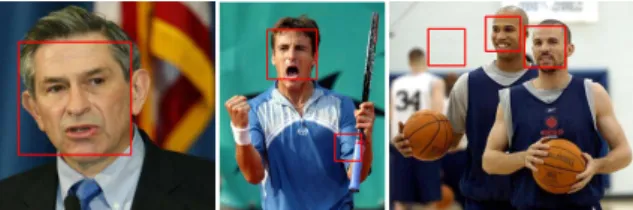
Face detection (see Figure 1) is a well studied prob-lem in computer vision, and good solutions are pre-sented in literature. However we notice that open source computer vision frameworks like OpenCV (Bradski et al., 2000), offer face detectors based on existing learning techniques, which are unable to yield high accuracies on the available public datasets. A root cause can be the fact that most of these mod-els have been created in the earlier ages of computer vision, when academic research was still interested in older cascade classifier based techniques, like (Viola and Jones, 2001). Academic research evolved and moved on, discovering more promising techniques like convolutional neural networks and loosing in-terest in well established and proven-to-work algo-rithms. This resulted in a well known computer vision library still providing a basic face detector, achieving only average detection results on any given dataset.
On the other side, users from the industry inter-ested in turning these open source computer vision frameworks into working applications, get stuck at improving the existing performance of the face detec-tion techniques. Their internal organizadetec-tional struc-ture does not allow to put efforts into research that tries to boost the performance of current algorithms. Two of the largest issues when trying to improve these existing techniques, are the availability of large
amounts of training data and the achievable accuracy limitation reported by academic research of different detection set-ups, using this basic detection model.
In order to fill the gap we decided to investi-gate how the current cascade classification pipeline for training a face detector inside OpenCV could be adapted to achieve a higher detection accuracy. We do this by adjusting the face annotations, improving the negative training sample collection and by using an active learning strategy to iteratively add hard pos-itive (pospos-itive windows classified as negatives in the previous iteration) and hard negative (negative win-dows classified as positives in the previous iteration) samples to the object detector training process.
Furthermore, we experience that industrial appli-cations of face detection tend to fail due to false pos-itive detections, as seen in Figure 1, because post-detection processing steps depend on a face being available. In the case of a face recognition applica-tion, the face detection can be the basis of gathering
Figure 1: Example ofCascadeClassifier.detectMultiScale()
training and test annotations (Learned-Miller et al., 2016; Wolf et al., 2011). Therefore we aim at improv-ing the available face detection model of OpenCV3.1, based on local binary patterns (Liao et al., 2007), aim-ing for a very high precision at an acceptable recall.
The remainder of this paper is structured as fol-lows. Section 2 presents related research, while sec-tion 3 discusses the used framework and datasets. This is followed by section 4 discussing the proposed approach in detail. Finally section 5 elaborates on the obtained results while section 6 and section 7 sum up conclusions and possible future improvements.
2
RELATED WORK
The OpenCV framework is an open source computer vision framework providing a collection of techniques ranging from basic image segmentation to complex 3D model generation. It steadily grows in size by contributions from a community of both academic re-searchers and industrial partners, adding recent ad-vances in the computer vision community, while try-ing to maintain the quality of the existtry-ing back-end. We notice that once new functionality is integrated for a longer period of time and heavily used by the community, investments in improving the functional-ity tends to stop. This could be explained by the fact that the computer vision community has no interest in actual relevant industrial implementations, but rather in pushing the state-of-the-art even further.
Recent advances in computer vision solve face de-tection by using complex techniques like multi-task cascaded convolutional neural networks (Zhang et al., 2016), convolutional neural networks combined with 3D information (Li et al., 2016) or recurrent convo-lutional neural networks (Jiang and Learned-Miller,
2016). These techniques yield very promising
re-sults, but tend to be fairly complex to implement in actual applications. There is still a lack in well docu-mented and supported open source software libraries that are easy to use. Furthermore we noticed OpenCV is paving the way of integrating these newer tech-niques, but up till now, their performance inside the OpenCV framework is still not as bug and error free as desired by industrial companies.
The work of Viola and Jones (Viola and Jones, 2001) on face detection using a boosted cascade of weak classifiers has been around for quite some time. It is the standard frontal face detector for many in-dustrial applications so far, like e.g. digital photo cameras. A downside is that many companies use the available software to train their own more com-plex face detection models, without sharing the mod-els back with the community. This is mainly due
to the fact that OpenCV operates under a BSD li-cense, allowing companies to use the code without sharing back any critical adaptations or changes. With our work we aim at improving the currently avail-able frontal face model based on local binary patterns (used as a baseline in this publication) and achieve a model that is able to accurately detect frontal faces in a large variety of set-ups.
One could argue that working on such an old tech-nique is basically a waste of time invested. However, several recent research papers like (Zheng et al., 2016; Puttemans et al., 2016a; Frejlichowski et al., 2016; Puttemans et al., 2016b; Shaikh et al., 2016) prove the importance of such well established techniques for specific cases of industrial object detection.
3
FRAMEWORK AND DATASET
For building our approach we depend on the
OpenCV3.1 framework 1, provided and maintained
by Intel. We focus on using the CascadeClassifier
object detection functionality in the C++ interface
to-gether with theopencv traincascadeapplication,
con-taining all functionality for building a boosted cas-cade of weak classifiers using the approach suggested by (Viola and Jones, 2001).
Since the training data of the current OpenCV face detection models is no longer available, we col-lected a set of face images for training our own frontal face detection model. The images are collected from various sources like YouTube videos and by using a bulk image grabber on social media, imageboards and google image search results. Remark that all of these images are not accompanied by ground truth face la-bels. On top of that, we created a multi-threaded tool that can use an existing face detection model to effi-ciently search for valuable face data in a given video, that can then again be added to the training data sets as hard positive and hard negative samples.
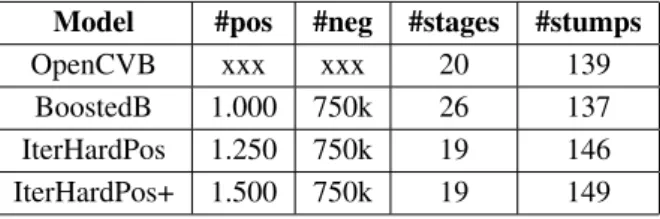
For training our new models, we manually anno-tate 1.000 face regions as positive training windows and combine this with 750.000 negative training win-dows, automatically grabbed from large resolution negative images not containing faces. As show in
Ta-1http://www.opencv.org
Table 1: Training data overview for trained models.
Model #pos #neg #stages #stumps
OpenCVB xxx xxx 20 139
BoostedB 1.000 750k 26 137
IterHardPos 1.250 750k 19 146
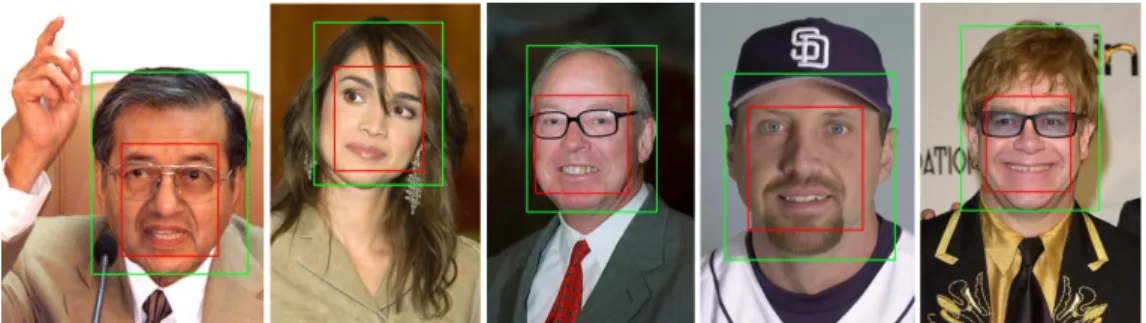
Figure 2: Changing the annotations from full-face to inner-face: (green) OpenCV (red) ours.
ble 1 we then increase the positives dataset for each new iteration with 250 extra hard positive samples. These are gathered from a large set of positive im-ages, in which we know faces occur. Whenever the initial detector is not able to find a face region, a man-ual intervention is required, asking for a face label, and adding it as a training sample for the following training iteration. The positive training set used for
training our finalIterativeHardPositives+model, can
be requested by contacting one of the paper authors. For validating our new models and comparing them to the existing OpenCV baseline, we use the
Face Detection Data Set and Benchmark2 (FDDB)
dataset (Jain and Learned-Miller, 2010). This dataset contains 5171 face annotations in 2845 images col-lected from the larger Faces in the Wild dataset (Berg et al., 2005). The dataset focuses on pushing the lim-its in unconstrained face detection. In order to be able to obtain a decent baseline, we converted the existing image annotations into the OpenCV used format, and
made them publicly available3.
4
SUGGESTED APPROACH
In the following subsections we will discuss the dif-ferent adaptations made to the existing cascade clas-sifier training pipeline, leading to an overall increase in performance, as discussed in section 5.
4.1
Changing the face’s region of
interest during annotation
When taking a closer look at the output of the OpenCV LBP frontal face detector, we notice that in many cases the detection output contains the complete head, including ears, hair and sometimes even back-ground information. This is due to the OpenCV train-ing data annotations. Figure 2 indicates that OpenCV
2http://vis-www.cs.umass.edu/fddb/
3http://eavise.be/OpenSourceFaceDetection/
aimed to include as much facial information as possi-ble to feed to the training algorithm. Since a face de-tector needs to be generic, we focus on the face part containing the most general features over any given face dataset. In order to reduce the amount of non-trivial face information, we decided to annotate faces as the inner face region only, seen as the red anno-tations in Figure 1, and as previously suggested by (Mathias et al., 2014) for similar face detection tech-niques. This approach has several benefits. It removes tons of features from the feature pool of the boosting algorithm, reducing the amount of features that need to be evaluated during model training. Furthermore the inner face is more robust to rotation (both in-plane as out-of-plane). We elaborate more on these in-plane and out-of-plane rotations in section 5.4.
4.2
Adapting the negative training
sample collection
OpenCV offers an automated way of collecting neg-ative samples from a set of random background im-ages not containing the object. The algorithm rescales the given negative images to different sizes and uses a sliding window based sequential collecting of neg-ative windows, without any overlap between sub-sequential windows. Once the set of negative images is completely processed, the process is repeated and adding a pixel offset in each image, to obtain slightly different samples (at pixel level). If a set is traversed multiple times, increasing the offset each time, this process equals applying a pixel shifting sliding win-dow approach, as illustrated in Figure 3(a). While the basic idea of capturing slight differences in your data might be a good starting point, this approach gener-ates a huge amount of negative samples which do not add extra meaningful knowledge to the process, and can thus not be seen as unique samples.
Looking at the boosting process used to train the cascade classifier (by default AdaBoost (Freund et al., 1999)), we notice that each new negative window can only be allowed as negative training sample for
(a) Original proces inside OpenCV framework.
(b) Suggested adapted pipeline.
Figure 3: Adaptations to the negative windows collection process.
a new stage, if the previous stages do not reject it. If there is only a slight pixel shift for different neg-atives, then this rejection phase will just evaluate a lot of windows, of which we already know that they will be rejected. Therefore we adapted the interface and removed the pixel offset procedure. By removing this procedure and having no overlap between subse-quent negative windows, we introduce a possible loss of valuable information shared around the borders of subsequent samples. This lost information might con-tain critical knowledge for building a robust detector. To reduce this loss of information we refine the scale generation in the image pyramid. Where OpenCV generates an image pyramid with a scale parameter of 1.4, we decide to lower this scale parameter value 1.1 to ensure that negative samples gathered on different pyramid scales are diverse enough while keeping as much valuable information as possible. This is illus-trated in Figure 3(b). By doing so, lost information on sample borders on one scale will be captured by either the previous or the subsequent scale. An extra benefit of refining the scale pyramid, is that the resulting ob-ject detection model is more robust to scale changes of the object, able to capture smaller variations in size. Based on these adaptations it is quite straightfor-ward to collect a large set of negative data samples, something necessary to create a robust face detection model for in the wild applications. Considering a high
resolution image of 1.080×1.920 pixels, we can
al-ready collect 30.000 negative training samples. This allows us to increase the number of negative samples per stage in our trained cascade classifier to multiple hundred thousands of samples, trying to model the background as good as possible. This will increase
training time per stage, but will reduce the amount of stages, and thus make the model faster, less complex and more accurate at detection time.
4.3
Iterative active learning strategy for
hard training samples
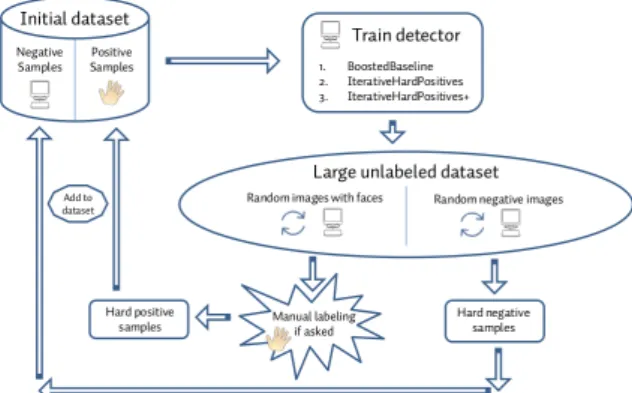
Supplying heaps of data to machine learning algo-rithms allow to learn very complex object detection models. The downside is that both in gathering pos-itive and negative training data, it is very difficult to tell which new sample will actually improve the ef-ficiency of the detection model. In order to decide which samples are actually valuable to be added to the process, we apply a technique called active learning. The idea is to use the model trained by the previous it-eration and use that model to tell us which samples are valuable (close to the decision boundary) and which are not (no ambiguity in labelling), when adding them to the next iteration training process, as seen in Fig-ure 4. We make a distinction between hard negatives and hard positives as explained below. Furthermore the advantage of active learning is that we limit the amount of manual labour drastically, since we only need to provide labels to new training samples that add extra knowledge to the trained classifier.
4.3.1 Hard negative samples
Hard negative samples are gathered by collecting a set of negative images and running our previously trained face detector on them. All detections returned are in fact negative windows that still trigger a detection, and are thus not assigned to the background yet by our current model. Basically these samples contain information that was not yet captured by the previ-ously collected set of negative samples and thus pro-vide valuable information to the training process.
Figure 4: A schematic overview of the active learning pro-cess (hand symbol) manual intervention/annotation (com-puter symbol) fully automated processing.
4.3.2 Hard positive samples
Hard positive samples are gathered by collecting a large set of unlabelled images containing faces. We only know the images contain one (or more) faces, but we do not have a labelled location. On these im-ages, the current face detector is executed (with a low detection certainty threshold) and a piece of software keeps track of images that do not trigger a detection. In that case, an operator is asked to manually select the face region for those triggered images and thus provide labels. This region is stored as a hard positive sample that can still give the model learning interface enough extra valuable knowledge on how it should be learning its model.
4.4
Halting training when negative
dataset is consumed
The original OpenCV implementation use pixel-wise offsets in the negative sample grabbing to avoid the training to halt when the original provided dataset is completely consumed in a first run. In section 4.2 we already describe that using these pixel shifted win-dows is overkill and adds a lot of redundant data. We halt the training when the negative dataset is com-pletely consumed. Once that happens we give the op-erator two possibilities. Either we allow to add extra images to the negative image dataset, or we return the amount of negative samples that was grabbed in the last stage before the training was halted. This allows the operator to finalize the last stage with this exact amount of samples and thus train a model using every single negative sample window, completely consum-ing the available negative dataset.
4.5
Using the adaptations to train
different face detection models
By smartly combining all the adaptations suggested in section 4.1, 4.2 and 4.3 we train different face de-tection models where we iteratively try to improve the accuracy of the obtained model. Table 1 describes the training data used for these models, in combination with the number of model stages and the number of features (each forming a stump/binary decision tree) selected by the boosting process.
Our first model (referred to as‘BoostedBaseline’)
can be seen as our baseline we iteratively try to im-prove by applying the active learning strategy. We limit the training to only incorporate stumps, which are single layer decision trees. One might argue that using more complex decision trees is more profitable but previous research shows that using more complex
trees actually slows the detection process (Reyzin and Schapire, 2006), because more features need to be evaluated in early stages. For each boosted learning model, the increase in performance when adding fea-tures should outweigh the complexity and thus the processing time. Our model training is halted when the collected set of random negative background im-ages is completely consumed.
For the second model, referred to as
‘Iterative-HardPositives’, we add 250 hard positive training samples collected through the active learning proce-dure, trying to improve the recall rate of the detec-tor. We also gather a limited set of hard negatives and add those to the training set. We noticed that adding these extra quality samples pushes the recall rate while slightly increasing the precision rate. The
third and final model, referred to as
‘IterativeHard-Positives+’, is again improved by providing 250 extra hard positive samples, in an attempt to push the re-ported recall even further.
5
RESULTS
5.1
Performance of trained models
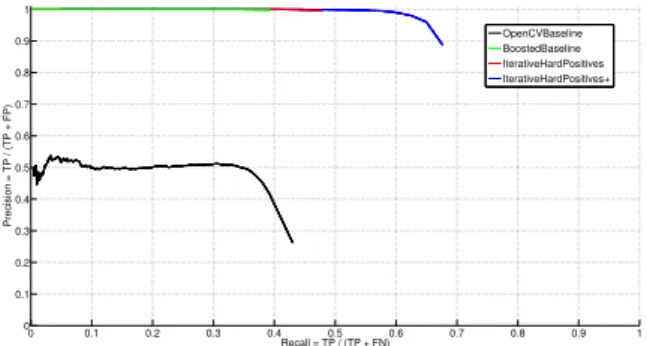
Figure 5 compares the trained models (
BoostedBase-line, IterativeHardPositives and IterativeHardPosi-tives+) from section 4.5 to theOpenCVBaseline de-tector on the FDDB test dataset. Performance is mea-sured using precision-recall plots. We notice a gen-erally large improvement of our self trained models (green, red and blue curve) over the OpenCV baseline (black curve). The OpenCV baseline model is only able to achieve a recall of about 40% (meaning 4 out of 10 objects are detected) at a precision of 40% (of all the detections returned, only 4 out of 10 are actual objects) for its optimal point. Of course one can make a trade-off and decide to sacrifice recall for a higher precision. Nonetheless the current OpenCV model is not able to detect objects with a certainty higher than 50% on the given FDDB dataset, containing a wild variety of faces in very challenging conditions.
0 0.1 0.2 0.3 0.4 0.5 0.6 0.7 0.8 0.9 1 0 0.1 0.2 0.3 0.4 0.5 0.6 0.7 0.8 0.9 1 Recall = TP / (TP + FN) Precision = TP / (TP + FP) OpenCVBaseline BoostedBaseline IterativeHardPositives IterativeHardPositives+
0 0.1 0.2 0.3 0.4 0.5 0.6 0.7 0.85 0.9 0.95 1 Recall = TP / (TP + FN) Precision = TP / (TP + FP) BoostedBaseline IterativeHardPositives IterativeHardPositives+
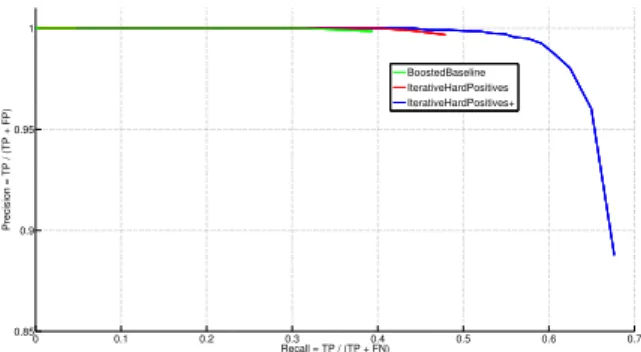
Figure 6: Close-up of PR curves of our detection models.
Compared to theOpenCVBaselinedetector, at the
optimal recall of 40% for that model, our
Boosted-Baselinedetector already increases the precision to-wards 99.5%, almost completely removing the exis-tence of false positive detections. Furthermore, each of our subsequent models, as seen in the close-up in Figure 6, increases the recall further without sacrific-ing the very high precision rate. At a recall value of
60%, a 50% increase compared to the
OpenCVBase-line detector, our IterativeHardPositives+ detector
only has a slight drop to 99% precision. As an
opti-mal working point ourIterativeHardPositives+model
reaches a precision of 90% at a recall of 68%. While many papers on face detection use precision recall curves to compare detection models efficiently, the official FDDB evaluation criteria is based on the true positive rate compared to the number of false pos-itive detections. We include this comparison for both theOpenCVBaselinedetector and our IterativeHard-Positives+detector, as seen in Figure 7. We also com-pare our technique to some state-of-the-art face detec-tion algorithms based on neural networks like FastR-CNN (Jiang and Learned-Miller, 2016), ConvNet3D (Li et al., 2016) and MultiTaskCNN (Zhang et al., 2016). This clearly shows that we already close the gap between cascade classifiers and neural networks a lot, while still having room for improvement.
0 500 1000 1500 2000 2500 0 0.1 0.2 0.3 0.4 0.5 0.6 0.7 0.8 0.9 1 False Positives = #FP
True Positive Rate = TP / (TP + FN)
FastRCNN ConvNet3D MultiTaskCNN OpenCVBaseline IterativeHardPositives+
Figure 7: Evaluation for FDDB dataset, comparing our al-gorithm to neural network based approaches.
Table 2: Timing results comparing both OpenCV baseline and self trained models for the FDDB dataset.
Model Whole Set Per Image
OpenCVBaseline 9 min 30 sec 0.20 sec
BoostedBaseline 6 min 8 sec 0.13 sec
IterativeHardPos 7 min 7 sec 0.15 sec
IterativeHardPos+ 9 min 6 sec 0.19 sec
5.2
Influence of adaptations to
processing time
One must make sure that adding all this extra train-ing data does not make the model overly complex and slow during detection time. As shown in Table 1 we have only a limited increase in used features as stump classifiers, while adding 50% more valuable positive training data. Furthermore the complexity in number of stages drops with our models. Since processing time is a key feature for many computer vision approaches applied in embedded systems, we took the liberty of measuring processing time over the complete FDDB test set, which can be seen in Table 2. We average the timings to receive a tim-ing per image, given the average resolution of the test
images is 400×300 pixels. These timings are
per-formed on a Intel(R) Xeon(R) CPU E5-2630 v2 sys-tem set-up. Our OpenCV build is optimized using the Threading Building Blocks for parallel processing. We clearly see, although we are using more features
in our model, that the processing time of our
Iterative-HardPositives+model does not exceed the processing
time of theOpenCVBaselinemodel. Furthermore, if
we use ourBoostedBaselineorIterativeHardPositives
detector, we process images remarkably faster than theOpenCVBaselinedetector.
5.3
A visual confirmation
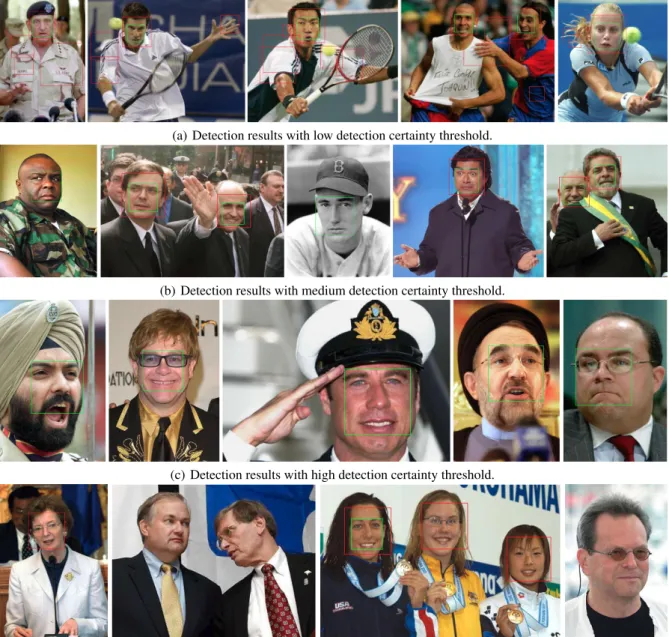
Figure 8 shows some visual detection output of our algorithm. We start by selecting a low detection cer-tainty threshold (Figure 8(a)) which clearly shows that both models are able to find faces, but imme-diately shows the downside of the OpenCV model, which generates a lot of false positive detections. We increase the detection certainty threshold to a medi-ate level (Figure 8(b)) and notice that both OpenCV and our own trained model are able to find faces, but gradually OpenCV starts to miss faces that are still detected by our model. Finally when setting a high detection certainty threshold (Figure 8(c)), we see that OpenCV misses a lot of faces that are still found by our model. But even in the case that our model detects
(a) Detection results with low detection certainty threshold.
(b) Detection results with medium detection certainty threshold.
(c) Detection results with high detection certainty threshold.
(d) Cases where both detectors fail (high certainty threshold) or where OpenCV finds a detection while we do not.
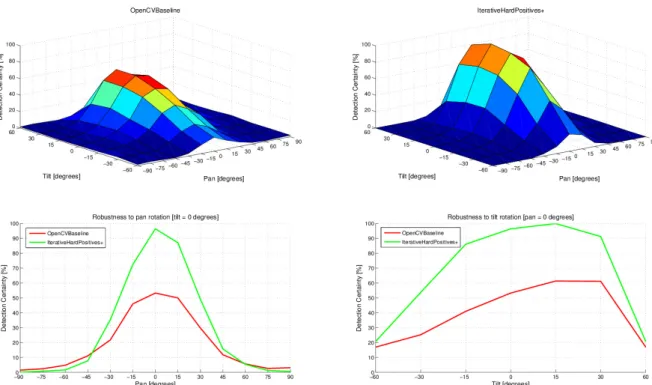
Figure 9: Testing out-of-plane rotational robustness for bothOpenCVBaselineand theIterativeHardPositives+detector.
more faces than OpenCV we still find cases where both models fail or where OpenCV actually finds a face that our models does not capture, as seen in Fig-ure 8(d). These undetected faces could be used as hard positive training samples but then we would need to search for a new database for evaluation purposes in order not to introduce dataset bias.
5.4
Testing out-of-plane rotation
robustness
As already stated in section 4.1 reducing the annota-tion region, which directly influences the face region that the detector will return, helps improving the out-of-plane rotation of the face detector. To test this, we
evaluated theOpenCVBaselineand the
IterativeHard-Positives+detector on the Head Pose Image Database (Gourier et al., 2004), as seen in Figure 9. This dataset contains a set of 30 sequences (15 persons, 2 se-quences per person) where people sequentially look at different positions, each associated with a pan (in
the range [-90◦,+90◦]) and a tilt angle (in the range
[-60◦,60◦]). At each position, we execute both
detec-tors and return the detection certainty of the models. averaged over the 30 sequences. We use the highest returned detection score on the dataset as the outer bound of our score range and normalize all other val-ues for this maximum. We see that in both pan and tilt
angle evaluations ourIterativeHardPositives+
detec-tor clearly outperforms theOpenCVBaselinedetector.
Especially in the tilt angle range, we see a large in-crease in efficiency. This extra test also confirms that
at a full frontal face, theIterativeHardPositives+
de-tector has about double the detection certainty as the
OpenCVBaselinedetector, which was already clearly noticeable in Figure 5.
6
CONCLUSIONS
The goal of this paper is to suggest adaptations to the current existing cascade classification pipeline in the open source computer vision framework OpenCV with the eye on improving its frontal face detection model. We aim at reducing the huge amount of false positive detections, by guaranteeing a high precision, while maintaining the recall as high as possible, to detect as many faces as possible. We test our ap-proach on the publicly available FDDB face dataset and prove that our adaptations to the pipeline generate
an enormous increase in performance. Using our
Iter-ativeHardPositives+detector, we achieve an increase in recall to 68% while maintaining a high precision of 90%. Compared to a 40% precision at 40% recall for the current implementation, this is quite impressive.
The suggested adaptations to the framework and the model clearly have benefits over the currently available model. Imagine a case where the output of the face detector is used to perform face
recog-nition. In such cases we aim at a precision that is as high as possible, since we want to ensure that the pipeline following on the actual detection, is not pro-vided with rubbish but with an actual face. Further-more our model is able to find Further-more faces in the wild and is more robust to out-of-plane rotations compared to the OpenCV baseline model.
We should take into account that we will never hit a 100% recall on datasets like FDDB, due to some high out-of-plane rotations, as seen in Figure 8(d). However one could argue that faces with an out-of-plane rotation of more than 45 degrees should be found by a profile face detector and combine both de-tectors together, as suggested in (Hulens et al., 2016).
7
FUTURE WORK
As future work we suggest to push the accuracy of the face detection model in the OpenCV framework even further. We have still room to increase the amount of hard positives samples, aiming for an even higher
recall rate. A good start could be to run our
Itera-tiveHardPositives+detector on the FDDB dataset and use the returned hard positive faces as training data. However this will force us to look at new evaluation datasets besides FDDB to avoid dataset bias.
At the moment the model is only evaluated on a single in-plane rotation. Like suggested in (Puttemans et al., 2016a) we could build a rotational 3D matrix of
the image and apply ourIterativeHardPositives+
de-tector several times to incorporate these in-plane ro-tations. This would allow us to find more faces and push the performance of our pipeline even further.
ACKNOWLEDGEMENTS
This work is supported by the KU Leuven, Cam-pus De Nayer and the Flanders Innovation & En-trepeneurship (AIO).
REFERENCES
Berg, T. L., Berg, A. C., Edwards, J., and Forsyth, D.
(2005). Whos in the picture. Advances in neural
in-formation processing systems, 17:137–144.
Bradski, G. et al. (2000). The opencv library.Doctor Dobbs
Journal, 25(11):120–126.
Frejlichowski, D., Go´sciewska, K., Forczma´nski, P., Nowosielski, A., and Hofman, R. (2016). Applying image features and adaboost classification for vehicle
detection in the sm4public system. InImage
Process-ing and Communications Challenges 7, pages 81–88. Freund, Y., Schapire, R., and Abe, N. (1999). A short
in-troduction to boosting.Japanese Society For Artificial
Intelligence, 14(771-780):1612.
Gourier, N., Hall, D., and Crowley, J. L. (2004). Estimating face orientation from robust detection of salient facial
features. InICPR International Workshop on Visual
Observation of Deictic Gestures.
Hulens, D., Van Beeck, K., and Goedem´e, T. (2016). Fast and accurate face orientation measurement in
low-resolution images on embedded hardware. In
Pro-ceedings of VISIGRAPP, volume 4, pages 538–544. Jain, V. and Learned-Miller, E. (2010). Fddb: A benchmark
for face detection in unconstrained settings.
Tech-nical Report UM-CS-2010-009, University of Mas-sachusetts, Amherst.
Jiang, H. and Learned-Miller, E. (2016). Face
de-tection with the faster r-cnn. arXiv preprint
arXiv:1606.03473.
Learned-Miller, E., Huang, G. B., RoyChowdhury, A., Li, H., and Hua, G. (2016). Labeled faces in the wild:
A survey. InAdvances in Face Detection and Facial
Image Analysis, pages 189–248.
Li, Y., Sun, B., Wu, T., Wang, Y., and Gao, W. (2016). Face detection with end-to-end integration of a convnet and
a 3d model.arXiv preprint arXiv:1606.00850.
Liao, S., Zhu, X., et al. (2007). Learning multi-scale block
local binary patterns for face recognition. InAdvances
in Biometrics, pages 828–837.
Mathias, M., Benenson, R., Pedersoli, M., and Van Gool, L. (2014). Face detection without bells and whistles. InEuropean Conference on Computer Vision, pages 720–735.
Puttemans, S., Van Ranst, W., and Goedem´e, T. (2016a). Detection of photovoltaic installations in rgb aerial
imaging: a comparative study. InGEOBIA2016.
Puttemans, S., Vanbrabant, Y., Tits, L., and Goedem´e, T. (2016b). Automated visual fruit detection for harvest
estimation and robotic harvesting. InIPTA2016.
Reyzin, L. and Schapire, R. E. (2006). How boosting the
margin can also boost classifier complexity. In
Pro-ceedings of the 23rd international conference on Ma-chine learning, pages 753–760.
Shaikh, F., Sharma, A., Gupta, P., and Khan, D. (2016). A driver drowsiness detection system using cascaded
adaboost. Imperial Journal of Interdisciplinary
Re-search, 2(5).
Viola, P. and Jones, M. (2001). Rapid object detection
us-ing a boosted cascade of simple features. InCVPR,
volume 1, pages I–511.
Wolf, L., Hassner, T., and Maoz, I. (2011). Face recog-nition in unconstrained videos with matched
back-ground similarity. InCVPR, pages 529–534.
Zhang, K., Zhang, Z., Li, Z., and Qiao, Y. (2016). Joint face detection and alignment using multi-task
cascaded convolutional networks. arXiv preprint
arXiv:1604.02878.
Zheng, Y., Yang, C., Merkulov, A., and Bandari, M. (2016). Early breast cancer detection with digital mammo-grams using haar-like features and adaboost
algo-rithm. InSPIE Commercial+ Scientific Sensing and
Imaging, pages 98710D–98710D. International Soci-ety for Optics and Photonics.