OpenAIR@RGU
The Open Access Institutional Repository
at Robert Gordon University
http://openair.rgu.ac.uk
This is an author produced version of a paper published in
Proceedings of the 21st ACM international conference on Information and
knowledge management (ISBN 9781450311564)
This version may not include final proof corrections and does not include
published layout or pagination.
Citation Details
Citation for the version of the work held in ‘OpenAIR@RGU’:
WANG, L., SONG, D. and ELYAN, E., 2012. Improving
bag-of-visual-words model with spatial-temporal correlation for video
retrieval. Available from OpenAIR@RGU. [online]. Available from:
http://openair.rgu.ac.uk
Citation for the publisher’s version:
WANG, L., SONG, D. and ELYAN, E., 2012. Improving
bag-of-visual-words model with spatial-temporal correlation for video
retrieval. In: Proceedings of the 21st ACM international conference
on Information and knowledge management. 29 October – 2
November 2012. New York, NY: ACM. Pp. 1303-1312
Copyright
Items in ‘OpenAIR@RGU’, Robert Gordon University Open Access Institutional Repository, are protected by copyright and intellectual property law. If you believe that any material held in ‘OpenAIR@RGU’ infringes copyright, please contact [email protected] with details. The item will be removed from the repository while the claim is investigated.
Improving Bag-of-visual-Words Model with
Spatial-Temporal Correlation for Video Retrieval
∗ABSTRACT
Most of the state-of-art approaches to Query-by-Example (QBE) video retrieval are based on the Bag-of-visual-Words (BovW) representation of visual content. It, however, ig-nores the spatial-temporal information, which is important for similarity measurement between videos. Direct incorpo-ration of such information into the video data representa-tion for a large scale data set is computarepresenta-tionally expensive in terms of storage and similarity measurement. It is also static regardless of the change of discriminative power of vi-sual words with respect to different queries. To tackle these limitations, in this paper, we propose to discover Spatial-Temporal Correlations (STC) imposed by the query exam-ple to improve the BovW model for video retrieval. The STC, in terms of spatial proximity and relative motion co-herence between different visual words, is crucial to identify the discriminative power of the visual words. We develop a novel technique to emphasize the most discriminative vi-sual words for similarity measurement, and incorporate this STC-based approach into the standard inverted index archi-tecture. Our approach is evaluated on the TRECVID2002 and CC WEB VIDEO datasets for two typical QBE video retrieval tasks respectively. The experimental results demon-strate that it substantially improves the BovW model as well as a state of the art method that also utilizes spatial-temporal information for QBE video retrieval.
Categories and Subject Descriptors
H.3.4 [Information Search and Retrieval]: Query for-mulation,Retrieval models,Search process
General Terms
Theory
Keywords
∗Spatial-Temporal Correlation, discriminative visual word, Content based Video Retrieval, Query-by-Example, Bag-of-visual-Word
1.
INTRODUCTION
The last decade has witnessed a rapid growth of video data over the Internet and online data repositories. There has been an urgent demand for more effective and efficient content-based video retrieval technology. In this paper, we focus on the Query-by-Example (QBE) video retrieval, which enables users to give a video example as the query to search against a data collection to find similar videos [26]. It is widely applied to many practical tasks such as near-duplicate video search, copyright infringement detection, instance search, etc. Most state-of-art approaches to large scale content based vi-sual retrieval are based on the Bag-of-vivi-sual-Words (BovW) model. As firstly introduced in the context of visual object search [23], high dimensional feature descriptors, such as SIFT [13] and SURF [1], are extracted to represent the stable and salient regions surrounding points-of-interest detected by local feature detectors. Popular detectors include Harris-Affine [14], Hessian-Harris-Affine [14], and Difference of Gaussian [13]. The regional descriptors generated from the collection or a training dataset are clustered and each cluster forms a visual word. Then given an image (or a keyframe in a video), the region descriptors in the image are quantized into dis-crete visual words. Specifically, the quantization function maps a region descriptor onto its closest cluster centroid. The region descriptor is then called an instance of the cor-responding visual word (in this paper, we use the term “vi-sual word” and “instance of vi“vi-sual word” interchangeably, for convenience, unless explicitly distinguished). As a re-sult, an image can be represented as a bag of visual words. A pair of descriptors mapped onto an identical visual word are considered as a match between their visual contents. The similarity between two images can be measured based on the distance between their BovW representations.
In QBE video retrieval, a video is represented by a sequence of sampled key frames, each of which is represented by a bag (usually as a frequency histogram) of visual words. The similarity between two videos is obtained by aggregating the similarities of key frames across the two videos [4] . To al-leviate the possible mismatches caused by unstable quan-tization, e.g. near identical regions being assigned to dif-ferent visual words, soft-quantization of visual words [20, 8] has been proposed to map each descriptor onto multiple
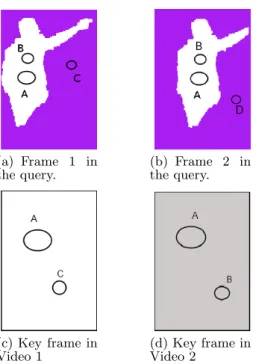
(a) Frame 1 in the query. (b) Frame 2 in the query. (c) Key frame in Video 1 (d) Key frame in Video 2
Figure 1: Emphasizing the discriminative visual words to compensate the neglect of spatial-temporal internal structure. Query consists of two frames is represented by visual words A, B, C and D, and the video 2 is likely to be more relevant than 1)
neighboring visual words (in the descriptor feature space). Despite its simple structure, the BovW model has shown a promising performance in the fields such as object/event recognition [25] and image/video retrieval [21].
A major limitation of the BovW model, especially for QBE video retrieval, is that the spatial-temporal relation between visual words has been neglected, despite its obvious impor-tance for similarity measurement of visual contents, mainly due to two reasons. First, the visual words within a frame are assumed independent of each other and the spatial re-lationship is discarded. Second, the temporal motions of visual words across the sequential frames are neglected. Figure 1 shows an illustrative example. Here, we make a simplified assumption that the relevant videos should in-clude the person appearing in the query. In Frame 1, the visual words A and B representing visual content of this per-son are messed up by another irrelevant visual word C. The BovW model, on one hand, discards the spatial relationship between A and B within the Frame 1, and on the other hand, neglects the motion of A and B from Frame1 to Frame 2. In the similarity measurement, the BovW model assumes that all visual words have an equal discriminative power. As a result, Video 1 and Video 2 are considered equally similar to the query. However, Video 2 is more likely to be relevant to the query, because the spatial relationship and motion co-herence between A and B strongly implies that they belong to an identical object and should be more discriminative than C and D with respect to this query. Thus the spatial-temporal correlation of visual words A and B is a strong clue of relevance.
To overcome the limitations, various approaches (described in more detail in Section 2) have been proposed to incor-porate the spatial-temporal constraints associated with vi-sual words. Some recent image/video retrieval methods add position, scale, main orientation and motion primitives of each visual word directly into the BovW representation, and then, for example, enhance the similarity measurement with Weak/Tight Geometric Constraint (WGC/TGC) verifica-tion of matched visual words between two images/videos [7, 32]. Nonetheless, the injected information results in a signif-icant increase of computation cost in the similarity match. Another direction is to expand the vocabulary with spatially correlated visual word combinations [30, 29, 33] to form ”vi-sual phrases”. However, it tremendously increases the stor-age cost of visual content representation, and does not take into account the temporal (motion) constraint.
To tackle the aforementioned limitations, instead of expand-ing or addexpand-ing extra spatial-temporal information directly into the BovW representation, we propose to identify and emphasize the most discriminative visual words (for exam-ple, A and B in the Figure 1) through exploiting the spatial-temporal correlation in an integrated manner, among differ-ent visual words in the query. The emphasizing of discrim-inative visual words would revise the query representation and exclude the irrelevant information, which compensates the neglect of spatial-temporal information. Furthermore, the spatial-temporal information discovery from query ex-ample does not result in extra storage cost for data represen-tation nor increased complexity in similarity measurement. We propose the characterize the discriminative visual words based on spatial proximity and temporal motion coherence. In the consecutive frames, an inherent object often has an explicit spatial structure and intensive spatial relationship. The motion of object layout across neighboring frames in a video often has a characteristic of coherence. This spatial-temporal relationship can be utilized to approximate the possibility that the visual words are associated with an iden-tical object, and such visual words usually have more dis-criminative power. In this paper, we base our proposed method on two assumptions on the discriminative visual words: i) they co-occur closely in a frame; ii) they move coherently across sequential frames. The spatial proximity and motion coherence is termed as spatial temporal correla-tion (STC).
In this paper, we present a novel technology to model the STC imposed by a query. Specifically, we propose to model the pair-wise STC by a Gaussian distribution based on the assumption that the layout of objects follows the law of Mixture Gaussian distribution [2, 12]. A similarity measure based on STC is developed, which emphasizes the discrim-inative visual words with respect to the query. Essentially, this leads to reformulation of the key frames of the query video, effectively involving the discriminative visual words that may or may not originally appear in the key frame and excluding the noisy ones. The discriminative power of a vi-sual word are determined by both the STC matrix and their frequencies. Furthermore, it is important to note that the retrieval technology can be easily incorporated into standard inverted indexing architecture to achieve high computational efficiency.
The rest of the paper is organized as follows: Section 2 re-views the related work on incorporating spatial-temporal in-formation in content based image/video retrieval; Section 3 describes our STC-based video retrieval technology in detail; Section 4 presents the experimental settings and results for an extensive evaluation on two typical QBE video retrieval tasks; Section 5 concludes the paper and points out future research directions.
2.
RELATED WORK
There have been some recent approaches that utilize the spa-tial or temporal constraint associated with the visual words to improve the BovW model. For example, spatial infor-mation is introduced into image/video retrieval [18, 19, 23] for a post-retrieval re-ranking, which matches visual words through verification of their neighboring visual words be-tween two images. Sivic et al. [23] employed weak tempo-ral constraint to remove the visual words which can not be tracked in 3 consecutive frames of video. Chum et al. [5] proposed a generative model to expand the query based on the strong spatial constraints discovered from the first round retrieval results and the query for image retrieval.
Utilizing additional spatial-temporal information incorpo-rated in the video representation, the idea of the WGC/TGC [7, 32] is that the scales and the main direction variations of the correctly matched visual words should be consistent. Spatial Pyramid Matching [11] is proposed to approximate the global geometric correspondence. It partitions the image into hierarchical sub-images to model the spatial relation of visual words and improve the similarity measurement. Machine learning based technologies have been proposed to join related visual words into visual phrases according to the spatial constraint. Sivic et al. [22] applied the latent seman-tic indexing based on co-occurring visual words. Zhang et al. [29] developed a supervised learning technique to com-bine co-occurring pairs of visual words to representative vi-sual phrases for known categories of images. Zhang et al. [30] proposed an approach to quantize an image into bins and encode the spatial information with the co-occurred vi-sual words as geometry-preserving vivi-sual phrases to achieve higher discriminative power. However, these approaches largely increase the dimensionality of visual content rep-resentation. Temporal information is commonly used in the recent video analysis technology based on the BovW model. For example, Wang et al.[25] proposed to incorpo-rate a number of motion primitives of each visual word into the BovW representation of videos. Nevertheless, the above approaches usually directly include the spatial-temporal in-formation into visual content representation, and the storage and computational cost is often high. This is one of the ma-jor obstacles for developing large scale content-based visual information retrieval technology. Furthermore, the spatial-temporal information incorporated in video representation is also not straightforward to be deployed with inverted index architecture.
There have been approaches to deriving the discriminative features according to spatial-temporal constraints at the pixel level for image/video retrieval. For example, similar to spa-tial points-of-interest detection, various spaspa-tial-temporal lo-cal points-of-interests detectors are proposed, such as
Spatial-Temporal Interest Points [10, 2] and Volumetric features [9]. The spatial-temporal local detectors are designed to detect the salient ”spatial-temporal corners” or ”sub-volume” of a video at pixel level, which has succeeded in action or event recognition. Nonetheless, at the pixels level it would not be able to capture the spatial-temporal constraints from a ”semantic” perspective. Furthermore, there are attempts to enhance the BovW by utilizing higher level spatial-temporal constraints between multiple visual words. Object-of-Interest extraction according to spatial-temporally distribution of the visual words are proposed [12], and it improves the visual object search. However, the Object-of-Interest based repre-sentation would lose much information associated with the background of videos. Overall, these are interesting direc-tions for further exploration but out of scope of this paper, where we focus on the visual words level in line with the state of the art in QBE video retrieval.
3.
VIDEO RETRIEVAL BASED ON STC
3.1
Video Representation based on the BovW
Model
In this paper, each video in a collection is represented as a set of key frames vd = {fd}, where each key frame fd
is represented by a K dimensional vector (K denotes the size of vocabulary) of visual words occurring in the frame: f={wi}where the weightwiof theithvisual words inf is
its Term Frequency (TF). Similarly, a given query example, which is also a video, is represented as vq ={fl}where fl
is a frame. For efficiency, a bunch of key frames {fq} ⊂
vq is sampled for the video similarity measurement. Note,
however, that we use all frames{fl}in the query for spatial-temporal correlation detection and measurement as shown in the next subsections.
The BovW model usually involves a very large vocabulary, and the representation vector f is sparse. Therefore, the inverted index architecture can be applied. For each visual word, a table is built to list all the frames where it appears. The key frame similarity sim(fd,fq) is measured by the
cosine function, which can be approximated by:
sim(fd,fq)≈
PK
i=1score(wi)
l(fd)∗l(fq)
(1) where scoring functionscore(wi) is defined as:
score(wi) =fq(wi)∗fd(wi) (2)
wherel(f) is theL2-Norm of vectorf, andscore(w i) is the
scoring function of each matched visual word acrossfdand
fq, given by the multiplication of the corresponding TFs.
The scores are accumulated to compute a similarity score between two key frames. In this paper, it is assumed that the video data are well segmented shots or the videos are short and consist of few shots. We then adopt the shot similarity measurement method proposed by Peng et al [17] where the highest similarity score among all possible pairs of key frames compared is used to measure the similarity between two video shots:
simvd,vq= max
fd∈vd,fq∈vq
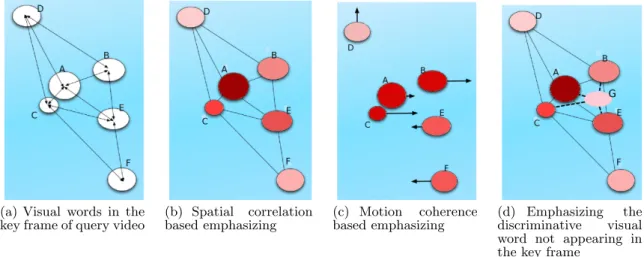
(a) Visual words in the key frame of query video
(b) Spatial correlation based emphasizing (c) Motion coherence based emphasizing (d) Emphasizing the discriminative visual word not appearing in the key frame
Figure 2: An example of visual words emphasizing approach. In (b), (c) and (d), the color intensity indicates the importance.
3.2
Characterizing Discriminative Visual Words
We aim to improve the BovW model by emphasizing the visual words satisfying the spatial proximity and temporal motion coherence constraints. Effectively, these visual words tend to be associated with an identical object. Tradition-ally, this association was addressed by image segmentation, which is computationally expensive [6]. Reliable segmen-tation and acceptable segmensegmen-tation quality are also open questions. In this paper, we approximate the discrimina-tive power of visual words according to the two assumptions proposed in Section 1. We develop a novel characterizing scheme by considering its spatially and temporally corre-lated visual words.
Regarding the spatial correlation, it can be measured by the proximity between visual words, e.g. the inverse of Eu-clidean Distance [28, 12]. An example is illustrated in Figure 2(a). Visual word A is located in a close proximity to B, C and E in the key frame of the query, and visual word A is assigned with a higher discriminative power as shown in Figure 2(b).
In addition, in the temporally consecutive frames, the reoc-curring visual words are tracked according to theL2Norm. Each tracked visual word moves to new position in the next frame, and associated with a motion vector (Figure 2(c)). We propose to measure the relative motion with respect to two visual words to indicate how the two visual words move coherently. In Figure 2(c), visual words A, B, and C move coherently to right, and they are assigned with a higher dis-criminative power.
Eventually, if a visual word had a strong STC with other words appearing in the same frame of query, the visual word is assumed to have a higher discriminative power.
Based on the above principles, our scoring function based on STC for a visual word in a key frame of the query video
is then formulated as follows:
score0(wi) = K
X
j=1
fq(wi)∗st(i, j)∗fd(wj) (4)
wherest(i, j) measures the STC between theithandjth vi-sual words. The formulation of STC measurement function will be shown in the next subsection.
3.3
The STC Measurement Function
As discussed in previous section, the STC measurement is formulated based on the principles shown in Figure 2. The STC between a pair of visual words should be inversely pro-portional to the physical space distance and relative motion associated.
As has been shown in [12, 3], the visual objects’ spatial layout can be modeled by a Gaussian Mixture Model. The spatial correlation between pair-wise visual words in a frame of the query video is then formulated as follows:
si,j= Pfq(wi) a=1 Pfq(wj) b=1 e −κd2a,b for fq(wi)&fq(wj)6= 0 0 otherwise (5) whereda,b= p
(xa−xb)2+ (ya−yb)2denotes the Euclidean
distance between the ath instance of the ith visual word and the bth instance of the jth visual word in the frame,
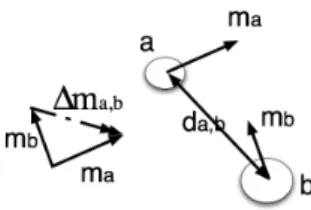
as shown in Figure 3. It should be noted that in a frame represented by a very large vocabulary, there usually exists only one instance for each visual word, and the spatial cor-relation sa,b between the two instances directly represents
the spatial correlation between the two visual words. The parameterκanalogs the inverse of variance in the Gaussian Distribution, which controls the decreasing speed of the spa-tial correlation. Generally, the larger is the parameterκ, the more visual words are considered as spatial correlated. Similar to the spatial correlation measurement, the modeling of temporal motion coherence is also based on the Gaussian
Figure 3: Relative Motion between a pair of in-stances of visual word
distribution. The measurement function is formulated by:
ti,j= Pfq(wi) a=1 Pfq(wj) b=1 e −γk∆ma,bk2 for f q(wi)&fq(wj)6= 0 0 otherwise (6) where ∆ma,b denotes the relative motion between instance
aof theithvisual word and instancebof thejthvisual word
in the frame. The relative motion vector ∆ma,bis calculated
by:
∆ma,b=ma−mb (7)
wheremdenotes the motion vector of the tracked instance of the visual word in consecutive frames, as shown in Fig-ure 3. Similarly, the parameterγin Equation 6 controls the decreasing of temporal correlation along with the expansion of the relative motion.
Equations 6 and 5 are combined to model the STC for a pair of visual words. To simplify the computation, an addition is utilized to fuse the two correlations. If any visual word in the pair is not tracked in next frame, the temporal correlation is set to zero. The STC within a frame and the entire query video are calculated as:
stli,j= (s l i,j+t l i,j) STi,j= L X l=1 stli,j (8) wherestl
i,jrepresents the STC between theithandjthvisual
words in thelthframe of query videovq, andLdenotes the
total number of frames invq. STi,jis the STC between the
ithandjthvisual words measured based on the entire query.
In this way, the STC of singular and rarely appearing visual words are relatively reduced.
In summary, an STC matrixST is generated for the query, and each entry ofST is a pair-wise correlation computed by Equation 8. How the STC incorporated to improve the BovW based similarity measurement will be described in the next subsection.
3.4
Key Frame Reformulation and Similarity
Measurement
By incorporating STC-based scoring function (Equation 4), the key frame similarity measure in Equation 2 becomes:
sim(fd,fq)≈ PK i=1score 0 (wi) l(fd)∗l(fq) (9) However, direct computation of Equation 9 is difficult to im-plement for the inverted index architecture due to the STC
computation. The original scoring function of Equation 2 corresponds to the inner product between the query and data representation vectors, which can be easily applied to inverted index system. To facilitate a similar computation, the numerator of Equantion 9 is rewritten as follows:
K X i=1 score0(wi) = K X i=1 K X j=1 fd(wj)∗fq(wi)∗st(i, j) = K X j=1 fd(wj)∗ K X i=1 st(i, j)∗fq(wi) = K X j=1 α(wj)∗fd(wj) (10)
The weighting vectorα=ST×fqandα∈RK, whereα(wi)
denotes the discriminative power (also called emphasizing weights) of the ith visual word, and can also be directly
used as the emphasizing weights. ST is the K×K STC matrix computed by Equation 8.
As shown in Equation 10, the STC is injected into the scor-ing function for emphasizscor-ing the discriminative visual words in the keyframes, which is equivalent to key frame reformu-lation. It must be noted that the STC is measured using all frames in the query (Equation 8), and as a result, some vi-sual words may be brought by the STC into the reformulated key frame, even though their original term frequency on the key frame is zero. For example, as shown in Figure 2(d), the visual word G is added with corresponding weights, because of its strong STC with A, B, C and E in the whole query. In this way, the STC based approach would, to some extent, compensate the information loss caused by the key frame sampling.
Equation 11 has been utilized to further quantize the em-phasizing weights of the discriminative visual words in the key frame. This is to avoid the risk of assigning an extreme weight to some individual visual word:
α0(wi) = 2 for α(wi)> σ 1 for σ/2<α(wi)< σ 0 for else (11)
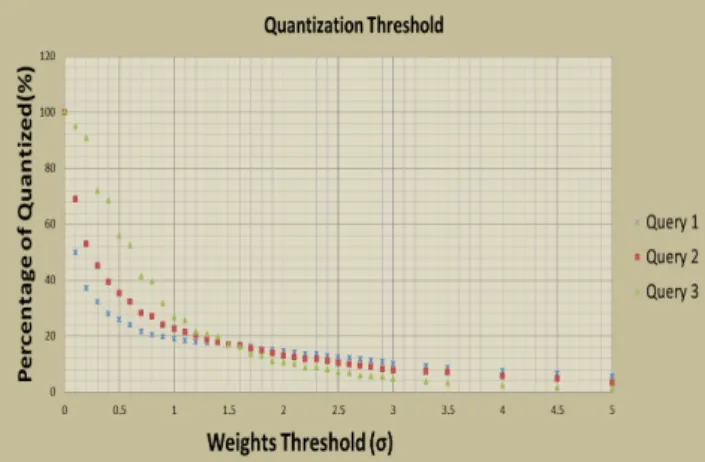
As shown in Figure 4, the choice ofσ determines the num-ber of discriminative visual words. Figure 4 represents some examples of theα0(wi) computed for various queries. Given
the same detector is used, the discriminative power distri-butions for different queries are not very different. Thus a static thresholdσcan be empirically selected for all queries (σ=1 in our experiment). The effect of quantization scheme will be discussed in Section 4.
Based on Equations 9 and 10, the frame level similarity measurement function becomes:
sim0(fd, fq)≈ PK i=1α 0 (wi)∗fd(wi) l(fd)∗l(fq) (12) It is important to note that the key frame reformulation will not largely increase the number of non-zero elements in the key frame representation. It would not only involve the discriminative visual words, but also exclude the noises. Furthermore, it avoids the extra computational and memory
Figure 4: The quantization thresholdσ decides the number of emphasized visual words.
costs of the direct inclusion of the spatial-temporal informa-tion into video representainforma-tion and indexing.
Having said that, in this paper, we are more interested in how the STC-based approach can improve the retrieval ef-fectiveness. In the next section, we present an extensive empirical evaluation.
4.
EXPERIMENTS
The goal of these experiments is to evaluate the effectiveness of the STC-based approach to improve the BovW model. In general, the video relevance can be defined on two lev-els: the visual level and concept level. Accordingly two Query-by-Example video retrieval tasks are used: (1) QBE near-duplicate video search task for searching visually sim-ilar videos; (2) general topics QBE video retrieval task, for retrieving “conceptually” similar videos.
In our experiments, salient points are detected by the Hes-sian detector, which works well to overcome the occlusion and cluttering [15]. The salient regions are described by SIFT feature. Hierarchical K-means [16] is used for visual vocabulary construction.
Mean Average Precision (MAP) is used as main performance indicator, and we also show the Precision-Recall curves of different models.
The classical BovW model and a state of the art BovW en-hancement approach based on Tight Geometric Constraint (TGC) [32] are used as the baselines. The TGC method is implemented with a publicly available toolkit SOTU [31]. The performances of four variations of the similarity mea-surement approaches proposed in this paper are reported, namely the STC-based retrieval models with and without weights quantization (Equation 11), denoted byst-BovW
andraw-strespectively; and retrieval model based on spa-tial (temporal) correlation only, denoted by s-BovW ( t-BovW).
4.1
Experimental Set Up
Two datasets commonly used datasets are selected for the experiments:
(1) CC_Web_VideoNear-duplicate video search is performed on data collection CC Web Video [27]. Most videos in this data-collection are short videos which are mostly 3-5 minutes long and not longer than 10 minutes. They are presented on the website of Youtube, Yahoo and Google Video. From original data collection, we randomly selected 4590 videos to form the experimental data collection, and totally 336K key frames are extracted to represent the videos in the data collection. The videos in the ground truth are labeled by “Exact duplicate”, “Similar”, “Major Changed”, “Long ver-sion” and “Not Relevant”. The evaluation is performed for 24 topics, using 69 queries respectively selected from “Ex-act”, “Similar” and “Major Changed” videos. 10 key frames are sampled from each query for retrieval. The average num-ber of the relevant videos is 84.7 per topic.
(2) TRECVID2002 The general topic QBE video retrieval task is performed on the dataset TRECVID2002 [24]. This dataset contains various video sources: old film, news, doc-umentary and advertisement. The retrieval task consists of 7 topics and each topic has at least 3 different queries. The topics involve searching for specific person, object, action, scene or instances of a category of person. The data collec-tion is composed of 40 randomly selected videos, which are segmented to approximately 3000 shots based on the shot boundary data provided by TRECVID2002. Each shot is normally no longer than 1 minute and associated with a sin-gle scene or sinsin-gle semantic concept. Totally, 30K keyframes are extracted. On average, each topic is associated with 23 relevant shots.
4.2
Experiment 1: QBE Near-Duplicate Video
Search
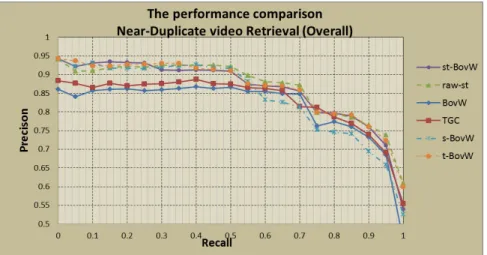
As shown by the Precision-Recall curves in Figure 5, the st-BovW outperforms the classical st-BovW and TGC methods. The raw-st performs similarly to the s-BovW, t-BovW and st-BovW.
Figure 6(a), 6(b) and 6(c) present the performances of differ-ent approaches using “Exact”, “Similar” and “Major Changed” queries respectively. The “Exact” queries have the highest quality, and the quality of “major changed” is the lowest. The influence of query quality on the performance of QBE video retrieval is obvious. The performance of good queries (“Exact” and “Similar”) is a lot better than the other type of queries.
Furthermore, as shown in Figure 6(a) and Figure 6(b), the classical BovW performs adequately well on the “Exact” and “Similar” queries. However, for “Major Changed” queries, which are of low quality, as shown by the Precision-Recall curves in Figure 6(c), both the st-BovW and TGC approaches outperform the classical BovW model, and the st-BovW out-perform TGC.
The performances in term of MAP are presented in Table 1, where E, S, M denotes “Exact”, “Similar” and “Major Changed” queries, respectively. On average, the st-BovW outperforms the classical BovW by 4%, which is statistically significant (p-value=0.046). The st-BovW performs much better than TGC for the low quality queries and slightly better for higher quality queries. The st-BovW outperforms TGC by about 10% and BovW by about 20% on the “Major
Figure 5: Precision-Recall curve for overall queries
(a) (b)
(c)
Table 1: Mean Average Precision Comparison MAP E S M Overall BovW 0.939 0.919 0.511 0.8170 TGC 0.940 0.913 0.553 0.8268(+0.010) st-BovW 0.944 0.927 0.619 0.8503(+0.033) raw-st 0.929 0.930 0.625 0.8477(+0.030) s-BovW 0.938 0.925 0.619 0.8360(+0.021) t-BovW 0.941 0.926 0.615 0.8486(+0.032)
Figure 8: Typical frames of relevant videos of topic ”Women in long dresses”
Changed” queries.
Noted that the raw-st performs nearly the same as the st-BovW, s-BovW and t-BovW in terms of Precision-Recall curves, and in term of MAP on average. However, as shown in Figure 5 and Figure 6(a), the precision of top ranked re-sults retrieved by raw-st is not as good as other approaches. This may be owing to the extreme weights assigned to some visual words which may be noise in some cases. The weights quantization scheme effectively reduces the risk of extreme weights for the discriminative visual words generated by the STC-based key frame reformulation and make the st-BovW perform more stably.
In summary, the evaluation on the near duplicate video search task shows that both TGC and st-BovW effectively improve the performance of the BovW model. st-BovW largely outperforms TGC on lower quality queries, which is more challenging for classical BovW model, and it has also performed comparably to TGC on high quality queries.
4.3
Results: General Topics QBE Video
Re-trieval
The QBE video retrieval for general topics is always a chal-lenging task. The topics cover the various user intentions, who may search for specific object/scene or a category of shot. The desired object may appear visually different in the relevant videos. For example, as shown in Figure 8, one of the topics in this experiment is searching for videos that contain women wearing long dresses. In the relevant videos, the persons may appear differently, and only a small amount of visual content maintained by the relevant videos are visu-ally matching the query. In other words, there is semantic gap between the visual similarity and topic relevance. In this experiment, we use a vocabulary of a small size 5000. The goal is to evaluate if the proposed STC-based discrim-inative visual words emphasizing technique can effectively compensate the neglect of spatial-temporal structure in the BovW model.
Table 2: Average Precision Comparison
AP BovW TGC st-BovW raw-st Eddie Rick-backer 0.1185 0.1119 0.1372 0.1510 Musician playing music instruments 0.1257 0.1083 0.1602 0.1490 Women in long dresses 0.0816 0.0851 0.0960 0.1009 Overhead Views of Cities 0.1204 0.1096 0.1302 0.1162 Oil fields, rig and Oil Equipment 0.1586 0.1500 0.1411 0.1414 Map of the Continental 0.1508 0.1638 0.1574 0.1243 Live beef or Dairy Cattle 0.099 0.0845 0.1156 0.1132 Overall 0.1220 0.1162 0.1340 0.1280
Table 3: Mean Average Precision Comparison be-tween STC based Approaches
Approaches s-BovW t-BovW st-BovW raw-st MAP 0.1258 0.1140 0.1340 0.1280 Average
Preci-sion on 10% Re-call
0.528 0.458 0.610 0.466
Figure 7 demonstrates that st-BovW outperforms the classi-cal BovW model and TGC model. Table 2 presents the Av-erage Precisions of different approaches on individual topics. It is shown that st-BovW outperforms the classical BovW model on 6 out of 7 topics. The average improvement is 10% and it is statistically significant (p-value=0.044). The exper-imental results prove that the discriminative visual words emphasizing technique based on STC also improves the per-formance of BovW model using relatively small vocabulary. It is also shown in the Table 2, that st-BovW outperforms TGC on 5 topics, except for two topics: “Oil fields, rig and Oil Equipment” and “Map of the Continental”. On the other hand, TGC fails in improving the classical BovW model in other 4 topics.
As can be seen in Table 3, the spatial correlation seems to become more crucial than temporal correlation. The evi-dence is that s-BovW outperforms t-BovW on average. In the query video for a general topic, the visual contents repre-senting users’ desire are often messed up with large amount of noise. Thus the emphasizing technique based on the spa-tial proximity assumption is more effective than the motion coherence to reduce the noise.
The weights quantization scheme has improved the perfor-mance of STC-based approaches as shown in Table 2. ST-BovW performs more stably than raw-st, and raw-st per-forms lower than the BovW baseline on 3 topics although achieving highest performance on other two topics. Another
Figure 7: Precision-Recall curve for queries with different key-frames
evidence is shown in Table 3, and the weights quantization scheme has promoted the precision on the top ranked re-trieved results.
In summary, the evaluation demonstrates that STC based technique can effectively improve the performance of classi-cal BovW, and st-BovW performs more stably than TGC-based approach on the general topic QBE video retrieval.
5.
CONCLUSIONS AND FUTURE WORK
In this paper, we have proposed a novel approach based on the spatial temporal correlation (STC) for QBE video re-trieval. The STC is discovered from the query and it is used to address the discriminative visual words in the BovW sim-ilarity measurement. Furthermore, we propose to empha-size the discriminative visual words and reformulate the key frames in the query. The similarity measurement function can be easily implemented based on the quantized empha-sizing weights.
A series of experimental results on the near-duplicate web video search and general topic video retrieval tasks show that the STC-based approach substantially improves the classical BovW model without increasing storage cost for video repre-sentation. The STC-based approach has also outperformed the state of the art TGC-based approach on some challeng-ing tasks. The results have verified our hypothesis that the discriminative visual words can be characterized and em-phasized according to STC to effectively compensates the neglect of spatial-temporal information and the information loss during the key-frame sampling in the classical BovW model.
A possible future research direction is to investigate in de-veloping new data representation model based on the dis-criminative visual words according to the spatial-temporal
correlation discovered from the whole video collection.
6.
REFERENCES
[1] H. Bay, A. Ess, T. Tuytelaars, and L. Van Gool. Speeded-up robust features (surf).Comput. Vis. Image Underst., 110:346–359, June 2008.
[2] L. Cao, Y. Tian, Z. Liu, B. Yao, Z. Zhang, and T. S. Huang. Action detection using multiple
spatial-temporal interest point features. InICME, pages 340–345, 2010.
[3] C. Carson, S. Belongie, H. Greenspan, and J. Malik. Blobworld: image segmentation using
expectation-maximization and its application to image querying.Pattern Analysis and Machine Intelligence, IEEE Transactions on, 24(8):1026 – 1038, aug 2002. [4] O. Chum, J. Philbin, M. Isard, and A. Zisserman.
Scalable near identical image and shot detection. In Proceedings of the 6th ACM international conference on Image and video retrieval, CIVR ’07, pages 549–556, New York, NY, USA, 2007. ACM. [5] O. Chum, J. Philbin, J. Sivic, M. Isard, and
A. Zisserman. Total recall: Automatic query expansion with a generative feature model for object retrieval. In Computer Vision, 2007. ICCV 2007. IEEE 11th International Conference on, pages 1 –8, oct. 2007. [6] R. Datta, D. Joshi, J. Li, and J. Z. Wang. Image
retrieval: Ideas, influences, and trends of the new age. ACM Computing Surveys, 40(2):1–60, 2008.
[7] H. J´egou, M. Douze, and C. Schmid. Improving bag-of-features for large scale image search.Int. J. Comput. Vision, 87:316–336, May 2010.
[8] Y.-G. Jiang and C.-W. Ngo. Visual word proximity and linguistics for semantic video indexing and near-duplicate retrieval.Comput. Vis. Image Underst., 113:405–414, March 2009.
[9] Y. Ke, R. Sukthankar, and M. Hebert. Efficient visual event detection using volumetric features. In
Proceedings of the Tenth IEEE International
Conference on Computer Vision (ICCV’05) Volume 1 - Volume 01, ICCV ’05, pages 166–173, Washington, DC, USA, 2005. IEEE Computer Society.
[10] I. Laptev and T. Lindeberg. Space-time interest points. InIN ICCV, pages 432–439, 2003.
[11] S. Lazebnik, C. Schmid, and J. Ponce. Beyond bags of features: Spatial pyramid matching for recognizing natural scene categories. InProceedings of the 2006 IEEE Computer Society Conference on Computer Vision and Pattern Recognition - Volume 2, CVPR ’06, pages 2169–2178, Washington, DC, USA, 2006. IEEE Computer Society.
[12] D. Liu and T. Chen. Video retrieval based on object discovery.Comput. Vis. Image Underst., 113:397–404, March 2009.
[13] D. G. Lowe. Distinctive image features from scale-invariant keypoints.Int. J. Comput. Vision, 60:91–110, November 2004.
[14] K. Mikolajczyk and C. Schmid. Scale & affine invariant interest point detectors.Int. J. Comput. Vision, 60(1):63–86, Oct. 2004.
[15] K. Mikolajczyk, T. Tuytelaars, C. Schmid,
A. Zisserman, J. Matas, F. Schaffalitzky, T. Kadir, and L. V. Gool. A comparison of affine region detectors. Int. J. Comput. Vision, 65(1-2):43–72, Nov. 2005. [16] D. Nist ˝Or and H. Stew ˝Onius. Scalable recognition
with a vocabulary tree. InIN CVPR, pages 2161–2168, 2006.
[17] Y. Peng and C.-W. Ngo. Emd-based video clip retrieval by many-to-many matching. InCIVR, pages 71–81, 2005.
[18] J. Philbin, O. Chum, M. Isard, J. Sivic, and
A. Zisserman. Object retrieval with large vocabularies and fast spatial matching. InComputer Vision and Pattern Recognition, 2007. CVPR 2007. IEEE Conference on, june 2007.
[19] J. Philbin, O. Chum, M. Isard, J. Sivic, and
A. Zisserman. Object retrieval with large vocabularies and fast spatial matching. InComputer Vision and Pattern Recognition, 2007. CVPR ’07. IEEE Conference on, pages 1 –8, june 2007. [20] J. Philbin, O. Chum, M. Isard, J. Sivic, and
A. Zisserman. Lost in quantization: Imprfoving particular object retrieval in large scale image databases. InComputer Vision and Pattern
Recognition, 2008. CVPR 2008. IEEE Conference on, pages 1 –8, june 2008.
[21] H. Ren, S. Lin, D. Zhang, S. Tang, and K. Gao. Visual words based spatiotemporal sequence matching in video copy detection. InProceedings of the 2009 IEEE international conference on Multimedia and Expo, ICME’09, pages 1382–1385, Piscataway, NJ, USA, 2009. IEEE Press.
[22] J. Sivic, B. Russell, A. Efros, A. Zisserman, and W. Freeman. Discovering objects and their location in images. InComputer Vision, 2005. ICCV 2005. Tenth IEEE International Conference on, volume 1, pages 370 – 377 Vol. 1, oct. 2005.
[23] J. Sivic and A. Zisserman. Video Google: Efficient
visual search of videos. In J. Ponce, M. Hebert, C. Schmid, and A. Zisserman, editors,Toward Category-Level Object Recognition, volume 4170 of LNCS, pages 127–144. Springer, 2006.
[24] A. F. Smeaton, P. Over, and W. Kraaij. Evaluation campaigns and trecvid. InMIR ’06: Proceedings of the 8th ACM International Workshop on Multimedia Information Retrieval, pages 321–330, New York, NY, USA, 2006. ACM Press.
[25] F. Wang, Y.-G. Jiang, and C.-W. Ngo. Video event detection using motion relativity and visual relatedness. InProceeding of the 16th ACM international conference on Multimedia, MM ’08, pages 239–248, New York, NY, USA, 2008. ACM. [26] L. Weng, Z. Li, R. Cai, Y. Zhang, Y. Zhou, L. T.
Yang, and L. Zhang. Query by document via a decomposition-based two-level retrieval approach. In Proceedings of the 34th international ACM SIGIR conference on Research and development in Information, SIGIR ’11, pages 505–514, New York, NY, USA, 2011. ACM.
[27] X. Wu, C.-W. Ngo, A. G. Hauptmann, and H.-K. Tan. Real-time near-duplicate elimination for web video search with content and context.Trans. Multi., 11:196–207, February 2009.
[28] J. Zhang, M. Marszalek, S. Lazebnik, and C. Schmid. Local features and kernels for classification of texture and object categories: A comprehensive study. In Computer Vision and Pattern Recognition Workshop, 2006. CVPRW ’06. Conference on, page 13, june 2006. [29] S. Zhang, Q. Tian, G. Hua, Q. Huang, and S. Li.
Descriptive visual words and visual phrases for image applications. InProceedings of the 17th ACM international conference on Multimedia, MM ’09, pages 75–84, New York, NY, USA, 2009. ACM. [30] Y. Zhang, Z. Jia, and T. Chen. Image retrieval with
geometry-preserving visual phrases. InCVPR, pages 809–816, 2011.
[31] W.-L. Zhao. http://www.cs.cityu.edu.hk/ wzhao2/ sotu.htm.
[32] W.-L. Zhao, X. Wu, and C.-W. Ngo. On the
Annotation of Web Videos by Efficient Near-Duplicate Search.IEEE Transactions on Multimedia,
12(5):448–461, Aug. 2010.
[33] Q.-F. Zheng and W. Gao. Constructing visual phrases for effective and efficient object-based image retrieval. ACM Trans. Multimedia Comput. Commun. Appl., 5:7:1–7:19, October 2008.