UCLA
UCLA Electronic Theses and Dissertations
TitleEfficient Latent Semantic Extraction from Cross Domain Data with Declarative Language Permalink https://escholarship.org/uc/item/28p2b1km Author Li, Mingda Publication Date 2020 Peer reviewed|Thesis/dissertation
UNIVERSITY OF CALIFORNIA Los Angeles
Efficient Latent Semantic Extraction from Cross Domain Data with Declarative Language
A dissertation submitted in partial satisfaction of the requirements for the degree Doctor of Philosophy in Computer Science
by
Mingda Li
c
Copyright by Mingda Li
ABSTRACT OF THE DISSERTATION
Efficient Latent Semantic Extraction from Cross Domain Data with Declarative Language
by
Mingda Li
Doctor of Philosophy in Computer Science University of California, Los Angeles, 2020
Professor Junghoo Cho, Co-Chair Professor Carlo Zaniolo, Co-Chair
With large amounts of data continuously generated by intelligence devices, efficient analysis of huge data collections to unearth valuable insights has become one of the most elusive challenges for both academia and industry. The key elements to establishing a scalable analyzing framework should involve (1) an intuitive interface to describe the desired outcome, (2) a well-crafted model that integrates all available information sources to derive the optimal outcome and (3) an efficient algorithm that performs the data integration and extraction within a reasonable amount of time. In this dissertation, we address these challenges by proposing (1) a cross-language interface for a succinct expression of recursive queries, (2) a domain specific neural network model that can incorporate information of multiple modality, and (3) a sample efficient training method that can be used even for extremely-large output-class classifiers.
Our contributions in this thesis are thus threefold: First, for the ubiquitous recursive queries in advanced data analytics, on top of BigDatalog and Apache Spark, we design a succinct and expressive analytics tool encapsulating the functionality and classical algorithms of Datalog, a quintessential logic programming language. We provide the Logical Library (LLib), a Spark MLlib-like high-level API supporting a wide range of recursive algorithms and the Logical DataFrame (LFrame), an extension to Spark DataFrame supporting both relational and logical operations. The LLib and LFrame enable smooth collaborations between logical applications and other Spark libraries and cross-language logical programming in Scala, Java, or Python. Second, we utilize
variants of recurrent neural network (RNN) to incorporate some enlightening sequential informa-tion overlooked by the conveninforma-tional works in two different domains including Spoken Language Understanding (SLU) and Internet Embedding (IE). In SLU, we address the problem caused by solely relying on the first best interpretation (hypothesis) of an audio command through a series of new architectures comprising bidirectional LSTM and pooling layers to jointly utilize the other hypotheses’ texts or embedding vectors, which are neglected but with valuable information missed by the first best hypothesis. In IE, we propose the DIP, an extension of RNN, to build up the in-ternet coordinate system with the IP address sequences, which are also unnoticed in conventional distance-based internet embedding algorithms but encode structural information of the network. Both DIP and the integration of all hypotheses bring significant performance improvements for the corresponding downstream tasks. Finally, we investigate the training algorithm for multi-class classifiers with a large output-class size, which is common in deep neural networks and typically implemented as a softmax final layer with one output neuron per each class. To avoid expensive computing the intractable normalizing constant of softmax for each training data point, we analyze the well-known negative sampling and improve it to the amplified negative sampling algorithm, which gains much higher performance with lower training cost.
The dissertation of Mingda Li is approved.
Yizhou Sun
Yingnian Wu
Carlo Zaniolo, Committee Co-Chair
Junghoo Cho, Committee Co-Chair
University of California, Los Angeles 2020
TABLE OF CONTENTS
1 Introduction . . . 1
1.1 Motivations . . . 1
1.2 Contributions . . . 3
1.3 Thesis Outline . . . 4
2 Extracting Latent Information from Unused IP Addresses . . . 6
2.1 Deep Learning IP Network Representations . . . 7
2.1.1 Introduction. . . 7
2.1.2 Background and Related Work . . . 9
2.1.3 Learning Network Representations. . . 11
2.1.4 Evaluation . . . 16
2.1.5 Discussion: Limitations and Opportunities. . . 19
2.2 Learning IP Maps for Network Spoofing Detection . . . 21
2.2.1 Introduction. . . 21
2.2.2 Towards Learned Maps for Spoofing Detection . . . 23
2.2.3 Learning-Based Spoofing Detection . . . 25
2.2.4 Evaluation . . . 30
2.2.5 Discussion: Limitations and Opportunities. . . 36
2.3 Conclusion . . . 38
3 Extracting Latent Information from Unused Speech Interpretations . . . 40
3.1 Introduction . . . 40
3.2 Baseline, Oracle and Direct Models . . . 43
3.2.2 Direct Models. . . 43
3.3 Integration of N-Best Hypotheses . . . 44
3.3.1 Hypothesized Text Concatenation . . . 44
3.3.2 Hypothesis Embedding Concatenation . . . 45
3.4 Experiments . . . 47
3.4.1 Dataset . . . 47
3.4.2 Performance on Entire Test Set. . . 47
3.4.3 Performance Comparison among Various Subsets . . . 48
3.4.4 Improvements on Different Domains and Different Numbers of Hypotheses 49 3.4.5 Intent Classification . . . 50
3.5 Conclusion . . . 50
4 Efficient Training with Amplified Negative Sampling . . . 52
4.1 Introduction . . . 52
4.2 Related Work . . . 54
4.3 Framework . . . 55
4.3.1 Preliminaries . . . 56
4.3.2 Negative Sampling . . . 57
4.3.3 Optimal Model of Negative Sampling and Full-gradient Model . . . 58
4.4 Amplified Negative Sampling. . . 60
4.5 Experiments . . . 64
4.5.1 Model Accuracy and Training Efficiency . . . 65
4.5.2 Experiments on Other Downstream Tasks . . . 67
4.6 Conclusion . . . 69
5.1 Introduction . . . 71
5.2 Preliminaries . . . 73
5.2.1 Datalog . . . 73
5.2.2 Related Platforms: Apache Spark, BigDatalog and RaSQL . . . 74
5.2.3 Spark MLlib and DataFrame . . . 75
5.3 LLib . . . 76
5.3.1 Working Paradigms Comparison: LLib, BigDatalog and RaSQL . . . 76
5.3.2 LLib Processing Pipeline and Underlying Architecture . . . 78
5.3.3 LLib Categories and an Example of Machine Learning with LLib . . . 82
5.3.4 Extension of LLib . . . 83
5.3.5 Collaboration with Other Applications . . . 83
5.3.6 User Defined Datalog Function . . . 85
5.4 LFrame . . . 86
5.4.1 Conversion from DataFrame to LFrame . . . 86
5.4.2 LFrame: Unary Operation . . . 86
5.4.3 LFrame: N-ary Operation . . . 88
5.5 Multi-language Programming. . . 90
5.6 Performance Overhead . . . 90
5.7 Conclusion . . . 91
6 Conclusions and Future Work . . . 93
LIST OF FIGURES
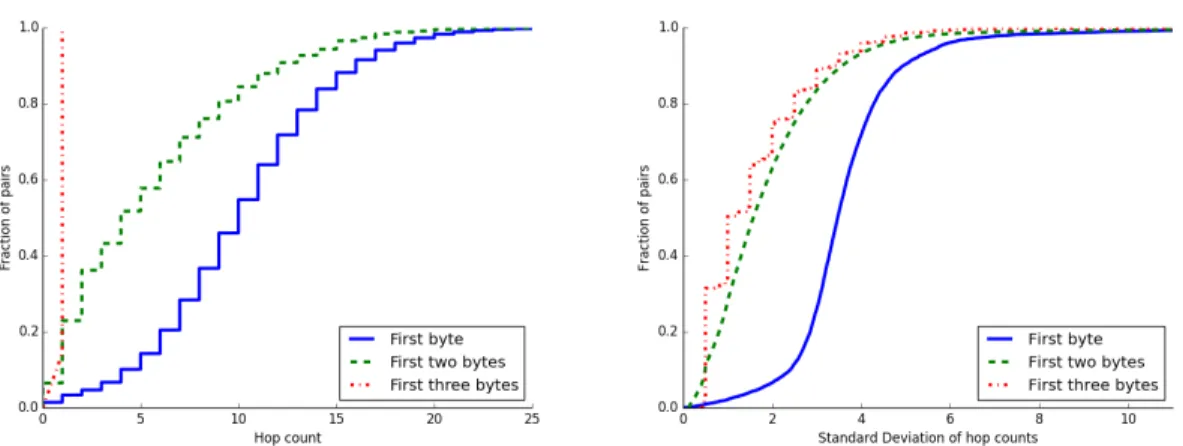
2.1 Cumulative distribution of (left) hop counts between pairs of host-server IPs that share the first, first two, or first three bytes, and (right) standard deviation of hop count distribution among groups of IPs sharing the first, first two, or first three bytes. The more similar two IPs are, the closer they are and the more similar their distances to the same third IP are. . . 10
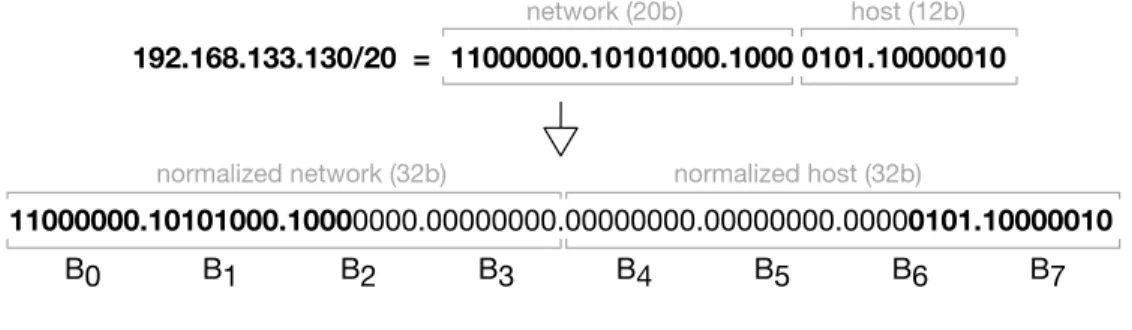
2.2 Generating a normalized IP address for 192.168.133.130/20. . . 13
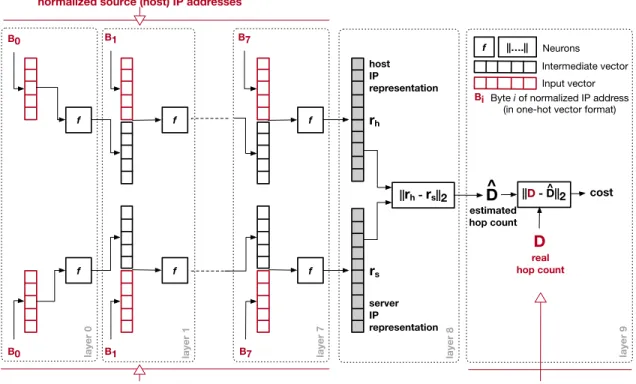
2.3 The neural network used for training our embedding model. The first eight layers re-ceive the normalized IP addresses as input and compute the IP representations. The ninth layer estimates the hop count between two IP addresses and the tenth layer mea-sures the model error. Elements in red are input. For simplicity we depict the input as one-dimensional vectors (one normalized IP); in reality, all inputs are matrices. . . 14
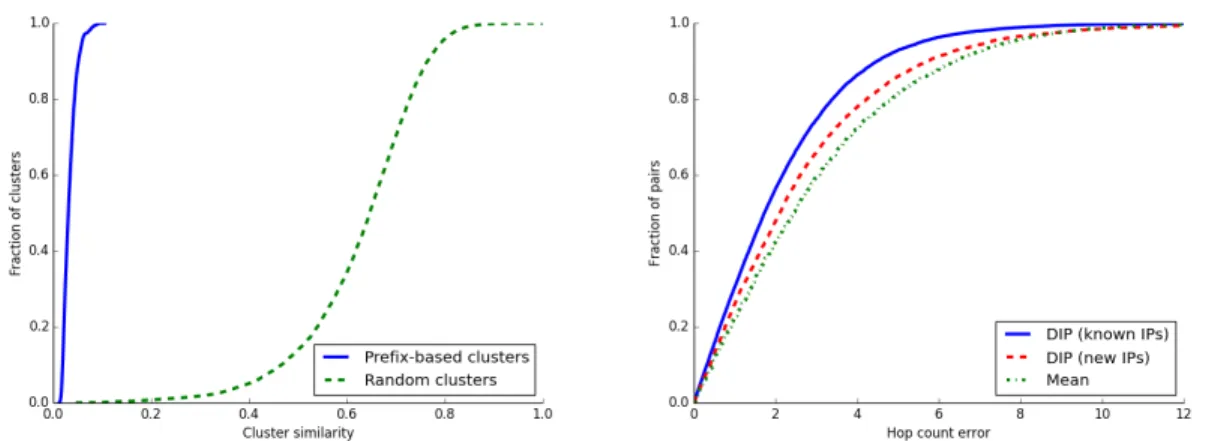
2.4 (left) Cumulative distribution of cluster similarity, computed using IP vector represen-tations, for prefix-based and end-host random clusters; (right) Cumulative distributions of absolute distance estimation errors for DIP andmean. DIP representations preserve real-world prefix-based clustering and predict distances accurately. . . 17
2.5 Map-based spoofing detection. Network maps detect only spoofed packets traversing protected ASes (colored in green). Host maps detect only packets spoofed with IPs present in the map (also colored in green). Learned host maps have the ability to detect all packets because they learn missing map entries. The paths in the diagrams indicate the apparent source of the packet (the spoofed source). In reality, all packets originate from the attacker. . . 26
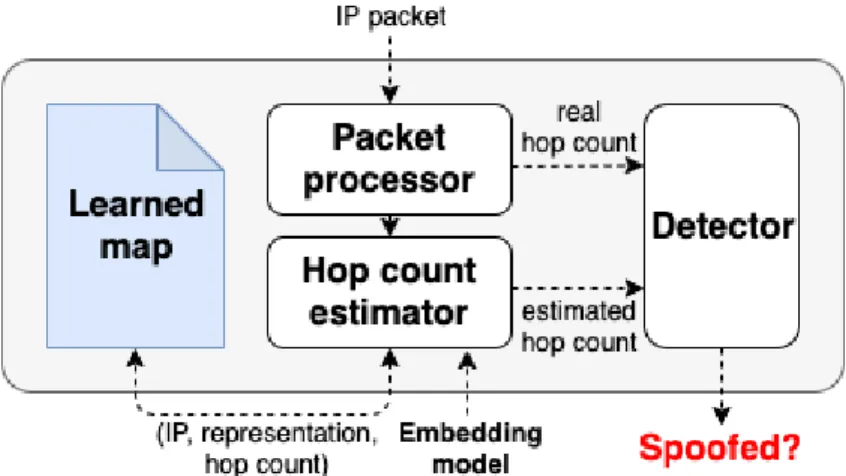
2.6 The learning-based spoofing detector uses an embedding of the Internet to estimate hop count information to any IP address and detect when the IP is used as the spoofed source of an attack packet. . . 29
2.7 Coverage for (left) exact and learned maps for 1,000 source IP addresses, and (right) learned maps for the same sources used in training (labeled “1/1”), ten times as many sources (“1/10”), and a hundred times as many sources (“1/100”). The bars represent the error of a learning-based spoofing detector, for each target, in hop counts.
Learning-based spoofing detectors adapt well to new sources with little loss of coverage. . . 32
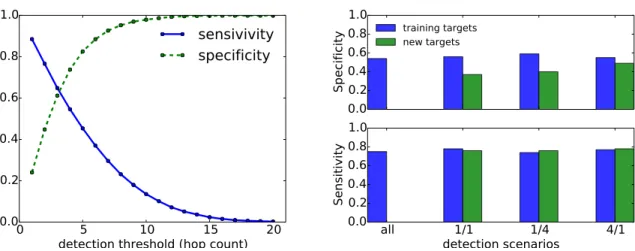
2.8 Detector accuracy under various scenarios. (left) We run detection on the same targets used in training and vary the detection threshold; increasing the threshold reduces sensitivity and improves specificity; (right) We perform detection using both training targets and new targets not used in the training process; we set the detection threshold to two hops (the average estimation error of the model); as we vary the ratio between training and detection targets, the sensitivity for the new targets is comparable to that of the training targets, while the specificity is lower; “all” indicates that we perform training and detection on all targets, therefore there are no new targets. . . 35
3.1 Baseline pipeline for domain or intent classification.. . . 43
3.2 Direct models evaluation pipeline. . . 44
3.3 Integration ofn-best hypotheses with two possible ways: 1) concatenate hypothesized text and 2) concatenate hypothesis embedding.. . . 45
3.4 Improvements on important domains. . . 49
3.5 The influence of different amount of hypotheses. . . 50
4.1 Model accuracy . . . 66
4.2 Training time. . . 66
4.3 Amplifying factor vs learning rate . . . 66
5.1 Working paradigm comparison between existing Spark-Based Datalog platforms and LLib. . . 77
LIST OF TABLES
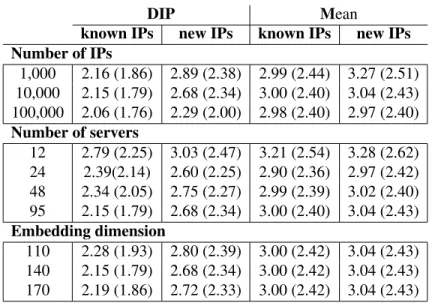
2.1 Absolute mean error (standard deviation between brackets) of distance prediction of DIP and mean, for both known and new IPs, when varying the number of IPs, the number of servers and the embedding dimension. The default values are 10,000 IPs,
95 servers, and 140 dimensions. . . 18
2.2 Map-based spoofing detection methods. . . 30
2.3 Performance of training for data sets containing hop count information from 96 servers to 1,000, 10,000, and 100,000 IPs. Each data set is sparse, with only about 15% of all entries available. . . 37
3.1 Spoken recognition quality distribution of thenbest hypotheses. . . 41
3.2 Motivating example: comparison of ASR n-Best hypotheses with the corresponding transcription. . . 42
3.3 Micro and Macro F1 score for multi-class domain classification. . . 47
3.4 Performance comparison for the subset (∼19%) where ASR first best disagrees with transcription. . . 48
3.5 Performance comparison for the subset (∼ 81%) where ASR first best agrees with transcription. . . 48
3.6 Intent classification for three important domains. . . 50
4.1 Word-analogy semantic-task top-1 accuracy. . . 68
4.2 Training time (seconds). . . 68
ACKNOWLEDGMENTS
First and foremost, I would like to thank my advisors, Professor Junghoo Cho and Professor Carlo Zaniolo. Professor Junghoo has been an exceptional advisor. He is my first mentor in the natural language processing field. Over the years, he gave me extremely visionary advice, generous support and timely feedbacks. His research foresight and ambition greatly motivated me. For each of my projects, he enthusiastically provided insightful suggestions and related articles. For each of my papers, he patiently pointed out logic flaws and unclear descriptions. I also feel so fortunate to have Professor Carlo as my co-advisor. His professional expertise and brilliant ideas guided me to resolve many challenging problems. He spared his valuable time teaching me how to come up an idea to satisfy urgent needs in academy, establish a system to implement the idea, and to illustrate findings with concrete examples.
I would also thank Professor Yizhou Sun and Professor Yingnian Wu for agreeing to be on my committee and providing their valuable time and advice on my research.
I would thank Tyson Condie for offering me the precious opportunity to join UCLA CS de-partment as a PhD student and offering funding support to my research. During the early years, he taught me the way of thinking as a system researcher. He showed me the frontier of distributed system research. He is quite smart and experienced. I could always get innovative thoughts while discussing with Tyson.
It is a great honour to work in ScAi lab. I would thank the whole UCLA ScAi group, especially Matteo Interlandi, Youfu Li, Zijun Xue, Jiaqi Gu, Jin Wang, Muhao Chen, Manoj Reddy, Ling Ding, Xuelu Chen, and Shi Gao who helped me at various times. Chapter Four is a version of the paper collaborated with Zijun Xue and my advisor Junghoo Cho, which is in preparation for publication.
I also want to thank all staff members of UCLA Computer Science Department, especially Joseph Brown, who helped me a lot for various questions I have ever met.
Alexa AI, where I learned a lot from many remarkable people. I want to thank my mentors in Nec Laboratories, Cristian Lumezanu and Bo Zong for their guidance on IP embedding and spoofing detection projects. Chapter Two consists of a version of the IP embedding paper (Li et al.,2018a) and a version of the spoofing detection paper, which is in preparation for publication. I want to thank Chengwei Su, Weitong Ruan, Xinyue Liu, Luca Soldaini, Wael Hamza and Fan Yang for their assistance and participation in the spoken language understanding project. Chapter Three is a version of the spoken language understanding project’s paper (Li et al.,2020). I also want to thank Yi Xia, Emiran Curtmola, Chainani Naresh, Gaurav Saxena for their generous support.
Lastly but most importantly, I own my parents and my girlfriend a debt of gratitude. Without their unconditional love and unbounded support, I cannot remain true to my original aspiration, keep pressing ahead and get through all those hard times.
VITA
2011-2015 B.S. Computer Science and Technology Harbin Institute of Technology
Harbin, China
2015–2016 Research Assistant ScAi Laboratory
University of California, Los Angeles Los Angeles, California
2016–2020 Teaching Assistant
Computer Science Department University of California, Los Angeles Los Angeles, California
2016 Research Intern Teradata Los Angeles, US 2017 Research Intern NEC Lab Princeton, US 2018 SDE Intern
Amazon AWS Redshift Palo Alto, US
2019 Applied Scientist Intern Amazon Alexa AI Boston, US
PUBLICATIONS
Mingda Li, Weitong Ruan, Xinyue Liu, Luca Soldaini, Wael Hamza, Chengwei Su. “Improving Spoken Language Understanding By Exploiting ASR N-best Hypotheses.” ArXiv 2020. To be submitted toSLT 2021
Mingda Li*, Zijun Xue*, Junghoo Cho. “Amplified Negative Sampling: Sample-Efficient Training for a Large-Class Classifier.” In review byKDD 2020
Mingda Li, Jin Wang, Youfu Li, Carlo Zaniolo. “LLib and LFrame: An Expressive Multi-Language Datalog Interface.” To be submitted toICLP 2020
Mingda Li, Cristian Lumezanu, Bo Zong, Haifeng Chen. “Learning-based spoofing detection.” In review by theEuroS&P WTMC 2020
Jin Wang, Chunbin Lin, Mingda Li, Carlo Zaniolo. “An Efficient Sliding Window Approach for Approximate Entity Extraction with Synonyms.” Accepted byEDBT 2019
Mingda Li, Cristian Lumezanu, Bo Zong, Haifeng Chen. “Deep Learning IP Network Representa-tions”BEST PAPER AWARDofACM SIGCOMM Big-DAMA 2018
Mingda Li, Cristian Lumezanu, Bo Zong, Haifeng Chen. “Learning IP Network Representations.” Accepted byACM SIGCOMM CCR 2018
Youfu Li, Mingda Li, Ling Ding, Matteo Interlandi . “RIOS: Runtime Integrated Optimizer for Spark.” Accepted bySOCC 2018
CHAPTER 1
Introduction
1.1
Motivations
In the big data era, we have witnessed the rising demand of efficiently and conveniently ex-tracting insights from large-scale data sets for decision making in different domains. The demand has driven researchers to propose various neural network-based algorithms revolutionizing many fields, ranging from image processing (He et al.,2016), natural language processing (Devlin et al., 2018) to speech recognition (Amodei et al.,2016), etc. In addition, the big data analytics and ma-chine learning platforms like PyTorch (Paszke et al., 2019), Tensorflow (Abadi et al., 2016) and Apache Spark (Zaharia et al.) are continuously built up in open source and commercial markets, to provide maximal flexibility and speed while implementing the analyzing pipeline with existing or user-defined algorithms.
Although the huge success has been achieved, for the advanced analytics on scalable data sets, there are still some challenges and ongoing efforts to tackle them, including:
• Excluded data.While great efforts have been dedicated to assimilate massive amounts of data for analysing algorithms, only a tip of the big data iceberg has been utilized during analysing. To make full use of the assimilated data, researchers design novel architectures of algorithms like the bi-directional RNN (Graves et al.,2013) to exploit the backward informa-tion, and involve more tasks for training like the masked language model and next sentence prediction mentioned in Bert (Devlin et al.,2018).
In two of the fastest growing areas in computer science, the internet embedding and spo-ken language understanding, we find some enlightening information not considered in the existing analyzing pipeline, which makes the performance of corresponding downstream
tasks non-optimal. Currently, while embedding the internet structure, only a single source of structural data among IP addresses like hop counts (Eriksson et al.,2008,2009) is utilized to build up the network coordinate system. We realize the IP address of the host in internet, a sequence of bits, could provide a coarse indication of the location of the host, but is over-looked by current internet embedding techniques. As for understanding the speech, only the recognition result (hypothesis) of an input speech with highest ASR confidence score (Tur and De Mori,2011) or reranking score (Peng et al.,2013;Morbini et al.,2012) is relied and transferred to the natural language understanding (NLU) module for domain or intent clas-sification. We find the first best hypothesis can be noisy, while the other hypotheses can be more similar to the ground-truth transcription of the speech. Driven by the above findings, we would like to propose novel frameworks involving the unnoticed information for a better performance in downstream tasks.
• Expensive computing. Among all the analysing algorithms, the neural networks with nu-merous layers and parameters are recently widely utilized in different domains due to their strength at learning features at different levels of data abstraction for a better decision mak-ing. However, the training could be quite computationally expensive especially when the final layer is a softmax layer for large-class classification (e.g. word embedding, graph em-bedding), since the cost of standard training algorithm is proportional to the output class size (e.g. size of words in a dictionary, nodes in a graph). To tackle the issue, a number of techniques like, negative sampling (Mikolov et al.,2013a), hierarchical softmax (Morin and Bengio,2005), adaptive softmax (Bengio,2008;Rawat et al.,2019) , are developed.
Negative sampling is one of the most popular techniques utilized in practice due to its sim-plicity and efficiency. Experimental observations show that a larger negative sample size can achieve a better downstream task performance. However, the training cost is more expensive for a larger sample size. Could we get the best of the two worlds? This dream motivates us to analyze the technique and further amplify the negative sampling to get a higher performance with unchanged or even smaller sample size.
an-alytics, data mining algorithms. An efficient development of a complicated recursive algo-rithm on the well-known data analytics platforms like Apache Spark requires deep under-standing of the algorithm and platform’s libraries. To simplify the development, a renais-sance of interest has been brought to Datalog, a declarative logic programming language, for its succinct expression of recursions. Numerous of Datalog systems including DeALS (Yang et al.), BigDatalog (Shkapsky et al.,2016), RaSQL (Gu et al.,2019) are built up but there is still space for improvement on usability and interoperability.
Most of the conventional Datalog systems adopt the Datalog syntax, which requires a deep understanding of logical programming. Recently, this is realized by RaSQL, which proposes a simple extension of SQL syntax to improve the usability. However, for a wider audience from data science community, should it be better to provide a data scientists’ familiar cross-language API encapsulating a wide range of Datalog algorithms like Spark MLlib? For a flexible developing, is it possible to support the logical operations within a DataFrame-like data structure? These two questions stimulate us for a better Datalog-based data analytics tool design.
1.2
Contributions
All the contributions of this thesis center around the aforementioned motivations and are sum-marized as follows:
• We realize and experimentally show the structural information contained in IP addresses for internet embedding and propose a deep learning based framework, DIP, to utilize the information. To the best of our knowledge, DIP is the first framework to predict distance (or hop count) to arbitrary IPs (even unknown hosts i.e., not contained in training data) based only on the value of their IP address and routable prefix without any other domain knowledge.
• We further explore the impact of deep learning in the network security area by using network embeddings to learn IP maps for spoofing detection. We combine the DIP with the hop count
filtering, a well-known map-based spoofing detection mechanism, which maps each IP to a hop count value for one target IP address and is restricted to the detection on specific targets. The new framework can help any Internet server detect packets spoofed with any IP address without any additional measurements to that IP.
• We pioneer the spoken language understanding research on jointly utilizing all hypotheses from ASR module. We investigate the exact matching between hypotheses and the ground-truth transcription of the input speech, which reveals the value contained in the 2nd−nth best hypotheses. To involve more than one hypothesis during NLU, we introduce a series of simple yet efficient models and significantly improve the SLU system robustness to the noises from ASR module.
• We take the effort to efficiently train the high computational cost large-class classifiers. We propose a new sample-efficient training algorithm, amplified negative sampling (ANS). We theoretically and experimentally demonstrate that the ANS leads to the higher-accuracy model of a larger sample size without paying its high computational cost.
• Finally, we design a cross-language (Python, Scala, or Java) Datalog programming inter-face with two important components, LLib and LFrame. LLib is a high-level logical library, providing the encapsulation of a wide range of Datalog algorithms. LFrame is an extension to DataFrame with the functionality of basic logical operations like definitions of recursive rules. With running examples, we show the simplified development of recursive applications and flexible collaborations between LLib or LFrame and existing Spark libraries.
1.3
Thesis Outline
In this dissertation, we mainly address three of the most important elements of the efficient scalable data analyzing. We firstly explore how to make full use of all information while extract-ing semantics and insights for decision makextract-ing. More specifically, in Chapter 2: (a) We propose the DIP, a variant of RNN, for establishing the network coordinate system via embedding the IP address sequence. Compared to the coordinate system built on single source of structural data like
latency or hop count, we demonstrate the superiority of DIP for unknown IPs; (b) We show the spoofing detection, one of a wide range of problems the DIP framework can be applicable to, and the benefits from DIP to significantly reduce the cost of achieving complete IP maps. In Chapter
3, we explore the value of unused ASR interpretations and numerous ways to integrate them in the spoken language understanding system.
Secondly, we explore how a large-class classifier can be efficiently trained through a sample-efficient training algorithm in Chapter4. In the chapter, the intuition, theoretical and experimental analysis of the developed algorithm, amplified negative sampling, are discussed. Then, we explore how to design a succinct interface for advanced data analytics with superiority on recursion ex-pressions in Chapter5. We develop a high-level Datalog library, LLib, for simplified end-to-end recursive application development with existing Datalog algorithms and a data structure, LFrame, for flexibly defining the logic of a new recursive application. We finally conclude the dissertation and discuss avenues for future work in Chapter6.
CHAPTER 2
Extracting Latent Information from Unused IP Addresses
In this chapter, we discuss IP addresses (IPs), the unused data in internet embedding domain by illustrating (1) the reasons why IPs could reveal the structural information of nodes in the Internet, (2) one approach to incorporate the IPs in the internet embedding and (3) one application which the new embedding framework can be utilized in.
We firstly present DIP, a deep learning based framework to learn structural properties of the Internet, such as node clustering or distance between nodes, from the IP addresses. Existing embedding-based approaches use linear algorithms on a single source of data, such as latency or hop count information, to approximate the position of a node in the Internet. In contrast, DIP com-putes low-dimensional representations of nodes that preserve structural properties and non-linear relationships across multiple, heterogeneous sources of structural information, such as IP, routing, and distance information. Using a large real-world data set, we show that DIP learns representa-tions that preserve the real-world clustering of the associated nodes and predicts distance between them more than 30% better than a mean-based approach. Furthermore, DIP accurately imputes hop count distance to unknown hosts (i.e., not used in training) given only their IP addresses and routable prefixes. Our framework is extensible to new data sources and applicable to a wide range of problems in network monitoring and security.
Then, we consider an important topic, spoofing defense, based on the full knowledge of the internet structural properties. Map-based IP spoofing defenses associate source IPs to immutable structural properties of the Internet, such as paths, hop counts, or neighbors to a target, and filter out packets whose header information does not match the maps. Although accurate, existing methods lack sufficient coverage. Network maps on AS border routers do not detect spoofed packets that traverse unprotected networks. Host maps at the edge protect only against spoofed packets with
source IPs known by the host. We propose to learn IP maps by constructing a structural model (or embedding) of the Internet from a limited number of measurements. We study the feasibility of learned IP maps by combining hop count filtering, a known map-based spoofing defense mecha-nism that maps IPs to hop counts to a target, and DIP, a deep learning based learning algorithm that computes vector representations of IPs that preserve hop count distance between them. Using a large data set of hop counts between Internet hosts, we show that learned maps can detect packets spoofed with almost anyIP address and traversing anypath using an embedding generated from only a few thousand IP addresses and hop counts between them. In addition, our embeddings are general: an Internet model trained for a set of hosts can be used by any other host to generate new IP maps with little loss in accuracy.
2.1
Deep Learning IP Network Representations
2.1.1 Introduction
The ability to map, analyze, and understand the structure of the Internet helps network manage-ment and operations by revealing opportunities for improvemanage-ment or potential design flaws. For ex-ample, accurately predicting the closest server is critical in peer selection and load balancing (Miao et al., 2017). Knowing how remote IPs are clustered can help diagnose anomalous events such as spoofing attacks (Jin et al., 2003). A holistic view of the network and its structure is essential towards achieving the vision of self-driving networks (Feamster and Rexford,2017).
Most previous attempts to uncover the Internet structure relying on active probing from multi-ple vantage points using tools such as tracerouteandping(Levchenko et al., 2017; Spring et al., 2003). Such techniques provide fine-grained introspection (i.e., can measure specific properties in specific parts of the network, such as the latency of a path) but pose a significant cost in terms of network overhead.
In contrast, embedding-based approaches use fewer, strategic measurements (Dabek et al., 2004; Eriksson et al., 2008) or passive observations on network traffic (Eriksson et al., 2007) to learn vector representations for the network end-hosts in a low-dimensional space. The
representa-tions approximate the posirepresenta-tions of hosts in the Internet and are used to recover structural network properties, such as distance between nodes or clustering of nodes. However, the complexity of the Internet and the sparse input data make it difficult to compute accurate representations. Oftentimes, embedding approaches rely on additional data sources, which cannot be easily used in the embed-ding process, to refine and tune the final embedembed-dings. For example, several embedembed-ding methods build representations based on distance-based metrics, such as latency or hop count, and then refine (or even replace) the final representations using additional probes or static information such as AS membership or routing information (Dabek et al.,2004;Eriksson et al.,2009).
The emergence of deep learning as a powerful tool to extract hidden features in data calls for revisiting the problem of learning network representations through embedding. In particular, deep learning techniques provide two key benefits. First, they allow multiple heterogeneous sources of information as input, thereby identifying more accurately the relationships between multiple sources of data that jointly contribute to a specific structural property (Karpathy and Fei-Fei,2015; Wang et al., 2018; Mikolov et al.,2013b). Second, deep neuron networks are extensible and can easily incorporate additional sources of information by attaching more neurons, network layers, or network branches (Wang et al.,2018). One can start with a model trained on the original com-ponents and re-train it using only the newly added parts or data sources (Erhan et al.,2010). This makes it easier for network operators to deploy, apply, or update neural network based models.
We propose DIP, a deep learning based framework to learn the structure of the Internet. DIP is a ten-layer neural network1 that computes a low-dimensional vector representation for any node2 in the Internet given only its IP address and routable prefix. DIP preserves both local and global structure: clustered nodes have similar representations and the distance between two representa-tions approximates the hop count between the associated nodes.
We train our neural network using three heterogeneous data sets: hop count distances between Internet nodes, the 32 bits IP address and inter-domain routable prefix information for each node.
1To avoid confusion and unless explicitly stated otherwise, we usenetworkorInternetto refer to the physical IP network andneural networkto refer to the neural network we design to learn the structural properties of the physical network
A key insight to train DIP is tofirst compute representations based on the IP and routing infor-mation, thereby recovering structural information hidden in the IP values, and refine them using a distance-based optimization. As the size of the routable prefix varies by IP, we first normalize the IP and prefix data by representing an IPv4 address on 64, rather than, 32 bits. To capture structural information encoded in the IP address value, we feed the eight bytes of the normalized IP sequen-tially at each of the first eight layers of the neural network. We then use the last two layers to get the hop count matrix and optimize the embedding distance prediction. With a trained DIP, we can estimate distance betweenanytwo Internet hosts as long as we have their IPs, even if they are not part of the training data.
Results on large real-world data sets of hop counts between thousands of IP addresses and 95 geographically distributed servers show that we can predict hop count distance between known hosts (i.e., whose IP address were used in the training) with an absolute error of around 2 hops and over 30% better than a mean-based method. We infer the distance between unknown IPs (i.e., not appearing in training data) with a small loss in accuracy compared to known IPs. In addition, the representations learned by DIP preserve the real-world clustering of the associated hosts. The accuracy of our model increases when we increase the training data set.
While our results are preliminary, they offer us a glimpse of the power of deep learning in recovering structural properties of the Internet from sparse data. DIP is the first framework that can estimate accurately the distance to any Internet host given only its IP address and routable prefix without any distance data.
2.1.2 Background and Related Work
What is structure? Many properties can make up the structure of the Internet: connectivity between IPs, routers, or networks; distance-based metrics such as hop count or latency; similarity-based metrics such as the set of one’s neighbors in the connectivity graph; path-similarity-based properties such as the sequence of routers on a path. Here, we focus on two specific properties that define both the local and the global structure of a network: clustering of end-hosts and hop count based distance between end-hosts.
Figure 2.1: Cumulative distribution of (left) hop counts between pairs of host-server IPs that share the first, first two, or first three bytes, and (right) standard deviation of hop count distribution among groups of IPs sharing the first, first two, or first three bytes. The more similar two IPs are, the closer they are and the more similar their distances to the same third IP are.
Network coordinate systemslearn vector representations for participating nodes such that the position of the node in the embedding approximates its position in the Internet. Most coordinate systems build embeddings using a single source of structural data: latency measurements among nodes or to predetermined landmark servers (Dabek et al.,2004;Ng and Zhang,2002;Costa et al., 2004;Pyxida;Zhao et al.,2011) or hop count information from passive traffic observations (Eriks-son et al.,2008,2009). Latency and hop count data is often sparse and cannot always be accurately embedded in metric spaces. To overcome these issues, several approaches use out-of-band informa-tion, such as location (Dabek et al.,2004) or routing (Eriksson et al.,2009) data, or perform active measurements (Eriksson et al.,2008) to impute the missing data and detect clusters or distances. Unlike them, we propose to train our embedding jointly using distances, routing information and host IP values, thereby learning hidden structural features encoded in a node’s IPv4 address. With a trained model, we are able to embed and find the hop count to any IP, without the participation of its host.
Deep neural networks consist of multiple layers of interconnected neurons (LeCun et al., 2015). A neuron aggregates multiple input values using local weights and biases, applies an activa-tion funcactiva-tion, and produces one or more numerical values as output. Given a training task, one can define an objective function to evaluate the output of the entire neural network,e.g., prediction er-ror. Using gradient-based back-propagation algorithms to optimize the objective function (Kingma
and Ba,2014), neural networks automatically tune the weights and biases of each neuron to achieve a better performance.
2.1.3 Learning Network Representations
DIP learns an embedding model that accurately reflects the structure of the Internet, i.e., serves node clustering and distances between nodes. The goal of learning is to minimize the pre-diction error for the distance between any two nodes. The learned model is defined by the structure of the neural network and the final values for the weights and biases of each neuron. Next, we describe the data used in learning and how we construct the neural network.
2.1.3.1 Data Sources
IP addresses and routing information.The IP address of a host provides a coarse indication of the location of the host in the Internet. To make routing scalable and fast, IP addresses are as-signed hierarchically and divided into a network (or routable) part and a host (or local) part. The routable part, usually expressed by an integer representing the number of bits (also called prefix), tells routers how to route the packet through the core of the Internet towards the destination net-work. Intuitively, IPs with the same routable prefix share a path towards them through the Internet core and are more likely to be close to each other.
Hop counts.The hop count between two hosts represents the number of routers on the default path between hosts. We use hop count, rather than latency, to measure the distance between two hosts, as it can be easily extracted from the TTL value of a network packet (Jin et al., 2003), without active measurements. In Section2.1.5, we discuss how to extend the model using latency measurements. Our hop count matrix is asymmetric and very sparse; it does not contain hop counts between all IPs.
2.1.3.2 IP Transformation
The key idea of our work is to use both local (IPs and routing information) and global (hop counts) structural information to guide the embedding of network nodes. By utilizing deep learning for embedding, we can identify and use hidden features encoded in the IP address of a given node. We perform several transformations on the input, guided by observations on real network data.
IP normalization.Because the routable information is tied to an IP address, we combine the IP and prefix values when feeding them to the neural network. To keep the size of the input constant and independent on the prefix size, we generate anormalized IP addressfor each regular IP. The process of normalization is depicted in Figure2.2. We divide each IP into the network and the host parts. We pad the end of the network part and the beginning of the host part with zero to obtain two four-byte values. We concatenate the values and get the eight bytes normalized IP. Further, for easier processing, we represent each byte of the input in one-hot vector format (256 dimensions), e.g., a one and the rest are 0s, where the 1’s position is the value of the byte (0 to 255).
Sequential feeding.IP addresses are assigned hierarchically and encode structural information of the network. To better understand how the hierarchical assignment affects node clustering, we perform two experiments on a data set of hop counts between 95 geographically distributed servers and ten million IP addresses of end hosts. Section2.1.4.1describes the data in more detail.
First, we group all pairs of host-server IPs according to whether they share (within the pair) the first byte, first two bytes, or first three bytes. We show the all-to-all hop counts between pairs in each of the three groups in Figure 2.1(left). The more similar two IP addresses are, the closer they are in terms of number of hops. Second, we group separately hosts and servers according to whether they share the first one, two, or three bytes and generate the hop count distribution for each pair of host-server groups that share the same prefix. We present the standard deviation for each pair in Figure2.1(right). The smaller the standard deviation is, the more similar the distances are. This means that the more similar two IPs are, the more likely they have the same hop count to another node.
As shown in Figure 2.1, an IP address can help learn node representations that capture the network structure. The more bytes of an IP address we know, the better we can constrain the
192.168.133.130/20 = 11000000.10101000.1000 0101.10000010
network (20b) host (12b)
11000000.10101000.10000000.00000000.00000000.00000000.00000101.10000010
normalized network (32b) normalized host (32b)
B0 B1 B2 B3 B4 B5 B6 B7
Figure 2.2: Generating a normalized IP address for 192.168.133.130/20.
representation we assign to it. In addition, the more significant bytes of an IP address have a higher influence on the position of the associated host relative to other hosts. Therefore, the key is to capture the sequential correlation among the bytes of an IP address.
2.1.3.3 Network Construction
Driven by the insight gained in the previous section, we develop DIP, a deep neural network that computes vector representations of network hosts based on their IP addresses and the hop counts to other hosts. The design of DIP, depicted in figure 2.3, is similar to that of a recurrent neural network (Mikolov et al., 2010), where new data is processed in the context provided by previous data (e.g., like processing natural language). We explain the details below. Even though the figure and our explanation refer to the input as one-hot vectors (e.g., a normalized IP is rep-resented as a vector of size 8x256=2,048), in reality the inputs are matrices (i.e., the number of IP addresses times 2,048). Because our hop count data (see Section2.1.4.1) is between separate end-hosts (sources) and servers (destinations) and because distances in the Internet are not always symmetric, we choose to feed the source and destination IPs separately in the neural network.
Intermediate IP representation. As mentioned earlier, to get the most out of the format and value of an IP address towards building a representative embedding for its host, we should treat each byte separately. The more significant bytes can provide a context for how to interpret the less significant bytes. Thus, we choose to input each byte of the normalized IP (a 256-dimension one-hot vectorBi256∈{0×,...,1 7}) separately at each layer of the network. The input of layeriis the
con-||rh - rs||2 estimated hop count real hop count cost f B1 B0 f B7 f host IP representation f B1 B0 f B7 f server IP representation ||D - D||2 rh rs D^ D
normalized source (host) IP addresses
normalized destination (server) IP addresses real hop count matrix
f Neurons
^
Intermediate vector Input vector
||….||
Bi Byte i of normalized IP address (in one-hot vector format)
layer 0 layer 1 layer 7 layer 8 layer 9
Figure 2.3: The neural network used for training our embedding model. The first eight layers receive the normalized IP addresses as input and compute the IP representations. The ninth layer estimates the hop count between two IP addresses and the tenth layer measures the model error. Elements in red are input. For simplicity we depict the input as one-dimensional vectors (one normalized IP); in reality, all inputs are matrices.
catenation of byteiwith the output of the previous layer (except for the first layer). This
Input= i=0 Bi256=0×1 i∈ {1, ...,7} concat(fdi−×11,Bi256×1) (2.1)
wheredis the dimension of the final IP representation andconcatrepresents the vector concatena-tion operaconcatena-tion.
At each layer, the activation function f is given by: fi= i=0 so f tsign(wid=×0256 × Bi256=0×1+bid=×01) i∈ {1, ...,7} so f tsign(wid∈{×(1256,...,+7}d) × concat(B256i∈{1×,...,1 7},fdi−×11) + bid∈{×11,...,7}) (2.2) where wi∈{0,...,7}
d×(256+d) are weights and b
i∈{0,...,7}
d×1 ) are biases; the softsign function is f(x) = 1 1+|x|.
Initially, we assign random values to all weights and zeros to all biases. We employsoftsignas the activation function for the ease of training, as softsignis more robust to saturation compared to other popular activation functions, such assigmoidandtanh.
Intermediate distance estimation. We use the first eight layers of the neural network to pro-cess each of the eight bytes of the input normalized IP address. The output of the eighth layer is the intermediate vector representation for each IP address in the input data. We then use the last two layers to estimate how good the representation is. First we compute the estimated hop counts given by the current representation using an Euclidean distance. Given two matricesHh×dandSs×d stor-ing the intermediate representations for thehhosts andsservers separately, the estimated distance matrix is:
Disth×s=Euclidean(Hh×d,Ss×d) (2.3)
Error reduction.Finally, we compare the estimated hop counts with the real hop counts matrix Dh×s to compute the cost as the mean difference of hop-counts. As the real hop count matrix is sparse, we compare only the valid entries:
Cost= ∑ h i=1∑sj=1W(i,j)(||r Hi∈{1,..,h} d×1 −r Sj∈{1,..,s} d×1 ||−D(i,j))
count o f non−zero D(i,j) (2.4)
D(i,j) represents the value of the element at ith row and jth column in matrix D. rHd×i∈{11,..,h} and rSd×j∈{11,..,s} are rows in the matricesHh×d andSs×d, and correspond to the representation of a host or
server in the embedding space.W is a binary (0-1) matrix whose elements are defined as: W(i,j)= 0 D(i,j)==0 1 D(i,j)6=0 (2.5)
To minimize the cost, we utilize the Adam algorithm, a gradient descent based back-propagation method (Kingma and Ba, 2014), which is able to automatically tune the learning rate during the training process.
2.1.4 Evaluation
2.1.4.1 Data and Methodology
We use a large data set of network hop counts from the Ark project (Ark IPv4). The data con-tains hop count information from 95 geographically distributed servers to ten million IP addresses that cover all routable prefixes in the Internet. We use data collected by Ark during Jun 2015. For each IP in the data, we look up the routable prefix and normalize it using the steps in Sec-tion2.1.3.2. Due to the cost of monitoring a large number of IPs, not all servers have hop counts for all ten million IPs. Our hop count matrix is incomplete and contains valid entries for only 29% of the pairs. We extract IP prefix information from Routeviews data (RouteViews) and use a default value of 24 for missing prefixes.
We build a prototype for DIP using TensorFlow. We train the neural network using several smaller data sets obtained by randomly sampling 1,000, 10,000, and 100,000 IPs from the original data and keeping only the hop counts to them. Sampling increases the sparsity of the data: less than 15% of the entries in the smaller data sets are valid. We also vary the number of servers and the dimensionality of the embedding space. Intuitively, having fewer IPs or servers may not provide sufficient constraints to learn accurate representations and lead to an underfit model. Increasing the number of dimensions can reveal more hidden features, invisible at lower dimensions, but may lead to overfitting. Each training session has 2,500 iterations,i.e., passes through the neural network to update the weights and biases. We use a GPU server with four 3.5GHz quad-core Intel
Figure 2.4: (left) Cumulative distribution of cluster similarity, computed using IP vector represen-tations, for prefix-based and end-host random clusters; (right) Cumulative distributions of absolute distance estimation errors for DIP andmean. DIP representations preserve real-world prefix-based clustering and predict distances accurately.
Xeon processors and 128GB of RAM. We generate testing sets by randomly sampling the original data and preserving the previously trained parameters for embedding arbitrary IP via its address (e.g., the weights and biases of each byte/layer).
2.1.4.2 Embedding Accuracy
Clustering. First, we assess how well DIP preserves the clustering of hosts in the original IP space. For this, we group all IPs first according to their routable prefix and then at random. For each cluster we compute an embedding similarity metric, defined as the ratio between the average distance between all pairs of IP representations in the cluster and the maximum distance across all clusters. The lower the similarity value, the closer to each other the IPs of a cluster are in the embedding space. Figure2.4(left) shows the similarity distribution for prefix-based and random clusters. Each IP representations is a 140-dimensional vector and computed after training the network using 10,000 IP addresses and 95 servers. Our embedding preserves the clustering of the original IP space well.
Distance prediction. To assess the quality of distance prediction, we first look at previous embedding mechanisms. Network coordinate approaches (Dabek et al.,2004;Ng and Zhang,2002) are not directly comparable as they embed latencies between strategically chosen pairs of nodes,
DIP Mean
known IPs new IPs known IPs new IPs Number of IPs 1,000 2.16 (1.86) 2.89 (2.38) 2.99 (2.44) 3.27 (2.51) 10,000 2.15 (1.79) 2.68 (2.34) 3.00 (2.40) 3.04 (2.43) 100,000 2.06 (1.76) 2.29 (2.00) 2.98 (2.40) 2.97 (2.40) Number of servers 12 2.79 (2.25) 3.03 (2.47) 3.21 (2.54) 3.28 (2.62) 24 2.39(2.14) 2.60 (2.25) 2.90 (2.36) 2.97 (2.42) 48 2.34 (2.05) 2.75 (2.27) 2.99 (2.39) 3.02 (2.40) 95 2.15 (1.79) 2.68 (2.34) 3.00 (2.40) 3.04 (2.43) Embedding dimension 110 2.28 (1.93) 2.80 (2.39) 3.00 (2.42) 3.04 (2.43) 140 2.15 (1.79) 2.68 (2.34) 3.00 (2.42) 3.04 (2.43) 170 2.19 (1.86) 2.72 (2.33) 3.00 (2.42) 3.04 (2.43)
Table 2.1: Absolute mean error (standard deviation between brackets) of distance prediction of DIP andmean, for both known and new IPs, when varying the number of IPs, the number of servers and the embedding dimension. The default values are 10,000 IPs, 95 servers, and 140 dimensions.
while we rely on hop count information from passively observed traffic. Erikssonet al.(Eriksson et al., 2009) propose a matrix factorization based algorithm to predict hop count information but first build baseline representations of the monitoring servers using an all-to-all hop count matrix. We lack complete hop count information among servers and build our embedding directly from incomplete server-to-host distances. Therefore, we compare against amean estimation approach, where we predict a host-to-server distance as the mean of all valid distances to the same server.
We look at how well our embedding estimates the hop count value between a host and a server. We first consider only the IP addresses used in the training process (i.e.,known IPs). For this, we train a model using 90% of all host-server pairs and use the remaining 10% for testing. Figure2.4
(right) compares the absolute error between estimated and real hop count for DIP andmeanfor the 10,000 IPs data set on 140 dimensions. DIP predicts distances with a mean absolute error of around two hops (23% mean relative error) and reduces the error of themeanestimation by almost 30%. Table 2.1presents the average absolute error and standard deviation for hop count estimation for embeddings trained with different number of hosts, servers, or dimensions. As expected, increasing the the number of IPs, servers, or the dimensionality reduces the absolute error. We also trained models with parameters outside the ranges presented in the table but found no improvement.
nodes based on their IP address.New IPsare IP addresses not used in the training process and that DIP has never seen before. Figure 2.4(right) and Table2.1 show that DIP approximates distance to new IPs with high accuracy. The distance prediction error is only around half a hop more than that for known IPs. To the best of our knowledge, DIP is the first framework to predict hop counts to arbitrary hosts based only on the value of their IP address and routable prefix and without any other domain knowledge.
2.1.5 Discussion: Limitations and Opportunities
We discuss several future applications and directions of using deep learning to understand and capture the Internet structure.
Extensions. An important benefit of using neural networks for learning the structure of the Internet is that they can be extended easily for other data sources. Similarly to previous embedding approaches (Dabek et al.,2004;Ng and Zhang,2002), we could use latency measurements instead of, or in addition to, hop counts. This would require simply changing the cost estimation part of the neural network (last two layers). While gathering latency measurements is expensive as it introduces traffic into the network, the ability of our approach to work with sparse data can limit the cost necessary to obtain the measurements.
Furthermore, AS membership information could help find more accurate representations as many ASes cover limited areas in the network and provide a coarse indication of locality (Eriksson et al., 2009). To add AS membership information, we could either extend the shape of our input vectors (by adding two bytes for AS number) or adapt the cost estimation layers to use AS data in estimating error, similarly to Erikssonet al.(Eriksson et al.,2009).
Applications. Building a model that accurately predicts structural properties of the Internet has several applications. Knowing the distance to remote IPs can help selecting a load balancing server or an overlay peer more efficiently and without having to perform expensive measurements. Understanding how nodes are clustered can make the transmission of video or large files faster by using close-by CDN nodes. DIP can be a passive defense mechanism against IP spoofing attacks, where malicious users change the source IP of attack packets to avoid identification and subvert
authentication. By comparing the predicted distance according to the spoofed source IP to the real distance (extracted from a packet’s TTL field), one could verify whether the packet is spoofed or not (Jin et al., 2003). This idea inspires our next research work introduced in the next section (Learning IP Maps for Network Spoofing Detection).
Limitations and future work. Our current approach uses structural information embedded in the value of IP addresses, routing data, and distances between nodes, but does not consider the actual physical links between nodes on the Internet (i.e., the Internet physical topology). Adding topology would further constrain the embedding, since it is well known that the Inter-net is not a metric space and latency or hop count distances cannot always be embedded in metric spaces (Dabek et al., 2004). We plan to extend our framework using graph embedding algorithms to take advantage of physical topology information (Wang et al.,2016a).
While our preliminary experiments focused on accuracy, the performance of building an em-bedding model is equally important. Training a model with 100,000 addresses and 95 servers on our 16-core GPU server takes a few hours, indicating that we may need to train models incrementally when resources are constrained (Bruzzone and Prieto, 1999). For example, in a live deployment, we envision reconstructing our model every few days to capture the changes in topology triggered by the dynamic Internet. We are currently studying ways to incrementally add or update models without rebuilding from scratch.
Because our data is sparse, not even the best embedding may be able to recover all structural properties. While we show that our results are reasonably accurate, even when we have less than 15% of all distances available, getting more data is clearly helpful (Eriksson et al.,2009). We plan to use active monitoring techniques (e.g.,traceroute) to collect more information for the training phase. Knowing the IPs and connectivity of routers in the network would make the training data set richer and constrain the representation of end-hosts further.
2.2
Learning IP Maps for Network Spoofing Detection
2.2.1 IntroductionSpoofing the source IP address of network packets is a mechanism frequently used in denial-of-service attacks (Chen et al., 2008; Spoofing-ps). IP spoofing can both hide the true source of the attack, thereby subverting IP-based firewalls and authentication mechanisms, and force legit-imate hosts to redirect malicious traffic, thereby amplifying the effects of the attack (DDoS in-cident). In 2018 alone, IP spoofing was the vehicle for several high-profile, terabyte-size DDoS attacks (Cloudflare;DDoS incident).
There are two types of defenses against spoofing attacks. Active methods encrypt connec-tions (Frankel and Krishnan, 2011), probe suspicious IPs (Feng et al., 2005), or mark legitimate packets with unique identifiers (Bremler-Barr and Levy,2005;Yaar et al.,2006). They come at the expense of bandwidth, latency, or computation overhead (Shue et al.,2005). Passive (or map-based) defenses construct explicit offline maps between IPs and immutable structural network properties, such as paths (Park and Lee,2001;Duan et al.,2008), neighboring networks (Ferguson and Senie, 2000;Killalea,2000;Baker and Savola,2004), or hop counts (Wang et al.,2007) and filter packets whose header information does not match the maps.
Passive map-based defenses have little detection overhead and are less intrusive than active defenses, but pose a significant construction cost. Measuring the network properties associated with each IP is a long and tedious process that requires intrusively probing other hosts, querying routing tables, or passively waiting to receive sufficient traffic (Jin et al.). In addition, as network properties are different for every vantage point, maps computed for a location cannot be easily transferred to a different location and must be recomputed.
We propose to learn a structural model (or embedding) of the Internet and use the model to predict, rather than explicitly compute, IP maps. Learning instead of measuring network properties could significantly reduce the cost of achieving complete host IP maps while making them more general. First, training a network embedding requires only a small set of ground truth information, such as distances between IPs (e.g. , hop counts, latencies) (Dabek et al., 2004;Lumezanu et al.,
2007;Eriksson et al., 2009). This reduces the amount of data necessarya priorifor constructing a good map, thereby reducing the construction cost. Second, network embeddings are general and can be used to predict associations betweenanyIP and its local network properties, even when the IP was not part of the training.
We study the feasibility of using network embeddings to learn IP maps for spoofing detection. Towards this goal, we present and build a learning-based spoofing detector that combines DIP, our previous deep learning based network embedding algorithm (Li et al.,2018a,b) and hop count filtering, and a popular host-based spoofing detection mechanism (Jin et al.). Hop count filtering compares the hop count information of packets arriving at a target server to the known hop count value from the packets’ IP source to the target. It considers a packet spoofed if the two values do not match. Rather than build an explicit map of known IP-to-hop-count associations, we use DIP to learn a network embedding that preserves hop count distance between IPs. Using the embedding, we predict with high accuracy the hop count between any two IPs and identify when a packet is spoofed.
We analyze the coverage, accuracy, and cost of our learning-based detector. We show that learning, instead of explicitly computing IP maps, dramatically increases the detection coverage over spoofed sources and targets. Our learning-based detector needs hop count information from only around 1,000 IPs to several targets to build a model that can help detect spoofing from most of the Internet. Although, not as accurate as the original hop count filtering in detecting packets spoofed with previously known IPs (i.e., to which the hop count is known), ours is the first map-based detector to identify spoofing with unknown IPs (i.e., for which the hop count to the target is not known). It can also be used to detect spoofing to new targets, not part of the training process, with only a small loss in accuracy. In addition, learning an embedding is fast: even with almost three million hop counts from 100,000 IPs, it takes less than an hour to learn an embedding that can predict maps for any IP address.
This work brings two contributions. First, we introduce a framework to helpanyInternet server detect packets spoofed with anyIP address without any additional measurements to that IP. This represents a major shift from previous map-based spoofing detection mechanisms, who are either restricted to specific targets or to detect packets spoofed with known IPs. Although our method
does not yet achieve by itself the accuracy necessary for a real-world deployment, it nevertheless shows that learning, rather than measuring, network properties could be an important piece in the spoofing detection puzzle.
Second, our work explores the impact of deep learning in the network and security operations decision making. As AI moves beyond just being the word du jour and increasingly becomes an integral part of the network, it is important to understand the trade-offs between its cost and benefits (Sommer and Paxson,2010). It is precisely such a trade-off that we analyze in our work: while learning IP maps for spoofing detection can ease the task of administrators and help build complete maps much faster, it may decrease the detection accuracy. Understanding this balance can lead to better and more protected networks.
2.2.2 Towards Learned Maps for Spoofing Detection
Map-based spoofing defense mechanisms associate IP addresses with immutable network prop-erties that are difficult to modify by attackers. Packets that carry information (i.e., in headers) not matching the map are dropped. Unlike active spoofing defense methods that encrypt con-nections (Frankel and Krishnan, 2011) or probe suspicious IPs (Feng et al., 2005), map-based approaches are less intrusive and do not introduce additional traffic. To be effective, map-based detection must providecoverage: given a random attacker, protect any target against attack packets spoofed with any IP address.
Network maps.Network-based maps reside on AS border routers and pair IPs to the incoming network interface (Baker and Savola, 2004;Duan et al.,2008) or with keys inserted in the packet by an upstream trusted party (Bremler-Barr and Levy, 2005). Such maps have the potential to provide complete coverage, if installed pervasively by allASes. However, their deployment has been slow. Recent measurements performed by CAIDA (Spoofing-state) show that around 25% of all ASes allow spoofed traffic to traverse them. Until all networks deploy network-based detection, the Internet is susceptible to spoofing. A likely cause for the incomplete coverage is the misaligned economic incentives (Lone et al.,2017): the cost to deploy network maps is high and supported by each AS, while the benefit is incremental and spread to the entire Internet.
Host maps. Host-based detection aligns the incentives by pushing the onus of detection to-wards the edge of the network. Hosts3, rather than routers, build and maintain IP maps and benefit immediately from them. Most notably, several solutions build maps between IPs and hop count values to the target, relying on hop count data as a measure of the network topology (Wang et al., 2007;Jin et al.). Hop counts can be easily derived from the IP TTL field, whose value depends on the network infrastructure (i.e., every router decrements the value before forwarding the packet) and cannot be easily forged by an attacker.
By pushing map computation to the edge, host-based maps decentralize the spoofing detection process and may see decreased coverage. First, theirdetection is limited to packets spoofed with IPs to which the target knows the hop count. They fail in detecting packets spoofed with IPs un-known4to the target. As attackers rely on surprise and obfuscation, they often use random spoofed addresses that can be from anywhere, even from non-routable ranges (Cloudflare). Increasing cov-erage by building complete maps is difficult. Passively collecting hop counts from incoming traffic is not likely to provide a large coverage (Jin et al.), while actively probing all IPs is expensive, intrusive, and time-consuming (Ark IPv4). Second, host maps arelocation specific. A map associ-ating IPs with hop counts to a target is only useful for that target and cannot be transferred to other hosts, even if they are part of the same network.
Learned host maps. We propose to learn IP-to-hop-count mappings, instead of extracting them from incoming packets. A natural solution is to first learn representations of IPs in a vector space and then estimate the distance (i.e., hop count) between IPs as the distance between their representations. Network embedding methods can easily compute IP representations in Euclidean spaces from a limited set of latency or hop count information (Dabek et al., 2004;Ng and Zhang, 2002;Costa et al.,2004;Pyxida;Eriksson et al.,2009). However, they are limited to the hosts part of the training set and cannot generate representations or hop counts for other hosts. This means that they cannot be used to estimate hop counts for, and thereby detect packets spoofed with, IP
3Throughout the chapter, we interchangeably refer to the server that deploys host-based maps as host, end-host, target, destination, or victim.
4We consider an IP addressunknownto a target if the target does not know the hop count to it. Existing host-based maps cannot detect packets spoofed with an unknown IP address.
addresses unknown to a target.
The emergence of learning frameworks that preserve structural network properties such as distances or clustering among nodes offers an alternative to build explicit host-based IP maps from passive or active measurements (Li et al.,2018a; Wang et al., 2016b). Deep learning based embeddings use several data sets,i.e., distances, routing information and host IP values, to learn IP representations. Because they learn hidden structural features encoded in a node’s IP address, they could generate representations for any node, given only its IP address (Li et al., 2018a). In addition, deep learning algorithms are easily extensible and adaptable when new or updated data is available.
Figure2.5presents a visual representation of the benefits of learning-based spoofing detection. Unlike network maps, which detect only spoofed packets traversing protected ASes (left diagram), or explicit host maps, which detect only packets spoofed with IP sources known by the host (middle diagram), learned host maps can detect packets spoofed with unknown IPs (right diagram). The host uses a learned structural model of the Internet to estimate a specific network property, e.g. hop count information, associated with the source IP of an incoming packet and decide whether the packet is spoofed or not. In the next section, we describe a learning-based spoofing detector combining hop count filtering with the DIP network embedding framework.
2.2.3 Learning-Based Spoofing Detection
To illustrate the benefits of a learning-based spoofing detector, we propose a prototype detection framework based on the hop count filtering method first introduced by Wang et al. (Jin et al.). Our prototype consists of two main components: an offline IP map learning module (to learn IP representations and estimate hop counts between IPs) and a spoofing detector (to detect spoofed traffic). We describe both modules next and study their effectiveness in the next section.
2.2.3.1 IP Map Learning
In a previous work, we introduced DIP, a deep learning framework that uses hop count in-formation between network host to learn an embedding of the Internet (Li et al., 2018a). Using a
Figure 2.5: Map-based spoofing detection. Network maps detect only spoofed packets traversing protected ASes (colored in green). Host maps detect only packets spoofed with IPs present in the map (also colored in green). Learned host maps have the ability to detect all packets because they learn missing map entries. The paths in the diagrams indicate the apparent source of the packet (the spoofed source). In reality, all packets originate from the attacker.
small data set of IP addresses, their prefix information, and hop counts among them, DIP computes a vector representation of each IP in a high-dimensional Euclidean space. The algorithm ensures that representations reflect hop counts between hosts: the Euclidean distance between two repre-sentations estimates the hop count between the associated IPs. We briefly describe DIP below and refer the reader to the work of Li et al.(2018a,b) for more details.
The training data for DIP includes the IP addresses and hop counts among them. The IP ad-dresses are hierarchical sequences which contain two parts, i.e. network (routable, routing prefix) and host (local) part. For example, for a 32-bit IPv4 address 192.167.2.17/24, the number 24 means the first 24 bits form the routable prefix, which can indicate the identification of the subnet. The rest 8 bits will be the local information for this IP address within the subnet. The hop count be-tween two IPs represents the total number of intermediate devices (e.g. routers) that a data package needs to pass. We use it as the distance between two IPs and the training objective is to estimate the hop count between two IPs. The utilized hop count matrix is actually very sparse and asymmetric. During training, we will not pre-filling any value to the matrix to avoid introducing noises. We will measure the loss only when the hop count information exists.
recurrent neural networks to capture the structure encoded in the value of an IP address (i.e., net-work part and host part provide an implicit hierarchy of IPs). According to the definition of the network and host part, we can find it is actually more significant to use the network part expressing the structural position. However, for IP addresses, their network parts can have different sizes. The network part’s size can be any value from 0 to 32 (IPv4). Similarly, the number of bits contained in the host part varies. Hence, before feeding in the IP addresses, we will normalize them by: 1) Divide the 32 bits into network and host parts; 2) For thenbits in network parts, we pad in 32−n 0s at the end; 3) For the 32−nbits in the host parts, we pad inn0s at the beginning. Then, we can get two four-byte normalized values.
With the two four-byte values, we can convert their each byte’s numerica