PAPER
Flow-level multipath load balancing in MPLS network
Zenghua ZHAO†a), Yantai SHU†, Lianfang ZHANG†, and Oliver YANG††b),Nonmembers
SUMMARY Multi-Protocol Label Switching (MPLS)
effi-ciently supports the explicit routes setup by the use of La-bel Switched Paths (LSPs) between the ingress LaLa-bel Switched Router (LSR) and the egress LSR. Hence it is possible to dis-tribute the network traffic among several paths to achieve load balancing, thus improving the network utilization, and minimiz-ing the congestion.
The packet-level traffic characteristics in the Internet are so complex that it is natural to do traffic engineering (TE) and control at the flow level. The emerging Multi-Protocol Label Switching (MPLS) has introduced an attractive solution to TE in IP networks. The main objective of this paper is to balance traffic at the flow level among the parallel Label Switched Paths (LSPs) in MPLS networks. We introduce a multipath load-balancing model at the flow level. In this model, each LSP is modeled as an M/G/1 processor-sharing queue. The load-balancing problem is then considered as an optimization problem. Based on the analysis of the model, we propose a heuristic but efficient mech-anism. It makes good use of the traffic characteristics at the flow level. The packets belonging to one flow will be dispatched to the same path. Therefore, packets disorder can be avoided ef-fectively. We discussed the traffic allocation granularity, and the implementation issues in details. In addition, this mechanism is implemented in the ingress LSRs and the egress LSRs, while the intermediate LSRs only forward the packets.
Extensive simulations using NS2 have been performed with MPLS modules. The simulation results show that the load through the network is well balanced so that the network throughput is improved and the delay is decreased efficiently.
key words: Flow level model, multipath load balancing, MPLS network
1. INTRODUCTION
The purpose of traffic engineering (TE) is to improve network performance through the optimization of net-work resources [1]. The emerging Multi-Protocol La-bel Switching (MPLS) technology has introduced an attractive solution to TE in IP networks. MPLS can efficiently support the explicit routes setup through the use of Label Switched Paths (LSPs) between the ingress Label Switched Router (LSR) and the egress LSR [2].
Manuscript received January 1, ?. Manuscript revised January 1, 2003. Final manuscript received January 1, 2003.
†The author is with the Faculty Department of
Com-puter Science, School of Electronics and Information Engi-neering, Tianjin University, Tianjin, 300072, China
††The author is with the Faculty CCNR Lab, School of
Information Technology and Engineering University of Ot-tawa OtOt-tawa, Ontario, Canada, K1N 6N5
a) E-mail: [email protected] b) E-mail: [email protected]
Hence it is possible to balance the traffic through the network, thus improving the network utilization and minimizing the congestion. Several researchers have proposed some solutions to balance the load in MPLS networks.
An analytical framework is presented in [3] where different models with different objective functions for best-effort and expedited-forwarding traffic respectively are established. However, it is too complex to imple-ment in operational networks. Moreover, it is impos-sible to obtain the delay contributed by the cross traf-fic which is used to calculate how much traftraf-fic should be shifted among the LSPs. Another load balancing mechanism called MATE (MPLS adaptive traffic engi-neering) [4] develops its algorithm based on the gradient project method, and hence unavoidably inherits its dis-advantages, namely high complexity and slow conver-gence. The ECMP (Equal Cost Multi-Path)algorithm [5] attempts to distribute the traffic as equally as possi-ble among the equal-cost paths. Since the link costs are static and bandwidth constraints are not considered, the traffic allocation is independent of the congestion status of each path. Therefore, it is possible that one of the paths will be more congested than the other.
Traffic distribution is an important part of the im-plementation of a load-balancing algorithm. The two pieces of work [3], [4] above have adopted the hash func-tion method. In this method, traffic is first distributed into N bins according to a hash function, where the number of bins determines the minimum amount of the traffic that can be shifted. If the total incom-ing traffic is of rate R bps, each bin would receive an amount ofr=R/Nbps. The traffic from theN bins is then mapped into several LSPs according to their load-balancing algorithms. Using the hash function on the IP fields, the incoming packets with same destination can be distributed into the same bin. It seems that it can reduce the possibilities of having packets arrive at the destination out of order as described in [4]. But un-fortunately, it does not work well. In order to achieve load balancing, the traffic should be shifted dynami-cally among the multiple LSPs in the unit of one bin (i.e. 1/Nof the total traffic). Therefore, the traffic from one bin will be shifted from one LSP to another during the load balance phase. In other words, the packets belonging to one flow may end up going along different LSPs, and therefore it is difficult to avoid packet
disor-dering that can impact on the performance of TCP. It is in general difficult to model the performance of the Internet traffic with a self-similar characteris-tic at the packet level [6]. Therefore, for traffic con-trol purpose, it is natural to characterize traffic at the flow level instead. Flows may be broadly categorized as streaming or elastic according to their nature [7]. It has been pointed out [8] that the arrival of flows in the Internet could be modeled as a Poisson process. Therefore, a new service model at the flow level would shed some light on network engineering issues, includ-ing flow-aware routinclud-ing, pricinclud-ing, admission control, and bandwidth sharing.
When many flows (fluid) share a single link evenly, an M/G/1 processor sharing (PS) queuing model [8] can be used. Also, since a symmetric queue is quasi reversible for a general service time distribution [9], we can exploit these properties to be explained in Section II, Finally, when compared with the Kleinrock’s Inde-pendence Assumption [10], an M/G/1 PS queue can approximate the network of transmission links more re-alistically [11], [chap 3].
In view of the above, we have adopted a PS (pro-cessor sharing) queueing network to model the MPLS networks according to traffic characteristics at the flow level. The main objective of this paper is to balance the traffic at the flow level among multiple parallel LSPs in an MPLS network. A per-flow traffic distri-bution that will avoid packet disorder as much as pos-sible is employed. Based on the analytical model, we propose a heuristic but efficient algorithm. Unlike the ECMP, we propose to measure the link status (such as delay)dynamically according to where the traffic is dis-tributed. Our simulation results demonstrate that our algorithm can distribute the traffic to different LSPs and balance their loads approximately.
The rest of the paper is organized as follows. Sec-tion 2 gives the flow-level analytical model. SecSec-tion 3 proposes a heuristic algorithm to balance the load in the MPLS networks based on the analytical model. Section 4 describes the implementation issues of the load-balancing mechanism. In Section 5, simulation is performed to evaluate the mechanism, and the results are shown. Section 6 concludes this paper.
2. THE ANALYTICAL MODEL AT THE
FLOW LEVEL IN MPLS NETWORKS In this section, we first introduce the traffic characteris-tics at the flow level before we give our multipath load-balancing model in MPLS networks. Using a simple case study, we want to shed some light on the heuristic load-balancing algorithm proposed in the next section. 2.1 Flow-level traffic characteristics
We define a flow to be a sequence of packets having
the same identifier (source address, destination address, port number, etc.). Of the two broad categories of flows, we only consider the elastic type, since elastic traffic nowadays makes up the majority of the Internet traffic. Flow arrivals are assumed to be Poisson and the flow size has a Pareto distribution given by
P[size≤x] = 1−x0/xβ,
for x≥x0>0, with 1< β ≤2. (1)
Note that this distribution has a finite mean and infinite variance. Like [8], we model a single bottleneck link fairly shared by elastic flows as an M/G/1 processor sharing a (PS) queue. Let ρ be the link utilization. Then forρ <1, the number of flows X(t) in progress has a geometric distribution,
P[X(t) =n] =ρn(1−ρ).
2.2 The model
We consider an MPLS network where multiple parallel LSPs exist between any given ingress LSR and egress LSR pair. The main objective is to distribute the traf-fic at each ingress LSR among the multiple LSPs so as to balance the load through the network and thus im-proving the network performance. Given an objective function, we can view this as an optimization problem [3], [4], [11].
Now the MPLS network considered could be ap-proximated as a PS queueing network, where each PS queue corresponds to a link, and an arrival flow as a customer. According to the basic theorem of quasi-reversible queueing networks [9], the stationary num-ber of flows on the links is independent and their in-variant distribution has a product-form. For simplic-ity, we assume further that every link bandwidth is equal to 1. Let L denote the link set, and R the set of LSPs. We assume that all the links are iden-tical. Letν be the total flow arrival rate entering the network,νr the flow arrival rate on LSPr, andµ−r1 be
the average flow size. Then ρr = νr/µr,Pνr = ν.
Let l ∈ L, ρl = Pr∈Lρr , then according to the
sta-tionary product-form distribution of customer number on the quasi-reversible queueing network [9][Theorem 3.3.2 ],P(n1, . . . , nL) =Ql∈Lρ
nl
l (1−ρl) and the
aver-age flows numbers on linklcan be obtained via E[nl] =
ρl
1−ρl
, for all l∈L .
Based on the above discussion on network oper-ation and assumptions, we can now pose our load-balancing problem as follows.
MinimizeP l∈L ρl 1−ρl, ρl<1, subject to P r∈R νr=ν. (2)
This is an optimization problem, and the solution could be given by a gradient-projection algorithm. But such an algorithm is complex and not robust. For example, it is difficult to determine the convergence step size of the algorithm. To gain more insights into our model, we shall first conduct a simple network case study with only one ingress-egress nodes pair with two LSPs be-tween them. We shall analyze it in details in the sec-tion below. Our experience will allow us to extend our model to several LSPs (and even to the whole MPLS network), and give us guidance in deducing a heuristic equation for traffic distribution in Section 3.
2.2.1 A simple case study
LSP1 LSP2 ingress LSR engress LSR
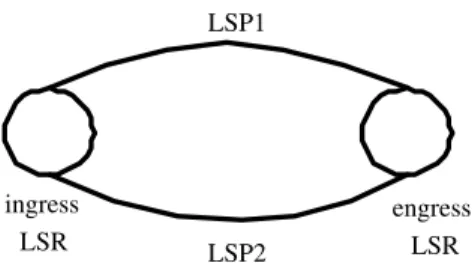
Fig. 1 A case of flow level multipath load-balancing model traf-fic
In Fig. 1, we consider only one ingress-egress LSR pair with two LSPs between them in an MPLS network. There are two types of traffic: engineered traffic and cross traffic. The engineered traffic is the traffic that needs to be balanced, and the cross traffic is the back-ground traffic that we have no control over. Engineered traffic flows traverse the network from the ingress LSR to the egress LSR.
We assume that the total engineered traffic flow rate is ν. According to the splitting mechanism dis-cussed below, traffic is distributed into the two LSPs, each with ν1 and ν2 respectively. We let ˜ν1 and ˜ν2 be
the cross traffic on LSP1 and on LSP2. The average size of flows is assumed to beµ−1 . Our optimal load
balancing should therefore minimize
ρ1+ ˜ρ1 1−ρ1−ρ˜1 + ρ2+ ˜ρ2 1−ρ2−ρ˜2, subject toν1+ν2=ν. (3) where ρi =νi/µ, and ˜ρi = ˜νi/µ,(i= 1,2). Using the
Lagrangian Multiplier method, it is easy to obtain the minimized condition of
1 (1−ρ1−ρ˜1)2
= 1
(1−ρ2−ρ˜2)2
After further substitution ofρi=νi/µ,(i= 1,2) to the
above equation, we can obtain: 1
µ−ν1−ν˜1 =
1
µ−ν2−ν˜2. (4)
Since the average response timeTof M/G/1 PS system is: T = Z x 1−ρdG(x) = 1 µ 1−ρ
wherexis the flow size with a general distributionG(x). Therefore, the average system response time before the engineered traffic arrives is
Ti= 1 µ 1−ρ˜i = 1 µ−ν˜i ,(i= 1,2). (5)
By substituting (5) in (4), and rewriting it, we can obtain the equilibrium point condition:
ν1−ν2= 1
T1
− 1
T2
. (6)
In order to further make the following algorithm robust, we have relaxed the equilibrium condition to
∆ν12=ν1−ν2∝ 1 T1 − 1 T2 . (7)
For the N paths case, the minimization problem be-comes MinimizePN i=1 ρi 1−ρi, subject toν1+· · ·+νN =ν,
which can be solved by the Lagrangian method, and the equations similar to the above can be obtained. That is, 1 µ−νi−ν˜i = 1 µ−νj−ν˜j, for alli, j = 1, . . . , N.
In the same way, we obtain the following relaxed con-ditions: ∆νij=νi−νj∝ 1 Ti − 1 Tj , ∀i, j= 1,2, . . . , N, i6=j. (8) 3. THE HEURISTICS
From the above discussion, we can deduce the method to distribute traffic among LSPs sharing the same ingress-egress LSR pair. Eq.(8) shows that the dif-ference of traffic distributed on any two LSPs should be proportional to the difference of the reciprocal of the average packet delays of the corresponding LSPs. However, in order to obtain a sensible deduction with a simple form, we only take the queueing delay into con-siderations in the theoretical analysis. Unfortunately, the propagation delay of LSPs cannot be neglected, es-pecially in core network such as MPLS. While we load traffic, we prefer load more traffic on the LSP with lower queueing delay and propagation delay. In addition, the above information obtained is static and it is difficult to be applied directly in real networks. In order to make the distribution method discussed above more feasible,
we propose a heuristic load balancing equation: wi = 1/di P k 1/dk , (9)
wherewi is the weight of LSPi, which determines how
much traffic should be distributed to LSPi, and di is
the total delay (including propagation delay) of LSPi which can be approximated by the round-trip time (RTT) measured dynamically. The difference between the weights of LSPiand LSPj is
∆wij =wi−wj = P k 1/dk 1 di − 1 dj , i.e. ∆wij ∝ 1 di− 1 dj . (10)
Since (10) is in accordance with (8), (9) is a feasible solution.
4. IMPLEMENTATION ISSUES
In this section, we will discuss further the implementa-tion issues involved in our mechanism.
Traffic Flow distr ibution Average delay estimation Flow -state table Traffic
Fig. 2 The mechanism in an ingress LSR
4.1 Overview of Flow-Level Load-Balancing Mecha-nism in MPLS Networks
Our mechanism is implemented only in the ingress LSRs and egress LSRs in MPLS networks. The ingress LSRs distribute the traffic input to the network at the flow levels according to our algorithm. The interme-diate LSRs do nothing but forward the traffic through them. This adheres to the philosophy of the backbone network’s design: keep complexity at the edge while make the middle as simple as possible. Moreover, the mechanism is asynchronous, and it is unnecessary for the ingress LSRs to exchange information.
Our mechanism functions implemented in the ingress LSR are shown in Fig.2. When a packet ar-rives, the flow distribution module in the ingress LSR first decides if it belongs to a new flow. If so, the flow will be assigned to a LSP according to our algo-rithm discussed above. Otherwise, the ingress LSR will search theflow-state table, and distribute the packet
to the LSP the existing flow the packet belongs to. The flow-state table is maintained by the flow distri-bution module, including the flow state information described below. The average delay estimation is used to measure the average delay of LSPs between the ingress LSR and the egress LSR.
4.2 Discussion of The Traffic Allocation Granularity For the sake of simplicity, we only consider the elastic flows that occupy most of the traffic on the Internet. The allocation granularity is larger at the flow level than that at the packet level. Although Krishnan et al. [12] advocated per-packet allocation granularity, we would argue that per-flow allocation granularity is fine enough for traffic distribution. The majority of elas-tic flows are very short (they are less than 1 Kbytes), and only a few of them are long-lived flows [13]. There-fore, for any given ingress LSR and egress LSR pair, the potential number of flows between the two LSRs is typi-cally much higher than the number of the parallel LSPs connecting them. This case is similar to what was sug-gested by Lai [14]. Moreover, the direct advantage of per-flow traffic distribution is that it decreases the dis-order phenomenon whereas the per-packet mechanism does not. This is due to the fact that, in the per-flow traffic distribution, all packets in a flow will go along the same path as long as the path is determined. 4.3 Flow State Table
In order to implement per-flow traffic distribution, we maintain a flow-state table in ingress LSR as men-tioned above. The items in theflow-state table are now shown in Table 1.
Table 1 Flow-state table maintained by ingress LSR
index flow identification LSP# last packet arrival time
The item flow identification records the 5-tuples of a flow, by which a flow can be identified. In or-der to speed up the searching process, an index item is added. Index is a short word and can be obtained by transformingflow identificationthrough a particular function. TheLSP#is the number of LSPs along which the flow should go. Last packet arrival timerecords the arrival time of the flow’s last packet.
The flow-state table is maintained only in the ingress LSR; it’s unnecessary for the core LSRs and egress LSRs to do so. In addition,The length of the table is a linear function of the number of the current active flows through the ingress LSR. In fact, in order to save memory, theflow identificationcan be removed without any impact on the process. Theflow-state ta-blelength can thus be shortened. On the other hand,
the speed of the CPU nowadays is faster and faster, and the memory is cheaper and cheaper, therefore, we think it’s worth improving the performance of the MPLS net-work at the cost of the maintenance of theflow-state table.
4.4 Flow Distribution
When a packet arrives, the ingress LSR first searches its flow-state table to see if this packet belongs to an existing flow. If so, the ingress LSR will ac-cess the corresponding entry, distribute the packet to
LSP# LSP, and update last packet arrival time with the packet arrival time. Otherwise, a new flow be-gins. Then, the ingress LSR records the flow identifi-cation, obtains the index through transformation, sets
last packet arrival time to the current time (i.e. the packet arrival time), and determines theLSP# accord-ing to our algorithm. At last, a new entry filled with all the above information is inserted into the flow-state table.
When a flow exists, the corresponding entry should be deleted from the flow-state table in time. The
Last packet arrival time is used to do so. The ingress LSR will verify each flow’sLast packet arrival time in its flow-state table. If the difference between this item and the current time is more than the threshold T, that is to say, the flow has existed, then this entry will be deleted from theflow-state table.
4.5 Delay Estimation
In order to monitor the real-time information of each LSP, we have adopted a probing mechanism. We send probing packets periodically to each LSP, and measure their round-trip time (RTT), then estimate the path delay using an exponential weighted moving average shown below.[15]
EDi= (1−α)×EDi−1+α×SRT Ti
whereEDiis theith estimated delay,SRT Tiis theith
measured RTT.
Theflow distribution modulewill use the esti-mated delay to distribute the traffic according to our algorithm discussed in the above section.
5. PERFORMANCE EVALUATION
We use NS-2 [16] with an MPLS module [17] to imple-ment our simulation. To illustrate our method feasible and general, two simulation scenarios are established. The first scenario is the simplest case with two paths between one IE (Ingress LSR - Egress LSR) pair. while in the second scenario there are four IE pairs where the intermediate links are shared by the LSPs from differ-ent IE pairs. In the simulation, A flow is simply a TCP
connection. Flow arrivals are Poisson arrival process with a mean of 20 flows per second. The flow size has a Pareto distribution withx0= 4, β= 1.5 (cf. (1)).
5.1 Simulation scenario 1
The network topology is shown in Fig.3. Each link is set to be 60Mbps with 10ms delay. There is only one ingress LSR and egress LSR pair with two parallel LSPs (numbered as LSP1 and LSP2) between them. Flows enter the MPLS network from the ingress LSR and exit from the egress LSR. In order to verify the efficiency of our mechanism, we have introduced cross traffic to change the link bandwidth available to flows entering the network. The cross traffic uses the on-off mode CBR (Constant Bit Rate) traffic, and goes through the intermediate LSRs. ingress LSR egressLSR LSR1 LSR2 LSR3 LSR4 flows flows cross traffic cross traffic
Fig. 3 Network topology 1
5.1.1 Simulation results
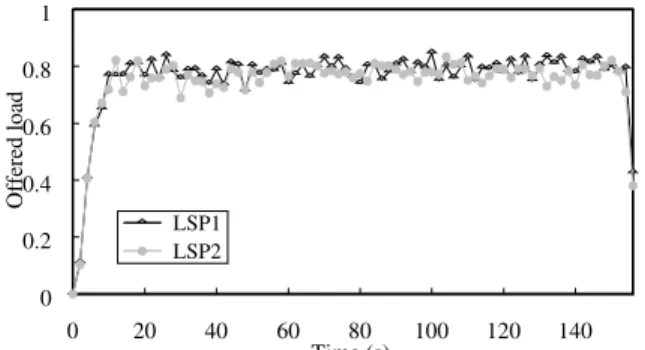
Figure 4 is used as a reference to show the offered load distributed on LSP1 and LSP2, without cross traffic in the network. 0 20 40 60 80 100 120 140 Time (s) 0 0.2 0.4 0.6 0.8 1 Offered load LSP1 LSP2
Fig. 4 Offered load distributed on LSP1 and LSP2 without
cross traffic
For comparison, Fig.5 allows some cross traffic run-ning at a data rate of 30Mbps. It starts at 50s and ends at 150s. During this period, the bandwidth avail-able on LSP1 has decreased. As can be seen from Fig. 6 the offered load is adaptively shifted from LSP1 to
0 20 40 60 80 100 120 140 Time (s) 0.0 0.2 0.4 0.6 0.8 1.0 Offered load LSP1 LSP2
Fig. 5 Offered load distributed on LSP1 and LSP2 with cross traffic 0 500 1000 1500 2000 2500 3000 Flow No. 0.040 0.045 0.050 0.055 0.060 Delay (s) with.load.balancing without.load.balancing
Fig. 6 End-to-end delay of flows
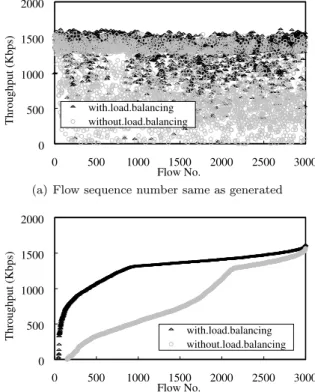
LSP2, and the load is balanced between the two LSPs very well. Fig.6 and Fig.7 illustrate the end-to-end de-lay and throughput of each flow respectively, where, Fig.7(b) rearrange the flow sequence according to the throughput in order to show the results clearly. The end-to-end throughput is increased and the end-to-end delay is decreased obviously. The results show the net-work performance is improved significantly compared with that in the original MPLS network.
5.2 Simulation scenario 2
In the sumulation above, the network topology is the simplest case which we used to deduce load balancing equation in theory. The simulation results say that the equation works well. In this section, we design a more practical MPLS network topology presented in Fig.8. There are four IE pairs with two parallel LSPs between each of them. The LSPs from different IE pairs share some intermediate links. For example, link1 is shared by LSP (ingress LSR1-LSR1-LSR2-egress LSR1) and LSP (ingress LSR2-LSR1-LSR2-egress LSR2). The cross traffic with different rate and duration are added to link1 and link4, as shown in Fig. 9.
5.2.1 simulation results
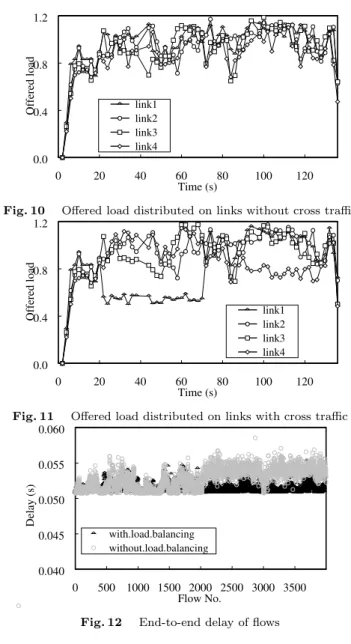
In this simulation, we collected the offered load of the four links. Fig. 10 shows the traffic are allocated evenly to the four links. During 20s and 70s, the cross traffic
0 500 1000 1500 2000 2500 3000 Flow No. 0 500 1000 1500 2000
Throughput (Kbps) with.load.balancingwithout.load.balancing
(a) Flow sequence number same as generated
0 500 1000 1500 2000 2500 3000 Flow No. 0 500 1000 1500 2000
Throughput (Kbps) with.load.balancingwithout.load.balancing
(b) Flow sequence number rearranged according to through-put
Fig. 7 End-to-end throughput of flows
flows egress LSR1 LSR1 LSR3 LSR2 LSR4 flows cross traffic cross traffic egress LSR2 ingress LSR1 ingress LSR2 link1 link2 link4 link3 ingress LSR3 ingress LSR4 egress LSR4 egress LSR3 cross
traffic trafficcross LSR8
LSR7
LSR6 LSR5
Fig. 8 Network topology 2
0 20 40 60 80 100 120 Time (s) 0.0 0.4 0.8 1.2 Offered load cross.traffic.on.link1 cross.traffic.on.link4
occupying about 50% bandwidth is added to link1, the traffic on link1 are then shifted partly to other links as shown in Fig. 11. Similar result can be observed during 90s and 130s. It’s worth to note that the traffic is shifted adaptively according to the strength of the cross traffic(in other words, the available bandwidth). That’s to say, our method balance the load very well. The end-to-end delay and throughput of each flow are shown in Fig. 12 and Fig. 13 respectively. Compared with the original MPLS network, our method improves flows performance. That is, the end-to-end throughput is increased and the end-to-end delay is decreased.
0 20 40 60 80 100 120 Time (s) 0.0 0.4 0.8 1.2
Offered load link1link2 link3 link4
Fig. 10 Offered load distributed on links without cross traffic
0 20 40 60 80 100 120 Time (s) 0.0 0.4 0.8 1.2
Offered load link1link2
link3 link4
Fig. 11 Offered load distributed on links with cross traffic
0 500 1000 1500 2000 2500 3000 3500 Flow No. 0.040 0.045 0.050 0.055 0.060 Delay (s) with.load.balancing without.load.balancing
Fig. 12 End-to-end delay of flows
6. CONCLUSIONS
In this paper, we have analyzed a flow-level model in order to balance the load among parallel LSPs in the MPLS networks. The purpose is to improve network
0 500 1000 1500 2000 2500 3000 3500 Flow No. 0 500 1000 1500 2000
Throughput (Kbps) with.load.balancingwithout.load.balancing
(a) Flow sequence number same as generated
0 500 1000 1500 2000 2500 3000 3500 Flow No. 0 500 1000 1500 2000
Throughput (Kbps) with.load.balancingwithout.loadbalancing
(b) Flow sequence number rearranged according to through-put
Fig. 13 End-to-end throughput of flows
performance and to minimize the congestion. Our anal-ysis allows us to propose a flow-level mechanism. Al-though a heuristic, our mechanism is efficient because it employs per-flow traffic distribution to avoid the packet disorder. It is also easy to implement in the ingress LSRs and egress LSRs. Our simulation results show that the load through the network is well balanced so that the network throughput is improved and the delay is decreased significantly.
Acknowlegement
This research is supported in part by the National Natural Science Foundation of China (NSFC) under grant No. 60472078 and No. 90104015, by the Cisco CCRP grant, by the NSF of Tianjin under grant No. 023601111, and No. 043600311, and by the Natural Sciences and Engineering Research Council of Canada (NSERC) under grant No. OGP0042878. Thanks to Hongmei Wang for her work on simulation.
References
[1] D. Awduche, et al., ”Requirements for traffic engineering over MPLS”, Internet RFC 2702, September. 1999. [2] Rosen, E., Viswanathan, A. and R. Callon, ”Multiprotocol
label switching architecture”, Internet RFC 3031, January 2001
[3] E. Dinan, D. Awduche, B. Jabbari, ”Analytical framework for dynamic traffic partitioning in MPLS networks”, IEEE ICC’00, NEW ORLEANS, pp.1604-1608, June 2000.
[4] A. Elwalid, C. Jin, S. Low, I. Widjaja, ”Mate: MPLS adaptive traffic engineering”, in Proceedings of IEEE IN-FOCOM’01, Anchorage, Alaska, pp.22-26, April 2001. [5] D. Awduche, A. Elwalid,I. Widjaja,X. Xiao, ”Overview and
Principles of Internet Traffic Engineering”, RFC3272,May 2002
[6] Feldmann, A., Huang, P., Gilbert, A.C. Willinger,, ”Dy-namics of IP traffic: a study of the role of variability and the impact of control”. Computer communication review, Sigcomm 29, no.4, 1999
[7] J. W. Roberts et al., ”Traffic Theory and the Internet”, IEEE Communications Magazine, pp. 94-99, January 2001 [8] S.B. Fredj, T. Bonald, A.Proutiere, G. Regnie, J.W. Roberts, ”Statistical bandwidth sharing: a study of con-gestion at flow level”, In Proceeding of ACM SIGCOMM ’01, San Diego, California, U.S.A. pp.27-31, August 2001 [9] Kelly, Reversibility and Stochastic Networks,Wiley,
Chich-ester, 1979
[10] Kleinrock L. Queueing Systems, vol.2. Wiley, New York, 1976
[11] D. Bertsekas, R. Gallager, Data Networks, Prentice Hall, 1992
[12] R. Krishnan and J. Silvester, ”Choice of Allocation Granu-larity in Multipath Source Routing Schemes”, Proceedings of the IEEE Conference on Computer Commuincations, San Francisco, CA, pp.322-329, March 1993.
[13] M.F. Arilitt, C. Williamson. ”Web server workload charac-terization: The search for invariants”. In Proceeding of the ACM SIGMETRICS’96 Conference, Philadelphia, pp.126-137, April 1996
[14] W.S. Lai. ”Bifurcated routing in computer networks”. com-puter communications review, vol.15, no.3, pp.28-49, 1985 [15] P. Karn and C. Partridge, ”Improving Round-Trip Time
Es-timates in Reliable Transport Protocols”, Computer Com-municators review, vol. 17, no.5 pp.2-7, August 1987. [16] NS-2 Network Simulator,
http://www.isi.edu/nsnam/ns/.
[17] Gaeil Ahn and Woojik Chun, ”Overview of MPLS networks simulator: Design and Implementation”, Chungnam Na-tional University, Korea
Zenghua Zhao was born in 1974.
She received her M.S. in Computer Sci-ence, Tianjin University, China, in 2000. Currently she is a Assistant Professor of Computer Science at Tianjin University, China. Her current interests are focussed on computer networks, modeling and sim-ulation, Wireless Multimedia network.
Yantai Shu was born in 1942. He
received his Ph.D at Tianjin University, China, in 1968. Currently he is a Profes-sor of Computer Science at Tianjin Uni-versity, China. His current interests are focussed on computer networks, real-time systems, modeling and simulation.
Lianfang Zhang was born in 1946.
He received his M.S. in Institute of Math-ematics, Academia Sinica in 1981. His re-search interests are in performance evalu-ation of computer networks.
Oliver Yang is a Full Professor
in the School of Information Technol-ogy and Engineering at University of Ot-tawa, Ontario, Canada. Dr. Yang re-ceived his Ph.D. degree in Electrical Engi-neering from the University of Waterloo, Ont., Canada in 1988. His research inter-ests are in modeling, analysis and perfor-mance evaluation of computer communi-cation networks, queueing theory, simula-tions, computational algorithms and their applications such as reliability and traffic analysis.